1
GLOBAL BUSINESS ENVIRONMENT REPORT
Doing Business in Saudi Arabia:
Business Proposal for Venturing into
the Automotive Sector of Saudi Arabia
Submitted to:
ProfessorMonika Jain
Submitted by:
Romani Banerjee
19DM167,PGDM – Marketing – SectionB
2
ACKNOWLEDGEMENT
I would like to take this opportunity to thank ProfessorMonika Jain Ma’am, for
giving me a chance to explore the Business Environment in Saudi Arabia, so that
I could come up with this elaborate Business Proposal to venture into their
Automotive Market.
Thank you for your constant supportand guidance, Ma’am.
3
INDEX
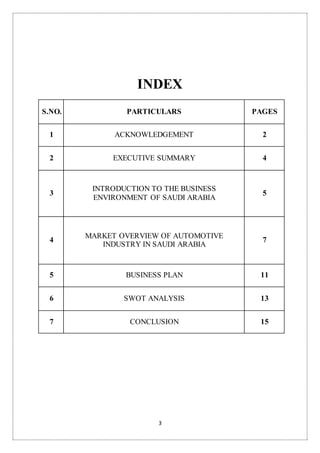
S.NO. PARTICULARS PAGES
1 ACKNOWLEDGEMENT 2
2 EXECUTIVE SUMMARY 4
3
INTRODUCTION TO THE BUSINESS
ENVIRONMENT OF SAUDI ARABIA
5
4
MARKET OVERVIEW OF AUTOMOTIVE
INDUSTRY IN SAUDI ARABIA
7
5 BUSINESS PLAN 11
6 SWOT ANALYSIS 13
7 CONCLUSION 15
4
EXECUTIVE SUMMARY
As a part of this project, I had the opportunity to explore the Saudi Arabian
Automotive Sectorand I analysed various business opportunities in the sector.
After closeanalysis, I found that 3 major cities, Riyadh, Jeddahand Dammam,
accountforclose to 65%ofallnew vehicles soldinSaudiArabia. And Riyadh,
being the capital, I formulated a business proposal to venture into the Light
Weight CommercialVehicle segmentof the Auto sectorin Riyadh.
In this document, I have closely analysed the broad picture of the business
environment of Saudi Arabia, followed by a detailed market overview of the
Automotive sector of Saudi.
I have mentioned various opportunities and barriers in the market of LWCVs in
Saudi as well, with market and industry forecasts data, supporting the viability of
my business proposal.
The main body of the report, constitutes a detailed business plan that I have
formulated for the Light Weight Commercial Vehicle segment in the Auto Market
of Riyadh.
To understand the viability of the plan I have performed an analysis of the
Strengths, Weaknesses, Opportunities and Threats that entail my business plan,
as well.
5
INTRODUCTION TO THE BUSINESS
ENVIRNMENT OF SAUDI ARABIA
The largest economy in the Middle East and the wealthiest Arab country in the
world is Saudi Arabia. The confirmed oil reserves make up 16 per cent of the
world's oil reserves and are the world's second highest after Venezuela.
Consequently, the economic performance of Saudi Arabia is closely linked to the
international oil price. The Saudieconomyhas grown well over the pastfew years
due to relatively high oil prices and a rise in oil production, with an average
growth rate of more than 6 per cent in 2010-13. Yet development isn't just due to
the energy industry. Over the same era, non-oil sector development reached
nearly 7 per cent.
Government spending has stood at 37.6 percent of the country's production
(GDP) over the last three years and budget deficits reached 14.0 percent of GDP.
Islamic practices are subject to laws to protect private property.
The slow and blurred judiciary is dependent, and its decisions must be
coordinated with executive branch. The government took drastic yet extremely
unorthodox measures in the year 2018 to reduce widespread inequality but there
are still issues with inadequate transparency and liability. The royal family and
other rulers have a strong influence on the energy and oil sectors. Nevertheless,
according to the report, Saudi Arabia maintained its spot as the highest paying
GCC nation for expatriates, with an average salary of $12,126. While there is
usually no income tax owed on employee wages in Saudi Arabia, social security
contributions and non-resident withholding taxes (WHT) are payable. Payments
to social security (GOSI) are paid to Saudi citizens at a costof 10%.
6
The oil sectoraccounts forroughly 87% ofSaudi budget revenues, 90% ofexport
earnings an d 42% of GDP. The oil reserves and production in Saudi Arabia are
largely managed by SaudiAramco, a state-owned corporation. The private sector
accounts for another 40 per cent of GDP. This is the main source of income in
Saudi Arabia.
Hence, Automotive sector seems to be a lucrative arm of the Saudi Arabian
Business Environment, to explore and venture into.
7
MARKET OVERVIEW OF
AUTOMOBILE SECTOR IN
SAUDI ARABIA
Saudi Arabia is the largest market for new automotive sales and auto parts in the
Middle East. It accounts for an estimated 40 percent of all vehicles sold in the
region. In 2016, Saudi Arabia imported close to a million vehicles that included
passenger cars, commercial vehicles and light trucks.
The SUV and luxury cars market remains strong and shows growing demand.
Brands such as BMW, Lexus and Mercedes continue to lead the luxury segment
in 2018. Saudi is also one of the biggest importer of Korean automotive products
and parts, with some of these imports being re-exported.
Opportunity-
The Saudi Arabian government is seeking to develop a domestic automotive
industry and has encouraged global vehicle manufacturers to establish local
operations in an effort to create jobs for Saudi’s growing youth and facilitate the
transfer of technology and skills.
Currently, there is a small amount of local auto parts and truck production, butno
light vehicle production. Mostvehicles and parts sold in the countryare imported.
Aftermarket parts for off-road vehicles and SUV’s have excellent potential in
Saudi Arabia.
Barriers in the Market-
Saudi Arabia’s industrial standards and conformity assessments are a significant
market barrier for Korean Auto & Auto parts exporters. The Saudi Arabia
Standards Organization (SASO) has issued numerous industry standards and
regulations that create burdensome documentation and complicated import
requirements that result in customs clearance delays and enforcement
inconsistencies.
8
Most used auto parts cannot be imported into Saudi Arabia, but reconditioned
engine and transmission parts are exempt if they comply with certified
standards.
Saudi Customs has a mandatory directive applicable to all imported products that
requires country of origin marking, either by embossing/engraving or a non-
removable label on the parts. Certificate of Origin must include similar
information and is required for all shipments arriving at Saudi ports.
Key MarketHighlights -
- After three consecutive years of double-digit declines, there are predictions
that the Saudi Arabian Light weight commercial vehicle segment should
be able to show a more positive performance across 2020, against the
backdrop of rising economic growth and high levels of pent-up demand
within the market.
- A growing economy, boosted by rising oil prices and production, should
prove supportive to both business and consumer confidence, leading to
greater spending on 'big-ticket' items, such as a new car.
- On the production side, Saudi Arabia presently has a small auto
manufacturing base, primarily in the Commercial Vehicle segment,
opening up avenues and opportunity for global players to set foot in this
segment.
Industry Forecasts-
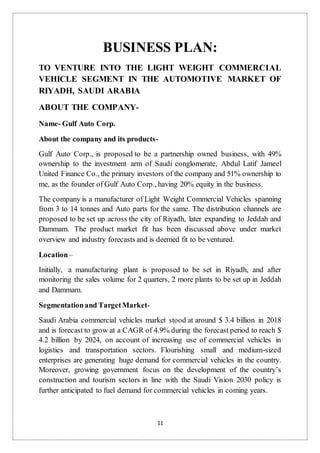
Across many market research agency reports, for the forecastperiod to 2023, are
now forecasting average annual growth of 3.6% in new vehicle sales, to just
above the 497,000-unit mark. They continue to forecast stronger growth in CV
sales (average year in year growth of 3.4%) over this period, with demand
underpinned by the premium segment.
9
However, despite this growth, they do not presently forecast a return to the
market's 2015 high (of over 878,000 units sold) before 2023. Demand for new
CVs should remain strong from the Constructionsector, given the Riyadh's
extensive pipeline of infrastructure projects.
- A stronger outlook foreconomic growth should also continue to encourage
local businesses to invest more in fleet renewal, lending support to CV
sales.
- Analysts also forecast a boost in the demand for new CVs as we move
through 2020, following three years of sales declines, as the economy
continues to gain in strength and with likely solid demand for vehicles from
the car rental sector.
- Greater numbers of women should also start to buy their own cars,
following the end to the ban on women driving in mid-2018.
- A higher interest rate environment as we move through 2020 may
encourage some consumers to buy a new car earlier in the year.
- Saudi Arabia has a small auto manufacturing base, primarily in the CV
segment. Hence, it is a hub of opportunities for new players to enter the
market.
- The National Automobile Industry Company has been producing a range
of Mercedes Benz trucks in Riyadh and Jeddah since 1977, and with Saudi
Automotive Manufacturing Company having operated a production plant
for MAN Truck and Bus in Riyadh since 2009.
- Since 2012, Isuzu Motors have operated a truck production plant in
Dammam, having produced arange ofRenault and Volvo branded vehicles
at King Abdullah Economic City since 2015.
- SaudiArabia's growing CVproductionindustry has led to the development
of an extensive CV spare parts supply chain across Saudi Arabia.
10
- Light commercial vehicle sales should also find greater supportin 2020, as
economic activity strengthens.
Product Market Fit-
That said, it is safe to see that the market for Light Weight Commercial Vehicles,
looks optimistic in cities of Riyadh, Dammam and Jeddah.
11
BUSINESS PLAN:
TO VENTURE INTO THE LIGHT WEIGHT COMMERCIAL
VEHICLE SEGMENT IN THE AUTOMOTIVE MARKET OF
RIYADH, SAUDI ARABIA
ABOUT THE COMPANY-
Name- Gulf Auto Corp.
About the company and its products-
Gulf Auto Corp., is proposed to be a partnership owned business, with 49%
ownership to the investment arm of Saudi conglomerate, Abdul Latif Jameel
United Finance Co., the primary investors of the company and 51% ownership to
me, as the founder of Gulf Auto Corp., having 20% equity in the business.
The company is a manufacturer of Light Weight Commercial Vehicles spanning
from 3 to 14 tonnes and Auto parts for the same. The distribution channels are
proposed to be set up across the city of Riyadh, later expanding to Jeddah and
Dammam. The product market fit has been discussed above under market
overview and industry forecasts and is deemed fit to be ventured.
Location–
Initially, a manufacturing plant is proposed to be set in Riyadh, and after
monitoring the sales volume for 2 quarters, 2 more plants to be set up in Jeddah
and Dammam.
Segmentationand TargetMarket-
Saudi Arabia commercial vehicles market stood at around $ 3.4 billion in 2018
and is forecast to grow at a CAGR of 4.9% during the forecast period to reach $
4.2 billion by 2024, on account of increasing use of commercial vehicles in
logistics and transportation sectors. Flourishing small and medium-sized
enterprises are generating huge demand for commercial vehicles in the country.
Moreover, growing government focus on the development of the country’s
construction and tourism sectors in line with the Saudi Vision 2030 policy is
further anticipated to fuel demand for commercial vehicles in coming years.
12
The market segment for LWCVs comprises, the construction conglomerates
across Saudi Arabia. The need for LWCVs is maximum in the infrastructure and
development arms of the Saudi Arabian economy, hence, my product is for this
particular market segment. These vehicles can be used for low volume logistics
only. The auto parts produced by us can be used for heavy and passenger vehicles
as well, hence the distribution network setup for the auto parts business is going
to be extensively and strategically placed across the country.
Pricing-
Competitive pricing modelis used to comeup with the price range of 60,000 SAR
to 1,20,000 SAR which is 10% cheaper than the Primary competitor, Toyota.
3.5 Tons LWCVs – 60,000 SAR
14 Tons LWCVs – 1,20,000 SAR
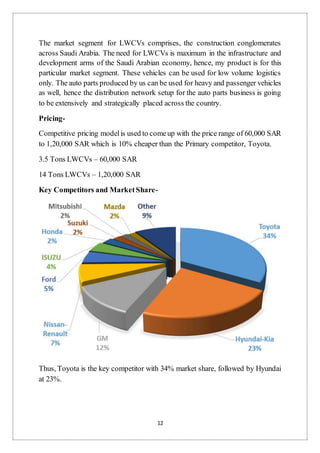
Key Competitors and MarketShare-
Thus, Toyota is the key competitor with 34% market share, followed by Hyundai
at 23%.
13
SWOT ANALYSIS
STRENGTHS-
- Promising growth in the segment, with a stronger outlook for economic
growth should also continue to encourage local businesses to invest more
in fleet renewal, lending supportto CV sales. Analysts forecast a boostin
the demand for new CVs as we move through 2020.
- Backing by a well-known Saudi Arabian Conglomerate, Abdul Lateef
Jameel United Financial Co.
- Competitive pricing, kept at 10% lower than that ofother big players in the
market
- Promising economic growth in Saudi Arabia with oil prices tilting to their
favour.
WEAKNESSES-
- Market barriers in Saudi- The Saudi Arabia Standards Organization
(SASO)has issued numerous industry standards and regulations that create
burdensome documentation and complicated import requirements that
result in customs clearance delays and enforcement inconsistencies.
- Cultural differences in trade practices
- Social stigmas associated with woman entrepreneurs in the country
- As a new entrant, setting up new distribution networks in an already
established market will be expensive.
OPPORTUNITIES-
- Robust economy of Saudi is a hub for new entrants in the Auto sector as
businesses flourish and there are huge investments in the infrastructure
industry by the government. Infrastructure industry being our target
consumers, opens up new avenues for growth.
14
- The market for LWCVs in Riyadh is untapped with very few local sellers
and notevery constructionfirm canafford Toyotas, hence, there is a market
for comparatively low costLWCV.
- Riyadh, Dammam and Jeddah account for over 65% of the total sales of
commercial vehicles in Saudi, hence we will be off to a good start since
the distribution channels will be based there.
THREATS-
- 34% of the market is captured by Toyota and 23% by Hyundai, as a new
entrant it will be difficult to penetrate their sales or target customers.
- Strict import laws in Saudi will force us to refrain from importing raw
materials and auto parts in bulk, from India. And with low scope of
outsourcing, costs will be high initially.
15
CONCLUSION
In all, it will be extremely challenging to venture into an already
established market of commercial vehicles, but with a strong distribution
network and highly competitive pricing model, it will only be a matter of
a few quarters before Gulf Auto Corp. catches up with the big Honchos of
the Automotive market like Toyotaand Hyundai.
With the robust economy of Saudi and backing of a big industrial
conglomerate, the venture might flourish, given a conducive business
environment.
Although, we need to keep a check on the high cultural and social
sensitivity ofthe country before venturing into any promotional activity for
our product.

Global business environment report

  • 1.
    1 GLOBAL BUSINESS ENVIRONMENTREPORT Doing Business in Saudi Arabia: Business Proposal for Venturing into the Automotive Sector of Saudi Arabia Submitted to: ProfessorMonika Jain Submitted by: Romani Banerjee 19DM167,PGDM – Marketing – SectionB
  • 2.
    2 ACKNOWLEDGEMENT I would liketo take this opportunity to thank ProfessorMonika Jain Ma’am, for giving me a chance to explore the Business Environment in Saudi Arabia, so that I could come up with this elaborate Business Proposal to venture into their Automotive Market. Thank you for your constant supportand guidance, Ma’am.
  • 3.
    3 INDEX S.NO. PARTICULARS PAGES 1ACKNOWLEDGEMENT 2 2 EXECUTIVE SUMMARY 4 3 INTRODUCTION TO THE BUSINESS ENVIRONMENT OF SAUDI ARABIA 5 4 MARKET OVERVIEW OF AUTOMOTIVE INDUSTRY IN SAUDI ARABIA 7 5 BUSINESS PLAN 11 6 SWOT ANALYSIS 13 7 CONCLUSION 15
  • 4.
    4 EXECUTIVE SUMMARY As apart of this project, I had the opportunity to explore the Saudi Arabian Automotive Sectorand I analysed various business opportunities in the sector. After closeanalysis, I found that 3 major cities, Riyadh, Jeddahand Dammam, accountforclose to 65%ofallnew vehicles soldinSaudiArabia. And Riyadh, being the capital, I formulated a business proposal to venture into the Light Weight CommercialVehicle segmentof the Auto sectorin Riyadh. In this document, I have closely analysed the broad picture of the business environment of Saudi Arabia, followed by a detailed market overview of the Automotive sector of Saudi. I have mentioned various opportunities and barriers in the market of LWCVs in Saudi as well, with market and industry forecasts data, supporting the viability of my business proposal. The main body of the report, constitutes a detailed business plan that I have formulated for the Light Weight Commercial Vehicle segment in the Auto Market of Riyadh. To understand the viability of the plan I have performed an analysis of the Strengths, Weaknesses, Opportunities and Threats that entail my business plan, as well.
  • 5.
    5 INTRODUCTION TO THEBUSINESS ENVIRNMENT OF SAUDI ARABIA The largest economy in the Middle East and the wealthiest Arab country in the world is Saudi Arabia. The confirmed oil reserves make up 16 per cent of the world's oil reserves and are the world's second highest after Venezuela. Consequently, the economic performance of Saudi Arabia is closely linked to the international oil price. The Saudieconomyhas grown well over the pastfew years due to relatively high oil prices and a rise in oil production, with an average growth rate of more than 6 per cent in 2010-13. Yet development isn't just due to the energy industry. Over the same era, non-oil sector development reached nearly 7 per cent. Government spending has stood at 37.6 percent of the country's production (GDP) over the last three years and budget deficits reached 14.0 percent of GDP. Islamic practices are subject to laws to protect private property. The slow and blurred judiciary is dependent, and its decisions must be coordinated with executive branch. The government took drastic yet extremely unorthodox measures in the year 2018 to reduce widespread inequality but there are still issues with inadequate transparency and liability. The royal family and other rulers have a strong influence on the energy and oil sectors. Nevertheless, according to the report, Saudi Arabia maintained its spot as the highest paying GCC nation for expatriates, with an average salary of $12,126. While there is usually no income tax owed on employee wages in Saudi Arabia, social security contributions and non-resident withholding taxes (WHT) are payable. Payments to social security (GOSI) are paid to Saudi citizens at a costof 10%.
  • 6.
    6 The oil sectoraccountsforroughly 87% ofSaudi budget revenues, 90% ofexport earnings an d 42% of GDP. The oil reserves and production in Saudi Arabia are largely managed by SaudiAramco, a state-owned corporation. The private sector accounts for another 40 per cent of GDP. This is the main source of income in Saudi Arabia. Hence, Automotive sector seems to be a lucrative arm of the Saudi Arabian Business Environment, to explore and venture into.
  • 7.
    7 MARKET OVERVIEW OF AUTOMOBILESECTOR IN SAUDI ARABIA Saudi Arabia is the largest market for new automotive sales and auto parts in the Middle East. It accounts for an estimated 40 percent of all vehicles sold in the region. In 2016, Saudi Arabia imported close to a million vehicles that included passenger cars, commercial vehicles and light trucks. The SUV and luxury cars market remains strong and shows growing demand. Brands such as BMW, Lexus and Mercedes continue to lead the luxury segment in 2018. Saudi is also one of the biggest importer of Korean automotive products and parts, with some of these imports being re-exported. Opportunity- The Saudi Arabian government is seeking to develop a domestic automotive industry and has encouraged global vehicle manufacturers to establish local operations in an effort to create jobs for Saudi’s growing youth and facilitate the transfer of technology and skills. Currently, there is a small amount of local auto parts and truck production, butno light vehicle production. Mostvehicles and parts sold in the countryare imported. Aftermarket parts for off-road vehicles and SUV’s have excellent potential in Saudi Arabia. Barriers in the Market- Saudi Arabia’s industrial standards and conformity assessments are a significant market barrier for Korean Auto & Auto parts exporters. The Saudi Arabia Standards Organization (SASO) has issued numerous industry standards and regulations that create burdensome documentation and complicated import requirements that result in customs clearance delays and enforcement inconsistencies.
  • 8.
    8 Most used autoparts cannot be imported into Saudi Arabia, but reconditioned engine and transmission parts are exempt if they comply with certified standards. Saudi Customs has a mandatory directive applicable to all imported products that requires country of origin marking, either by embossing/engraving or a non- removable label on the parts. Certificate of Origin must include similar information and is required for all shipments arriving at Saudi ports. Key MarketHighlights - - After three consecutive years of double-digit declines, there are predictions that the Saudi Arabian Light weight commercial vehicle segment should be able to show a more positive performance across 2020, against the backdrop of rising economic growth and high levels of pent-up demand within the market. - A growing economy, boosted by rising oil prices and production, should prove supportive to both business and consumer confidence, leading to greater spending on 'big-ticket' items, such as a new car. - On the production side, Saudi Arabia presently has a small auto manufacturing base, primarily in the Commercial Vehicle segment, opening up avenues and opportunity for global players to set foot in this segment. Industry Forecasts- Across many market research agency reports, for the forecastperiod to 2023, are now forecasting average annual growth of 3.6% in new vehicle sales, to just above the 497,000-unit mark. They continue to forecast stronger growth in CV sales (average year in year growth of 3.4%) over this period, with demand underpinned by the premium segment.
  • 9.
    9 However, despite thisgrowth, they do not presently forecast a return to the market's 2015 high (of over 878,000 units sold) before 2023. Demand for new CVs should remain strong from the Constructionsector, given the Riyadh's extensive pipeline of infrastructure projects. - A stronger outlook foreconomic growth should also continue to encourage local businesses to invest more in fleet renewal, lending support to CV sales. - Analysts also forecast a boost in the demand for new CVs as we move through 2020, following three years of sales declines, as the economy continues to gain in strength and with likely solid demand for vehicles from the car rental sector. - Greater numbers of women should also start to buy their own cars, following the end to the ban on women driving in mid-2018. - A higher interest rate environment as we move through 2020 may encourage some consumers to buy a new car earlier in the year. - Saudi Arabia has a small auto manufacturing base, primarily in the CV segment. Hence, it is a hub of opportunities for new players to enter the market. - The National Automobile Industry Company has been producing a range of Mercedes Benz trucks in Riyadh and Jeddah since 1977, and with Saudi Automotive Manufacturing Company having operated a production plant for MAN Truck and Bus in Riyadh since 2009. - Since 2012, Isuzu Motors have operated a truck production plant in Dammam, having produced arange ofRenault and Volvo branded vehicles at King Abdullah Economic City since 2015. - SaudiArabia's growing CVproductionindustry has led to the development of an extensive CV spare parts supply chain across Saudi Arabia.
  • 10.
    10 - Light commercialvehicle sales should also find greater supportin 2020, as economic activity strengthens. Product Market Fit- That said, it is safe to see that the market for Light Weight Commercial Vehicles, looks optimistic in cities of Riyadh, Dammam and Jeddah.
  • 11.
    11 BUSINESS PLAN: TO VENTUREINTO THE LIGHT WEIGHT COMMERCIAL VEHICLE SEGMENT IN THE AUTOMOTIVE MARKET OF RIYADH, SAUDI ARABIA ABOUT THE COMPANY- Name- Gulf Auto Corp. About the company and its products- Gulf Auto Corp., is proposed to be a partnership owned business, with 49% ownership to the investment arm of Saudi conglomerate, Abdul Latif Jameel United Finance Co., the primary investors of the company and 51% ownership to me, as the founder of Gulf Auto Corp., having 20% equity in the business. The company is a manufacturer of Light Weight Commercial Vehicles spanning from 3 to 14 tonnes and Auto parts for the same. The distribution channels are proposed to be set up across the city of Riyadh, later expanding to Jeddah and Dammam. The product market fit has been discussed above under market overview and industry forecasts and is deemed fit to be ventured. Location– Initially, a manufacturing plant is proposed to be set in Riyadh, and after monitoring the sales volume for 2 quarters, 2 more plants to be set up in Jeddah and Dammam. Segmentationand TargetMarket- Saudi Arabia commercial vehicles market stood at around $ 3.4 billion in 2018 and is forecast to grow at a CAGR of 4.9% during the forecast period to reach $ 4.2 billion by 2024, on account of increasing use of commercial vehicles in logistics and transportation sectors. Flourishing small and medium-sized enterprises are generating huge demand for commercial vehicles in the country. Moreover, growing government focus on the development of the country’s construction and tourism sectors in line with the Saudi Vision 2030 policy is further anticipated to fuel demand for commercial vehicles in coming years.
  • 12.
    12 The market segmentfor LWCVs comprises, the construction conglomerates across Saudi Arabia. The need for LWCVs is maximum in the infrastructure and development arms of the Saudi Arabian economy, hence, my product is for this particular market segment. These vehicles can be used for low volume logistics only. The auto parts produced by us can be used for heavy and passenger vehicles as well, hence the distribution network setup for the auto parts business is going to be extensively and strategically placed across the country. Pricing- Competitive pricing modelis used to comeup with the price range of 60,000 SAR to 1,20,000 SAR which is 10% cheaper than the Primary competitor, Toyota. 3.5 Tons LWCVs – 60,000 SAR 14 Tons LWCVs – 1,20,000 SAR Key Competitors and MarketShare- Thus, Toyota is the key competitor with 34% market share, followed by Hyundai at 23%.
  • 13.
    13 SWOT ANALYSIS STRENGTHS- - Promisinggrowth in the segment, with a stronger outlook for economic growth should also continue to encourage local businesses to invest more in fleet renewal, lending supportto CV sales. Analysts forecast a boostin the demand for new CVs as we move through 2020. - Backing by a well-known Saudi Arabian Conglomerate, Abdul Lateef Jameel United Financial Co. - Competitive pricing, kept at 10% lower than that ofother big players in the market - Promising economic growth in Saudi Arabia with oil prices tilting to their favour. WEAKNESSES- - Market barriers in Saudi- The Saudi Arabia Standards Organization (SASO)has issued numerous industry standards and regulations that create burdensome documentation and complicated import requirements that result in customs clearance delays and enforcement inconsistencies. - Cultural differences in trade practices - Social stigmas associated with woman entrepreneurs in the country - As a new entrant, setting up new distribution networks in an already established market will be expensive. OPPORTUNITIES- - Robust economy of Saudi is a hub for new entrants in the Auto sector as businesses flourish and there are huge investments in the infrastructure industry by the government. Infrastructure industry being our target consumers, opens up new avenues for growth.
  • 14.
    14 - The marketfor LWCVs in Riyadh is untapped with very few local sellers and notevery constructionfirm canafford Toyotas, hence, there is a market for comparatively low costLWCV. - Riyadh, Dammam and Jeddah account for over 65% of the total sales of commercial vehicles in Saudi, hence we will be off to a good start since the distribution channels will be based there. THREATS- - 34% of the market is captured by Toyota and 23% by Hyundai, as a new entrant it will be difficult to penetrate their sales or target customers. - Strict import laws in Saudi will force us to refrain from importing raw materials and auto parts in bulk, from India. And with low scope of outsourcing, costs will be high initially.
  • 15.
    15 CONCLUSION In all, itwill be extremely challenging to venture into an already established market of commercial vehicles, but with a strong distribution network and highly competitive pricing model, it will only be a matter of a few quarters before Gulf Auto Corp. catches up with the big Honchos of the Automotive market like Toyotaand Hyundai. With the robust economy of Saudi and backing of a big industrial conglomerate, the venture might flourish, given a conducive business environment. Although, we need to keep a check on the high cultural and social sensitivity ofthe country before venturing into any promotional activity for our product.