P.O. Box 26893
Manama, Bahrain
Telephone: +973 17 533570
tarek.fadlallah@bh.nomura.com
1
Sunday 16th
October, 2005
Petrodollar Pyramids
Liquidity vs. Value
Covert visits to Riyadh and Dubai recently revealed that opinions are strongly divided on the prospects for
the local stock markets and it seems unlikely that these entrenched views can be swayed in the near term.
With no hint of a correction in sight the upper hand for the time being is very much with the optimists who
can point to their bulging bank balances while the pessimists squirm with envy.
But the matter is not yet settled and the stakes are too high to shirk away from mature debate – the
combined market value of the six GCC markets has now surpassed $1 trillion.
Sympathy for the cautious stance on stocks is evident among the professional investment community but
most concede that the markets have spawned their own dynamic and bred resolute retail confidence.
Despite such sentiment we have yet to be offered any compelling arguments to support current valuations
and doubt the existence of any credible economic model that can justify regional market multiples.
The liquidity explanation advanced by some commentators has severe limitations in the modern era of
ostensibly free and efficient capital markets and risks comparison with “Ponzi” schemes.
These schemes are named after Charles Ponzi who cost investors millions of dollars in the 1920s by
promising high returns using money taken from new customers to pay off earlier investors.
Over the years these schemes have evolved a number of variants but the essential element has remained the
same – prices will keep going up as long as the next buyer will pay a higher price.
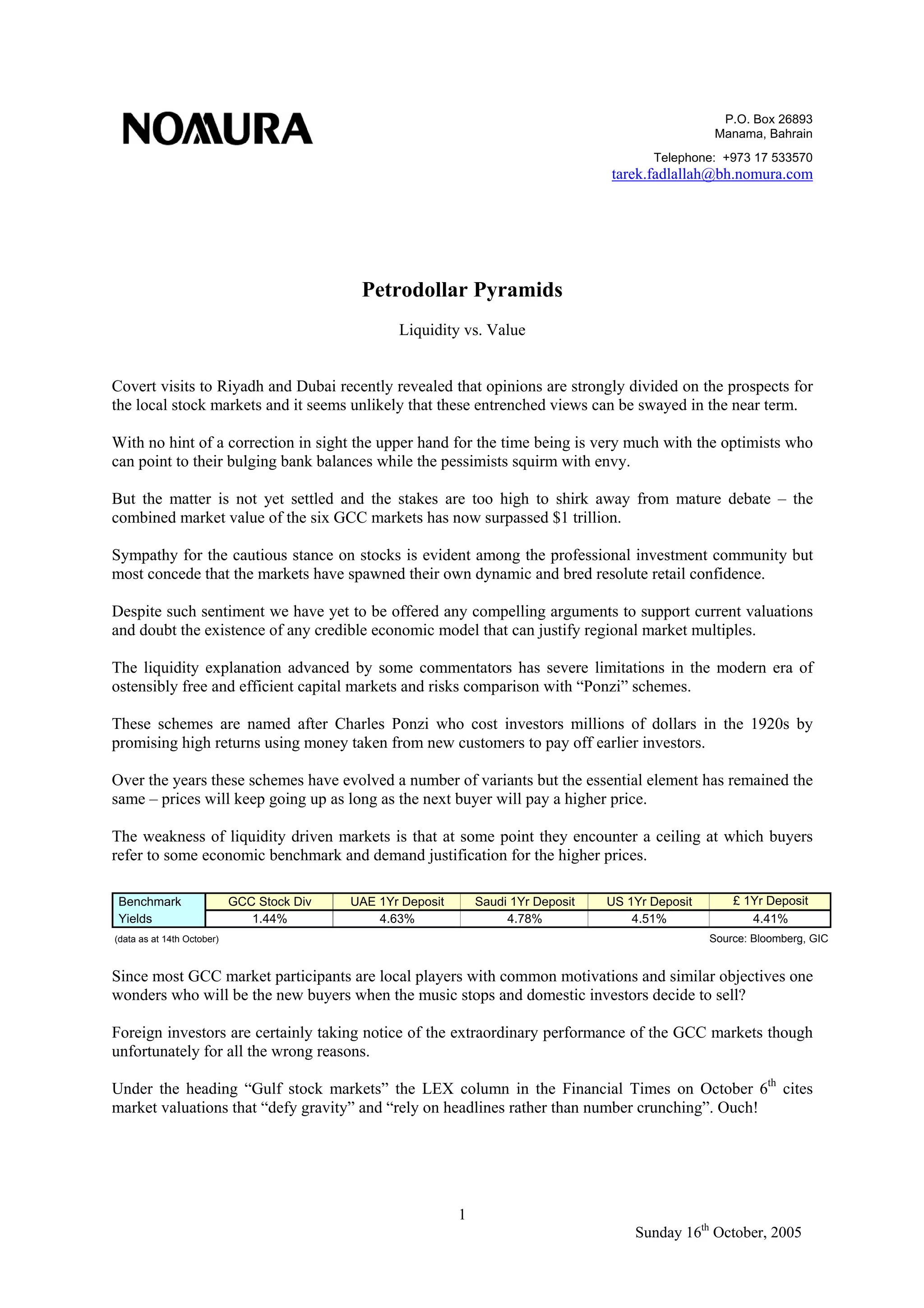
The weakness of liquidity driven markets is that at some point they encounter a ceiling at which buyers
refer to some economic benchmark and demand justification for the higher prices.
Benchmark GCC Stock Div UAE 1Yr Deposit Saudi 1Yr Deposit US 1Yr Deposit £ 1Yr Deposit
Yields 1.44% 4.63% 4.78% 4.51% 4.41%
(data as at 14th October) Source: Bloomberg, GIC
Since most GCC market participants are local players with common motivations and similar objectives one
wonders who will be the new buyers when the music stops and domestic investors decide to sell?
Foreign investors are certainly taking notice of the extraordinary performance of the GCC markets though
unfortunately for all the wrong reasons.
Under the heading “Gulf stock markets” the LEX column in the Financial Times on October 6th
cites
market valuations that “defy gravity” and “rely on headlines rather than number crunching”. Ouch!
P.O. Box 26893
Manama, Bahrain
Telephone: +973 17 533570
tarek.fadlallah@bh.nomura.com
2
Sunday 16th
October, 2005
GCC in a Relative World
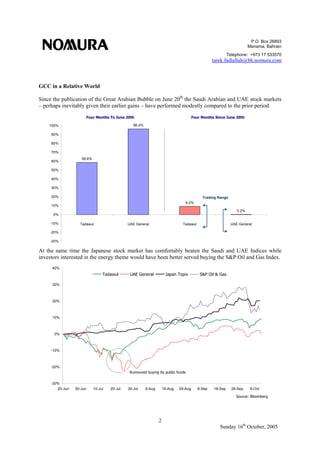
Since the publication of the Great Arabian Bubble on June 20th
the Saudi Arabian and UAE stock markets
– perhaps inevitably given their earlier gains – have performed modestly compared to the prior period.
At the same time the Japanese stock market has comfortably beaten the Saudi and UAE Indices while
investors interested in the energy theme would have been better served buying the S&P Oil and Gas Index.
-30%
-20%
-10%
0%
10%
20%
30%
40%
20-Jun 30-Jun 10-Jul 20-Jul 30-Jul 9-Aug 19-Aug 29-Aug 8-Sep 18-Sep 28-Sep 8-Oct
Tadawul UAE General Japan Topix S&P Oil & Gas
58.6%
96.4%
9.2%
0.2%
-30%
-20%
-10%
0%
10%
20%
30%
40%
50%
60%
70%
80%
90%
100%
Tadawul UAE General Tadawul UAE General
Four Months To June 20th Four Months Since June 20th
Trading Range
Source: Bloomberg
Rumoured buying by public funds
P.O. Box 26893
Manama, Bahrain
Telephone: +973 17 533570
tarek.fadlallah@bh.nomura.com
3
Sunday 16th
October, 2005
The IPO Phenomenon
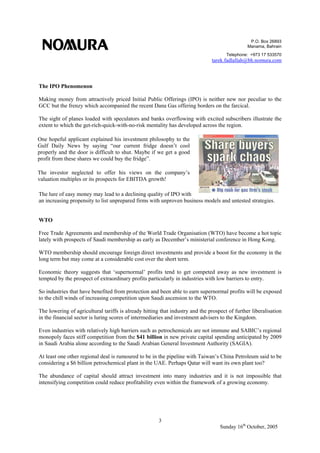
Making money from attractively priced Initial Public Offerings (IPO) is neither new nor peculiar to the
GCC but the frenzy which accompanied the recent Dana Gas offering borders on the farcical.
The sight of planes loaded with speculators and banks overflowing with excited subscribers illustrate the
extent to which the get-rich-quick-with-no-risk mentality has developed across the region.
The lure of easy money may lead to a declining quality of IPO with
an increasing propensity to list unprepared firms with unproven business models and untested strategies.
WTO
Free Trade Agreements and membership of the World Trade Organisation (WTO) have become a hot topic
lately with prospects of Saudi membership as early as December’s ministerial conference in Hong Kong.
WTO membership should encourage foreign direct investments and provide a boost for the economy in the
long term but may come at a considerable cost over the short term.
Economic theory suggests that ‘supernormal’ profits tend to get competed away as new investment is
tempted by the prospect of extraordinary profits particularly in industries with low barriers to entry.
So industries that have benefited from protection and been able to earn supernormal profits will be exposed
to the chill winds of increasing competition upon Saudi ascension to the WTO.
The lowering of agricultural tariffs is already hitting that industry and the prospect of further liberalisation
in the financial sector is luring scores of intermediaries and investment advisers to the Kingdom.
Even industries with relatively high barriers such as petrochemicals are not immune and SABIC’s regional
monopoly faces stiff competition from the $41 billion in new private capital spending anticipated by 2009
in Saudi Arabia alone according to the Saudi Arabian General Investment Authority (SAGIA).
At least one other regional deal is rumoured to be in the pipeline with Taiwan’s China Petroleum said to be
considering a $6 billion petrochemical plant in the UAE. Perhaps Qatar will want its own plant too?
The abundance of capital should attract investment into many industries and it is not impossible that
intensifying competition could reduce profitability even within the framework of a growing economy.
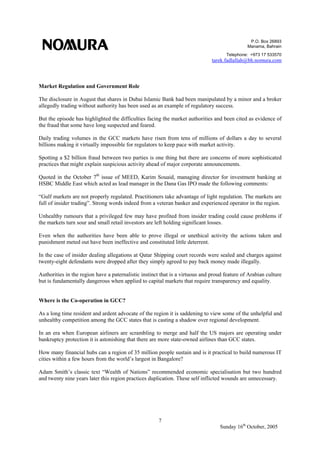
One hopeful applicant explained his investment philosophy to the
Gulf Daily News by saying “our current fridge doesn’t cool
properly and the door is difficult to shut. Maybe if we get a good
profit from these shares we could buy the fridge”.
The investor neglected to offer his views on the company’s
valuation multiples or its prospects for EBITDA growth!
P.O. Box 26893
Manama, Bahrain
Telephone: +973 17 533570
tarek.fadlallah@bh.nomura.com
4
Sunday 16th
October, 2005
The Saudi Banks
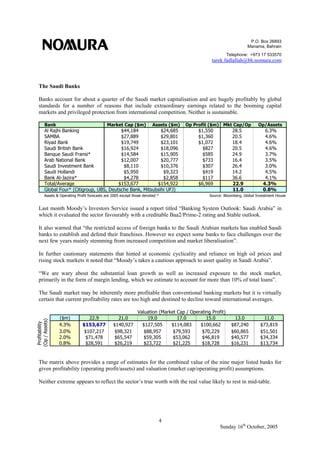
Banks account for about a quarter of the Saudi market capitalisation and are hugely profitably by global
standards for a number of reasons that include extraordinary earnings related to the booming capital
markets and privileged protection from international competition. Neither is sustainable.
Bank Market Cap ($m) Assets ($m) Op Profit ($m) Mkt Cap/Op Op/Assets
Al Rajhi Banking $44,184 $24,685 $1,550 28.5 6.3%
SAMBA $27,889 $29,801 $1,360 20.5 4.6%
Riyad Bank $19,749 $23,101 $1,072 18.4 4.6%
Saudi British Bank $16,924 $18,096 $827 20.5 4.6%
Banque Saudi Fransi* $14,584 $15,905 $585 24.9 3.7%
Arab National Bank $12,007 $20,777 $733 16.4 3.5%
Saudi Investment Bank $8,110 $10,376 $307 26.4 3.0%
Saudi Hollandi $5,950 $9,323 $419 14.2 4.5%
Bank Al-Jazira* $4,278 $2,858 $117 36.6 4.1%
Total/Average $153,677 $154,922 $6,969 22.9 4.3%
Global Four* (Citigroup, UBS, Deutsche Bank, Mitsubsihi UFJ) 11.0 0.8%
Assets & Operating Profit forecasts are 2005 except those denoted * Source: Bloomberg, Global Investment House
Last month Moody’s Investors Service issued a report titled “Banking System Outlook: Saudi Arabia” in
which it evaluated the sector favourably with a creditable Baa2/Prime-2 rating and Stable outlook.
It also warned that “the restricted access of foreign banks to the Saudi Arabian markets has enabled Saudi
banks to establish and defend their franchises. However we expect some banks to face challenges over the
next few years mainly stemming from increased competition and market liberalisation”.
In further cautionary statements that hinted at economic cyclicality and reliance on high oil prices and
rising stock markets it noted that “Moody’s takes a cautious approach to asset quality in Saudi Arabia”.
“We are wary about the substantial loan growth as well as increased exposure to the stock market,
primarily in the form of margin lending, which we estimate to account for more than 10% of total loans”.
The Saudi market may be inherently more profitable than conventional banking markets but it is virtually
certain that current profitability rates are too high and destined to decline toward international averages.
($m) 22.9 21.0 19.0 17.0 15.0 13.0 11.0
4.3% $153,677 $140,927 $127,505 $114,083 $100,662 $87,240 $73,819
3.0% $107,217 $98,321 $88,957 $79,593 $70,229 $60,865 $51,501
2.0% $71,478 $65,547 $59,305 $53,062 $46,819 $40,577 $34,334
0.8% $28,591 $26,219 $23,722 $21,225 $18,728 $16,231 $13,734
Valuation (Market Cap / Operating Profit)
The matrix above provides a range of estimates for the combined value of the nine major listed banks for
given profitability (operating profit/assets) and valuation (market cap/operating profit) assumptions.
Neither extreme appears to reflect the sector’s true worth with the real value likely to rest in mid-table.
Profitability
(Op/Assets)
P.O. Box 26893
Manama, Bahrain
Telephone: +973 17 533570
tarek.fadlallah@bh.nomura.com
5
Sunday 16th
October, 2005
The Dubai Miracle
Among the regional economies Dubai is arguably the most exposed to the threat of lower asset prices with
potentially serious ramifications given the direct impact of stocks and property on its economic fabric.
The government’s well intentioned but heavy hand in the real estate and stock markets in particular have
raised concerns of potential conflicts of interest and distortions in the market place.
The carefully crafted and brilliantly implemented interventionist model has served the Emirate well over
the past decade and defied the sceptics who miscalculated its efficacy and potency.
But even if Dubai’s potential remains great there are grounds to question whether the spectacular growth
can be sustained at current levels without the growing pains of every emerging economy.
the context of a global property boom that has seen similar excesses and carries comparable capital risks.
Low interest rates, plentiful liquidity and financial deregulation have boosted prices from Manhattan to
Manchester and Moscow though not all have experienced the unbounded speculation of the Dubai market.
The implication for the GCC is clear since central banks take their queue from the Federal Reserve and
official interest rates in both Saudi Arabia and the UAE were lifted by ¼% again last month.
There is already evidence of a slowdown in rents and property values
with lower premiums in the secondary market for projects under
construction and little rush to secure allotments in new developments.
The buy-to-let logic is also being undermined by rising rates that have
seen a narrowing differential between mortgage rates and rental yields.
Moreover the sight of construction workers striking over unpaid wages is
a warning of the tenuous nature of some of the development financing.
In mitigation of these disturbing signs Dubai’s high prices must be put in
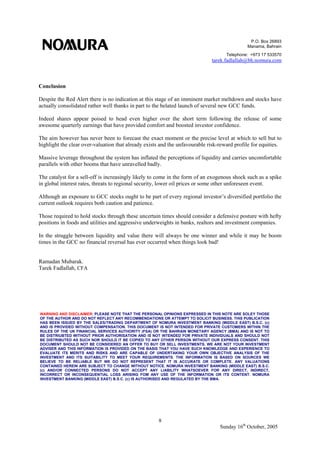
The chart on the left shows
the impressive rise in the
Philadelphia Housing Index
after US interest rates peaked
at the end of May last year.
But since yields bottomed at
the end of June this year the
index has fallen by 17%.
Given the forecast for higher
interest rates the outlook for
US and indeed international
property appear gloomy.300
350
400
450
500
550
600
Oct-03 Dec-03 Feb-04 Apr-04 Jun-04 Aug-04 Oct-04 Dec-04 Feb-05 Apr-05 Jun-05 Aug-05 Oct-05
3.0
3.5
4.0
4.5
5.0Philadelphia US Housing Index US 10 Year Treasury (right hand scale)
property rally
P.O. Box 26893
Manama, Bahrain
Telephone: +973 17 533570
tarek.fadlallah@bh.nomura.com
6
Sunday 16th
October, 2005
Emaar
Notwithstanding the global outlook there is undoubtedly an element of froth in the Dubai property market
with the prospect of a deteriorating demand/supply balance over the next two years.
But it is an open debate as to whether the property market will crash or whether the downside risks might
be alleviated by the controlled and regulated nature of the properties designated for foreign buyers.
On balance it may be possible to argue for a relatively benign scenario for property deflation in Dubai with
prices drifting downward gently if rental yields remain competitive with stock yields and the risk free rate.
Nomura has no corporate view on Dubai’s largest listed property company but Emaar’s valuations appear
high compared to its global peers which have proven records through several economic cycles.
UAE Hong Kong Singapore United Kingdom
Emaar Cheung Kong Capital Land Land Securities
Market Cap ($million) 44,016 23,876 5,383 11,434
PER (forecast) 31.5 13.4 12.1 20.9
PBR (x) 5.8 1.0 1.6 1.0
Dividend Yield (%) 0.75 2.24 1.20 3.08
(as at 14th October)
Source: Bloomberg, IBES, Shuaa Capital
Earlier this month a respected regional investment company published a report in which it estimated
Emaar’s Discounted Cash Flow valuation at AED 20.53 per share.
The estimate was couched in a politically diplomatic but economically bizarre [Neutral] rating given that
the assigned valuation was 21% below the prevailing share price.
The logic that Emaar deserves a premium appears flawed as (i) economically sensitive firms usually trade
at a market discount at this stage in the cycle in anticipation of higher interest rates and lower asset values;
(ii) the reference market benchmark index is itself overvalued.
Emaar has announced ambitious plans to spend $15 billion on building shopping malls in the Middle East,
developing Cairo Heights, constructing Damascus Hills and buying stakes in European realtors.
Notwithstanding the company’s excellent credentials it seems unlikely that it can replicate its domestic
success and maintain its profit margins in new markets in which it lacks experience and local knowledge.
Spending money is easy but making it is more difficult and even with fairly hopeful assumptions it may
take several years for Emaar’s valuations to fall into line with international averages.
PRICE 26.5 2004 2005e 2006e 2007e 2008e 2009e
EPS (AED) 0.28 0.84 1.18 1.45 1.71 1.73
PER (X) 94.64 31.55 22.46 18.28 15.50 15.32
Source: Shuaa Capital, Bloomberg
Given a straight choice between buying physical property in Dubai and shares in Emaar the former should
provide a better running yield and more reliable prospects for capital preservation. But both are risky.
P.O. Box 26893
Manama, Bahrain
Telephone: +973 17 533570
tarek.fadlallah@bh.nomura.com
7
Sunday 16th
October, 2005
Market Regulation and Government Role
The disclosure in August that shares in Dubai Islamic Bank had been manipulated by a minor and a broker
allegedly trading without authority has been used as an example of regulatory success.
But the episode has highlighted the difficulties facing the market authorities and been cited as evidence of
the fraud that some have long suspected and feared.
Daily trading volumes in the GCC markets have risen from tens of millions of dollars a day to several
billions making it virtually impossible for regulators to keep pace with market activity.
Spotting a $2 billion fraud between two parties is one thing but there are concerns of more sophisticated
practices that might explain suspicious activity ahead of major corporate announcements.
Quoted in the October 7th
issue of MEED, Karim Souaid, managing director for investment banking at
HSBC Middle East which acted as lead manager in the Dana Gas IPO made the following comments:
“Gulf markets are not properly regulated. Practitioners take advantage of light regulation. The markets are
full of insider trading”. Strong words indeed from a veteran banker and experienced operator in the region.
Unhealthy rumours that a privileged few may have profited from insider trading could cause problems if
the markets turn sour and small retail investors are left holding significant losses.
Even when the authorities have been able to prove illegal or unethical activity the actions taken and
punishment meted out have been ineffective and constituted little deterrent.
In the case of insider dealing allegations at Qatar Shipping court records were sealed and charges against
twenty-eight defendants were dropped after they simply agreed to pay back money made illegally.
Authorities in the region have a paternalistic instinct that is a virtuous and proud feature of Arabian culture
but is fundamentally dangerous when applied to capital markets that require transparency and equality.
Where is the Co-operation in GCC?
As a long time resident and ardent advocate of the region it is saddening to view some of the unhelpful and
unhealthy competition among the GCC states that is casting a shadow over regional development.
In an era when European airliners are scrambling to merge and half the US majors are operating under
bankruptcy protection it is astonishing that there are more state-owned airlines than GCC states.
How many financial hubs can a region of 35 million people sustain and is it practical to build numerous IT
cities within a few hours from the world’s largest in Bangalore?
Adam Smith’s classic text “Wealth of Nations” recommended economic specialisation but two hundred
and twenty nine years later this region practices duplication. These self inflicted wounds are unnecessary.
P.O. Box 26893
Manama, Bahrain
Telephone: +973 17 533570
tarek.fadlallah@bh.nomura.com
8
Sunday 16th
October, 2005
Conclusion
Despite the Red Alert there is no indication at this stage of an imminent market meltdown and stocks have
actually consolidated rather well thanks in part to the belated launch of several new GCC funds.
Indeed shares appear poised to head even higher over the short term following the release of some
awesome quarterly earnings that have provided comfort and boosted investor confidence.
The aim however has never been to forecast the exact moment or the precise level at which to sell but to
highlight the clear over-valuation that already exists and the unfavourable risk-reward profile for equities.
Massive leverage throughout the system has inflated the perceptions of liquidity and carries uncomfortable
parallels with other booms that have unravelled badly.
The catalyst for a sell-off is increasingly likely to come in the form of an exogenous shock such as a spike
in global interest rates, threats to regional security, lower oil prices or some other unforeseen event.
Although an exposure to GCC stocks ought to be part of every regional investor’s diversified portfolio the
current outlook requires both caution and patience.
Those required to hold stocks through these uncertain times should consider a defensive posture with hefty
positions in foods and utilities and aggressive underweights in banks, realtors and investment companies.
In the struggle between liquidity and value there will always be one winner and while it may be boom
times in the GCC no financial reversal has ever occurred when things look bad!
Ramadan Mubarak.
Tarek Fadlallah, CFA
WARNING AND DISCLAIMER: PLEASE NOTE THAT THE PERSONAL OPINIONS EXPRESSED IN THIS NOTE ARE SOLEY THOSE
OF THE AUTHOR AND DO NOT REFLECT ANY RECOMMENDATIONS OR ATTEMPT TO SOLICIT BUSINESS. THIS PUBLICATION
HAS BEEN ISSUED BY THE SALES/TRADING DEPARTMENT OF NOMURA INVESTMENT BANKING (MIDDLE EAST) B.S.C. (c)
AND IS PROVIDED WITHOUT COMPENSATION. THIS DOCUMENT IS NOT INTENDED FOR PRIVATE CUSTOMERS WITHIN THE
RULES OF THE UK FINANCIAL SERVICES AUTHORITY (FSA) OR THE BAHRAIN MONETARY AGENCY (BMA) AND IS NOT TO
BE DISTRIUBTED WITHOUT PRIOR AUTHORISATION AND IS NOT INTENDED FOR PRIVATE INDIVIDUALS AND SHOULD NOT
BE DISTRIBUTED AS SUCH NOR SHOULD IT BE COPIED TO ANY OTHER PERSON WITHOUT OUR EXPRESS CONSENT. THIS
DOCUMENT SHOULD NOT BE CONSIDERED AN OFFER TO BUY OR SELL INVESTMENTS. WE ARE NOT YOUR INVESTMENT
ADVISER AND THIS INFORMATION IS PROVIDED ON THE BASIS THAT YOU HAVE SUCH KNOWLEDGE AND EXPERIENCE TO
EVALUATE ITS MERITS AND RISKS AND ARE CAPABLE OF UNDERTAKING YOUR OWN OBJECTIVE ANALYSIS OF THE
INVESTMENT AND ITS SUITABILITY TO MEET YOUR REQUIREMENTS. THE INFORMATION IS BASED ON SOURCES WE
BELIEVE TO BE RELIABLE BUT WE DO NOT REPRESENT THAT IT IS ACCURATE OR COMPLETE. ANY VALUATIONS
CONTAINED HEREIN ARE SUBJECT TO CHANGE WITHOUT NOTICE. NOMURA INVESTMENT BANKING (MIDDLE EAST) B.S.C.
(c) AND/OR CONNECTED PERSONS DO NOT ACCEPT ANY LIABILITY WHATSOEVER FOR ANY DIRECT, INDIRECT,
INCORRECT OR INCONSEQUENTIAL LOSS ARISING FOM ANY USE OF THE INFORMATION OR ITS CONTENT. NOMURA
INVESTMENT BANKING (MIDDLE EAST) B.S.C. (c) IS AUTHORISED AND REGULATED BY THE BMA.

Petrodollar Pyramids (October 2005)

  • 1.
    P.O. Box 26893 Manama,Bahrain Telephone: +973 17 533570 tarek.fadlallah@bh.nomura.com 1 Sunday 16th October, 2005 Petrodollar Pyramids Liquidity vs. Value Covert visits to Riyadh and Dubai recently revealed that opinions are strongly divided on the prospects for the local stock markets and it seems unlikely that these entrenched views can be swayed in the near term. With no hint of a correction in sight the upper hand for the time being is very much with the optimists who can point to their bulging bank balances while the pessimists squirm with envy. But the matter is not yet settled and the stakes are too high to shirk away from mature debate – the combined market value of the six GCC markets has now surpassed $1 trillion. Sympathy for the cautious stance on stocks is evident among the professional investment community but most concede that the markets have spawned their own dynamic and bred resolute retail confidence. Despite such sentiment we have yet to be offered any compelling arguments to support current valuations and doubt the existence of any credible economic model that can justify regional market multiples. The liquidity explanation advanced by some commentators has severe limitations in the modern era of ostensibly free and efficient capital markets and risks comparison with “Ponzi” schemes. These schemes are named after Charles Ponzi who cost investors millions of dollars in the 1920s by promising high returns using money taken from new customers to pay off earlier investors. Over the years these schemes have evolved a number of variants but the essential element has remained the same – prices will keep going up as long as the next buyer will pay a higher price. The weakness of liquidity driven markets is that at some point they encounter a ceiling at which buyers refer to some economic benchmark and demand justification for the higher prices. Benchmark GCC Stock Div UAE 1Yr Deposit Saudi 1Yr Deposit US 1Yr Deposit £ 1Yr Deposit Yields 1.44% 4.63% 4.78% 4.51% 4.41% (data as at 14th October) Source: Bloomberg, GIC Since most GCC market participants are local players with common motivations and similar objectives one wonders who will be the new buyers when the music stops and domestic investors decide to sell? Foreign investors are certainly taking notice of the extraordinary performance of the GCC markets though unfortunately for all the wrong reasons. Under the heading “Gulf stock markets” the LEX column in the Financial Times on October 6th cites market valuations that “defy gravity” and “rely on headlines rather than number crunching”. Ouch!
  • 2.
    P.O. Box 26893 Manama,Bahrain Telephone: +973 17 533570 tarek.fadlallah@bh.nomura.com 2 Sunday 16th October, 2005 GCC in a Relative World Since the publication of the Great Arabian Bubble on June 20th the Saudi Arabian and UAE stock markets – perhaps inevitably given their earlier gains – have performed modestly compared to the prior period. At the same time the Japanese stock market has comfortably beaten the Saudi and UAE Indices while investors interested in the energy theme would have been better served buying the S&P Oil and Gas Index. -30% -20% -10% 0% 10% 20% 30% 40% 20-Jun 30-Jun 10-Jul 20-Jul 30-Jul 9-Aug 19-Aug 29-Aug 8-Sep 18-Sep 28-Sep 8-Oct Tadawul UAE General Japan Topix S&P Oil & Gas 58.6% 96.4% 9.2% 0.2% -30% -20% -10% 0% 10% 20% 30% 40% 50% 60% 70% 80% 90% 100% Tadawul UAE General Tadawul UAE General Four Months To June 20th Four Months Since June 20th Trading Range Source: Bloomberg Rumoured buying by public funds
  • 3.
    P.O. Box 26893 Manama,Bahrain Telephone: +973 17 533570 tarek.fadlallah@bh.nomura.com 3 Sunday 16th October, 2005 The IPO Phenomenon Making money from attractively priced Initial Public Offerings (IPO) is neither new nor peculiar to the GCC but the frenzy which accompanied the recent Dana Gas offering borders on the farcical. The sight of planes loaded with speculators and banks overflowing with excited subscribers illustrate the extent to which the get-rich-quick-with-no-risk mentality has developed across the region. The lure of easy money may lead to a declining quality of IPO with an increasing propensity to list unprepared firms with unproven business models and untested strategies. WTO Free Trade Agreements and membership of the World Trade Organisation (WTO) have become a hot topic lately with prospects of Saudi membership as early as December’s ministerial conference in Hong Kong. WTO membership should encourage foreign direct investments and provide a boost for the economy in the long term but may come at a considerable cost over the short term. Economic theory suggests that ‘supernormal’ profits tend to get competed away as new investment is tempted by the prospect of extraordinary profits particularly in industries with low barriers to entry. So industries that have benefited from protection and been able to earn supernormal profits will be exposed to the chill winds of increasing competition upon Saudi ascension to the WTO. The lowering of agricultural tariffs is already hitting that industry and the prospect of further liberalisation in the financial sector is luring scores of intermediaries and investment advisers to the Kingdom. Even industries with relatively high barriers such as petrochemicals are not immune and SABIC’s regional monopoly faces stiff competition from the $41 billion in new private capital spending anticipated by 2009 in Saudi Arabia alone according to the Saudi Arabian General Investment Authority (SAGIA). At least one other regional deal is rumoured to be in the pipeline with Taiwan’s China Petroleum said to be considering a $6 billion petrochemical plant in the UAE. Perhaps Qatar will want its own plant too? The abundance of capital should attract investment into many industries and it is not impossible that intensifying competition could reduce profitability even within the framework of a growing economy. One hopeful applicant explained his investment philosophy to the Gulf Daily News by saying “our current fridge doesn’t cool properly and the door is difficult to shut. Maybe if we get a good profit from these shares we could buy the fridge”. The investor neglected to offer his views on the company’s valuation multiples or its prospects for EBITDA growth!
  • 4.
    P.O. Box 26893 Manama,Bahrain Telephone: +973 17 533570 tarek.fadlallah@bh.nomura.com 4 Sunday 16th October, 2005 The Saudi Banks Banks account for about a quarter of the Saudi market capitalisation and are hugely profitably by global standards for a number of reasons that include extraordinary earnings related to the booming capital markets and privileged protection from international competition. Neither is sustainable. Bank Market Cap ($m) Assets ($m) Op Profit ($m) Mkt Cap/Op Op/Assets Al Rajhi Banking $44,184 $24,685 $1,550 28.5 6.3% SAMBA $27,889 $29,801 $1,360 20.5 4.6% Riyad Bank $19,749 $23,101 $1,072 18.4 4.6% Saudi British Bank $16,924 $18,096 $827 20.5 4.6% Banque Saudi Fransi* $14,584 $15,905 $585 24.9 3.7% Arab National Bank $12,007 $20,777 $733 16.4 3.5% Saudi Investment Bank $8,110 $10,376 $307 26.4 3.0% Saudi Hollandi $5,950 $9,323 $419 14.2 4.5% Bank Al-Jazira* $4,278 $2,858 $117 36.6 4.1% Total/Average $153,677 $154,922 $6,969 22.9 4.3% Global Four* (Citigroup, UBS, Deutsche Bank, Mitsubsihi UFJ) 11.0 0.8% Assets & Operating Profit forecasts are 2005 except those denoted * Source: Bloomberg, Global Investment House Last month Moody’s Investors Service issued a report titled “Banking System Outlook: Saudi Arabia” in which it evaluated the sector favourably with a creditable Baa2/Prime-2 rating and Stable outlook. It also warned that “the restricted access of foreign banks to the Saudi Arabian markets has enabled Saudi banks to establish and defend their franchises. However we expect some banks to face challenges over the next few years mainly stemming from increased competition and market liberalisation”. In further cautionary statements that hinted at economic cyclicality and reliance on high oil prices and rising stock markets it noted that “Moody’s takes a cautious approach to asset quality in Saudi Arabia”. “We are wary about the substantial loan growth as well as increased exposure to the stock market, primarily in the form of margin lending, which we estimate to account for more than 10% of total loans”. The Saudi market may be inherently more profitable than conventional banking markets but it is virtually certain that current profitability rates are too high and destined to decline toward international averages. ($m) 22.9 21.0 19.0 17.0 15.0 13.0 11.0 4.3% $153,677 $140,927 $127,505 $114,083 $100,662 $87,240 $73,819 3.0% $107,217 $98,321 $88,957 $79,593 $70,229 $60,865 $51,501 2.0% $71,478 $65,547 $59,305 $53,062 $46,819 $40,577 $34,334 0.8% $28,591 $26,219 $23,722 $21,225 $18,728 $16,231 $13,734 Valuation (Market Cap / Operating Profit) The matrix above provides a range of estimates for the combined value of the nine major listed banks for given profitability (operating profit/assets) and valuation (market cap/operating profit) assumptions. Neither extreme appears to reflect the sector’s true worth with the real value likely to rest in mid-table. Profitability (Op/Assets)
  • 5.
    P.O. Box 26893 Manama,Bahrain Telephone: +973 17 533570 tarek.fadlallah@bh.nomura.com 5 Sunday 16th October, 2005 The Dubai Miracle Among the regional economies Dubai is arguably the most exposed to the threat of lower asset prices with potentially serious ramifications given the direct impact of stocks and property on its economic fabric. The government’s well intentioned but heavy hand in the real estate and stock markets in particular have raised concerns of potential conflicts of interest and distortions in the market place. The carefully crafted and brilliantly implemented interventionist model has served the Emirate well over the past decade and defied the sceptics who miscalculated its efficacy and potency. But even if Dubai’s potential remains great there are grounds to question whether the spectacular growth can be sustained at current levels without the growing pains of every emerging economy. the context of a global property boom that has seen similar excesses and carries comparable capital risks. Low interest rates, plentiful liquidity and financial deregulation have boosted prices from Manhattan to Manchester and Moscow though not all have experienced the unbounded speculation of the Dubai market. The implication for the GCC is clear since central banks take their queue from the Federal Reserve and official interest rates in both Saudi Arabia and the UAE were lifted by ¼% again last month. There is already evidence of a slowdown in rents and property values with lower premiums in the secondary market for projects under construction and little rush to secure allotments in new developments. The buy-to-let logic is also being undermined by rising rates that have seen a narrowing differential between mortgage rates and rental yields. Moreover the sight of construction workers striking over unpaid wages is a warning of the tenuous nature of some of the development financing. In mitigation of these disturbing signs Dubai’s high prices must be put in The chart on the left shows the impressive rise in the Philadelphia Housing Index after US interest rates peaked at the end of May last year. But since yields bottomed at the end of June this year the index has fallen by 17%. Given the forecast for higher interest rates the outlook for US and indeed international property appear gloomy.300 350 400 450 500 550 600 Oct-03 Dec-03 Feb-04 Apr-04 Jun-04 Aug-04 Oct-04 Dec-04 Feb-05 Apr-05 Jun-05 Aug-05 Oct-05 3.0 3.5 4.0 4.5 5.0Philadelphia US Housing Index US 10 Year Treasury (right hand scale) property rally
  • 6.
    P.O. Box 26893 Manama,Bahrain Telephone: +973 17 533570 tarek.fadlallah@bh.nomura.com 6 Sunday 16th October, 2005 Emaar Notwithstanding the global outlook there is undoubtedly an element of froth in the Dubai property market with the prospect of a deteriorating demand/supply balance over the next two years. But it is an open debate as to whether the property market will crash or whether the downside risks might be alleviated by the controlled and regulated nature of the properties designated for foreign buyers. On balance it may be possible to argue for a relatively benign scenario for property deflation in Dubai with prices drifting downward gently if rental yields remain competitive with stock yields and the risk free rate. Nomura has no corporate view on Dubai’s largest listed property company but Emaar’s valuations appear high compared to its global peers which have proven records through several economic cycles. UAE Hong Kong Singapore United Kingdom Emaar Cheung Kong Capital Land Land Securities Market Cap ($million) 44,016 23,876 5,383 11,434 PER (forecast) 31.5 13.4 12.1 20.9 PBR (x) 5.8 1.0 1.6 1.0 Dividend Yield (%) 0.75 2.24 1.20 3.08 (as at 14th October) Source: Bloomberg, IBES, Shuaa Capital Earlier this month a respected regional investment company published a report in which it estimated Emaar’s Discounted Cash Flow valuation at AED 20.53 per share. The estimate was couched in a politically diplomatic but economically bizarre [Neutral] rating given that the assigned valuation was 21% below the prevailing share price. The logic that Emaar deserves a premium appears flawed as (i) economically sensitive firms usually trade at a market discount at this stage in the cycle in anticipation of higher interest rates and lower asset values; (ii) the reference market benchmark index is itself overvalued. Emaar has announced ambitious plans to spend $15 billion on building shopping malls in the Middle East, developing Cairo Heights, constructing Damascus Hills and buying stakes in European realtors. Notwithstanding the company’s excellent credentials it seems unlikely that it can replicate its domestic success and maintain its profit margins in new markets in which it lacks experience and local knowledge. Spending money is easy but making it is more difficult and even with fairly hopeful assumptions it may take several years for Emaar’s valuations to fall into line with international averages. PRICE 26.5 2004 2005e 2006e 2007e 2008e 2009e EPS (AED) 0.28 0.84 1.18 1.45 1.71 1.73 PER (X) 94.64 31.55 22.46 18.28 15.50 15.32 Source: Shuaa Capital, Bloomberg Given a straight choice between buying physical property in Dubai and shares in Emaar the former should provide a better running yield and more reliable prospects for capital preservation. But both are risky.
  • 7.
    P.O. Box 26893 Manama,Bahrain Telephone: +973 17 533570 tarek.fadlallah@bh.nomura.com 7 Sunday 16th October, 2005 Market Regulation and Government Role The disclosure in August that shares in Dubai Islamic Bank had been manipulated by a minor and a broker allegedly trading without authority has been used as an example of regulatory success. But the episode has highlighted the difficulties facing the market authorities and been cited as evidence of the fraud that some have long suspected and feared. Daily trading volumes in the GCC markets have risen from tens of millions of dollars a day to several billions making it virtually impossible for regulators to keep pace with market activity. Spotting a $2 billion fraud between two parties is one thing but there are concerns of more sophisticated practices that might explain suspicious activity ahead of major corporate announcements. Quoted in the October 7th issue of MEED, Karim Souaid, managing director for investment banking at HSBC Middle East which acted as lead manager in the Dana Gas IPO made the following comments: “Gulf markets are not properly regulated. Practitioners take advantage of light regulation. The markets are full of insider trading”. Strong words indeed from a veteran banker and experienced operator in the region. Unhealthy rumours that a privileged few may have profited from insider trading could cause problems if the markets turn sour and small retail investors are left holding significant losses. Even when the authorities have been able to prove illegal or unethical activity the actions taken and punishment meted out have been ineffective and constituted little deterrent. In the case of insider dealing allegations at Qatar Shipping court records were sealed and charges against twenty-eight defendants were dropped after they simply agreed to pay back money made illegally. Authorities in the region have a paternalistic instinct that is a virtuous and proud feature of Arabian culture but is fundamentally dangerous when applied to capital markets that require transparency and equality. Where is the Co-operation in GCC? As a long time resident and ardent advocate of the region it is saddening to view some of the unhelpful and unhealthy competition among the GCC states that is casting a shadow over regional development. In an era when European airliners are scrambling to merge and half the US majors are operating under bankruptcy protection it is astonishing that there are more state-owned airlines than GCC states. How many financial hubs can a region of 35 million people sustain and is it practical to build numerous IT cities within a few hours from the world’s largest in Bangalore? Adam Smith’s classic text “Wealth of Nations” recommended economic specialisation but two hundred and twenty nine years later this region practices duplication. These self inflicted wounds are unnecessary.
  • 8.
    P.O. Box 26893 Manama,Bahrain Telephone: +973 17 533570 tarek.fadlallah@bh.nomura.com 8 Sunday 16th October, 2005 Conclusion Despite the Red Alert there is no indication at this stage of an imminent market meltdown and stocks have actually consolidated rather well thanks in part to the belated launch of several new GCC funds. Indeed shares appear poised to head even higher over the short term following the release of some awesome quarterly earnings that have provided comfort and boosted investor confidence. The aim however has never been to forecast the exact moment or the precise level at which to sell but to highlight the clear over-valuation that already exists and the unfavourable risk-reward profile for equities. Massive leverage throughout the system has inflated the perceptions of liquidity and carries uncomfortable parallels with other booms that have unravelled badly. The catalyst for a sell-off is increasingly likely to come in the form of an exogenous shock such as a spike in global interest rates, threats to regional security, lower oil prices or some other unforeseen event. Although an exposure to GCC stocks ought to be part of every regional investor’s diversified portfolio the current outlook requires both caution and patience. Those required to hold stocks through these uncertain times should consider a defensive posture with hefty positions in foods and utilities and aggressive underweights in banks, realtors and investment companies. In the struggle between liquidity and value there will always be one winner and while it may be boom times in the GCC no financial reversal has ever occurred when things look bad! Ramadan Mubarak. Tarek Fadlallah, CFA WARNING AND DISCLAIMER: PLEASE NOTE THAT THE PERSONAL OPINIONS EXPRESSED IN THIS NOTE ARE SOLEY THOSE OF THE AUTHOR AND DO NOT REFLECT ANY RECOMMENDATIONS OR ATTEMPT TO SOLICIT BUSINESS. THIS PUBLICATION HAS BEEN ISSUED BY THE SALES/TRADING DEPARTMENT OF NOMURA INVESTMENT BANKING (MIDDLE EAST) B.S.C. (c) AND IS PROVIDED WITHOUT COMPENSATION. THIS DOCUMENT IS NOT INTENDED FOR PRIVATE CUSTOMERS WITHIN THE RULES OF THE UK FINANCIAL SERVICES AUTHORITY (FSA) OR THE BAHRAIN MONETARY AGENCY (BMA) AND IS NOT TO BE DISTRIUBTED WITHOUT PRIOR AUTHORISATION AND IS NOT INTENDED FOR PRIVATE INDIVIDUALS AND SHOULD NOT BE DISTRIBUTED AS SUCH NOR SHOULD IT BE COPIED TO ANY OTHER PERSON WITHOUT OUR EXPRESS CONSENT. THIS DOCUMENT SHOULD NOT BE CONSIDERED AN OFFER TO BUY OR SELL INVESTMENTS. WE ARE NOT YOUR INVESTMENT ADVISER AND THIS INFORMATION IS PROVIDED ON THE BASIS THAT YOU HAVE SUCH KNOWLEDGE AND EXPERIENCE TO EVALUATE ITS MERITS AND RISKS AND ARE CAPABLE OF UNDERTAKING YOUR OWN OBJECTIVE ANALYSIS OF THE INVESTMENT AND ITS SUITABILITY TO MEET YOUR REQUIREMENTS. THE INFORMATION IS BASED ON SOURCES WE BELIEVE TO BE RELIABLE BUT WE DO NOT REPRESENT THAT IT IS ACCURATE OR COMPLETE. ANY VALUATIONS CONTAINED HEREIN ARE SUBJECT TO CHANGE WITHOUT NOTICE. NOMURA INVESTMENT BANKING (MIDDLE EAST) B.S.C. (c) AND/OR CONNECTED PERSONS DO NOT ACCEPT ANY LIABILITY WHATSOEVER FOR ANY DIRECT, INDIRECT, INCORRECT OR INCONSEQUENTIAL LOSS ARISING FOM ANY USE OF THE INFORMATION OR ITS CONTENT. NOMURA INVESTMENT BANKING (MIDDLE EAST) B.S.C. (c) IS AUTHORISED AND REGULATED BY THE BMA.