Become a Poet
           And earn more credit for it!
           And earn more credit for it!


 Before you start this project, be sure to save it to your desktop!
Click FILE, choose SAVE AS, and change WHERE to DESKTOP.


Name:
First, let’s look at what poetry is
                  ...

๏ Poetry is when an
     emotion has found its
     thought and the
     thought has found
     words. ~Robert Frost
Quote taken from:
      http://www.quotegarden.com/poetry.html
How is poetry different from
          prose?
Poetry                                  Prose (or writing)
Tries to communicate an emotion,
                                        Tries to communicate information,
an experience, or an idea in as few
                                        ideas, or stories in detailed,
words as possible.
                                        supported, paragraph-writing.
 Focuses on choosing the right
                                        Focuses on using a lot of words to
words (and avoiding using
                                        describe your topic.
unnecessary words).
                                        Has sentences that are arranged in
Pays special attention to breaking
                                        paragraphs, sections, or pages.
up thoughts into lines and stanzas.

Uses poetic techniques to create
rhythm and flow (rhyming, imagery,
syllable count, line length, similes,
metaphors, alliteration).
The Woman on the Peak
                        See the differences?
The woman stands upon the barren peak,

                      Poem
Gazing down on the world beneath.
                                                                                                Prose
                                                                                     Sentences arranged in
The lonely chill seeps from the ground


Into her feet, spreading, upward bound.                                                 two paragraphs
                                          Intentional line breaks
The angry wind whistles ‘round her head,

                                                                           A woman stands on a mountain top with the cold seeping into her
Whipping her hair into streaming snakes,                            body. There is nothing around her on the mountain top; it’ bare and
                                                 Imagery            unwelcoming. She looks on the valley below as the wind whips around her.
                                                                    It’s a strong wind. She wants to go somewhere warmer, but she is unable to
While she watches, wishes, weakly wails.
                                                                    go to the peaceful beauty below.
                                                  Simile                   In the valley, the sun shines from behind the clouds causing flowers to
                                                                    bloom. It seems like a much a happier place than the mountain top. A
                                                   Two              breeze sends quivers through the leaves of trees, but it’s softer than the

                                                 stanzas
                                                                    mountain wind. The water gurgles in a brook. The woman looks at this
Beyond the mountain, sunshine peeks,
                                                                    beautiful valley and all of the nature inside of it, but all the woman can do is
                                                                    cry.
Teasing flowers to survive and thrive.
                                              Personification       Notice how this prose still uses beautiful
The breeze whispers through the leaves,
                                                                    language, but the wording is more direct
Causing gentle quivers to sway the trees.                           and less figurative. The prose gives
Laughter gurgles as the splashing brook                             more explanation and less feeling.
Playfully tumbles over rugged rocks,
                                                                                                         *Content adapted from
While the woman above can only grieve.
Question: Why would
  the way you write something
 matter? In other words, how do
 the differences between poetry
and prose affect the meaning that
comes across in the writing? Use
specifics from the last few slides.


Your Answer:
Next, let’s see how poets write
           poetry. . .
Poets include figurative
language to make their poetry
more powerful.

Figurative language includes:
Metaphor, Simile, Symbolism,
Personification, Allegory,
Irony, Imagery.

Poets also use rhyme, rhythm,
and line length to make a
point.
Metaphor
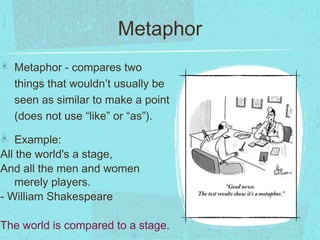
  Metaphor - compares two
  things that wouldn’t usually be
  seen as similar to make a point
  (does not use “like” or “as”).

    Example:
All the world's a stage,
And all the men and women
    merely players.
- William Shakespeare

The world is compared to a stage.
Metaphor Poem
Tranquility
Time slides
a gentle ocean
waves upon waves,
washing the shore,
loving the shore.


- by Star Fields


What is the metaphor in this
poem (what’s being
compared)?
Write your own metaphor


Write your own
metaphor. To what
could you compare your
life or yourself?
Symbolism
Using something to represent
an idea in poetry (or other
speaking/writing) is
symbolism.

Examples:
A cross represents Christianity.

Green represents environmentally
friendly products.

A heart represents love.

A storm represents trouble.
Symbolism in Poetry
“One Perfect Rose” by Dorothy Parker

A single flow'r he sent me, since we met.

All tenderly his messenger he chose;

Deep-hearted, pure, with scented dew still wet

One perfect rose.


What does the rose symbolize
(stand for) in this poem?
Create Your Own Symbol


What THING might
symbolize your feelings
or ideas?
Personification

  Giving human traits to
  something that is not human.

  Example: The wind yelled
  through the cracks in the
  window pane.

Yelling is a human action, but the
  wind is not alive.
Personification in a Poem
    Anger
Anger sits cracking his whip against the wall
   his red face swollen with blood.
   He is being eaten up from the inside
   and festers alone in the darkness.

His clothes are all torn and his face is all cracked.
    He is a volcano ready to explode
    with eyes like huge, dark smouldering hollows, just waiting to erupt.
    He is bent over and furious
    with himself and the world.


•   What does the author do make anger seem like it’s
    alive? Explain at least three.
Your Example of
           Personification


Look around you and
choose an object. Describe
it in a way that makes it
“come alive.”
Imagery

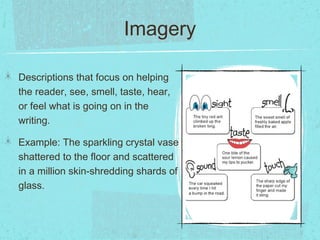
Descriptions that focus on helping
the reader, see, smell, taste, hear,
or feel what is going on in the
writing.

Example: The sparkling crystal vase
shattered to the floor and scattered
in a million skin-shredding shards of
glass.
Imagery in Poetry
The Way I Play Soccer

Sweat streams down my face,
And my skin turns red under the watchful eye of the sun.
The sound of cleats pounding the earth is deafening
As my enemies charge down the field towards me.
I can sense the shooter is going to miss;
All at once, the ball collides into my chest.
Screams of victory roar across the field.
The grass stained, game ball rests
Rests lovingly between my two hands.
Poetry by Natasha Niemi


•What sights, sounds, smells,
feelings, or tastes do you find in
this excerpt?
Your Example of Imagery


Your Example: Describe the
room, yard, building, or area
around you in such a way that
people will feel, hear, see,
smell, or taste it.
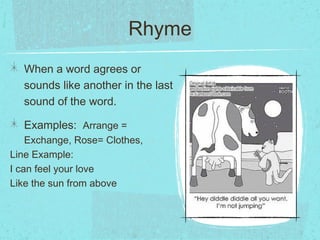
Rhyme
  When a word agrees or
  sounds like another in the last
  sound of the word.

  Examples: Arrange =
    Exchange, Rose= Clothes,
Line Example:
I can feel your love
Like the sun from above
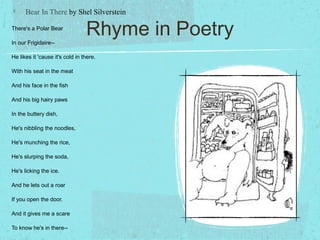
Bear In There by Shel Silverstein

There's a Polar Bear

In our Frigidaire--
                                 Rhyme in Poetry
He likes it 'cause it's cold in there.

With his seat in the meat

And his face in the fish

And his big hairy paws

In the buttery dish,

He's nibbling the noodles,

He's munching the rice,

He's slurping the soda,

He's licking the ice.

And he lets out a roar

If you open the door.

And it gives me a scare

To know he's in there--
Come up with end rhyme of
           your own


How could you rhyme this line:


“If I could have you in an
embrace”
Now write your own!
   Use at least three poetic
 techniques and write a brief
     poem of your own.

This site will help you come up
  with a topic for your poem.
 Use these techniques: Metaphor,
 Simile, Symbolism,
 Personification, Allegory, Irony,
 Imagery, Rhyme, Rhythm, Line
 Length, Alliteration, Illusion, etc.

 Write your poem on the next
 slide.
Your Poem
Explain your technique


Explain the three (or more) poetic techniques you
used in your poem.
Congrats!


       You’re a Poet!
Send your finished project to
       your mentor.

Become a poet

  • 1.
    Become a Poet And earn more credit for it! And earn more credit for it! Before you start this project, be sure to save it to your desktop! Click FILE, choose SAVE AS, and change WHERE to DESKTOP. Name:
  • 2.
    First, let’s lookat what poetry is ... ๏ Poetry is when an emotion has found its thought and the thought has found words. ~Robert Frost Quote taken from: http://www.quotegarden.com/poetry.html
  • 3.
    How is poetrydifferent from prose? Poetry Prose (or writing) Tries to communicate an emotion, Tries to communicate information, an experience, or an idea in as few ideas, or stories in detailed, words as possible. supported, paragraph-writing. Focuses on choosing the right Focuses on using a lot of words to words (and avoiding using describe your topic. unnecessary words). Has sentences that are arranged in Pays special attention to breaking paragraphs, sections, or pages. up thoughts into lines and stanzas. Uses poetic techniques to create rhythm and flow (rhyming, imagery, syllable count, line length, similes, metaphors, alliteration).
  • 4.
    The Woman onthe Peak See the differences? The woman stands upon the barren peak, Poem Gazing down on the world beneath. Prose Sentences arranged in The lonely chill seeps from the ground Into her feet, spreading, upward bound. two paragraphs Intentional line breaks The angry wind whistles ‘round her head, A woman stands on a mountain top with the cold seeping into her Whipping her hair into streaming snakes, body. There is nothing around her on the mountain top; it’ bare and Imagery unwelcoming. She looks on the valley below as the wind whips around her. It’s a strong wind. She wants to go somewhere warmer, but she is unable to While she watches, wishes, weakly wails. go to the peaceful beauty below. Simile In the valley, the sun shines from behind the clouds causing flowers to bloom. It seems like a much a happier place than the mountain top. A Two breeze sends quivers through the leaves of trees, but it’s softer than the stanzas mountain wind. The water gurgles in a brook. The woman looks at this Beyond the mountain, sunshine peeks, beautiful valley and all of the nature inside of it, but all the woman can do is cry. Teasing flowers to survive and thrive. Personification Notice how this prose still uses beautiful The breeze whispers through the leaves, language, but the wording is more direct Causing gentle quivers to sway the trees. and less figurative. The prose gives Laughter gurgles as the splashing brook more explanation and less feeling. Playfully tumbles over rugged rocks, *Content adapted from While the woman above can only grieve.
  • 5.
    Question: Why would the way you write something matter? In other words, how do the differences between poetry and prose affect the meaning that comes across in the writing? Use specifics from the last few slides. Your Answer:
  • 6.
    Next, let’s seehow poets write poetry. . . Poets include figurative language to make their poetry more powerful. Figurative language includes: Metaphor, Simile, Symbolism, Personification, Allegory, Irony, Imagery. Poets also use rhyme, rhythm, and line length to make a point.
  • 7.
    Metaphor Metaphor- compares two things that wouldn’t usually be seen as similar to make a point (does not use “like” or “as”). Example: All the world's a stage, And all the men and women merely players. - William Shakespeare The world is compared to a stage.
  • 8.
    Metaphor Poem Tranquility Time slides agentle ocean waves upon waves, washing the shore, loving the shore. - by Star Fields What is the metaphor in this poem (what’s being compared)?
  • 9.
    Write your ownmetaphor Write your own metaphor. To what could you compare your life or yourself?
  • 10.
    Symbolism Using something torepresent an idea in poetry (or other speaking/writing) is symbolism. Examples: A cross represents Christianity. Green represents environmentally friendly products. A heart represents love. A storm represents trouble.
  • 11.
    Symbolism in Poetry “OnePerfect Rose” by Dorothy Parker A single flow'r he sent me, since we met. All tenderly his messenger he chose; Deep-hearted, pure, with scented dew still wet One perfect rose. What does the rose symbolize (stand for) in this poem?
  • 12.
    Create Your OwnSymbol What THING might symbolize your feelings or ideas?
  • 13.
    Personification Givinghuman traits to something that is not human. Example: The wind yelled through the cracks in the window pane. Yelling is a human action, but the wind is not alive.
  • 14.
    Personification in aPoem Anger Anger sits cracking his whip against the wall his red face swollen with blood. He is being eaten up from the inside and festers alone in the darkness. His clothes are all torn and his face is all cracked. He is a volcano ready to explode with eyes like huge, dark smouldering hollows, just waiting to erupt. He is bent over and furious with himself and the world. • What does the author do make anger seem like it’s alive? Explain at least three.
  • 15.
    Your Example of Personification Look around you and choose an object. Describe it in a way that makes it “come alive.”
  • 16.
    Imagery Descriptions that focuson helping the reader, see, smell, taste, hear, or feel what is going on in the writing. Example: The sparkling crystal vase shattered to the floor and scattered in a million skin-shredding shards of glass.
  • 17.
    Imagery in Poetry TheWay I Play Soccer Sweat streams down my face, And my skin turns red under the watchful eye of the sun. The sound of cleats pounding the earth is deafening As my enemies charge down the field towards me. I can sense the shooter is going to miss; All at once, the ball collides into my chest. Screams of victory roar across the field. The grass stained, game ball rests Rests lovingly between my two hands. Poetry by Natasha Niemi •What sights, sounds, smells, feelings, or tastes do you find in this excerpt?
  • 18.
    Your Example ofImagery Your Example: Describe the room, yard, building, or area around you in such a way that people will feel, hear, see, smell, or taste it.
  • 19.
    Rhyme Whena word agrees or sounds like another in the last sound of the word. Examples: Arrange = Exchange, Rose= Clothes, Line Example: I can feel your love Like the sun from above
  • 20.
    Bear In Thereby Shel Silverstein There's a Polar Bear In our Frigidaire-- Rhyme in Poetry He likes it 'cause it's cold in there. With his seat in the meat And his face in the fish And his big hairy paws In the buttery dish, He's nibbling the noodles, He's munching the rice, He's slurping the soda, He's licking the ice. And he lets out a roar If you open the door. And it gives me a scare To know he's in there--
  • 21.
    Come up withend rhyme of your own How could you rhyme this line: “If I could have you in an embrace”
  • 22.
    Now write yourown! Use at least three poetic techniques and write a brief poem of your own. This site will help you come up with a topic for your poem. Use these techniques: Metaphor, Simile, Symbolism, Personification, Allegory, Irony, Imagery, Rhyme, Rhythm, Line Length, Alliteration, Illusion, etc. Write your poem on the next slide.
  • 23.
  • 24.
    Explain your technique Explainthe three (or more) poetic techniques you used in your poem.
  • 25.
    Congrats! You’re a Poet! Send your finished project to your mentor.