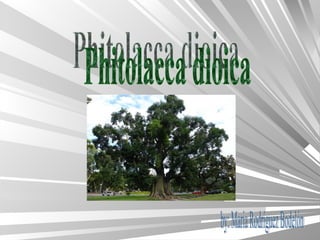
Phitolacca dioica by: Maria Rodríguez Bodelón
Ombu: Phytolacca dioica Famlia: Fitolacáceas Portugués name: Umbú          Guaraní name: Ïmboú         English name: Umbra Tree Spanish name : Bella sombra   Names
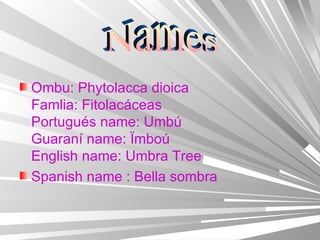
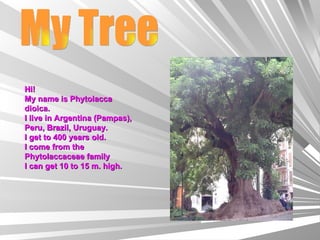
My Tree Hi! My name is Phytolacca dioica.  I live in Argentina (Pampas), Peru, Brazil, Uruguay.  I get to 400 years old.  I come from the Phytolaccaceae family I can get 10 to 15 m. high.
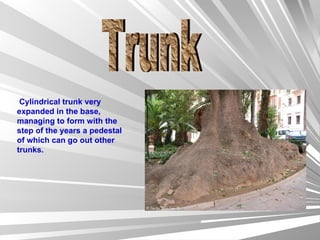
Trunk   Cylindrical trunk very expanded in the base, managing to form with the step of the years a pedestal of which can go out other trunks.
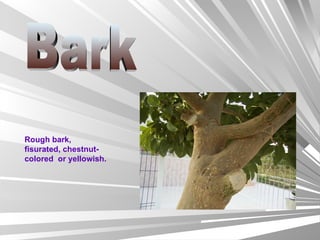
Rough bark, fisurated, chestnut-colored  or yellowish. Bark
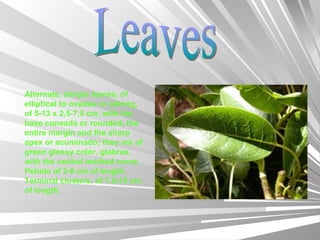
Leaves Alternate, simple leaves, of elliptical to ovadas or oblong, of 5-13 x 2,5-7,5 cm, with the base cuneada or rounded, the entire margin and the sharp apex or acuminado; they are of green glossy color, glabras, with the central marked nerve. Petiole of 2-8 cm of length. Terminal clusters, of 7,5-15 cm of length.
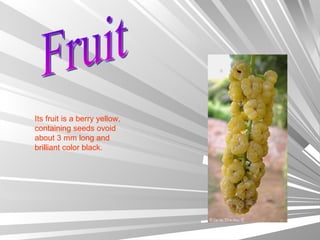
Fruit Its fruit is a berry yellow, containing seeds ovoid about 3 mm long and brilliant color black.
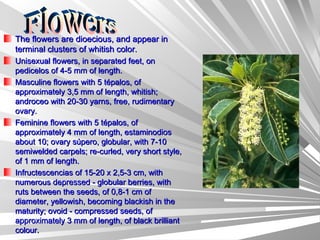
The flowers are dioecious, and appear in terminal clusters of whitish color. Unisexual flowers, in separated feet, on pedicelos of 4-5 mm of length.  Masculine flowers with 5 tépalos, of approximately 3,5 mm of length, whitish; androceo with 20-30 yarns, free, rudimentary ovary.  Feminine flowers with 5 tépalos, of approximately 4 mm of length, estaminodios about 10; ovary súpero, globular, with 7-10 semiwelded carpels; re-curled, very short style, of 1 mm of length.  Infructescencias of 15-20 x 2,5-3 cm, with numerous depressed - globular berries, with ruts between the seeds, of 0,8-1 cm of diameter, yellowish, becoming blackish in the maturity; ovoid - compressed seeds, of approximately 3 mm of length, of black brilliant colour. Flowers
Uses It multiplies by seeds. The fruits are gathered from the tree and set to soften in water to detach the seeds. Once extracted and dry, they can be sowed or stored, preserving his viability at least for one year.  Slightly demanding and rustic enough species in general.  It possesses a very rapid growth.  It must not stand firm near buildings for the aggressiveness of his roots.  Its uses must limit to gardens, with sufficient space for its growth.
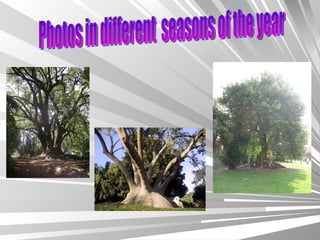
Photos in different  seasons of the year
Sites where I have extracted the information Wikipedia, Google and Books Photos: Plaza Pueblo Nuevo and  Google images.
THE END

Maria RodríGuez

  • 1.
    Phitolacca dioica by:Maria Rodríguez Bodelón
  • 2.
    Ombu: Phytolacca dioicaFamlia: Fitolacáceas Portugués name: Umbú         Guaraní name: Ïmboú        English name: Umbra Tree Spanish name : Bella sombra Names
  • 3.
    My Tree Hi!My name is Phytolacca dioica. I live in Argentina (Pampas), Peru, Brazil, Uruguay. I get to 400 years old. I come from the Phytolaccaceae family I can get 10 to 15 m. high.
  • 4.
    Trunk   Cylindricaltrunk very expanded in the base, managing to form with the step of the years a pedestal of which can go out other trunks.
  • 5.
    Rough bark, fisurated,chestnut-colored or yellowish. Bark
  • 6.
    Leaves Alternate, simpleleaves, of elliptical to ovadas or oblong, of 5-13 x 2,5-7,5 cm, with the base cuneada or rounded, the entire margin and the sharp apex or acuminado; they are of green glossy color, glabras, with the central marked nerve. Petiole of 2-8 cm of length. Terminal clusters, of 7,5-15 cm of length.
  • 7.
    Fruit Its fruitis a berry yellow, containing seeds ovoid about 3 mm long and brilliant color black.
  • 8.
    The flowers aredioecious, and appear in terminal clusters of whitish color. Unisexual flowers, in separated feet, on pedicelos of 4-5 mm of length. Masculine flowers with 5 tépalos, of approximately 3,5 mm of length, whitish; androceo with 20-30 yarns, free, rudimentary ovary. Feminine flowers with 5 tépalos, of approximately 4 mm of length, estaminodios about 10; ovary súpero, globular, with 7-10 semiwelded carpels; re-curled, very short style, of 1 mm of length. Infructescencias of 15-20 x 2,5-3 cm, with numerous depressed - globular berries, with ruts between the seeds, of 0,8-1 cm of diameter, yellowish, becoming blackish in the maturity; ovoid - compressed seeds, of approximately 3 mm of length, of black brilliant colour. Flowers
  • 9.
    Uses It multipliesby seeds. The fruits are gathered from the tree and set to soften in water to detach the seeds. Once extracted and dry, they can be sowed or stored, preserving his viability at least for one year. Slightly demanding and rustic enough species in general. It possesses a very rapid growth. It must not stand firm near buildings for the aggressiveness of his roots. Its uses must limit to gardens, with sufficient space for its growth.
  • 10.
    Photos in different seasons of the year
  • 11.
    Sites where Ihave extracted the information Wikipedia, Google and Books Photos: Plaza Pueblo Nuevo and Google images.
  • 12.