MARGARINE PRODUCTION, PROCESSING AND TECHNOLOGY
Dorra KOUKA
Introduction
Margarine
structure
Margarine
composition
Production
of
margarine
Nutritional
value
Conclusion
Plan
Margarine is recognized by health professionals and consumers alike as a healthy
table spread and a cheaper alternative to butter for use in cooking and in food
preparation.
1869
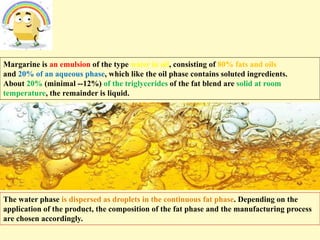
Margarine is an emulsion of the type water in oil, consisting of 80% fats and oils
and 20% of an aqueous phase, which like the oil phase contains soluted ingredients.
About 20% (minimal --12%) of the triglycerides of the fat blend are solid at room
temperature, the remainder is liquid.
The water phase is dispersed as droplets in the continuous fat phase. Depending on the
application of the product, the composition of the fat phase and the manufacturing process
are chosen accordingly.
One of the main requirements of the margarine lipidic fraction is
that it provides an appropriate texture to the final product; this will
depend both on the fat composition and on its physical structure.
Fats :
- vegetable oils
- marine oils
- solid fats
Hydrogenation
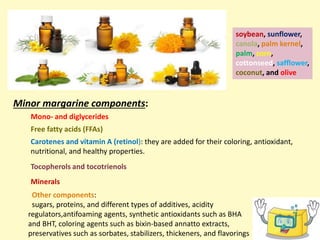
soybean, sunflower,
canola, palm kernel,
palm, corn,
cottonseed, safflower,
coconut, and olive
Minor margarine components:
Mono- and diglycerides
Free fatty acids (FFAs)
Carotenes and vitamin A (retinol): they are added for their coloring, antioxidant,
nutritional, and healthy properties.
Tocopherols and tocotrienols
Minerals
Other components:
sugars, proteins, and different types of additives, acidity
regulators,antifoaming agents, synthetic antioxidants such as BHA
and BHT, coloring agents such as bixin-based annatto extracts,
preservatives such as sorbates, stabilizers, thickeners, and flavorings
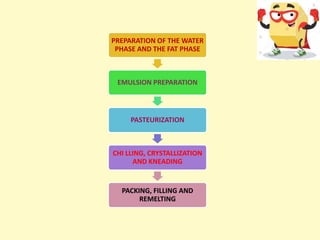
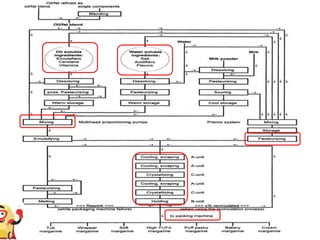
PREPARATION OF THE WATER
PHASE AND THE FAT PHASE
EMULSION PREPARATION
PASTEURIZATION
CHI LLING, CRYSTALLIZATION
AND KNEADING
PACKING, FILLING AND
REMELTING
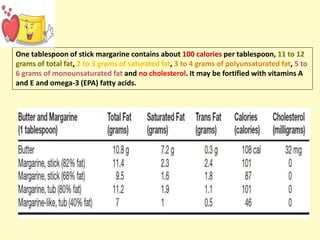
One tablespoon of stick margarine contains about 100 calories per tablespoon, 11 to 12
grams of total fat, 2 to 3 grams of saturated fat, 3 to 4 grams of polyunsaturated fat, 5 to
6 grams of monounsaturated fat and no cholesterol. It may be fortified with vitamins A
and E and omega-3 (EPA) fatty acids.
Margarine is the earliest of the designed food
staples. As such, it can be tailored to deliver
nutritional and functional advantages in terms
of fatty acid composition, the addition of
essential micronutrients, spreadability,
and performance as a bakery fat. Accurate
methods are necessary to guide margarine
design and to monitor the legitimacy of claims
on margarine labels.
Thanks for your attention
- Carr R (1986) Oilseeds, fat and oils. National Research Council Training Program, Chatham,
Ontario, pp. 10–14.
- Dritschel M (1970) How to evaluate margarine quality. Food Engineering, October: 90–93.
-Krytz K (1989) Formulation and packaging margarines and shortenings. Annual Meeting of
the American Oil Chemists’ Society, Cincinnali, Ohio, May 3–6, 1989.
- Journal of the American Oil Chemists Society 66(4): 459–460.
- Moore E (1974) Margarine and cooking fats. Unilever Educational Booklet Series, No. 4, pp.
7–14.
- Ward J (1988) Processing canola oil products. Journal of the American Oil Chemists Society
65: 1731–1734.
- Wiederman L (1978) Margarine and margarine oil, formulation and control. Journal of the -
American Oil Chemists Society 55(11): 823–829.
REFERENCES

MARGARINE PRODUCTION, PROCESSING AND TECHNOLOGY.pptx

  • 1.
    MARGARINE PRODUCTION, PROCESSINGAND TECHNOLOGY Dorra KOUKA
  • 2.
  • 3.
    Margarine is recognizedby health professionals and consumers alike as a healthy table spread and a cheaper alternative to butter for use in cooking and in food preparation.
  • 4.
  • 5.
    Margarine is anemulsion of the type water in oil, consisting of 80% fats and oils and 20% of an aqueous phase, which like the oil phase contains soluted ingredients. About 20% (minimal --12%) of the triglycerides of the fat blend are solid at room temperature, the remainder is liquid. The water phase is dispersed as droplets in the continuous fat phase. Depending on the application of the product, the composition of the fat phase and the manufacturing process are chosen accordingly.
  • 6.
    One of themain requirements of the margarine lipidic fraction is that it provides an appropriate texture to the final product; this will depend both on the fat composition and on its physical structure. Fats : - vegetable oils - marine oils - solid fats Hydrogenation
  • 7.
    soybean, sunflower, canola, palmkernel, palm, corn, cottonseed, safflower, coconut, and olive Minor margarine components: Mono- and diglycerides Free fatty acids (FFAs) Carotenes and vitamin A (retinol): they are added for their coloring, antioxidant, nutritional, and healthy properties. Tocopherols and tocotrienols Minerals Other components: sugars, proteins, and different types of additives, acidity regulators,antifoaming agents, synthetic antioxidants such as BHA and BHT, coloring agents such as bixin-based annatto extracts, preservatives such as sorbates, stabilizers, thickeners, and flavorings
  • 8.
    PREPARATION OF THEWATER PHASE AND THE FAT PHASE EMULSION PREPARATION PASTEURIZATION CHI LLING, CRYSTALLIZATION AND KNEADING PACKING, FILLING AND REMELTING
  • 10.
    One tablespoon ofstick margarine contains about 100 calories per tablespoon, 11 to 12 grams of total fat, 2 to 3 grams of saturated fat, 3 to 4 grams of polyunsaturated fat, 5 to 6 grams of monounsaturated fat and no cholesterol. It may be fortified with vitamins A and E and omega-3 (EPA) fatty acids.
  • 11.
    Margarine is theearliest of the designed food staples. As such, it can be tailored to deliver nutritional and functional advantages in terms of fatty acid composition, the addition of essential micronutrients, spreadability, and performance as a bakery fat. Accurate methods are necessary to guide margarine design and to monitor the legitimacy of claims on margarine labels.
  • 12.
    Thanks for yourattention
  • 13.
    - Carr R(1986) Oilseeds, fat and oils. National Research Council Training Program, Chatham, Ontario, pp. 10–14. - Dritschel M (1970) How to evaluate margarine quality. Food Engineering, October: 90–93. -Krytz K (1989) Formulation and packaging margarines and shortenings. Annual Meeting of the American Oil Chemists’ Society, Cincinnali, Ohio, May 3–6, 1989. - Journal of the American Oil Chemists Society 66(4): 459–460. - Moore E (1974) Margarine and cooking fats. Unilever Educational Booklet Series, No. 4, pp. 7–14. - Ward J (1988) Processing canola oil products. Journal of the American Oil Chemists Society 65: 1731–1734. - Wiederman L (1978) Margarine and margarine oil, formulation and control. Journal of the - American Oil Chemists Society 55(11): 823–829. REFERENCES