Group 3
Presentation
Introduction
Google Maps
www.maps.google.com
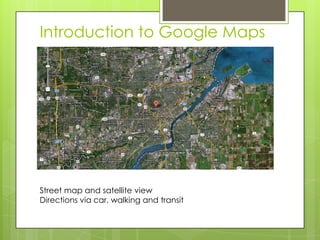
Introduction to Google Maps


Street map and satellite view
Directions via car, walking and transit
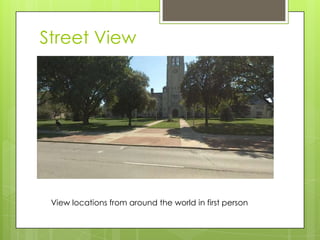
Street View


 View locations from around the world in first person
Mapping Mashups

 Overlay  data onto a map
 Created using Application Program
  Interfaces (API’s)
 Benefits to Consumers
 Benefits to Education
Mashup Sites
 Programmable
             Web
 www.programmableweb.com

 Google Maps Mania
 http://googlemapsmania.blogspot.com/

 100Things to do with Google Maps
 http://gmapsmania.googlepages.com/100
 thingstodowithgooglemapsmashups
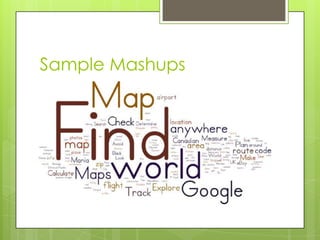
Sample Mashups
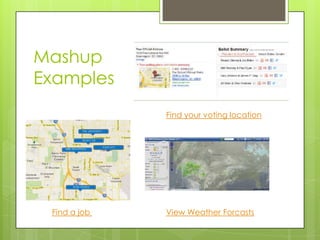
Mashup
Examples
              Find your voting location


 Find a job   View Weather Forcasts
Mashups in Education
 Geography
 History
 Literature
 Personalize
            data
 View Geographic Trends
 Create and share maps and mashups

Maps intro

Editor's Notes

  • #3 Google Maps is a a mapping program that is developed by Google. Google Maps allows users to view street maps and satellite views of any location across the globe.
  • #4 In addition, Google Maps includes a service called Street View that allows users to view streets, highways, and landmarks from a first—person perspective.
  • #5 Mapping programs such as Google Maps serve the basis of many common mashup services, which overlay data from a second data source onto a map. A mashup is a combination of two or more API’s (application programming interfaces). By combining data from many different sources, mashups provide many benefits to consumers as well as for teaching and learning.
  • #6 Here are some sites that serve as repositories for mashups and mashup applications.
  • #7 Mashups allow consumers to find gas prices, crime reports, road traffic information, weather forecasts, and much more…
  • #8 Here are some more examples of mapping mashups.Mashups can be used to search for a job, find your voting location, and view weather forecasts.
  • #9 Many mapping mashups are used for geography and history mashups, as these subjects frequently involve places and events. Maps can also be used in literature courses, for example to track a character’s journey throughout a book. Mapping mashups allow for students to take a more personal look at data, as they can compare data about where they live with their classmates. In addition, mashups provide illustration of geographic trends, and students can evaluate these trends to see how they are personally affected. Additionally, students can create and share their own mapping mashups with their classmates as a supplement to or replacement for traditional classroom assessments.