#MapLesotho
Ciarán Staunton and Colin Broderick
21st June 2016
Overview
- Explain the genesis of the Mapping Project
- Explain what the project has done to date
- Case Studies of how the #MapLesotho data is vital for
Planning in Lesotho
- Our ambitions for the next phase
REQUEST FOR ASSISTANCE
2012
“.....we would like to be assisted
with training in GIS. The Division
has computers but neither a
licence nor sufficient skills to
take advantage of open source
software on the internet.”
Challenges since 2013
● No budget for software associated with the project
● ARCGIS licenses expired in 2012 and 2013
● Land Administration Authority charging for data, not updating data
● Training aimed at Assistant Physical Planners (APPs) - not under the direct
control of the Ministry
● Perception that work was done only when we were present for training
● Access to the internet and suitable laptops at District Government offices
● While the APPs were spread out they had no access to surveying equipment
Solutions
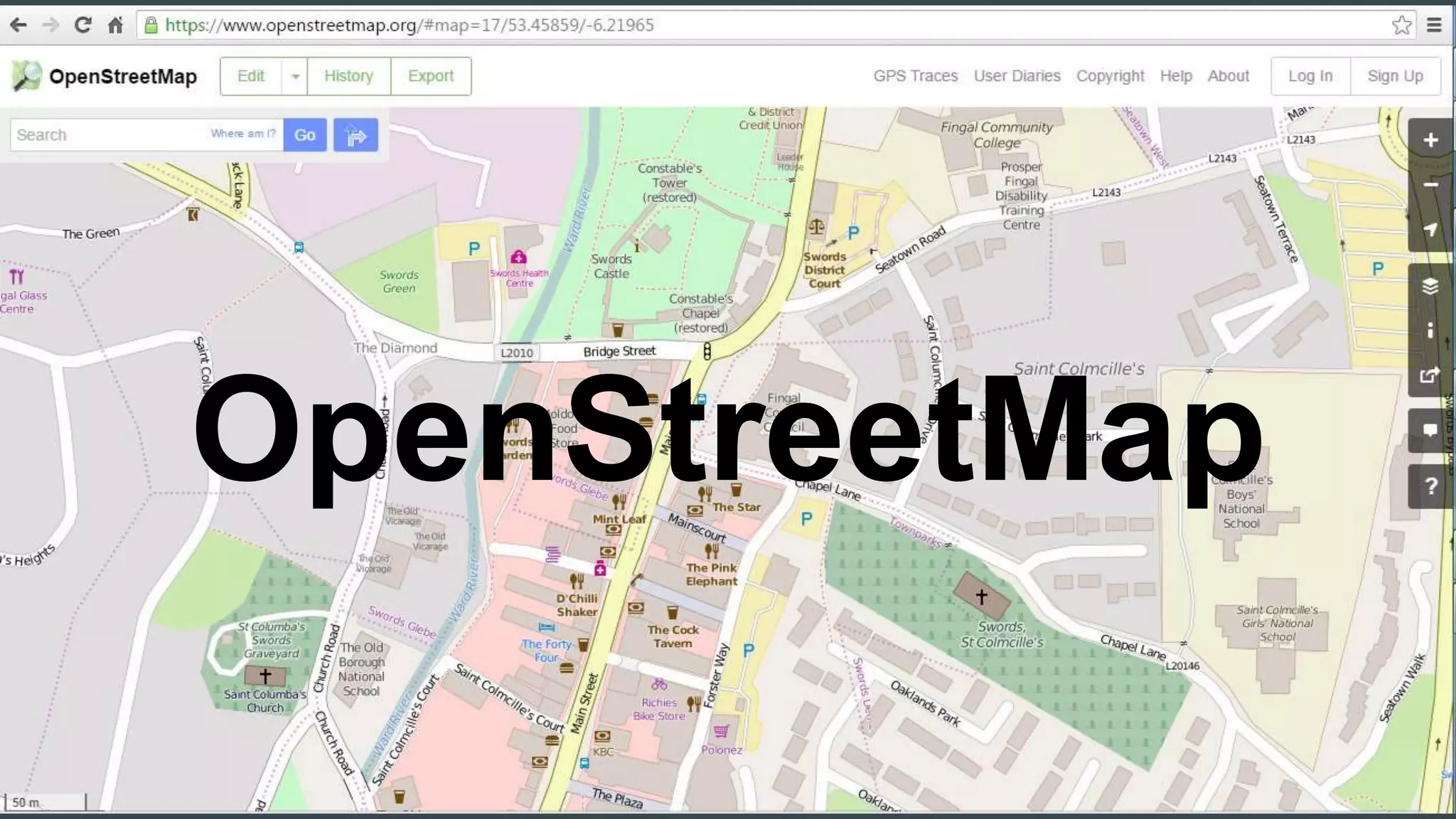
OpenStreetMap
Task
Manager
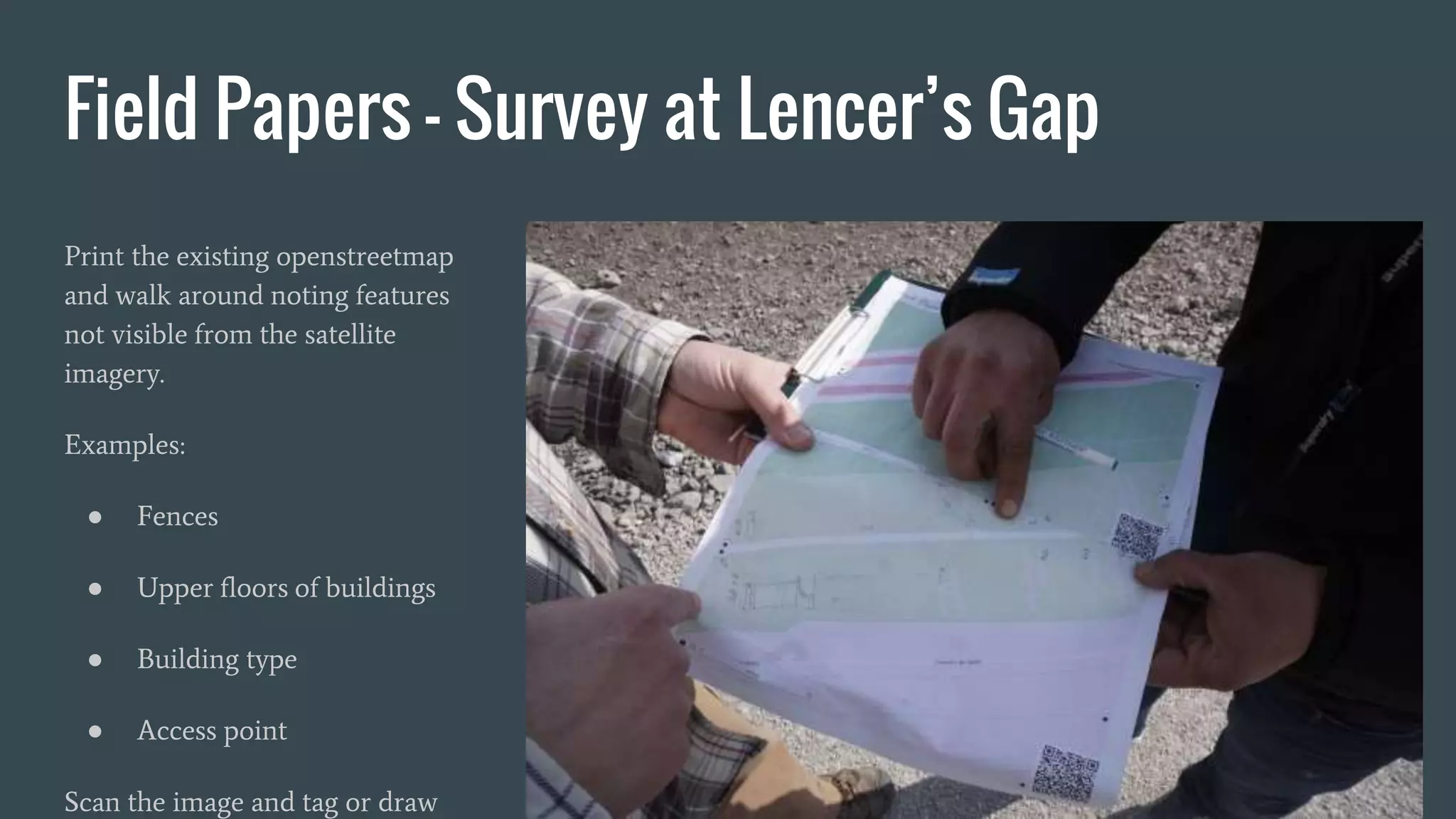
Field Papers - Survey at Lencer’s Gap
Print the existing openstreetmap
and walk around noting features
not visible from the satellite
imagery.
Examples:
● Fences
● Upper floors of buildings
● Building type
● Access point
Scan the image and tag or draw
Drive or Walk around the
street and capture images
using the Mapillary mobile
phone application. The
pictures help us see more
that can be added to the
map.
QGIS
MapBox
Crowdsource to #MapLesotho
Osmose error checker
finds over 70 error
types
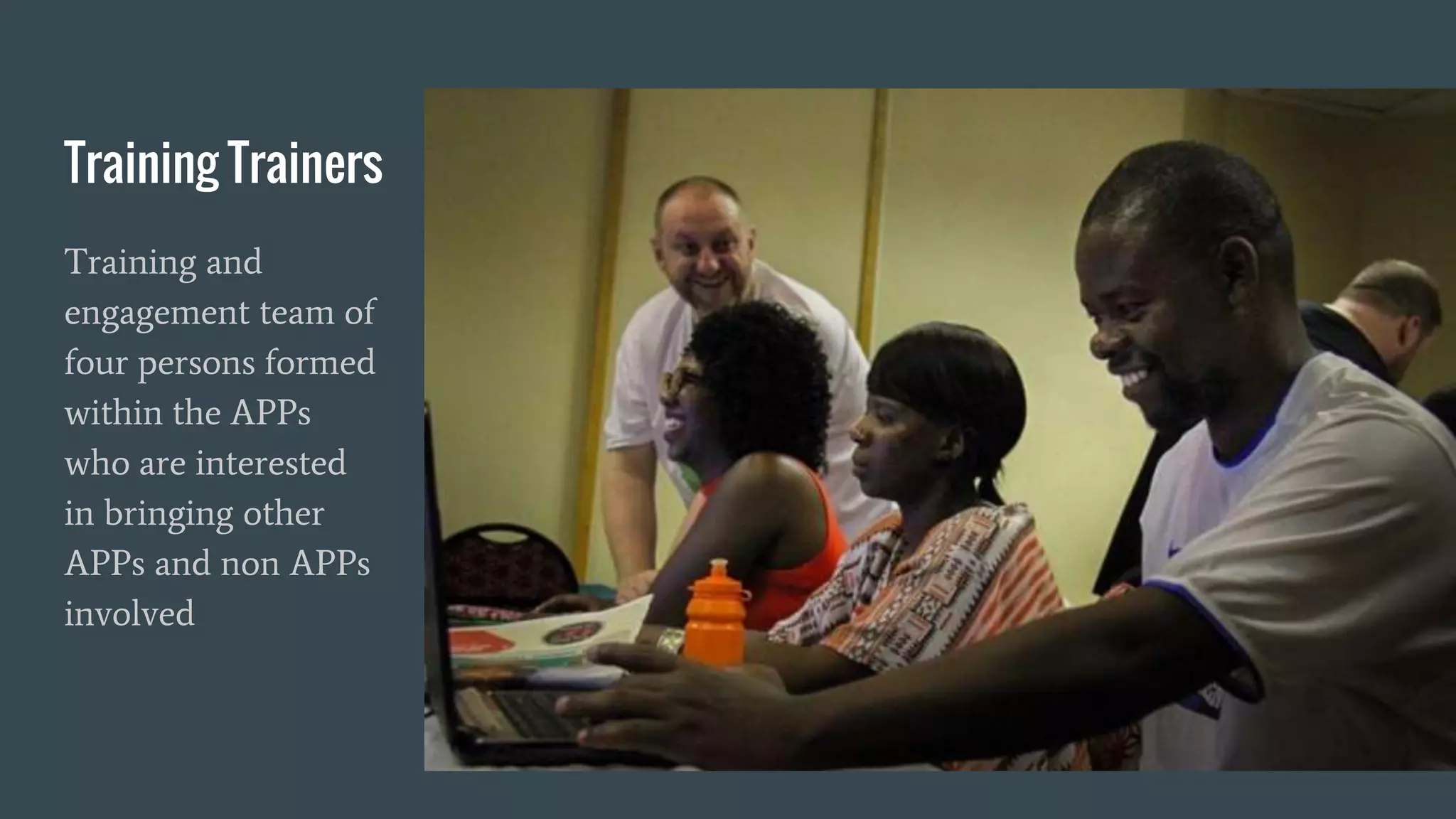
Training Trainers
Training and
engagement team of
four persons formed
within the APPs
who are interested
in bringing other
APPs and non APPs
involved
Make a map of Lesotho
- Opensource
- Crowdsource
- Analysis
- Social Media
- Integrated technology
Easy to remember, descriptive
and realistic
Ciaran above this
point Colin after this
point
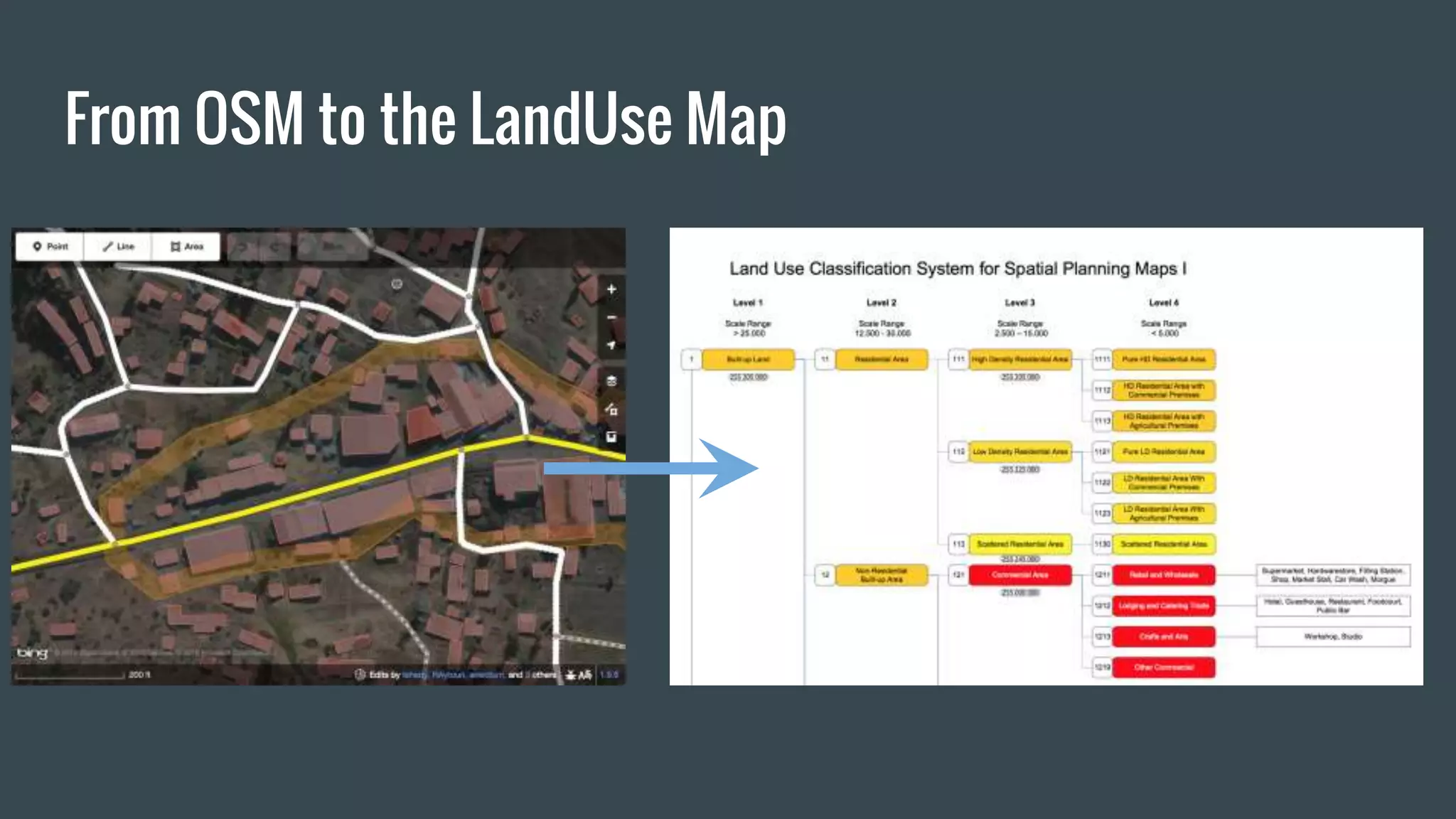
From OSM to the LandUse Map
From OSM to the LandUse
Map
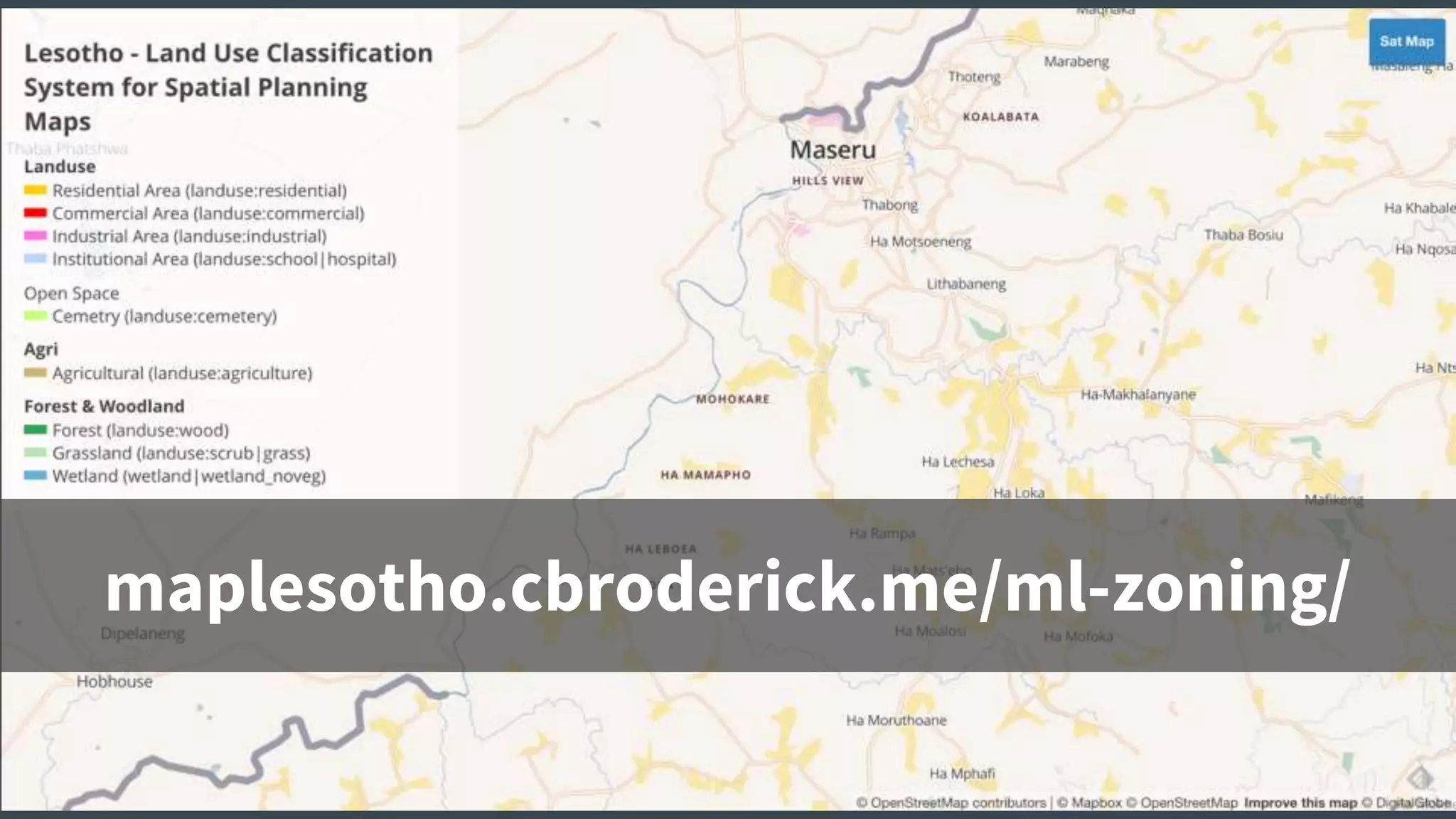
maplesotho.cbroderick.me/ml-zoning/
Case Study 1: Is Lesotho building in the wrong places?
OpenStreetMap maps buildings. It is used to map rivers, streams and canals. So are
the buildings too close to the waterbodies?
In 2007 the country experienced terrible flooding, which had a human, agricultural
and infrastructural cost
What follows is an example of how we downloaded the building data and looked at
it in the context of the waterbodies
I can also give you an indication of whether the buildings more recently built are
making the situation worse or better
Case Study 2: The Golden Hour
Lesotho, like every country in the world
has a challenge with where health services
are located. Outside cities or far from
population centres pose risks for people
who need emergency care
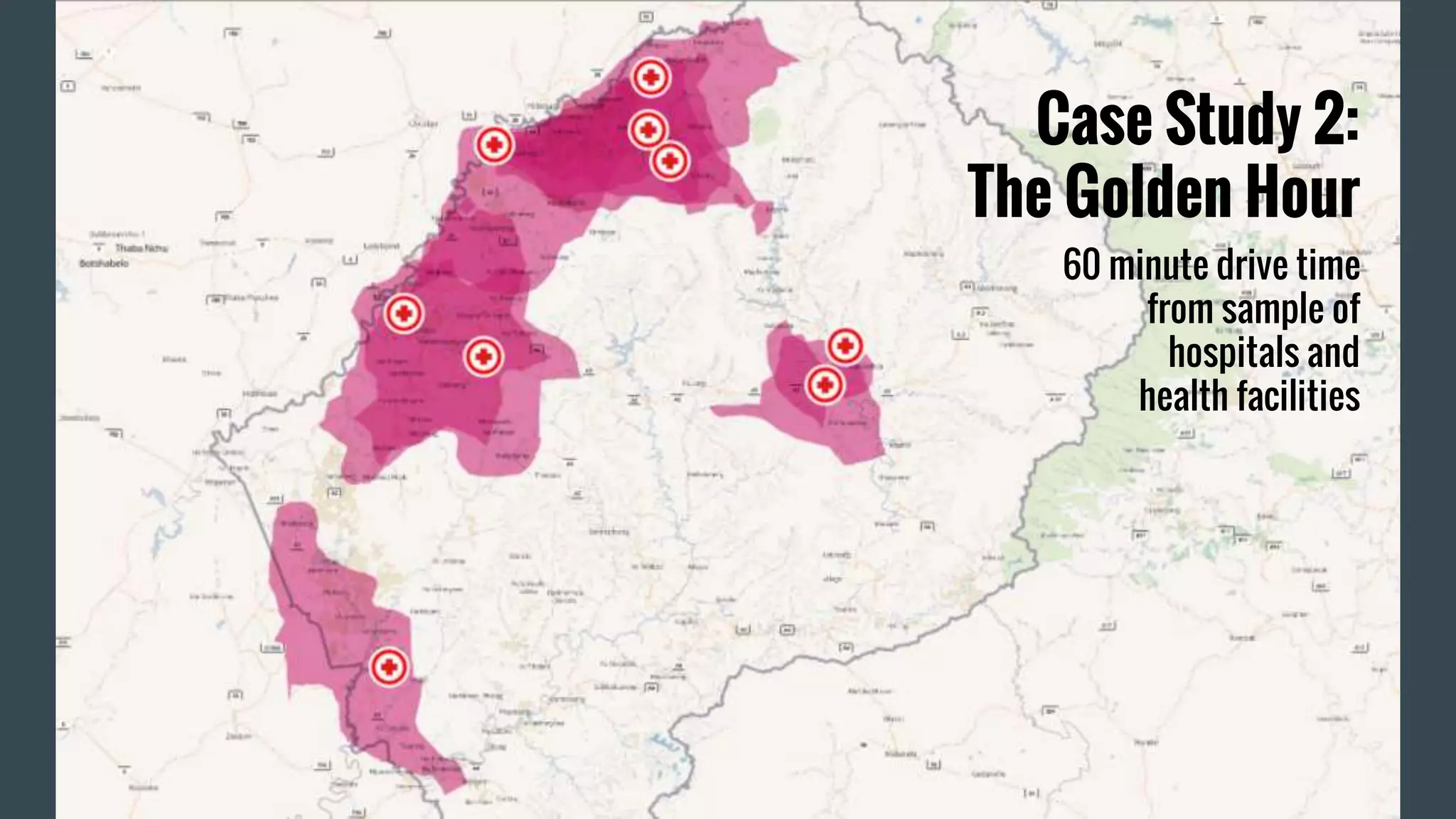
Case Study 2:
The Golden Hour
60 minute drive time
from sample of
hospitals and
health facilities
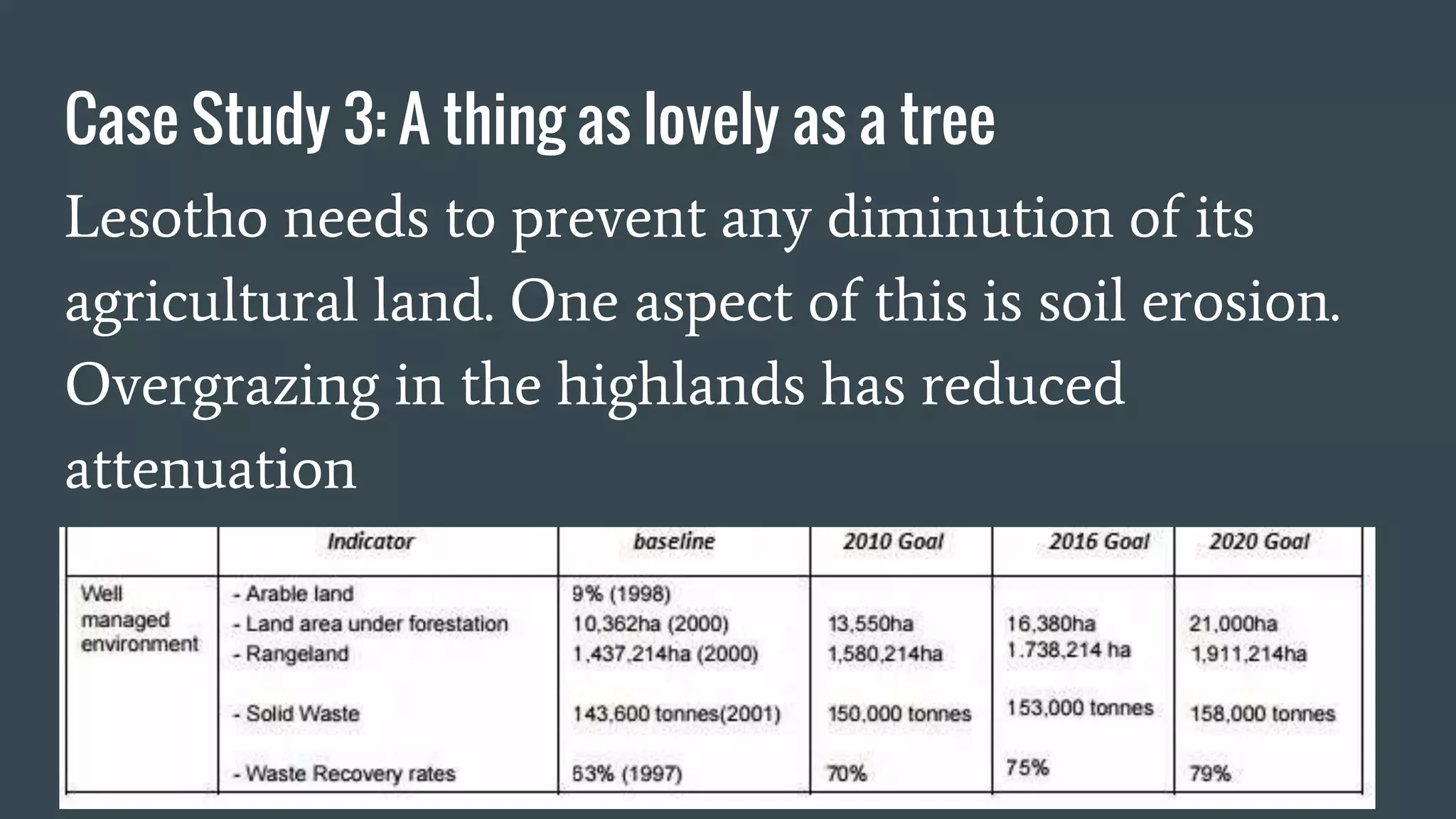
Case Study 3: A thing as lovely as a tree
Lesotho needs to prevent any diminution of its
agricultural land. One aspect of this is soil erosion.
Overgrazing in the highlands has reduced
attenuation
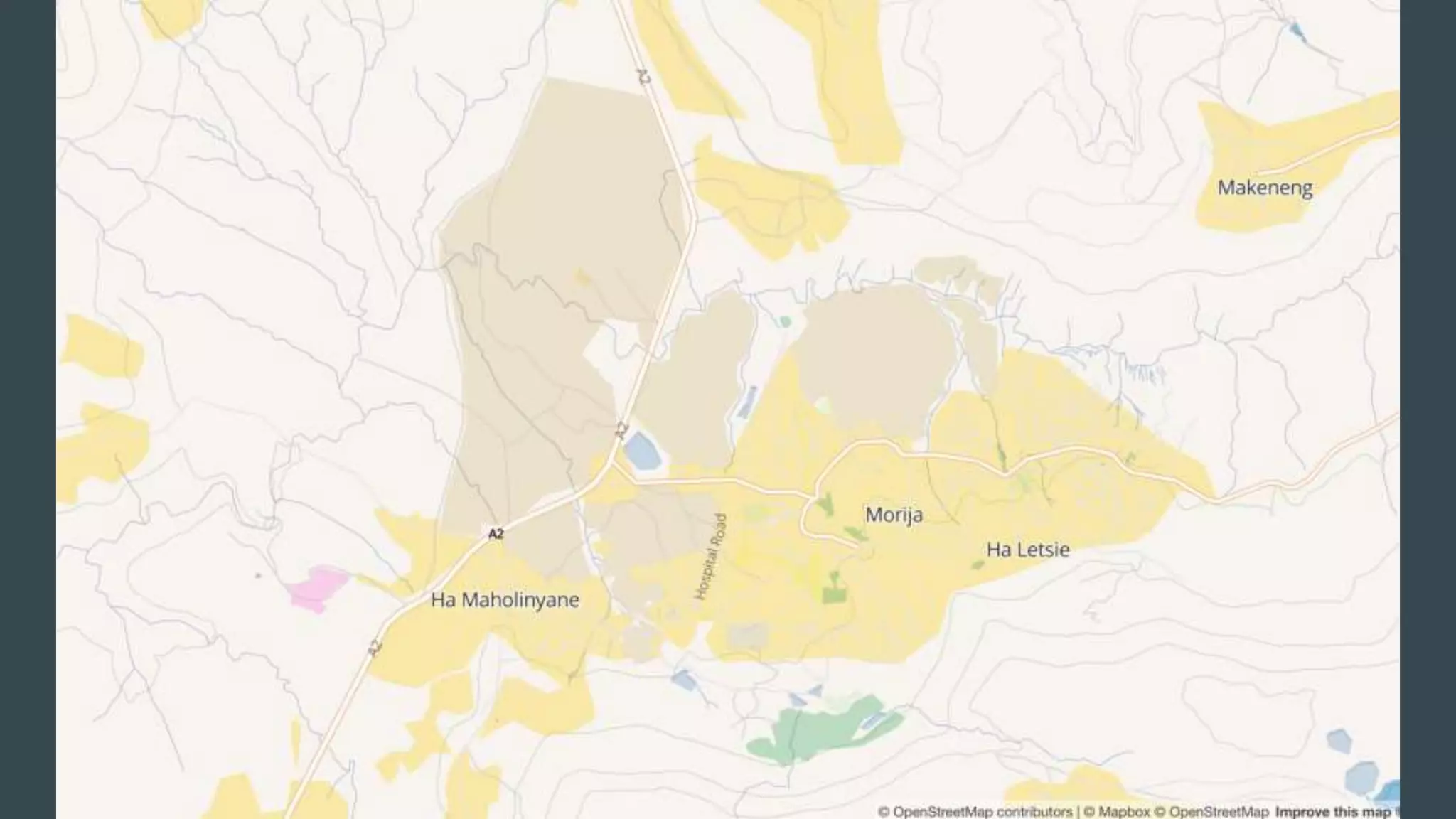
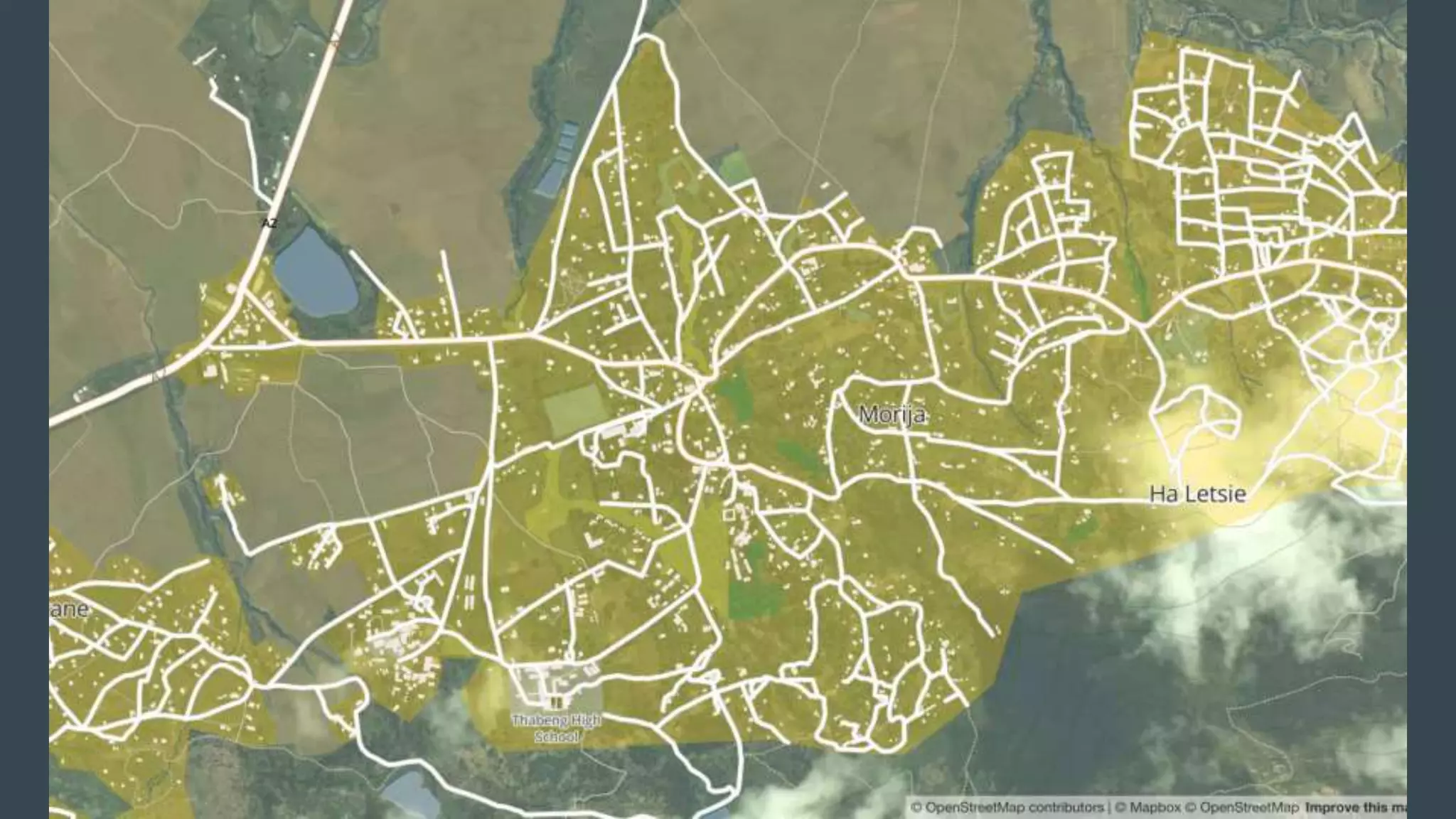
Case Study 4: Profiling a Town
Quick use case to show how useful
information derived from OSM can be
quickly used to determine the focus of
further planning studies.
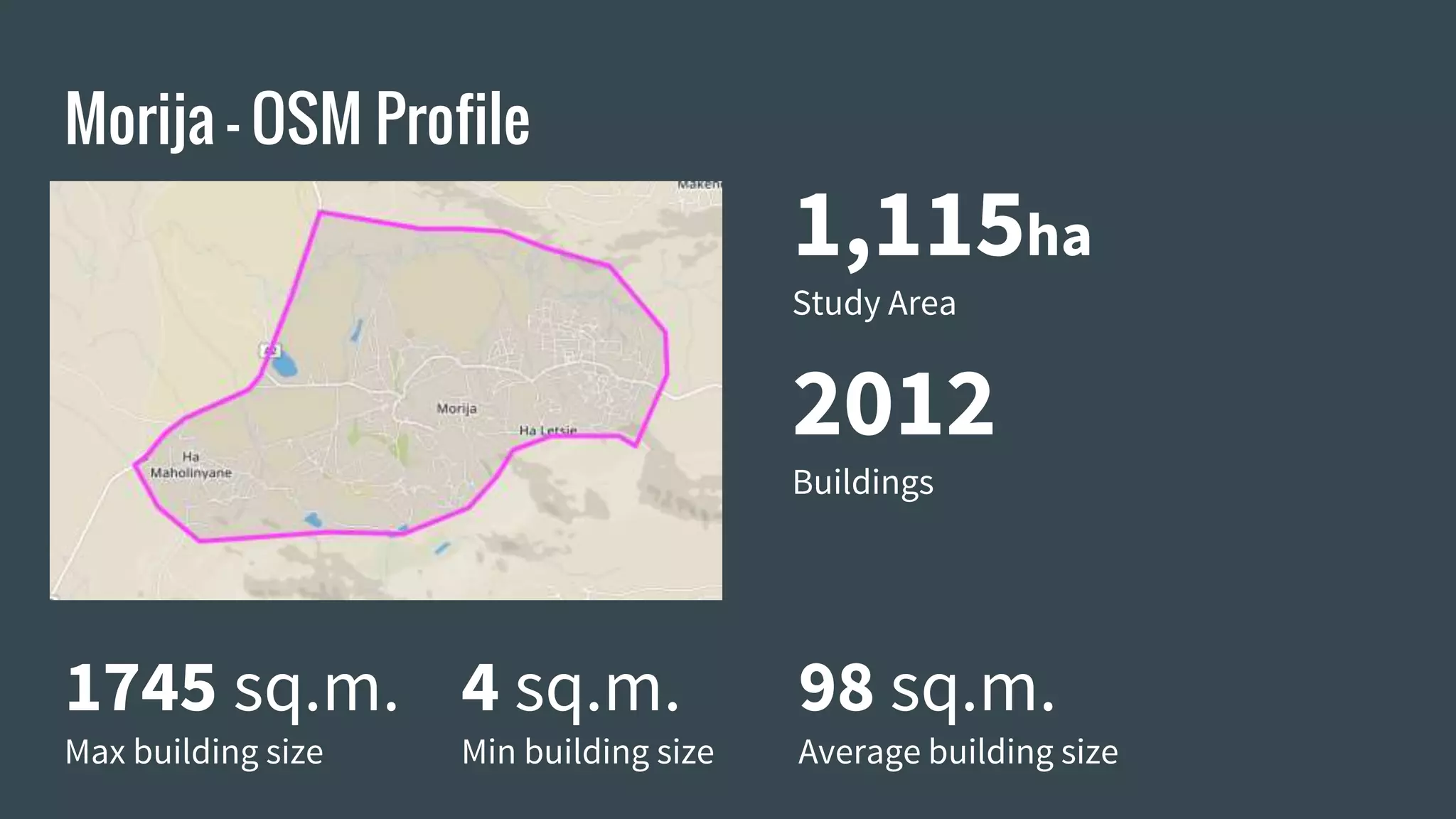
Morija - OSM Profile
2012
Buildings
1,115ha
Study Area
1745 sq.m.
Max building size
4 sq.m.
Min building size
98 sq.m.
Average building size
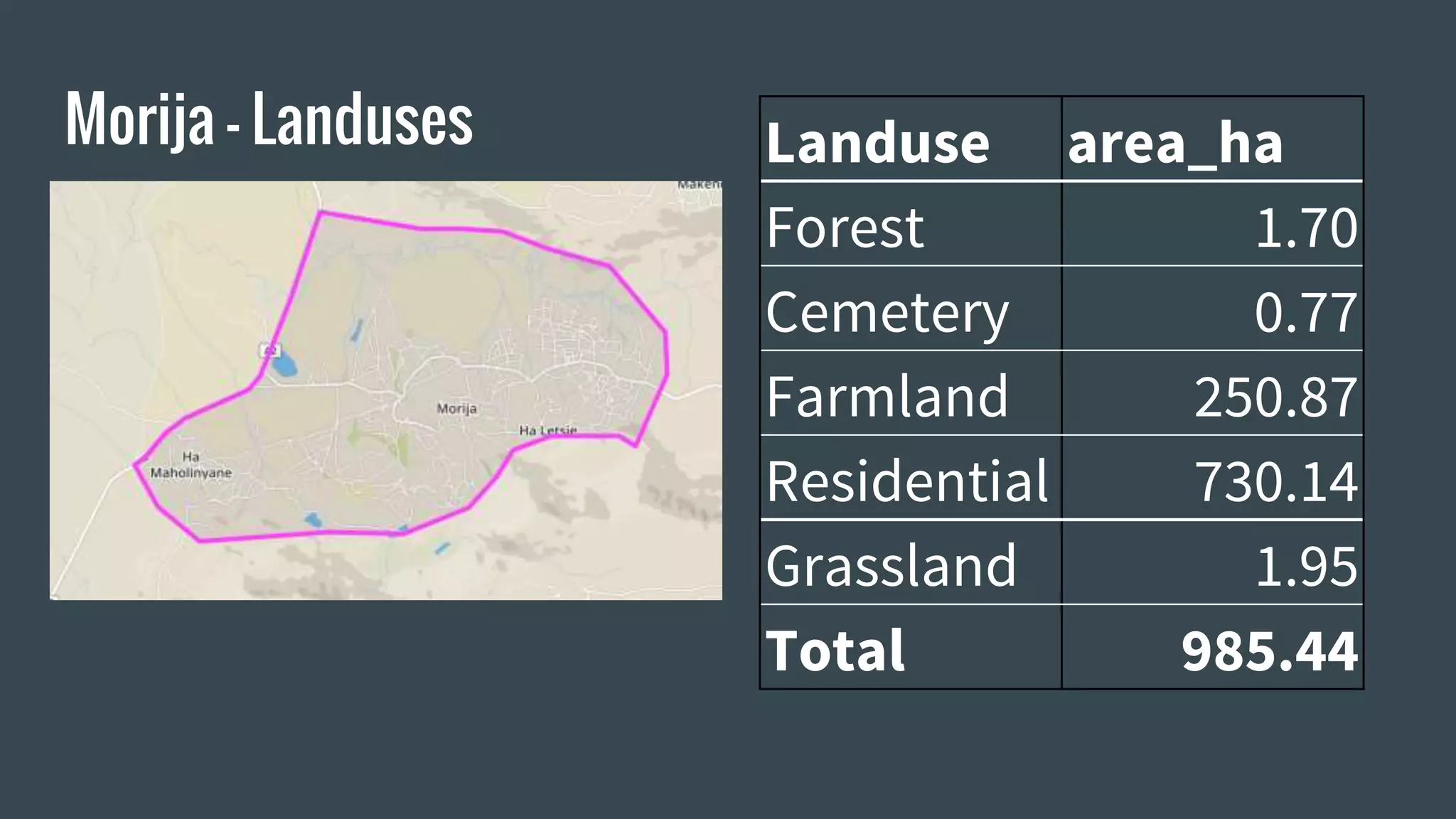
Morija - Landuses Landuse area_ha
Forest 1.70
Cemetery 0.77
Farmland 250.87
Residential 730.14
Grassland 1.95
Total 985.44
Morija - Building Typology
Building number per hectare % of total
shed 10 0.01 0.50%
house 18 0.02 0.89%
commercial 59 0.08 2.93%
yes 1639 2.24 81.46%
construction 125 0.17 6.21%
hut 157 0.22 7.80%
school 4 0.01 0.20%
Total 2012
Colin above this
point Ciarán after this
point
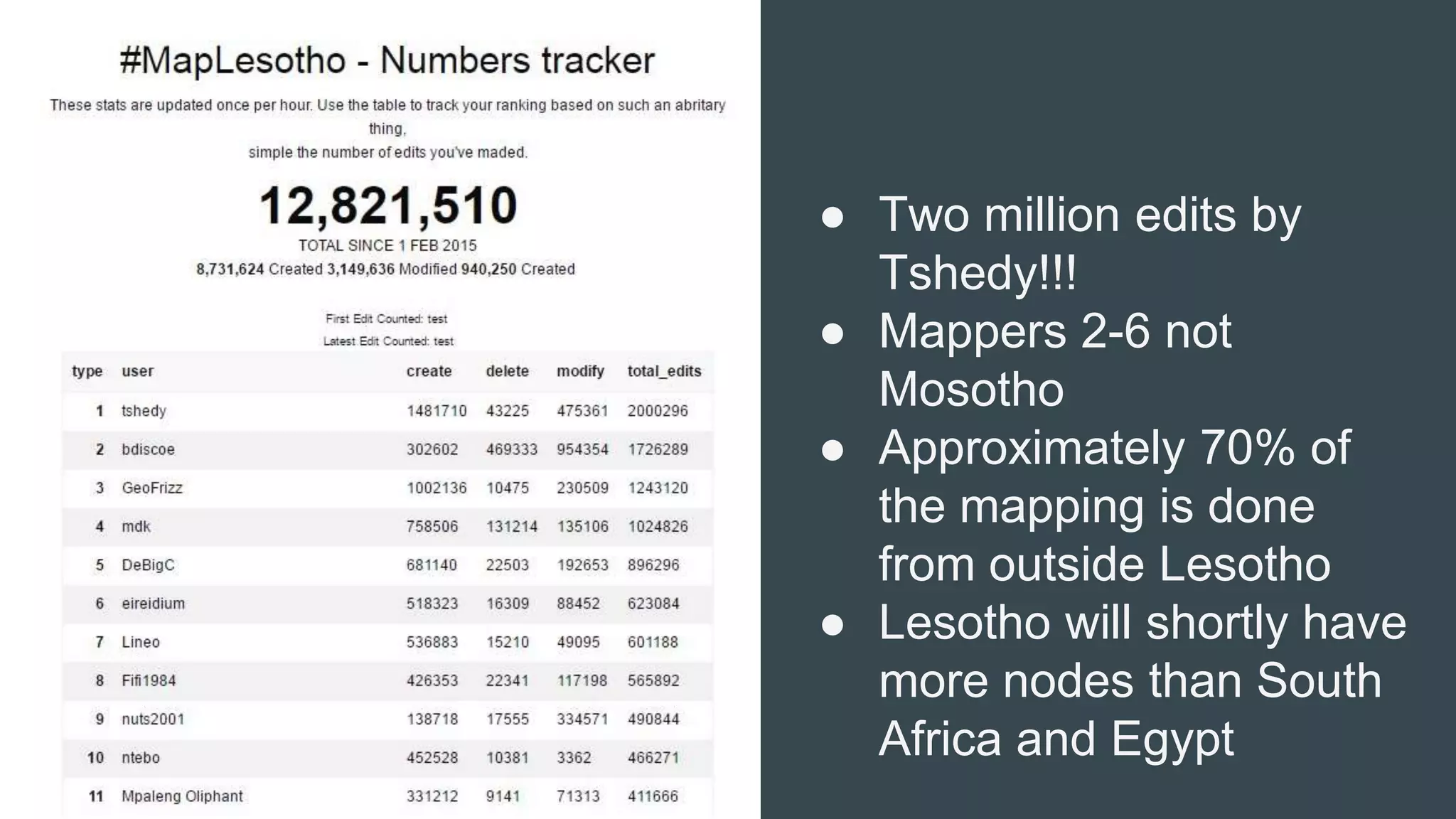
● Two million edits by
Tshedy!!!
● Mappers 2-6 not
Mosotho
● Approximately 70% of
the mapping is done
from outside Lesotho
● Lesotho will shortly have
more nodes than South
Africa and Egypt
Phase 2
The Mapping is now
adding finesse to the
drawn features, improving
road and building shapes
and adding unmapped
things like farmland and
forests.
Lesotho is divided up into
its ten districts and one
city, so eleven tasks
altogether.
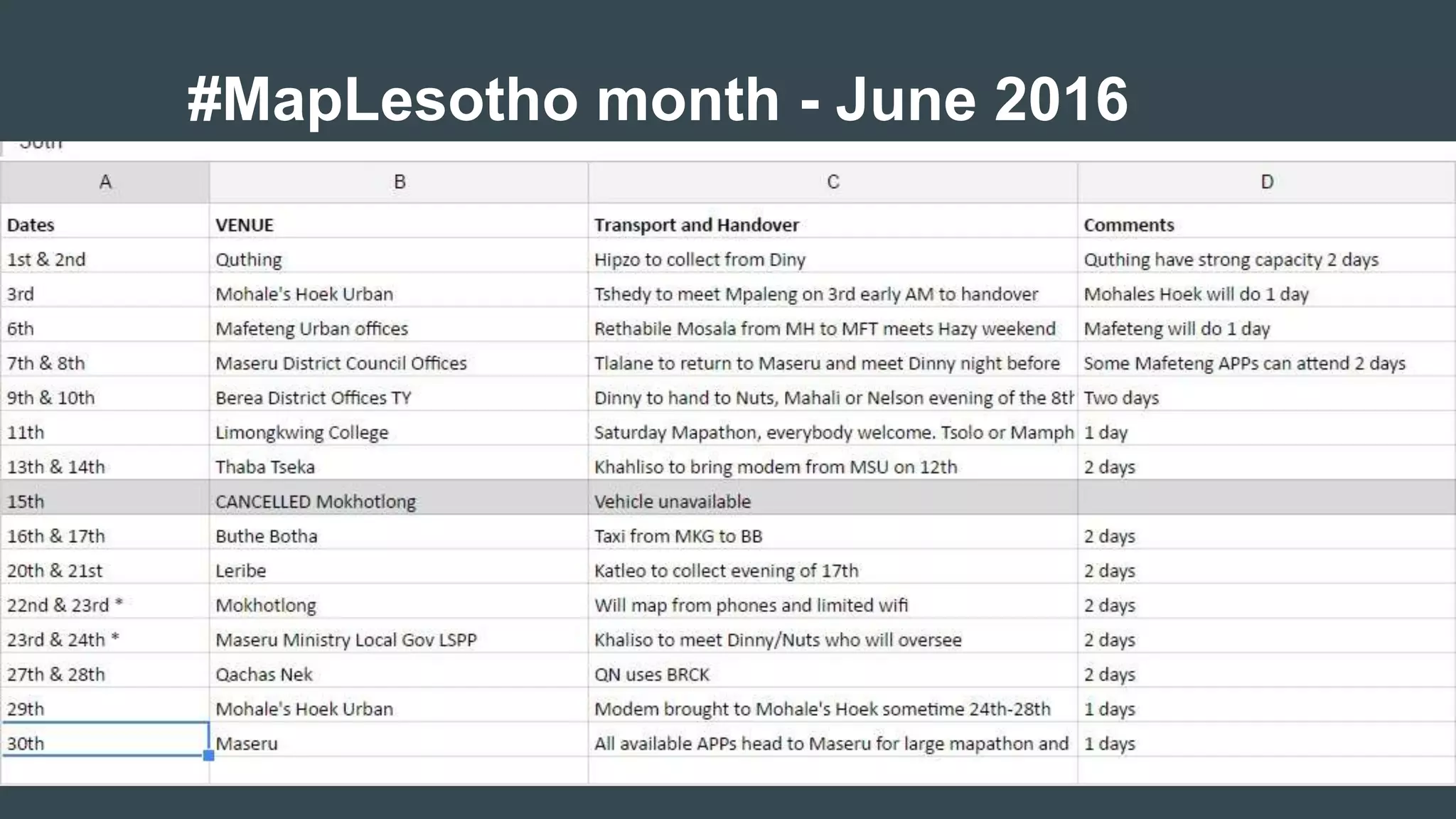
#MapLesotho month - June 2016
MapLesotho.wordpress.com
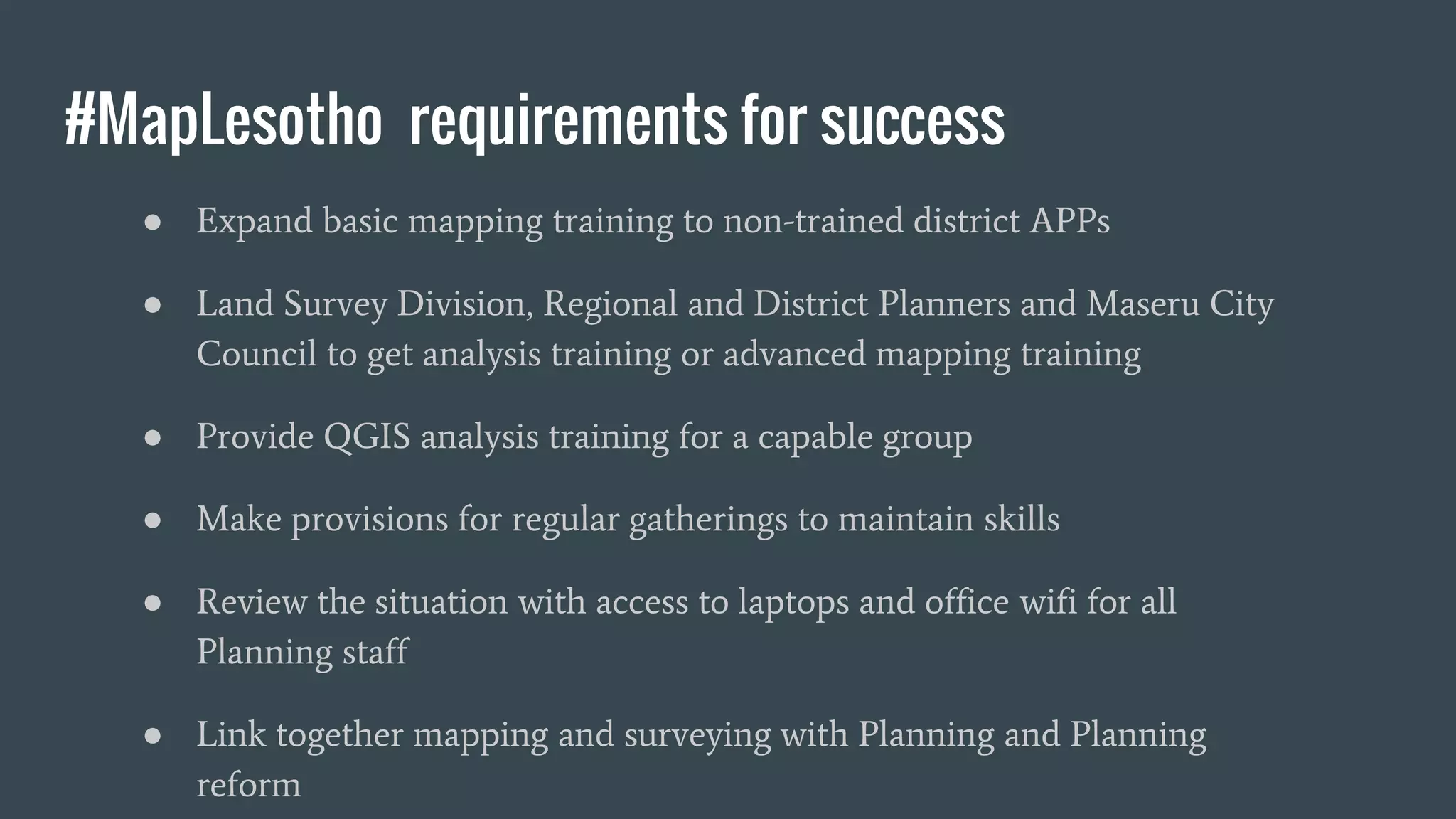
#MapLesotho requirements for success
● Expand basic mapping training to non-trained district APPs
● Land Survey Division, Regional and District Planners and Maseru City
Council to get analysis training or advanced mapping training
● Provide QGIS analysis training for a capable group
● Make provisions for regular gatherings to maintain skills
● Review the situation with access to laptops and office wifi for all
Planning staff
● Link together mapping and surveying with Planning and Planning
reform
#MapLesotho
Ciarán Staunton and Colin Broderick
21st June 2016

#Map lesotho

  • 1.
    #MapLesotho Ciarán Staunton andColin Broderick 21st June 2016
  • 2.
    Overview - Explain thegenesis of the Mapping Project - Explain what the project has done to date - Case Studies of how the #MapLesotho data is vital for Planning in Lesotho - Our ambitions for the next phase
  • 3.
    REQUEST FOR ASSISTANCE 2012 “.....wewould like to be assisted with training in GIS. The Division has computers but neither a licence nor sufficient skills to take advantage of open source software on the internet.”
  • 4.
    Challenges since 2013 ●No budget for software associated with the project ● ARCGIS licenses expired in 2012 and 2013 ● Land Administration Authority charging for data, not updating data ● Training aimed at Assistant Physical Planners (APPs) - not under the direct control of the Ministry ● Perception that work was done only when we were present for training ● Access to the internet and suitable laptops at District Government offices ● While the APPs were spread out they had no access to surveying equipment
  • 5.
  • 6.
  • 7.
  • 8.
    Field Papers -Survey at Lencer’s Gap Print the existing openstreetmap and walk around noting features not visible from the satellite imagery. Examples: ● Fences ● Upper floors of buildings ● Building type ● Access point Scan the image and tag or draw
  • 9.
    Drive or Walkaround the street and capture images using the Mapillary mobile phone application. The pictures help us see more that can be added to the map.
  • 10.
  • 11.
  • 12.
  • 13.
    Osmose error checker findsover 70 error types
  • 16.
    Training Trainers Training and engagementteam of four persons formed within the APPs who are interested in bringing other APPs and non APPs involved
  • 17.
    Make a mapof Lesotho - Opensource - Crowdsource - Analysis - Social Media - Integrated technology Easy to remember, descriptive and realistic
  • 18.
    Ciaran above this pointColin after this point
  • 19.
    From OSM tothe LandUse Map
  • 20.
    From OSM tothe LandUse Map
  • 21.
  • 22.
    Case Study 1:Is Lesotho building in the wrong places? OpenStreetMap maps buildings. It is used to map rivers, streams and canals. So are the buildings too close to the waterbodies? In 2007 the country experienced terrible flooding, which had a human, agricultural and infrastructural cost What follows is an example of how we downloaded the building data and looked at it in the context of the waterbodies I can also give you an indication of whether the buildings more recently built are making the situation worse or better
  • 25.
    Case Study 2:The Golden Hour Lesotho, like every country in the world has a challenge with where health services are located. Outside cities or far from population centres pose risks for people who need emergency care
  • 26.
    Case Study 2: TheGolden Hour 60 minute drive time from sample of hospitals and health facilities
  • 27.
    Case Study 3:A thing as lovely as a tree Lesotho needs to prevent any diminution of its agricultural land. One aspect of this is soil erosion. Overgrazing in the highlands has reduced attenuation
  • 28.
    Case Study 4:Profiling a Town Quick use case to show how useful information derived from OSM can be quickly used to determine the focus of further planning studies.
  • 31.
    Morija - OSMProfile 2012 Buildings 1,115ha Study Area 1745 sq.m. Max building size 4 sq.m. Min building size 98 sq.m. Average building size
  • 32.
    Morija - LandusesLanduse area_ha Forest 1.70 Cemetery 0.77 Farmland 250.87 Residential 730.14 Grassland 1.95 Total 985.44
  • 33.
    Morija - BuildingTypology Building number per hectare % of total shed 10 0.01 0.50% house 18 0.02 0.89% commercial 59 0.08 2.93% yes 1639 2.24 81.46% construction 125 0.17 6.21% hut 157 0.22 7.80% school 4 0.01 0.20% Total 2012
  • 34.
    Colin above this pointCiarán after this point
  • 35.
    ● Two millionedits by Tshedy!!! ● Mappers 2-6 not Mosotho ● Approximately 70% of the mapping is done from outside Lesotho ● Lesotho will shortly have more nodes than South Africa and Egypt
  • 37.
    Phase 2 The Mappingis now adding finesse to the drawn features, improving road and building shapes and adding unmapped things like farmland and forests. Lesotho is divided up into its ten districts and one city, so eleven tasks altogether.
  • 38.
  • 39.
  • 40.
    #MapLesotho requirements forsuccess ● Expand basic mapping training to non-trained district APPs ● Land Survey Division, Regional and District Planners and Maseru City Council to get analysis training or advanced mapping training ● Provide QGIS analysis training for a capable group ● Make provisions for regular gatherings to maintain skills ● Review the situation with access to laptops and office wifi for all Planning staff ● Link together mapping and surveying with Planning and Planning reform
  • 41.
    #MapLesotho Ciarán Staunton andColin Broderick 21st June 2016

Editor's Notes

  • #3 What’s being covered today
  • #4 While the first contact with Lesotho was started with Action Ireland Trust the relationship was formalised with Fingal County Council and The Ministry for Local Gov and Cheiftanship as the principals.
  • #14 We use Osmose as well as two other error detection tools
  • #15 Portmarnock Community School have made #MapLesotho become a success. They are the National Champions in the Young Social Innovators contest, and will travel to the Philipines to represent Ireland
  • #16 And some of these young people could easily