MANUAL MUSCLE TESTING
Dr. Simran Mishra
Assistant Professor, Department of
Kinesiology and Kinesiotherapeutics
SIHS-COP, Pune
LEARNING OBJECTIVES
At the end of the lecture second year students should be
able to
•Define Manual Muscle Testing
•Explain Grading
•Describe Patient Preparation
•Describe Procedure of assessment of Muscle Strength
2
Introduction
4
Basics
5-6
Definition
7
Purpose
8
Grading
9-13
Principles
14
Preparation and Examination
15 onwards
Contents
3
4
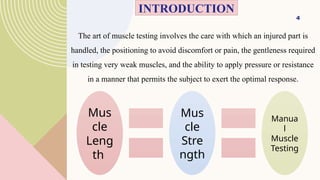
INTRODUCTION
The art of muscle testing involves the care with which an injured part is
handled, the positioning to avoid discomfort or pain, the gentleness required
in testing very weak muscles, and the ability to apply pressure or resistance
in a manner that permits the subject to exert the optimal response.
Mus
cle
Leng
th
Mus
cle
Stre
ngth
Manua
l
Muscle
Testing
5
BASIC COMPONENTS OF MOTOR
EXAMINATION:
• Nutrition or Bulk of muscle
• Tone
• Reflexes
• Range of motion (ROM)
• Manual muscle test (MMT)
• Functional Assessment
Muscle length testing is used to determine whether the
muscle length is limited or excessive, i.e., whether the
muscle is too short to permit normal range of motion,
or stretched and allowing too much range of motion.
Muscle strength testing is used to determine the
capability of muscles or muscle groups to function in
movement and their ability to provide stability and
support.
Manual muscle test (MMT) is a
procedure for the evaluation of
strength of individual muscle or
muscles group, based upon the
effective performance of a
movement in relation to the forces
of gravity or Manual Resistance
through the available Range of
motion (ROM).
PURPOSE
8
i. It is diagnostic Tool.
ii. The severity of problem can be understand.
iii. We can planning our treatment goals.
iv. Determine the extend & degree of muscular weakness resulting
from disease, injury.
v. Correlating muscle picture with in level innervations
(myotoms) .
vi. Prevents deformities by locating problem areas.
vii. Help and Evaluate effectiveness of treatment to the therapist.
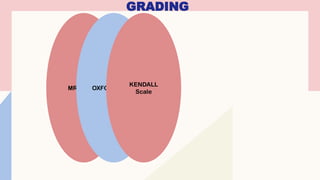
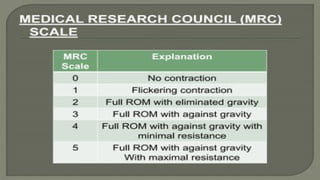
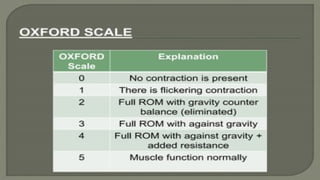
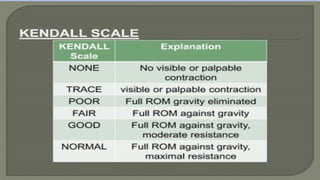
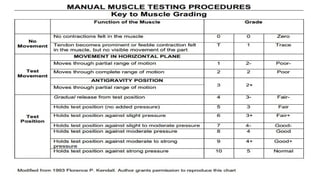
GRADING
MRC Scale
OXFORD Scale
KENDALL
Scale
10
11
12
13
14
PRINCIPALS
1) Position
2) Stabilization
3) Demonstration
4) Application of Grades
5) Application of Resistance
6) Checking normal strength
7) Objectivity
8) Documentation
THANK
YOU

Manual Muscle Testing, Assessment And Grading

  • 1.
    MANUAL MUSCLE TESTING Dr.Simran Mishra Assistant Professor, Department of Kinesiology and Kinesiotherapeutics SIHS-COP, Pune
  • 2.
    LEARNING OBJECTIVES At theend of the lecture second year students should be able to •Define Manual Muscle Testing •Explain Grading •Describe Patient Preparation •Describe Procedure of assessment of Muscle Strength 2
  • 3.
  • 4.
    4 INTRODUCTION The art ofmuscle testing involves the care with which an injured part is handled, the positioning to avoid discomfort or pain, the gentleness required in testing very weak muscles, and the ability to apply pressure or resistance in a manner that permits the subject to exert the optimal response. Mus cle Leng th Mus cle Stre ngth Manua l Muscle Testing
  • 5.
    5 BASIC COMPONENTS OFMOTOR EXAMINATION: • Nutrition or Bulk of muscle • Tone • Reflexes • Range of motion (ROM) • Manual muscle test (MMT) • Functional Assessment
  • 6.
    Muscle length testingis used to determine whether the muscle length is limited or excessive, i.e., whether the muscle is too short to permit normal range of motion, or stretched and allowing too much range of motion. Muscle strength testing is used to determine the capability of muscles or muscle groups to function in movement and their ability to provide stability and support.
  • 7.
    Manual muscle test(MMT) is a procedure for the evaluation of strength of individual muscle or muscles group, based upon the effective performance of a movement in relation to the forces of gravity or Manual Resistance through the available Range of motion (ROM).
  • 8.
    PURPOSE 8 i. It isdiagnostic Tool. ii. The severity of problem can be understand. iii. We can planning our treatment goals. iv. Determine the extend & degree of muscular weakness resulting from disease, injury. v. Correlating muscle picture with in level innervations (myotoms) . vi. Prevents deformities by locating problem areas. vii. Help and Evaluate effectiveness of treatment to the therapist.
  • 9.
  • 10.
  • 11.
  • 12.
  • 13.
  • 14.
    14 PRINCIPALS 1) Position 2) Stabilization 3)Demonstration 4) Application of Grades 5) Application of Resistance 6) Checking normal strength 7) Objectivity 8) Documentation
  • 15.

Editor's Notes

  • #4 Muscle testing is an integral part of physical examination. It provides information, not obtained by other procedures, that is useful in differential diagnosis, prognosis and treatment of neuromuscular and musculoskeletal disorders.
  • #8 WHY MMT IS PERFORMED? : To get some answers such as:- Is a particular muscle is normal? Is it weak? (How much weak) Is it strong enough? (How much strong) Is it weak on both the side (bilateral symmetrical)? Is it weak only on one side (Unilateral)? Is proximal muscles are weaker than the proximal one? Is there any particular pattern of muscle weakness?