TEST AND MEASUREMENTS
Thiscourse consists of theoretical and laboratory sessions, which
are designed to give the students skills and knowledge necessary to
perform:
A- MUSCLE TESTING
A complete manual muscle test procedures.
B- RANGE OF MOTION
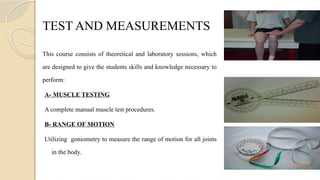
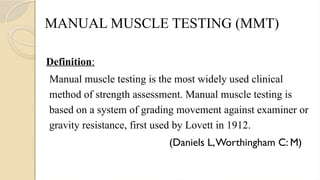
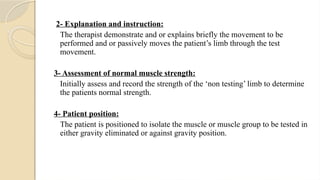
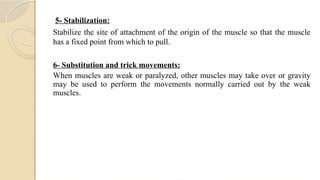
Utilizing goniometry to measure the range of motion for all joints
in the body.
3.
MANUAL MUSCLE TESTING(MMT)
Definition:
Manual muscle testing is the most widely used clinical
method of strength assessment. Manual muscle testing is
based on a system of grading movement against examiner or
gravity resistance, first used by Lovett in 1912.
(Daniels L,Worthingham C: M)
4.
MANUAL MUSCLE TESTING
WhyMMT is done?
Is to provide information that may be of assistance to a
number of health professionals in:
differential diagnosis
treatment planning and
prognosis
.
5.
Pre-hand Knowledge:
Originand insertion of a muscle and its primary function.
The direction of the muscle fibers and their line of pull.
Participating muscles e.g. prime movers, antagonist, synergists
6.
Pre-hand knowledge (continued)..
Positioning and stabilization techniques
Ability to detect contraction in a muscle
About the joint laxity and deformity
Trick movements
7.
MUSCLE TESTING ASSESSMENTPROCEDURE
1- Introduction and acquiring consent:
The therapist should introduce himself/herself mentioning his/her name
and department.
He/she should take consent from the patient if the patient is willing to
allow further assessment or treatment.
Patient should be informed about any expected pain or discomfort before
performing treatment or assessment.
8.
2- Explanation andinstruction:
The therapist demonstrate and or explains briefly the movement to be
performed and or passively moves the patient’s limb through the test
movement.
3- Assessment of normal muscle strength:
Initially assess and record the strength of the ‘non testing’ limb to determine
the patients normal strength.
4- Patient position:
The patient is positioned to isolate the muscle or muscle group to be tested in
either gravity eliminated or against gravity position.
9.
5- Stabilization:
Stabilize thesite of attachment of the origin of the muscle so that the muscle
has a fixed point from which to pull.
6- Substitution and trick movements:
When muscles are weak or paralyzed, other muscles may take over or gravity
may be used to perform the movements normally carried out by the weak
muscles.
10.
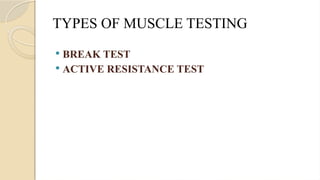
TYPES OF MUSCLETESTING
BREAK TEST
ACTIVE RESISTANCE TEST
11.
BREAK TEST
1. Manualresistance applied to the limb when it is at the end range
2. Resistance always acts opposite to the contracting muscle.
3. Manual resistance should be aligned with line of pull of tested muscle.
4. The patient is asked to hold strongly and not allow the therapist to ‘break’
the hold with manual resistance.
12.
ACTIVE RESISTANCE TEST
1)Anapplication of a manual resistance against an actively contracting
muscle or a group of muscle.
2)During the motion therapist gradually increases the amount of manual
resistance till the maximum tolerance level of the patient and motion stops.
13.
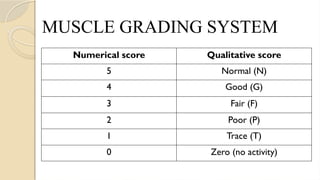
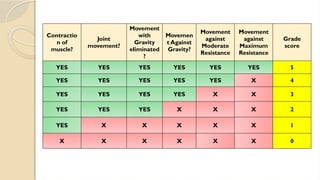
MUSCLE GRADING SYSTEM
Numericalscore Qualitative score
5 Normal (N)
4 Good (G)
3 Fair (F)
2 Poor (P)
1 Trace (T)
0 Zero (no activity)
14.
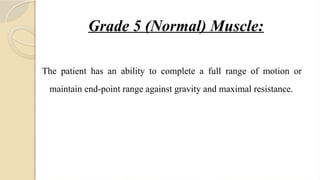
Grade 5 (Normal)Muscle:
The patient has an ability to complete a full range of motion or
maintain end-point range against gravity and maximal resistance.
16.
Grade 4 (Good)Muscle:
The patient has an ability to complete a full range of motion against
gravity and can tolerate strong resistance without breaking the test
position
18.
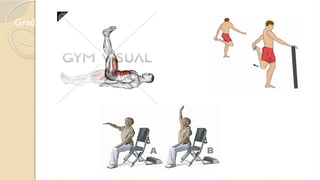
Grade 3 (Fair)Muscle:
The grade 3 muscle test is based on an objective measure. The
patient has an ability to complete a full range of motion
against only gravity.
Grade 2 (Poor)Muscle:
The patient has an ability to complete a full range of motion in a position
that minimizes the force of gravity. This position often is described as the
horizontal plane of motion.
22.
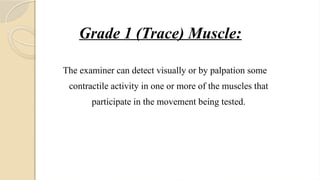
Grade 1 (Trace)Muscle:
The examiner can detect visually or by palpation some
contractile activity in one or more of the muscles that
participate in the movement being tested.
23.
Grade 0 (Zero)Muscle:
Muscle palpation or visual inspection reveals no contraction
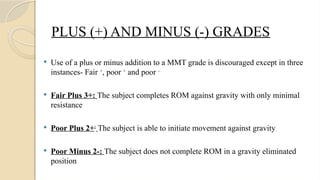
PLUS (+) ANDMINUS (-) GRADES
Use of a plus or minus addition to a MMT grade is discouraged except in three
instances- Fair +
, poor +
and poor –
Fair Plus 3+: The subject completes ROM against gravity with only minimal
resistance
Poor Plus 2+:
The subject is able to initiate movement against gravity
Poor Minus 2-: The subject does not complete ROM in a gravity eliminated
position
26.
VISUAL PREDICTORS
Observation ofthe patient before the examination will provide valuable clues
to muscular weakness and performance deficits. For example, the examiner
can:
Watch the patient as he or she enters the treatment area to detect gross
abnormalities of gait.
Watch the patient sit and rise from a chair, Perform gross checks of bilateral
muscle groups.
Watch the patient’s posture in different positions