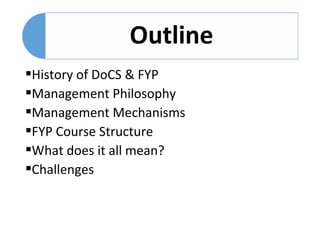
History of DoCS & FYP
Management Philosophy
Management Mechanisms
FYP Course Structure
What does it all mean?
Challenges
• Commenced 1991
• FYP (1991 – 2002)
• Development Project (Create software system)
• Research
• 2002 – Present
• Research Oriented
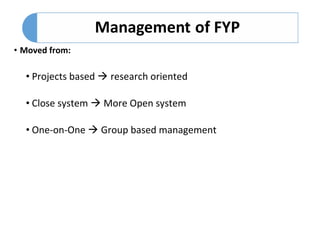
• Moved from:
• Projects based  research oriented
• Close system  More Open system
• One-on-One  Group based management
•One-on-One  Group based management
• Team of coordinators - appointed by department at
beginning of semester; manage all admin elements
• Multiple supervisors (Primary, Secondary) – assigned based
on interest and topic expertise, mutual agreement
• Multiple assessors (Primary, 1 Other) – all staff for
individual activities, supervisor + 1 other for final thesis
• Open presentations at every stage of Project
• Open feedback and review at every stage
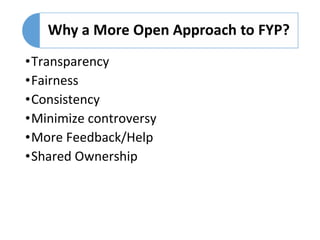
•Transparency
•Fairness
•Consistency
•Minimize controversy
•More Feedback/Help
•Shared Ownership
• Used to be a 1 semester course (we found no course outline)
• As of 2015  2 semesters
• Semester 1 – Proposal
• Semester 2 – Research Project/Thesis
• Why this shift?
•Separate project idea development/proposal from implementation/evaluation
•More time to think/work
•No more August submissions/grading 
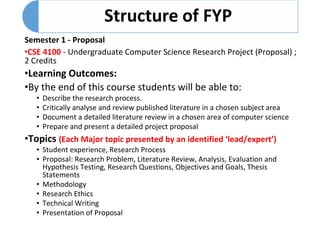
Semester 1 - Proposal
•CSE 4100 - Undergraduate Computer Science Research Project (Proposal) ;
2 Credits
•Learning Outcomes:
•By the end of this course students will be able to:
• Describe the research process.
• Critically analyse and review published literature in a chosen subject area
• Document a detailed literature review in a chosen area of computer science
• Prepare and present a detailed project proposal
•Topics (Each Major topic presented by an identified ‘lead/expert’)
• Student experience, Research Process
• Proposal: Research Problem, Literature Review, Analysis, Evaluation and
Hypothesis Testing, Research Questions, Objectives and Goals, Thesis
Statements
• Methodology
• Research Ethics
• Technical Writing
• Presentation of Proposal
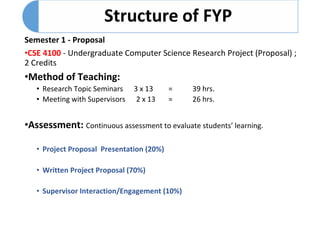
Semester 1 - Proposal
•CSE 4100 - Undergraduate Computer Science Research Project (Proposal) ;
2 Credits
•Method of Teaching:
• Research Topic Seminars 3 x 13 = 39 hrs.
• Meeting with Supervisors 2 x 13 = 26 hrs.
•Assessment: Continuous assessment to evaluate students’ learning.
• Project Proposal Presentation (20%)
• Written Project Proposal (70%)
• Supervisor Interaction/Engagement (10%)
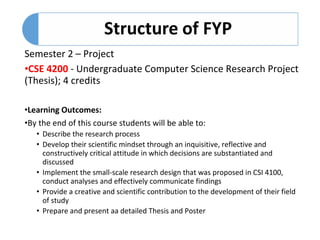
Semester 2 – Project
•CSE 4200 - Undergraduate Computer Science Research Project
(Thesis); 4 credits
•Learning Outcomes:
•By the end of this course students will be able to:
• Describe the research process
• Develop their scientific mindset through an inquisitive, reflective and
constructively critical attitude in which decisions are substantiated and
discussed
• Implement the small-scale research design that was proposed in CSI 4100,
conduct analyses and effectively communicate findings
• Provide a creative and scientific contribution to the development of their field
of study
• Prepare and present aa detailed Thesis and Poster
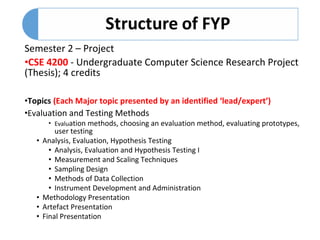
Semester 2 – Project
•CSE 4200 - Undergraduate Computer Science Research Project
(Thesis); 4 credits
•Topics (Each Major topic presented by an identified ‘lead/expert’)
•Evaluation and Testing Methods
• Evaluation methods, choosing an evaluation method, evaluating prototypes,
user testing
• Analysis, Evaluation, Hypothesis Testing
• Analysis, Evaluation and Hypothesis Testing I
• Measurement and Scaling Techniques
• Sampling Design
• Methods of Data Collection
• Instrument Development and Administration
• Methodology Presentation
• Artefact Presentation
• Final Presentation
Semester 2 – Project
•CSE 4200 - Undergraduate Computer Science Research Project
(Thesis); 4 credits
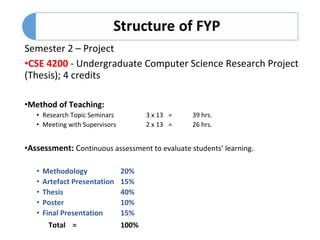
•Method of Teaching:
• Research Topic Seminars 3 x 13 = 39 hrs.
• Meeting with Supervisors 2 x 13 = 26 hrs.
•Assessment: Continuous assessment to evaluate students’ learning.
• Methodology 20%
• Artefact Presentation 15%
• Thesis 40%
• Poster 10%
• Final Presentation 15%
Total = 100%
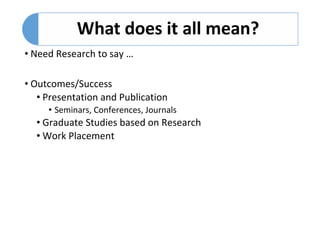
• Need Research to say …
• Outcomes/Success
• Presentation and Publication
• Seminars, Conferences, Journals
• Graduate Studies based on Research
• Work Placement
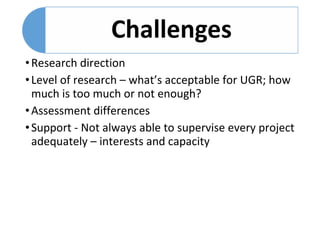
•Research direction
•Level of research – what’s acceptable for UGR; how
much is too much or not enough?
•Assessment differences
•Support - Not always able to supervise every project
adequately – interests and capacity
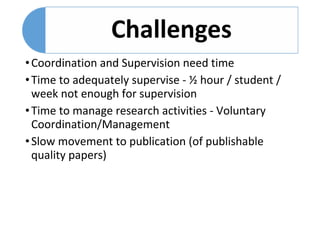
•Coordination and Supervision need time
•Time to adequately supervise - ½ hour / student /
week not enough for supervision
•Time to manage research activities - Voluntary
Coordination/Management
•Slow movement to publication (of publishable
quality papers)
Managing Undergraduate Research - Perspective from Dept CS

Managing Undergraduate Research - Perspective from Dept CS

  • 2.
    History of DoCS& FYP Management Philosophy Management Mechanisms FYP Course Structure What does it all mean? Challenges
  • 3.
    • Commenced 1991 •FYP (1991 – 2002) • Development Project (Create software system) • Research • 2002 – Present • Research Oriented
  • 4.
    • Moved from: •Projects based  research oriented • Close system  More Open system • One-on-One  Group based management
  • 5.
    •One-on-One  Groupbased management • Team of coordinators - appointed by department at beginning of semester; manage all admin elements • Multiple supervisors (Primary, Secondary) – assigned based on interest and topic expertise, mutual agreement • Multiple assessors (Primary, 1 Other) – all staff for individual activities, supervisor + 1 other for final thesis • Open presentations at every stage of Project • Open feedback and review at every stage
  • 6.
  • 7.
    • Used tobe a 1 semester course (we found no course outline) • As of 2015  2 semesters • Semester 1 – Proposal • Semester 2 – Research Project/Thesis • Why this shift? •Separate project idea development/proposal from implementation/evaluation •More time to think/work •No more August submissions/grading 
  • 8.
    Semester 1 -Proposal •CSE 4100 - Undergraduate Computer Science Research Project (Proposal) ; 2 Credits •Learning Outcomes: •By the end of this course students will be able to: • Describe the research process. • Critically analyse and review published literature in a chosen subject area • Document a detailed literature review in a chosen area of computer science • Prepare and present a detailed project proposal •Topics (Each Major topic presented by an identified ‘lead/expert’) • Student experience, Research Process • Proposal: Research Problem, Literature Review, Analysis, Evaluation and Hypothesis Testing, Research Questions, Objectives and Goals, Thesis Statements • Methodology • Research Ethics • Technical Writing • Presentation of Proposal
  • 9.
    Semester 1 -Proposal •CSE 4100 - Undergraduate Computer Science Research Project (Proposal) ; 2 Credits •Method of Teaching: • Research Topic Seminars 3 x 13 = 39 hrs. • Meeting with Supervisors 2 x 13 = 26 hrs. •Assessment: Continuous assessment to evaluate students’ learning. • Project Proposal Presentation (20%) • Written Project Proposal (70%) • Supervisor Interaction/Engagement (10%)
  • 10.
    Semester 2 –Project •CSE 4200 - Undergraduate Computer Science Research Project (Thesis); 4 credits •Learning Outcomes: •By the end of this course students will be able to: • Describe the research process • Develop their scientific mindset through an inquisitive, reflective and constructively critical attitude in which decisions are substantiated and discussed • Implement the small-scale research design that was proposed in CSI 4100, conduct analyses and effectively communicate findings • Provide a creative and scientific contribution to the development of their field of study • Prepare and present aa detailed Thesis and Poster
  • 11.
    Semester 2 –Project •CSE 4200 - Undergraduate Computer Science Research Project (Thesis); 4 credits •Topics (Each Major topic presented by an identified ‘lead/expert’) •Evaluation and Testing Methods • Evaluation methods, choosing an evaluation method, evaluating prototypes, user testing • Analysis, Evaluation, Hypothesis Testing • Analysis, Evaluation and Hypothesis Testing I • Measurement and Scaling Techniques • Sampling Design • Methods of Data Collection • Instrument Development and Administration • Methodology Presentation • Artefact Presentation • Final Presentation
  • 12.
    Semester 2 –Project •CSE 4200 - Undergraduate Computer Science Research Project (Thesis); 4 credits •Method of Teaching: • Research Topic Seminars 3 x 13 = 39 hrs. • Meeting with Supervisors 2 x 13 = 26 hrs. •Assessment: Continuous assessment to evaluate students’ learning. • Methodology 20% • Artefact Presentation 15% • Thesis 40% • Poster 10% • Final Presentation 15% Total = 100%
  • 13.
    • Need Researchto say … • Outcomes/Success • Presentation and Publication • Seminars, Conferences, Journals • Graduate Studies based on Research • Work Placement
  • 14.
    •Research direction •Level ofresearch – what’s acceptable for UGR; how much is too much or not enough? •Assessment differences •Support - Not always able to supervise every project adequately – interests and capacity
  • 15.
    •Coordination and Supervisionneed time •Time to adequately supervise - ½ hour / student / week not enough for supervision •Time to manage research activities - Voluntary Coordination/Management •Slow movement to publication (of publishable quality papers)