BPOPS103
Principles of Programming In C
Prof Reshma
Assistant Professor
Department of Computer Science & Engineering
CMR Institute of Technology
E-mail ID: reshma@cmrit.ac.in
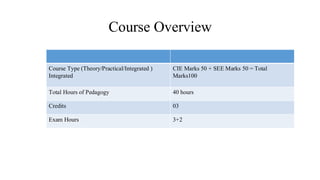
Course Overview
Course Type (Theory/Practical/Integrated )
Integrated
CIE Marks 50 + SEE Marks 50 = Total
Marks100
Total Hours of Pedagogy 40 hours
Credits 03
Exam Hours 3+2
Introduction to
Principles of Programming using C
Welcome to the space where you
will learn to write code from
scratch and visualize your outputs
from mere lines of code.
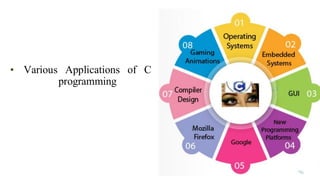
• Various Applications of C
programming
To define C
⚫It can be defined by the following ways:
1.Mother language
2.System programming language
3.Procedure-oriented programming language
4.Structured programming language
5.Mid-level programming language
Why should we learn coding?
⚫ Coding or Programming is a way in
which a human like you or me would
communicate with a computer.
⚫ When you would like a computer to
perform some tasks you have assigned,
the language you need to use is called a
coding language.
What is this subject prerequisite?
⚫Knowledge on flowcharts,
logical and relational
operators and few
mathematical concepts like
quadratic equations,
trigonometric functions.
⚫You can learn this subject
even if you know nothing
about coding.
Course Objectives:
CLO 1. Elucidate the basic architecture and functionalities of a Computer
CLO 2. Apply programming constructs of C language to solve the real-world
problems
CLO 3.Explore user-defined data structures like arrays, structures and pointers in
implementing solutions to problems
CLO 4. Design and Develop Solutions to problems using structured programming
constructs such as functions and procedures
Lesson Plan
⚫Introduction to Computer Hardware, Overview of C
⚫Managing Input and Output, Branching, Looping
⚫Arrays and Strings
⚫Functions and Recursions
⚫Structures and Pointers
⚫Files
Course Syllabus
MODULE 1:
Introduction to C: Introduction to computers, input and output devices, designing efficient
programs.
Introduction to C, Structure of C program, Files used in a C program, Compilers, Compiling and
executing C programs, variables, constants, Input/output statements in C
Example programs – basic c program implementations – mathematical operations, area
findings etc
MODULE 2:
Operators in C, Type conversion and typecasting.
Decision control and Looping statements: Introduction to decision control, Conditional
branching statements, iterative statements, nested loops, break and continue statements, goto
statement.
Example programs – simple calculator, finding largest of two number, finding number is odd or even etc
Course Syllabus
MODULE 3 :
Functions: Introduction using functions, Function definition, function declaration, function
call, return statement,
passing parameters to functions, scope of variables, storage classes, recursive functions.
Arrays: Declaration of arrays, accessing the elements of an array, storing values in arrays,
Operations on arrays, Passing arrays to functions
Two dimensional arrays, operations on two-dimensional arrays, two-dimensional arrays to
functions, multidimensional arrays.
Applications of arrays : Applications of arrays, case study with sorting techniques.
Basic Algorithms: Searching and Sorting Algorithms (Linear search, Binary search,
Bubble sort and Selection sort).
Example Programs: Finding Factorial of a positive integer, GCD of two numbers and Fibonacci
sequence, algorithm implementations
Course Syllabus
MODULE 5:
Structures:Introduction to structures and functions ,Union , Union inside structures
,Enumerated datatype.
Files: Introduction to files,using files in C,reading and writing data files, Detecting end of file
Example Programs:structure creation ,read and write data in file
MODULE 4 :
Introduction to Strings: String taxonomy, operations on strings, Miscellaneous string
and character functions, arrays of strings.
Pointers: Introduction to Pointers, Declaring Pointer Variables,types of pointers,passing
argument to function using pointers
Example programs: string application programs, pointer implementation
Course Outcomes
• CO1. Elucidate the basic architecture and functionalities of a computer
and also recognize the hardware parts.
• CO 2. Apply programming constructs of C language to solve the real
world problem
• CO 3.Explore user-defined data structures like arrays in implementing
solutions to problems like searching and sorting
• CO 4.Explore user-defined data structures like structures, unions and
pointers in implementing solutions
• CO5.Design and Develop Solutions to problems using modular
programming constructs using functions
CO-PO mapping
⚫PO1: Engineering knowledge
⚫PO2: Problem analysis
⚫PO3: Design/development of solutions
⚫PO4: Conduct investigations of complex problems
⚫PO5: Modern tool usage
⚫PO6: The engineer and society
⚫PO7: Environment and sustainability
⚫PO8: Ethics
⚫PO9: Individual and team work
⚫PO10: Communication
⚫PO11: Project management and finance
⚫PO12: Lifelong learning
⚫Program Specific Outcomes (PSO)
◦ PSO1: Design and develop applications using different stacks of web and programming technologies.
◦ PSO2: Design and develop secure, parallel, distributed, networked, and digital systems.
◦ PSO3: Apply software engineering methods to design, develop, test and manage software systems.
◦ PSO4: Design and develop intelligent applications for business and industry.
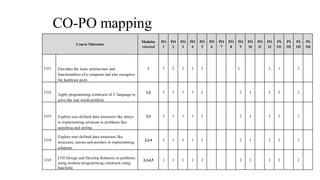
CO-PO mapping
Course Outcomes
Modules
covered
PO
1
PO
2
PO
3
PO
4
PO
5
PO
6
PO
7
PO
8
PO
9
PO
10
PO
11
PO
12
PS
O1
PS
O2
PS
O3
PS
O4
CO1 Elucidate the basic architecture and
functionalities of a computer and also recognize
the hardware parts
1 3 2 2 2 2 2 2 1 2
CO2
Apply programming constructs of C language to
solve the real world problem
1,2 3 3 3 3 2 2 2 2 2 2
CO3 Explore user-defined data structures like arrays
in implementing solutions to problems like
searching and sorting
2,3 3 3 3 3 2 2 2 2 2 2
CO4
Explore user-defined data structures like
structures, unions and pointers in implementing
solutions
2,3,4 3 3 3 3 2 2 2 2 2 2
CO5
CO5.Design and Develop Solutions to problems
using modular programming constructs using
functions
2,3,4,5 3 3 3 3 2 2 2 2 2 2
Expected classroom behaviour
• Maintain good behavior.
• Expected to be interactive.
• Stick to deadlines for assignment and quiz submissions.
• Be serious about attendance
• No disruption in class.
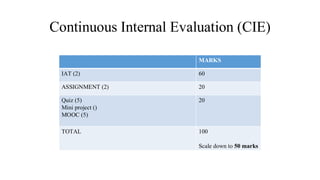
Continuous Internal Evaluation (CIE)
MARKS
IAT (2) 60
ASSIGNMENT (2) 20
Quiz (5)
Mini project ()
MOOC (5)
20
TOTAL 100
Scale down to 50 marks
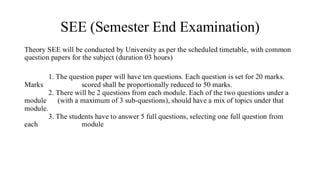
SEE (Semester End Examination)
Theory SEE will be conducted by University as per the scheduled timetable, with common
question papers for the subject (duration 03 hours)
1. The question paper will have ten questions. Each question is set for 20 marks.
Marks scored shall be proportionally reduced to 50 marks.
2. There will be 2 questions from each module. Each of the two questions under a
module (with a maximum of 3 sub-questions), should have a mix of topics under that
module.
3. The students have to answer 5 full questions, selecting one full question from
each module
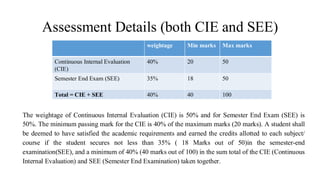
The weightage of Continuous Internal Evaluation (CIE) is 50% and for Semester End Exam (SEE) is
50%. The minimum passing mark for the CIE is 40% of the maximum marks (20 marks). A student shall
be deemed to have satisfied the academic requirements and earned the credits allotted to each subject/
course if the student secures not less than 35% ( 18 Marks out of 50)in the semester-end
examination(SEE), and a minimum of 40% (40 marks out of 100) in the sum total of the CIE (Continuous
Internal Evaluation) and SEE (Semester End Examination) taken together.
Assessment Details (both CIE and SEE)
weightage Min marks Max marks
Continuous Internal Evaluation
(CIE)
40% 20 50
Semester End Exam (SEE) 35% 18 50
Total = CIE + SEE 40% 40 100
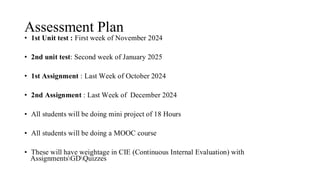
Assessment Plan
• 1st Unit test : First week of November 2024
• 2nd unit test: Second week of January 2025
• 1st Assignment : Last Week of October 2024
• 2nd Assignment : Last Week of December 2024
• All students will be doing mini project of 18 Hours
• All students will be doing a MOOC course
• These will have weightage in CIE (Continuous Internal Evaluation) with
AssignmentsGDQuizzes
Course Outcomes
By the end of this course, students will be able to :
● Elucidate the basic architecture and functionalities of a computer with
recognition of the hardware devices/parts.
● Apply programming constructs of C language for the solution of the real world
problem
● Explore user-defined data structures like arrays with implementation of
searching and sorting algorithms in C Language
● Develop Solutions to problems using modular programming constructs by user
defined functions
● Implement user-defined data structures like strut, union and pointers in C
Language
Textbooks & Reference Books
Textbooks
1. Computer fundamentals and programming in c, “Reema Thareja”, Oxford
University, Second edition,
2017.
Reference Books:
1. E. Balaguruswamy, Programming in ANSI C, 7th Edition, Tata McGraw-
Hill.
2. Brian W. Kernighan and Dennis M. Ritchie, The ‘C’ Programming
Language, Prentice Hall of India.
Web links and Video Lectures (e-Resources):
1. elearning.vtu.ac.in/econtent/courses/video/BS/15PCD23.html
2. https://nptel.ac.in/courses/106/105/106105171/ MOOC courses can be
adopted for more clarity in
understanding the topics and verities of problem solving methods.
Google Classroom Links
• C Section
https://classroom.google.com/c/NzA2NjQ5NjIxNTMz?cjc=jowe4mn
Code: jowe4mn
• D Section
• https://classroom.google.com/c/NzA2NjQ5NjIxNTMz?cjc=jowe4mn
Code: jowe4mn
•
• Display
•
Some useful links
Online compilers: https://repl.it/~
MOOC:
https://nptel.ac.in/courses/106105171
Websites for Competitive coding questions / Challenging projects
⚫ www.hackerearth.com
⚫ www.hackerrank.com
⚫ www.codechef.com
For aptitude
⚫ www.indiabix.com
Website that will help for placements:*
⚫ www.w3resource.com/sql-exercises/sql-retrive-from-table-table.php#SQLEDITOR
⚫ www.indiabix.com
⚫ www.w3schools.com
⚫ www.geeksforgeeks.com
THANK YOU

Expection Setting-1st ppt-Reshma.pdfjjkk

  • 1.
    BPOPS103 Principles of ProgrammingIn C Prof Reshma Assistant Professor Department of Computer Science & Engineering CMR Institute of Technology E-mail ID: reshma@cmrit.ac.in
  • 2.
    Course Overview Course Type(Theory/Practical/Integrated ) Integrated CIE Marks 50 + SEE Marks 50 = Total Marks100 Total Hours of Pedagogy 40 hours Credits 03 Exam Hours 3+2
  • 3.
    Introduction to Principles ofProgramming using C Welcome to the space where you will learn to write code from scratch and visualize your outputs from mere lines of code.
  • 4.
    • Various Applicationsof C programming
  • 5.
    To define C ⚫Itcan be defined by the following ways: 1.Mother language 2.System programming language 3.Procedure-oriented programming language 4.Structured programming language 5.Mid-level programming language
  • 6.
    Why should welearn coding? ⚫ Coding or Programming is a way in which a human like you or me would communicate with a computer. ⚫ When you would like a computer to perform some tasks you have assigned, the language you need to use is called a coding language.
  • 7.
    What is thissubject prerequisite? ⚫Knowledge on flowcharts, logical and relational operators and few mathematical concepts like quadratic equations, trigonometric functions. ⚫You can learn this subject even if you know nothing about coding.
  • 8.
    Course Objectives: CLO 1.Elucidate the basic architecture and functionalities of a Computer CLO 2. Apply programming constructs of C language to solve the real-world problems CLO 3.Explore user-defined data structures like arrays, structures and pointers in implementing solutions to problems CLO 4. Design and Develop Solutions to problems using structured programming constructs such as functions and procedures
  • 9.
    Lesson Plan ⚫Introduction toComputer Hardware, Overview of C ⚫Managing Input and Output, Branching, Looping ⚫Arrays and Strings ⚫Functions and Recursions ⚫Structures and Pointers ⚫Files
  • 10.
    Course Syllabus MODULE 1: Introductionto C: Introduction to computers, input and output devices, designing efficient programs. Introduction to C, Structure of C program, Files used in a C program, Compilers, Compiling and executing C programs, variables, constants, Input/output statements in C Example programs – basic c program implementations – mathematical operations, area findings etc MODULE 2: Operators in C, Type conversion and typecasting. Decision control and Looping statements: Introduction to decision control, Conditional branching statements, iterative statements, nested loops, break and continue statements, goto statement. Example programs – simple calculator, finding largest of two number, finding number is odd or even etc
  • 11.
    Course Syllabus MODULE 3: Functions: Introduction using functions, Function definition, function declaration, function call, return statement, passing parameters to functions, scope of variables, storage classes, recursive functions. Arrays: Declaration of arrays, accessing the elements of an array, storing values in arrays, Operations on arrays, Passing arrays to functions Two dimensional arrays, operations on two-dimensional arrays, two-dimensional arrays to functions, multidimensional arrays. Applications of arrays : Applications of arrays, case study with sorting techniques. Basic Algorithms: Searching and Sorting Algorithms (Linear search, Binary search, Bubble sort and Selection sort). Example Programs: Finding Factorial of a positive integer, GCD of two numbers and Fibonacci sequence, algorithm implementations
  • 12.
    Course Syllabus MODULE 5: Structures:Introductionto structures and functions ,Union , Union inside structures ,Enumerated datatype. Files: Introduction to files,using files in C,reading and writing data files, Detecting end of file Example Programs:structure creation ,read and write data in file MODULE 4 : Introduction to Strings: String taxonomy, operations on strings, Miscellaneous string and character functions, arrays of strings. Pointers: Introduction to Pointers, Declaring Pointer Variables,types of pointers,passing argument to function using pointers Example programs: string application programs, pointer implementation
  • 13.
    Course Outcomes • CO1.Elucidate the basic architecture and functionalities of a computer and also recognize the hardware parts. • CO 2. Apply programming constructs of C language to solve the real world problem • CO 3.Explore user-defined data structures like arrays in implementing solutions to problems like searching and sorting • CO 4.Explore user-defined data structures like structures, unions and pointers in implementing solutions • CO5.Design and Develop Solutions to problems using modular programming constructs using functions
  • 14.
    CO-PO mapping ⚫PO1: Engineeringknowledge ⚫PO2: Problem analysis ⚫PO3: Design/development of solutions ⚫PO4: Conduct investigations of complex problems ⚫PO5: Modern tool usage ⚫PO6: The engineer and society ⚫PO7: Environment and sustainability ⚫PO8: Ethics ⚫PO9: Individual and team work ⚫PO10: Communication ⚫PO11: Project management and finance ⚫PO12: Lifelong learning ⚫Program Specific Outcomes (PSO) ◦ PSO1: Design and develop applications using different stacks of web and programming technologies. ◦ PSO2: Design and develop secure, parallel, distributed, networked, and digital systems. ◦ PSO3: Apply software engineering methods to design, develop, test and manage software systems. ◦ PSO4: Design and develop intelligent applications for business and industry.
  • 15.
    CO-PO mapping Course Outcomes Modules covered PO 1 PO 2 PO 3 PO 4 PO 5 PO 6 PO 7 PO 8 PO 9 PO 10 PO 11 PO 12 PS O1 PS O2 PS O3 PS O4 CO1Elucidate the basic architecture and functionalities of a computer and also recognize the hardware parts 1 3 2 2 2 2 2 2 1 2 CO2 Apply programming constructs of C language to solve the real world problem 1,2 3 3 3 3 2 2 2 2 2 2 CO3 Explore user-defined data structures like arrays in implementing solutions to problems like searching and sorting 2,3 3 3 3 3 2 2 2 2 2 2 CO4 Explore user-defined data structures like structures, unions and pointers in implementing solutions 2,3,4 3 3 3 3 2 2 2 2 2 2 CO5 CO5.Design and Develop Solutions to problems using modular programming constructs using functions 2,3,4,5 3 3 3 3 2 2 2 2 2 2
  • 16.
    Expected classroom behaviour •Maintain good behavior. • Expected to be interactive. • Stick to deadlines for assignment and quiz submissions. • Be serious about attendance • No disruption in class.
  • 17.
    Continuous Internal Evaluation(CIE) MARKS IAT (2) 60 ASSIGNMENT (2) 20 Quiz (5) Mini project () MOOC (5) 20 TOTAL 100 Scale down to 50 marks
  • 18.
    SEE (Semester EndExamination) Theory SEE will be conducted by University as per the scheduled timetable, with common question papers for the subject (duration 03 hours) 1. The question paper will have ten questions. Each question is set for 20 marks. Marks scored shall be proportionally reduced to 50 marks. 2. There will be 2 questions from each module. Each of the two questions under a module (with a maximum of 3 sub-questions), should have a mix of topics under that module. 3. The students have to answer 5 full questions, selecting one full question from each module
  • 19.
    The weightage ofContinuous Internal Evaluation (CIE) is 50% and for Semester End Exam (SEE) is 50%. The minimum passing mark for the CIE is 40% of the maximum marks (20 marks). A student shall be deemed to have satisfied the academic requirements and earned the credits allotted to each subject/ course if the student secures not less than 35% ( 18 Marks out of 50)in the semester-end examination(SEE), and a minimum of 40% (40 marks out of 100) in the sum total of the CIE (Continuous Internal Evaluation) and SEE (Semester End Examination) taken together. Assessment Details (both CIE and SEE) weightage Min marks Max marks Continuous Internal Evaluation (CIE) 40% 20 50 Semester End Exam (SEE) 35% 18 50 Total = CIE + SEE 40% 40 100
  • 20.
    Assessment Plan • 1stUnit test : First week of November 2024 • 2nd unit test: Second week of January 2025 • 1st Assignment : Last Week of October 2024 • 2nd Assignment : Last Week of December 2024 • All students will be doing mini project of 18 Hours • All students will be doing a MOOC course • These will have weightage in CIE (Continuous Internal Evaluation) with AssignmentsGDQuizzes
  • 21.
    Course Outcomes By theend of this course, students will be able to : ● Elucidate the basic architecture and functionalities of a computer with recognition of the hardware devices/parts. ● Apply programming constructs of C language for the solution of the real world problem ● Explore user-defined data structures like arrays with implementation of searching and sorting algorithms in C Language ● Develop Solutions to problems using modular programming constructs by user defined functions ● Implement user-defined data structures like strut, union and pointers in C Language
  • 22.
    Textbooks & ReferenceBooks Textbooks 1. Computer fundamentals and programming in c, “Reema Thareja”, Oxford University, Second edition, 2017. Reference Books: 1. E. Balaguruswamy, Programming in ANSI C, 7th Edition, Tata McGraw- Hill. 2. Brian W. Kernighan and Dennis M. Ritchie, The ‘C’ Programming Language, Prentice Hall of India. Web links and Video Lectures (e-Resources): 1. elearning.vtu.ac.in/econtent/courses/video/BS/15PCD23.html 2. https://nptel.ac.in/courses/106/105/106105171/ MOOC courses can be adopted for more clarity in understanding the topics and verities of problem solving methods.
  • 23.
    Google Classroom Links •C Section https://classroom.google.com/c/NzA2NjQ5NjIxNTMz?cjc=jowe4mn Code: jowe4mn • D Section • https://classroom.google.com/c/NzA2NjQ5NjIxNTMz?cjc=jowe4mn Code: jowe4mn • • Display •
  • 24.
    Some useful links Onlinecompilers: https://repl.it/~ MOOC: https://nptel.ac.in/courses/106105171 Websites for Competitive coding questions / Challenging projects ⚫ www.hackerearth.com ⚫ www.hackerrank.com ⚫ www.codechef.com For aptitude ⚫ www.indiabix.com Website that will help for placements:* ⚫ www.w3resource.com/sql-exercises/sql-retrive-from-table-table.php#SQLEDITOR ⚫ www.indiabix.com ⚫ www.w3schools.com ⚫ www.geeksforgeeks.com
  • 25.