MANAGING PERFORMANCE DIALOGUE
IN LOCAL GOVERNMENT
Research director Harri Laihonen, PhD
Co-authored with Tomi Rajala (2), JarmoVakkuri (3) and Petra Haapala (4)
UNDERLYING PROJECT
OUR TWO PRESENTATIONS
https://www.researchgate.net/project/Performance-dialogue-in-public-management
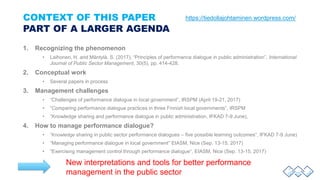
CONTEXT OF THIS PAPER
PART OF A LARGER AGENDA
1. Recognizing the phenomenon
• Laihonen, H. and Mäntylä, S. (2017), “Principles of performance dialogue in public administration”, International
Journal of Public Sector Management, 30(5), pp. 414-428.
2. Conceptual work
• Several papers in process
3. Management challenges
• “Challenges of performance dialogue in local government”, IRSPM (April 19-21, 2017)
• “Comparing performance dialogue practices in three Finnish local governments”, IRSPM
• ”Knowledge sharing and performance dialogue in public administration, IFKAD 7-9 June),
4. How to manage performance dialogue?
• ”Knowledge sharing in public sector performance dialogues – five possible learning outcomes”, IFKAD 7-9 June)
• ”Managing performance dialogue in local government” EIASM, Nice (Sep. 13-15, 2017)
• “Exercising management control through performance dialogue”, EIASM, Nice (Sep. 13-15, 2017)
New interpretations and tools for better performance
management in the public sector
https://tiedollajohtaminen.wordpress.com/
AGENDA
PURPOSE AND RESEARCH QUESTIONS
This paper proposes novel ways of thinking about the management of ambiguity in public
sector performance. After exploring the main obstacles of performance dialogue, we turn the
focus to the ways of improving the use of performance information and enhancing
managers’ awareness of their environment through performance dialogue.
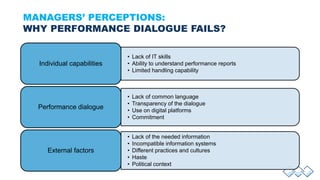
MANAGERS’ PERCEPTIONS:
WHY PERFORMANCE DIALOGUE FAILS?
• Lack of IT skills
• Ability to understand performance reports
• Limited handling capability
Individual capabilities
• Lack of common language
• Transparency of the dialogue
• Use on digital platforms
• Commitment
Performance dialogue
• Lack of the needed information
• Incompatible information systems
• Different practices and cultures
• Haste
• Political context
External factors
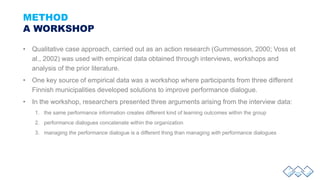
METHOD
A WORKSHOP
• Qualitative case approach, carried out as an action research (Gummesson, 2000; Voss et
al., 2002) was used with empirical data obtained through interviews, workshops and
analysis of the prior literature.
• One key source of empirical data was a workshop where participants from three different
Finnish municipalities developed solutions to improve performance dialogue.
• In the workshop, researchers presented three arguments arising from the interview data:
1. the same performance information creates different kind of learning outcomes within the group
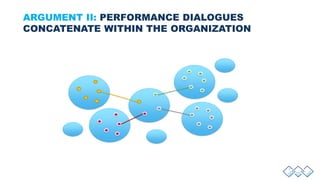
2. performance dialogues concatenate within the organization
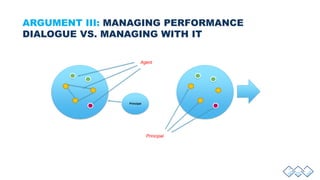
3. managing the performance dialogue is a different thing than managing with performance dialogues
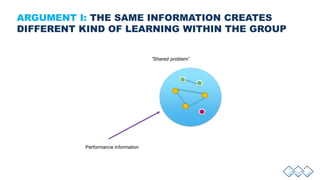
ARGUMENT I: THE SAME INFORMATION CREATES
DIFFERENT KIND OF LEARNING WITHIN THE GROUP
”Shared problem”
Performance information
ARGUMENT II: PERFORMANCE DIALOGUES
CONCATENATE WITHIN THE ORGANIZATION
ARGUMENT III: MANAGING PERFORMANCE
DIALOGUE VS. MANAGING WITH IT
Agent
Principal
Principal
WHAT WE LEARNED?
CONCLUSIONS
• The participants recognized the phenomena and had no difficulties in linking the interview
data with their own experiences.
• The central argument arising is that there seems to be an apparent need for
understanding distinct forms of performance dialogue in different organizational settings
and environments.
• It is important to distinguish performance-oriented dialogues from other dialogues.
• Individuals, groups and organizations usually know how to practice dialogues in general,
but not all of these dialogues are associated with the design or use of performance
information.
• Finally, it is reasonable to assume that the more complicated organizational context, the
more difficult performance dialogues become.
FUTURE: PERFORMANCE MEASUREMENT FOR
HYBRID GOVERNANCE (HYPER)
• Understanding hybrid governance by theorizing new ways
of assessing the value of these institutional arrangements.
• Contribution to performance measurement research by
understanding the design and use of performance metrics
in highly complicated settings of hybrid activities.
Hybrids
• Shared ownership
• Goal incongruence and different institutional logics
• Variety in the sources of financing
• Economic and social control
• Focus on micro, meso and macro levels of hybrid
activities
Grossi, G., Reichard, C.,
Thomasson, A. and Vakkuri,
J. 2017. Performance
measurement of hybrid
organizations. Special issue
in Public Money &
Management, 37 (6), 379-430
https://www.routledge.com/
authors/i16601-jarmo-
vakkuri
THANK YOU!

Managing performance dialogue in local government

  • 1.
    MANAGING PERFORMANCE DIALOGUE INLOCAL GOVERNMENT Research director Harri Laihonen, PhD Co-authored with Tomi Rajala (2), JarmoVakkuri (3) and Petra Haapala (4)
  • 2.
    UNDERLYING PROJECT OUR TWOPRESENTATIONS https://www.researchgate.net/project/Performance-dialogue-in-public-management
  • 3.
    CONTEXT OF THISPAPER PART OF A LARGER AGENDA 1. Recognizing the phenomenon • Laihonen, H. and Mäntylä, S. (2017), “Principles of performance dialogue in public administration”, International Journal of Public Sector Management, 30(5), pp. 414-428. 2. Conceptual work • Several papers in process 3. Management challenges • “Challenges of performance dialogue in local government”, IRSPM (April 19-21, 2017) • “Comparing performance dialogue practices in three Finnish local governments”, IRSPM • ”Knowledge sharing and performance dialogue in public administration, IFKAD 7-9 June), 4. How to manage performance dialogue? • ”Knowledge sharing in public sector performance dialogues – five possible learning outcomes”, IFKAD 7-9 June) • ”Managing performance dialogue in local government” EIASM, Nice (Sep. 13-15, 2017) • “Exercising management control through performance dialogue”, EIASM, Nice (Sep. 13-15, 2017) New interpretations and tools for better performance management in the public sector https://tiedollajohtaminen.wordpress.com/
  • 4.
    AGENDA PURPOSE AND RESEARCHQUESTIONS This paper proposes novel ways of thinking about the management of ambiguity in public sector performance. After exploring the main obstacles of performance dialogue, we turn the focus to the ways of improving the use of performance information and enhancing managers’ awareness of their environment through performance dialogue.
  • 5.
    MANAGERS’ PERCEPTIONS: WHY PERFORMANCEDIALOGUE FAILS? • Lack of IT skills • Ability to understand performance reports • Limited handling capability Individual capabilities • Lack of common language • Transparency of the dialogue • Use on digital platforms • Commitment Performance dialogue • Lack of the needed information • Incompatible information systems • Different practices and cultures • Haste • Political context External factors
  • 6.
    METHOD A WORKSHOP • Qualitativecase approach, carried out as an action research (Gummesson, 2000; Voss et al., 2002) was used with empirical data obtained through interviews, workshops and analysis of the prior literature. • One key source of empirical data was a workshop where participants from three different Finnish municipalities developed solutions to improve performance dialogue. • In the workshop, researchers presented three arguments arising from the interview data: 1. the same performance information creates different kind of learning outcomes within the group 2. performance dialogues concatenate within the organization 3. managing the performance dialogue is a different thing than managing with performance dialogues
  • 7.
    ARGUMENT I: THESAME INFORMATION CREATES DIFFERENT KIND OF LEARNING WITHIN THE GROUP ”Shared problem” Performance information
  • 8.
    ARGUMENT II: PERFORMANCEDIALOGUES CONCATENATE WITHIN THE ORGANIZATION
  • 9.
    ARGUMENT III: MANAGINGPERFORMANCE DIALOGUE VS. MANAGING WITH IT Agent Principal Principal
  • 10.
    WHAT WE LEARNED? CONCLUSIONS •The participants recognized the phenomena and had no difficulties in linking the interview data with their own experiences. • The central argument arising is that there seems to be an apparent need for understanding distinct forms of performance dialogue in different organizational settings and environments. • It is important to distinguish performance-oriented dialogues from other dialogues. • Individuals, groups and organizations usually know how to practice dialogues in general, but not all of these dialogues are associated with the design or use of performance information. • Finally, it is reasonable to assume that the more complicated organizational context, the more difficult performance dialogues become.
  • 11.
    FUTURE: PERFORMANCE MEASUREMENTFOR HYBRID GOVERNANCE (HYPER) • Understanding hybrid governance by theorizing new ways of assessing the value of these institutional arrangements. • Contribution to performance measurement research by understanding the design and use of performance metrics in highly complicated settings of hybrid activities. Hybrids • Shared ownership • Goal incongruence and different institutional logics • Variety in the sources of financing • Economic and social control • Focus on micro, meso and macro levels of hybrid activities Grossi, G., Reichard, C., Thomasson, A. and Vakkuri, J. 2017. Performance measurement of hybrid organizations. Special issue in Public Money & Management, 37 (6), 379-430 https://www.routledge.com/ authors/i16601-jarmo- vakkuri
  • 12.