Session ID:
Session Classification:
Managing Enterprise Risk:
WHY U NO HAZ METRICS?
Alex Hutton
David Mortman
Jack Jones
Caroline Wong
John D. Johnson
GRC-W23
Intermediate
A Manufacturing Company A Financial Organization CXOWARE
enStratus Symantec
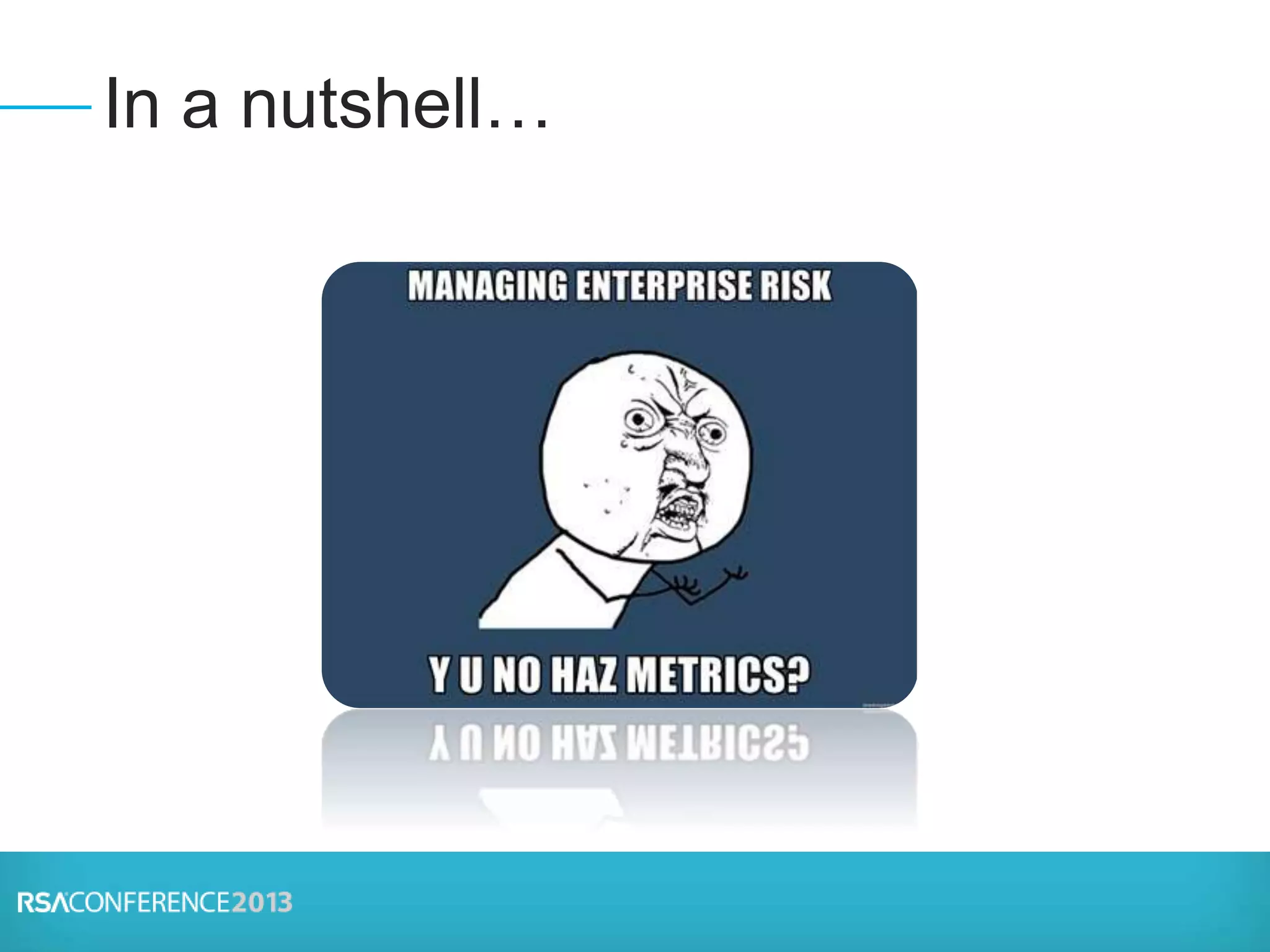
In a nutshell…
► How is risk management related to security?
► What is the goal of risk management?
► How do we define risk?
► How can we manage risk?
► What is the value of having security metrics?
► How do I develop meaningful metrics?
► How can good measurements and practices reduce risk?
► Where can I find models, frameworks & best practices?
► How can I adapt these for my organization?
► Are there good data sets I can leverage here?
► How do I estimate future events by looking at the past? Is this
voodoo?
Agenda
► Favorites:
► Cost Center Most At Risk
► Cost Center With Most Variance
► Asset Class With Most Variance
► Most Useful:
► Fraud Cause Counts
► Amount of Exposure per Cause
► Amount Lost per Cause
Alex
► Risk Landscape Visibility –helps us understand how well informed
(or not) our risk decisions are. The values represent data and
estimates regarding four elements (asset population, threat
conditions, value/liability at risk, and control conditions). This helps
us to focus on specific areas of poor visibility, thus improving our
ability to make well-informed risk decisions.
Jack
► Root Cause Analysis — which helps us understand why undesirable
conditions exist (e.g., non-compliance with policy). This enables us
to focus on our efforts to systemically improve.
Jack
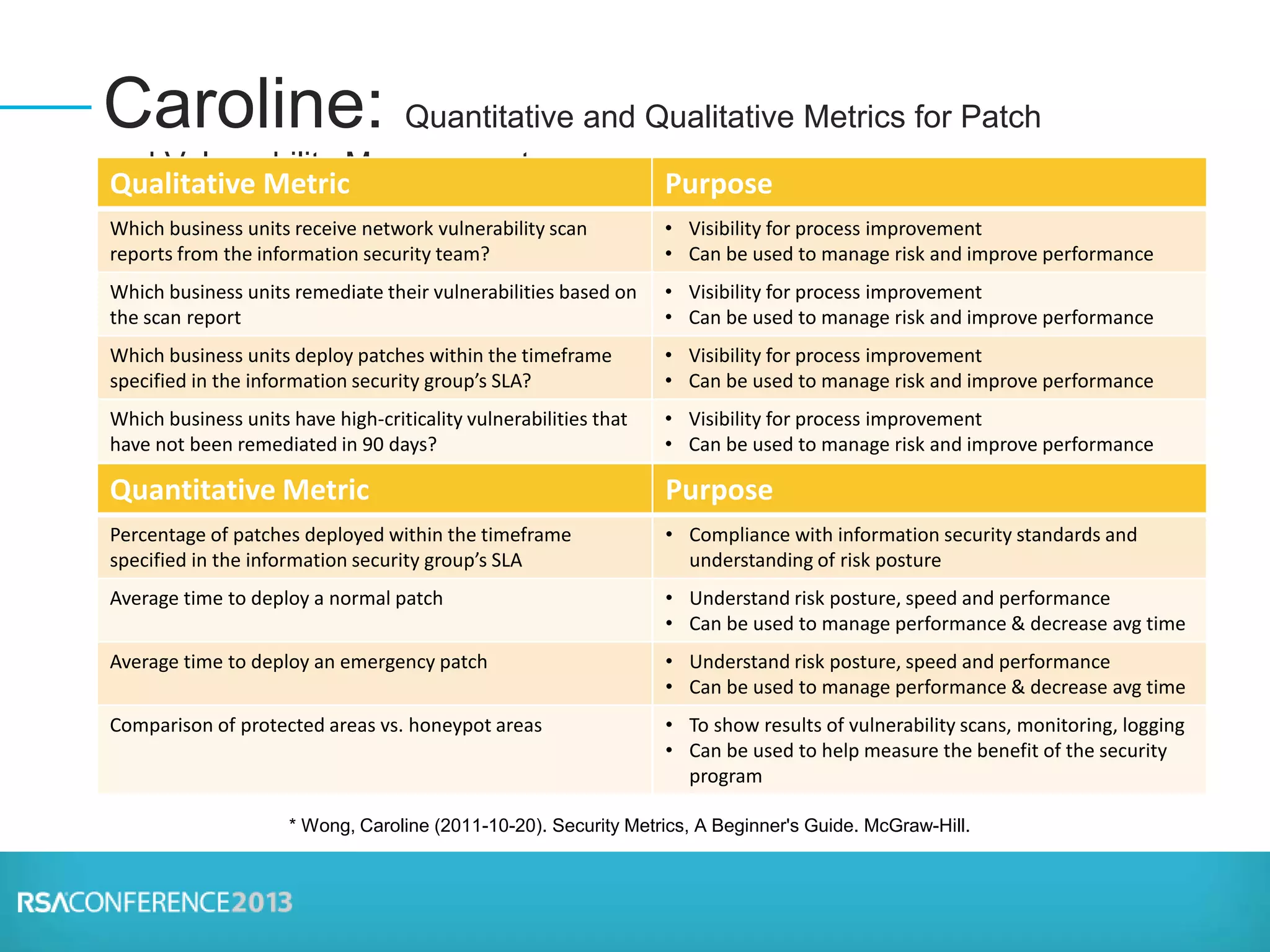
Caroline: Quantitative and Qualitative Metrics for Patch
and Vulnerability Management
* Wong, Caroline (2011-10-20). Security Metrics, A Beginner's Guide. McGraw-Hill.
Qualitative Metric Purpose
Which business units receive network vulnerability scan
reports from the information security team?
• Visibility for process improvement
• Can be used to manage risk and improve performance
Which business units remediate their vulnerabilities based on
the scan report
• Visibility for process improvement
• Can be used to manage risk and improve performance
Which business units deploy patches within the timeframe
specified in the information security group’s SLA?
• Visibility for process improvement
• Can be used to manage risk and improve performance
Which business units have high-criticality vulnerabilities that
have not been remediated in 90 days?
• Visibility for process improvement
• Can be used to manage risk and improve performance
Quantitative Metric Purpose
Percentage of patches deployed within the timeframe
specified in the information security group’s SLA
• Compliance with information security standards and
understanding of risk posture
Average time to deploy a normal patch • Understand risk posture, speed and performance
• Can be used to manage performance & decrease avg time
Average time to deploy an emergency patch • Understand risk posture, speed and performance
• Can be used to manage performance & decrease avg time
Comparison of protected areas vs. honeypot areas • To show results of vulnerability scans, monitoring, logging
• Can be used to help measure the benefit of the security
program
COBIT 5 Process Reference
Model
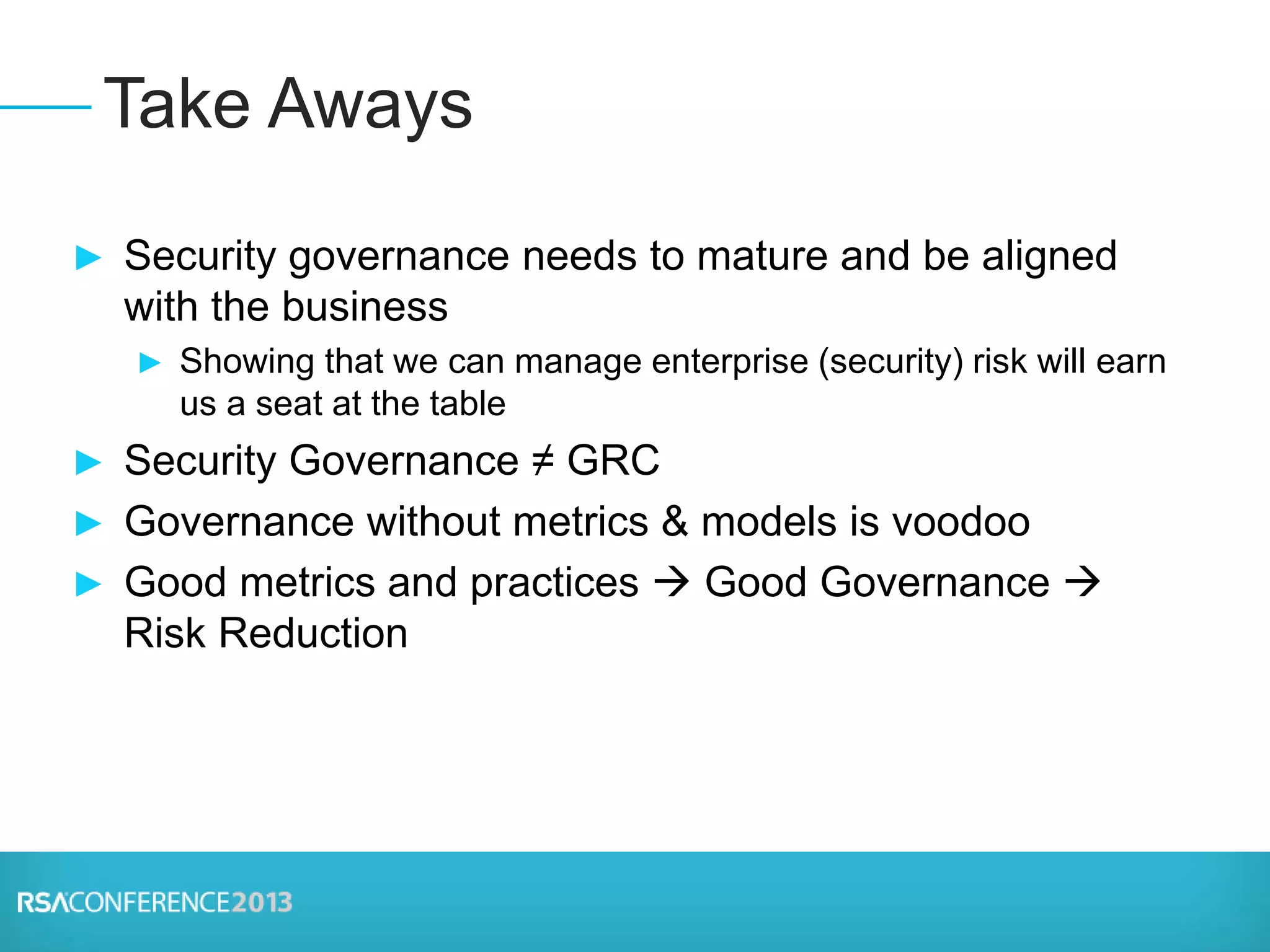
► Security governance needs to mature and be aligned
with the business
► Showing that we can manage enterprise (security) risk will earn
us a seat at the table
► Security Governance ≠ GRC
► Governance without metrics & models is voodoo
► Good metrics and practices  Good Governance 
Risk Reduction
Take Aways
► “Managing risk means aligning the capabilities of the
organization, and the exposure of the organization with
the tolerance of the data owners.” (Jack)
► “Whatever Metric you present, it is a risk metric. Any
security metric you present will be consciously or sub-
consciously interpreted by the audience in their own
internal risk model. It is inescapable. ” (Alex)
Take Aways
Links:
• New School Security Blog
http://www.newschoolsecurity.com
• FAIR Framework
http://fairwiki.riskmanagementinsight.com
• Verizon VERIS Framework
https://verisframework.wiki.zoho.com
• Security Metrics: A Beginner’s Guide,
Caroline Wong
http://is.gd/6g62uS

Managing Enterprise Risk: Why U No Haz Metrics?

  • 1.
    Session ID: Session Classification: ManagingEnterprise Risk: WHY U NO HAZ METRICS? Alex Hutton David Mortman Jack Jones Caroline Wong John D. Johnson GRC-W23 Intermediate A Manufacturing Company A Financial Organization CXOWARE enStratus Symantec
  • 2.
  • 3.
    ► How isrisk management related to security? ► What is the goal of risk management? ► How do we define risk? ► How can we manage risk? ► What is the value of having security metrics? ► How do I develop meaningful metrics? ► How can good measurements and practices reduce risk? ► Where can I find models, frameworks & best practices? ► How can I adapt these for my organization? ► Are there good data sets I can leverage here? ► How do I estimate future events by looking at the past? Is this voodoo? Agenda
  • 4.
    ► Favorites: ► CostCenter Most At Risk ► Cost Center With Most Variance ► Asset Class With Most Variance ► Most Useful: ► Fraud Cause Counts ► Amount of Exposure per Cause ► Amount Lost per Cause Alex
  • 5.
    ► Risk LandscapeVisibility –helps us understand how well informed (or not) our risk decisions are. The values represent data and estimates regarding four elements (asset population, threat conditions, value/liability at risk, and control conditions). This helps us to focus on specific areas of poor visibility, thus improving our ability to make well-informed risk decisions. Jack
  • 6.
    ► Root CauseAnalysis — which helps us understand why undesirable conditions exist (e.g., non-compliance with policy). This enables us to focus on our efforts to systemically improve. Jack
  • 7.
    Caroline: Quantitative andQualitative Metrics for Patch and Vulnerability Management * Wong, Caroline (2011-10-20). Security Metrics, A Beginner's Guide. McGraw-Hill. Qualitative Metric Purpose Which business units receive network vulnerability scan reports from the information security team? • Visibility for process improvement • Can be used to manage risk and improve performance Which business units remediate their vulnerabilities based on the scan report • Visibility for process improvement • Can be used to manage risk and improve performance Which business units deploy patches within the timeframe specified in the information security group’s SLA? • Visibility for process improvement • Can be used to manage risk and improve performance Which business units have high-criticality vulnerabilities that have not been remediated in 90 days? • Visibility for process improvement • Can be used to manage risk and improve performance Quantitative Metric Purpose Percentage of patches deployed within the timeframe specified in the information security group’s SLA • Compliance with information security standards and understanding of risk posture Average time to deploy a normal patch • Understand risk posture, speed and performance • Can be used to manage performance & decrease avg time Average time to deploy an emergency patch • Understand risk posture, speed and performance • Can be used to manage performance & decrease avg time Comparison of protected areas vs. honeypot areas • To show results of vulnerability scans, monitoring, logging • Can be used to help measure the benefit of the security program
  • 8.
    COBIT 5 ProcessReference Model
  • 9.
    ► Security governanceneeds to mature and be aligned with the business ► Showing that we can manage enterprise (security) risk will earn us a seat at the table ► Security Governance ≠ GRC ► Governance without metrics & models is voodoo ► Good metrics and practices  Good Governance  Risk Reduction Take Aways
  • 10.
    ► “Managing riskmeans aligning the capabilities of the organization, and the exposure of the organization with the tolerance of the data owners.” (Jack) ► “Whatever Metric you present, it is a risk metric. Any security metric you present will be consciously or sub- consciously interpreted by the audience in their own internal risk model. It is inescapable. ” (Alex) Take Aways
  • 11.
    Links: • New SchoolSecurity Blog http://www.newschoolsecurity.com • FAIR Framework http://fairwiki.riskmanagementinsight.com • Verizon VERIS Framework https://verisframework.wiki.zoho.com • Security Metrics: A Beginner’s Guide, Caroline Wong http://is.gd/6g62uS