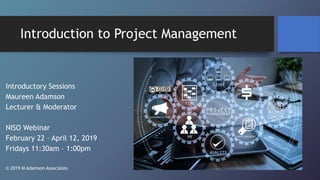
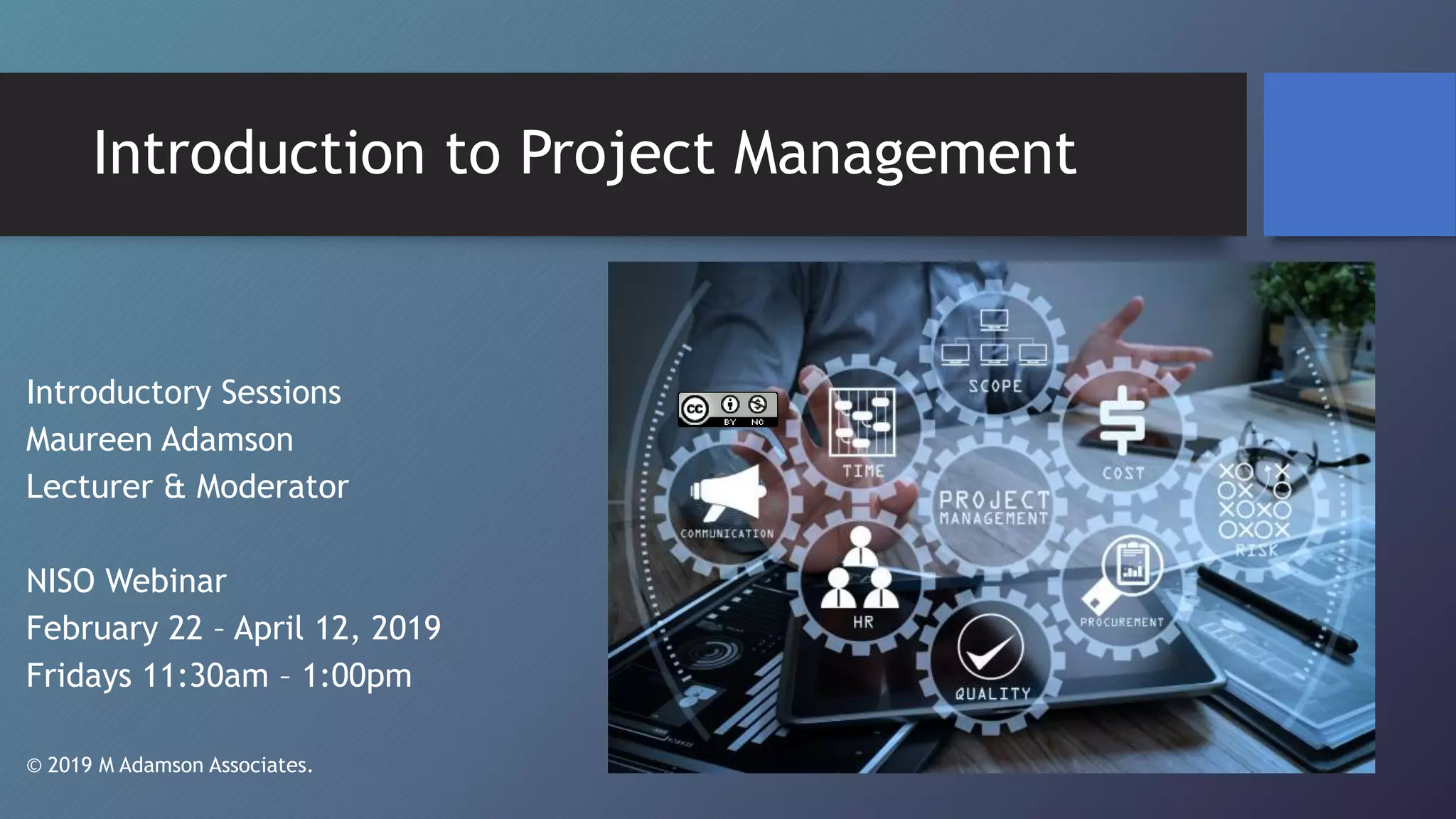

Introduction to Project Management
Introductory Sessions
Maureen Adamson
Lecturer & Moderator
NISO Webinar
February 22 – April 12, 2019
Fridays 11:30am – 1:00pm
© 2019 M Adamson Associates.
Team, Speakers & Resources
Jill O’Neill, NISO Coordinator
joneill@niso.org
Maureen Adamson,
Presenter & Moderator
maureen@madamsonassociates.com
Handouts
Added throughout course
See chat for link
Guest Speakers
March 22: Kristine Sunda, K Shannon Associates
March 29: Bill Trippe, Platform Strategies
Al Brown, JSTOR
April 5: Eugene Spiegle, Rutgers Business School
April 12: Kate McCready & Kirsten Clark
University of Minnesota
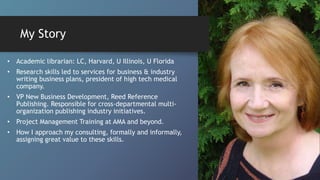
My Story
• Academic librarian: LC, Harvard, U Illinois, U Florida
• Research skills led to services for business & industry
writing business plans, president of high tech medical
company.
• VP New Business Development, Reed Reference
Publishing. Responsible for cross-departmental multi-
organization publishing industry initiatives.
• Project Management Training at AMA and beyond.
• How I approach my consulting, formally and informally,
assigning great value to these skills.
Overview
What is Project Management?
Key Concepts, Vocabulary, and Styles
Defining the Project
Predictive & Adaptive Approaches
Project Management Training & Education
Organizational Issues and Approaches
The Age of Agile & Product Development
Software Considerations
Academic Library Applications
“A project is a temporary endeavor undertaken to create a
unique product or service.” - PMIBOK
“A project is a creative endeavor to build a product or service
engaging all the stakeholders meaningfully thereby meeting
or exceeding the expectations of the end customer.”
- Maneesh Dutt
Two Definitions of Project Management
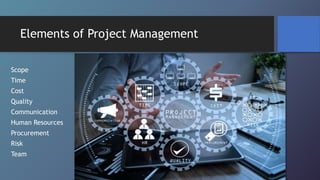
Elements of Project Management
Scope
Time
Cost
Quality
Communication
Human Resources
Procurement
Risk
Team
Core
Characteristics
Projects have a beginning, middle,
and end.
Provides structure to achieve clear
objectives.
Project management is an agreed-
upon style of communication.
Project management is a learned
skill
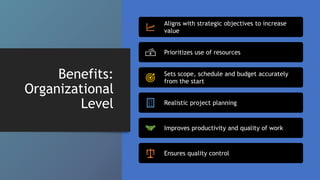
Benefits:
Organizational
Level
Aligns with strategic objectives to increase
value
Prioritizes use of resources
Sets scope, schedule and budget accurately
from the start
Realistic project planning
Improves productivity and quality of work
Ensures quality control
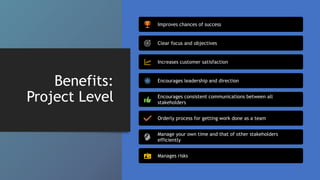
Benefits:
Project Level
Improves chances of success
Clear focus and objectives
Increases customer satisfaction
Encourages leadership and direction
Encourages consistent communications between all
stakeholders
Orderly process for getting work done as a team
Manage your own time and that of other stakeholders
efficiently
Manages risks
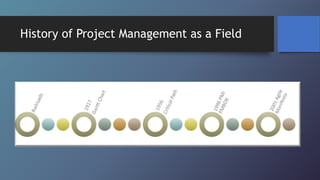
History of Project Management as a Field
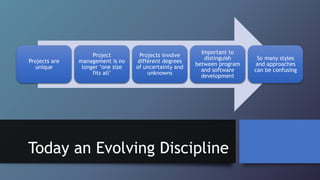
Today an Evolving Discipline
Projects are
unique
Project
management is no
longer ‘one size
fits all’
Projects involve
different degrees
of uncertainty and
unknowns
Important to
distinguish
between program
and software
development
So many styles
and approaches
can be confusing
“When you come to a fork in the road, take it.”
- Yogi Berra
... And THAT is what we are going to do!
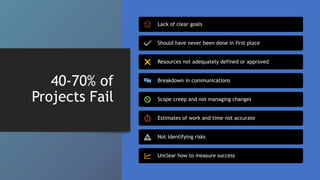
40-70% of
Projects Fail
Lack of clear goals
Should have never been done in first place
Resources not adequately defined or approved
Breakdown in communications
Scope creep and not managing changes
Estimates of work and time not accurate
Not identifying risks
Unclear how to measure success
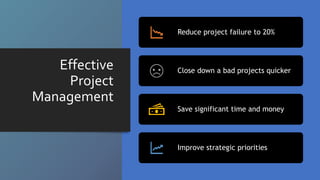
Effective
Project
Management
Reduce project failure to 20%
Close down a bad projects quicker
Save significant time and money
Improve strategic priorities
Understanding Project Management As a Field
Literature & Vocabulary
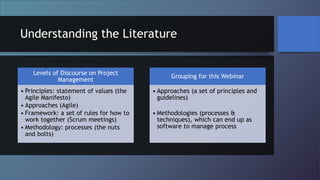
Understanding the Literature
Levels of Discourse on Project
Management
• Principles: statement of values (the
Agile Manifesto)
• Approaches (Agile)
• Framework: a set of rules for how to
work together (Scrum meetings)
• Methodology: processes (the nuts
and bolts)
Grouping for this Webinar
• Approaches (a set of principles and
guidelines)
• Methodologies (processes &
techniques), which can end up as
software to manage process
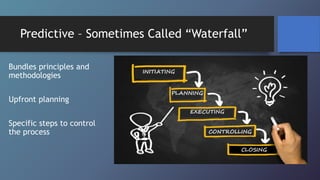
Predictive – Sometimes Called “Waterfall”
Bundles principles and
methodologies
Upfront planning
Specific steps to control
the process
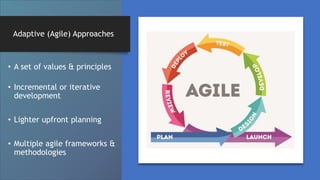
Adaptive (Agile) Approaches
• A set of values & principles
• Incremental or iterative
development
• Lighter upfront planning
• Multiple agile frameworks &
methodologies
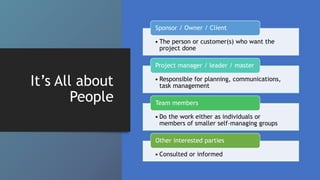
It’s All about
People
• The person or customer(s) who want the
project done
Sponsor / Owner / Client
• Responsible for planning, communications,
task management
Project manager / leader / master
• Do the work either as individuals or
members of smaller self-managing groups
Team members
• Consulted or informed
Other interested parties
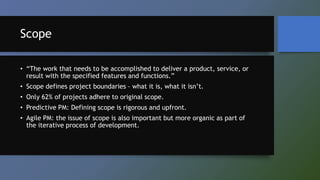
Scope
• “The work that needs to be accomplished to deliver a product, service, or
result with the specified features and functions.”
• Scope defines project boundaries – what it is, what it isn’t.
• Only 62% of projects adhere to original scope.
• Predictive PM: Defining scope is rigorous and upfront.
• Agile PM: the issue of scope is also important but more organic as part of
the iterative process of development.
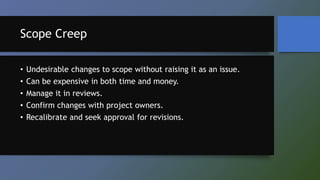
Scope Creep
• Undesirable changes to scope without raising it as an issue.
• Can be expensive in both time and money.
• Manage it in reviews.
• Confirm changes with project owners.
• Recalibrate and seek approval for revisions.
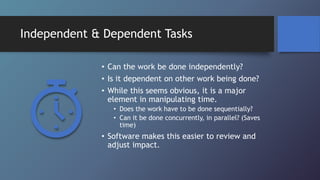
Independent & Dependent Tasks
• Can the work be done independently?
• Is it dependent on other work being done?
• While this seems obvious, it is a major
element in manipulating time.
• Does the work have to be done sequentially?
• Can it be done concurrently, in parallel? (Saves
time)
• Software makes this easier to review and
adjust impact.
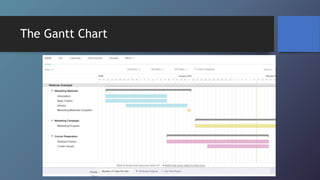
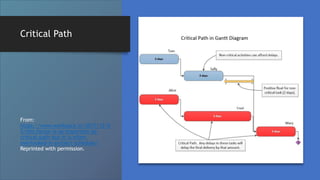
The Gantt Chart
Critical Path
From:
https://www.workpack.in/2017/12/0
5/this-factor-is-as-important-as-
critical-path-but-it-is-often-
overlooked-in-project-schedule/
Reprinted with permission.
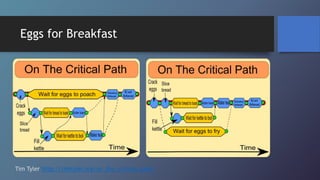
Eggs for Breakfast
Tim Tyler http://timtyler.org/on_the_critical_path/
Milestones
• The completion of a major phase of work.
• Marks the beginning of a new phase.
• In PM, used as a scheduling and reporting marker.
• Can be deadlines for delivery, an event, demo, ‘going live.’
• Important when dealing with stakeholders.
• Celebrate project achievements.
• In Agile, can be a completion of increments, uncertainties
translated into knowledge.
End of Sample
Complete Webinar available from
https://www.niso.org
Thank you!

Managing Change with Project Management Skills

  • 1.
    Introduction to ProjectManagement Introductory Sessions Maureen Adamson Lecturer & Moderator NISO Webinar February 22 – April 12, 2019 Fridays 11:30am – 1:00pm © 2019 M Adamson Associates.
  • 2.
    Team, Speakers &Resources Jill O’Neill, NISO Coordinator joneill@niso.org Maureen Adamson, Presenter & Moderator maureen@madamsonassociates.com Handouts Added throughout course See chat for link Guest Speakers March 22: Kristine Sunda, K Shannon Associates March 29: Bill Trippe, Platform Strategies Al Brown, JSTOR April 5: Eugene Spiegle, Rutgers Business School April 12: Kate McCready & Kirsten Clark University of Minnesota
  • 3.
    My Story • Academiclibrarian: LC, Harvard, U Illinois, U Florida • Research skills led to services for business & industry writing business plans, president of high tech medical company. • VP New Business Development, Reed Reference Publishing. Responsible for cross-departmental multi- organization publishing industry initiatives. • Project Management Training at AMA and beyond. • How I approach my consulting, formally and informally, assigning great value to these skills.
  • 4.
    Overview What is ProjectManagement? Key Concepts, Vocabulary, and Styles Defining the Project Predictive & Adaptive Approaches Project Management Training & Education Organizational Issues and Approaches The Age of Agile & Product Development Software Considerations Academic Library Applications
  • 5.
    “A project isa temporary endeavor undertaken to create a unique product or service.” - PMIBOK “A project is a creative endeavor to build a product or service engaging all the stakeholders meaningfully thereby meeting or exceeding the expectations of the end customer.” - Maneesh Dutt Two Definitions of Project Management
  • 6.
    Elements of ProjectManagement Scope Time Cost Quality Communication Human Resources Procurement Risk Team
  • 7.
    Core Characteristics Projects have abeginning, middle, and end. Provides structure to achieve clear objectives. Project management is an agreed- upon style of communication. Project management is a learned skill
  • 8.
    Benefits: Organizational Level Aligns with strategicobjectives to increase value Prioritizes use of resources Sets scope, schedule and budget accurately from the start Realistic project planning Improves productivity and quality of work Ensures quality control
  • 9.
    Benefits: Project Level Improves chancesof success Clear focus and objectives Increases customer satisfaction Encourages leadership and direction Encourages consistent communications between all stakeholders Orderly process for getting work done as a team Manage your own time and that of other stakeholders efficiently Manages risks
  • 10.
    History of ProjectManagement as a Field
  • 11.
    Today an EvolvingDiscipline Projects are unique Project management is no longer ‘one size fits all’ Projects involve different degrees of uncertainty and unknowns Important to distinguish between program and software development So many styles and approaches can be confusing
  • 12.
    “When you cometo a fork in the road, take it.” - Yogi Berra ... And THAT is what we are going to do!
  • 13.
    40-70% of Projects Fail Lackof clear goals Should have never been done in first place Resources not adequately defined or approved Breakdown in communications Scope creep and not managing changes Estimates of work and time not accurate Not identifying risks Unclear how to measure success
  • 14.
    Effective Project Management Reduce project failureto 20% Close down a bad projects quicker Save significant time and money Improve strategic priorities
  • 15.
    Understanding Project ManagementAs a Field Literature & Vocabulary
  • 16.
    Understanding the Literature Levelsof Discourse on Project Management • Principles: statement of values (the Agile Manifesto) • Approaches (Agile) • Framework: a set of rules for how to work together (Scrum meetings) • Methodology: processes (the nuts and bolts) Grouping for this Webinar • Approaches (a set of principles and guidelines) • Methodologies (processes & techniques), which can end up as software to manage process
  • 17.
    Predictive – SometimesCalled “Waterfall” Bundles principles and methodologies Upfront planning Specific steps to control the process
  • 18.
    Adaptive (Agile) Approaches •A set of values & principles • Incremental or iterative development • Lighter upfront planning • Multiple agile frameworks & methodologies
  • 19.
    It’s All about People •The person or customer(s) who want the project done Sponsor / Owner / Client • Responsible for planning, communications, task management Project manager / leader / master • Do the work either as individuals or members of smaller self-managing groups Team members • Consulted or informed Other interested parties
  • 20.
    Scope • “The workthat needs to be accomplished to deliver a product, service, or result with the specified features and functions.” • Scope defines project boundaries – what it is, what it isn’t. • Only 62% of projects adhere to original scope. • Predictive PM: Defining scope is rigorous and upfront. • Agile PM: the issue of scope is also important but more organic as part of the iterative process of development.
  • 21.
    Scope Creep • Undesirablechanges to scope without raising it as an issue. • Can be expensive in both time and money. • Manage it in reviews. • Confirm changes with project owners. • Recalibrate and seek approval for revisions.
  • 22.
    Independent & DependentTasks • Can the work be done independently? • Is it dependent on other work being done? • While this seems obvious, it is a major element in manipulating time. • Does the work have to be done sequentially? • Can it be done concurrently, in parallel? (Saves time) • Software makes this easier to review and adjust impact.
  • 23.
  • 24.
  • 25.
    Eggs for Breakfast TimTyler http://timtyler.org/on_the_critical_path/
  • 26.
    Milestones • The completionof a major phase of work. • Marks the beginning of a new phase. • In PM, used as a scheduling and reporting marker. • Can be deadlines for delivery, an event, demo, ‘going live.’ • Important when dealing with stakeholders. • Celebrate project achievements. • In Agile, can be a completion of increments, uncertainties translated into knowledge.
  • 27.
    End of Sample CompleteWebinar available from https://www.niso.org Thank you!