




Managing a paradigm shift in
assessment – a matter of
mindset
Isabela Villas Boas, Casa Thomas Jefferson, Brasilia, Brazil
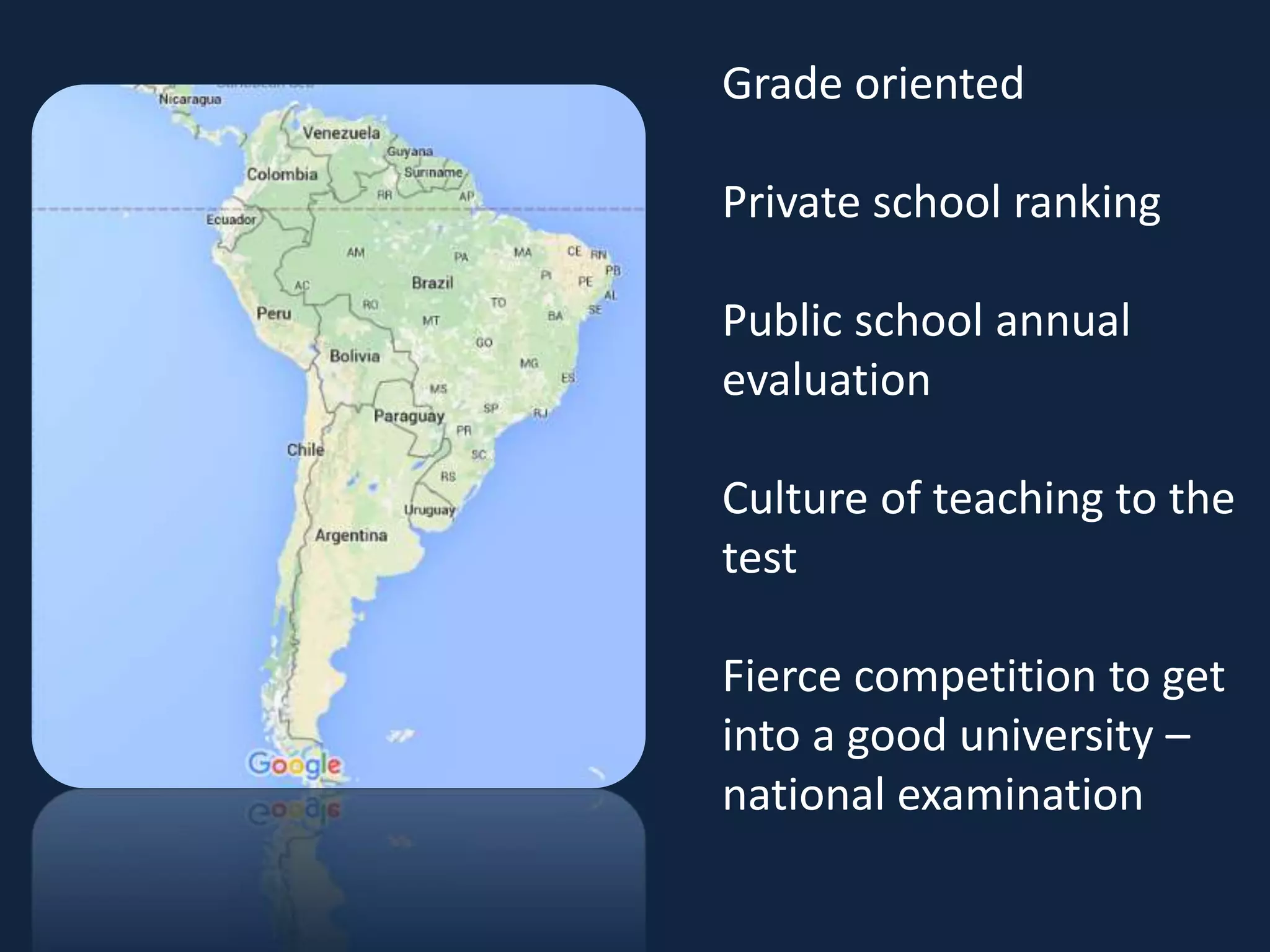
Grade oriented
Private school ranking
Public school annual
evaluation
Culture of teaching to the
test
Fierce competition to get
into a good university –
national examination
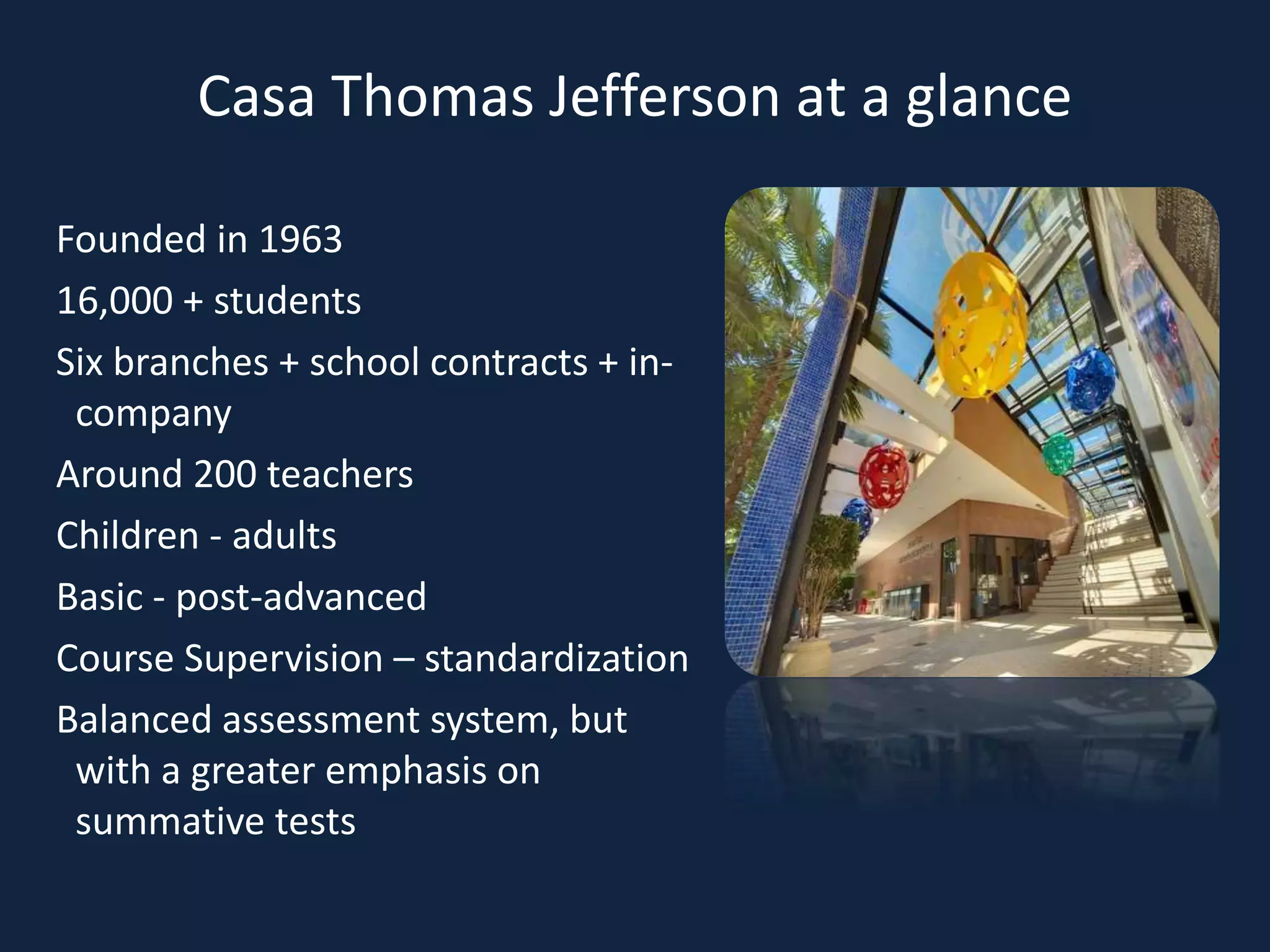
Casa Thomas Jefferson at a glance
Founded in 1963
16,000 + students
Six branches + school contracts + in-
company
Around 200 teachers
Children - adults
Basic - post-advanced
Course Supervision – standardization
Balanced assessment system, but
with a greater emphasis on
summative tests
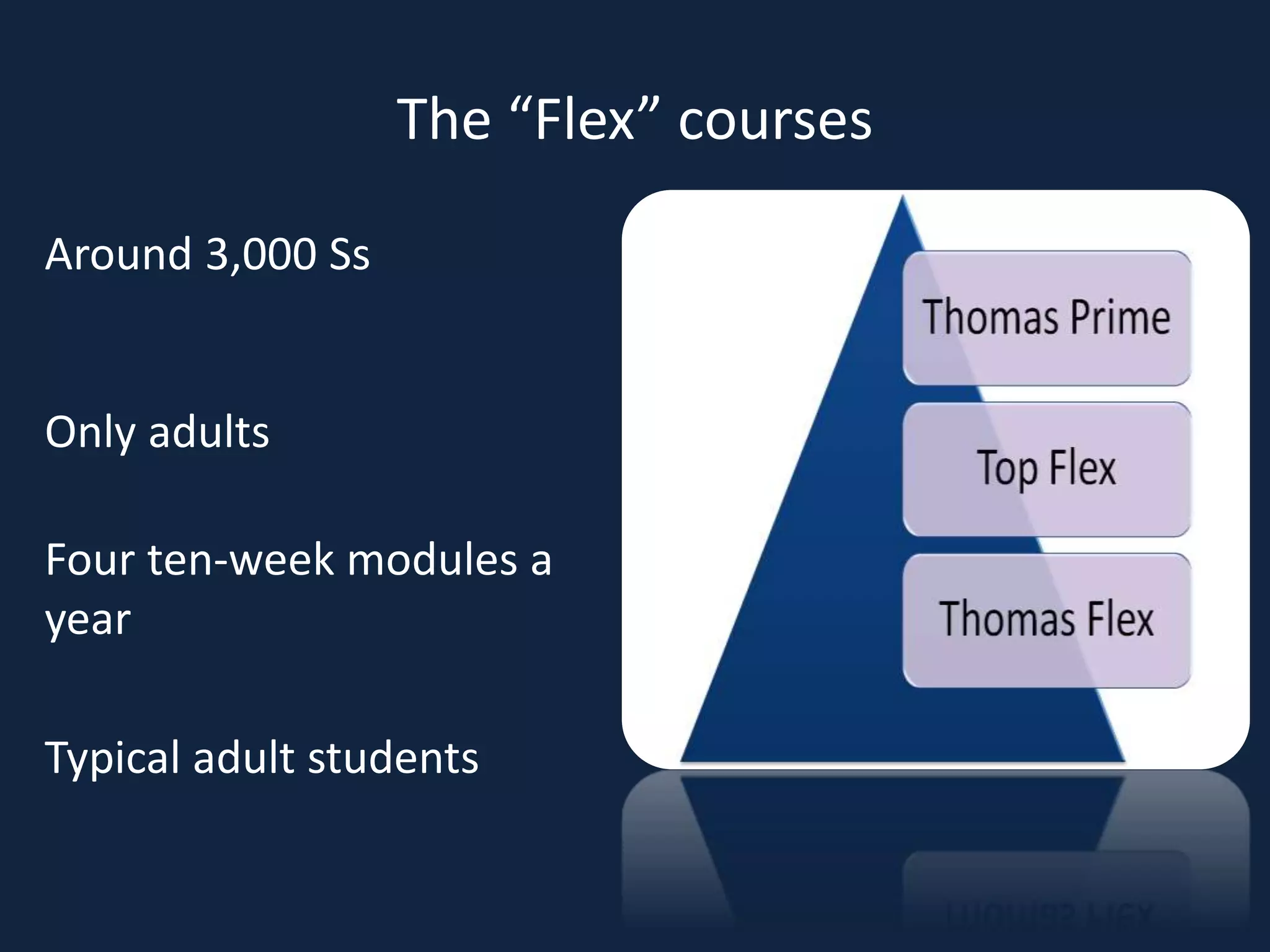
The “Flex” courses
Around 3,000 Ss
Only adults
Four ten-week modules a
year
Typical adult students
Traditional assessment system
After ten weeks of instruction:
One day for written test: reading comprehension,
grammar, vocabulary; about 60% of the test
focused on grammar structures and functions
One day for oral test: done in pairs; students stand
outside the classroom and wait for their turn
(following the proficiency test model)
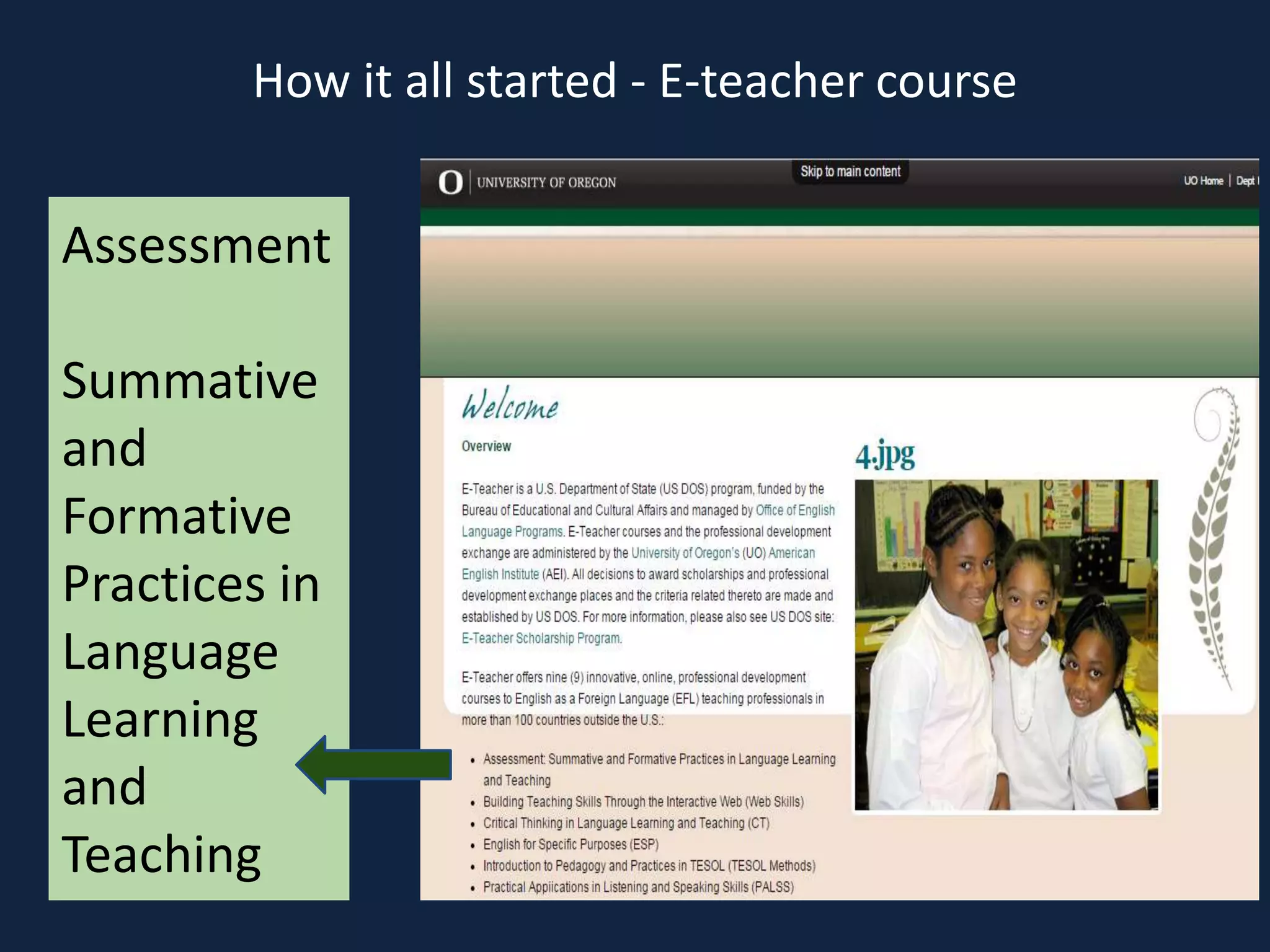
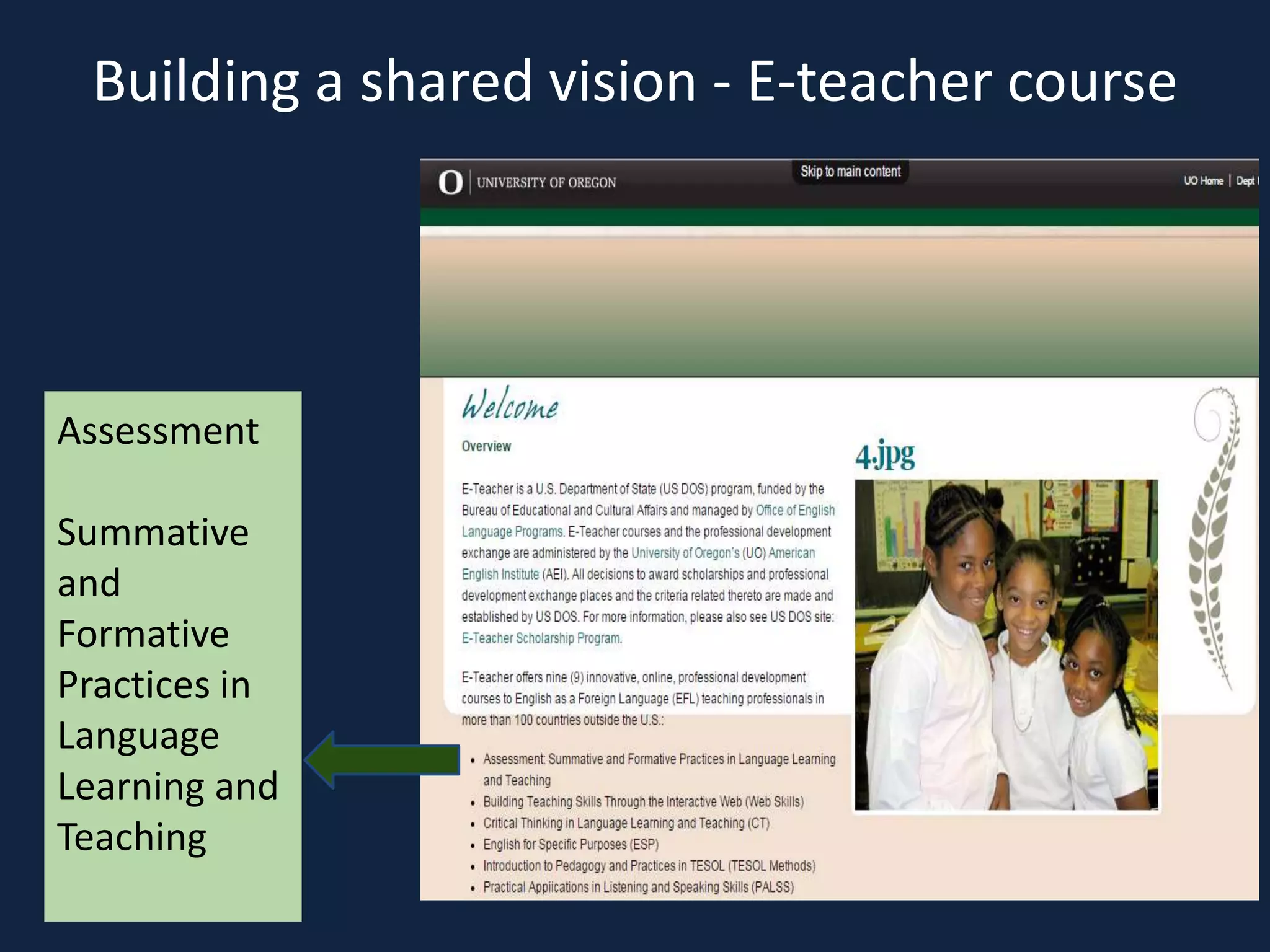
How it all started - E-teacher course
Assessment
Summative
and
Formative
Practices in
Language
Learning
and
Teaching
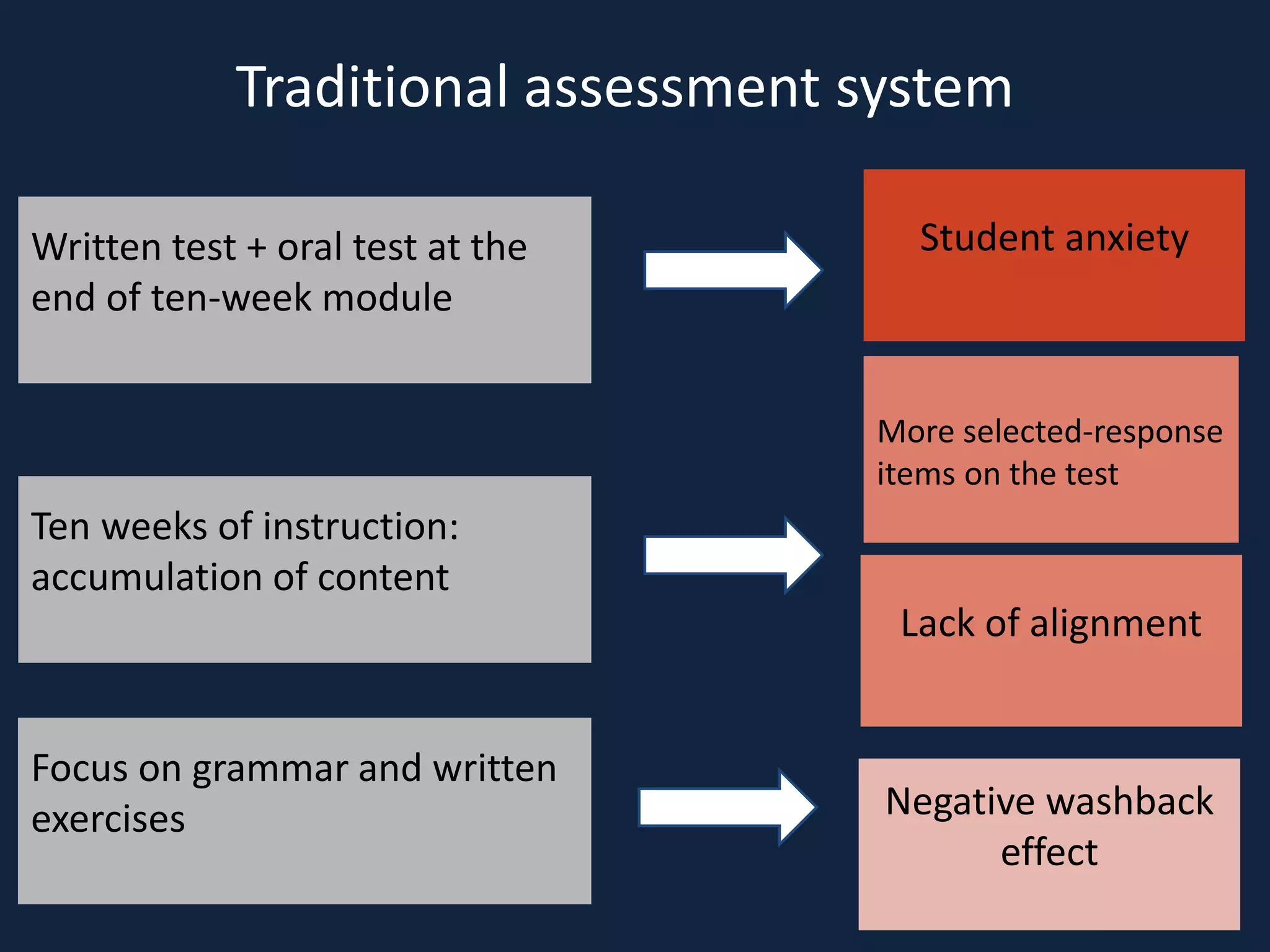
Traditional assessment system
Written test + oral test at the
end of ten-week module
Ten weeks of instruction:
accumulation of content
Focus on grammar and written
exercises
Student anxiety
More selected-response
items on the test
Lack of alignment
Negative washback
effect
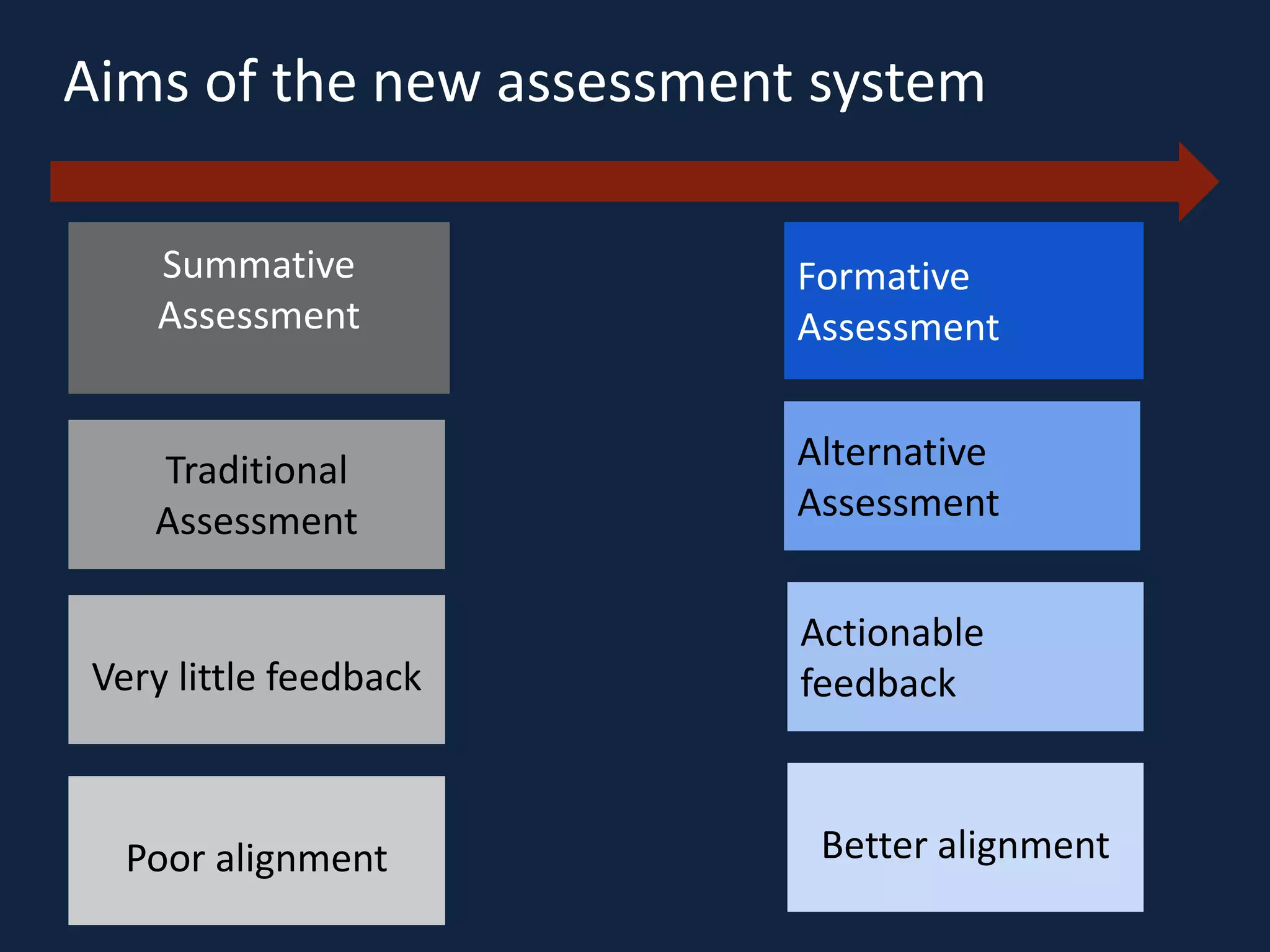
Summative
Assessment
Formative
Assessment
Traditional
Assessment
Alternative
Assessment
Aims of the new assessment system
Very little feedback
Actionable
feedback
Poor alignment Better alignment
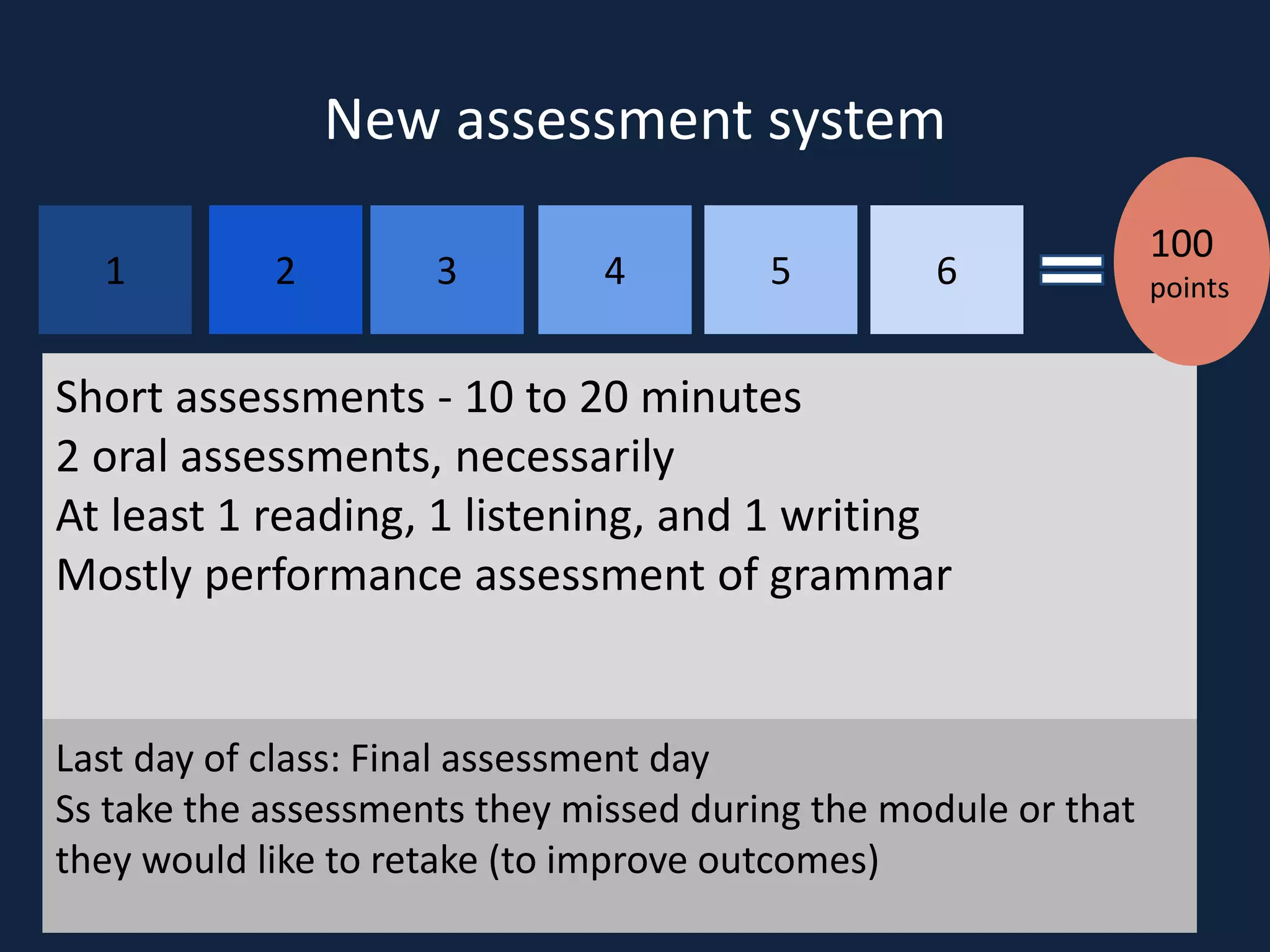
New assessment system
1 2 3 4 5 6
Short assessments - 10 to 20 minutes
2 oral assessments, necessarily
At least 1 reading, 1 listening, and 1 writing
Mostly performance assessment of grammar
100
points
Last day of class: Final assessment day
Ss take the assessments they missed during the module or that
they would like to retake (to improve outcomes)
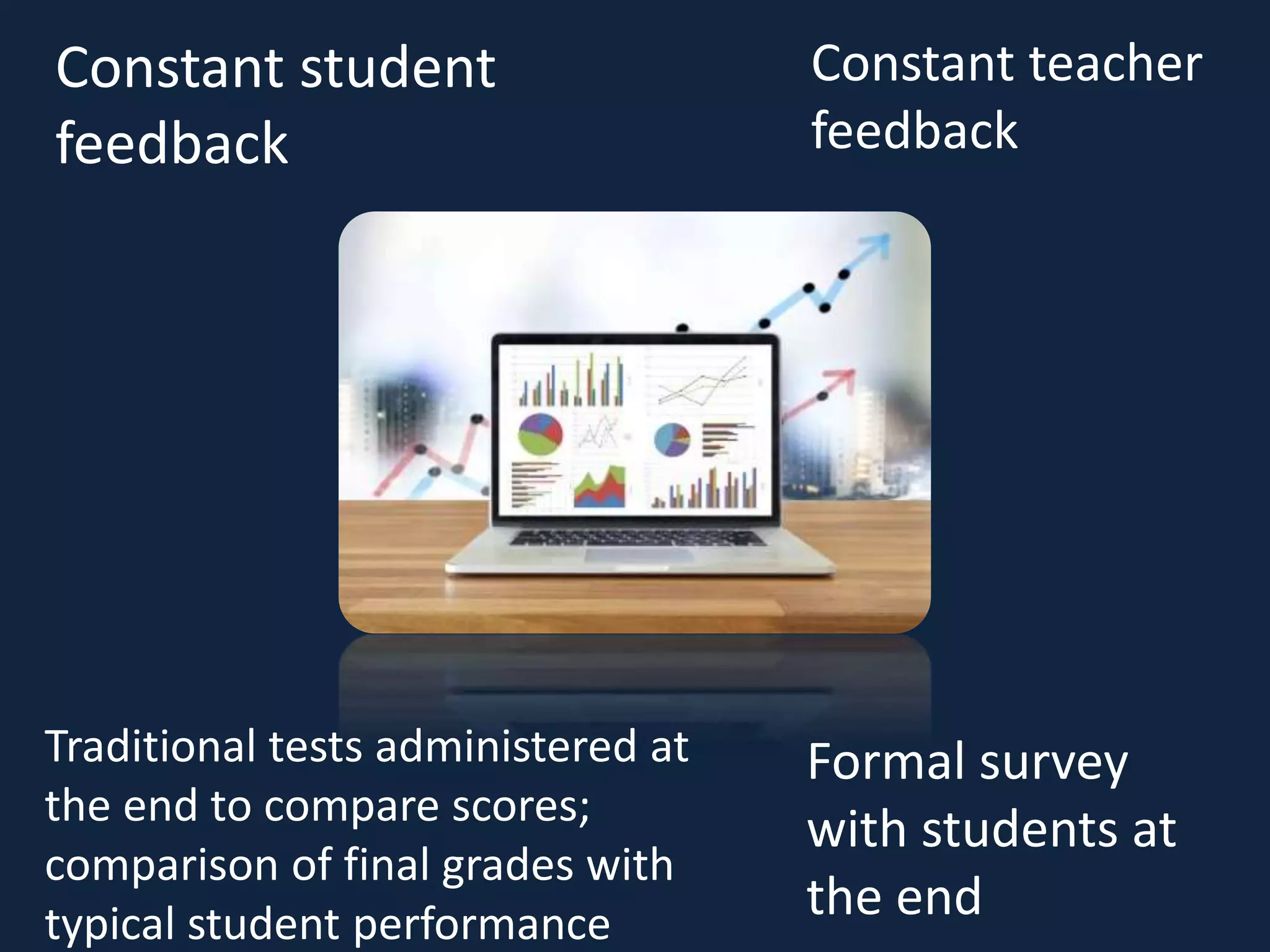
Traditional tests administered at
the end to compare scores;
comparison of final grades with
typical student performance
Constant student
feedback
Constant teacher
feedback
Formal survey
with students at
the end
 Students had similar scores on their
assessments and on the summative
test
 Students had similar or higher final
grades than the final grades in previous
modules
 Students felt more at ease with the
pilot system; less pressure
Building a shared vision - E-teacher course
Assessment
Summative
and
Formative
Practices in
Language
Learning and
Teaching
Phase-in stage
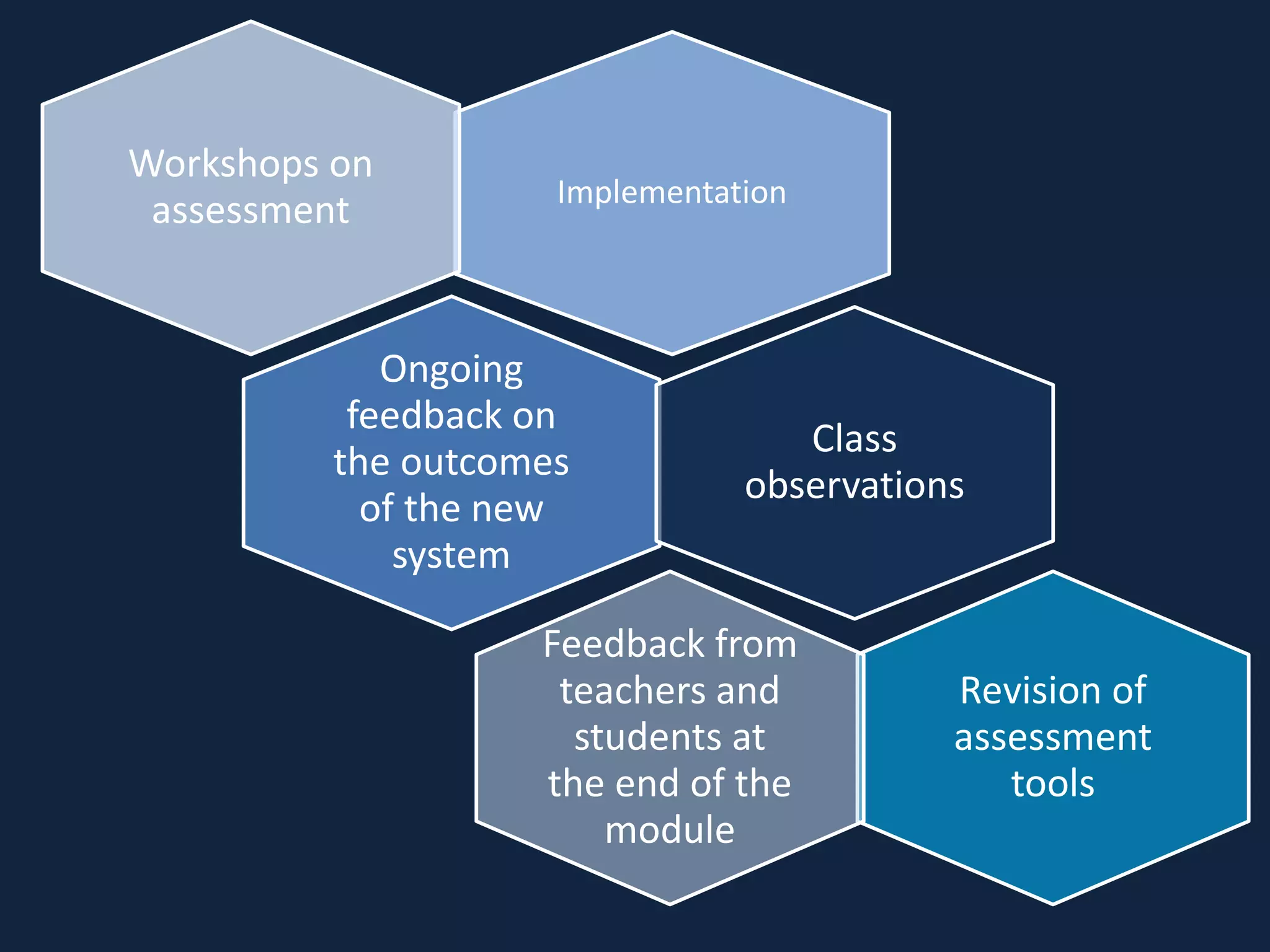
Implementation
Workshops on
assessment
Ongoing
feedback on
the outcomes
of the new
system
Class
observations
Revision of
assessment
tools
Feedback from
teachers and
students at
the end of the
module
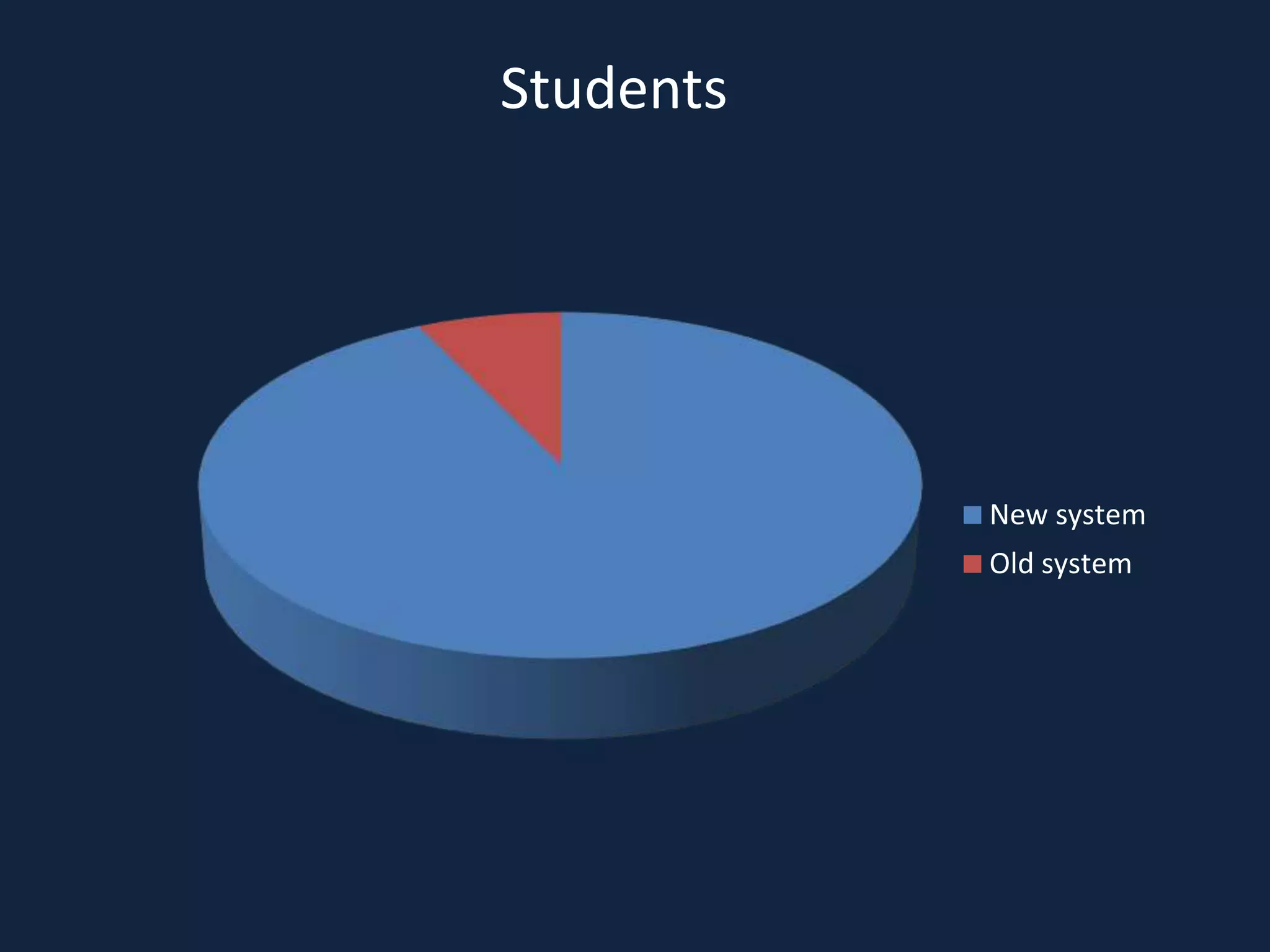
New system
Old system
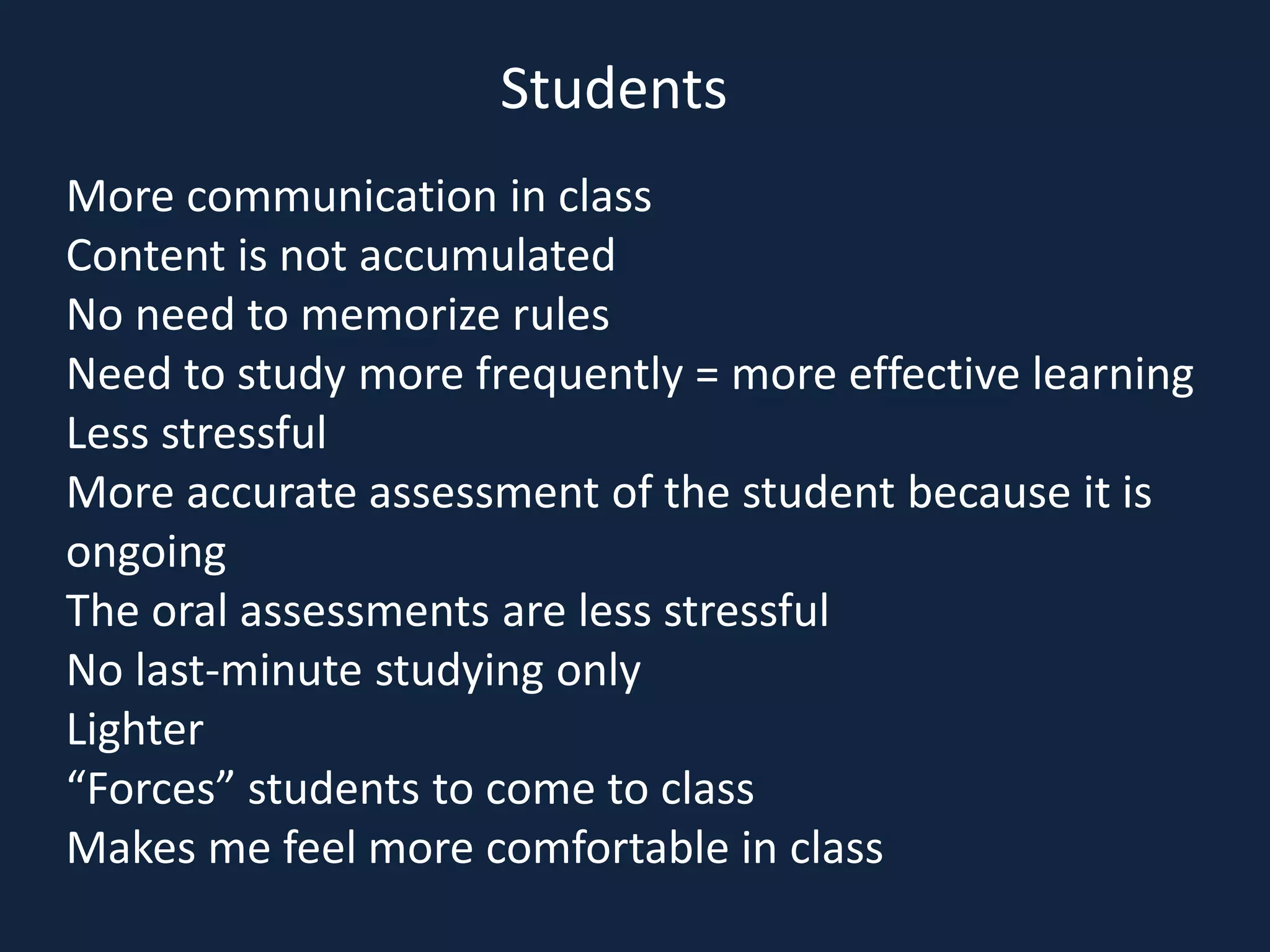
Students
More communication in class
Content is not accumulated
No need to memorize rules
Need to study more frequently = more effective learning
Less stressful
More accurate assessment of the student because it is
ongoing
The oral assessments are less stressful
No last-minute studying only
Lighter
“Forces” students to come to class
Makes me feel more comfortable in class
Students
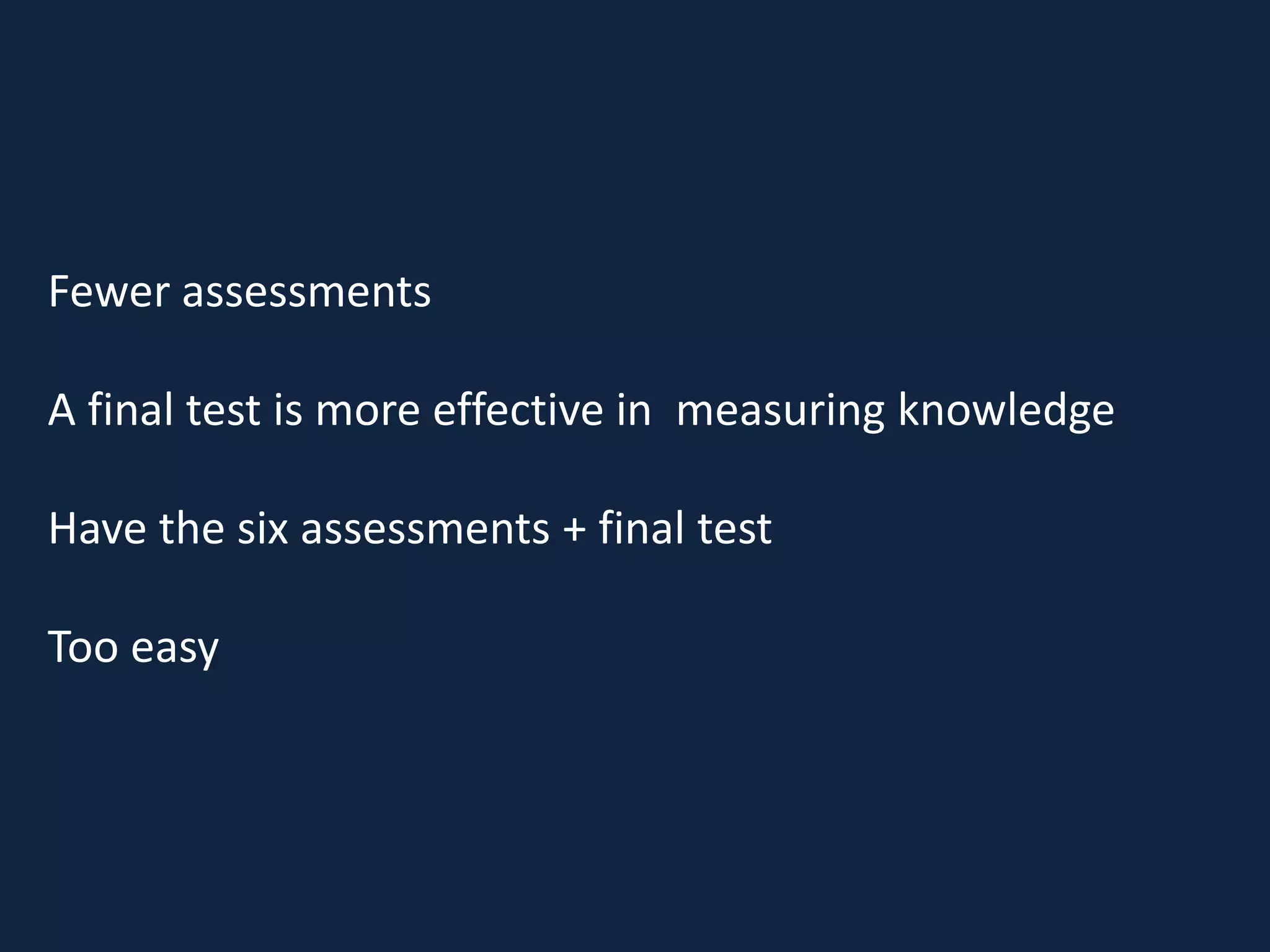
Fewer assessments
A final test is more effective in measuring knowledge
Have the six assessments + final test
Too easy
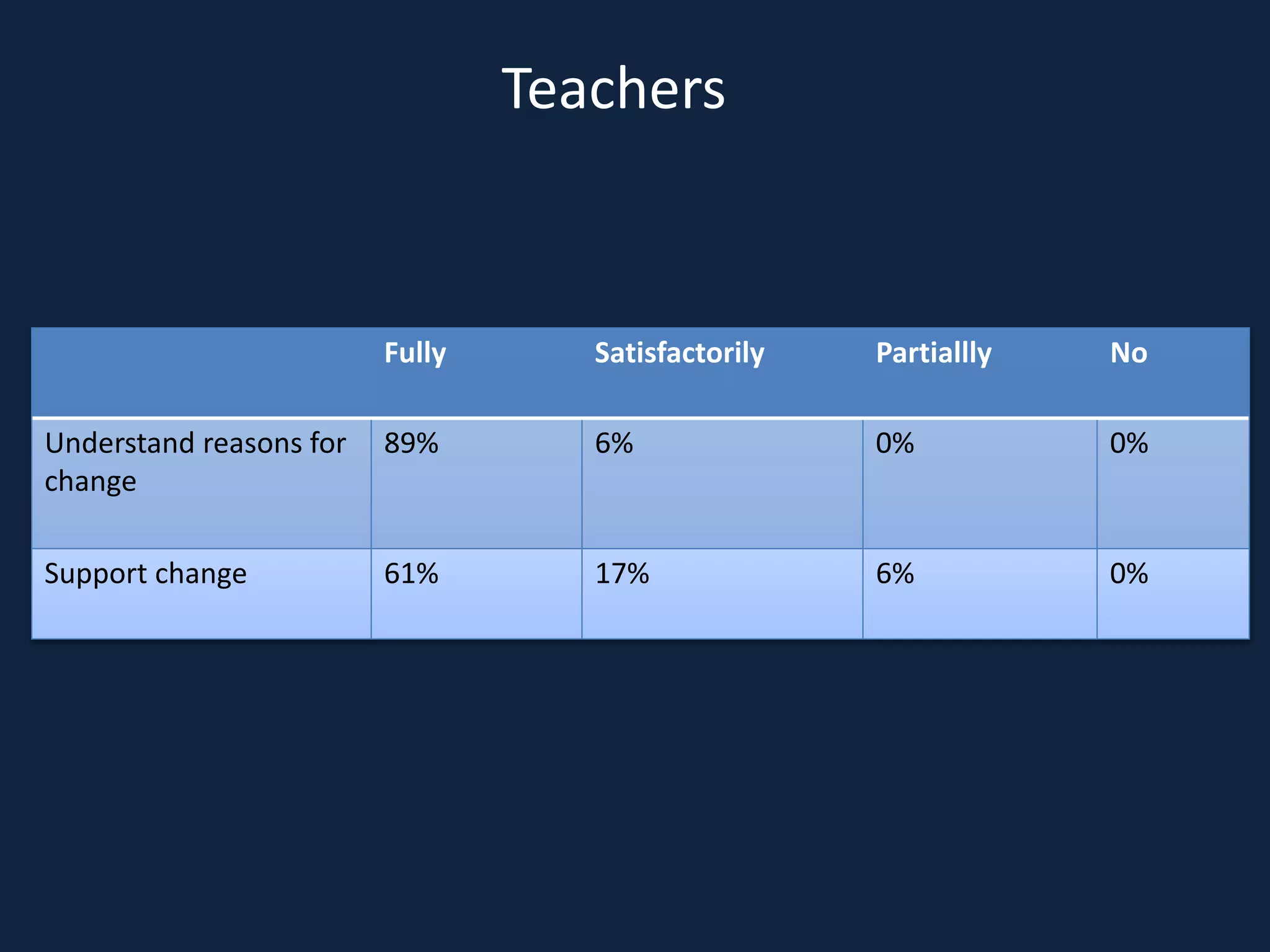
Fully Satisfactorily Partiallly No
Understand reasons for
change
89% 6% 0% 0%
Support change 61% 17% 6% 0%
Teachers
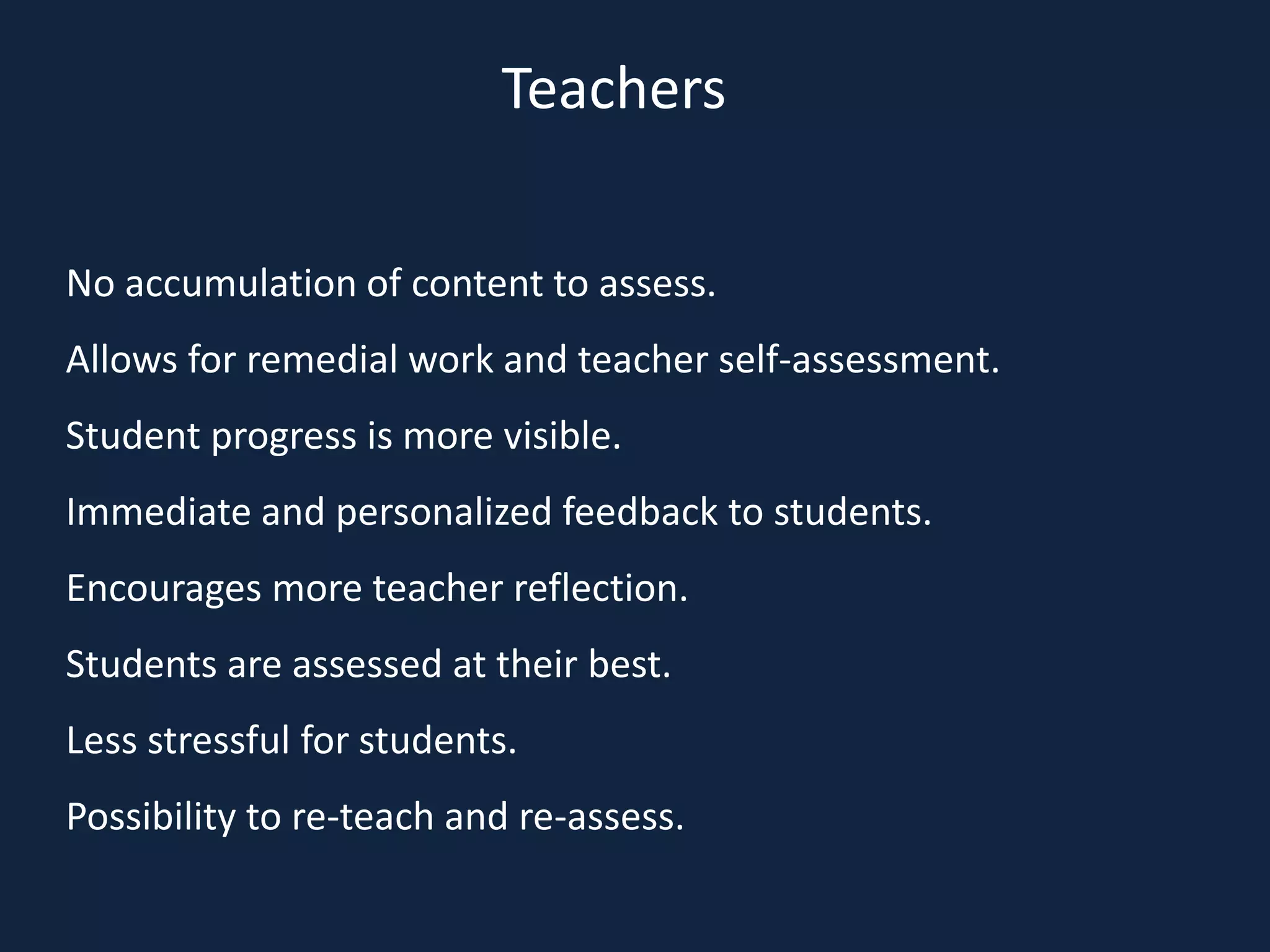
No accumulation of content to assess.
Allows for remedial work and teacher self-assessment.
Student progress is more visible.
Immediate and personalized feedback to students.
Encourages more teacher reflection.
Students are assessed at their best.
Less stressful for students.
Possibility to re-teach and re-assess.
Teachers
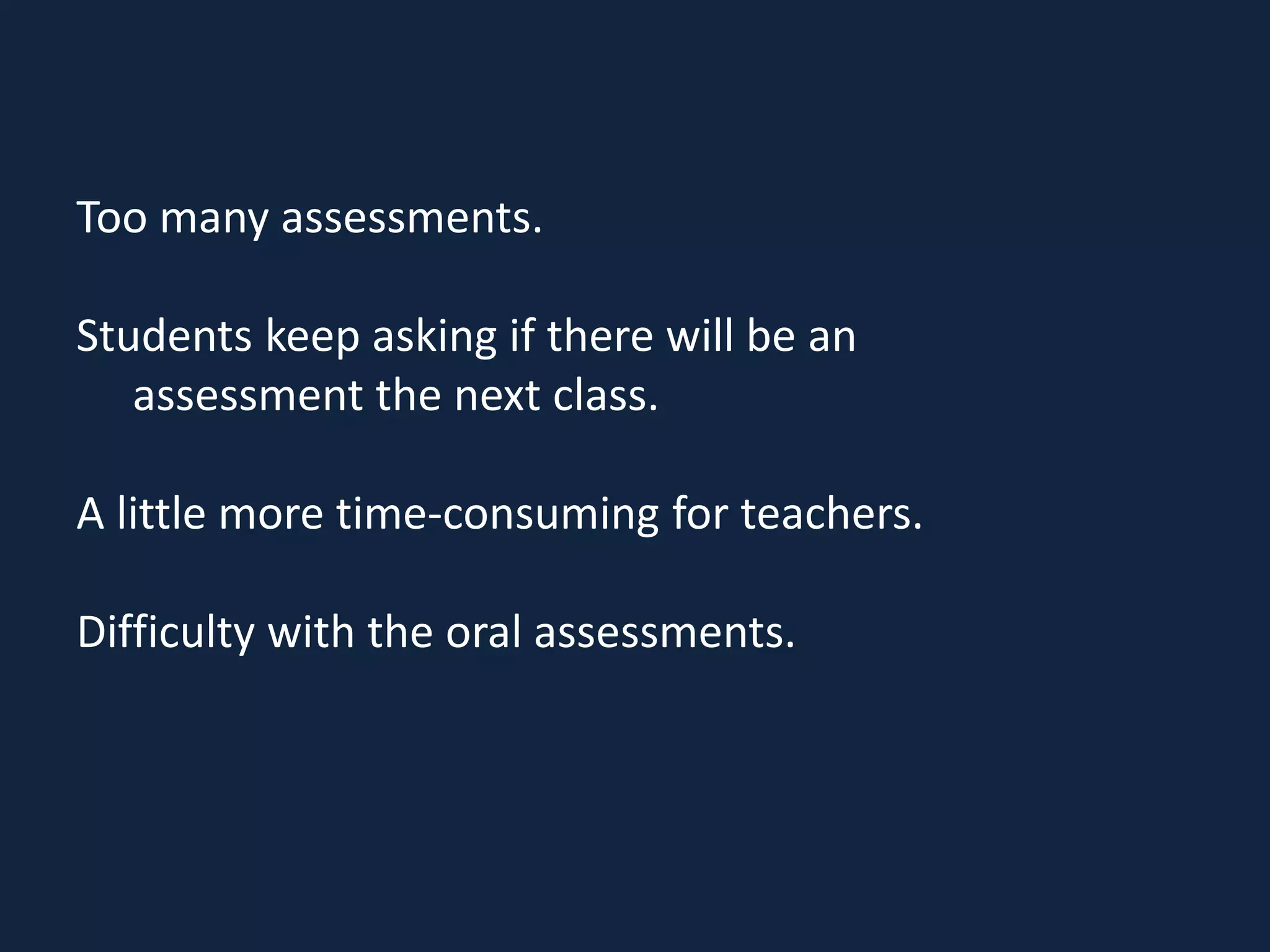
Too many assessments.
Students keep asking if there will be an
assessment the next class.
A little more time-consuming for teachers.
Difficulty with the oral assessments.
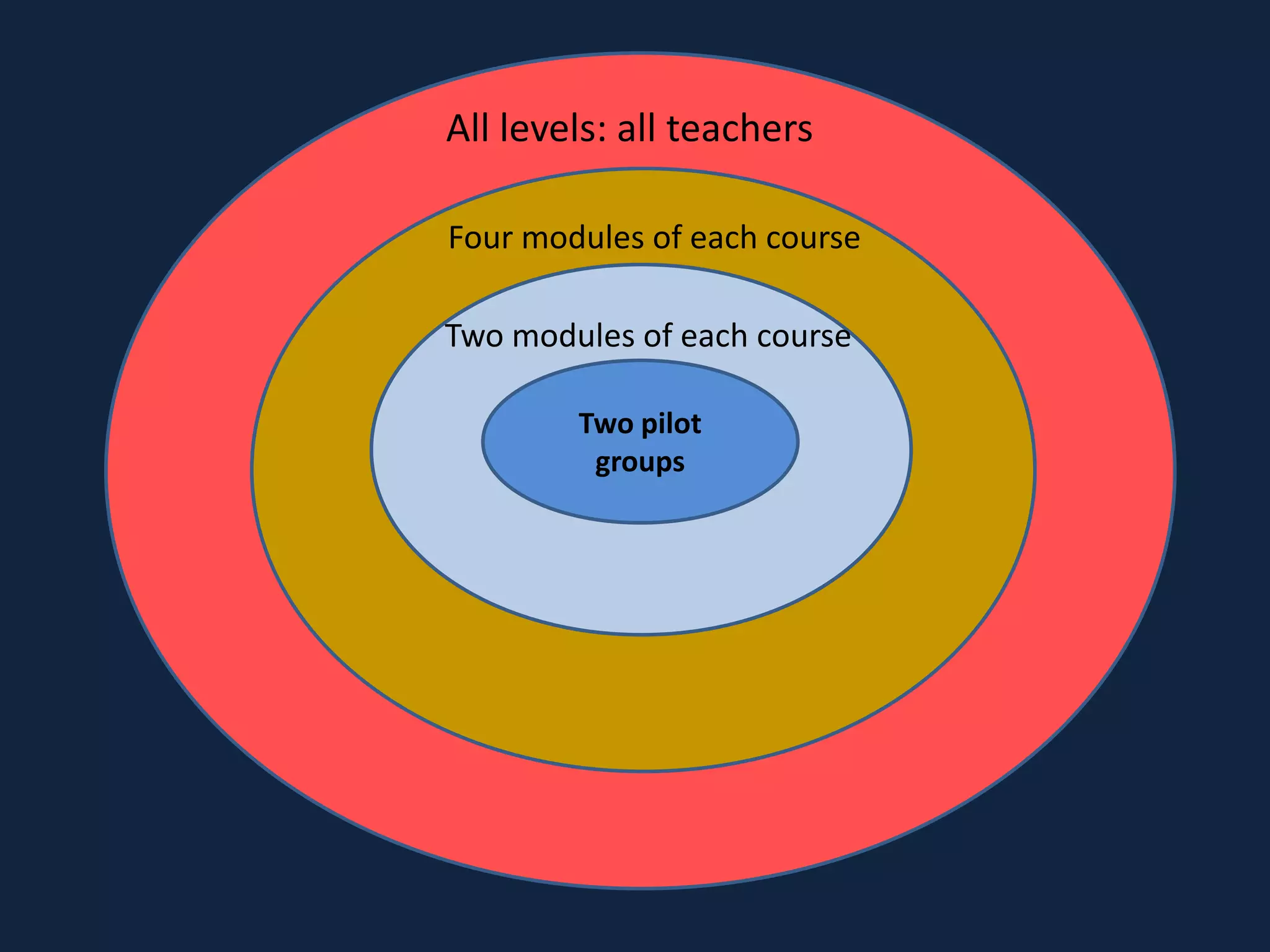
Two pilot
groups
Two modules of each course
Four modules of each course
All levels: all teachers
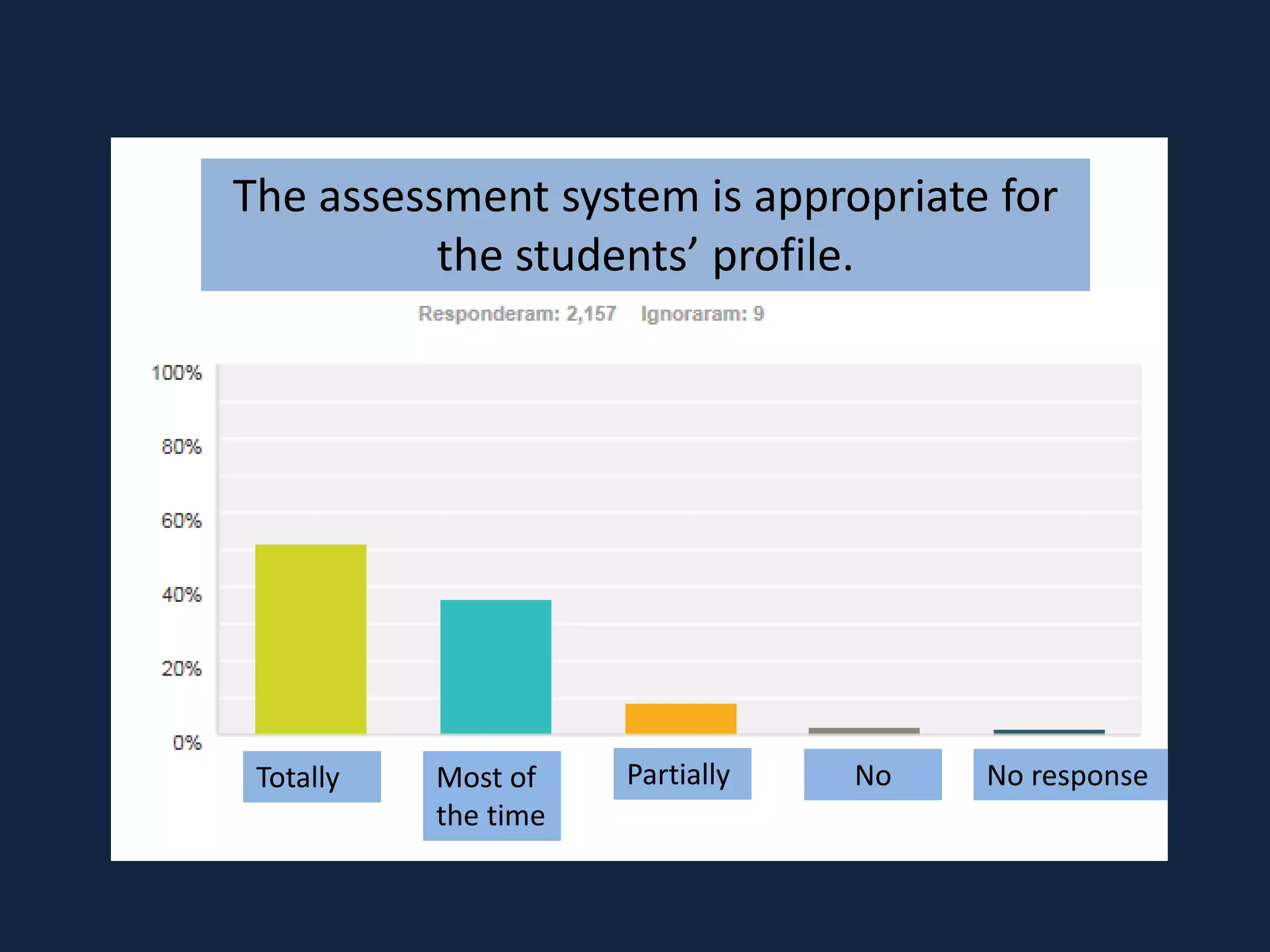
The assessment system is appropriate for
the students’ profile.
Totally Most of
the time
Partially No No response
Change in staff
Few but very loud complaints
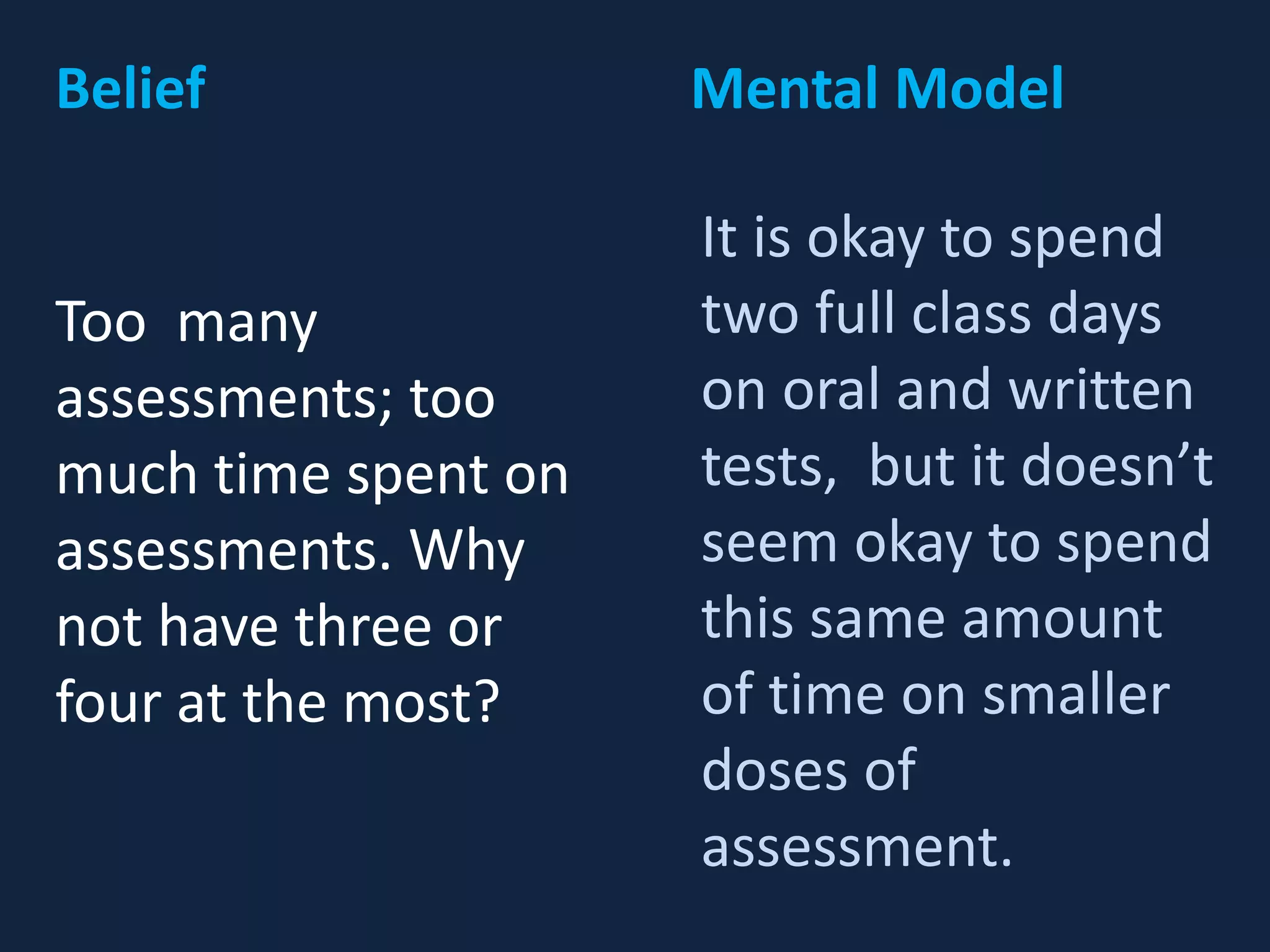
Too many assessments; too much time spent on assessments. Why
not have four or three at the most?
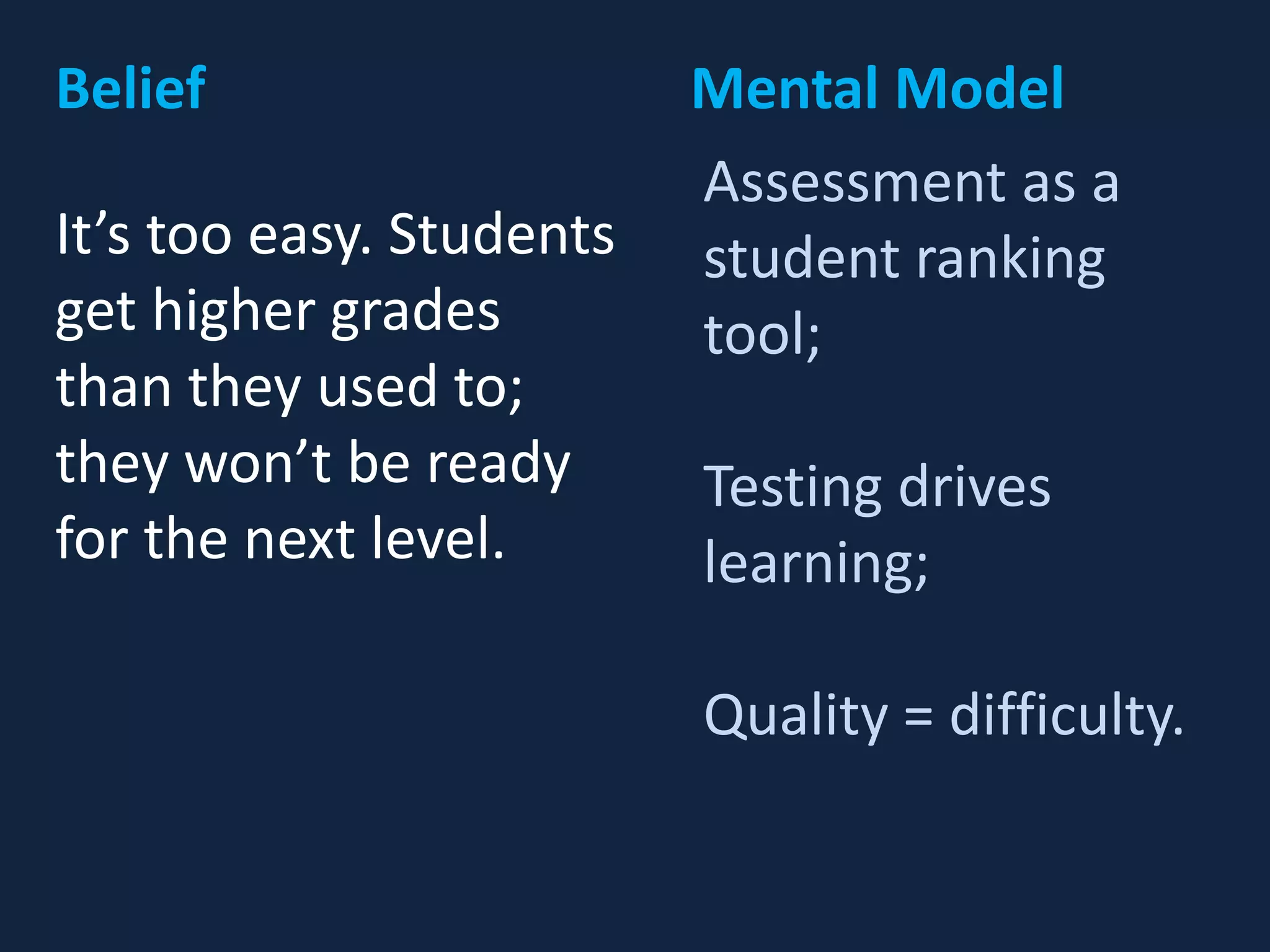
Assessments are too easy. Students get higher grades than they
used to; they won’t be ready for the next level.
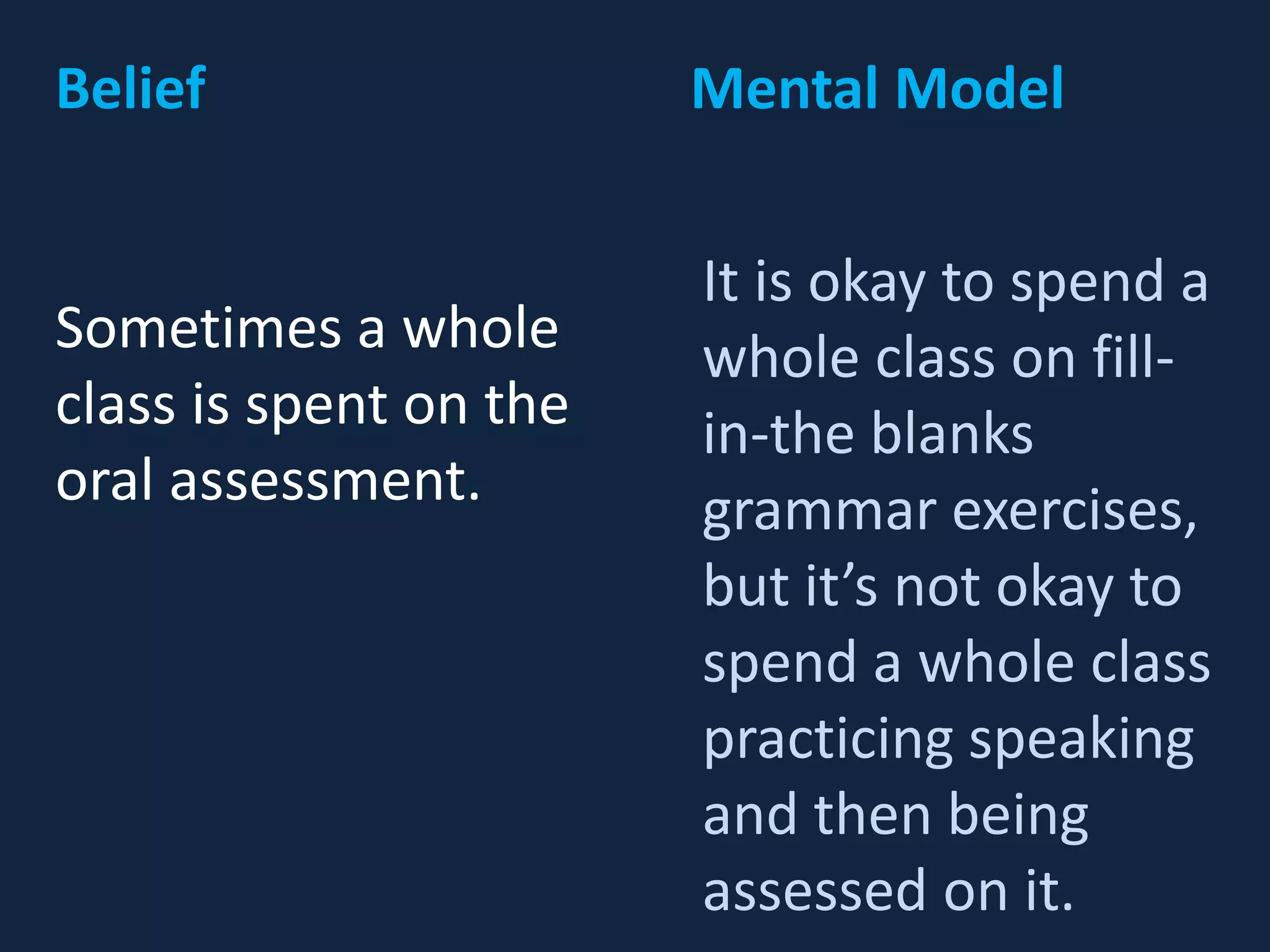
Sometimes a whole class is spent on the oral assessment.
Grammar is not being assessed.
Our mental models –
theories about the
way the world works
– influence our
actions.
Examine mental
models: Unexamined
mental models limit
people’s ability to
change.
Schools that Learn, Peter Senge
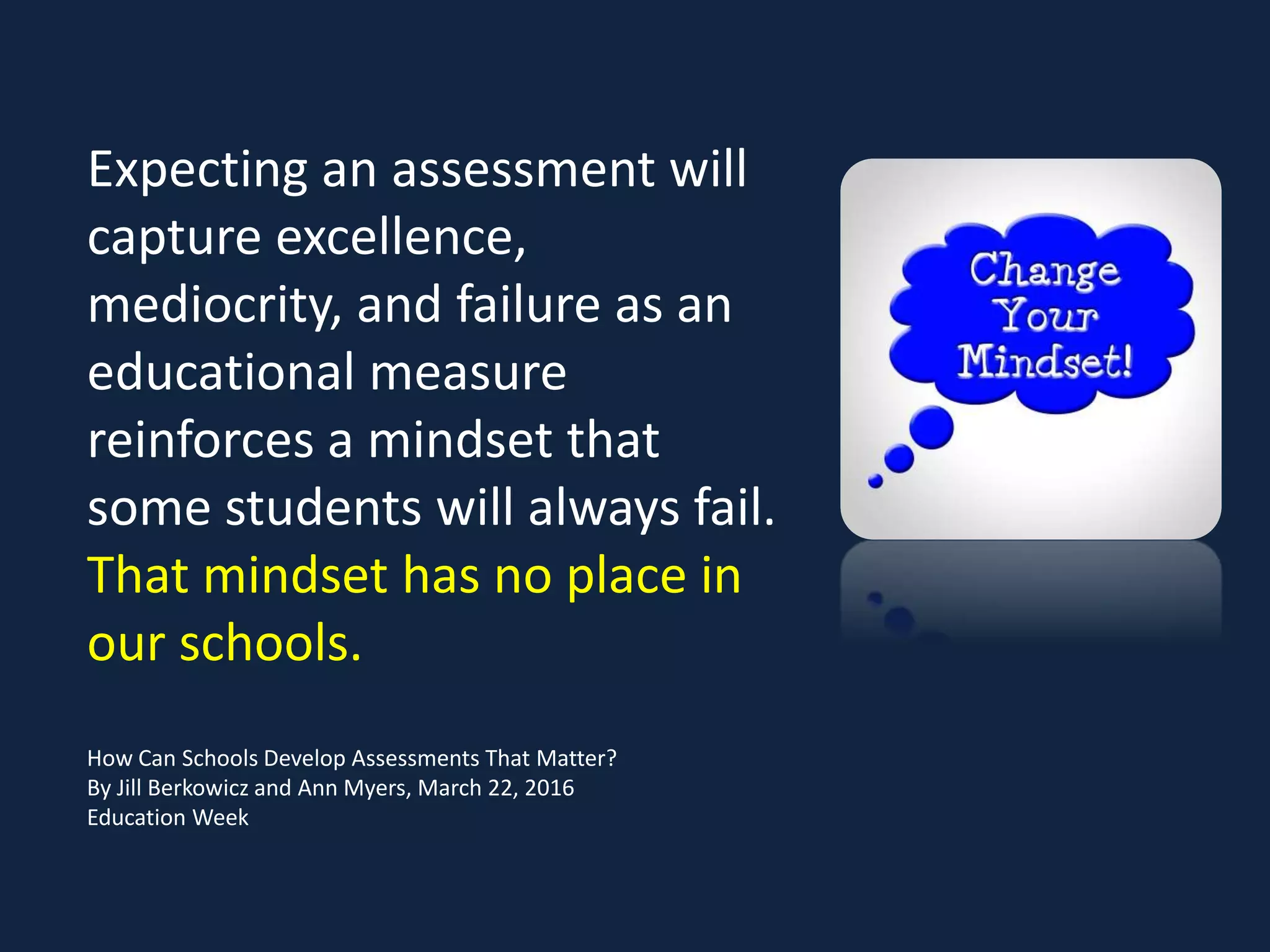
Expecting an assessment will
capture excellence,
mediocrity, and failure as an
educational measure
reinforces a mindset that
some students will always fail.
That mindset has no place in
our schools.
How Can Schools Develop Assessments That Matter?
By Jill Berkowicz and Ann Myers, March 22, 2016
Education Week
Too many
assessments; too
much time spent on
assessments. Why
not have three or
four at the most?
It is okay to spend
two full class days
on oral and written
tests, but it doesn’t
seem okay to spend
this same amount
of time on smaller
doses of
assessment.
Belief Mental Model
It’s too easy. Students
get higher grades
than they used to;
they won’t be ready
for the next level.
Assessment as a
student ranking
tool;
Testing drives
learning;
Quality = difficulty.
Belief Mental Model
Sometimes a whole
class is spent on the
oral assessment.
It is okay to spend a
whole class on fill-
in-the blanks
grammar exercises,
but it’s not okay to
spend a whole class
practicing speaking
and then being
assessed on it.
Belief Mental Model
Grammar is not being
assessed.
Grammar should be
assessed by way of
discrete grammar
items.
Belief Mental Model
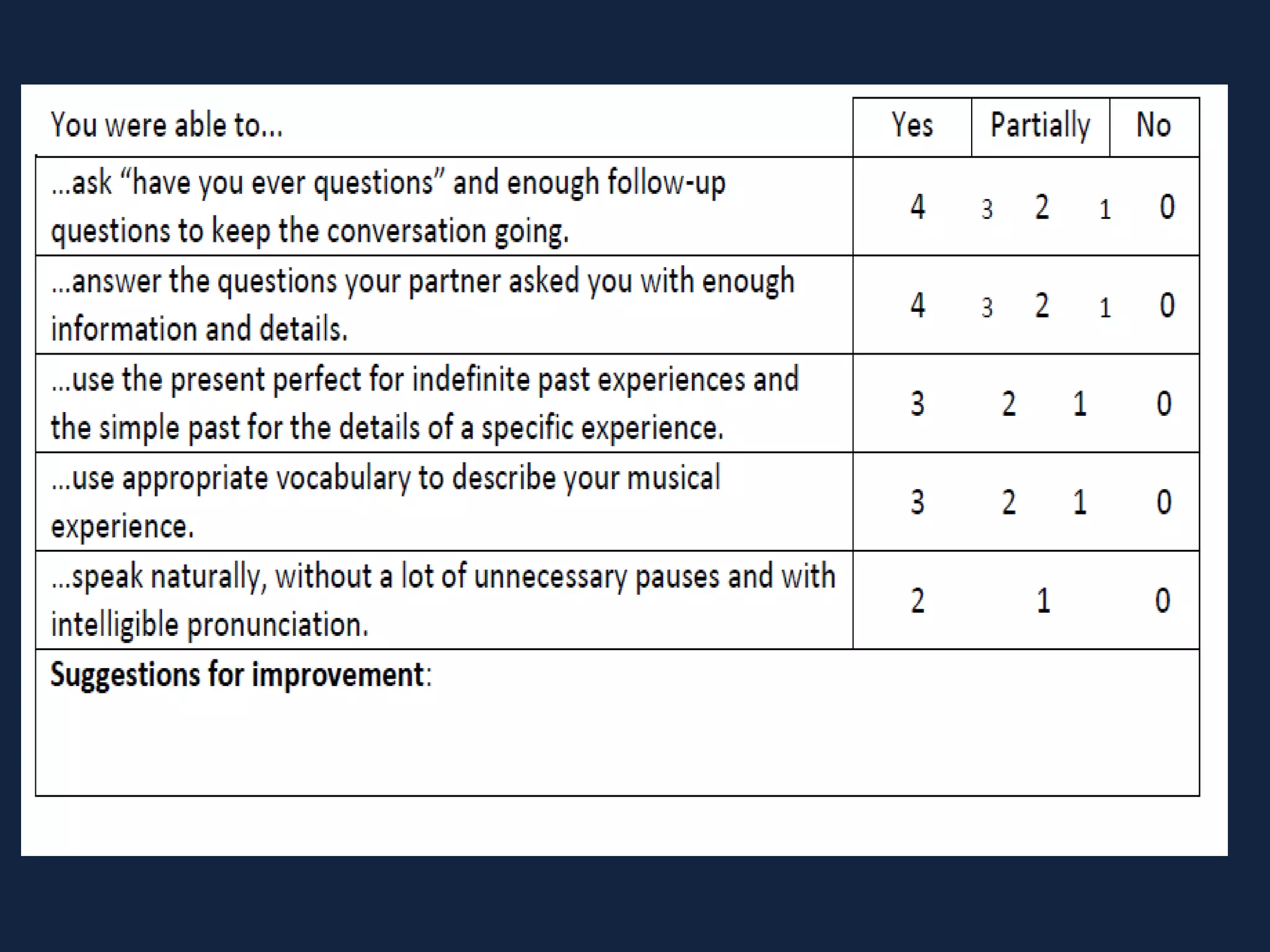
Example of assessment: Speaking
Students will be able to
talk about past
experiences related to
music and expand the
conversation by
providing details on the
experience.
Ask your partner some questions about musical experience. Begin with a “have you
ever” question and then ask some follow-up questions. Below are some ideas, but you
can create your own questions about experiences related to music.
Have you ever been to a rock/jazz/pop concert?
Have you ever played in a band?
Have you ever traveled just to go to a concert?
_____________________________________________________________?
Instructions
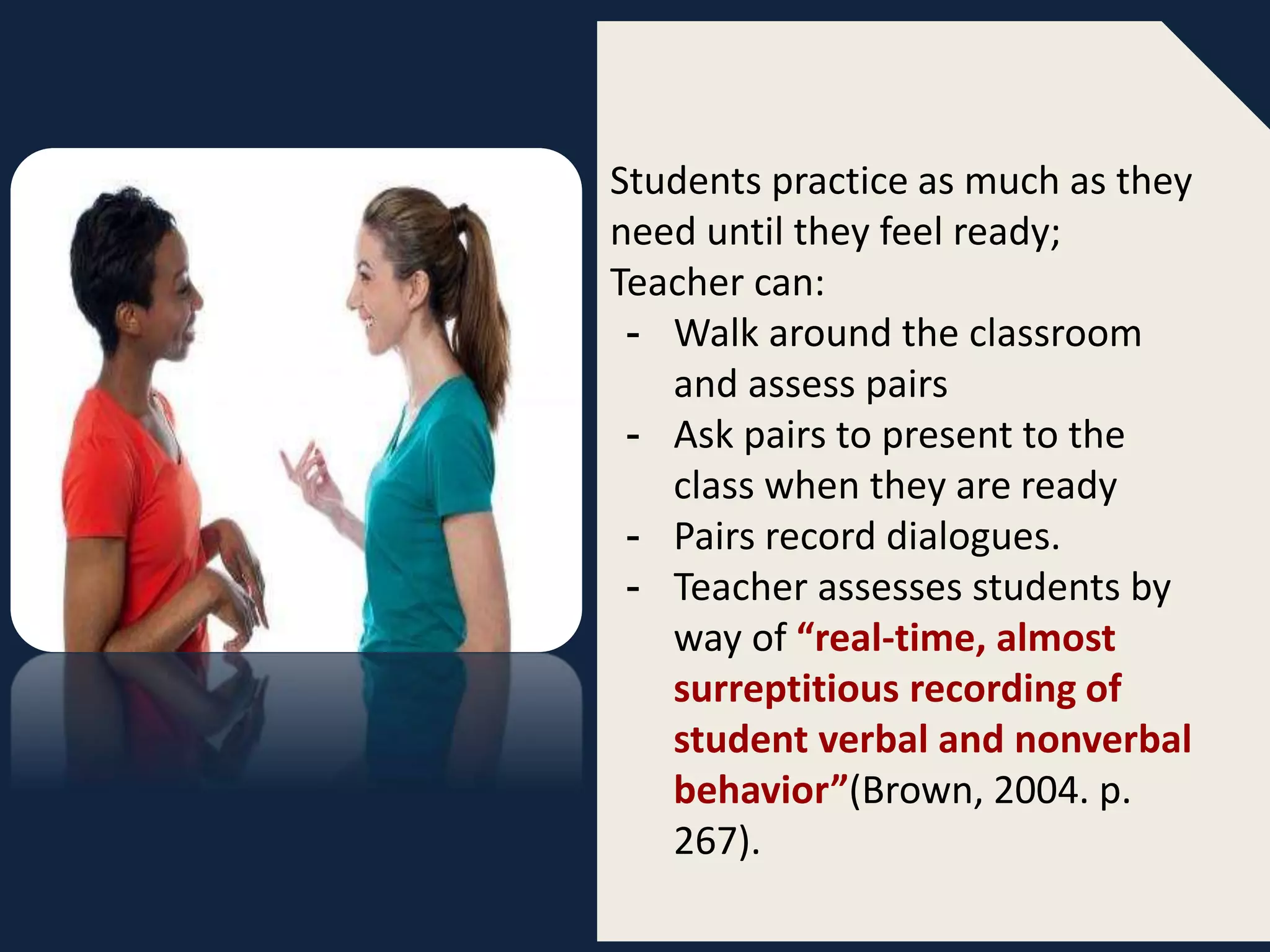
Students practice as much as they
need until they feel ready;
Teacher can:
- Walk around the classroom
and assess pairs
- Ask pairs to present to the
class when they are ready
- Pairs record dialogues.
- Teacher assesses students by
way of “real-time, almost
surreptitious recording of
student verbal and nonverbal
behavior”(Brown, 2004. p.
267).
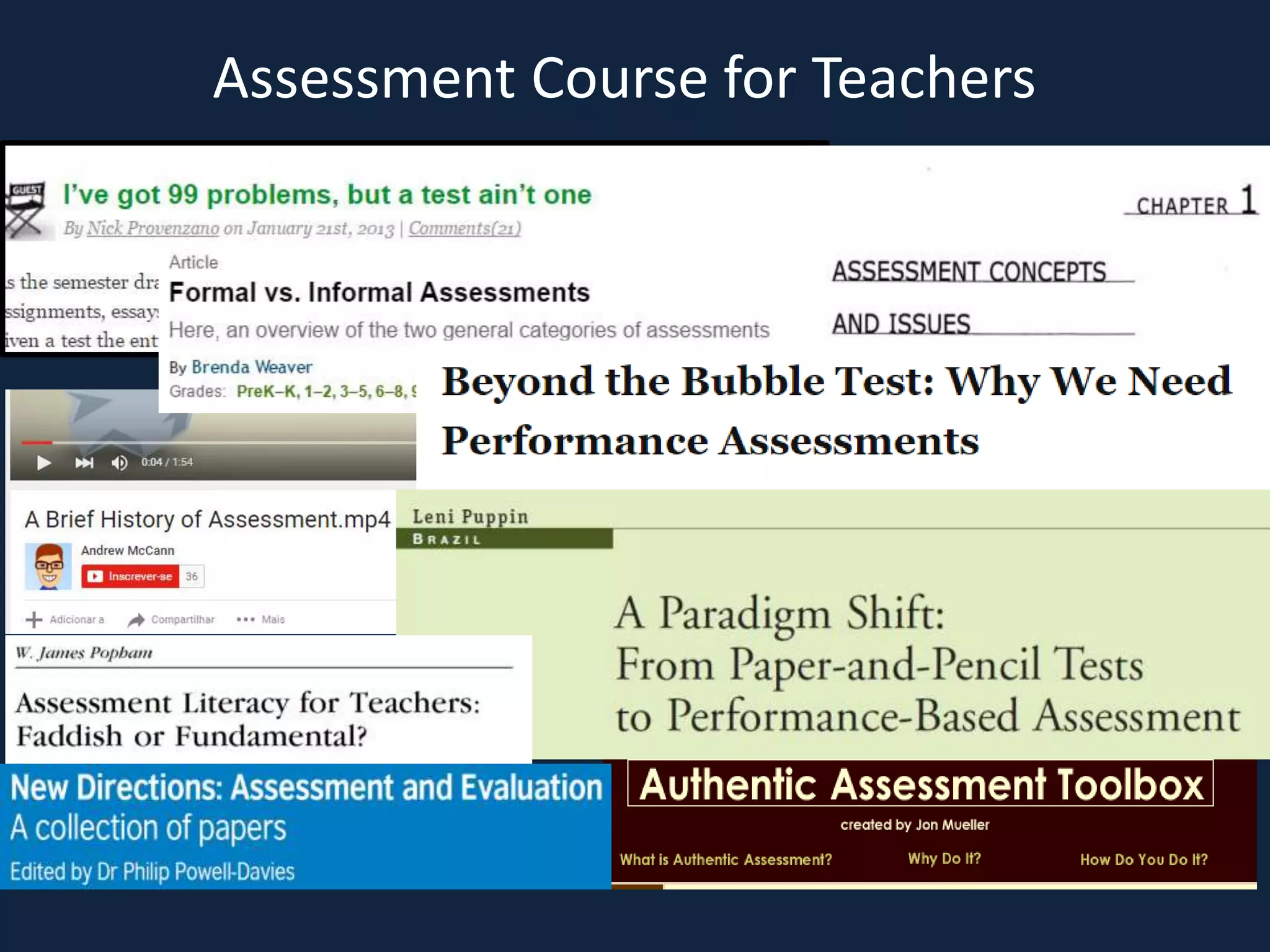
Assessment Course for Teachers
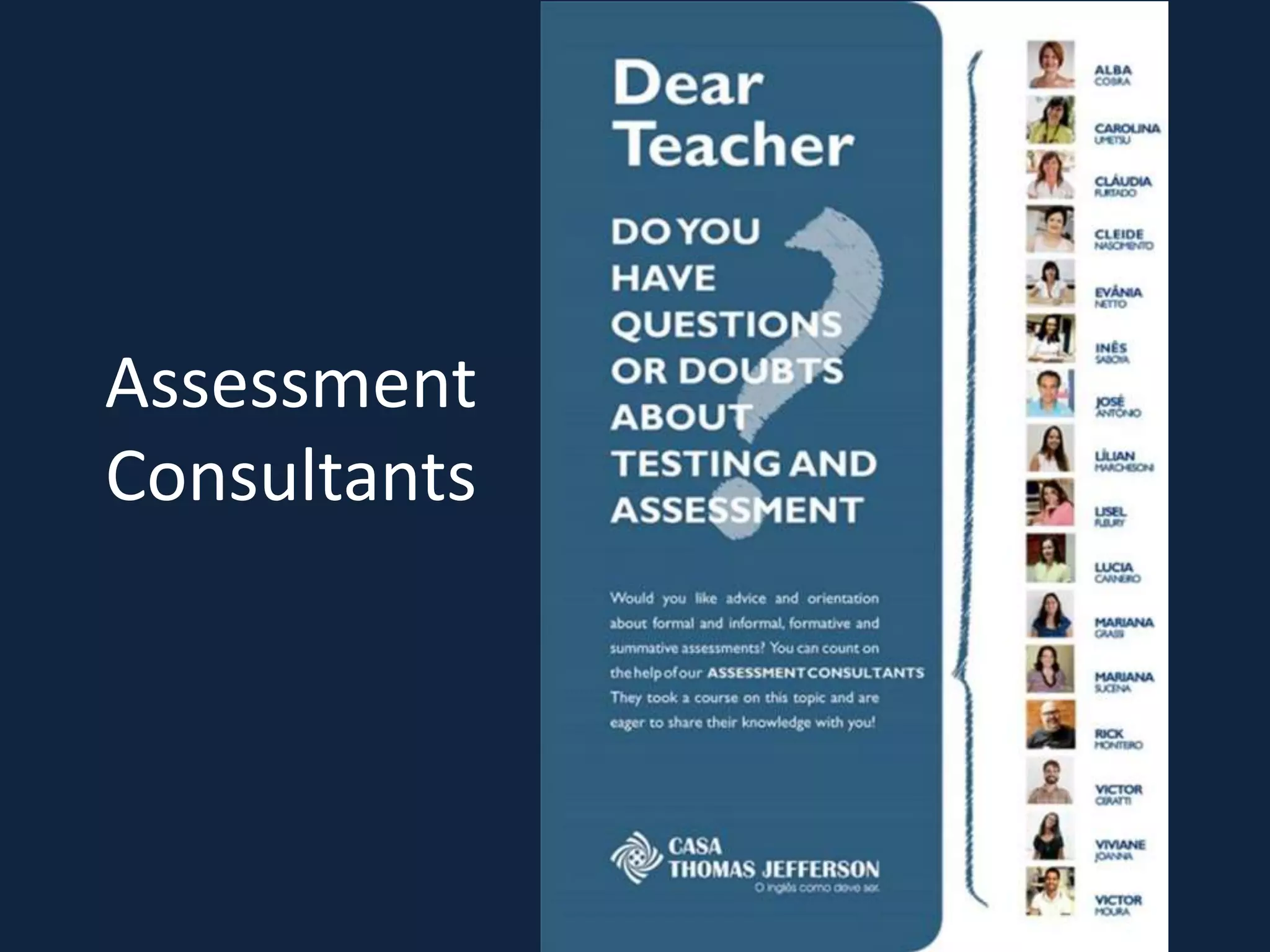
Assessment
Consultants
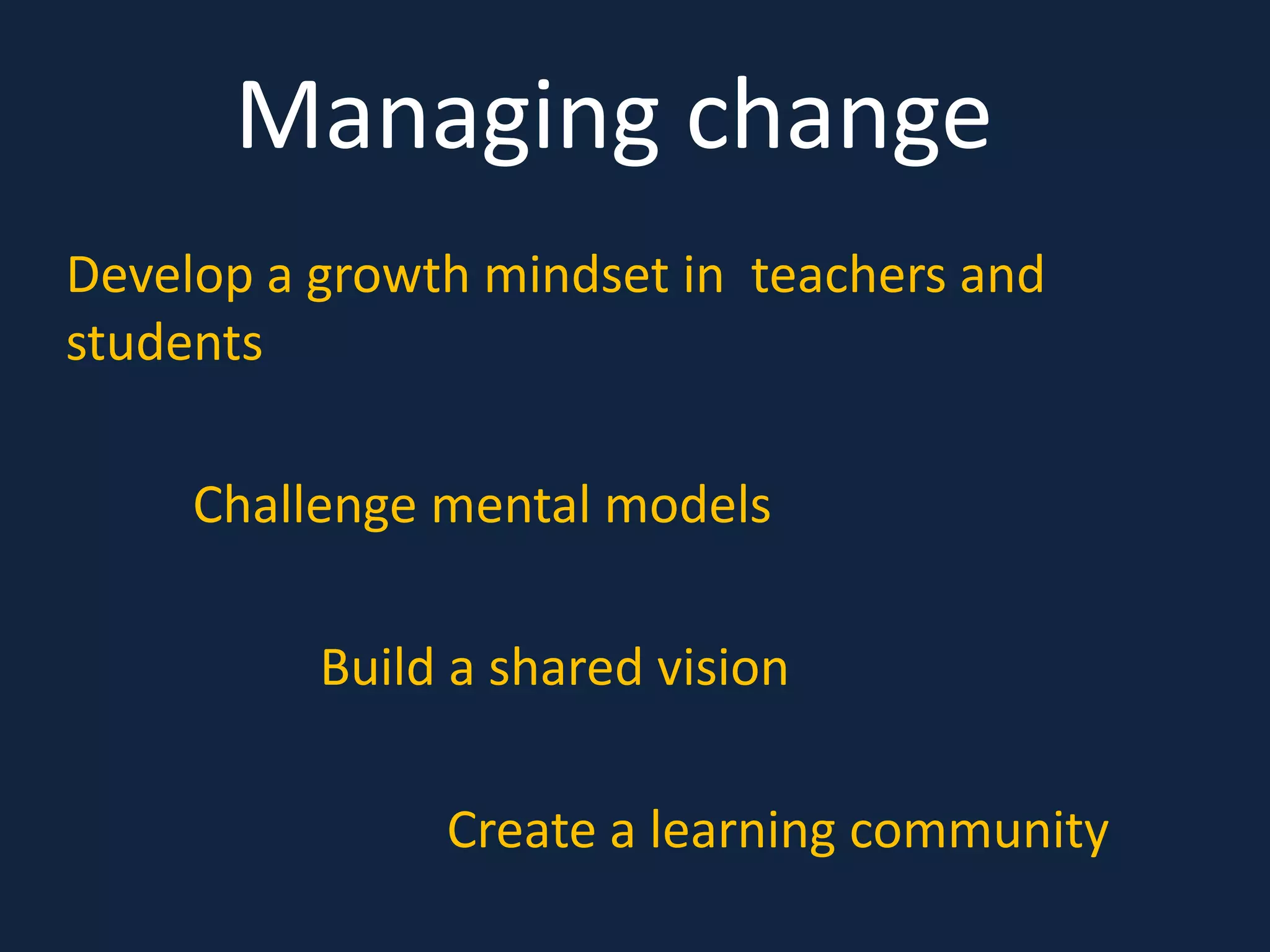
Develop a growth mindset in teachers and
students
Challenge mental models
Build a shared vision
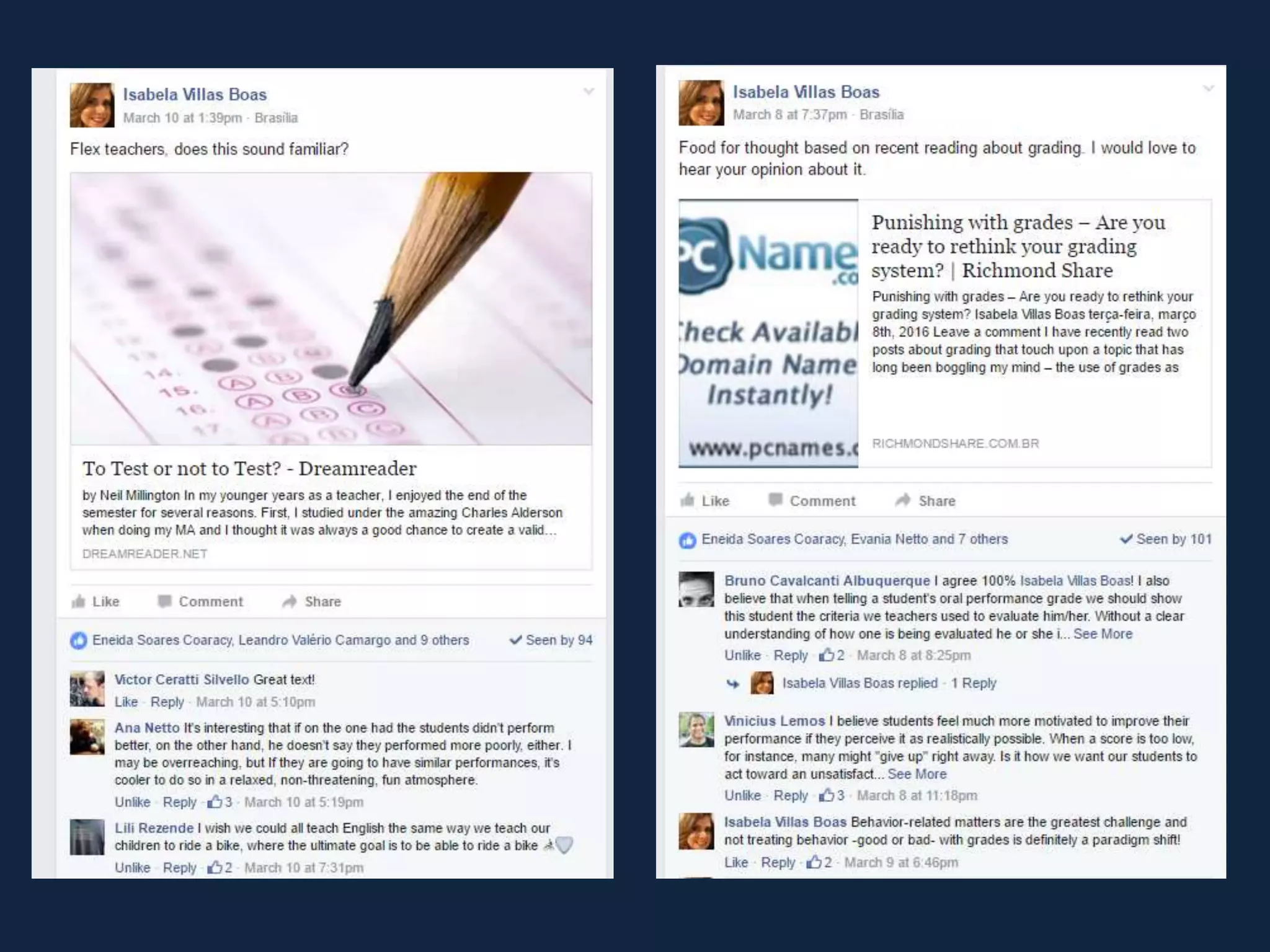
Create a learning community
Managing change
CHANGE ONE TEACHER AND ONE
STUDENT AT A TIME

Managing a paradigm shift in assessment: a matter or mindset

  • 1.
    Managing a paradigmshift in assessment – a matter of mindset Isabela Villas Boas, Casa Thomas Jefferson, Brasilia, Brazil
  • 2.
    Grade oriented Private schoolranking Public school annual evaluation Culture of teaching to the test Fierce competition to get into a good university – national examination
  • 3.
    Casa Thomas Jeffersonat a glance Founded in 1963 16,000 + students Six branches + school contracts + in- company Around 200 teachers Children - adults Basic - post-advanced Course Supervision – standardization Balanced assessment system, but with a greater emphasis on summative tests
  • 5.
    The “Flex” courses Around3,000 Ss Only adults Four ten-week modules a year Typical adult students
  • 6.
    Traditional assessment system Afterten weeks of instruction: One day for written test: reading comprehension, grammar, vocabulary; about 60% of the test focused on grammar structures and functions One day for oral test: done in pairs; students stand outside the classroom and wait for their turn (following the proficiency test model)
  • 7.
    How it allstarted - E-teacher course Assessment Summative and Formative Practices in Language Learning and Teaching
  • 8.
    Traditional assessment system Writtentest + oral test at the end of ten-week module Ten weeks of instruction: accumulation of content Focus on grammar and written exercises Student anxiety More selected-response items on the test Lack of alignment Negative washback effect
  • 9.
    Summative Assessment Formative Assessment Traditional Assessment Alternative Assessment Aims of thenew assessment system Very little feedback Actionable feedback Poor alignment Better alignment
  • 10.
    New assessment system 12 3 4 5 6 Short assessments - 10 to 20 minutes 2 oral assessments, necessarily At least 1 reading, 1 listening, and 1 writing Mostly performance assessment of grammar 100 points Last day of class: Final assessment day Ss take the assessments they missed during the module or that they would like to retake (to improve outcomes)
  • 13.
    Traditional tests administeredat the end to compare scores; comparison of final grades with typical student performance Constant student feedback Constant teacher feedback Formal survey with students at the end
  • 14.
     Students hadsimilar scores on their assessments and on the summative test  Students had similar or higher final grades than the final grades in previous modules  Students felt more at ease with the pilot system; less pressure
  • 15.
    Building a sharedvision - E-teacher course Assessment Summative and Formative Practices in Language Learning and Teaching
  • 18.
  • 19.
    Implementation Workshops on assessment Ongoing feedback on theoutcomes of the new system Class observations Revision of assessment tools Feedback from teachers and students at the end of the module
  • 21.
  • 22.
    More communication inclass Content is not accumulated No need to memorize rules Need to study more frequently = more effective learning Less stressful More accurate assessment of the student because it is ongoing The oral assessments are less stressful No last-minute studying only Lighter “Forces” students to come to class Makes me feel more comfortable in class Students
  • 23.
    Fewer assessments A finaltest is more effective in measuring knowledge Have the six assessments + final test Too easy
  • 24.
    Fully Satisfactorily PartialllyNo Understand reasons for change 89% 6% 0% 0% Support change 61% 17% 6% 0% Teachers
  • 25.
    No accumulation ofcontent to assess. Allows for remedial work and teacher self-assessment. Student progress is more visible. Immediate and personalized feedback to students. Encourages more teacher reflection. Students are assessed at their best. Less stressful for students. Possibility to re-teach and re-assess. Teachers
  • 26.
    Too many assessments. Studentskeep asking if there will be an assessment the next class. A little more time-consuming for teachers. Difficulty with the oral assessments.
  • 27.
    Two pilot groups Two modulesof each course Four modules of each course All levels: all teachers
  • 28.
    The assessment systemis appropriate for the students’ profile. Totally Most of the time Partially No No response
  • 30.
  • 31.
    Few but veryloud complaints Too many assessments; too much time spent on assessments. Why not have four or three at the most? Assessments are too easy. Students get higher grades than they used to; they won’t be ready for the next level. Sometimes a whole class is spent on the oral assessment. Grammar is not being assessed.
  • 32.
    Our mental models– theories about the way the world works – influence our actions. Examine mental models: Unexamined mental models limit people’s ability to change. Schools that Learn, Peter Senge
  • 33.
    Expecting an assessmentwill capture excellence, mediocrity, and failure as an educational measure reinforces a mindset that some students will always fail. That mindset has no place in our schools. How Can Schools Develop Assessments That Matter? By Jill Berkowicz and Ann Myers, March 22, 2016 Education Week
  • 34.
    Too many assessments; too muchtime spent on assessments. Why not have three or four at the most? It is okay to spend two full class days on oral and written tests, but it doesn’t seem okay to spend this same amount of time on smaller doses of assessment. Belief Mental Model
  • 35.
    It’s too easy.Students get higher grades than they used to; they won’t be ready for the next level. Assessment as a student ranking tool; Testing drives learning; Quality = difficulty. Belief Mental Model
  • 36.
    Sometimes a whole classis spent on the oral assessment. It is okay to spend a whole class on fill- in-the blanks grammar exercises, but it’s not okay to spend a whole class practicing speaking and then being assessed on it. Belief Mental Model
  • 37.
    Grammar is notbeing assessed. Grammar should be assessed by way of discrete grammar items. Belief Mental Model
  • 38.
    Example of assessment:Speaking Students will be able to talk about past experiences related to music and expand the conversation by providing details on the experience.
  • 39.
    Ask your partnersome questions about musical experience. Begin with a “have you ever” question and then ask some follow-up questions. Below are some ideas, but you can create your own questions about experiences related to music. Have you ever been to a rock/jazz/pop concert? Have you ever played in a band? Have you ever traveled just to go to a concert? _____________________________________________________________? Instructions
  • 40.
    Students practice asmuch as they need until they feel ready; Teacher can: - Walk around the classroom and assess pairs - Ask pairs to present to the class when they are ready - Pairs record dialogues. - Teacher assesses students by way of “real-time, almost surreptitious recording of student verbal and nonverbal behavior”(Brown, 2004. p. 267).
  • 42.
  • 43.
  • 45.
    Develop a growthmindset in teachers and students Challenge mental models Build a shared vision Create a learning community Managing change
  • 46.
    CHANGE ONE TEACHERAND ONE STUDENT AT A TIME