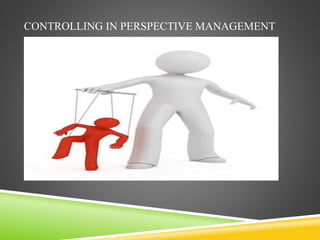



CONTROLLING IN PERSPECTIVE MANAGEMENT
TEAM MEMBERS
Mugdha Pednekar
Sana Khan
Aisha Khan
Tamseel Shahajahan
Rameez Bagban
 WHAT
 WHY
 HOW
DEFINITION OF CONTROLLING
“Controlling is determining what is being
accomplished, that is, evaluating the performance and
if necessary, applying corrective measures so that
performance takes place according to plans.”
–George Terry.
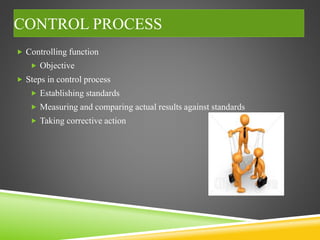
CONTROL PROCESS
 Controlling function
 Objective
 Steps in control process
 Establishing standards
 Measuring and comparing actual results against standards
 Taking corrective action
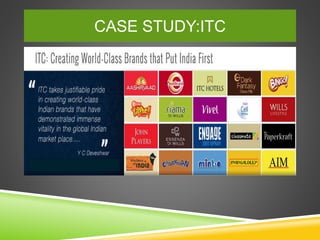
CASE STUDY:ITC
ITC’S VISION AND MISSION
THE ITC VISION »
Sustain ITC's position as one of
India's most valuable
corporations through world class
performance, creating growing
value for the Indian economy
and the Company's stakeholders
THE ITC MISSION »
To enhance the wealth
generating capability of the
enterprise in a globalising
environment, delivering superior
and sustainable stakeholder
value
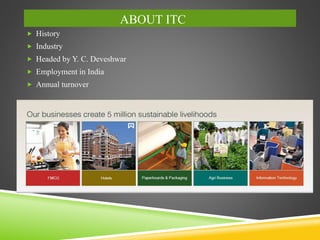
ABOUT ITC
 History
 Industry
 Headed by Y. C. Deveshwar
 Employment in India
 Annual turnover
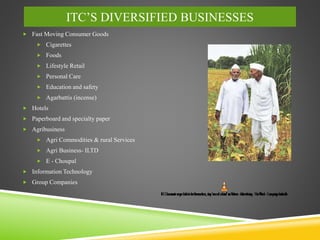
ITC’S DIVERSIFIED BUSINESSES
 Fast Moving Consumer Goods
 Cigarettes
 Foods
 Lifestyle Retail
 Personal Care
 Education and safety
 Agarbattis (incense)
 Hotels
 Paperboard and specialty paper
 Agribusiness
 Agri Commodities & rural Services
 Agri Business- ILTD
 E - Choupal
 Information Technology
 Group Companies
CONTROL TECHNIQUES
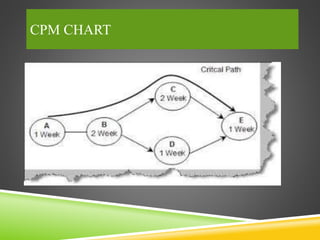
 CPM (Critical Path Method):
 It helps reduce project duration and cost.
 It reveals all the dependencies in the organization.
 Too much of confusion when dealing with a complex project.
 PERT (Program Evaluation and Review Technique)
 The large amount of project data can be organized.
 Visible critical path
 PERT is not easily scalable for smaller projects.
CPM CHART
CONTROL TECHNIQUES
 Direct supervision and observation:
 The managers himself observes the employee and their work.
 Many problems are solved during the supervision.
 Auditing:
 Operational auditing
 External auditing
BENEFITS OF CONTROL SYSTEM
 Increase productivity
 Reduce defects
 Helps meet deadlines
 Facilitates communication
 Improves safety
 Lowers cost
 Gives the workers control over their environment
PROBLEMS IN CONTROL PROCESS
 Magnitude of change
 Time rate of change
 Information Overload
 Erroneous Standards
 Workers Resistance
WHAT ITC DO TO CONTROL QUALITY
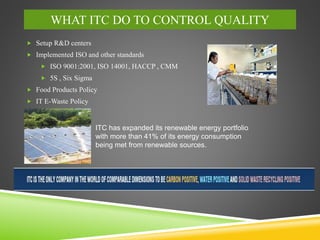
 Setup R&D centers
 Implemented ISO and other standards
 ISO 9001:2001, ISO 14001, HACCP , CMM
 5S , Six Sigma
 Food Products Policy
 IT E-Waste Policy
ITC has expanded its renewable energy portfolio
with more than 41% of its energy consumption
being met from renewable sources.
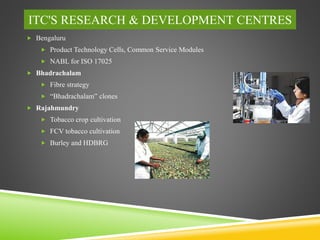
ITC'S RESEARCH & DEVELOPMENT CENTRES
 Bengaluru
 Product Technology Cells, Common Service Modules
 NABL for ISO 17025
 Bhadrachalam
 Fibre strategy
 “Bhadrachalam” clones
 Rajahmundry
 Tobacco crop cultivation
 FCV tobacco cultivation
 Burley and HDBRG
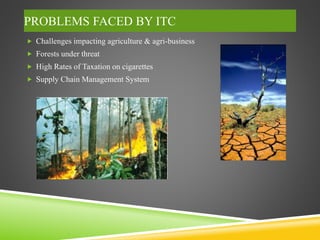
PROBLEMS FACED BY ITC
 Challenges impacting agriculture & agri-business
 Forests under threat
 High Rates of Taxation on cigarettes
 Supply Chain Management System
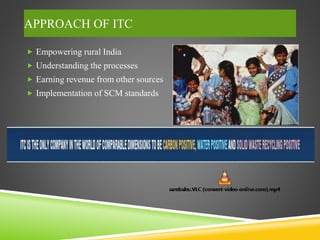
APPROACH OF ITC
 Empowering rural India
 Understanding the processes
 Earning revenue from other sources
 Implementation of SCM standards
SUMMARY
 Answered What, Why, How.
 Objective of control system.
 Steps involved.
 Benefits of control system.
 Problems in control system.
 Control techniques.
 Case Study
ANY QUESTIONS

Managerial control ITC casestudy

  • 1.
  • 2.
    TEAM MEMBERS Mugdha Pednekar SanaKhan Aisha Khan Tamseel Shahajahan Rameez Bagban
  • 3.
  • 4.
    DEFINITION OF CONTROLLING “Controllingis determining what is being accomplished, that is, evaluating the performance and if necessary, applying corrective measures so that performance takes place according to plans.” –George Terry.
  • 5.
    CONTROL PROCESS  Controllingfunction  Objective  Steps in control process  Establishing standards  Measuring and comparing actual results against standards  Taking corrective action
  • 6.
  • 7.
    ITC’S VISION ANDMISSION THE ITC VISION » Sustain ITC's position as one of India's most valuable corporations through world class performance, creating growing value for the Indian economy and the Company's stakeholders THE ITC MISSION » To enhance the wealth generating capability of the enterprise in a globalising environment, delivering superior and sustainable stakeholder value
  • 8.
    ABOUT ITC  History Industry  Headed by Y. C. Deveshwar  Employment in India  Annual turnover
  • 9.
    ITC’S DIVERSIFIED BUSINESSES Fast Moving Consumer Goods  Cigarettes  Foods  Lifestyle Retail  Personal Care  Education and safety  Agarbattis (incense)  Hotels  Paperboard and specialty paper  Agribusiness  Agri Commodities & rural Services  Agri Business- ILTD  E - Choupal  Information Technology  Group Companies
  • 10.
    CONTROL TECHNIQUES  CPM(Critical Path Method):  It helps reduce project duration and cost.  It reveals all the dependencies in the organization.  Too much of confusion when dealing with a complex project.  PERT (Program Evaluation and Review Technique)  The large amount of project data can be organized.  Visible critical path  PERT is not easily scalable for smaller projects.
  • 11.
  • 12.
    CONTROL TECHNIQUES  Directsupervision and observation:  The managers himself observes the employee and their work.  Many problems are solved during the supervision.  Auditing:  Operational auditing  External auditing
  • 13.
    BENEFITS OF CONTROLSYSTEM  Increase productivity  Reduce defects  Helps meet deadlines  Facilitates communication  Improves safety  Lowers cost  Gives the workers control over their environment
  • 14.
    PROBLEMS IN CONTROLPROCESS  Magnitude of change  Time rate of change  Information Overload  Erroneous Standards  Workers Resistance
  • 15.
    WHAT ITC DOTO CONTROL QUALITY  Setup R&D centers  Implemented ISO and other standards  ISO 9001:2001, ISO 14001, HACCP , CMM  5S , Six Sigma  Food Products Policy  IT E-Waste Policy ITC has expanded its renewable energy portfolio with more than 41% of its energy consumption being met from renewable sources.
  • 16.
    ITC'S RESEARCH &DEVELOPMENT CENTRES  Bengaluru  Product Technology Cells, Common Service Modules  NABL for ISO 17025  Bhadrachalam  Fibre strategy  “Bhadrachalam” clones  Rajahmundry  Tobacco crop cultivation  FCV tobacco cultivation  Burley and HDBRG
  • 17.
    PROBLEMS FACED BYITC  Challenges impacting agriculture & agri-business  Forests under threat  High Rates of Taxation on cigarettes  Supply Chain Management System
  • 18.
    APPROACH OF ITC Empowering rural India  Understanding the processes  Earning revenue from other sources  Implementation of SCM standards
  • 19.
    SUMMARY  Answered What,Why, How.  Objective of control system.  Steps involved.  Benefits of control system.  Problems in control system.  Control techniques.  Case Study
  • 20.

Editor's Notes

  • #6 Controlling is determining what is being accomplished, that is, evaluating the performance and if necessary, applying corrective measures so that performance takes place according to plans. –George Terry.