1. Introduction to Management
Management is the organizational process that includes strategic planning, setting objectives,
managing resources, deploying the human and financial assets needed to achieve objectives,
and measuring results. Management also includes recording and storing facts and information
for later use or for others within the organization. Management functions are not limited to
managers and supervisors. Every member of the organization has some management and
reporting functions as part of their job.
2. Four Functions of Management
2.1.Planning
Planning is the function of management that involves setting objectives and determining a
course of action for achieving those objectives. Planning requires that managers be aware of
environmental conditions facing their organization and forecast future conditions. It also
requires that managers be good decision makers.Planning is a process consisting of several
steps. The process begins with environmental scanning which simply means that planners
must be aware of the critical contingencies facing their organization in terms of economic
conditions, their competitors, and their customers. Planners must then attempt to forecast
future conditions. These forecasts form the basis for planning.
Planners must establish objectives, which are statements of what needs to be achieved and
when. Planners must then identify alternative courses of action for achieving objectives. After
evaluating the various alternatives, planners must make decisions about the best courses of
action for achieving objectives. They must then formulate necessary steps and ensure
effective implementation of plans. Finally, planners must constantly evaluate the success of
their plans and take corrective action when necessary.There are many different types of plans
and planning. Strategic planning involves analysing competitive opportunities and threats, as
well as the strengths and weaknesses of the organization, and then determining how to
position the organization to compete effectively in their environment. Strategic planning has
a long time frame, often three years or more. Strategic planning generally includes the entire
organization and includes formulation of objectives. Strategic planning is often based on the
organization’s mission, which is its fundamental reason for existence. An organization’s top
management most often conducts strategic planning.
Tactical planning is intermediate-range (one to three years) planning that is designed to
develop relatively concrete and specific means to implement the strategic plan. Middle-level
managers often engage in tactical planning.
Operational planning generally assumes the existence of organization-wide or subunit goals
and objectives and specifies ways to achieve them. Operational planning is short-range (less
than a year) planning that is designed to develop specific action steps that support the
strategic and tactical plans
2.2.Organizing
Organizing is the function of management that involves developing an organizational
structure and allocating human resources to ensure the accomplishment of objectives. The
structure of the organization is the framework within which effort is coordinated. The
structure is usually represented by an organization chart, which provides a graphic
representation of the chain of command within an organization. Decisions made about the
structure of an organization are generally referred to as organizational design decisions.
Organizing also involves the design of individual jobs within the organization. Decisions
must be made about the duties and responsibilities of individual jobs, as well as the manner in
which the duties should be carried out. Decisions made about the nature of jobs within the
organization are generally called “job design” decisions.
Organizing at the level of the organization involves deciding how best to departmentalize, or
cluster, jobs into departments to coordinate effort effectively. There are many different ways
to departmentalize, including organizing by function, product, geography, or customer. Many
larger organizations use multiple methods of departmentalization.
Organizing at the level of a particular job involves how best to design individual jobs to most
effectively use human resources. Traditionally, job design was based on principles of division
of labour and specialization, which assumed that the more narrow the job content, the more
proficient the individual performing the job could become. However, experience has shown
that it is possible for jobs to become too narrow and specialized. For example, how would
you like to screw lids on jars one day after another, as you might have done many decades
ago if you worked in company that made and sold jellies and jams? When this happens,
negative outcomes result, including decreased job satisfaction and organizational
commitment, increased absenteeism, and turnover.
Recently, many organizations have attempted to strike a balance between the need for worker
specialization and the need for workers to have jobs that entail variety and autonomy. Many
jobs are now designed based on such principles as empowerment, job
enrichment and teamwork. For example, HUI Manufacturing, a custom sheet metal
fabricator, has done away with traditional “departments” to focus on listening and responding
to customer needs. From company-wide meetings to team huddles, HUI employees know and
understand their customers and how HUI might service them best
2.3.Leading
Leading involves the social and informal sources of influence that you use to inspire action
taken by others. If managers are effective leaders, their subordinates will be enthusiastic
about exerting effort to attain organizational objectives.
The behavioural sciences have made many contributions to understanding this function of
management. Personality research and studies of job attitudes provide important information
as to how managers can most effectively lead subordinates. For example, this research tells us
that to become effective at leading, managers must first understand their subordinates’
personalities, values, attitudes, and emotions.
Studies of motivation and motivation theory provide important information about the ways in
which workers can be energized to put forth productive effort. Studies of communication
provide direction as to how managers can effectively and persuasively communicate. Studies
of leadership and leadership style provide information regarding questions, such as, “What
makes a manager a good leader? And in what situations are certain leadership styles most
appropriate and effective?
2.4.Controlling
Controlling involves ensuring that performance does not deviate from standards. Controlling
consists of three steps, which include (1) establishing performance standards, (2) comparing
actual performance against standards, and (3) taking corrective action when necessary.
Performance standards are often stated in monetary terms such as revenue, costs, or profits
but may also be stated in other terms, such as units produced, number of defective products,
or levels of quality or customer service.
The measurement of performance can be done in several ways, depending on the
performance standards, including financial statements, sales reports, production results,
customer satisfaction, and formal performance appraisals. Managers at all levels engage in
the managerial function of controlling to some degree.
The managerial function of controlling should not be confused with control in the
behavioural or manipulative sense. This function does not imply that managers should
attempt to control or to manipulate the personalities, values, attitudes, or emotions of their
subordinates. Instead, this function of management concerns the manager’s role in taking
necessary actions to ensure that the work-related activities of subordinates are consistent with
and contributing toward the accomplishment of organizational and departmental objectives.
Effective controlling requires the existence of plans, since planning provides the necessary
performance standards or objectives. Controlling also requires a clear understanding of where
responsibility for deviations from standards lies. Two traditional control techniques are
budget and performance audits. An audit involves an examination and verification of records
and supporting documents. A budget audit provides information about where the organization
is with respect to what was planned or budgeted for, whereas a performance audit might try
to determine whether the figures reported are a reflection of actual performance. Although
controlling is often thought of in terms of financial criteria, managers must also control
production and operations processes, procedures for delivery of services, compliance with
company policies, and many other activities within the organization.
The management functions of planning, organizing, leading, and controlling are widely
considered to be the best means of describing the manager’s job, as well as the best way to
classify accumulated knowledge about the study of management. Although there have been
tremendous changes in the environment faced by managers and the tools used by managers to
perform their roles, managers still perform these essential functions.
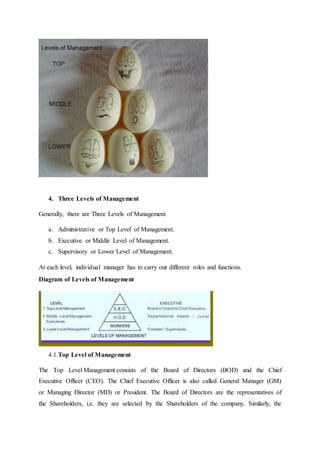
3. Levels of Management
3.1.Meaning of Levels of Management
Many managers work in an organisation. However, these managers do not work at the same
level. They work and operate at different positions. Hierarchy of these managerial positions is
called Levels of Management.
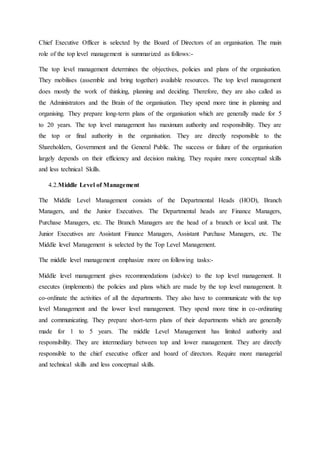
4. Three Levels of Management
Generally, there are Three Levels of Management
a. Administrative or Top Level of Management.
b. Executive or Middle Level of Management.
c. Supervisory or Lower Level of Management.
At each level, individual manager has to carry out different roles and functions.
Diagram of Levels of Management
4.1.Top Level of Management
The Top Level Management consists of the Board of Directors (BOD) and the Chief
Executive Officer (CEO). The Chief Executive Officer is also called General Manager (GM)
or Managing Director (MD) or President. The Board of Directors are the representatives of
the Shareholders, i.e. they are selected by the Shareholders of the company. Similarly, the
Chief Executive Officer is selected by the Board of Directors of an organisation. The main
role of the top level management is summarized as follows:-
The top level management determines the objectives, policies and plans of the organisation.
They mobilises (assemble and bring together) available resources. The top level management
does mostly the work of thinking, planning and deciding. Therefore, they are also called as
the Administrators and the Brain of the organisation. They spend more time in planning and
organising. They prepare long-term plans of the organisation which are generally made for 5
to 20 years. The top level management has maximum authority and responsibility. They are
the top or final authority in the organisation. They are directly responsible to the
Shareholders, Government and the General Public. The success or failure of the organisation
largely depends on their efficiency and decision making. They require more conceptual skills
and less technical Skills.
4.2.Middle Level of Management
The Middle Level Management consists of the Departmental Heads (HOD), Branch
Managers, and the Junior Executives. The Departmental heads are Finance Managers,
Purchase Managers, etc. The Branch Managers are the head of a branch or local unit. The
Junior Executives are Assistant Finance Managers, Assistant Purchase Managers, etc. The
Middle level Management is selected by the Top Level Management.
The middle level management emphasize more on following tasks:-
Middle level management gives recommendations (advice) to the top level management. It
executes (implements) the policies and plans which are made by the top level management. It
co-ordinate the activities of all the departments. They also have to communicate with the top
level Management and the lower level management. They spend more time in co-ordinating
and communicating. They prepare short-term plans of their departments which are generally
made for 1 to 5 years. The middle Level Management has limited authority and
responsibility. They are intermediary between top and lower management. They are directly
responsible to the chief executive officer and board of directors. Require more managerial
and technical skills and less conceptual skills.
4.3.Lower Level of Management
The lower level management consists of the Foremen and the Supervisors. They are selected
by the middle level management. It is also called Operative / Supervisory level or First Line
of Management.The lower level management performs following activities:-
Lower level management directs the workers / employees. They develops morale in the
workers.It maintains a link between workers and the middle level management. The lower
level management informs the workers about the decisions which are taken by the
management. They also inform the management about the performance, difficulties, feelings,
demands, etc., of the workers. They spend more time in directing and controlling. The lower
level managers make daily, weekly and monthly plans. They have limited authority but
important responsibility of getting the work done from the workers. They regularly report and
are directly responsible to the middle level management. Along with the experience and basic
management skills, they also require more technical and communication skills.
5. Media Management
A uniform definition of the term media management does not yet exist, and the field of media
management in its present form is neither clearly defined nor cohesive. Notwithstanding this
fact, among existing definitions there is a shared base concerning the business administrative
character of media management and the functional understanding of management. In the
following a number of definitions are provided.
Media Management consists of (1) the ability to supervise and motivate employees and (2)
the ability to operate facilities and resources in a cost-effective (profitable) manner.
The core task of media management is to build a bridge between the general theoretical
disciplines of management and specifies of the media industry.
“Media and internet management covers all the goal-oriented activities of planning,
organization and control within the framework of the creation and distribution processes for
information or entertainment content in media enterprises
Media management is seen as a business administration discipline that identifies and
describes strategic and operational phenomena and problems in the leadership of media
enterprises. Media management contains the functions strategic management, procurement
management, production management, organizational management and marketing of media
enterprises.
6. Objectives of Media
Outline what the media plan is expected to accomplish.Because the media objectives tell
what is to be accomplished, they do not mention specific media selection yet. Media selection
is at the strategy level; objectives deal only with what is to be done. Poor example Use
network television to provide broad national coverage Use media that will provide broad
national coverage to support national sales and distribution. Media objectives can take many
forms and cover many different areas: however, the following objectives are basic to most media
plans.
6.1.Target Audience
Whom are you trying to reach?
Reach/Frequency
Present relevant level of Reach and (Average) Frequency for a 4-week period. For example,
Reach 80%, and Average Frequency 5. First, you need to consider which one is more
important for your advertising objectives since there is trade-off between Reach and
Frequency. Do you want reach? Or more frequency? Which is more important?
6.2.General Rule of Thumb
If you want to increase broad range of awareness, coverage is more important. So, focus on
Reach. If you want to attract new customers nationally, emphasize Reach. IF you want to
hold current users in key markets, increase Frequency. If you want to focus on convincing
your target audience that your brand is better than Brand B, “exposure” is more important.
So, frequency needs to be emphasized.
How much “Frequency” is enough? ”Effective Frequency” Three plus rule
What is proper “Reach” level? Typically between 50%-80%.
Geographic coverage (Rationality):
Where advertising should be placed? Is there a need for certain geographic emphasis? For
example, top 25 or top 50 DMAs.
6.3.Creative implications
Does the copy platform or creative strategy have any implications for planning media?
(Sometimes the creative strategy, by its nature, can limit selection planning to a single
medium).
6.4.Promotion support: Include if media will be needed to support promotion effort.
Trade Communication: If applicable, indicate what media need to do to support trade
consumers.
6.5.Budget limitation: Put your working media cost here.
7. Types of media
There are different types of mass media that we are accustomed to in this day and age.
Whether it's children, young people, or adults, we've all had our share of media-related
exposure every day. Learn more about what comprises the media in our modern-day world.
Mass media refers to communication devices, which can be used to communicate and interact
with a large number of audiences in different languages. Be it the pictorial messages of the
early ages, or the high-technology media that are available today, one thing that we all agree
upon, is that mass media are an inseparable part of our lives. Entertainment and media always
go hand in hand, but in addition to the entertainment, mass media also remain to be an
effective medium for communication, dissemination of information, advertising, marketing,
and in general, for expressing and sharing views, opinions, and ideas. Mass media is a
double-edged sword which means that there are positive as well as negative influences of
media.
7.1.Print Media
Print media encompasses mass communication through printed material. It includes
newspapers, magazines, booklets and brochures, house magazines, periodicals or newsletters,
direct mailers, handbills or flyers, billboards, press releases, and books
7.1.1. Newspapers
Newspapers enjoyed the position of the most preferred medium to reach a wider audience
until electronic communication emerged on the media scene. In the early days, newspapers
were the only medium that masses at large depended on, for daily news. A newspaper carries
all kinds of communication related to a variety of topics like politics, socialism, current
affairs, entertainment, finance, stocks, etc. Apart from this, it also includes topics which are
in lighter vein like cartoons, crosswords, Sudoku, movie reviews, book reviews, puzzles,
crosswords, etc. This captivates the imagination and interests of readers, from all age groups.
Newspapers are an important platform of mass communication as they reach every nook and
corner of the world where electronic media fails to reach. It plays a pivotal role in providing
authentic first-hand information, building opinions, updating the knowledge of the reader,
and serves as a good platform for advertisers to promote their products. However, with the
emergence of Internet, which updates information every second, and is just a click away, the
popularity of newspapers has reduced.
7.1.2. Magazines
Magazines are another type of popular culture print media. They usually cater to a specific
type of audience who are looking for information based on a particular subject. Magazines
cover a plethora of topics like current affairs, business, finance, consumers, gadgets, self-
help, luxury, lifestyle, beauty, fashion, entertainment, travel, etc. Magazines like TIME and
Reader's Digest include information which is all-pervasive. The frequency of magazines can
be weekly, fortnightly, bi-monthly, quarterly, half-yearly, or yearly. These magazines are the
best forum for advertisers as they have a niche readership. The readers look for a specific
type of information, say for example, a camera ad in a Gadget magazine will definitely have a
direct brand impact on the reader who wants to buy a camera. Also, the shelf life and brand
recall of magazines is far better than newspapers which have a short life span.
7.1.3. Booklets and Brochures
Booklets and brochures are a part of the promotional literature of a product, or an
organization. There are two types of booklets and brochures.
7.1.4. Pre-buying promotion
Usually in malls and stores, promotional literature is distributed free to all (with discount
offers, or other schemes which seem profitable). For example, a free booklet about cosmetics
will include information about the products, latest trends, contents, the benefits of using
them, the available range, or colours, discount coupons, etc. This, will most likely, have a
positive impact on your decision-making.
7.1.5. Post-buying promotion
These booklets and brochures are usually given with a product for better customer experience
and easy usage, post purchasing. You must have observed when you buy any new item, it is
usually accompanied with a small booklet giving details about the benefits of using the
product, usage directions, cleaning and storage instructions. The guidelines are usually
followed by a series of 'how to' images which facilitate easy information about the product.
These booklets may also include 'Other offerings' section. Organizations also have their own
profiles in the form of brochures which they give to their stakeholders to create a favourable
image. It highlights the information about the company, its capacity and capability, services
and solutions offered, milestone achievements, sustainability, innovation, awards, etc. In this
case people "do judge the book by its cover", and hence, these booklets and brochures are
designed in an attractive format using colours and photos.
7.1.6. House Magazines, Periodicals or Newsletters
Most of the organizations today have learned that it is important to communicate with all the
stakeholders in order to be successful. Hence, the customers, shareholders, investors,
solicitors, and employees are updated about the activities of the organization from time to
time. Many organizations today invent various platforms like house magazines, periodicals,
or newsletters to keep the stakeholders posted about the news related to the company. Usually
the house magazines include data about a company's achievements, employee engagement
activities, and information about the offerings. A periodical or newsletter, is more or less,
designed on similar lines but its size is restricted to a few pages only. Mostly, it includes
similar information but in a very short format. Their frequency ranges from weekly to yearly.
It has an encouraging impact on the stakeholders because of the 'feel-good factor'. They
believe that the company cares to communicate with them, and this also increases their
confidence about the prospects of the company.
7.1.7. Direct Mailers
Direct mailers are small pamphlets, which are devices for direct advertising and marketing.
Usually they arrive at our doorstep through the postal mails. Direct mails are a relatively
cheaper option of marketing as bulk advertising is cost-effective through post. Most of them
include colourful advertisements, discount and gift coupons, preapproved credit card offers,
automobile, realtor, and political promotion. Direct mailing system is best suited for B2B
business. People have a tendency to remember what they see in the advertisement, and recall
it while making a purchase, or a voting decision. Also, the attractive offers on a commercial
direct mailer prompt many to make a positive buying decision.
7.1.8. Handbills or Flyers
Handbills or flyers is a form of communication which is printed on a small paper. It is easy to
carry, colourful, attractive, and legible to read. They are handed out to all the passers-by.
These are useful mainly for restaurants, hotels, nightclubs, political campaigns, delis,
concerts, rallies, political campaigns, etc. People are more prompted to throw it away without
reading. Hence, many a time this fails to be an effective medium of mass communication.
7.1.9. Billboards
Billboards or hoardings are huge advertisements that are put up at a height in strategic
locations to fetch more attention. They usually attract the targeted audience by their bold
colours, attention-grabbing headlines, creativity, designs, special effects, etc. Initially,
billboards started by hand painting huge boards, and eventually graduated to putting up
printed sheets. Later came a trend for incorporating neon signs, videos, and graphic (which
are part of electronic communication) cut-outs which extend out from the boards, 3D rubber,
or plastic balloon objects, etc. Such billboards are called bulletins. They command the best
customer exposure. Communication in these types of billboards should be in minimum
words. The images should speak louder than the words. They are a successful medium of
communication as they are good at captivating and retaining customer attention.
7.1.10. Press Releases
A press release is an important device of communication because it takes the relevant
communication directly to the press. Whenever government, organizations, NGOs, retail
outlets, design houses, celebrities, etc. have a newsworthy announcement to make, they draft
a press note which is then sent to the members of the press in the form of a hard copy, fax,
mail, or CD. A press release is also distributed in a press conference. A press release answers
all the "W type" questions like what, who, where, how, and when, in its content. A quote of
the spokesperson is also added to give it credibility. This is issued on the letterhead of the
organization. It begins with a headline and dateline, and closes with the media contact for the
organization. Most of the matter in a press release gets picked up by journalists, hence it
should be worded wisely and strategically.
7.1.11. Books
Last but not the least, books are a significant medium of mass communication as they have a
large reader base. The expressions and opinions of the writer are taken to the readers in the
form of a compiled book. The printed form of communication was popular earlier. However,
with the advent of electronic media, print media has taken a backseat. Although, it is said that
the electronic, or new age media have replaced the print media, there exists a majority of
audience who prefer the print media for various communication purposes. However, it is true
that, print media harms the environmental balance with its requirement for paper and
chemical ink. Also, disposing off redundant print material is a problem. Most of the people
today have television sets, radios, and Internet access which are sustainable, eco-friendly, and
cost-effective forms of communication. Moreover, print is a one way communication, while
electronic media allows interaction
7.2.Electronic Media
Electronic media is the kind of media which requires the user to utilize an electric connection
to access it. It is also known as 'Broadcast Media'. It includes television, radio, and new-age
media like Internet, computers, telephones, etc.
7.2.1. Television
Television appeals both the auditory and visual senses, and hence is an important
communication device as it beholds the attention of the audience. For many people, it is
impossible to imagine a life without their television sets, be it the daily news, or even the
soap operas. Television has become an advertising hub where advertisers are ready to spend
huge amounts for an ad of few seconds, especially for programs with high viewership. An apt
example would be, Super Bowl Season. It offers various programs to appeal the masses of
different age groups. It is a popular means of communication which provides both
information and entertainment. This category also includes electronic media like movies,
CDs and DVDs as well as the electronic gadgets.
7.2.2. Radio
Radio has a significant reach. A considerable number of Americans tune into radio every
week while on their way to work. Advertising on the radio with catchy jingles and phrases is
a tried and tested means of communication. Radio lost its popularity with the boom of
television. But till day, radio remains one of the favourite means of electronic
communication. Moreover, it is an interactive means of communication with all the dial-in
programs which give the listeners an opportunity to feature on radio.
7.3.New Age Media
With the advent of Internet, we are now enjoying the benefits of high technology mass media,
which is not only faster than the old school mass media, but also has a widespread range.
Mobile phones, computers, and Internet are often referred to as the new-age media.
Internethas opened up several new opportunities for mass communication which include
email, websites, podcasts, e-forums, e-books, blogging, Internet TV, and many others which
are booming today. Internet has also started social networking sites which have redefined
mass communication all together. Sites like Facebook, Twitter, and YouTube have made
communication to the masses all the more entertaining, interesting, and easier!
7.3.1. Mobile Phones
Mobile phones have become a boon to mankind. It has made communication possible at any
time, and from anywhere. Nowadays, a smart device like a mobile phone is not only used for
interaction, but also for other technical utilities like operating pumps from remote locations,
etc. You can also get alerts of your monetary transactions on a mobile phone. About a decade
ago, who would have thought of having Internet on mobiles? Today, we can stay in touch
with the whole world via Internet on our mobile phones.
7.3.2. Computers
With the invention of computers the impossible has become possible. We virtually get
information about everything from pin to piano with the help of computers. It has added
speed and multimedia to the information which was earlier available only in the print format.
Also, anyone can voice their opinions through computers. Computers have added a new
breakthrough in the mass media by combining human intelligence with the cutting edge
technology.
7.3.3. Internet
This is the most important device of the new age media. The discovery of Internet can be
called the biggest invention in mass media. In earlier days, news used to reach people only
with the morning newspaper. But today, live updates reach us simultaneously as the events
unfold. For example, the royal wedding of Kate Middleton and Prince William was watched
live on the Internet by millions of people around the world. Internet has inspired interaction
and connectivity through its social networking medium. It has become one of the core means
of mass communication. We cannot think of leading our lives without it. Let us see how
Internet impacts mass communication through the following mediums.
7.3.4. Emails
Emails or electronic mails have drastically reduced the time it took for drafting and sending
letters, or mails. Electronic mails have also facilitated lesser usage of paper.
7.3.5. Websites
Internet has a plethora of websites dedicated to various people, companies, brands, causes,
activities, etc. The most significant utility of these websites is for providing information,
search engines, downloads through libraries, and interaction through the social networking
sites. Because of these websites, carrying out e-commerce transactions has also become easy.
7.3.6. Podcasts
Podcasts are mediums of mass communication that include short video or audio files. They
can be seen and heard on mobiles, computers, and portable media instruments. They are
engaging devices of communication.
7.3.7. eForums
eForums are bulletin boards on websites where people start threads on topics. These are
usually hosted on a website. These forums are open platforms to discuss a range of topics
right from which wall colour is appropriate for a baby girl's room to the research on the God
particle. People give their opinions and share their experiences on various topics.
7.3.8. eBook
There are a number of websites which have hosted eBooks and online libraries. The main
benefit of having eBooks is that you don't have to carry bulky books. You can read them on
your eBook readers, mobiles, computer screens, or other devices. You can even adjust the
font
Size to suit your requirements.
7.3.9. Blogging
A blog is a space on the Internet where a single person or a group of people record their
information, opinions, photos, videos, etc. It is an interesting and free platform to talk about
any topic. Interaction happens in the form of comments or feedback.
7.3.10. Internet TV
It is also known as online TV. It usually has an archive of programs. You have to choose the
program, you wish to view from the list. You can either view the programs directly from the
host server, or download the content on your computer. It is an effective means of
communication.
7.3.11. Facebook
It is the most popular social networking website. Facebook has several applications which
people utilize. It is the best platform to meet old friends, or make new ones. Advertisers also
like this forum for communicating about their products.
7.3.12. Twitter
It is also a famous social networking website. Twitter is a microblogging site which allows
interaction and feedback of different people. There was a time when it was very popular
among celebrities and individuals. Today, the governments of various nations have
understood the importance of "tweeting" information to the public, and regularly share
information through Twitter.
7.3.13. YouTube
It is a website which uploads content in a video format. It houses a range of interesting videos
that appeal to people of all generations. From films to educational videos, you will find
Everything on YouTube.
8. News Management
News Management is the primary way in which you can customize the featured content on
your Binder Brand Portal landing page. You can use the various news options to inform your
users of company news, feature content from the Asset Bank or Collections, direct users to
pre-filtered states of the Asset Bank, or link to other external resources to name a few
options.
Each news type supports a different set of configurable elements, and is represented in a
unique visual way on the landing page. Content can be published as a News item,
News Slider, Navigation Block, or Featured News.
9. Radio resource management (RRM)
is the system level control of co-channel interference and other radio transmission
characteristics in wireless communication systems, for example cellular networks, wireless
networks and broadcasting systems. RRM involves strategies and algorithms for controlling
parameters such as transmit power, user allocation, beamforming, data rates, handover
criteria, modulation scheme, error coding scheme, etc. The objective is to utilize the limited
radio-frequency spectrum resources and radio network infrastructure as efficiently as
possible.
RRM concerns multi-user and multi-cell network capacity issues, rather than the point-to-
point channel capacity. Traditional telecommunications research and education often dwell
upon channel coding and source coding with a single user in mind, although it may not be
possible to achieve the maximum channel capacity when several users and adjacent base
stations share the same frequency channel. Efficient dynamic RRM schemes may increase the
system spectral efficiency by an order of magnitude, which often is considerably more than
what is possible by introducing advanced channel coding and source coding schemes. RRM
is especially important in systems limited by co-channel interference rather than by noise, for
example cellular systems and broadcast networks homogeneously covering large areas,
and wireless networks consisting of many adjacent access that may reuse the same channel
frequencies.
The cost for deploying a wireless network is normally dominated by base station sites (real
estate costs, planning, maintenance, distribution network, energy, etc.) and sometimes also by
frequency license fees. The objective of radio resource management is therefore typically to
maximize the system spectral efficiency in bit/s/Hz/area unit or Erlangen/MHz/site, under
some kind of user fairness constraint, for example, that the grade of service should be above a
certain level. The latter involves covering a certain area and avoiding outage due to co-
channel interference, noise, attenuation caused by path losses, fading caused by shadowing
and multipath, Doppler shift and other forms of distortion. The grade of service is also
affected by blocking due to admission control, scheduling starvation or inability to
guarantee quality of service that is requested by the users.
While classical radio resource managements primarily considered the allocation of time and
frequency resources (with fixed spatial reuse patterns), recent multi-user MIMO techniques
enables adaptive resource management also in the spatial domain. In cellular networks, this
means that the fractional frequency reuse in the GSM standard has been replaced by a
universal frequency reuse in LTE standard.

Introduction to management

  • 1.
    1. Introduction toManagement Management is the organizational process that includes strategic planning, setting objectives, managing resources, deploying the human and financial assets needed to achieve objectives, and measuring results. Management also includes recording and storing facts and information for later use or for others within the organization. Management functions are not limited to managers and supervisors. Every member of the organization has some management and reporting functions as part of their job. 2. Four Functions of Management 2.1.Planning Planning is the function of management that involves setting objectives and determining a course of action for achieving those objectives. Planning requires that managers be aware of environmental conditions facing their organization and forecast future conditions. It also requires that managers be good decision makers.Planning is a process consisting of several steps. The process begins with environmental scanning which simply means that planners must be aware of the critical contingencies facing their organization in terms of economic conditions, their competitors, and their customers. Planners must then attempt to forecast future conditions. These forecasts form the basis for planning. Planners must establish objectives, which are statements of what needs to be achieved and when. Planners must then identify alternative courses of action for achieving objectives. After evaluating the various alternatives, planners must make decisions about the best courses of action for achieving objectives. They must then formulate necessary steps and ensure effective implementation of plans. Finally, planners must constantly evaluate the success of their plans and take corrective action when necessary.There are many different types of plans and planning. Strategic planning involves analysing competitive opportunities and threats, as well as the strengths and weaknesses of the organization, and then determining how to position the organization to compete effectively in their environment. Strategic planning has a long time frame, often three years or more. Strategic planning generally includes the entire organization and includes formulation of objectives. Strategic planning is often based on the organization’s mission, which is its fundamental reason for existence. An organization’s top management most often conducts strategic planning.
  • 2.
    Tactical planning isintermediate-range (one to three years) planning that is designed to develop relatively concrete and specific means to implement the strategic plan. Middle-level managers often engage in tactical planning. Operational planning generally assumes the existence of organization-wide or subunit goals and objectives and specifies ways to achieve them. Operational planning is short-range (less than a year) planning that is designed to develop specific action steps that support the strategic and tactical plans 2.2.Organizing Organizing is the function of management that involves developing an organizational structure and allocating human resources to ensure the accomplishment of objectives. The structure of the organization is the framework within which effort is coordinated. The structure is usually represented by an organization chart, which provides a graphic representation of the chain of command within an organization. Decisions made about the structure of an organization are generally referred to as organizational design decisions. Organizing also involves the design of individual jobs within the organization. Decisions must be made about the duties and responsibilities of individual jobs, as well as the manner in which the duties should be carried out. Decisions made about the nature of jobs within the organization are generally called “job design” decisions. Organizing at the level of the organization involves deciding how best to departmentalize, or cluster, jobs into departments to coordinate effort effectively. There are many different ways to departmentalize, including organizing by function, product, geography, or customer. Many larger organizations use multiple methods of departmentalization. Organizing at the level of a particular job involves how best to design individual jobs to most effectively use human resources. Traditionally, job design was based on principles of division of labour and specialization, which assumed that the more narrow the job content, the more proficient the individual performing the job could become. However, experience has shown that it is possible for jobs to become too narrow and specialized. For example, how would you like to screw lids on jars one day after another, as you might have done many decades ago if you worked in company that made and sold jellies and jams? When this happens, negative outcomes result, including decreased job satisfaction and organizational commitment, increased absenteeism, and turnover. Recently, many organizations have attempted to strike a balance between the need for worker specialization and the need for workers to have jobs that entail variety and autonomy. Many
  • 3.
    jobs are nowdesigned based on such principles as empowerment, job enrichment and teamwork. For example, HUI Manufacturing, a custom sheet metal fabricator, has done away with traditional “departments” to focus on listening and responding to customer needs. From company-wide meetings to team huddles, HUI employees know and understand their customers and how HUI might service them best 2.3.Leading Leading involves the social and informal sources of influence that you use to inspire action taken by others. If managers are effective leaders, their subordinates will be enthusiastic about exerting effort to attain organizational objectives. The behavioural sciences have made many contributions to understanding this function of management. Personality research and studies of job attitudes provide important information as to how managers can most effectively lead subordinates. For example, this research tells us that to become effective at leading, managers must first understand their subordinates’ personalities, values, attitudes, and emotions. Studies of motivation and motivation theory provide important information about the ways in which workers can be energized to put forth productive effort. Studies of communication provide direction as to how managers can effectively and persuasively communicate. Studies of leadership and leadership style provide information regarding questions, such as, “What makes a manager a good leader? And in what situations are certain leadership styles most appropriate and effective? 2.4.Controlling Controlling involves ensuring that performance does not deviate from standards. Controlling consists of three steps, which include (1) establishing performance standards, (2) comparing actual performance against standards, and (3) taking corrective action when necessary. Performance standards are often stated in monetary terms such as revenue, costs, or profits but may also be stated in other terms, such as units produced, number of defective products, or levels of quality or customer service. The measurement of performance can be done in several ways, depending on the performance standards, including financial statements, sales reports, production results, customer satisfaction, and formal performance appraisals. Managers at all levels engage in the managerial function of controlling to some degree. The managerial function of controlling should not be confused with control in the behavioural or manipulative sense. This function does not imply that managers should attempt to control or to manipulate the personalities, values, attitudes, or emotions of their
  • 4.
    subordinates. Instead, thisfunction of management concerns the manager’s role in taking necessary actions to ensure that the work-related activities of subordinates are consistent with and contributing toward the accomplishment of organizational and departmental objectives. Effective controlling requires the existence of plans, since planning provides the necessary performance standards or objectives. Controlling also requires a clear understanding of where responsibility for deviations from standards lies. Two traditional control techniques are budget and performance audits. An audit involves an examination and verification of records and supporting documents. A budget audit provides information about where the organization is with respect to what was planned or budgeted for, whereas a performance audit might try to determine whether the figures reported are a reflection of actual performance. Although controlling is often thought of in terms of financial criteria, managers must also control production and operations processes, procedures for delivery of services, compliance with company policies, and many other activities within the organization. The management functions of planning, organizing, leading, and controlling are widely considered to be the best means of describing the manager’s job, as well as the best way to classify accumulated knowledge about the study of management. Although there have been tremendous changes in the environment faced by managers and the tools used by managers to perform their roles, managers still perform these essential functions. 3. Levels of Management 3.1.Meaning of Levels of Management Many managers work in an organisation. However, these managers do not work at the same level. They work and operate at different positions. Hierarchy of these managerial positions is called Levels of Management.
  • 5.
    4. Three Levelsof Management Generally, there are Three Levels of Management a. Administrative or Top Level of Management. b. Executive or Middle Level of Management. c. Supervisory or Lower Level of Management. At each level, individual manager has to carry out different roles and functions. Diagram of Levels of Management 4.1.Top Level of Management The Top Level Management consists of the Board of Directors (BOD) and the Chief Executive Officer (CEO). The Chief Executive Officer is also called General Manager (GM) or Managing Director (MD) or President. The Board of Directors are the representatives of the Shareholders, i.e. they are selected by the Shareholders of the company. Similarly, the
  • 6.
    Chief Executive Officeris selected by the Board of Directors of an organisation. The main role of the top level management is summarized as follows:- The top level management determines the objectives, policies and plans of the organisation. They mobilises (assemble and bring together) available resources. The top level management does mostly the work of thinking, planning and deciding. Therefore, they are also called as the Administrators and the Brain of the organisation. They spend more time in planning and organising. They prepare long-term plans of the organisation which are generally made for 5 to 20 years. The top level management has maximum authority and responsibility. They are the top or final authority in the organisation. They are directly responsible to the Shareholders, Government and the General Public. The success or failure of the organisation largely depends on their efficiency and decision making. They require more conceptual skills and less technical Skills. 4.2.Middle Level of Management The Middle Level Management consists of the Departmental Heads (HOD), Branch Managers, and the Junior Executives. The Departmental heads are Finance Managers, Purchase Managers, etc. The Branch Managers are the head of a branch or local unit. The Junior Executives are Assistant Finance Managers, Assistant Purchase Managers, etc. The Middle level Management is selected by the Top Level Management. The middle level management emphasize more on following tasks:- Middle level management gives recommendations (advice) to the top level management. It executes (implements) the policies and plans which are made by the top level management. It co-ordinate the activities of all the departments. They also have to communicate with the top level Management and the lower level management. They spend more time in co-ordinating and communicating. They prepare short-term plans of their departments which are generally made for 1 to 5 years. The middle Level Management has limited authority and responsibility. They are intermediary between top and lower management. They are directly responsible to the chief executive officer and board of directors. Require more managerial and technical skills and less conceptual skills.
  • 7.
    4.3.Lower Level ofManagement The lower level management consists of the Foremen and the Supervisors. They are selected by the middle level management. It is also called Operative / Supervisory level or First Line of Management.The lower level management performs following activities:- Lower level management directs the workers / employees. They develops morale in the workers.It maintains a link between workers and the middle level management. The lower level management informs the workers about the decisions which are taken by the management. They also inform the management about the performance, difficulties, feelings, demands, etc., of the workers. They spend more time in directing and controlling. The lower level managers make daily, weekly and monthly plans. They have limited authority but important responsibility of getting the work done from the workers. They regularly report and are directly responsible to the middle level management. Along with the experience and basic management skills, they also require more technical and communication skills. 5. Media Management A uniform definition of the term media management does not yet exist, and the field of media management in its present form is neither clearly defined nor cohesive. Notwithstanding this fact, among existing definitions there is a shared base concerning the business administrative character of media management and the functional understanding of management. In the following a number of definitions are provided. Media Management consists of (1) the ability to supervise and motivate employees and (2) the ability to operate facilities and resources in a cost-effective (profitable) manner. The core task of media management is to build a bridge between the general theoretical disciplines of management and specifies of the media industry. “Media and internet management covers all the goal-oriented activities of planning, organization and control within the framework of the creation and distribution processes for information or entertainment content in media enterprises Media management is seen as a business administration discipline that identifies and describes strategic and operational phenomena and problems in the leadership of media enterprises. Media management contains the functions strategic management, procurement
  • 8.
    management, production management,organizational management and marketing of media enterprises. 6. Objectives of Media Outline what the media plan is expected to accomplish.Because the media objectives tell what is to be accomplished, they do not mention specific media selection yet. Media selection is at the strategy level; objectives deal only with what is to be done. Poor example Use network television to provide broad national coverage Use media that will provide broad national coverage to support national sales and distribution. Media objectives can take many forms and cover many different areas: however, the following objectives are basic to most media plans. 6.1.Target Audience Whom are you trying to reach? Reach/Frequency Present relevant level of Reach and (Average) Frequency for a 4-week period. For example, Reach 80%, and Average Frequency 5. First, you need to consider which one is more important for your advertising objectives since there is trade-off between Reach and Frequency. Do you want reach? Or more frequency? Which is more important? 6.2.General Rule of Thumb If you want to increase broad range of awareness, coverage is more important. So, focus on Reach. If you want to attract new customers nationally, emphasize Reach. IF you want to hold current users in key markets, increase Frequency. If you want to focus on convincing your target audience that your brand is better than Brand B, “exposure” is more important. So, frequency needs to be emphasized. How much “Frequency” is enough? ”Effective Frequency” Three plus rule What is proper “Reach” level? Typically between 50%-80%. Geographic coverage (Rationality): Where advertising should be placed? Is there a need for certain geographic emphasis? For example, top 25 or top 50 DMAs. 6.3.Creative implications
  • 9.
    Does the copyplatform or creative strategy have any implications for planning media? (Sometimes the creative strategy, by its nature, can limit selection planning to a single medium). 6.4.Promotion support: Include if media will be needed to support promotion effort. Trade Communication: If applicable, indicate what media need to do to support trade consumers. 6.5.Budget limitation: Put your working media cost here. 7. Types of media There are different types of mass media that we are accustomed to in this day and age. Whether it's children, young people, or adults, we've all had our share of media-related exposure every day. Learn more about what comprises the media in our modern-day world. Mass media refers to communication devices, which can be used to communicate and interact with a large number of audiences in different languages. Be it the pictorial messages of the early ages, or the high-technology media that are available today, one thing that we all agree upon, is that mass media are an inseparable part of our lives. Entertainment and media always go hand in hand, but in addition to the entertainment, mass media also remain to be an effective medium for communication, dissemination of information, advertising, marketing, and in general, for expressing and sharing views, opinions, and ideas. Mass media is a double-edged sword which means that there are positive as well as negative influences of media. 7.1.Print Media Print media encompasses mass communication through printed material. It includes newspapers, magazines, booklets and brochures, house magazines, periodicals or newsletters, direct mailers, handbills or flyers, billboards, press releases, and books 7.1.1. Newspapers Newspapers enjoyed the position of the most preferred medium to reach a wider audience until electronic communication emerged on the media scene. In the early days, newspapers were the only medium that masses at large depended on, for daily news. A newspaper carries all kinds of communication related to a variety of topics like politics, socialism, current affairs, entertainment, finance, stocks, etc. Apart from this, it also includes topics which are
  • 10.
    in lighter veinlike cartoons, crosswords, Sudoku, movie reviews, book reviews, puzzles, crosswords, etc. This captivates the imagination and interests of readers, from all age groups. Newspapers are an important platform of mass communication as they reach every nook and corner of the world where electronic media fails to reach. It plays a pivotal role in providing authentic first-hand information, building opinions, updating the knowledge of the reader, and serves as a good platform for advertisers to promote their products. However, with the emergence of Internet, which updates information every second, and is just a click away, the popularity of newspapers has reduced. 7.1.2. Magazines Magazines are another type of popular culture print media. They usually cater to a specific type of audience who are looking for information based on a particular subject. Magazines cover a plethora of topics like current affairs, business, finance, consumers, gadgets, self- help, luxury, lifestyle, beauty, fashion, entertainment, travel, etc. Magazines like TIME and Reader's Digest include information which is all-pervasive. The frequency of magazines can be weekly, fortnightly, bi-monthly, quarterly, half-yearly, or yearly. These magazines are the best forum for advertisers as they have a niche readership. The readers look for a specific type of information, say for example, a camera ad in a Gadget magazine will definitely have a direct brand impact on the reader who wants to buy a camera. Also, the shelf life and brand recall of magazines is far better than newspapers which have a short life span. 7.1.3. Booklets and Brochures Booklets and brochures are a part of the promotional literature of a product, or an organization. There are two types of booklets and brochures. 7.1.4. Pre-buying promotion Usually in malls and stores, promotional literature is distributed free to all (with discount offers, or other schemes which seem profitable). For example, a free booklet about cosmetics will include information about the products, latest trends, contents, the benefits of using them, the available range, or colours, discount coupons, etc. This, will most likely, have a positive impact on your decision-making.
  • 11.
    7.1.5. Post-buying promotion Thesebooklets and brochures are usually given with a product for better customer experience and easy usage, post purchasing. You must have observed when you buy any new item, it is usually accompanied with a small booklet giving details about the benefits of using the product, usage directions, cleaning and storage instructions. The guidelines are usually followed by a series of 'how to' images which facilitate easy information about the product. These booklets may also include 'Other offerings' section. Organizations also have their own profiles in the form of brochures which they give to their stakeholders to create a favourable image. It highlights the information about the company, its capacity and capability, services and solutions offered, milestone achievements, sustainability, innovation, awards, etc. In this case people "do judge the book by its cover", and hence, these booklets and brochures are designed in an attractive format using colours and photos. 7.1.6. House Magazines, Periodicals or Newsletters Most of the organizations today have learned that it is important to communicate with all the stakeholders in order to be successful. Hence, the customers, shareholders, investors, solicitors, and employees are updated about the activities of the organization from time to time. Many organizations today invent various platforms like house magazines, periodicals, or newsletters to keep the stakeholders posted about the news related to the company. Usually the house magazines include data about a company's achievements, employee engagement activities, and information about the offerings. A periodical or newsletter, is more or less, designed on similar lines but its size is restricted to a few pages only. Mostly, it includes similar information but in a very short format. Their frequency ranges from weekly to yearly. It has an encouraging impact on the stakeholders because of the 'feel-good factor'. They believe that the company cares to communicate with them, and this also increases their confidence about the prospects of the company. 7.1.7. Direct Mailers Direct mailers are small pamphlets, which are devices for direct advertising and marketing. Usually they arrive at our doorstep through the postal mails. Direct mails are a relatively cheaper option of marketing as bulk advertising is cost-effective through post. Most of them include colourful advertisements, discount and gift coupons, preapproved credit card offers, automobile, realtor, and political promotion. Direct mailing system is best suited for B2B business. People have a tendency to remember what they see in the advertisement, and recall
  • 12.
    it while makinga purchase, or a voting decision. Also, the attractive offers on a commercial direct mailer prompt many to make a positive buying decision. 7.1.8. Handbills or Flyers Handbills or flyers is a form of communication which is printed on a small paper. It is easy to carry, colourful, attractive, and legible to read. They are handed out to all the passers-by. These are useful mainly for restaurants, hotels, nightclubs, political campaigns, delis, concerts, rallies, political campaigns, etc. People are more prompted to throw it away without reading. Hence, many a time this fails to be an effective medium of mass communication. 7.1.9. Billboards Billboards or hoardings are huge advertisements that are put up at a height in strategic locations to fetch more attention. They usually attract the targeted audience by their bold colours, attention-grabbing headlines, creativity, designs, special effects, etc. Initially, billboards started by hand painting huge boards, and eventually graduated to putting up printed sheets. Later came a trend for incorporating neon signs, videos, and graphic (which are part of electronic communication) cut-outs which extend out from the boards, 3D rubber, or plastic balloon objects, etc. Such billboards are called bulletins. They command the best customer exposure. Communication in these types of billboards should be in minimum words. The images should speak louder than the words. They are a successful medium of communication as they are good at captivating and retaining customer attention. 7.1.10. Press Releases A press release is an important device of communication because it takes the relevant communication directly to the press. Whenever government, organizations, NGOs, retail outlets, design houses, celebrities, etc. have a newsworthy announcement to make, they draft a press note which is then sent to the members of the press in the form of a hard copy, fax, mail, or CD. A press release is also distributed in a press conference. A press release answers all the "W type" questions like what, who, where, how, and when, in its content. A quote of the spokesperson is also added to give it credibility. This is issued on the letterhead of the organization. It begins with a headline and dateline, and closes with the media contact for the organization. Most of the matter in a press release gets picked up by journalists, hence it should be worded wisely and strategically.
  • 13.
    7.1.11. Books Last butnot the least, books are a significant medium of mass communication as they have a large reader base. The expressions and opinions of the writer are taken to the readers in the form of a compiled book. The printed form of communication was popular earlier. However, with the advent of electronic media, print media has taken a backseat. Although, it is said that the electronic, or new age media have replaced the print media, there exists a majority of audience who prefer the print media for various communication purposes. However, it is true that, print media harms the environmental balance with its requirement for paper and chemical ink. Also, disposing off redundant print material is a problem. Most of the people today have television sets, radios, and Internet access which are sustainable, eco-friendly, and cost-effective forms of communication. Moreover, print is a one way communication, while electronic media allows interaction 7.2.Electronic Media Electronic media is the kind of media which requires the user to utilize an electric connection to access it. It is also known as 'Broadcast Media'. It includes television, radio, and new-age media like Internet, computers, telephones, etc. 7.2.1. Television Television appeals both the auditory and visual senses, and hence is an important communication device as it beholds the attention of the audience. For many people, it is impossible to imagine a life without their television sets, be it the daily news, or even the soap operas. Television has become an advertising hub where advertisers are ready to spend huge amounts for an ad of few seconds, especially for programs with high viewership. An apt example would be, Super Bowl Season. It offers various programs to appeal the masses of different age groups. It is a popular means of communication which provides both information and entertainment. This category also includes electronic media like movies, CDs and DVDs as well as the electronic gadgets. 7.2.2. Radio Radio has a significant reach. A considerable number of Americans tune into radio every week while on their way to work. Advertising on the radio with catchy jingles and phrases is a tried and tested means of communication. Radio lost its popularity with the boom of television. But till day, radio remains one of the favourite means of electronic
  • 14.
    communication. Moreover, itis an interactive means of communication with all the dial-in programs which give the listeners an opportunity to feature on radio. 7.3.New Age Media With the advent of Internet, we are now enjoying the benefits of high technology mass media, which is not only faster than the old school mass media, but also has a widespread range. Mobile phones, computers, and Internet are often referred to as the new-age media. Internethas opened up several new opportunities for mass communication which include email, websites, podcasts, e-forums, e-books, blogging, Internet TV, and many others which are booming today. Internet has also started social networking sites which have redefined mass communication all together. Sites like Facebook, Twitter, and YouTube have made communication to the masses all the more entertaining, interesting, and easier! 7.3.1. Mobile Phones Mobile phones have become a boon to mankind. It has made communication possible at any time, and from anywhere. Nowadays, a smart device like a mobile phone is not only used for interaction, but also for other technical utilities like operating pumps from remote locations, etc. You can also get alerts of your monetary transactions on a mobile phone. About a decade ago, who would have thought of having Internet on mobiles? Today, we can stay in touch with the whole world via Internet on our mobile phones. 7.3.2. Computers With the invention of computers the impossible has become possible. We virtually get information about everything from pin to piano with the help of computers. It has added speed and multimedia to the information which was earlier available only in the print format. Also, anyone can voice their opinions through computers. Computers have added a new breakthrough in the mass media by combining human intelligence with the cutting edge technology. 7.3.3. Internet This is the most important device of the new age media. The discovery of Internet can be called the biggest invention in mass media. In earlier days, news used to reach people only with the morning newspaper. But today, live updates reach us simultaneously as the events unfold. For example, the royal wedding of Kate Middleton and Prince William was watched
  • 15.
    live on theInternet by millions of people around the world. Internet has inspired interaction and connectivity through its social networking medium. It has become one of the core means of mass communication. We cannot think of leading our lives without it. Let us see how Internet impacts mass communication through the following mediums. 7.3.4. Emails Emails or electronic mails have drastically reduced the time it took for drafting and sending letters, or mails. Electronic mails have also facilitated lesser usage of paper. 7.3.5. Websites Internet has a plethora of websites dedicated to various people, companies, brands, causes, activities, etc. The most significant utility of these websites is for providing information, search engines, downloads through libraries, and interaction through the social networking sites. Because of these websites, carrying out e-commerce transactions has also become easy. 7.3.6. Podcasts Podcasts are mediums of mass communication that include short video or audio files. They can be seen and heard on mobiles, computers, and portable media instruments. They are engaging devices of communication. 7.3.7. eForums eForums are bulletin boards on websites where people start threads on topics. These are usually hosted on a website. These forums are open platforms to discuss a range of topics right from which wall colour is appropriate for a baby girl's room to the research on the God particle. People give their opinions and share their experiences on various topics. 7.3.8. eBook There are a number of websites which have hosted eBooks and online libraries. The main benefit of having eBooks is that you don't have to carry bulky books. You can read them on your eBook readers, mobiles, computer screens, or other devices. You can even adjust the font Size to suit your requirements. 7.3.9. Blogging
  • 16.
    A blog isa space on the Internet where a single person or a group of people record their information, opinions, photos, videos, etc. It is an interesting and free platform to talk about any topic. Interaction happens in the form of comments or feedback. 7.3.10. Internet TV It is also known as online TV. It usually has an archive of programs. You have to choose the program, you wish to view from the list. You can either view the programs directly from the host server, or download the content on your computer. It is an effective means of communication. 7.3.11. Facebook It is the most popular social networking website. Facebook has several applications which people utilize. It is the best platform to meet old friends, or make new ones. Advertisers also like this forum for communicating about their products. 7.3.12. Twitter It is also a famous social networking website. Twitter is a microblogging site which allows interaction and feedback of different people. There was a time when it was very popular among celebrities and individuals. Today, the governments of various nations have understood the importance of "tweeting" information to the public, and regularly share information through Twitter. 7.3.13. YouTube It is a website which uploads content in a video format. It houses a range of interesting videos that appeal to people of all generations. From films to educational videos, you will find Everything on YouTube. 8. News Management News Management is the primary way in which you can customize the featured content on your Binder Brand Portal landing page. You can use the various news options to inform your users of company news, feature content from the Asset Bank or Collections, direct users to pre-filtered states of the Asset Bank, or link to other external resources to name a few options.
  • 17.
    Each news typesupports a different set of configurable elements, and is represented in a unique visual way on the landing page. Content can be published as a News item, News Slider, Navigation Block, or Featured News. 9. Radio resource management (RRM) is the system level control of co-channel interference and other radio transmission characteristics in wireless communication systems, for example cellular networks, wireless networks and broadcasting systems. RRM involves strategies and algorithms for controlling parameters such as transmit power, user allocation, beamforming, data rates, handover criteria, modulation scheme, error coding scheme, etc. The objective is to utilize the limited radio-frequency spectrum resources and radio network infrastructure as efficiently as possible. RRM concerns multi-user and multi-cell network capacity issues, rather than the point-to- point channel capacity. Traditional telecommunications research and education often dwell upon channel coding and source coding with a single user in mind, although it may not be possible to achieve the maximum channel capacity when several users and adjacent base stations share the same frequency channel. Efficient dynamic RRM schemes may increase the system spectral efficiency by an order of magnitude, which often is considerably more than what is possible by introducing advanced channel coding and source coding schemes. RRM is especially important in systems limited by co-channel interference rather than by noise, for example cellular systems and broadcast networks homogeneously covering large areas, and wireless networks consisting of many adjacent access that may reuse the same channel frequencies. The cost for deploying a wireless network is normally dominated by base station sites (real estate costs, planning, maintenance, distribution network, energy, etc.) and sometimes also by frequency license fees. The objective of radio resource management is therefore typically to maximize the system spectral efficiency in bit/s/Hz/area unit or Erlangen/MHz/site, under some kind of user fairness constraint, for example, that the grade of service should be above a certain level. The latter involves covering a certain area and avoiding outage due to co- channel interference, noise, attenuation caused by path losses, fading caused by shadowing and multipath, Doppler shift and other forms of distortion. The grade of service is also affected by blocking due to admission control, scheduling starvation or inability to guarantee quality of service that is requested by the users.
  • 18.
    While classical radioresource managements primarily considered the allocation of time and frequency resources (with fixed spatial reuse patterns), recent multi-user MIMO techniques enables adaptive resource management also in the spatial domain. In cellular networks, this means that the fractional frequency reuse in the GSM standard has been replaced by a universal frequency reuse in LTE standard.