www.inboundoutboundmarketing.com2013 IO Marketing – Proprietary and Confidential
Roadmap
 The strategic management process
 Mission and vision statements
 Analyzing strategic drivers and core competencies
 SWOT analysis
 Scenario planning
2013 IO Marketing – Proprietary and Confidential
The Strategic Management Process
 Define the business and its mission.
 Perform external and internal audits.
 Translate the mission into strategic goals.
 Generate and select strategies to reach strategic
goals.
 Implement the strategy.
 Evaluate performance.
2013 IO Marketing – Proprietary and Confidential
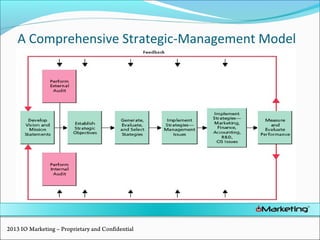
A Comprehensive Strategic-Management Model
2013 IO Marketing – Proprietary and Confidential
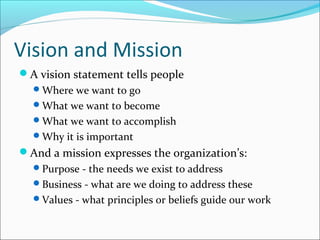
Vision and Mission
A vision statement tells people
Where we want to go
What we want to become
What we want to accomplish
Why it is important
And a mission expresses the organization’s:
Purpose - the needs we exist to address
Business - what are we doing to address these
Values - what principles or beliefs guide our work
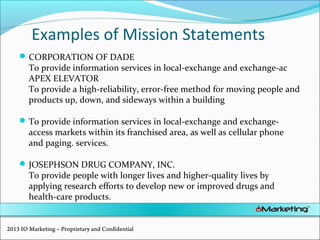
Examples of Mission Statements
CORPORATION OF DADE
To provide information services in local-exchange and exchange-ac
APEX ELEVATOR
To provide a high-reliability, error-free method for moving people and
products up, down, and sideways within a building
To provide information services in local-exchange and exchange-
access markets within its franchised area, as well as cellular phone
and paging. services.
JOSEPHSON DRUG COMPANY, INC.
To provide people with longer lives and higher-quality lives by
applying research efforts to develop new or improved drugs and
health-care products.
2013 IO Marketing – Proprietary and Confidential
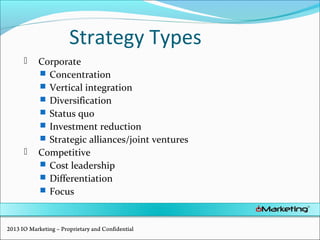
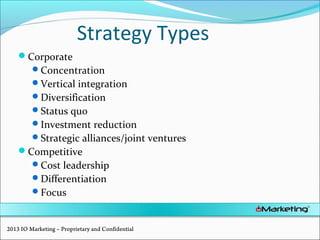
Strategy Types
 Corporate
 Concentration
 Vertical integration
 Diversification
 Status quo
 Investment reduction
 Strategic alliances/joint ventures
 Competitive
 Cost leadership
 Differentiation
 Focus
2013 IO Marketing – Proprietary and Confidential
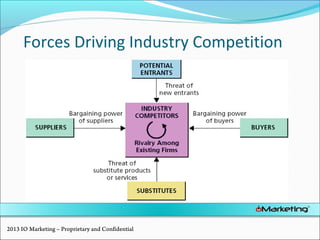
Forces Driving Industry Competition
2013 IO Marketing – Proprietary and Confidential
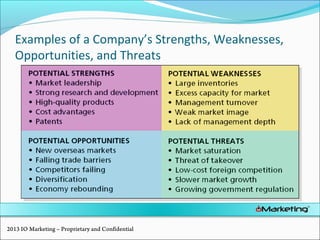
Examples of a Company’s Strengths, Weaknesses,
Opportunities, and Threats
2013 IO Marketing – Proprietary and Confidential
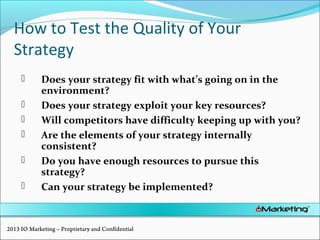
How to Test the Quality of Your
Strategy
 Does your strategy fit with what’s going on in the
environment?
 Does your strategy exploit your key resources?
 Will competitors have difficulty keeping up with you?
 Are the elements of your strategy internally
consistent?
 Do you have enough resources to pursue this
strategy?
 Can your strategy be implemented?
2013 IO Marketing – Proprietary and Confidential
Strategy Types
Corporate
Concentration
Vertical integration
Diversification
Status quo
Investment reduction
Strategic alliances/joint ventures
Competitive
Cost leadership
Differentiation
Focus
2013 IO Marketing – Proprietary and Confidential
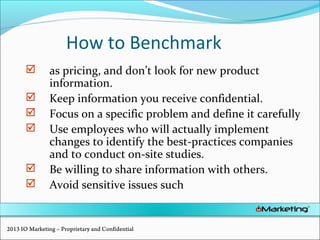
How to Benchmark
 as pricing, and don’t look for new product
information.
 Keep information you receive confidential.
 Focus on a specific problem and define it carefully
 Use employees who will actually implement
changes to identify the best-practices companies
and to conduct on-site studies.
 Be willing to share information with others.
 Avoid sensitive issues such
2013 IO Marketing – Proprietary and Confidential
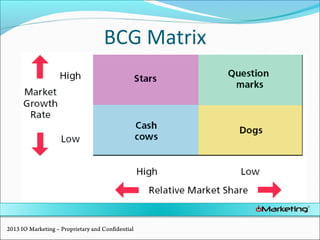
BCG Matrix
2013 IO Marketing – Proprietary and Confidential
Scenario Planning Principles
 Scenarios have value only to the extent that they inform
decision makers and influence decision making.
 Scenarios add value to decision making only when
managers and others use them to systematically shape
questions about the present and the future, and to guide
how to go about answering them.
 In each step of developing scenarios, the emphasis must
be on identifying, challenging, and refining the substance
of managers’ mindsets and knowledge.
2013 IO Marketing – Proprietary and Confidential

Management strategy

  • 1.
    www.inboundoutboundmarketing.com2013 IO Marketing– Proprietary and Confidential
  • 2.
    Roadmap  The strategicmanagement process  Mission and vision statements  Analyzing strategic drivers and core competencies  SWOT analysis  Scenario planning 2013 IO Marketing – Proprietary and Confidential
  • 3.
    The Strategic ManagementProcess  Define the business and its mission.  Perform external and internal audits.  Translate the mission into strategic goals.  Generate and select strategies to reach strategic goals.  Implement the strategy.  Evaluate performance. 2013 IO Marketing – Proprietary and Confidential
  • 4.
    A Comprehensive Strategic-ManagementModel 2013 IO Marketing – Proprietary and Confidential
  • 5.
    Vision and Mission Avision statement tells people Where we want to go What we want to become What we want to accomplish Why it is important And a mission expresses the organization’s: Purpose - the needs we exist to address Business - what are we doing to address these Values - what principles or beliefs guide our work
  • 6.
    Examples of MissionStatements CORPORATION OF DADE To provide information services in local-exchange and exchange-ac APEX ELEVATOR To provide a high-reliability, error-free method for moving people and products up, down, and sideways within a building To provide information services in local-exchange and exchange- access markets within its franchised area, as well as cellular phone and paging. services. JOSEPHSON DRUG COMPANY, INC. To provide people with longer lives and higher-quality lives by applying research efforts to develop new or improved drugs and health-care products. 2013 IO Marketing – Proprietary and Confidential
  • 7.
    Strategy Types  Corporate Concentration  Vertical integration  Diversification  Status quo  Investment reduction  Strategic alliances/joint ventures  Competitive  Cost leadership  Differentiation  Focus 2013 IO Marketing – Proprietary and Confidential
  • 8.
    Forces Driving IndustryCompetition 2013 IO Marketing – Proprietary and Confidential
  • 9.
    Examples of aCompany’s Strengths, Weaknesses, Opportunities, and Threats 2013 IO Marketing – Proprietary and Confidential
  • 10.
    How to Testthe Quality of Your Strategy  Does your strategy fit with what’s going on in the environment?  Does your strategy exploit your key resources?  Will competitors have difficulty keeping up with you?  Are the elements of your strategy internally consistent?  Do you have enough resources to pursue this strategy?  Can your strategy be implemented? 2013 IO Marketing – Proprietary and Confidential
  • 11.
    Strategy Types Corporate Concentration Vertical integration Diversification Statusquo Investment reduction Strategic alliances/joint ventures Competitive Cost leadership Differentiation Focus 2013 IO Marketing – Proprietary and Confidential
  • 12.
    How to Benchmark as pricing, and don’t look for new product information.  Keep information you receive confidential.  Focus on a specific problem and define it carefully  Use employees who will actually implement changes to identify the best-practices companies and to conduct on-site studies.  Be willing to share information with others.  Avoid sensitive issues such 2013 IO Marketing – Proprietary and Confidential
  • 13.
    BCG Matrix 2013 IOMarketing – Proprietary and Confidential
  • 14.
    Scenario Planning Principles Scenarios have value only to the extent that they inform decision makers and influence decision making.  Scenarios add value to decision making only when managers and others use them to systematically shape questions about the present and the future, and to guide how to go about answering them.  In each step of developing scenarios, the emphasis must be on identifying, challenging, and refining the substance of managers’ mindsets and knowledge. 2013 IO Marketing – Proprietary and Confidential