Management History
Module
By
Usama Tariq
CONTENTS
 What is Management
 4 Functions Of Management
 Early Management
 Examples Of Early Management
 Major Approaches to Management
 Classical Approach
 Behavioral Approach
 Quantitative Approach
 Contemporary Approach
What is Management?
The organization and coordination of the
activities of a business in order to achieve
defined objectives.
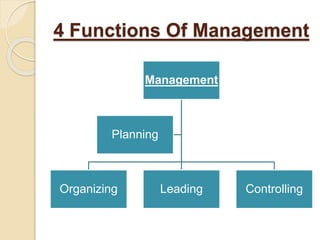
4 Functions Of Management
Management
Organizing Leading Controlling
Planning
Early Management
Management has been practiced for a long time.
Let’s have a look at some of the most interesting
examples.
Pyramids
Wars
Great Wall
Of China
Major Approaches to
Management
 Classical Approach
 Behavioral Approach
 Quantitative Approach
 Contemporary Approach
Classical Approach
The first study of management, often called
Classical Approach, emphasized rationality and
making organization and workers as efficient as
possible.
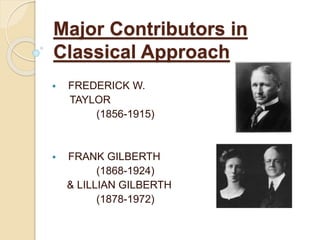
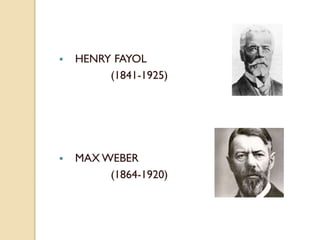
Major Contributors in
Classical Approach
 FREDERICK W.
TAYLOR
(1856-1915)
 FRANK GILBERTH
(1868-1924)
& LILLIAN GILBERTH
(1878-1972)
Theories
 Taylor’s Theory of Scientific Management
 Fayol’s Administrative Theory
 Weber’s Theory of Bureaucracy
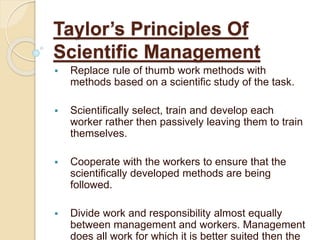
Taylor’s Principles Of
Scientific Management
 Replace rule of thumb work methods with
methods based on a scientific study of the task.
 Scientifically select, train and develop each
worker rather then passively leaving them to train
themselves.
 Cooperate with the workers to ensure that the
scientifically developed methods are being
followed.
 Divide work and responsibility almost equally
between management and workers. Management
does all work for which it is better suited then the
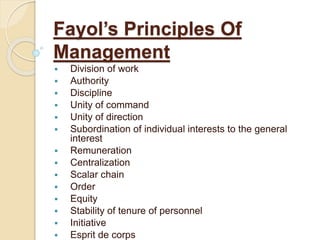
Fayol’s Principles Of
Management
 Division of work
 Authority
 Discipline
 Unity of command
 Unity of direction
 Subordination of individual interests to the general
interest
 Remuneration
 Centralization
 Scalar chain
 Order
 Equity
 Stability of tenure of personnel
 Initiative
 Esprit de corps
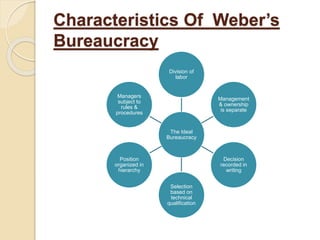
Characteristics Of Weber’s
Bureaucracy
The Ideal
Bureaucracy
Division of
labor
Management
& ownership
is separate
Decision
recorded in
writing
Selection
based on
technical
qualification
Position
organized in
hierarchy
Managers
subject to
rules &
procedures
Behavioral Approach
The field of study that researches the actions
(behavior) of people at work is called
Organizational Behavior(OB).
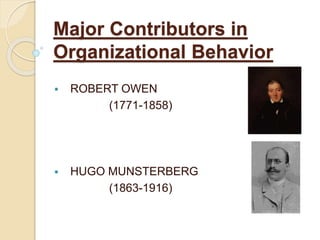
Major Contributors in
Organizational Behavior
 ROBERT OWEN
(1771-1858)
 HUGO MUNSTERBERG
(1863-1916)
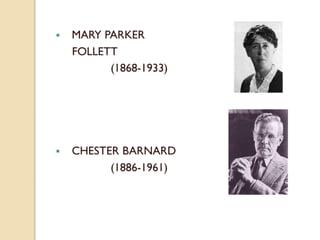
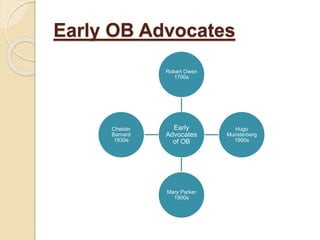
Early OB Advocates
Early
Advocates
of OB
Robert Owen
1700s
Hugo
Munsterberg
1900s
Mary Parker
1900s
Chester
Barnard
1930s
Quantitative Approach
The Quantitative Approach involves the use of
quantitative techniques to improve decision
making. This approach has also been labeled
operations research of management science.
It includes applications of statistics, optimization
models, information models and computer
simulations.
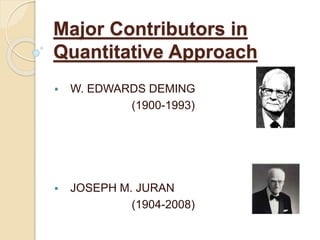
Major Contributors in
Quantitative Approach
 W. EDWARDS DEMING
(1900-1993)
 JOSEPH M. JURAN
(1904-2008)
Quality Management
Quality Management, is a management
philosophy devoted to continual improvement
and responding to customer needs and
expectations.
Branches Of Quantitative
Management
 Management Science
 Operations Management
 Management Information Systems
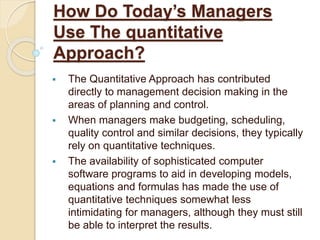
How Do Today’s Managers
Use The quantitative
Approach?
 The Quantitative Approach has contributed
directly to management decision making in the
areas of planning and control.
 When managers make budgeting, scheduling,
quality control and similar decisions, they typically
rely on quantitative techniques.
 The availability of sophisticated computer
software programs to aid in developing models,
equations and formulas has made the use of
quantitative techniques somewhat less
intimidating for managers, although they must still
be able to interpret the results.
Contemporary Approach
Contemporary Approach means new, recent or
current approaches in the field of management.
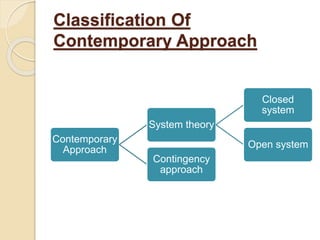
Classification Of
Contemporary Approach
Contemporary
Approach
System theory
Closed
system
Open system
Contingency
approach
System Theory
A set of interrelated and interdependent parts
arranged in a manner that produces a unified
whole.
Types Of System Theory
 Closed System
 Open System
a) Closed System
System that are not influenced by and do not
interact with their environment.
b) Open System
A system that interact with their environment.
Contingency Approach
A management approach which says that
organizations are different, face different
situation and require different ways of managing.

Popular Contingency
Variables
 Organization Size
 Routineness Of Task Technology
 Environmental Uncertainty
 Individual Differences
Management history module by usama tariq

Management history module by usama tariq

  • 2.
  • 3.
    CONTENTS  What isManagement  4 Functions Of Management  Early Management  Examples Of Early Management  Major Approaches to Management  Classical Approach  Behavioral Approach  Quantitative Approach  Contemporary Approach
  • 4.
    What is Management? Theorganization and coordination of the activities of a business in order to achieve defined objectives.
  • 5.
    4 Functions OfManagement Management Organizing Leading Controlling Planning
  • 6.
    Early Management Management hasbeen practiced for a long time. Let’s have a look at some of the most interesting examples.
  • 7.
  • 8.
  • 9.
  • 10.
    Major Approaches to Management Classical Approach  Behavioral Approach  Quantitative Approach  Contemporary Approach
  • 11.
    Classical Approach The firststudy of management, often called Classical Approach, emphasized rationality and making organization and workers as efficient as possible.
  • 12.
    Major Contributors in ClassicalApproach  FREDERICK W. TAYLOR (1856-1915)  FRANK GILBERTH (1868-1924) & LILLIAN GILBERTH (1878-1972)
  • 14.
    Theories  Taylor’s Theoryof Scientific Management  Fayol’s Administrative Theory  Weber’s Theory of Bureaucracy
  • 15.
    Taylor’s Principles Of ScientificManagement  Replace rule of thumb work methods with methods based on a scientific study of the task.  Scientifically select, train and develop each worker rather then passively leaving them to train themselves.  Cooperate with the workers to ensure that the scientifically developed methods are being followed.  Divide work and responsibility almost equally between management and workers. Management does all work for which it is better suited then the
  • 16.
    Fayol’s Principles Of Management Division of work  Authority  Discipline  Unity of command  Unity of direction  Subordination of individual interests to the general interest  Remuneration  Centralization  Scalar chain  Order  Equity  Stability of tenure of personnel  Initiative  Esprit de corps
  • 17.
    Characteristics Of Weber’s Bureaucracy TheIdeal Bureaucracy Division of labor Management & ownership is separate Decision recorded in writing Selection based on technical qualification Position organized in hierarchy Managers subject to rules & procedures
  • 18.
    Behavioral Approach The fieldof study that researches the actions (behavior) of people at work is called Organizational Behavior(OB).
  • 19.
    Major Contributors in OrganizationalBehavior  ROBERT OWEN (1771-1858)  HUGO MUNSTERBERG (1863-1916)
  • 21.
    Early OB Advocates Early Advocates ofOB Robert Owen 1700s Hugo Munsterberg 1900s Mary Parker 1900s Chester Barnard 1930s
  • 22.
    Quantitative Approach The QuantitativeApproach involves the use of quantitative techniques to improve decision making. This approach has also been labeled operations research of management science. It includes applications of statistics, optimization models, information models and computer simulations.
  • 23.
    Major Contributors in QuantitativeApproach  W. EDWARDS DEMING (1900-1993)  JOSEPH M. JURAN (1904-2008)
  • 24.
    Quality Management Quality Management,is a management philosophy devoted to continual improvement and responding to customer needs and expectations.
  • 25.
    Branches Of Quantitative Management Management Science  Operations Management  Management Information Systems
  • 26.
    How Do Today’sManagers Use The quantitative Approach?  The Quantitative Approach has contributed directly to management decision making in the areas of planning and control.  When managers make budgeting, scheduling, quality control and similar decisions, they typically rely on quantitative techniques.  The availability of sophisticated computer software programs to aid in developing models, equations and formulas has made the use of quantitative techniques somewhat less intimidating for managers, although they must still be able to interpret the results.
  • 27.
    Contemporary Approach Contemporary Approachmeans new, recent or current approaches in the field of management.
  • 28.
    Classification Of Contemporary Approach Contemporary Approach Systemtheory Closed system Open system Contingency approach
  • 29.
    System Theory A setof interrelated and interdependent parts arranged in a manner that produces a unified whole.
  • 30.
    Types Of SystemTheory  Closed System  Open System
  • 31.
    a) Closed System Systemthat are not influenced by and do not interact with their environment.
  • 32.
    b) Open System Asystem that interact with their environment.
  • 33.
    Contingency Approach A managementapproach which says that organizations are different, face different situation and require different ways of managing.
  • 34.
    Popular Contingency Variables  OrganizationSize  Routineness Of Task Technology  Environmental Uncertainty  Individual Differences