ninth edition
STEPHEN P. ROBBINS
PowerPoint Presentation by Charlie Cook
The University of West Alabama
MARY COULTER
© 2007 Prentice Hall, Inc.
All rights reserved.
Motivating
Motivating
Employees
Employees
Chapter
Chapter
16
16
© 2007 Prentice Hall, Inc. All rights reserved. 16–2
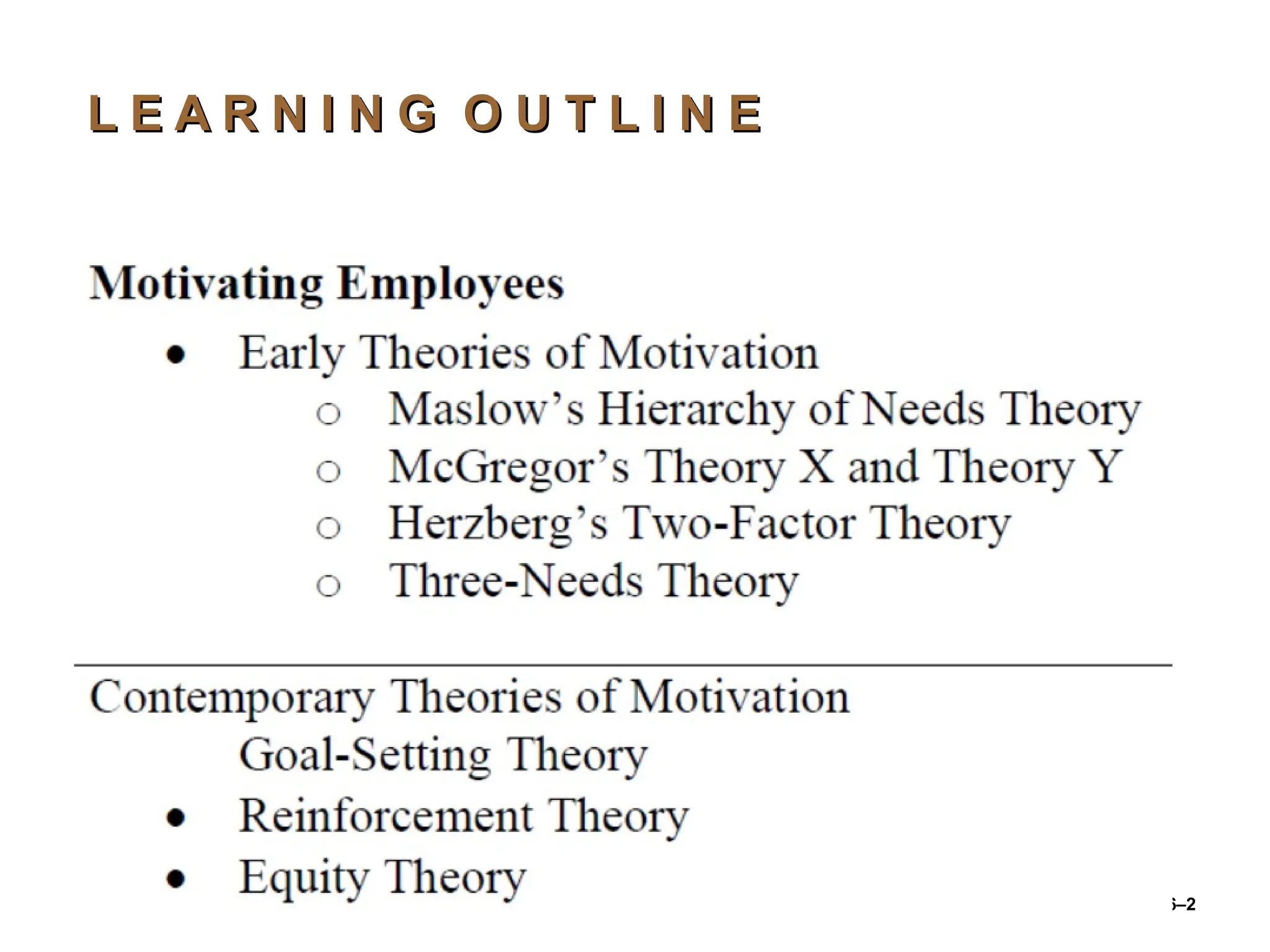
L E A R N I N G O U T L I N E
© 2007 Prentice Hall, Inc. All rights reserved. 16–3
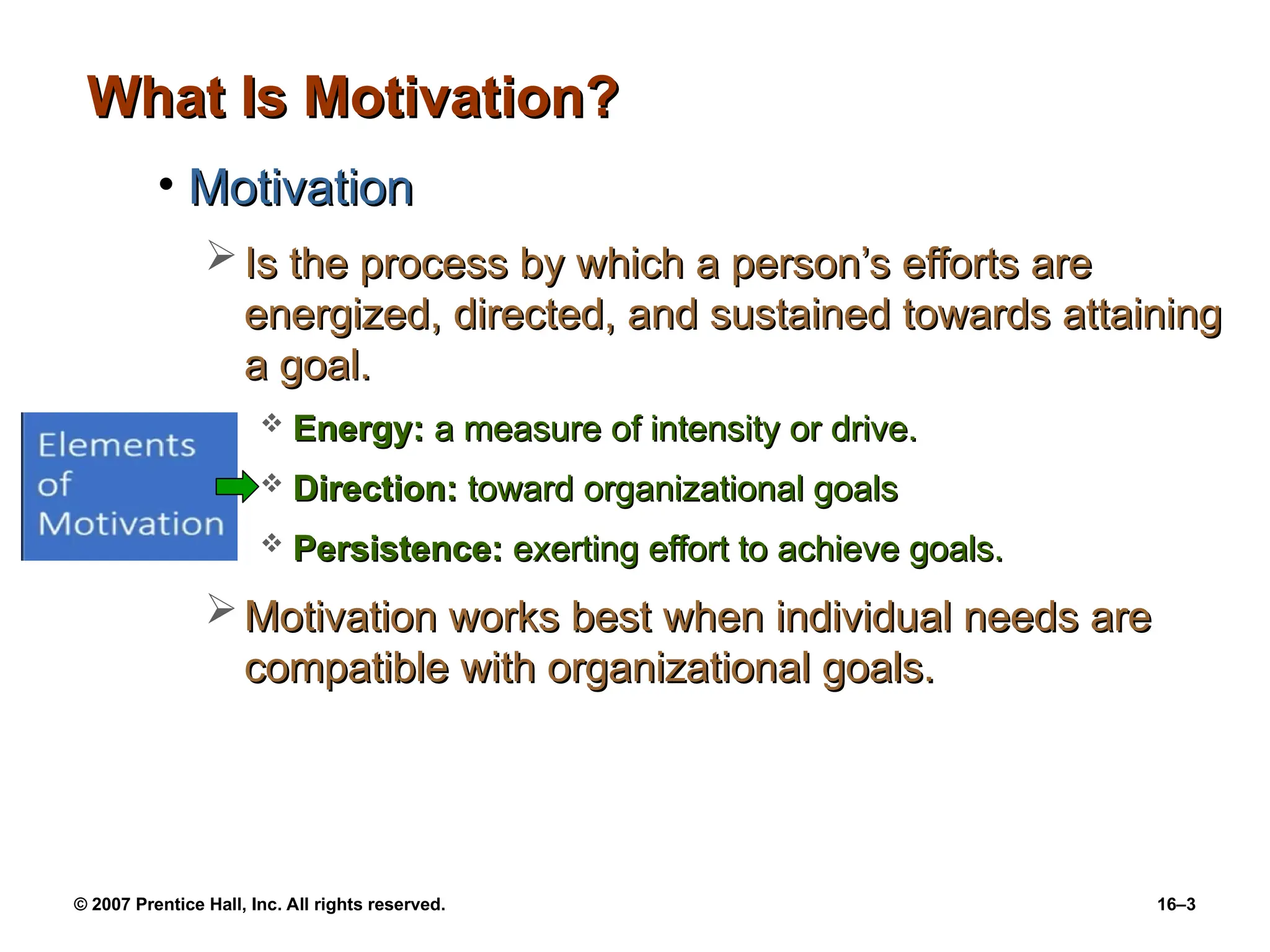
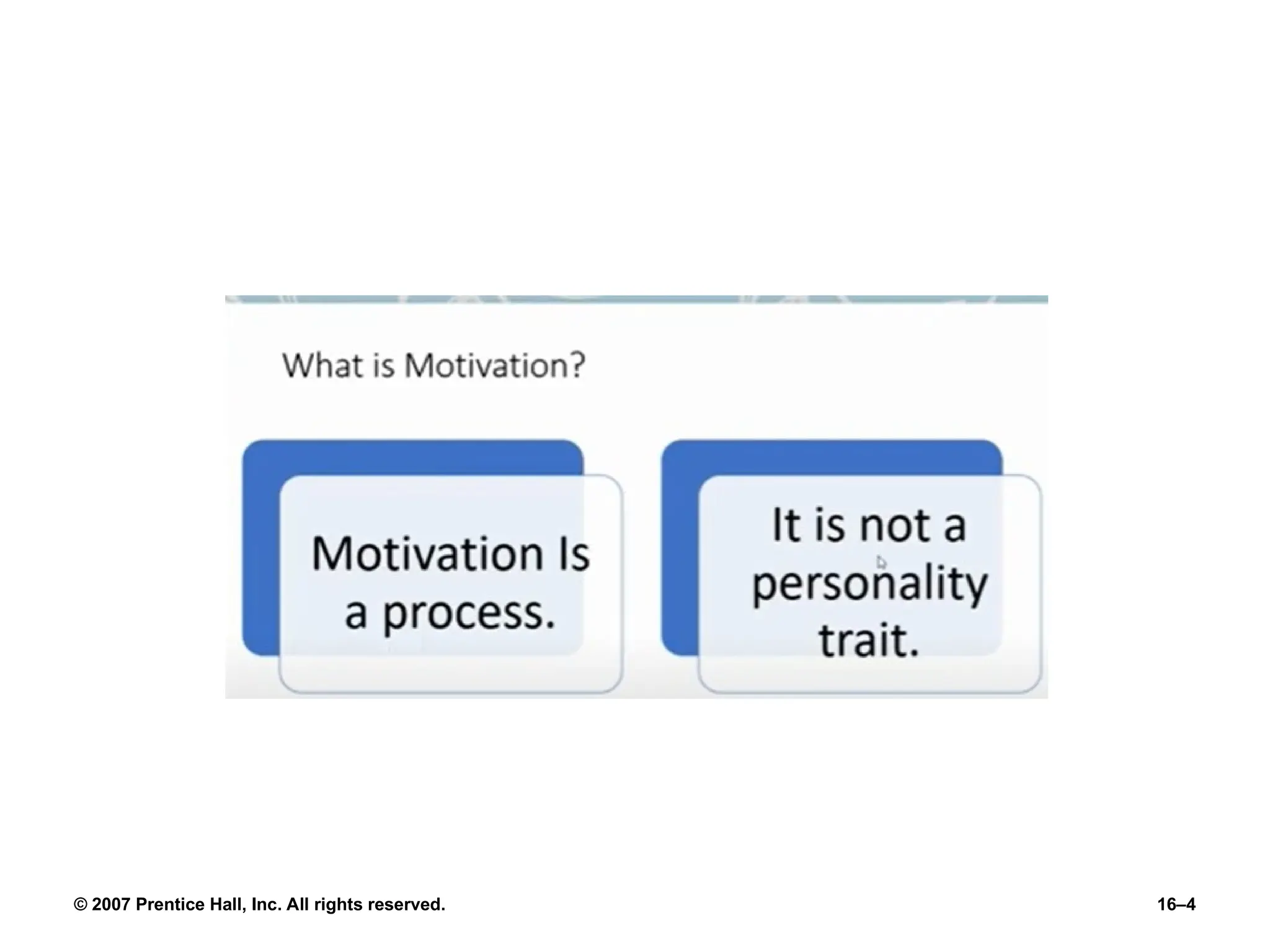
What Is Motivation?
What Is Motivation?
• Motivation
Motivation
 Is the process by which a person’s efforts are
Is the process by which a person’s efforts are
energized, directed, and sustained towards attaining
a goal.
a goal.
 Energy:
Energy: a measure of intensity or drive.
a measure of intensity or drive.
 Direction:
Direction: toward organizational goals
toward organizational goals
 Persistence:
Persistence: exerting effort to achieve goals.
exerting effort to achieve goals.
 Motivation works best when individual needs are
Motivation works best when individual needs are
compatible with organizational goals.
© 2007 Prentice Hall, Inc. All rights reserved. 16–4
© 2007 Prentice Hall, Inc. All rights reserved. 16–5
Early Theories of Motivation
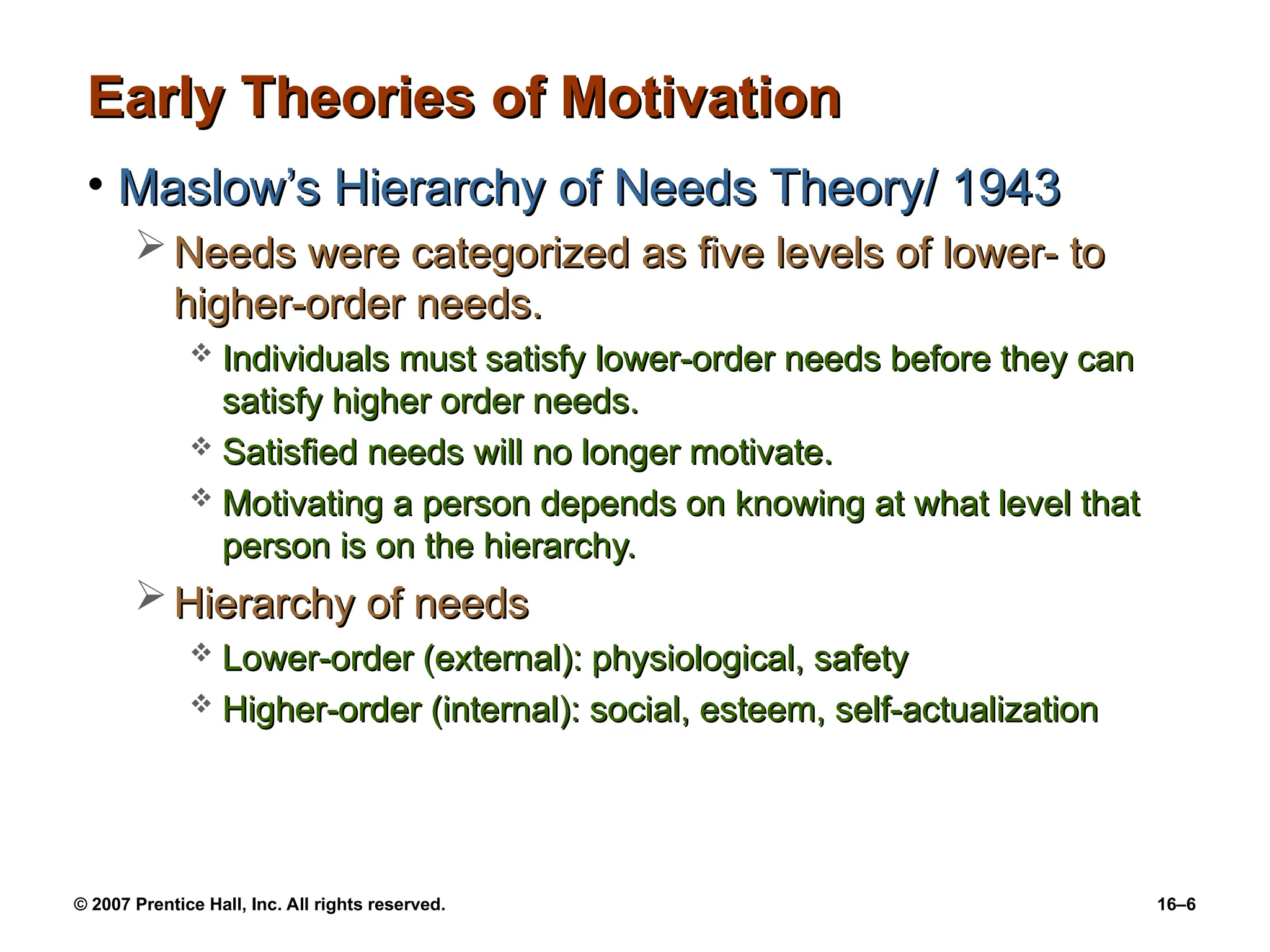
• Maslow’s Hierarchy of Needs
Maslow’s Hierarchy of Needs
• MacGregor’s Theories X and Y
MacGregor’s Theories X and Y
• Herzberg’s Two-Factor Theory
Herzberg’s Two-Factor Theory
• Three needs theory
Three needs theory
© 2007 Prentice Hall, Inc. All rights reserved. 16–6
Early Theories of Motivation
• Maslow’s Hierarchy of Needs Theory/ 1943
Maslow’s Hierarchy of Needs Theory/ 1943
 Needs were categorized as five levels of lower- to
Needs were categorized as five levels of lower- to
higher-order needs.
higher-order needs.
 Individuals must satisfy lower-order needs before they can
Individuals must satisfy lower-order needs before they can
satisfy higher order needs.
 Satisfied needs will no longer motivate.
Satisfied needs will no longer motivate.
 Motivating a person depends on knowing at what level that
Motivating a person depends on knowing at what level that
person is on the hierarchy.
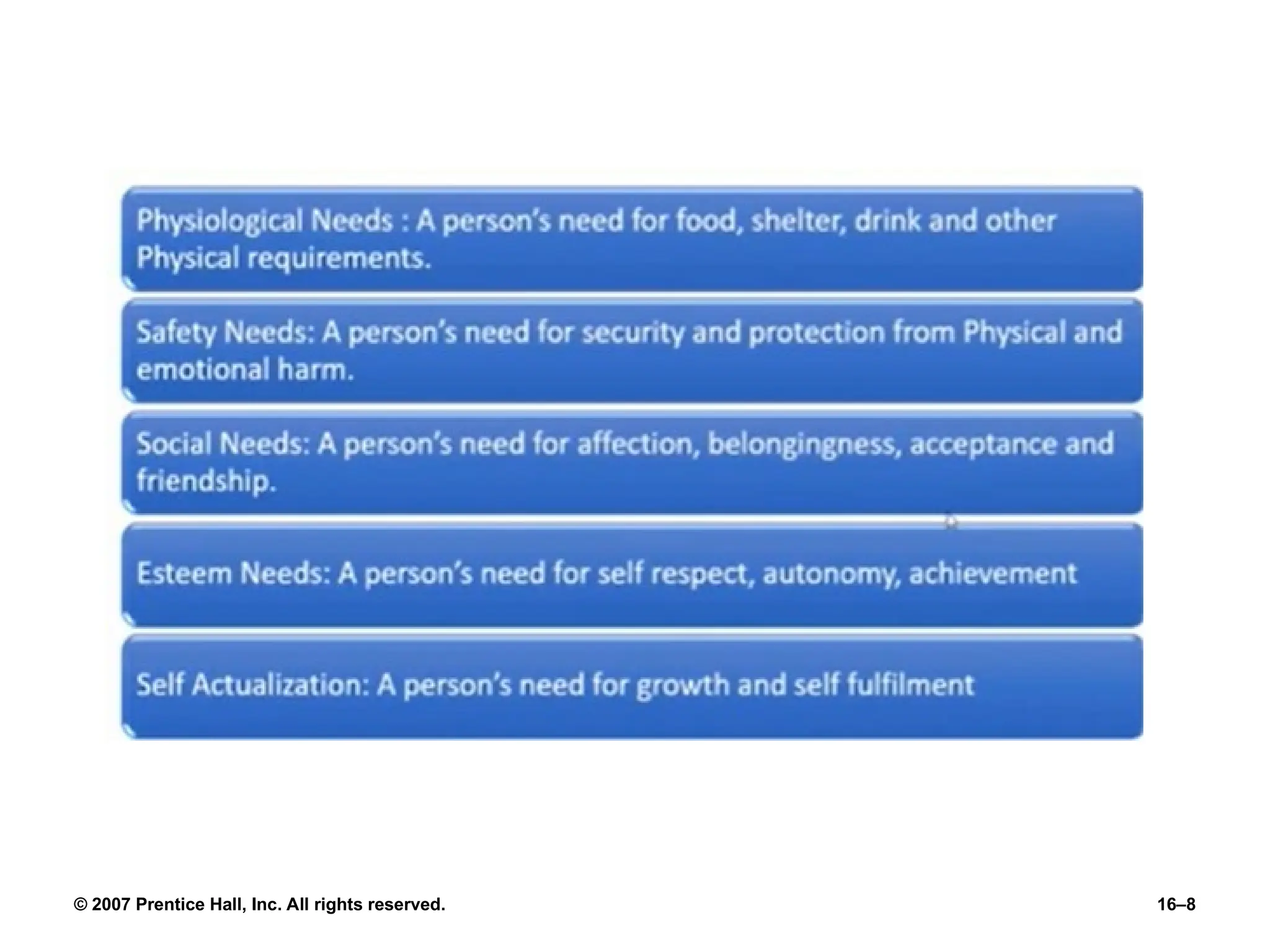
 Hierarchy of needs
Hierarchy of needs
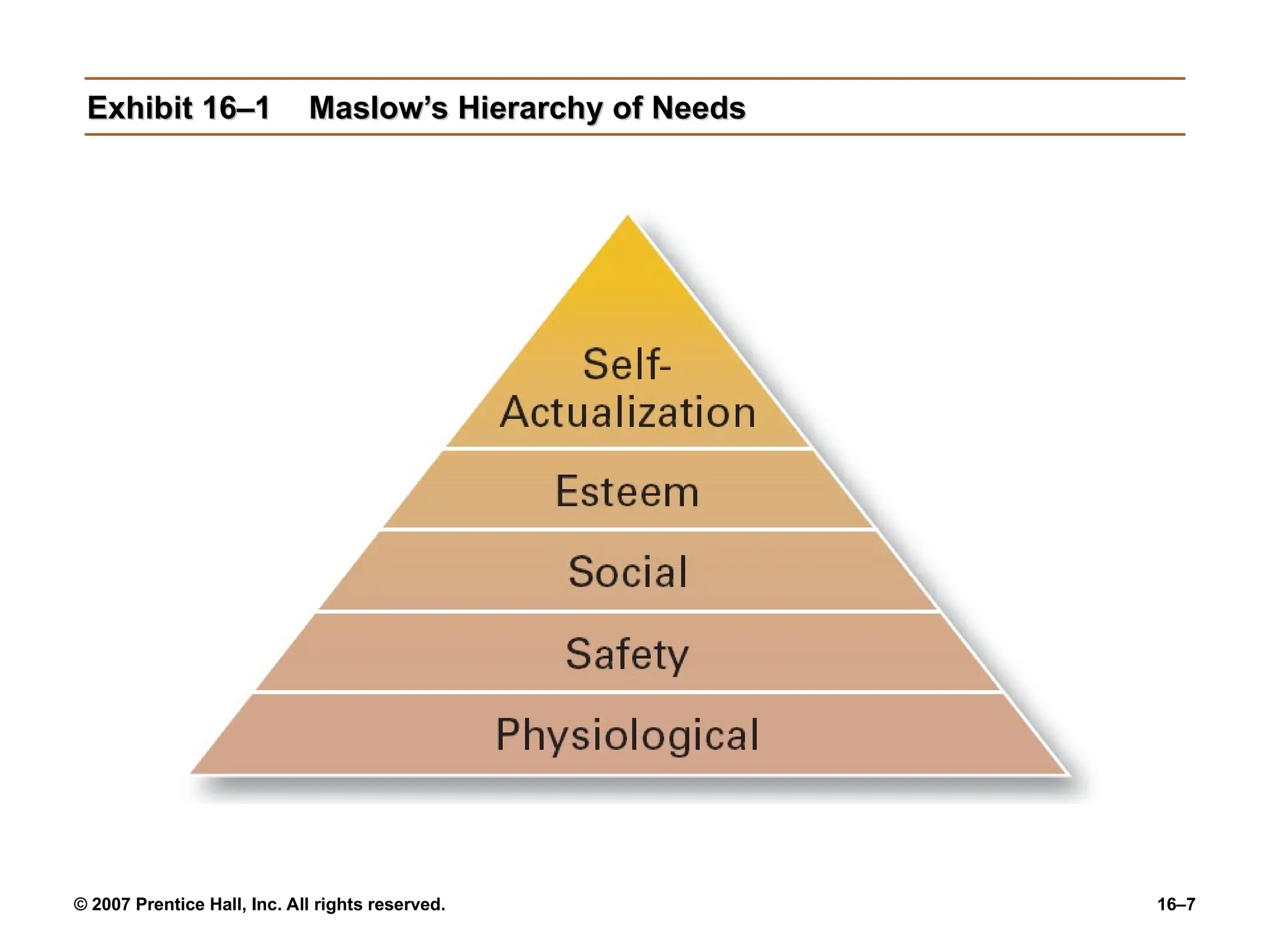
 Lower-order (external): physiological, safety
Lower-order (external): physiological, safety
 Higher-order (internal): social, esteem, self-actualization
Higher-order (internal): social, esteem, self-actualization
© 2007 Prentice Hall, Inc. All rights reserved. 16–7
Exhibit 16–1
Exhibit 16–1 Maslow’s Hierarchy of Needs
Maslow’s Hierarchy of Needs
© 2007 Prentice Hall, Inc. All rights reserved. 16–8
© 2007 Prentice Hall, Inc. All rights reserved. 16–9
Early Theories of Motivation (cont’d)
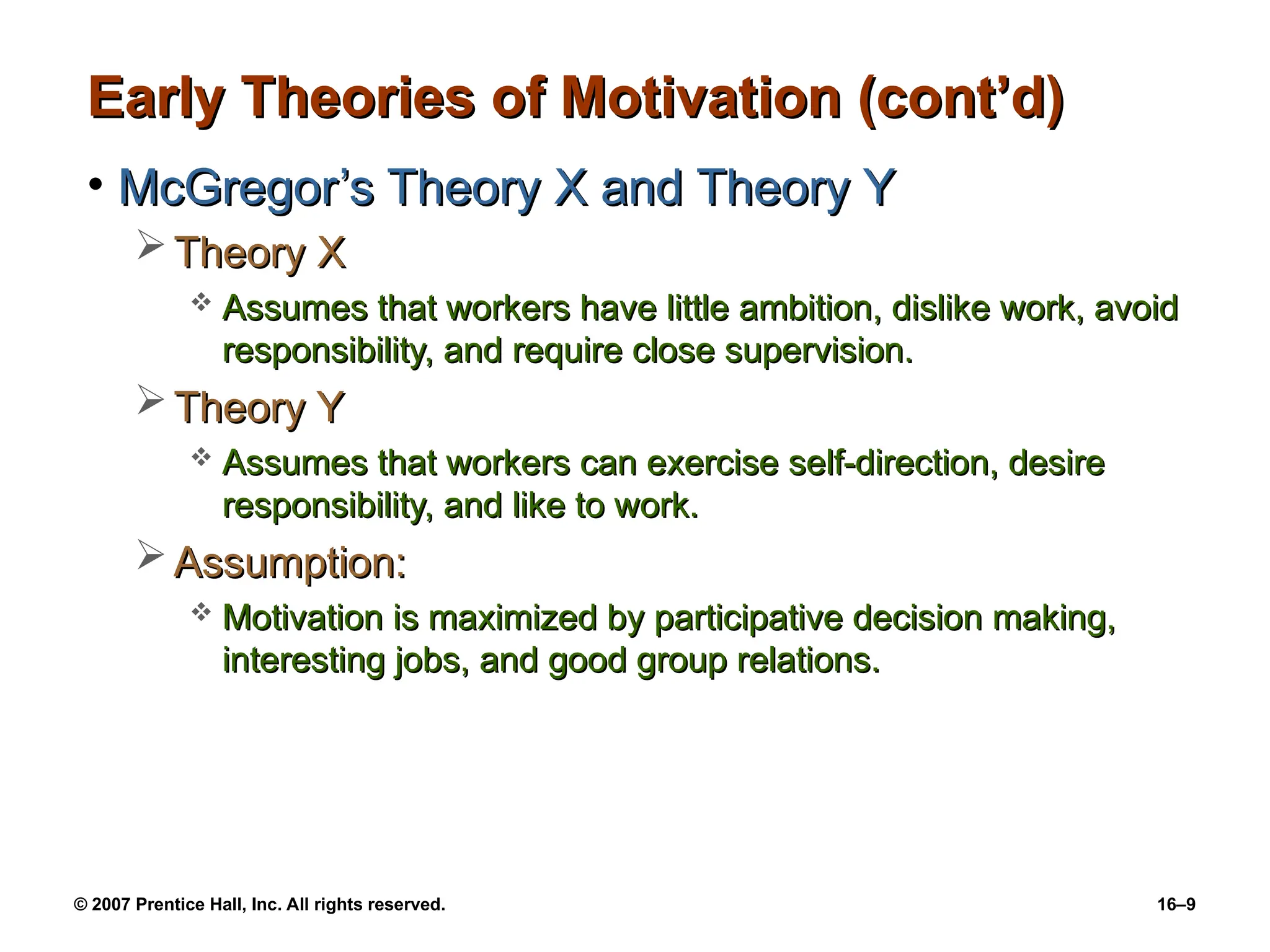
• McGregor’s Theory X and Theory Y
McGregor’s Theory X and Theory Y
 Theory X
Theory X
 Assumes that workers have little ambition, dislike work, avoid
Assumes that workers have little ambition, dislike work, avoid
responsibility, and require close supervision.
 Theory Y
Theory Y
 Assumes that workers can exercise self-direction, desire
Assumes that workers can exercise self-direction, desire
responsibility, and like to work.
 Assumption:
Assumption:
 Motivation is maximized by participative decision making,
Motivation is maximized by participative decision making,
interesting jobs, and good group relations.
© 2007 Prentice Hall, Inc. All rights reserved. 16–10
© 2007 Prentice Hall, Inc. All rights reserved. 16–11
Early Theories of Motivation (cont’d)
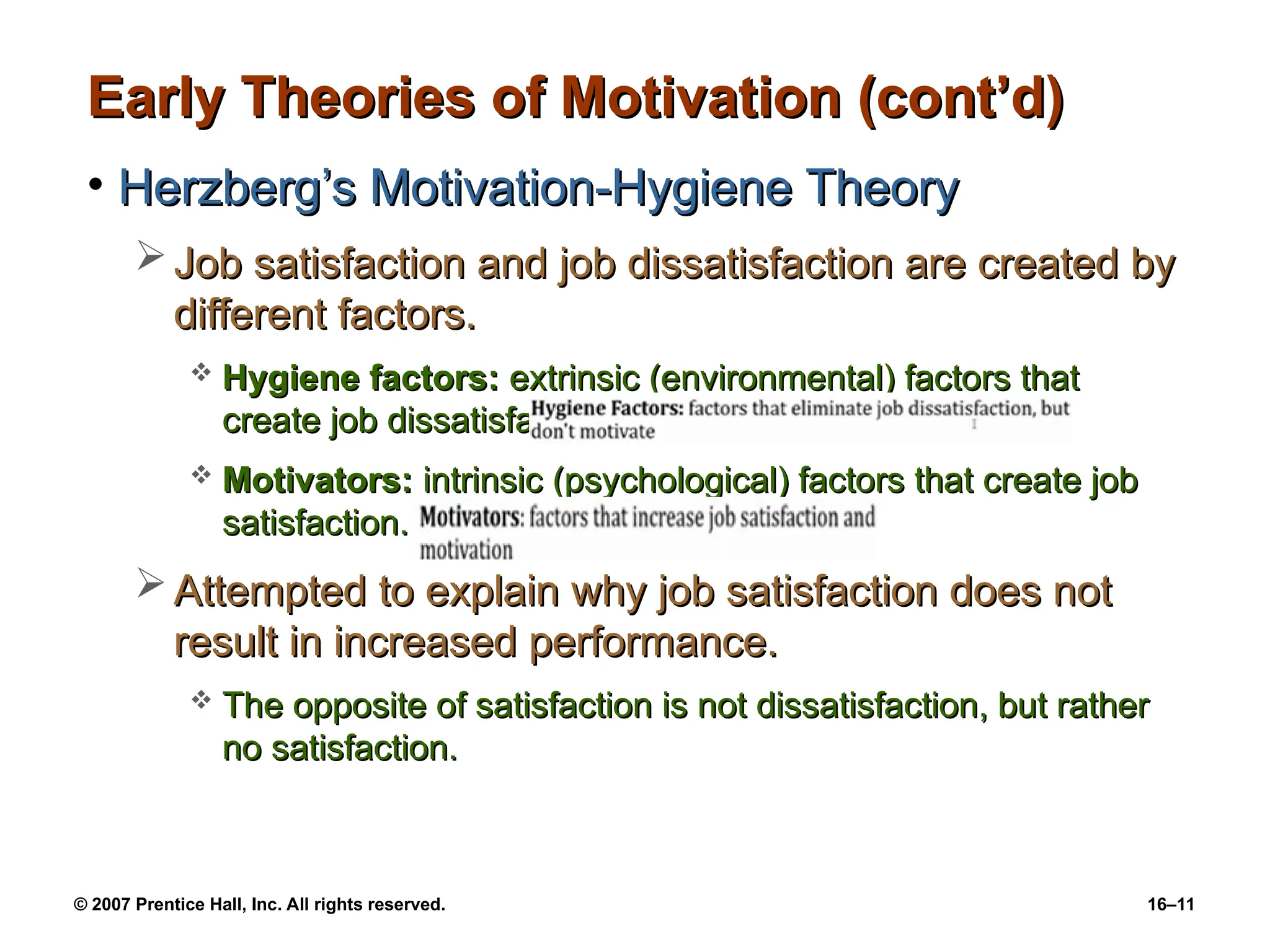
• Herzberg’s Motivation-Hygiene Theory
Herzberg’s Motivation-Hygiene Theory
 Job satisfaction and job dissatisfaction are created by
Job satisfaction and job dissatisfaction are created by
different factors.
different factors.
 Hygiene factors:
Hygiene factors: extrinsic (environmental) factors that
extrinsic (environmental) factors that
create job dissatisfaction.
 Motivators:
Motivators: intrinsic (psychological) factors that create job
intrinsic (psychological) factors that create job
satisfaction.
satisfaction.
 Attempted to explain why job satisfaction does not
Attempted to explain why job satisfaction does not
result in increased performance.
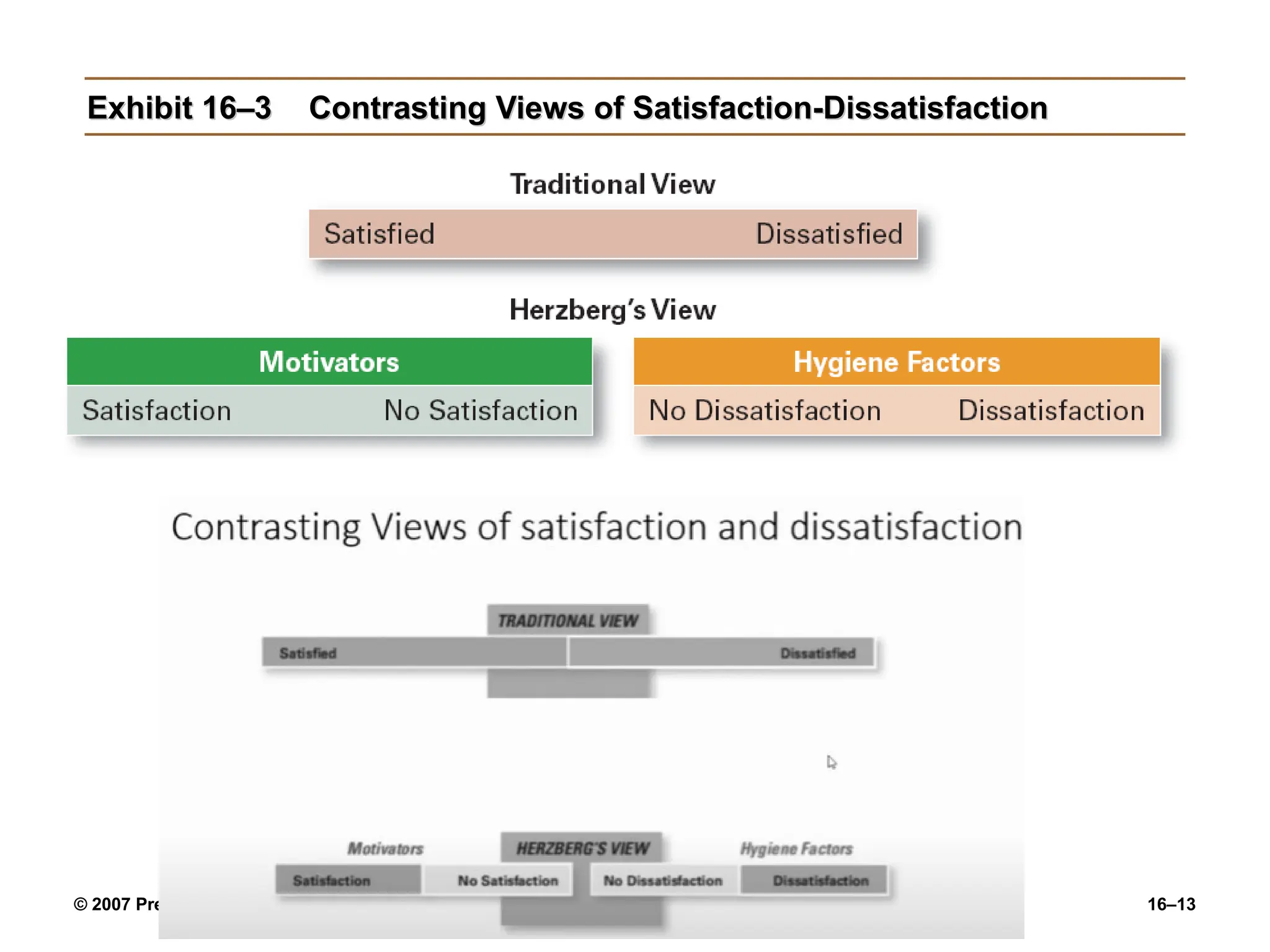
 The opposite of satisfaction is not dissatisfaction, but rather
The opposite of satisfaction is not dissatisfaction, but rather
no satisfaction.
no satisfaction.
© 2007 Prentice Hall, Inc. All rights reserved. 16–12
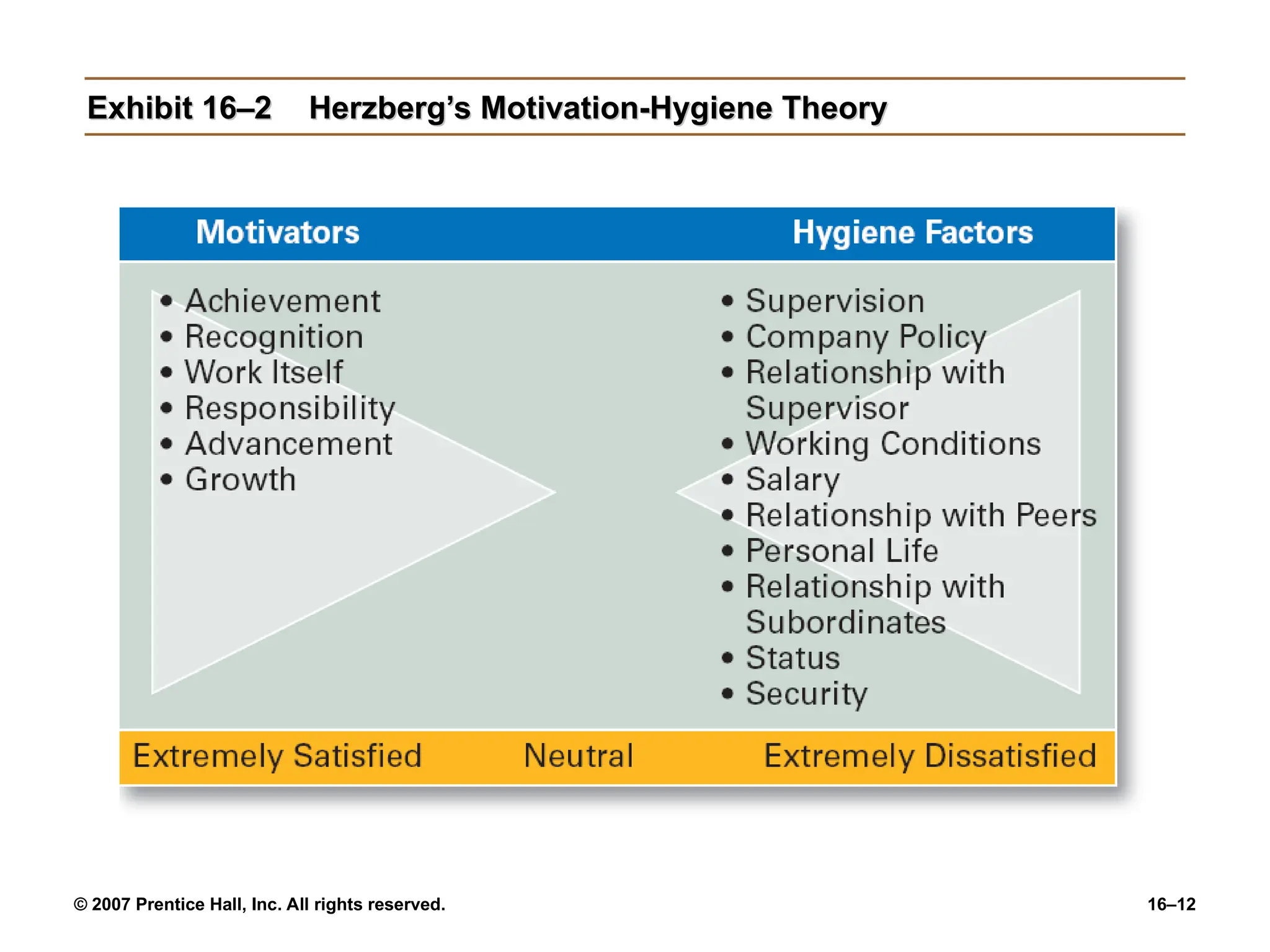
Exhibit 16–2
Exhibit 16–2 Herzberg’s Motivation-Hygiene Theory
Herzberg’s Motivation-Hygiene Theory
© 2007 Prentice Hall, Inc. All rights reserved. 16–13
Exhibit 16–3
Exhibit 16–3 Contrasting Views of Satisfaction-Dissatisfaction
Contrasting Views of Satisfaction-Dissatisfaction
© 2007 Prentice Hall, Inc. All rights reserved. 16–14
© 2007 Prentice Hall, Inc. All rights reserved. 16–15
© 2007 Prentice Hall, Inc. All rights reserved. 16–16
© 2007 Prentice Hall, Inc. All rights reserved. 16–17
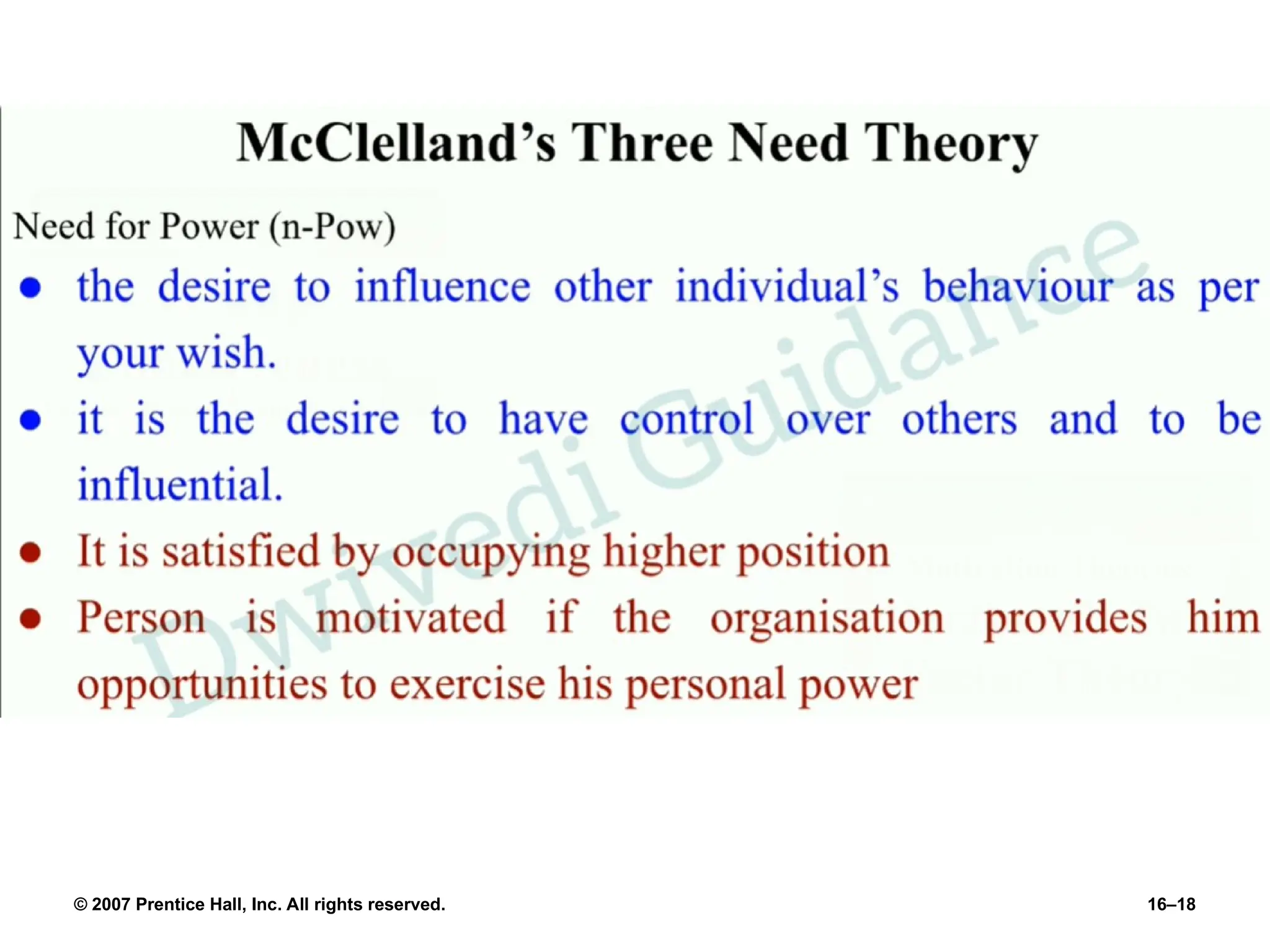
© 2007 Prentice Hall, Inc. All rights reserved. 16–18
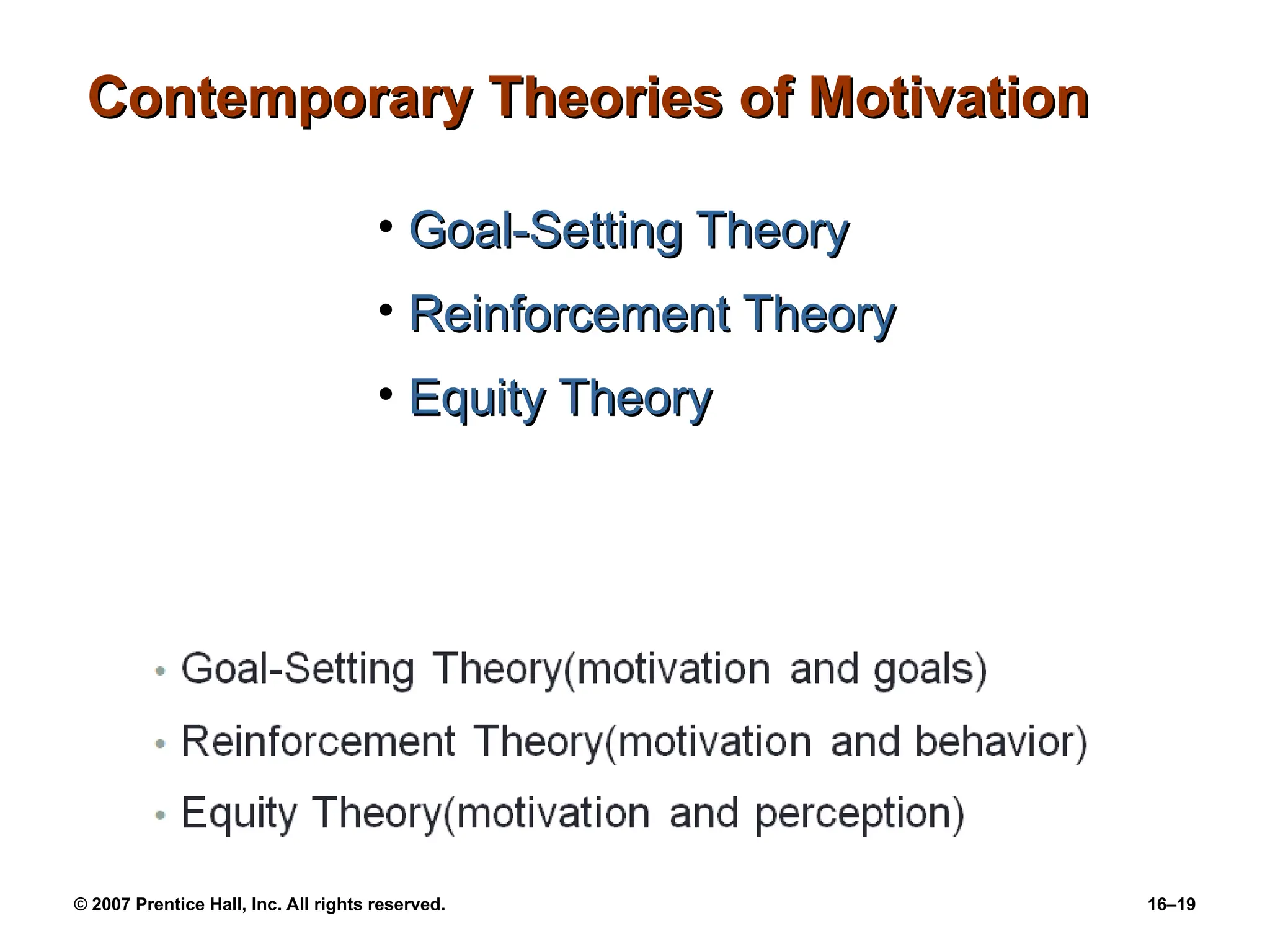
© 2007 Prentice Hall, Inc. All rights reserved. 16–19
Contemporary Theories of Motivation
• Goal-Setting Theory
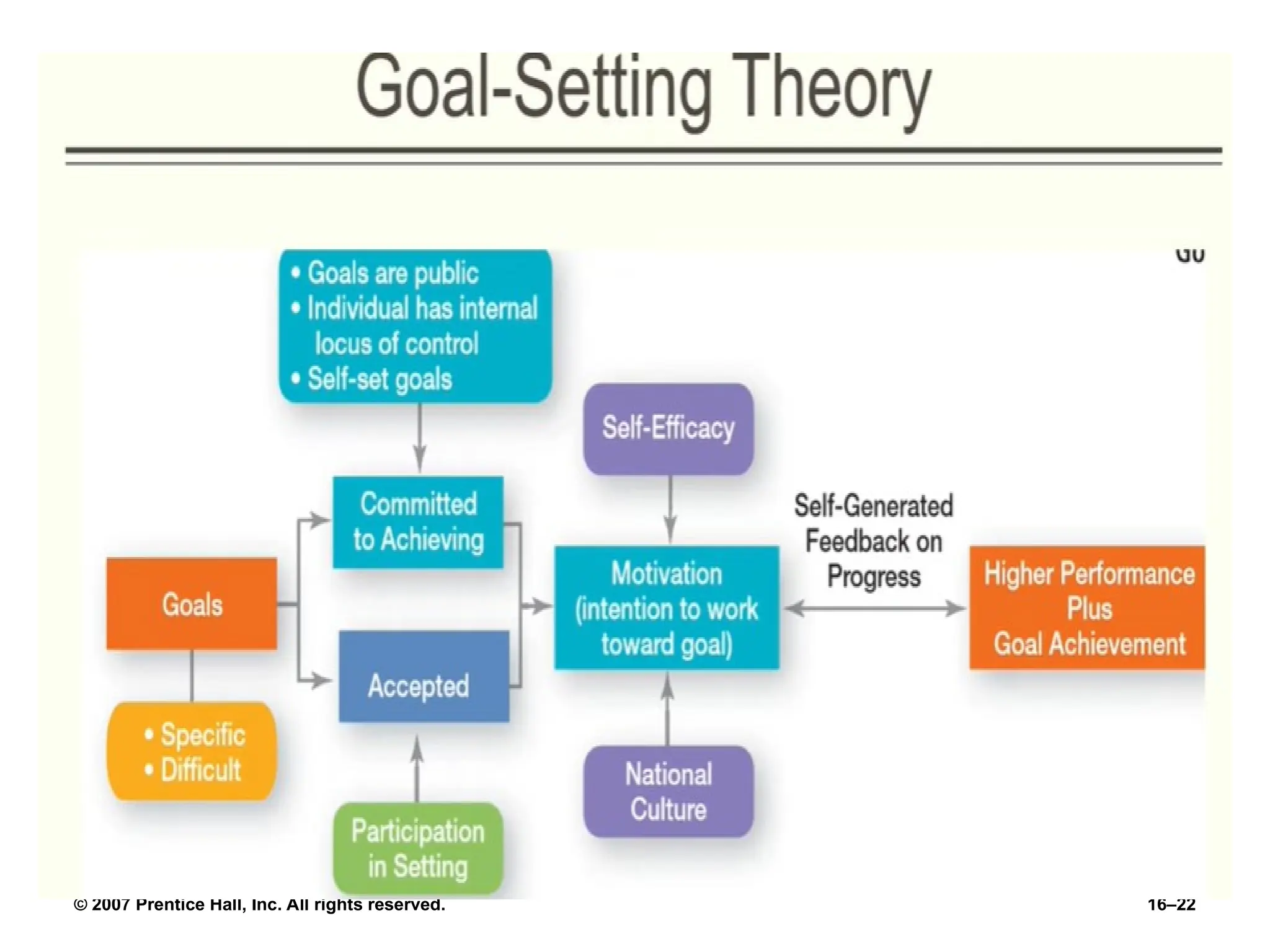
Goal-Setting Theory
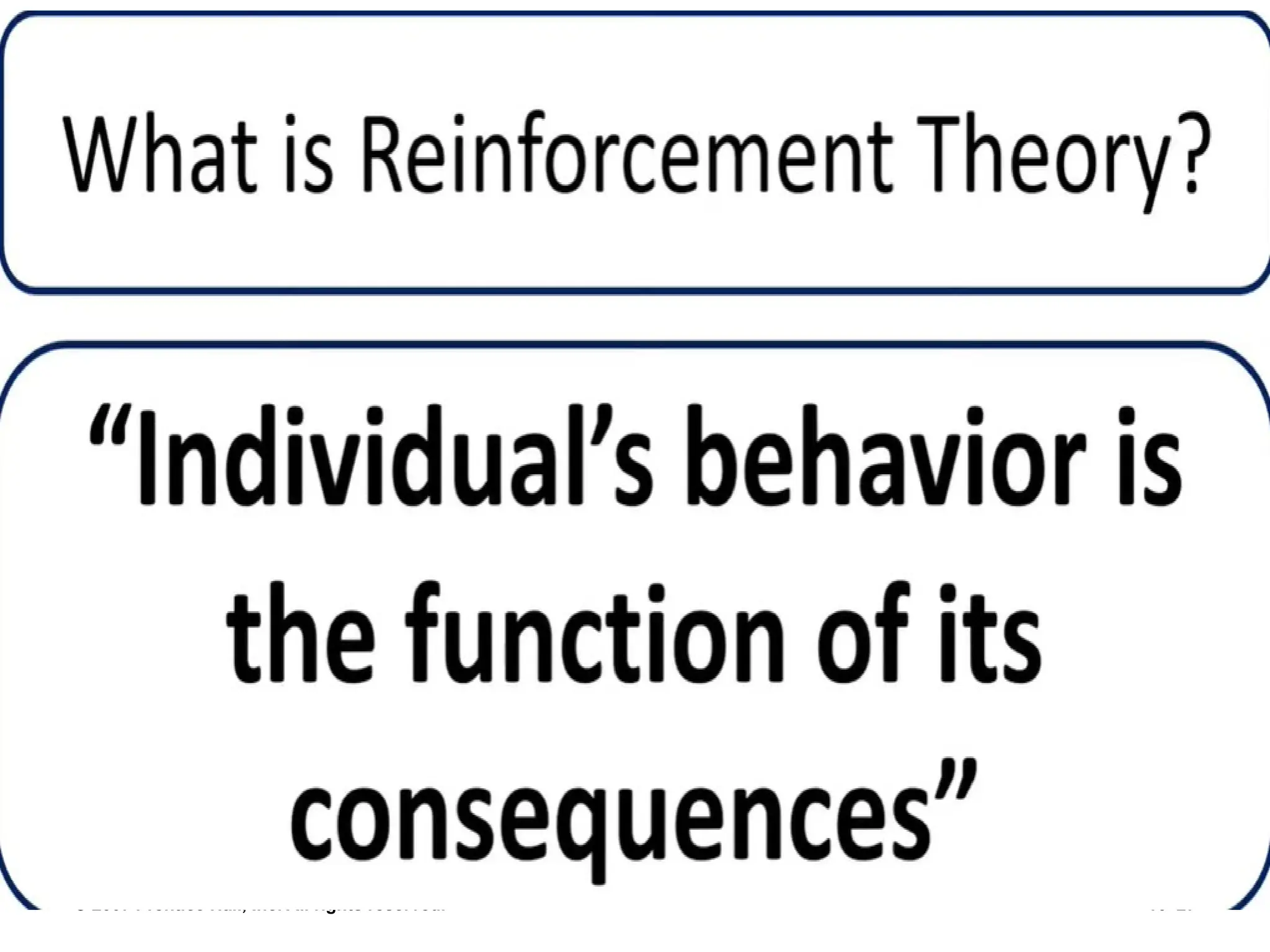
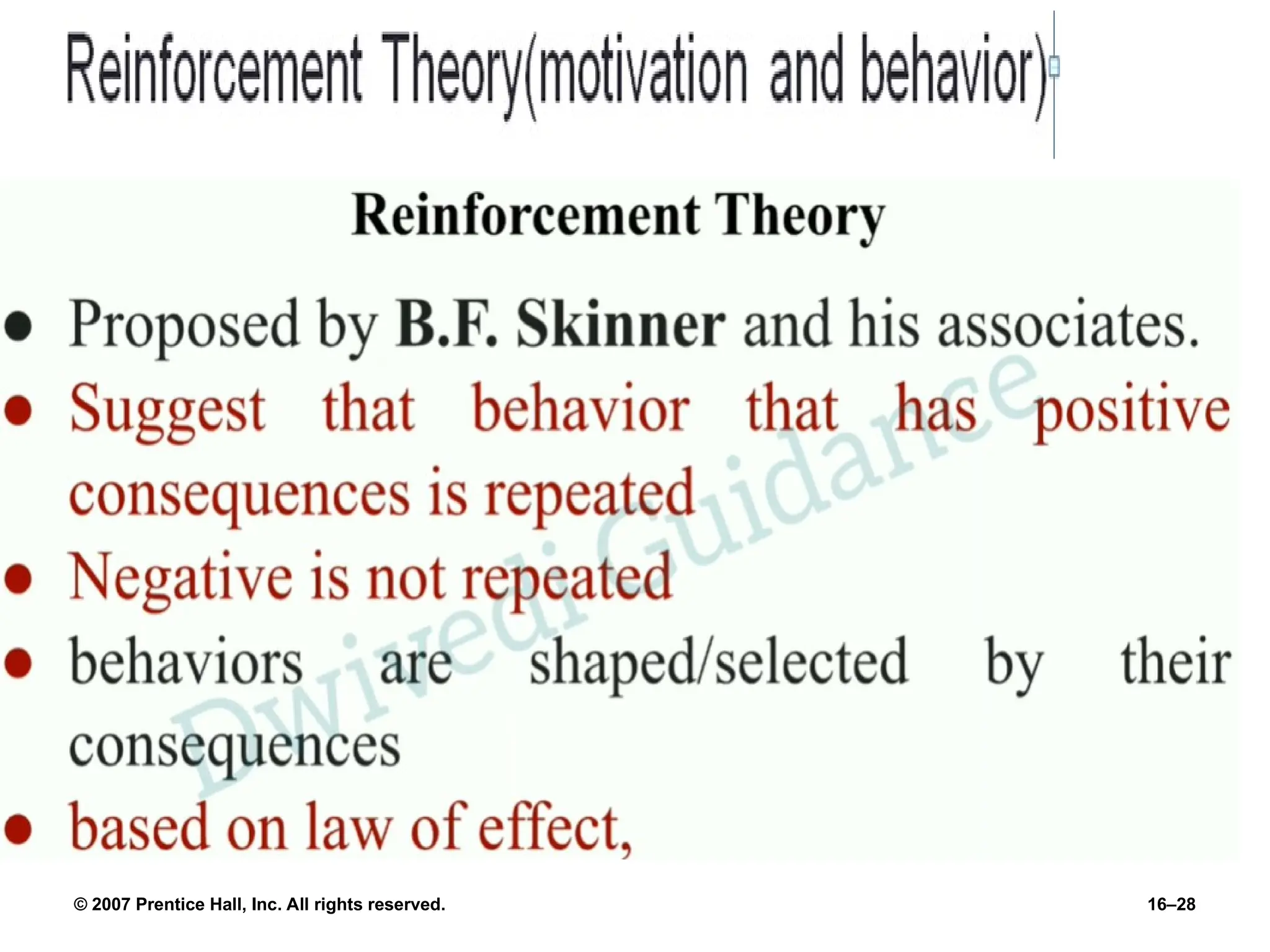
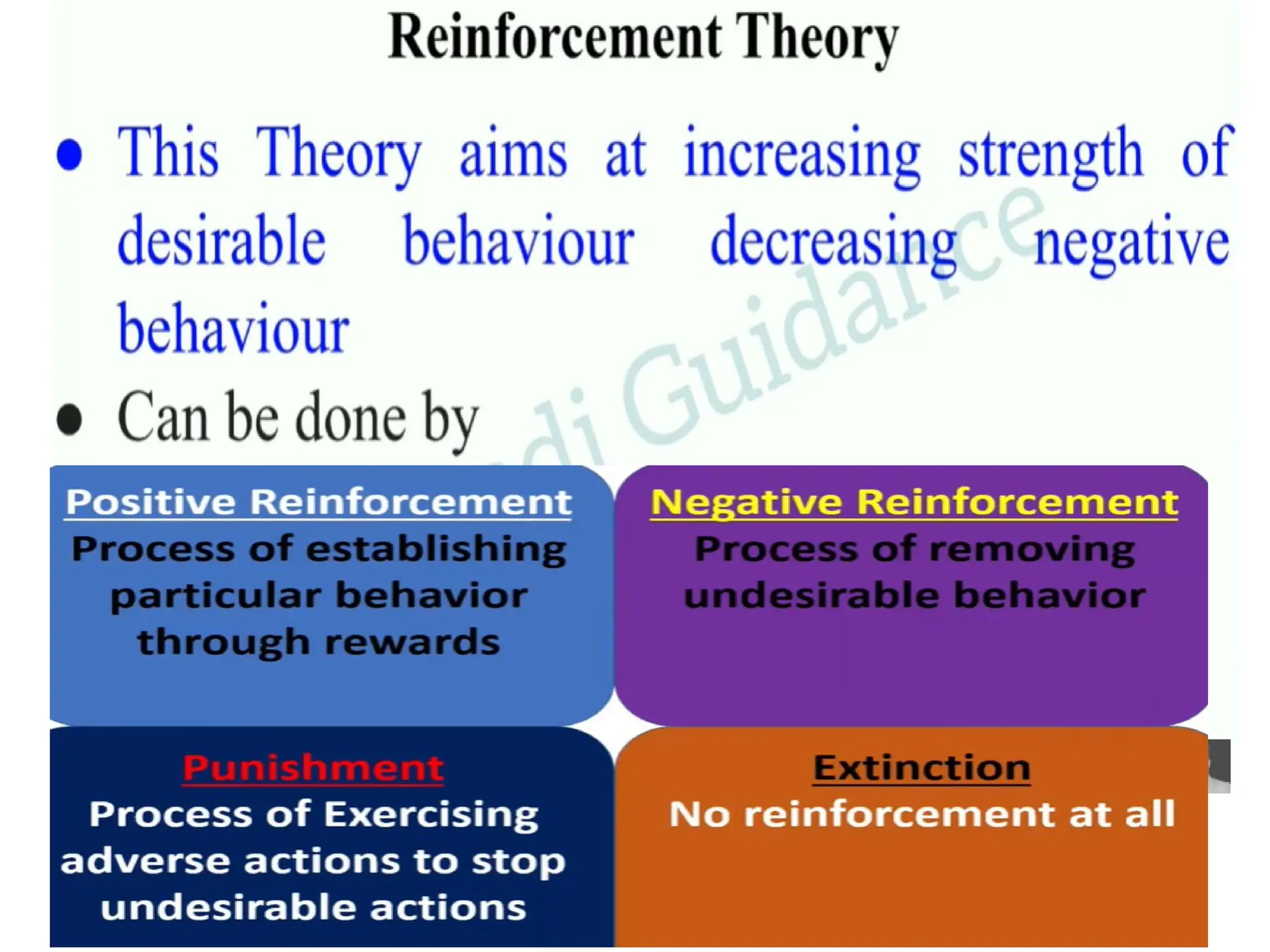
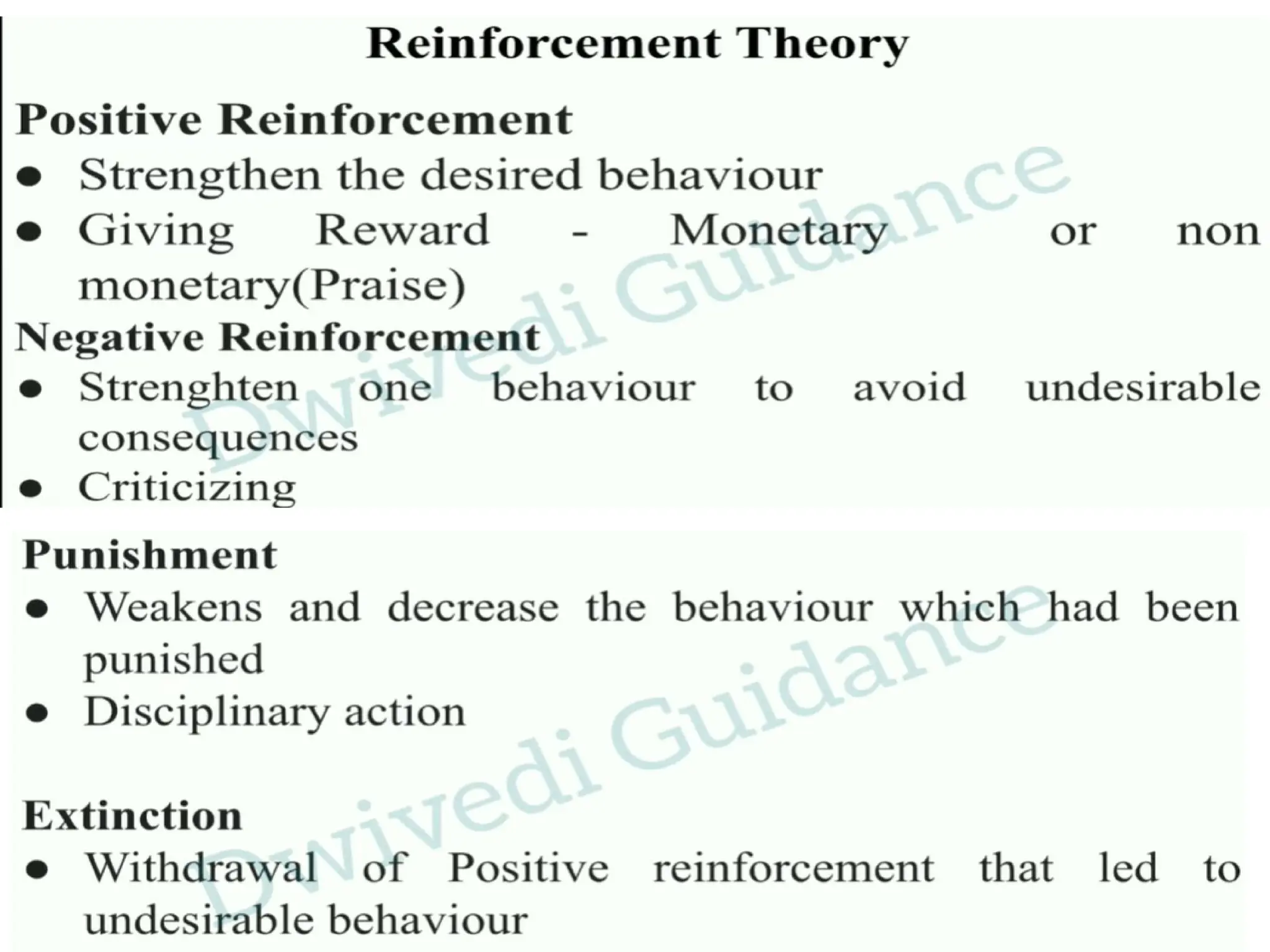
• Reinforcement Theory
Reinforcement Theory
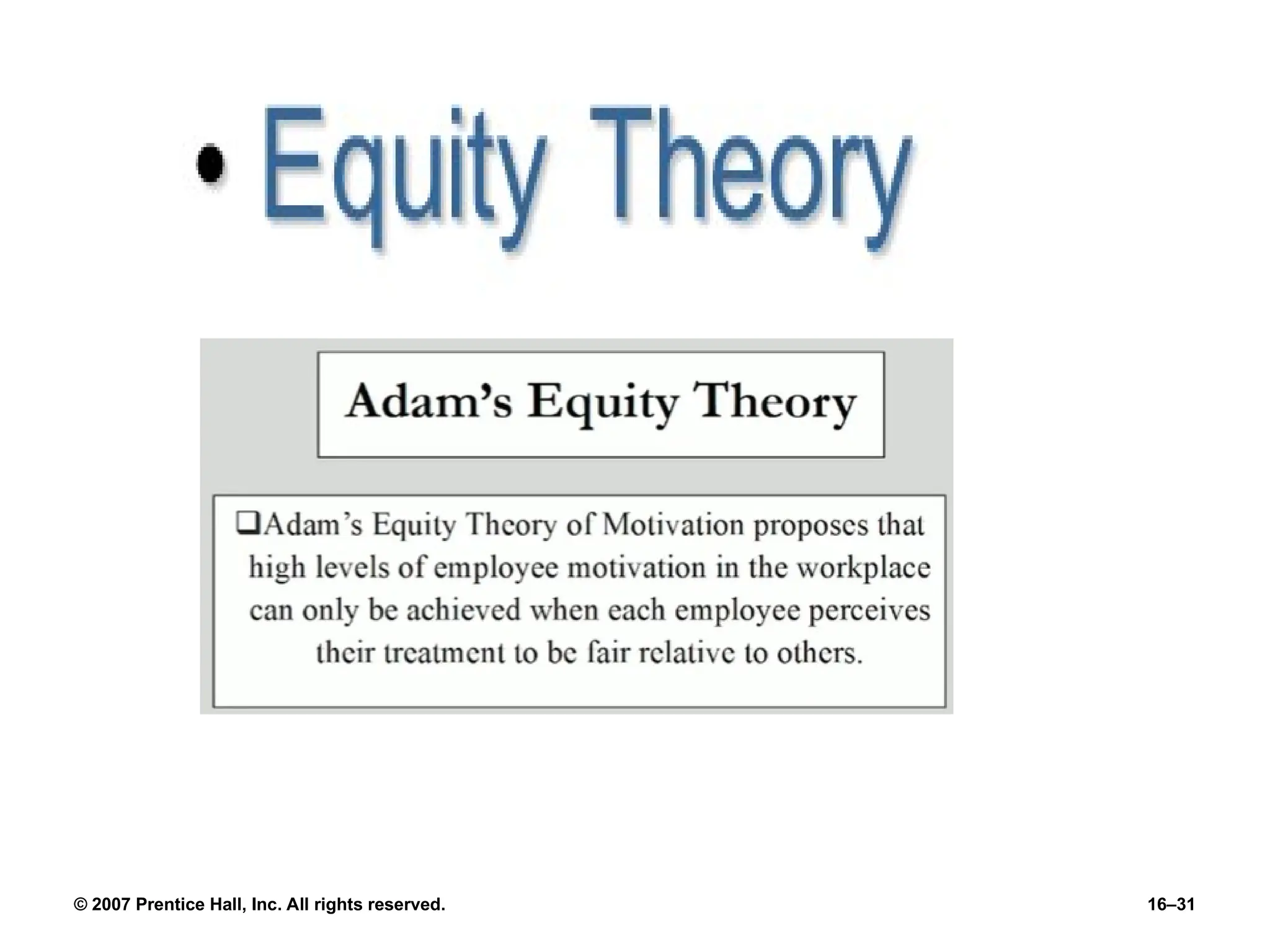
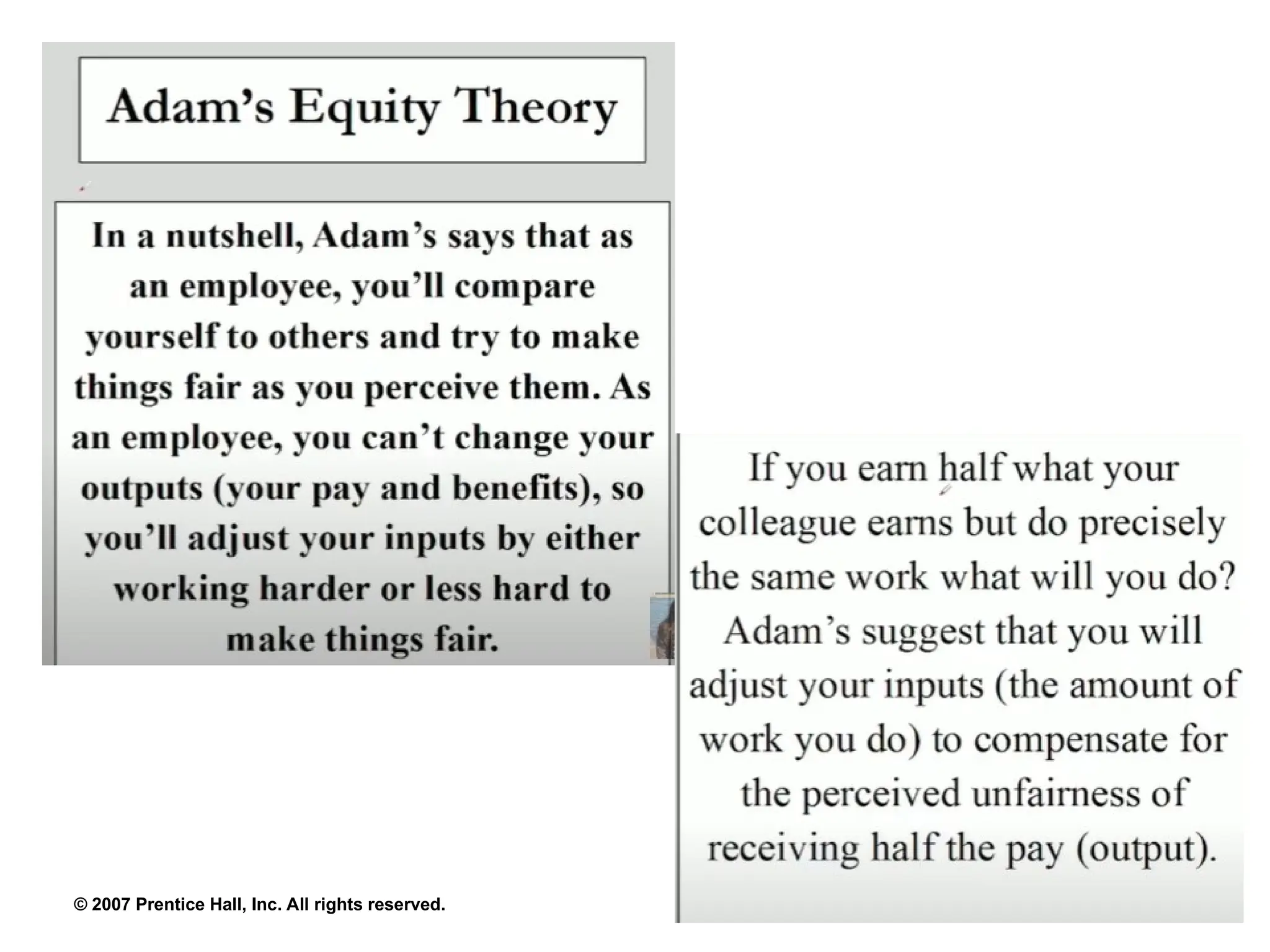
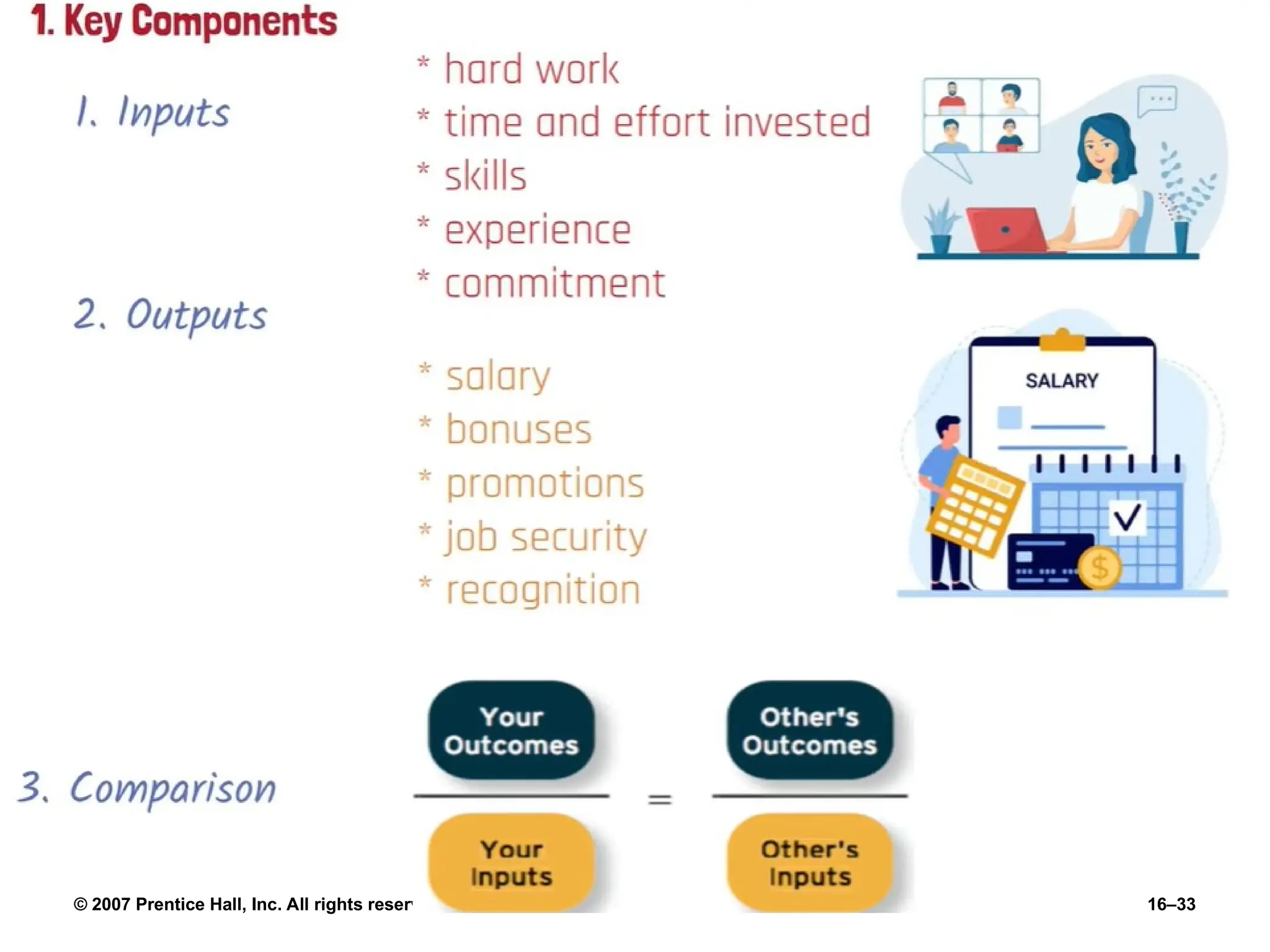
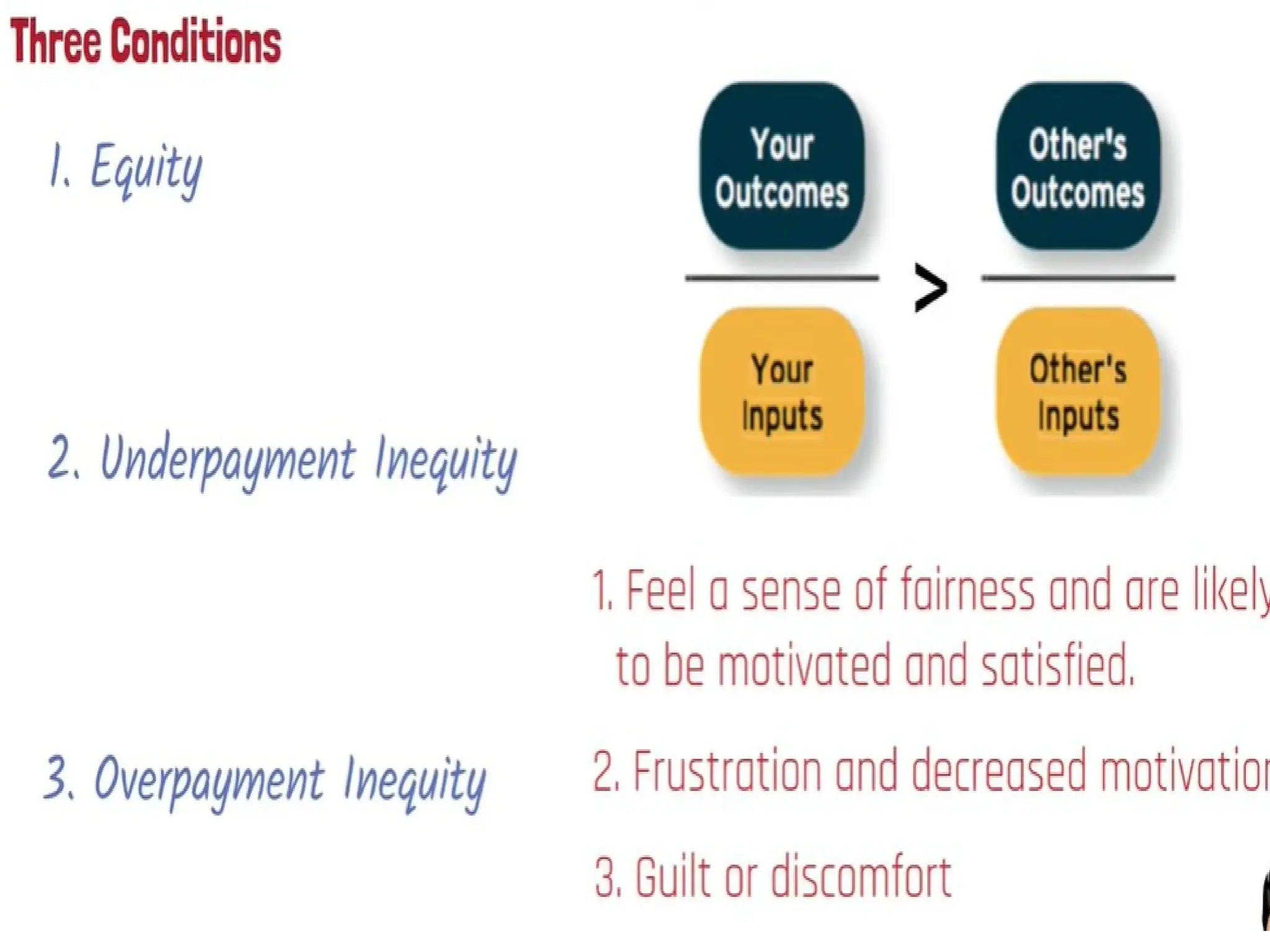
• Equity Theory
Equity Theory
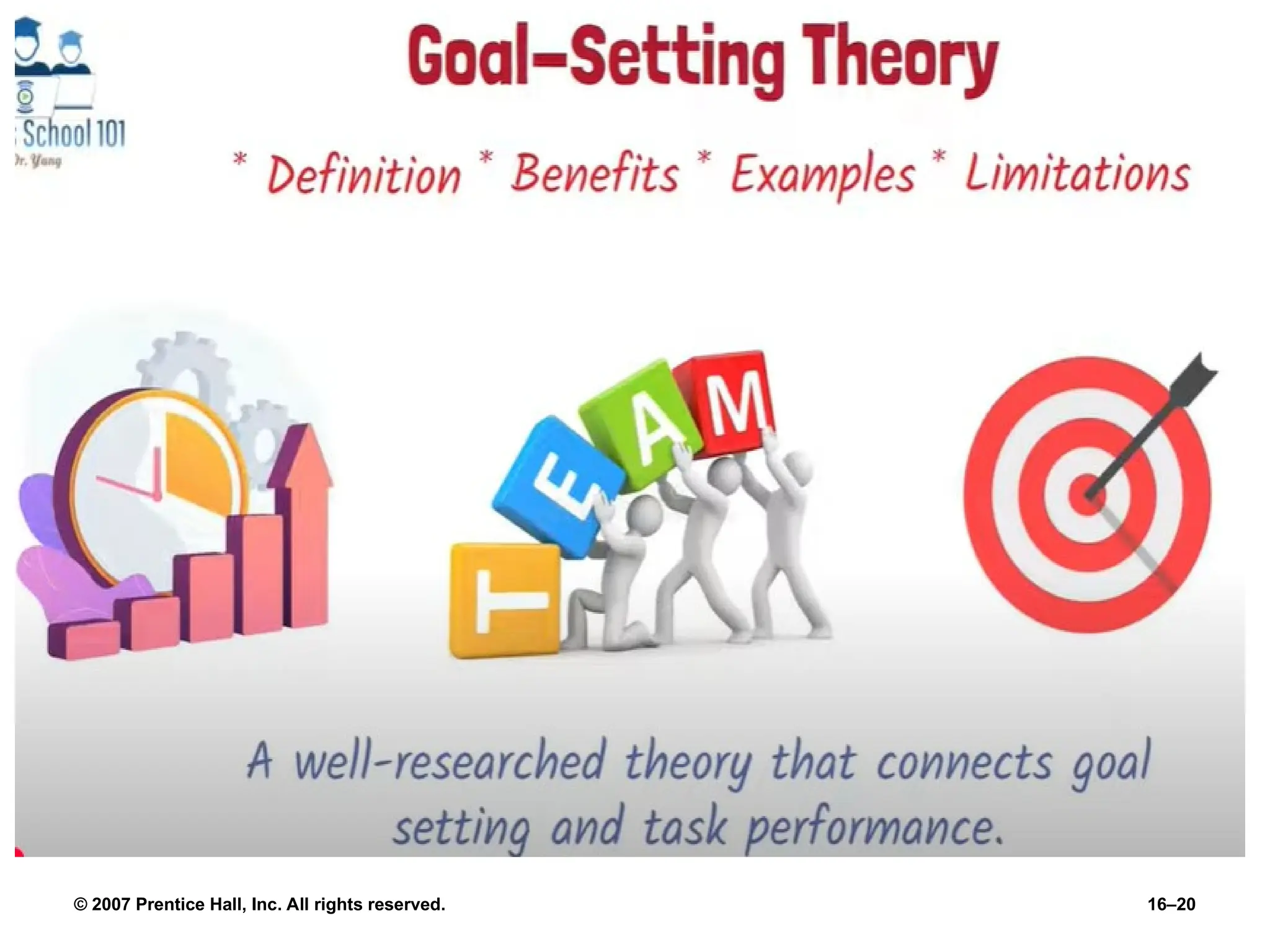
© 2007 Prentice Hall, Inc. All rights reserved. 16–20
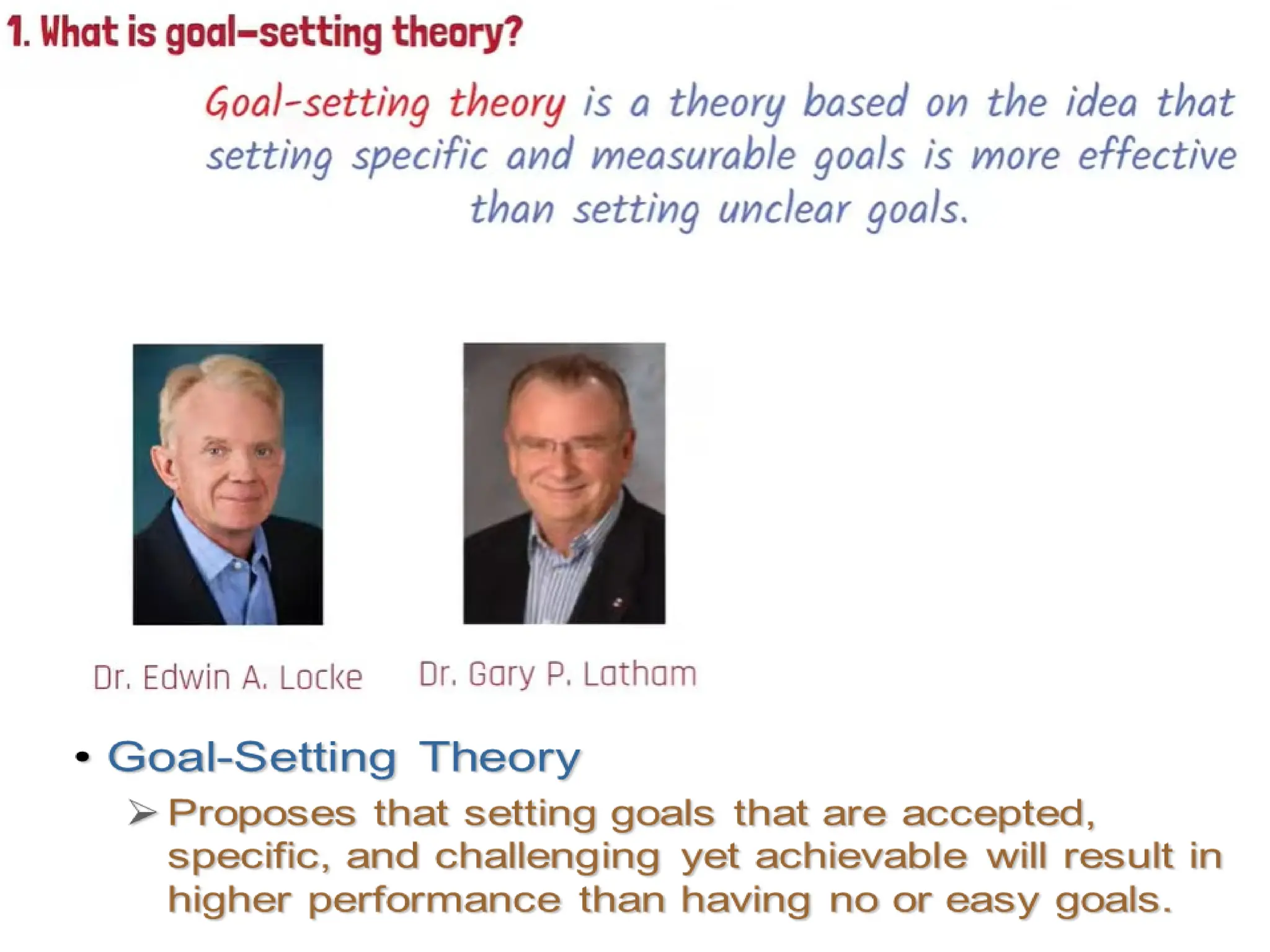
© 2007 Prentice Hall, Inc. All rights reserved. 16–21
© 2007 Prentice Hall, Inc. All rights reserved. 16–22
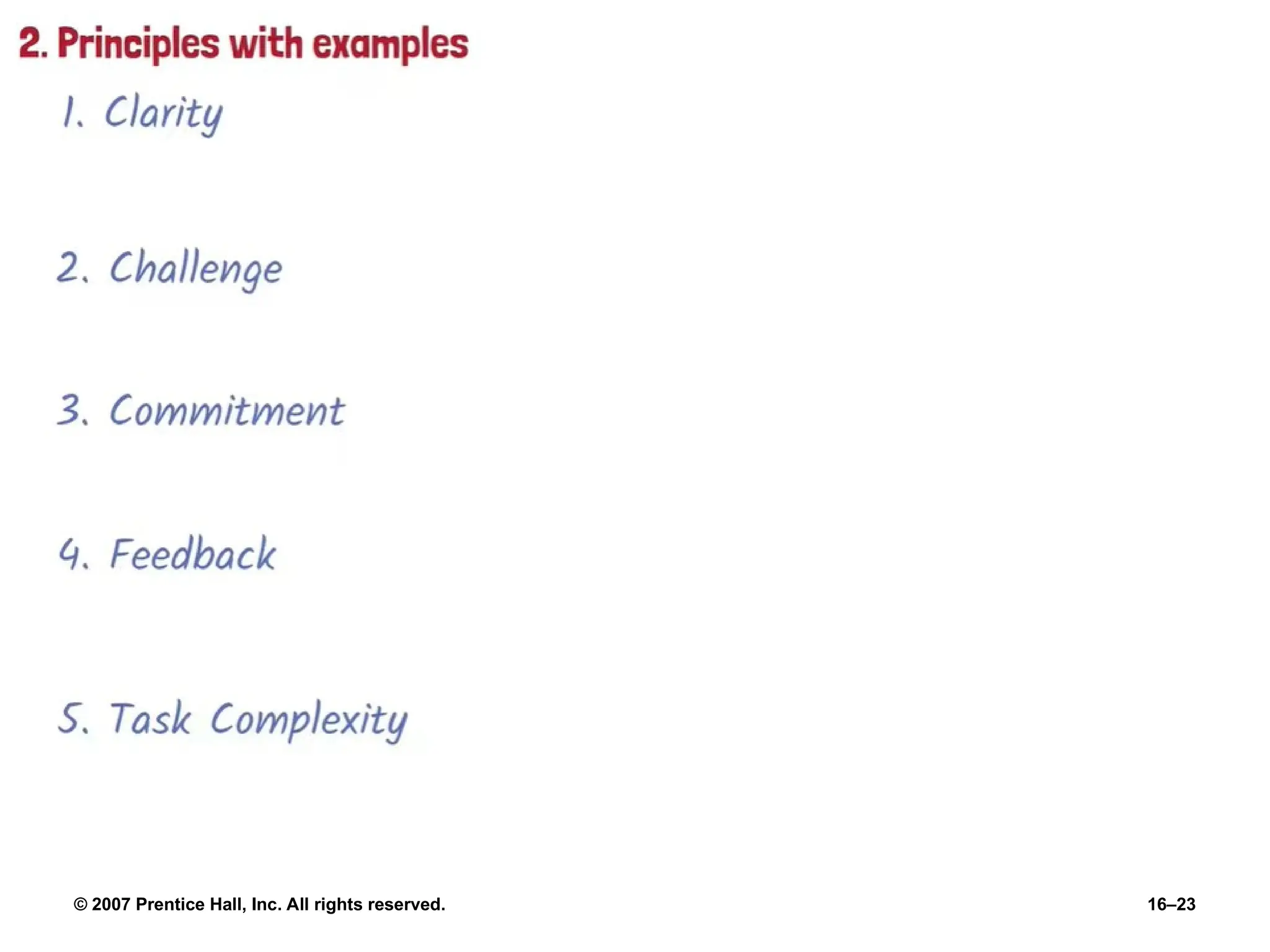
© 2007 Prentice Hall, Inc. All rights reserved. 16–23
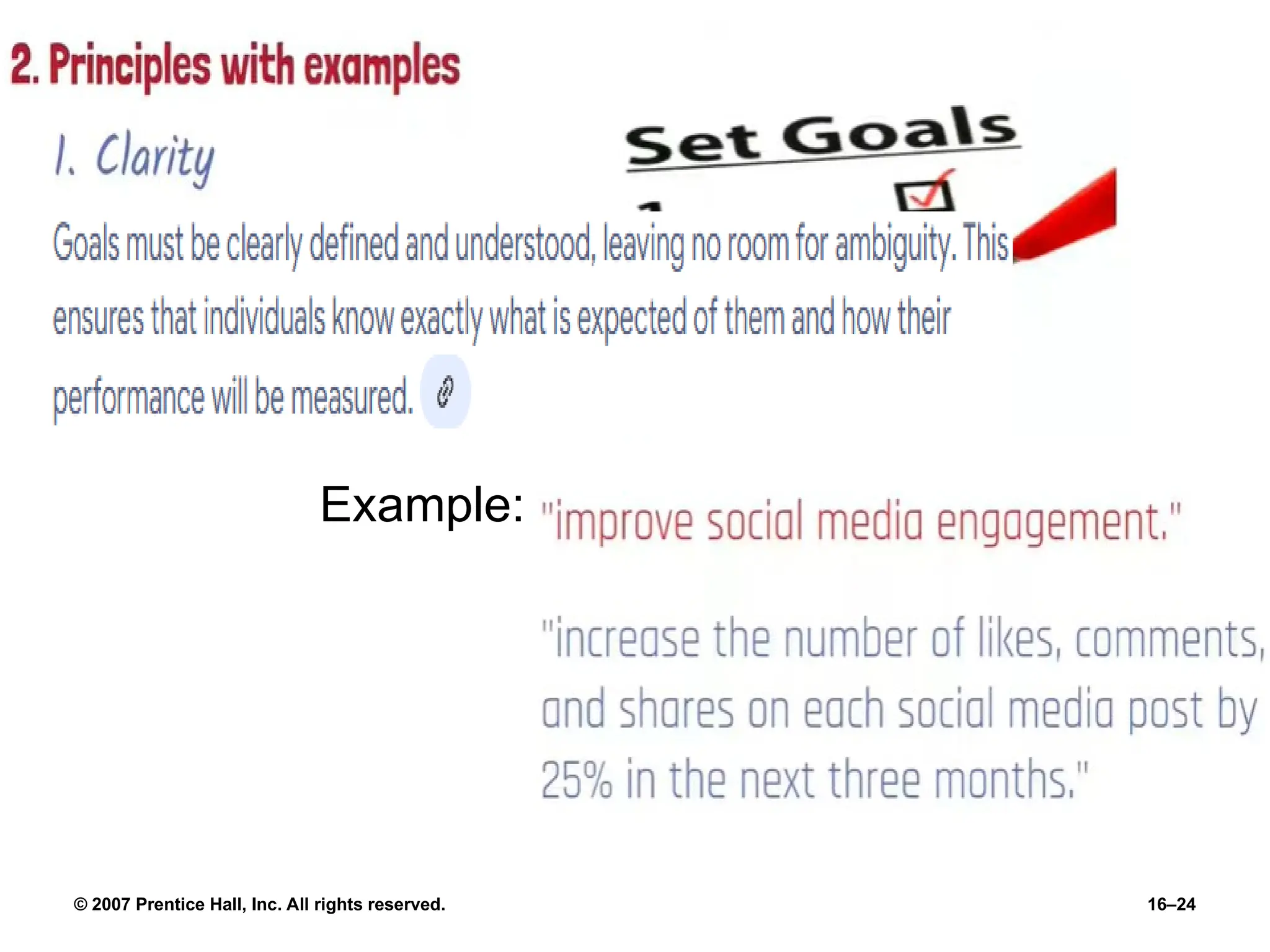
© 2007 Prentice Hall, Inc. All rights reserved. 16–24
Example:
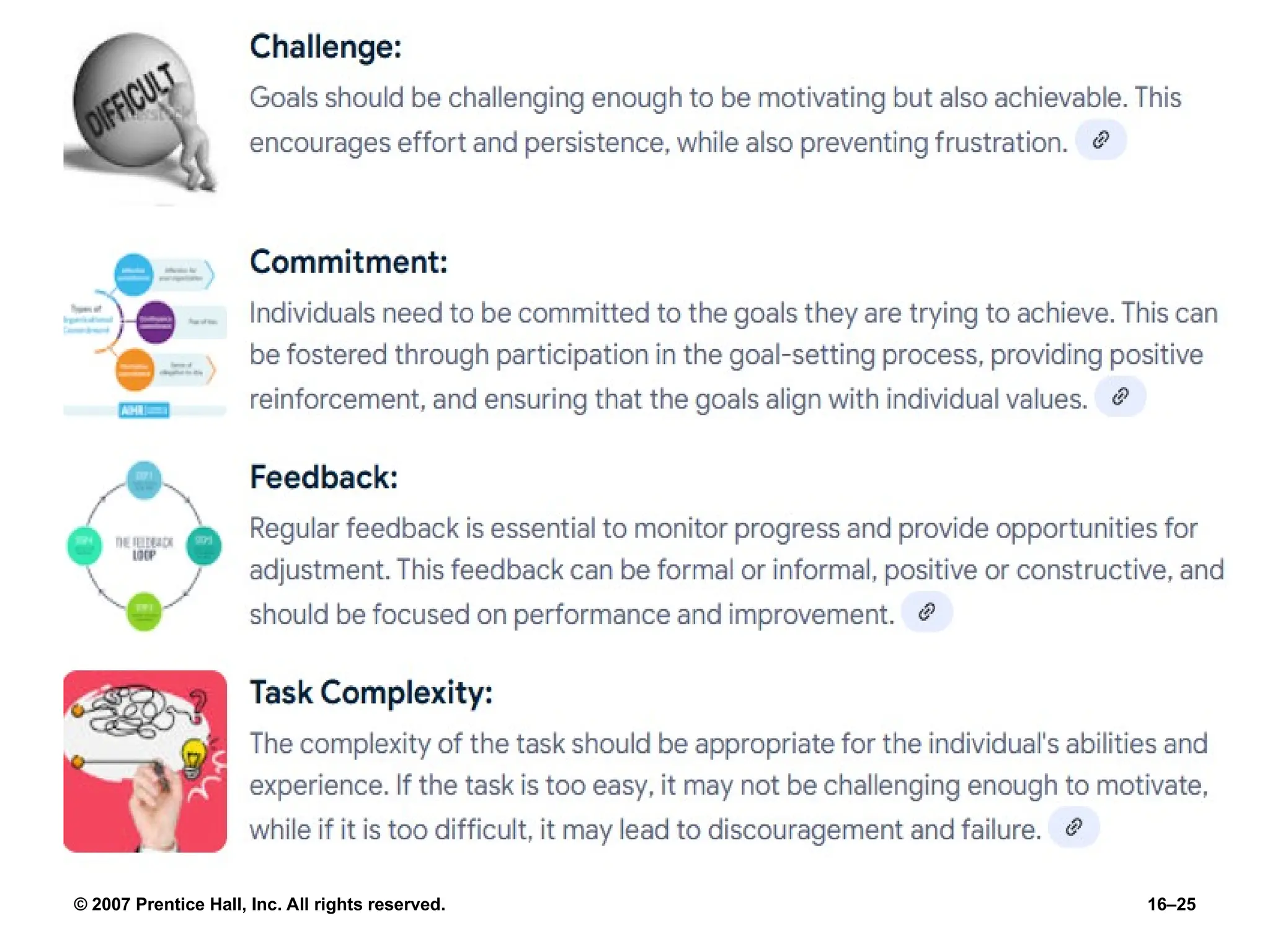
© 2007 Prentice Hall, Inc. All rights reserved. 16–25
© 2007 Prentice Hall, Inc. All rights reserved. 16–26
© 2007 Prentice Hall, Inc. All rights reserved. 16–27
© 2007 Prentice Hall, Inc. All rights reserved. 16–28
© 2007 Prentice Hall, Inc. All rights reserved. 16–29
© 2007 Prentice Hall, Inc. All rights reserved. 16–30
© 2007 Prentice Hall, Inc. All rights reserved. 16–31
© 2007 Prentice Hall, Inc. All rights reserved. 16–32
© 2007 Prentice Hall, Inc. All rights reserved. 16–33
© 2007 Prentice Hall, Inc. All rights reserved. 16–34
© 2007 Prentice Hall, Inc. All rights reserved. 16–35
END
END
© 2007 Prentice Hall, Inc. All rights reserved. 16–36

Management lecture number 14-3.ppt slide

  • 1.
    ninth edition STEPHEN P.ROBBINS PowerPoint Presentation by Charlie Cook PowerPoint Presentation by Charlie Cook The University of West Alabama The University of West Alabama MARY COULTER © 2007 Prentice Hall, Inc. © 2007 Prentice Hall, Inc. All rights reserved. All rights reserved. Motivating Motivating Employees Employees Chapter Chapter 16 16
  • 2.
    © 2007 PrenticeHall, Inc. All rights reserved. 16–2 L E A R N I N G O U T L I N E L E A R N I N G O U T L I N E
  • 3.
    © 2007 PrenticeHall, Inc. All rights reserved. 16–3 What Is Motivation? What Is Motivation? • Motivation Motivation  Is the process by which a person’s efforts are Is the process by which a person’s efforts are energized, directed, and sustained towards attaining energized, directed, and sustained towards attaining a goal. a goal.  Energy: Energy: a measure of intensity or drive. a measure of intensity or drive.  Direction: Direction: toward organizational goals toward organizational goals  Persistence: Persistence: exerting effort to achieve goals. exerting effort to achieve goals.  Motivation works best when individual needs are Motivation works best when individual needs are compatible with organizational goals. compatible with organizational goals.
  • 4.
    © 2007 PrenticeHall, Inc. All rights reserved. 16–4
  • 5.
    © 2007 PrenticeHall, Inc. All rights reserved. 16–5 Early Theories of Motivation Early Theories of Motivation • Maslow’s Hierarchy of Needs Maslow’s Hierarchy of Needs • MacGregor’s Theories X and Y MacGregor’s Theories X and Y • Herzberg’s Two-Factor Theory Herzberg’s Two-Factor Theory • Three needs theory Three needs theory
  • 6.
    © 2007 PrenticeHall, Inc. All rights reserved. 16–6 Early Theories of Motivation Early Theories of Motivation • Maslow’s Hierarchy of Needs Theory/ 1943 Maslow’s Hierarchy of Needs Theory/ 1943  Needs were categorized as five levels of lower- to Needs were categorized as five levels of lower- to higher-order needs. higher-order needs.  Individuals must satisfy lower-order needs before they can Individuals must satisfy lower-order needs before they can satisfy higher order needs. satisfy higher order needs.  Satisfied needs will no longer motivate. Satisfied needs will no longer motivate.  Motivating a person depends on knowing at what level that Motivating a person depends on knowing at what level that person is on the hierarchy. person is on the hierarchy.  Hierarchy of needs Hierarchy of needs  Lower-order (external): physiological, safety Lower-order (external): physiological, safety  Higher-order (internal): social, esteem, self-actualization Higher-order (internal): social, esteem, self-actualization
  • 7.
    © 2007 PrenticeHall, Inc. All rights reserved. 16–7 Exhibit 16–1 Exhibit 16–1 Maslow’s Hierarchy of Needs Maslow’s Hierarchy of Needs
  • 8.
    © 2007 PrenticeHall, Inc. All rights reserved. 16–8
  • 9.
    © 2007 PrenticeHall, Inc. All rights reserved. 16–9 Early Theories of Motivation (cont’d) Early Theories of Motivation (cont’d) • McGregor’s Theory X and Theory Y McGregor’s Theory X and Theory Y  Theory X Theory X  Assumes that workers have little ambition, dislike work, avoid Assumes that workers have little ambition, dislike work, avoid responsibility, and require close supervision. responsibility, and require close supervision.  Theory Y Theory Y  Assumes that workers can exercise self-direction, desire Assumes that workers can exercise self-direction, desire responsibility, and like to work. responsibility, and like to work.  Assumption: Assumption:  Motivation is maximized by participative decision making, Motivation is maximized by participative decision making, interesting jobs, and good group relations. interesting jobs, and good group relations.
  • 10.
    © 2007 PrenticeHall, Inc. All rights reserved. 16–10
  • 11.
    © 2007 PrenticeHall, Inc. All rights reserved. 16–11 Early Theories of Motivation (cont’d) Early Theories of Motivation (cont’d) • Herzberg’s Motivation-Hygiene Theory Herzberg’s Motivation-Hygiene Theory  Job satisfaction and job dissatisfaction are created by Job satisfaction and job dissatisfaction are created by different factors. different factors.  Hygiene factors: Hygiene factors: extrinsic (environmental) factors that extrinsic (environmental) factors that create job dissatisfaction. create job dissatisfaction.  Motivators: Motivators: intrinsic (psychological) factors that create job intrinsic (psychological) factors that create job satisfaction. satisfaction.  Attempted to explain why job satisfaction does not Attempted to explain why job satisfaction does not result in increased performance. result in increased performance.  The opposite of satisfaction is not dissatisfaction, but rather The opposite of satisfaction is not dissatisfaction, but rather no satisfaction. no satisfaction.
  • 12.
    © 2007 PrenticeHall, Inc. All rights reserved. 16–12 Exhibit 16–2 Exhibit 16–2 Herzberg’s Motivation-Hygiene Theory Herzberg’s Motivation-Hygiene Theory
  • 13.
    © 2007 PrenticeHall, Inc. All rights reserved. 16–13 Exhibit 16–3 Exhibit 16–3 Contrasting Views of Satisfaction-Dissatisfaction Contrasting Views of Satisfaction-Dissatisfaction
  • 14.
    © 2007 PrenticeHall, Inc. All rights reserved. 16–14
  • 15.
    © 2007 PrenticeHall, Inc. All rights reserved. 16–15
  • 16.
    © 2007 PrenticeHall, Inc. All rights reserved. 16–16
  • 17.
    © 2007 PrenticeHall, Inc. All rights reserved. 16–17
  • 18.
    © 2007 PrenticeHall, Inc. All rights reserved. 16–18
  • 19.
    © 2007 PrenticeHall, Inc. All rights reserved. 16–19 Contemporary Theories of Motivation Contemporary Theories of Motivation • Goal-Setting Theory Goal-Setting Theory • Reinforcement Theory Reinforcement Theory • Equity Theory Equity Theory
  • 20.
    © 2007 PrenticeHall, Inc. All rights reserved. 16–20
  • 21.
    © 2007 PrenticeHall, Inc. All rights reserved. 16–21
  • 22.
    © 2007 PrenticeHall, Inc. All rights reserved. 16–22
  • 23.
    © 2007 PrenticeHall, Inc. All rights reserved. 16–23
  • 24.
    © 2007 PrenticeHall, Inc. All rights reserved. 16–24 Example:
  • 25.
    © 2007 PrenticeHall, Inc. All rights reserved. 16–25
  • 26.
    © 2007 PrenticeHall, Inc. All rights reserved. 16–26
  • 27.
    © 2007 PrenticeHall, Inc. All rights reserved. 16–27
  • 28.
    © 2007 PrenticeHall, Inc. All rights reserved. 16–28
  • 29.
    © 2007 PrenticeHall, Inc. All rights reserved. 16–29
  • 30.
    © 2007 PrenticeHall, Inc. All rights reserved. 16–30
  • 31.
    © 2007 PrenticeHall, Inc. All rights reserved. 16–31
  • 32.
    © 2007 PrenticeHall, Inc. All rights reserved. 16–32
  • 33.
    © 2007 PrenticeHall, Inc. All rights reserved. 16–33
  • 34.
    © 2007 PrenticeHall, Inc. All rights reserved. 16–34
  • 35.
    © 2007 PrenticeHall, Inc. All rights reserved. 16–35
  • 36.
    END END © 2007 PrenticeHall, Inc. All rights reserved. 16–36