CASE STUDY METHOD
 The case study method is a teaching and learning
approach in management education and research
that involves analyzing real-world scenarios to
explore the complexities of managerial decisions,
business strategies, and organizational challenges.
 This method helps students develop analytical,
decision-making, and problem-solving skills.
Objectives of the Case Study Method
 Practical Application: Bridge the gap between
theoretical knowledge and practical application by
analyzing real-world business problems.
 Critical Thinking: Enhance critical thinking skills by
requiring learners to evaluate situations, identify
problems, and assess potential solutions.
 Decision-Making: Simulate decision-making
scenarios to prepare learners for real managerial
challenges.
 Collaborative Learning: Foster teamwork and
collaborative learning through group discussions
and brainstorming.
 Understanding Dynamics: Improve understanding
of organizational behaviour, market dynamics, and
industry-specific challenges.
 Skill Development: Cultivate skills like analytical
reasoning, communication, leadership, and
adaptability.
Guidelines for Analyzing a Case Study
1. Understand the Context
 Read the case thoroughly to grasp the background, key players, and
context.
 Identify the industry, organization, and environment in which the case
operates.
2. Define the Problem
 Pinpoint the main issues or challenges faced by the organization.
 Differentiate between symptoms of the problem and its root causes.
3. Gather Relevant Information
 Highlight critical facts and data provided in the case.
 Consider external factors, such as market trends, competitors, and
economic conditions.
4. Analyze the Case:
 Apply relevant management theories, models, or
frameworks (e.g., SWOT, PESTEL).
 Assess the implications of different decisions and actions.
5. Develop Alternatives:
 Brainstorm potential solutions or strategies to address
the problem.
 Evaluate the feasibility and consequences of each
alternative.
6. Propose Recommendations:
 Select the best course of action based on the analysis.
 Justify recommendations with logical arguments and evidence from
the case.
7. Implementation Plan:
 Outline actionable steps for implementing the recommended solution.
 Consider resources, timelines, and potential risks.
8. Evaluate Outcomes:
 Predict the likely outcomes and monitor metrics for success.
 Reflect on any limitations or constraints of the recommended
approach.
Best Practices for Case Study Analysis
 Engage in Active Reading
 Take notes, highlight key points, and summarize the case in your
own words.
 Adopt Multiple Perspectives
 Consider the viewpoints of different stakeholders involved in the
case.
 Support with Evidence
 Use data and facts from the case to substantiate your arguments.
 Work Collaboratively
 Discuss the case with peers to gain diverse insights and
perspectives.
 Be Creative and Practical
 Think innovatively but ensure your solutions are realistic and
actionable.
 Reflect on Learnings
 After completing the analysis, identify what you learned and how
it applies to other contexts.
By following these guidelines, the case study method can
become a powerful tool for learning and development in
management education and practice.
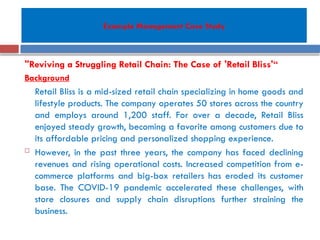
Example Management Case Study
"Reviving a Struggling Retail Chain: The Case of 'Retail Bliss'“
Background
Retail Bliss is a mid-sized retail chain specializing in home goods and
lifestyle products. The company operates 50 stores across the country
and employs around 1,200 staff. For over a decade, Retail Bliss
enjoyed steady growth, becoming a favorite among customers due to
its affordable pricing and personalized shopping experience.
 However, in the past three years, the company has faced declining
revenues and rising operational costs. Increased competition from e-
commerce platforms and big-box retailers has eroded its customer
base. The COVID-19 pandemic accelerated these challenges, with
store closures and supply chain disruptions further straining the
business.
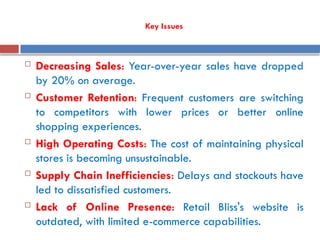
Key Issues
 Decreasing Sales: Year-over-year sales have dropped
by 20% on average.
 Customer Retention: Frequent customers are switching
to competitors with lower prices or better online
shopping experiences.
 High Operating Costs: The cost of maintaining physical
stores is becoming unsustainable.
 Supply Chain Inefficiencies: Delays and stockouts have
led to dissatisfied customers.
 Lack of Online Presence: Retail Bliss's website is
outdated, with limited e-commerce capabilities.
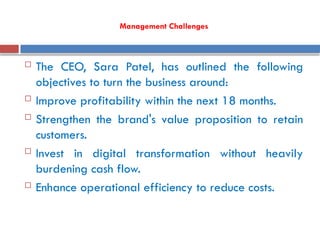
Management Challenges
 The CEO, Sara Patel, has outlined the following
objectives to turn the business around:
 Improve profitability within the next 18 months.
 Strengthen the brand's value proposition to retain
customers.
 Invest in digital transformation without heavily
burdening cash flow.
 Enhance operational efficiency to reduce costs.
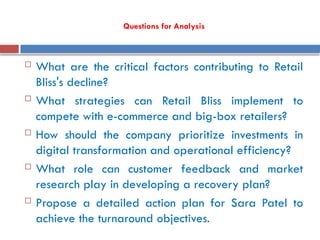
Questions for Analysis
 What are the critical factors contributing to Retail
Bliss's decline?
 What strategies can Retail Bliss implement to
compete with e-commerce and big-box retailers?
 How should the company prioritize investments in
digital transformation and operational efficiency?
 What role can customer feedback and market
research play in developing a recovery plan?
 Propose a detailed action plan for Sara Patel to
achieve the turnaround objectives.
Sample Solution Framework
1. Define the Problem
 Retail Bliss is struggling due to external competition,
lack of a digital presence, operational inefficiencies,
and declining customer loyalty.
2. Analyze the Case
 Conduct a SWOT analysis to identify strengths,
weaknesses, opportunities, and threats.
 Assess customer preferences through surveys or
focus groups.
3. Develop Alternatives
Option1: Invest heavily in e-commerce, offering a
seamless online shopping experience.
Option2: Close underperforming stores and focus on
profitable locations.
Option3: Launch exclusive product lines to
differentiate from competitors.
Option4: Partner with third-party logistics providers
to streamline the supply chain.
4. Recommendation
Implement a hybrid strategy:
Strengthen e-commerce while keeping key
physical stores as brand touch points.
Use data analytics to personalize customer
experiences online and offline.
Negotiate with suppliers for better terms to
improve inventory management.
5.Implementation Plan
 Redesign the website for better usability and
introduce an app for mobile shopping.
 Train employees to adapt to an omnichannel retail
model.
 Roll out a loyalty program offering discounts and
exclusive perks to frequent shoppers.
 Phase out underperforming stores and invest in top-
performing locations.
6. Expected Outcomes
 Increase in sales by 25% within two years.
 Reduction in operational costs by 15% through supply
chain optimization.
 Improved customer satisfaction and retention metrics.
This case allows MBA students to explore topics like
competitive strategy, digital transformation, supply
chain management, and customer relationship
management while fostering critical thinking and
practical problem-solving skills.

Management Case study analysis for MBA students-

  • 1.
    CASE STUDY METHOD The case study method is a teaching and learning approach in management education and research that involves analyzing real-world scenarios to explore the complexities of managerial decisions, business strategies, and organizational challenges.  This method helps students develop analytical, decision-making, and problem-solving skills.
  • 2.
    Objectives of theCase Study Method  Practical Application: Bridge the gap between theoretical knowledge and practical application by analyzing real-world business problems.  Critical Thinking: Enhance critical thinking skills by requiring learners to evaluate situations, identify problems, and assess potential solutions.  Decision-Making: Simulate decision-making scenarios to prepare learners for real managerial challenges.
  • 3.
     Collaborative Learning:Foster teamwork and collaborative learning through group discussions and brainstorming.  Understanding Dynamics: Improve understanding of organizational behaviour, market dynamics, and industry-specific challenges.  Skill Development: Cultivate skills like analytical reasoning, communication, leadership, and adaptability.
  • 4.
    Guidelines for Analyzinga Case Study 1. Understand the Context  Read the case thoroughly to grasp the background, key players, and context.  Identify the industry, organization, and environment in which the case operates. 2. Define the Problem  Pinpoint the main issues or challenges faced by the organization.  Differentiate between symptoms of the problem and its root causes. 3. Gather Relevant Information  Highlight critical facts and data provided in the case.  Consider external factors, such as market trends, competitors, and economic conditions.
  • 5.
    4. Analyze theCase:  Apply relevant management theories, models, or frameworks (e.g., SWOT, PESTEL).  Assess the implications of different decisions and actions. 5. Develop Alternatives:  Brainstorm potential solutions or strategies to address the problem.  Evaluate the feasibility and consequences of each alternative.
  • 6.
    6. Propose Recommendations: Select the best course of action based on the analysis.  Justify recommendations with logical arguments and evidence from the case. 7. Implementation Plan:  Outline actionable steps for implementing the recommended solution.  Consider resources, timelines, and potential risks. 8. Evaluate Outcomes:  Predict the likely outcomes and monitor metrics for success.  Reflect on any limitations or constraints of the recommended approach.
  • 7.
    Best Practices forCase Study Analysis  Engage in Active Reading  Take notes, highlight key points, and summarize the case in your own words.  Adopt Multiple Perspectives  Consider the viewpoints of different stakeholders involved in the case.  Support with Evidence  Use data and facts from the case to substantiate your arguments.  Work Collaboratively  Discuss the case with peers to gain diverse insights and perspectives.
  • 8.
     Be Creativeand Practical  Think innovatively but ensure your solutions are realistic and actionable.  Reflect on Learnings  After completing the analysis, identify what you learned and how it applies to other contexts. By following these guidelines, the case study method can become a powerful tool for learning and development in management education and practice.
  • 9.
    Example Management CaseStudy "Reviving a Struggling Retail Chain: The Case of 'Retail Bliss'“ Background Retail Bliss is a mid-sized retail chain specializing in home goods and lifestyle products. The company operates 50 stores across the country and employs around 1,200 staff. For over a decade, Retail Bliss enjoyed steady growth, becoming a favorite among customers due to its affordable pricing and personalized shopping experience.  However, in the past three years, the company has faced declining revenues and rising operational costs. Increased competition from e- commerce platforms and big-box retailers has eroded its customer base. The COVID-19 pandemic accelerated these challenges, with store closures and supply chain disruptions further straining the business.
  • 10.
    Key Issues  DecreasingSales: Year-over-year sales have dropped by 20% on average.  Customer Retention: Frequent customers are switching to competitors with lower prices or better online shopping experiences.  High Operating Costs: The cost of maintaining physical stores is becoming unsustainable.  Supply Chain Inefficiencies: Delays and stockouts have led to dissatisfied customers.  Lack of Online Presence: Retail Bliss's website is outdated, with limited e-commerce capabilities.
  • 11.
    Management Challenges  TheCEO, Sara Patel, has outlined the following objectives to turn the business around:  Improve profitability within the next 18 months.  Strengthen the brand's value proposition to retain customers.  Invest in digital transformation without heavily burdening cash flow.  Enhance operational efficiency to reduce costs.
  • 12.
    Questions for Analysis What are the critical factors contributing to Retail Bliss's decline?  What strategies can Retail Bliss implement to compete with e-commerce and big-box retailers?  How should the company prioritize investments in digital transformation and operational efficiency?  What role can customer feedback and market research play in developing a recovery plan?  Propose a detailed action plan for Sara Patel to achieve the turnaround objectives.
  • 13.
    Sample Solution Framework 1.Define the Problem  Retail Bliss is struggling due to external competition, lack of a digital presence, operational inefficiencies, and declining customer loyalty. 2. Analyze the Case  Conduct a SWOT analysis to identify strengths, weaknesses, opportunities, and threats.  Assess customer preferences through surveys or focus groups.
  • 14.
    3. Develop Alternatives Option1:Invest heavily in e-commerce, offering a seamless online shopping experience. Option2: Close underperforming stores and focus on profitable locations. Option3: Launch exclusive product lines to differentiate from competitors. Option4: Partner with third-party logistics providers to streamline the supply chain.
  • 15.
    4. Recommendation Implement ahybrid strategy: Strengthen e-commerce while keeping key physical stores as brand touch points. Use data analytics to personalize customer experiences online and offline. Negotiate with suppliers for better terms to improve inventory management.
  • 16.
    5.Implementation Plan  Redesignthe website for better usability and introduce an app for mobile shopping.  Train employees to adapt to an omnichannel retail model.  Roll out a loyalty program offering discounts and exclusive perks to frequent shoppers.  Phase out underperforming stores and invest in top- performing locations.
  • 17.
    6. Expected Outcomes Increase in sales by 25% within two years.  Reduction in operational costs by 15% through supply chain optimization.  Improved customer satisfaction and retention metrics. This case allows MBA students to explore topics like competitive strategy, digital transformation, supply chain management, and customer relationship management while fostering critical thinking and practical problem-solving skills.