Course Project: Development and Analysis of Two Mini Case
Studies
Class: BUSN412 Business Policy
GRADING RUBRIC & EXPECTATIONS AT THE BOTTOM
Objectives
Select, develop, and analyze two mini case studies. The purpose
of this project is to identify a successful strategy and compare
and contrast it with an unsuccessful strategy, with the aim of
identifying critical success factors (CSFs). You may select two
strategies developed in the same company or from entirely
different companies—or, indeed, different industries.
Case studies are used extensively in teaching business.
Typically students perform an analysis on a case study prepared
by an author or the professor—in this instance, the student is
the author of the cases. The case study research strategy
provides the opportunity to develop an in-depth understanding
of an organization or event—data can be collected from
multiple sources (for example, company websites, interviews, or
published articles).
Please select two examples that reflect success and failure—
collect data from multiple sources and develop two mini case
studies of 500 words in length. Perform a cross-case analysis by
comparing and contrasting the case studies on points of parity
and points of difference. This should entail developing a
framework, similar to many of the frameworks presented in
class (e.g., SWOT or Five Forces) and analyzing the key data in
your case studies. The analysis should be presented after your
case studies and should be followed by a brief concluding
statement and references in APA format.
Guidelines
Mini Case I: (Success): Sufficient length begins with general
points and moves to a focus on specifics, evidence of success,
good quality content—relevant, accurate, and timely.
Mini Case II: (Failure): Sufficient length begins with general
points and moves to a focus on specifics, evidence of failure,
good quality content—relevant, accurate, and timely.
Cross-Case Analysis: Once you have completed your cases you
need to conduct a cross-case analysis. This requires comparing
the two cases to determine points of similarity and points of
difference.
Research Skills: Each case uses four to six sources, and sources
are cited in the text and at the end of the case study in APA
format.
Writing Skills: Ideas are communicated clearly in business
English and using the appropriate business terminology. Work
should be prepared following the development of a rough draft,
revision, editing, and proofing to produce a final polished
report.
A successful project will meet all of these requirements to earn
a maximum of 200 points. At the conclusion of this project it
will be beneficial to compare what factors are selected by your
peers. Are there patterns here?
Milestones
· Week 1: Select company strategies, read supporting documents
in Doc Sharing.
· Weeks 2–7: Research and prepare rough draft and analysis,
followed by revision, editing, and proofing—obtaining
feedback.
· Week 8: Submit Final Report.
Grading Rubrics
Category
Points
%
Description
Mini Case I: Success
40
20%
A quality paper will meet
or exceed 500 words.
Mini Case II: Failure
40
20%
A quality paper will meet or
exceed 500 words.
Cross-Case Analysis
40
20%
Includes framework and
critical success factors.
Research Skills
40
20%
Based on accurate, relevant,
and timely sources.
Writing Skills
40
20%
Business English,
grammatically correct,
error free, APA format.
Total
200
100%
A quality paper will meet
or exceed all of the above
requirements.
Best Practices
The Process for Developing a Case Study and Cross-Case
Analysis
· Generate topic ideas (brainstorm – use your experience – your
interests – career oriented choices).
· Develop initial ideas (explore the Internet – library data
bases).
· Select a topic (find the best fit between assignment and
information/interest/experience obtained).
· Develop a research question/set of questions - e.g. Why did
this strategy succeed? (answering this question this will guide
data collection and helps interpret results).
· Data collection and analysis:
Decide on suitable sources and means to access these sources
Conduct interviews/observations, if appropriate
Collect published sources and record publication details (use
APA format)
Review data and determine gaps that need to be filled
Determine case study structure (chronological or organized
around key events/issues)
Interpret data in relation to the initial research question
· Develop an outline – Say what you are going to say – Say it –
Say you have said it (i.e. Introduction – Main body – Summary
and conclusion).
· Develop a rough draft, revise, edit and proof – this is critical
to producing a good quality document.
· A good case study should be:
Significant
Complete
Consider alternative perspectives
Display sufficient evidence
Be written in an engaging manner
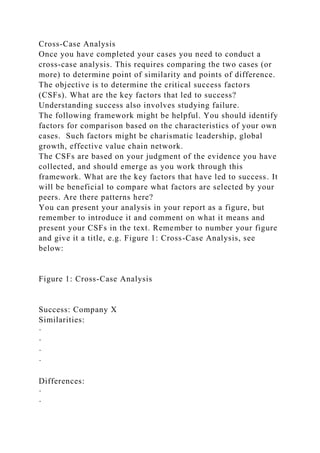
Cross-Case Analysis
Once you have completed your cases you need to conduct a
cross-case analysis. This requires comparing the two cases (or
more) to determine point of similarity and points of difference.
The objective is to determine the critical success factors
(CSFs). What are the key factors that led to success?
Understanding success also involves studying failure.
The following framework might be helpful. You should identify
factors for comparison based on the characteristics of your own
cases. Such factors might be charismatic leadership, global
growth, effective value chain network.
The CSFs are based on your judgment of the evidence you have
collected, and should emerge as you work through this
framework. What are the key factors that have led to success. It
will be beneficial to compare what factors are selected by your
peers. Are there patterns here?
You can present your analysis in your report as a figure, but
remember to introduce it and comment on what it means and
present your CSFs in the text. Remember to number your figure
and give it a title, e.g. Figure 1: Cross-Case Analysis, see
below:
Figure 1: Cross-Case Analysis
Success: Company X
Similarities:
·
·
·
·
Differences:
·
·
·
·
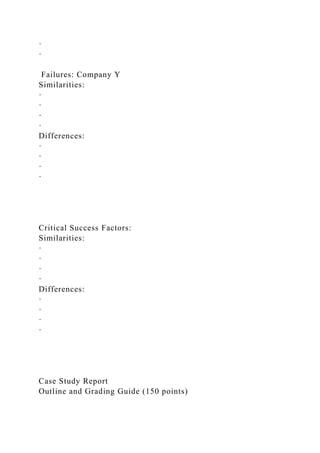
Failures: Company Y
Similarities:
·
·
·
·
Differences:
·
·
·
·
Critical Success Factors:
Similarities:
·
·
·
·
Differences:
·
·
·
·
Case Study Report
Outline and Grading Guide (150 points)
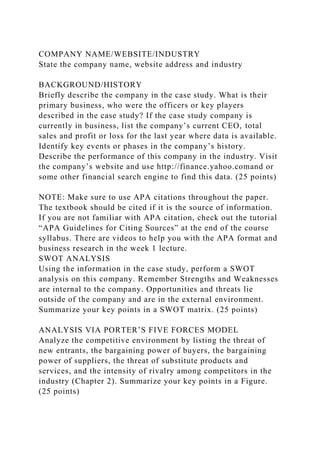
COMPANY NAME/WEBSITE/INDUSTRY
State the company name, website address and industry
BACKGROUND/HISTORY
Briefly describe the company in the case study. What is their
primary business, who were the officers or key players
described in the case study? If the case study company is
currently in business, list the company’s current CEO, total
sales and profit or loss for the last year where data is available.
Identify key events or phases in the company’s history.
Describe the performance of this company in the industry. Visit
the company’s website and use http://finance.yahoo.comand or
some other financial search engine to find this data. (25 points)
NOTE: Make sure to use APA citations throughout the paper.
The textbook should be cited if it is the source of information.
If you are not familiar with APA citation, check out the tutorial
“APA Guidelines for Citing Sources” at the end of the course
syllabus. There are videos to help you with the APA format and
business research in the week 1 lecture.
SWOT ANALYSIS
Using the information in the case study, perform a SWOT
analysis on this company. Remember Strengths and Weaknesses
are internal to the company. Opportunities and threats lie
outside of the company and are in the external environment.
Summarize your key points in a SWOT matrix. (25 points)
ANALYSIS VIA PORTER’S FIVE FORCES MODEL
Analyze the competitive environment by listing the threat of
new entrants, the bargaining power of buyers, the bargaining
power of suppliers, the threat of substitute products and
services, and the intensity of rivalry among competitors in the
industry (Chapter 2). Summarize your key points in a Figure.
(25 points)
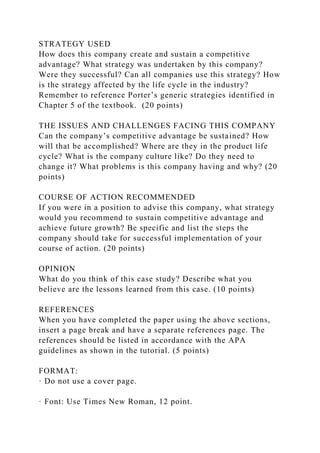
STRATEGY USED
How does this company create and sustain a competitive
advantage? What strategy was undertaken by this company?
Were they successful? Can all companies use this strategy? How
is the strategy affected by the life cycle in the industry?
Remember to reference Porter’s generic strategies identified in
Chapter 5 of the textbook. (20 points)
THE ISSUES AND CHALLENGES FACING THIS COMPANY
Can the company’s competitive advantage be sustained? How
will that be accomplished? Where are they in the product life
cycle? What is the company culture like? Do they need to
change it? What problems is this company having and why? (20
points)
COURSE OF ACTION RECOMMENDED
If you were in a position to advise this company, what strategy
would you recommend to sustain competitive advantage and
achieve future growth? Be specific and list the steps the
company should take for successful implementation of your
course of action. (20 points)
OPINION
What do you think of this case study? Describe what you
believe are the lessons learned from this case. (10 points)
REFERENCES
When you have completed the paper using the above sections,
insert a page break and have a separate references page. The
references should be listed in accordance with the APA
guidelines as shown in the tutorial. (5 points)
FORMAT:
· Do not use a cover page.
· Font: Use Times New Roman, 12 point.
· Place your name in the upper left hand corner of the page.
· Each section of your paper should be headed by the bolded,
capitalized item described above.
· Indent paragraphs.
· Insert page numbers bottom right.
· Limit the paper to no more than 4 double spaced pages.
· Use APA citations throughout the paper. If you are not
familiar with APA citation, refer to tutorial, which is contained
in the last section of our course syllabus.
· Include a separate “References” page at the end of the paper
(This is not one of the 4 pages).
· Please prepare reference page as follows:
References
Dess, G., Lumpkin, G. & Eisner, A. (2012).Strategic
Management (6e). Boston: McGraw-Hill Irwin.
Save your paper in the following format: Your last name your
initials and the company discussed in the case study
EXAMPLE: If your name is Edward R Jones and you are writing
a case study on Google, then the file name for your paper would
be jonesergoogle.doc
Place the paper in the drop box designated by the weekly
assignment.
Note that the report is worth 150 points and points are allocated
for each section as noted in the outline.
SWOT Analysis and Strategic Scorecard
One of the most common business tools during organizational
assessment is the strengths, weaknesses, opportunities and
threats (SWOT) model. Another is developing a balanced
scorecard based on a prescribed or planned set of performance
objectives that will be measured and evaluated regularly. In this
assignment, you will learn about both and how to apply them in
business.
Integrate the research and analysis from the previous three
assignments and produce a SWOT analysis and a strategic
scorecard for Chipotle.
Part 1—SWOT Analysis (2 pages)
Your SWOT analysis should summarize the opportunities and
threats from the external environmental scan with the strengths
and weaknesses from your organizational assessment or internal
environmental scan.
Your output should include a matrix depicting strengths or
weaknesses on the horizontal axis and opportunities or threats
on the vertical axis. This matrix will reveal a set of strategy
forces that can be used to assess the current strategy and
identify important potential changes to the strategic direction of
the company.
In creating your SWOT analysis, look for natural pairings of
internal and external factors that match internal resources and
capabilities to the external environment. Internal strengths and
external opportunities depicted in the upper left quadrant on
your matrix might form complementary pairs that suggest
necessary strategic focus for the business unit to pursue
opportunities that fit its competitive strengths. Conversely,
internal weaknesses and external threats shown in the lower
right quadrant of the matrix may combine to illustrate the need
for a defensive strategy to avoid becoming highly susceptible to
competitive threats.
Your matrix should not simply be a collection of four lists
compiled together in a matrix. Your analysis should combine
factors and explain why specific strengths complement specific
opportunities, and selected weaknesses are amplified by
external threats. In addition to your matrix, provide a brief
narrative that summarizes the main findings in your analysis
and the implications for the current and projected strategy.
Part 2—Balanced Scorecard/KPIs (4 pages)
Use the balanced scorecard or another similar tool to
recommend indicators and measurements that will tell you if the
company is successful or unsuccessful in progressing toward
your vision through execution of strategy.
A balanced scorecard presents organizational performance on
four primary groups of measures:
1. Financial
2. Customer (external stakeholder)
3. Learning and Growth
4. Internal Process
You should develop a strategy scorecard that ties the
performance of your business unit in these areas to its overall
business strategy. The challenge you face is selecting 2–3
measures in each of the four areas that give a measurable and
reliable indication of the business unit performance in the key
activities that promote strategic fit, customer value, and
sustained competitive advantage.
Write a 6-page report in Word format. Apply APA standards to
citation of sources. Use the following file naming convention:
M6_A2.doc.
Due by Tuesday, August 6, 2013
Assignment Component
Proficiency
Maximum Points
Identify SWOT in a matrix.
All appropriate and obvious strengths, weaknesses,
opportunities, and threats are clearly identified and organized in
an appropriate matrix.
18
Explain why specific strengths complement specific
opportunities, and selected weaknesses are amplified by
external threats.
Explanation of why specific strengths complement specific
opportunities is clear, appropriate, and grounded in reasoning.
Explanation of why certain weaknesses are amplified by
external threats is clear, appropriate, and grounded in reasoning.
18
Summarize main finding in analysis and implications for the
current and projected strategy.
Main findings are clearly summarized. Implications for the
current and projected strategy are accurately identified and
concisely explained.
18
Using scorecard, recommend measurements, and indicators of
business unit performance in key activities to promote strategic
fit, customer value, and sustained competitive advantage.
Recommended measurements and indicators are clear and
detailed. How they promote strategic fit, customer value, and
sustained competitive advantage is clear and accurate.
18
Write using ethical scholarship and proper grammar and
mechanics.
Writing is clear, concise, and in an organized manner;
demonstrates ethical scholarship in accurate representation and
attribution of sources; and displays accurate spelling, grammar,
and punctuation.
8
Total:
80
Course Project Development and Analysis of Two Mini Case Studies.docx

Course Project Development and Analysis of Two Mini Case Studies.docx

  • 1.
    Course Project: Developmentand Analysis of Two Mini Case Studies Class: BUSN412 Business Policy GRADING RUBRIC & EXPECTATIONS AT THE BOTTOM Objectives Select, develop, and analyze two mini case studies. The purpose of this project is to identify a successful strategy and compare and contrast it with an unsuccessful strategy, with the aim of identifying critical success factors (CSFs). You may select two strategies developed in the same company or from entirely different companies—or, indeed, different industries. Case studies are used extensively in teaching business. Typically students perform an analysis on a case study prepared by an author or the professor—in this instance, the student is the author of the cases. The case study research strategy provides the opportunity to develop an in-depth understanding of an organization or event—data can be collected from multiple sources (for example, company websites, interviews, or published articles). Please select two examples that reflect success and failure— collect data from multiple sources and develop two mini case studies of 500 words in length. Perform a cross-case analysis by comparing and contrasting the case studies on points of parity and points of difference. This should entail developing a framework, similar to many of the frameworks presented in class (e.g., SWOT or Five Forces) and analyzing the key data in your case studies. The analysis should be presented after your case studies and should be followed by a brief concluding statement and references in APA format.
  • 2.
    Guidelines Mini Case I:(Success): Sufficient length begins with general points and moves to a focus on specifics, evidence of success, good quality content—relevant, accurate, and timely. Mini Case II: (Failure): Sufficient length begins with general points and moves to a focus on specifics, evidence of failure, good quality content—relevant, accurate, and timely. Cross-Case Analysis: Once you have completed your cases you need to conduct a cross-case analysis. This requires comparing the two cases to determine points of similarity and points of difference. Research Skills: Each case uses four to six sources, and sources are cited in the text and at the end of the case study in APA format. Writing Skills: Ideas are communicated clearly in business English and using the appropriate business terminology. Work should be prepared following the development of a rough draft, revision, editing, and proofing to produce a final polished report. A successful project will meet all of these requirements to earn a maximum of 200 points. At the conclusion of this project it will be beneficial to compare what factors are selected by your peers. Are there patterns here? Milestones · Week 1: Select company strategies, read supporting documents in Doc Sharing. · Weeks 2–7: Research and prepare rough draft and analysis, followed by revision, editing, and proofing—obtaining feedback. · Week 8: Submit Final Report. Grading Rubrics Category
  • 3.
    Points % Description Mini Case I:Success 40 20% A quality paper will meet or exceed 500 words. Mini Case II: Failure 40 20% A quality paper will meet or exceed 500 words. Cross-Case Analysis 40 20% Includes framework and critical success factors. Research Skills 40 20% Based on accurate, relevant, and timely sources. Writing Skills 40 20% Business English, grammatically correct, error free, APA format. Total 200 100% A quality paper will meet or exceed all of the above requirements.
  • 4.
    Best Practices The Processfor Developing a Case Study and Cross-Case Analysis · Generate topic ideas (brainstorm – use your experience – your interests – career oriented choices). · Develop initial ideas (explore the Internet – library data bases). · Select a topic (find the best fit between assignment and information/interest/experience obtained). · Develop a research question/set of questions - e.g. Why did this strategy succeed? (answering this question this will guide data collection and helps interpret results). · Data collection and analysis: Decide on suitable sources and means to access these sources Conduct interviews/observations, if appropriate Collect published sources and record publication details (use APA format) Review data and determine gaps that need to be filled Determine case study structure (chronological or organized around key events/issues) Interpret data in relation to the initial research question · Develop an outline – Say what you are going to say – Say it – Say you have said it (i.e. Introduction – Main body – Summary and conclusion). · Develop a rough draft, revise, edit and proof – this is critical to producing a good quality document. · A good case study should be: Significant Complete Consider alternative perspectives Display sufficient evidence Be written in an engaging manner
  • 5.
    Cross-Case Analysis Once youhave completed your cases you need to conduct a cross-case analysis. This requires comparing the two cases (or more) to determine point of similarity and points of difference. The objective is to determine the critical success factors (CSFs). What are the key factors that led to success? Understanding success also involves studying failure. The following framework might be helpful. You should identify factors for comparison based on the characteristics of your own cases. Such factors might be charismatic leadership, global growth, effective value chain network. The CSFs are based on your judgment of the evidence you have collected, and should emerge as you work through this framework. What are the key factors that have led to success. It will be beneficial to compare what factors are selected by your peers. Are there patterns here? You can present your analysis in your report as a figure, but remember to introduce it and comment on what it means and present your CSFs in the text. Remember to number your figure and give it a title, e.g. Figure 1: Cross-Case Analysis, see below: Figure 1: Cross-Case Analysis Success: Company X Similarities: · · · · Differences: · ·
  • 6.
    · · Failures: Company Y Similarities: · · · · Differences: · · · · CriticalSuccess Factors: Similarities: · · · · Differences: · · · · Case Study Report Outline and Grading Guide (150 points)
  • 7.
    COMPANY NAME/WEBSITE/INDUSTRY State thecompany name, website address and industry BACKGROUND/HISTORY Briefly describe the company in the case study. What is their primary business, who were the officers or key players described in the case study? If the case study company is currently in business, list the company’s current CEO, total sales and profit or loss for the last year where data is available. Identify key events or phases in the company’s history. Describe the performance of this company in the industry. Visit the company’s website and use http://finance.yahoo.comand or some other financial search engine to find this data. (25 points) NOTE: Make sure to use APA citations throughout the paper. The textbook should be cited if it is the source of information. If you are not familiar with APA citation, check out the tutorial “APA Guidelines for Citing Sources” at the end of the course syllabus. There are videos to help you with the APA format and business research in the week 1 lecture. SWOT ANALYSIS Using the information in the case study, perform a SWOT analysis on this company. Remember Strengths and Weaknesses are internal to the company. Opportunities and threats lie outside of the company and are in the external environment. Summarize your key points in a SWOT matrix. (25 points) ANALYSIS VIA PORTER’S FIVE FORCES MODEL Analyze the competitive environment by listing the threat of new entrants, the bargaining power of buyers, the bargaining power of suppliers, the threat of substitute products and services, and the intensity of rivalry among competitors in the industry (Chapter 2). Summarize your key points in a Figure. (25 points)
  • 8.
    STRATEGY USED How doesthis company create and sustain a competitive advantage? What strategy was undertaken by this company? Were they successful? Can all companies use this strategy? How is the strategy affected by the life cycle in the industry? Remember to reference Porter’s generic strategies identified in Chapter 5 of the textbook. (20 points) THE ISSUES AND CHALLENGES FACING THIS COMPANY Can the company’s competitive advantage be sustained? How will that be accomplished? Where are they in the product life cycle? What is the company culture like? Do they need to change it? What problems is this company having and why? (20 points) COURSE OF ACTION RECOMMENDED If you were in a position to advise this company, what strategy would you recommend to sustain competitive advantage and achieve future growth? Be specific and list the steps the company should take for successful implementation of your course of action. (20 points) OPINION What do you think of this case study? Describe what you believe are the lessons learned from this case. (10 points) REFERENCES When you have completed the paper using the above sections, insert a page break and have a separate references page. The references should be listed in accordance with the APA guidelines as shown in the tutorial. (5 points) FORMAT: · Do not use a cover page. · Font: Use Times New Roman, 12 point.
  • 9.
    · Place yourname in the upper left hand corner of the page. · Each section of your paper should be headed by the bolded, capitalized item described above. · Indent paragraphs. · Insert page numbers bottom right. · Limit the paper to no more than 4 double spaced pages. · Use APA citations throughout the paper. If you are not familiar with APA citation, refer to tutorial, which is contained in the last section of our course syllabus. · Include a separate “References” page at the end of the paper (This is not one of the 4 pages). · Please prepare reference page as follows: References Dess, G., Lumpkin, G. & Eisner, A. (2012).Strategic Management (6e). Boston: McGraw-Hill Irwin. Save your paper in the following format: Your last name your initials and the company discussed in the case study EXAMPLE: If your name is Edward R Jones and you are writing a case study on Google, then the file name for your paper would be jonesergoogle.doc Place the paper in the drop box designated by the weekly assignment.
  • 10.
    Note that thereport is worth 150 points and points are allocated for each section as noted in the outline. SWOT Analysis and Strategic Scorecard One of the most common business tools during organizational assessment is the strengths, weaknesses, opportunities and threats (SWOT) model. Another is developing a balanced scorecard based on a prescribed or planned set of performance objectives that will be measured and evaluated regularly. In this assignment, you will learn about both and how to apply them in business. Integrate the research and analysis from the previous three assignments and produce a SWOT analysis and a strategic scorecard for Chipotle. Part 1—SWOT Analysis (2 pages) Your SWOT analysis should summarize the opportunities and threats from the external environmental scan with the strengths and weaknesses from your organizational assessment or internal environmental scan. Your output should include a matrix depicting strengths or weaknesses on the horizontal axis and opportunities or threats on the vertical axis. This matrix will reveal a set of strategy forces that can be used to assess the current strategy and identify important potential changes to the strategic direction of the company. In creating your SWOT analysis, look for natural pairings of internal and external factors that match internal resources and capabilities to the external environment. Internal strengths and external opportunities depicted in the upper left quadrant on your matrix might form complementary pairs that suggest necessary strategic focus for the business unit to pursue opportunities that fit its competitive strengths. Conversely, internal weaknesses and external threats shown in the lower right quadrant of the matrix may combine to illustrate the need for a defensive strategy to avoid becoming highly susceptible to
  • 11.
    competitive threats. Your matrixshould not simply be a collection of four lists compiled together in a matrix. Your analysis should combine factors and explain why specific strengths complement specific opportunities, and selected weaknesses are amplified by external threats. In addition to your matrix, provide a brief narrative that summarizes the main findings in your analysis and the implications for the current and projected strategy. Part 2—Balanced Scorecard/KPIs (4 pages) Use the balanced scorecard or another similar tool to recommend indicators and measurements that will tell you if the company is successful or unsuccessful in progressing toward your vision through execution of strategy. A balanced scorecard presents organizational performance on four primary groups of measures: 1. Financial 2. Customer (external stakeholder) 3. Learning and Growth 4. Internal Process You should develop a strategy scorecard that ties the performance of your business unit in these areas to its overall business strategy. The challenge you face is selecting 2–3 measures in each of the four areas that give a measurable and reliable indication of the business unit performance in the key activities that promote strategic fit, customer value, and sustained competitive advantage. Write a 6-page report in Word format. Apply APA standards to citation of sources. Use the following file naming convention: M6_A2.doc. Due by Tuesday, August 6, 2013 Assignment Component Proficiency Maximum Points Identify SWOT in a matrix. All appropriate and obvious strengths, weaknesses, opportunities, and threats are clearly identified and organized in
  • 12.
    an appropriate matrix. 18 Explainwhy specific strengths complement specific opportunities, and selected weaknesses are amplified by external threats. Explanation of why specific strengths complement specific opportunities is clear, appropriate, and grounded in reasoning. Explanation of why certain weaknesses are amplified by external threats is clear, appropriate, and grounded in reasoning. 18 Summarize main finding in analysis and implications for the current and projected strategy. Main findings are clearly summarized. Implications for the current and projected strategy are accurately identified and concisely explained. 18 Using scorecard, recommend measurements, and indicators of business unit performance in key activities to promote strategic fit, customer value, and sustained competitive advantage. Recommended measurements and indicators are clear and detailed. How they promote strategic fit, customer value, and sustained competitive advantage is clear and accurate. 18 Write using ethical scholarship and proper grammar and mechanics. Writing is clear, concise, and in an organized manner; demonstrates ethical scholarship in accurate representation and attribution of sources; and displays accurate spelling, grammar, and punctuation. 8 Total: 80