Malnutrition Screening in Acute
Care: Who’s at Risk?
By Katherin Rehn
Learning Objectives
• Upon completion of this program, attendees
will…
▫ Learn why it is important to diagnose
malnutrition
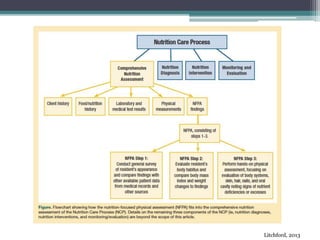
▫ Be able to identify causes of malnutrition
▫ Recognize six symptoms of malnutrition
▫ Be able to identify protocol for a nutrition-focused
physical assessment
▫ Be able to identify muscle and subcutaneous fat
sites on the body
▫ Recognize complications of malnutrition
What is Malnutrition?
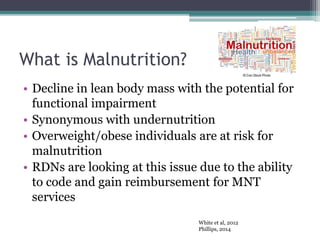
• Decline in lean body mass with the potential for
functional impairment
• Synonymous with undernutrition
• Overweight/obese individuals are at risk for
malnutrition
• RDNs are looking at this issue due to the ability
to code and gain reimbursement for MNT
services
White et al, 2012
Phillips, 2014
Causes
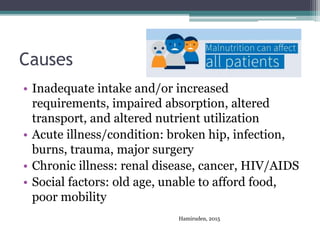
• Inadequate intake and/or increased
requirements, impaired absorption, altered
transport, and altered nutrient utilization
• Acute illness/condition: broken hip, infection,
burns, trauma, major surgery
• Chronic illness: renal disease, cancer, HIV/AIDS
• Social factors: old age, unable to afford food,
poor mobility
Hamiruden, 2015
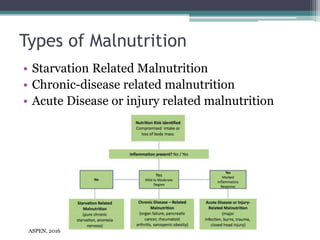
Types of Malnutrition
• Starvation Related Malnutrition
• Chronic-disease related malnutrition
• Acute Disease or injury related malnutrition
ASPEN, 2016
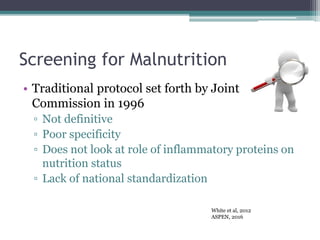
Screening for Malnutrition
• Traditional protocol set forth by Joint
Commission in 1996
▫ Not definitive
▫ Poor specificity
▫ Does not look at role of inflammatory proteins on
nutrition status
▫ Lack of national standardization
White et al, 2012
ASPEN, 2016
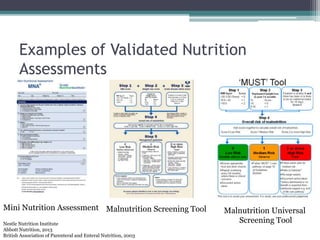
Examples of Validated Nutrition
Assessments
Mini Nutrition Assessment Malnutrition Screening Tool Malnutrition Universal
Screening ToolNestle Nutrition Institute
Abbott Nutrition, 2013
British Association of Parenteral and Enteral Nutrition, 2003
ACEND and ASPEN Standards
• Identification of 2 or more of the following must
be present to diagnose malnutrition
▫ Insufficient energy intake
▫ Weight loss
▫ Loss of muscle mass
▫ Loss of subcutaneous fat
▫ Localized or generalized fluid accumulation that
may sometimes mask weight loss
▫ Diminished functional status as measured by grip
strength
White et al, 2012
ASPEN, 2016
Litchford, 2013
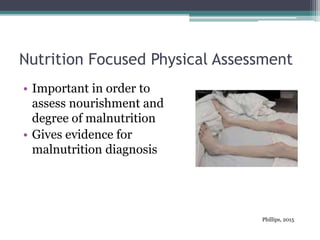
Nutrition Focused Physical Assessment
• Important in order to
assess nourishment and
degree of malnutrition
• Gives evidence for
malnutrition diagnosis
Phillips, 2015
Before Performing an Assessment
• Make sure to introduce self to
family and patient, explain
rationale for examination
• Ask pt permission for exam
• Wash/dry hands thoroughly
and use gloves
• Use standard precautions to
prevent disease transmission
Scollard, 2015
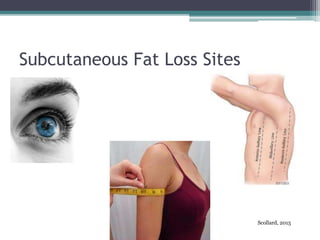
Subcutaneous Fat Loss Sites
Scollard, 2015
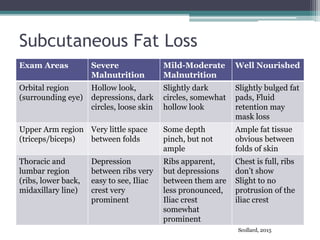
Subcutaneous Fat Loss
Exam Areas Severe
Malnutrition
Mild-Moderate
Malnutrition
Well Nourished
Orbital region
(surrounding eye)
Hollow look,
depressions, dark
circles, loose skin
Slightly dark
circles, somewhat
hollow look
Slightly bulged fat
pads, Fluid
retention may
mask loss
Upper Arm region
(triceps/biceps)
Very little space
between folds
Some depth
pinch, but not
ample
Ample fat tissue
obvious between
folds of skin
Thoracic and
lumbar region
(ribs, lower back,
midaxillary line)
Depression
between ribs very
easy to see, Iliac
crest very
prominent
Ribs apparent,
but depressions
between them are
less pronounced,
Iliac crest
somewhat
prominent
Chest is full, ribs
don’t show
Slight to no
protrusion of the
iliac crest
Scollard, 2015
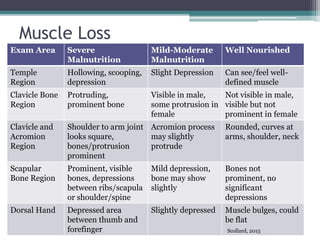
Muscle Loss
Exam Area Severe
Malnutrition
Mild-Moderate
Malnutrition
Well Nourished
Temple
Region
Hollowing, scooping,
depression
Slight Depression Can see/feel well-
defined muscle
Clavicle Bone
Region
Protruding,
prominent bone
Visible in male,
some protrusion in
female
Not visible in male,
visible but not
prominent in female
Clavicle and
Acromion
Region
Shoulder to arm joint
looks square,
bones/protrusion
prominent
Acromion process
may slightly
protrude
Rounded, curves at
arms, shoulder, neck
Scapular
Bone Region
Prominent, visible
bones, depressions
between ribs/scapula
or shoulder/spine
Mild depression,
bone may show
slightly
Bones not
prominent, no
significant
depressions
Dorsal Hand Depressed area
between thumb and
forefinger
Slightly depressed Muscle bulges, could
be flat
Scollard, 2015
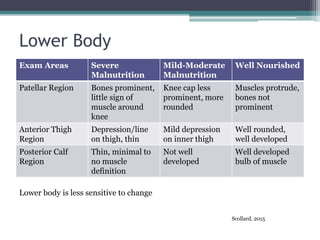
Lower Body
Exam Areas Severe
Malnutrition
Mild-Moderate
Malnutrition
Well Nourished
Patellar Region Bones prominent,
little sign of
muscle around
knee
Knee cap less
prominent, more
rounded
Muscles protrude,
bones not
prominent
Anterior Thigh
Region
Depression/line
on thigh, thin
Mild depression
on inner thigh
Well rounded,
well developed
Posterior Calf
Region
Thin, minimal to
no muscle
definition
Not well
developed
Well developed
bulb of muscle
Lower body is less sensitive to change
Scollard, 2015
Rule Out Edema
• Make sure patient is at
dry weight so excess fluid
does not cause you to
miss malnutrition
• Can check ankles and
look for pitting after
touching ankles
Scollard, 2015
Complications of Malnutrition
• Increased morbidity and mortality
• Decreased function and quality of life
• Increased frequency and length of hospital stay
• Higher healthcare costs
Hamiruden, 2015
Conclusions
• Need to have standardized, universal assessment
tools for malnutrition to identify patients and
help prevent negative outcomes
• Healthcare team needs to work together in order
to create these standards
• Need to also work together for better treatment
and discharge plans
White et al, 2012
References
1. White JV, Guenter P, Jenson G, et al. Consensus statement: Academy of Nutrition and Dietetics and American Society
for Parenteral and Enteral Nutrition: Characteristics recommended for the identification and documentation of adult
malnutrition (undernutrition). J Parenter Enteral Nutr. 2012; 36: 275-283.
2. Feed your patient: ASPEN’s malnutrition solution center. ASPEN website. http://www.nutritioncare.org/Malnutrition/.
Updated 2016. Accessed March 17, 2016.
3. Litchford M. Putting the nutrition-focused physical assessment into practice in long-term care. Annals of Long-Term
Care Website. http://www.annalsoflongtermcare.com/content/putting-nutrition-focused-physical-
assessment-practice. Published November 14, 2013. Accessed March 17, 2016.
4. Scolard T. Nutrition-focused physical assessment: Practical methods to start and move your clinical practice forward.
Utah Academy of Nutrition and Dietetics. March 27, 2015. http://www.eatrightutah.org/docs/AM15-Speaker2-04b.pdf
Accessed March 17, 2016
5. Hamiruden HR, Charleton K, Walten K. Outcomes related to nutrition screening in community living older adults: A
systematic literature review. Arch Gerontol Geriatr. 2016; 62: 9- 25.
6. Phillips W. Coding for malnutrition in adult patients: What the physician needs to know. Nutrition Issues in
Gastroenterology. September, 2014.https://med.virginia.edu/ginutrition/wp-
content/uploads/sites/199/2014/06/Parrish-Sept- 14.pdf. Accessed May 5, 2016.
7. Mini Nutrition Assessment. Nestle Nutrition Institute Website. http://www.mna-elderly.com. Accessed May 16, 2016.
8. Malnutrition Screening Tool. Abbott Nutrition Website. http://static.abbottnutrition.com/cms-
prod/abbottnutrition.com/img/Malnutrition%20Screening%20Tool_FINAL%20_Professional.pdf. Updated 2013.
Accessed May 16, 2016.
9. Malnutrition Universal Screening Tool. British Association of Parenteral and Enteral Nutrition Website. Published
2003. Accessed May 16, 2016.
10. Skipper A, Ferguson M, Thompson K, Castellanos V, Porcari J. Nutrition screening tools: An analysis for evidence. J
Parenter Eneteral Nutr. 2012; 36: 292-298.

malnutritionppt

  • 1.
    Malnutrition Screening inAcute Care: Who’s at Risk? By Katherin Rehn
  • 2.
    Learning Objectives • Uponcompletion of this program, attendees will… ▫ Learn why it is important to diagnose malnutrition ▫ Be able to identify causes of malnutrition ▫ Recognize six symptoms of malnutrition ▫ Be able to identify protocol for a nutrition-focused physical assessment ▫ Be able to identify muscle and subcutaneous fat sites on the body ▫ Recognize complications of malnutrition
  • 3.
    What is Malnutrition? •Decline in lean body mass with the potential for functional impairment • Synonymous with undernutrition • Overweight/obese individuals are at risk for malnutrition • RDNs are looking at this issue due to the ability to code and gain reimbursement for MNT services White et al, 2012 Phillips, 2014
  • 4.
    Causes • Inadequate intakeand/or increased requirements, impaired absorption, altered transport, and altered nutrient utilization • Acute illness/condition: broken hip, infection, burns, trauma, major surgery • Chronic illness: renal disease, cancer, HIV/AIDS • Social factors: old age, unable to afford food, poor mobility Hamiruden, 2015
  • 5.
    Types of Malnutrition •Starvation Related Malnutrition • Chronic-disease related malnutrition • Acute Disease or injury related malnutrition ASPEN, 2016
  • 6.
    Screening for Malnutrition •Traditional protocol set forth by Joint Commission in 1996 ▫ Not definitive ▫ Poor specificity ▫ Does not look at role of inflammatory proteins on nutrition status ▫ Lack of national standardization White et al, 2012 ASPEN, 2016
  • 7.
    Examples of ValidatedNutrition Assessments Mini Nutrition Assessment Malnutrition Screening Tool Malnutrition Universal Screening ToolNestle Nutrition Institute Abbott Nutrition, 2013 British Association of Parenteral and Enteral Nutrition, 2003
  • 8.
    ACEND and ASPENStandards • Identification of 2 or more of the following must be present to diagnose malnutrition ▫ Insufficient energy intake ▫ Weight loss ▫ Loss of muscle mass ▫ Loss of subcutaneous fat ▫ Localized or generalized fluid accumulation that may sometimes mask weight loss ▫ Diminished functional status as measured by grip strength White et al, 2012 ASPEN, 2016
  • 9.
  • 10.
    Nutrition Focused PhysicalAssessment • Important in order to assess nourishment and degree of malnutrition • Gives evidence for malnutrition diagnosis Phillips, 2015
  • 11.
    Before Performing anAssessment • Make sure to introduce self to family and patient, explain rationale for examination • Ask pt permission for exam • Wash/dry hands thoroughly and use gloves • Use standard precautions to prevent disease transmission Scollard, 2015
  • 12.
    Subcutaneous Fat LossSites Scollard, 2015
  • 13.
    Subcutaneous Fat Loss ExamAreas Severe Malnutrition Mild-Moderate Malnutrition Well Nourished Orbital region (surrounding eye) Hollow look, depressions, dark circles, loose skin Slightly dark circles, somewhat hollow look Slightly bulged fat pads, Fluid retention may mask loss Upper Arm region (triceps/biceps) Very little space between folds Some depth pinch, but not ample Ample fat tissue obvious between folds of skin Thoracic and lumbar region (ribs, lower back, midaxillary line) Depression between ribs very easy to see, Iliac crest very prominent Ribs apparent, but depressions between them are less pronounced, Iliac crest somewhat prominent Chest is full, ribs don’t show Slight to no protrusion of the iliac crest Scollard, 2015
  • 14.
    Muscle Loss Exam AreaSevere Malnutrition Mild-Moderate Malnutrition Well Nourished Temple Region Hollowing, scooping, depression Slight Depression Can see/feel well- defined muscle Clavicle Bone Region Protruding, prominent bone Visible in male, some protrusion in female Not visible in male, visible but not prominent in female Clavicle and Acromion Region Shoulder to arm joint looks square, bones/protrusion prominent Acromion process may slightly protrude Rounded, curves at arms, shoulder, neck Scapular Bone Region Prominent, visible bones, depressions between ribs/scapula or shoulder/spine Mild depression, bone may show slightly Bones not prominent, no significant depressions Dorsal Hand Depressed area between thumb and forefinger Slightly depressed Muscle bulges, could be flat Scollard, 2015
  • 15.
    Lower Body Exam AreasSevere Malnutrition Mild-Moderate Malnutrition Well Nourished Patellar Region Bones prominent, little sign of muscle around knee Knee cap less prominent, more rounded Muscles protrude, bones not prominent Anterior Thigh Region Depression/line on thigh, thin Mild depression on inner thigh Well rounded, well developed Posterior Calf Region Thin, minimal to no muscle definition Not well developed Well developed bulb of muscle Lower body is less sensitive to change Scollard, 2015
  • 16.
    Rule Out Edema •Make sure patient is at dry weight so excess fluid does not cause you to miss malnutrition • Can check ankles and look for pitting after touching ankles Scollard, 2015
  • 17.
    Complications of Malnutrition •Increased morbidity and mortality • Decreased function and quality of life • Increased frequency and length of hospital stay • Higher healthcare costs Hamiruden, 2015
  • 18.
    Conclusions • Need tohave standardized, universal assessment tools for malnutrition to identify patients and help prevent negative outcomes • Healthcare team needs to work together in order to create these standards • Need to also work together for better treatment and discharge plans White et al, 2012
  • 19.
    References 1. White JV,Guenter P, Jenson G, et al. Consensus statement: Academy of Nutrition and Dietetics and American Society for Parenteral and Enteral Nutrition: Characteristics recommended for the identification and documentation of adult malnutrition (undernutrition). J Parenter Enteral Nutr. 2012; 36: 275-283. 2. Feed your patient: ASPEN’s malnutrition solution center. ASPEN website. http://www.nutritioncare.org/Malnutrition/. Updated 2016. Accessed March 17, 2016. 3. Litchford M. Putting the nutrition-focused physical assessment into practice in long-term care. Annals of Long-Term Care Website. http://www.annalsoflongtermcare.com/content/putting-nutrition-focused-physical- assessment-practice. Published November 14, 2013. Accessed March 17, 2016. 4. Scolard T. Nutrition-focused physical assessment: Practical methods to start and move your clinical practice forward. Utah Academy of Nutrition and Dietetics. March 27, 2015. http://www.eatrightutah.org/docs/AM15-Speaker2-04b.pdf Accessed March 17, 2016 5. Hamiruden HR, Charleton K, Walten K. Outcomes related to nutrition screening in community living older adults: A systematic literature review. Arch Gerontol Geriatr. 2016; 62: 9- 25. 6. Phillips W. Coding for malnutrition in adult patients: What the physician needs to know. Nutrition Issues in Gastroenterology. September, 2014.https://med.virginia.edu/ginutrition/wp- content/uploads/sites/199/2014/06/Parrish-Sept- 14.pdf. Accessed May 5, 2016. 7. Mini Nutrition Assessment. Nestle Nutrition Institute Website. http://www.mna-elderly.com. Accessed May 16, 2016. 8. Malnutrition Screening Tool. Abbott Nutrition Website. http://static.abbottnutrition.com/cms- prod/abbottnutrition.com/img/Malnutrition%20Screening%20Tool_FINAL%20_Professional.pdf. Updated 2013. Accessed May 16, 2016. 9. Malnutrition Universal Screening Tool. British Association of Parenteral and Enteral Nutrition Website. Published 2003. Accessed May 16, 2016. 10. Skipper A, Ferguson M, Thompson K, Castellanos V, Porcari J. Nutrition screening tools: An analysis for evidence. J Parenter Eneteral Nutr. 2012; 36: 292-298.

Editor's Notes

  • #4 Picture: http://www.canstockphoto.com/images-photos/malnutrition.html
  • #5 Image: http://www.unitedforclinicalnutrition.com/en/prevalence-malnutrition
  • #7 Image: http://blog.dcrworkforce.com/effective-psychological-screening-contingent-candidates
  • #12 Image: http://diarmfs.com/risk-assessment-reports/
  • #13 http://www.hospitalcruces.com/referenciaOculoplastia.asp?lng=en http://sphpm.blogspot.com/2015/05/mid-upper-arm-circumference-as.html http://ncp.sagepub.com/content/early/2015/03/06/0884533615573053.full.pdf
  • #17 http://www.mayoclinic.org/diseases-conditions/edema/multimedia/edema-in-ankle/img-20006137
  • #18 http://www.healthitoutcomes.com/doc/hospital-reduces-length-of-stay-saves-0001