Enterprise EHS SoftwareSolutions
MAKING THE CASE FOR
TOTAL WORKER HEALTH
APRIL 5, 2016
Enterprise EHS SoftwareSolutions
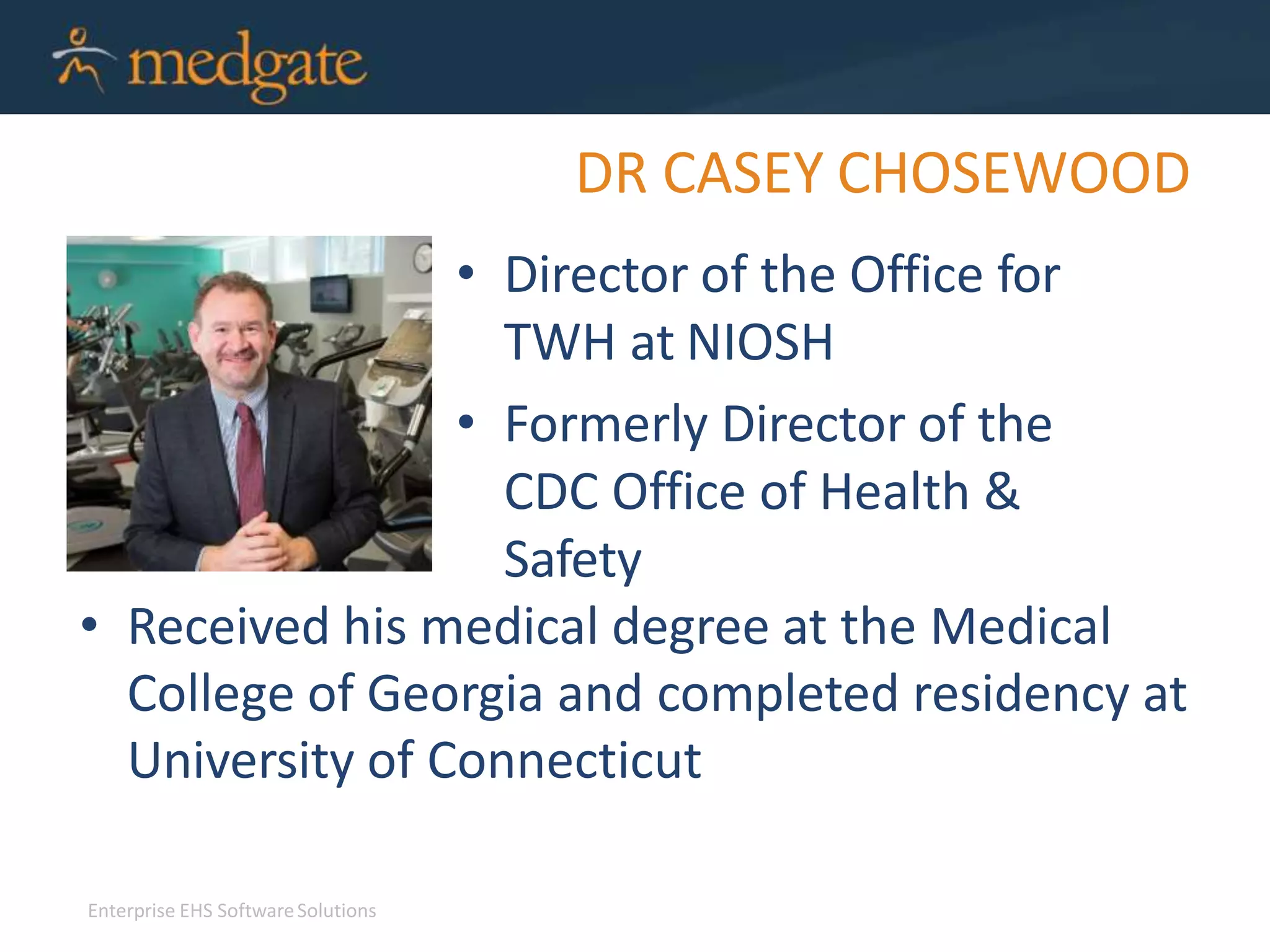
DR CASEY CHOSEWOOD
• Director of the Office for
TWH at NIOSH
• Formerly Director of the
CDC Office of Health &
Safety
• Received his medical degree at the Medical
College of Georgia and completed residency at
University of Connecticut
Enterprise EHS SoftwareSolutions
Dr Casey Chosewood,
Director Office for Total
Worker Health
David Poole
Product Marketing Manager
Moderator
Advancing Worker Well-being
Making the Case for Total Worker Health®
Medgate Webinar Series
April 5, 2016
L. Casey Chosewood, MD, MPH
Director, Office for Total Worker Health®
National Institute for Occupational Safety and Health
Centers for Disease Control and Prevention
The findings and conclusions in this presentation have not been formally disseminated by theNational
Institute for Occupational Safety and Health, and should not be construed to represent any agency
determination orpolicy.
Work in the 21st Century
 Legacy chemical, physical, and biological hazards
remain
 Employment patterns are changing dramatically
 Aging and more diverse workforce
 Work-home boundary increasingly porous
 Can work become a means to expanding worker
well-being?
5
9
Source: Dr. Kent Anger, Oregon Health and Science University, 2014.
1
0
TOTAL WORKER HEALTH"
ADVANCING WORKER SAFETY, HEALTH, AND WELL-BEING
TOTAL WORKER HEALTH"
ADVANCING WORKFR SAFFTV. HFALTM.AND WFI.L-BFING
Rank <1
10LeadingcausesofDeathbyAgeGroup,UnitedStates- 2014
45-54 55-64 65+ Total
1
Congenital
Anomalies
4,746
Malignant
Neoplasms
44,834
Malignant
Neoplasms
115,282
Heart
Disease
489,722
Heart
!)isease
614,348
2
Short
Gestation
4,173
Malignant
Neoplasms
413,885
Malignant
Neoplasms
591,699
ChronicLow. ChronicLow.
3 Respiratory Respiratory
Disease !)isease
Maternal
Pregnancy
Comp.
1,574 124,693 147,101
4
SIDS
1,545
Cerebro-
vascular
113,308
Heart
Disease
953
Heart
Disease
3,341
Diabetes
Memtns
13,342
Alzheimer's
Disease
92,604
Cerebro-
vascular
133,103
6
PlacentaCord.
Membranes
965
Influenza&
Pneumonia
109
Heart
Disease
122
Congenital
Anomalies
377
Liver
Disease
725
Liver
Disease
2,582
Diabetes
Mellitns
6,062
Liver
Disease
12,792
Diabetes
Mellitns
54,161
Alzheimer's
!)isease
93,541
ChronicLow.
Respiratory
Disease
68
7
Bacterial
Sepsis
544
ChronicLOVI
Respiratory
Disease
53
Influenza&
Pneumonia
57
ChronicLOVI
Respiratory
Disease
71
Influenza&
Pneumonia
199
Diabetes
Mell'itns
709
Diabetes
Mellitns
1,999
Cerebro-
vascular
5,349
Diabetes
Meltitns
76,488
8
Respiratory
Distress
460
Septicemia
53
Cerebro-
vasa.rlar
45
Cerebro-
vascular
43
Diabetes
Mellitus
181
HIV
583
Cerebro-
vascular
1,745
ChronicLow.
Respiratory
Disease
4.402
9
Benign
Neoplasms
38
Benign
Neoplasms
36
Influenza&
Pneumonia
41
Cerebro-
vasa.rlar
579
HIV
1,174
Influenza&
Pneumonia
2,731
Circulatory
System
Disease
444
ChronicLow
Respiratory
Disease
178
10
PerinatalPeriod
38
Septicemia
33
Septicemia
2,514
Neonatal
Hemorrhage
441
Benign
Neoplasms
38
Cerebro-
vasa.rlar
177
Influenza&
Pneumonia
549
Influenza&
Pneumonia
1,125
Influenza&
Pneumon
ia 55,227
Septicemia Nephritis Nephritis
5,709 39,957 48,146
Influenza&
Pneumoni
a 5,390
Septicemia
29,124
C . . . . I D r -Data Source:National VrtallSta stics System,National Center for Healthstatislics,CDC.
Produced by: Na·on.al Center forlnju,y Prevention and Con.trol, CDC using WISQARSTM_
--c . . r r . .
---
(;j.m.
' g a
Isn’t Behavior Change Enough?
“It is unreasonable to expect people to
change their behavior when the social,
cultural and physical environments around
them fully conspire against them….”
Adapted from M. Marmot/Institute of Medicine Report 14
Protecting Workers Is the Cornerstone of
Total Worker Health®
Photo Credit: Jawad Qasrawi/Hazards Magazine, 22 July 2014
Sources: S. Hertlich, M. Hamilo, S. Kuvalehti [FI], WHO/ILO/J.Takala, as featuredin:
Journal of Occupational and Environmental Hygiene, 11: 326–337; May 2014. (DOI: 10.1080/15459624.2013.863131)
1
6
17
1
8
Kubo J, et al., Occup Environ Med 2014; 71:159-166.
What isTotalWorkerHealth® ?
….policies, programs, and practices that
integrate protection from work-related safety &
health hazards with promotion of injury and
illness prevention efforts to advance worker
well-being.
19
Keep Workers Safe
Invest More in Worker Health
Create Worker Well-Being
20
True or False?
TWH is a workplace
wellness program.
FALSE!
21
Critical Questions Arise Regarding
Traditional Workplace Wellness Programs
• Are they truly voluntary when enticements such as
discounts on health insurance benefits are offered?
• Do they discriminate against those with chronic
conditions?
• Are privacy protections adequate?
• Do they promote unnecessary/dangerous screenings?
• Are interventions evidence-based?
• Are costs shifted to those from a lower socioeconomic
status?
• Do they lower healthcare costs?
22
Genetic Testing May Be Coming to Your Office
A handful of firms are offering employees free or subsidized tests for markers linked
to metabolism, weight gain and overeating
Holly Savage, who participated in a pilot study with a genetic wellness program called Newtopia, has lost nearly 50 pounds in the last year. PHOTO: JASON P.
SMITH FOR THE WALL STREET JOURNAL
23
“TWH is MORE than a traditional
wellness program.”
24
Issues Relevant to Advancing Worker Well-being
Through Total Worker Health®
Control of Hazards andExposures
• Chemicals
• PhysicalAgents
• BiologicalAgents
• PsychosocialFactors
• HumanFactors
• Risk Assessment and Risk Management
Organization ofWork
• Fatigue and Stress Prevention
• Work IntensificationPrevention
• Safe Staffing
• Overtime Management
• Healthier Shift Work
• Reduction of Risks from Long Work Hours
• Flexible WorkArrangements
• Adequate Meal and Rest Breaks
Built EnvironmentSupports
• Healthy Air Quality
• Access to Healthy, Affordable Food Options
• Safe and Clean Restroom Facilities
• Safe, Clean and Equipped Eating Facilities
• Safe Access to the Workplace
• Environments Designed to Accommodate
WorkerDiversity
Leadership
• Shared Commitment to Safety, Health,
andWell-Being
• Supportive Managers, Supervisors,
andExecutives
• Responsible Business Decision-Making
• Meaningful Work and Engagement
• Worker Recognition and Respect
Compensation andBenefits
• Adequate Wages and Prevention of
WageTheft
• Equitable Performance Appraisals
andPromotion
• Work-LifePrograms
• Paid Time Off (Sick, Vacation, Caregiving)
• Disability Insurance (Short- & Long-Term)
• Workers’ Compensation Benefits
• Affordable, Comprehensive Healthcare
and Life Insurance
• Prevention of Cost Shifting between
Payers (Workers’ Compensation,
HealthInsurance)
• Retirement Planning and Benefits
• Chronic Disease Prevention and
Disease Management
• Access to Confidential, Quality
Healthcare Services
• Career and Skills Development
CommunitySupports
• Healthy CommunityDesign
• Safe, Healthy and Affordable Housing
Options
• Safe and Clean Environment (Air and Water
Quality, Noise Levels, Tobacco-Free Policies)
• Access to Safe Green Spaces and Non-
MotorizedPathways
• Access to Affordable, Quality Healthcare
and Well-BeingResources
Changing WorkforceDemographics
• Multigenerational and Diverse Workforce
• Aging Workforce and Older Workers
• Vulnerable Worker Populations
• Workers with Disabilities
• Occupational HealthDisparities
• Increasing Number of Small Employers
• Global and MultinationalWorkforce
PolicyIssues
• Health InformationPrivacy
• ReasonableAccommodations
• Return-to-Work
• Equal EmploymentOpportunity
• Family and MedicalLeave
• Elimination of Bullying,Violence,
Harassment, and Discrimination
• Prevention of Stressful Job
MonitoringPractices
• Worker-Centered Organizational Policies
• Promoting ProductiveAging
New EmploymentPatterns
• Contracting and Subcontracting
• Precarious and Contingent Employment
• Multi-EmployerWorksites
• Organizational Restructuring, Downsizing
andMergers
• Financial and Job Security
November2015
Total Worker Health® is a registered trademark of the US Department of Health and Human Services
“Where have all the good jobs gone?”
TWH Policies, Programs and Practices Look Like This:
• Worker-centered operations and worker participation in workplace
problem solving
• Paid family & sick leave, paid medical benefits
• Equitable wages
• Safe staffing, voluntary overtime
• Discrimination, harassment, and violence prevention
• Health-enhancing work organization and supervision
• Work Intensification prevention
• Respect, fair performance appraisals & advancement opportunities
• Work-Life Integration
• Attention to work factors causing chronic conditions
• Confidential occupational health services
• Support for productive aging across working life
26
True or False?
Your job can predict your
chances of being
overweight or obese.
TRUE! 27
28
TOTAL WORKER HEALTH"
ADVANCING WORKER SAFETY, HEALTH, AND WELL-BEING
OCCU PATIONALHEALTH
By AMERICAN HEART ASSOCIATION NEWS
Researchers evaluated 5,566 employed workers to determine how many met the ideals for blood
pressure, body mass index, total cholesterol, blood sugar, physical activity, smoking and diet quality.
Some of the occupations that registered
the worst numbers were:
Police and firefighters
--w-Service occupations
(Includes people who prepare food, do buildingand
grounds keeping, cleaning, and deliver personal
care-hairstylists, animal care, makeup artists, funeral
services, healthcare support, and entertainment.)
Sales, office and
administrative support
Some of the occupations that registered
the best numbers were:
Management and
professionals
Healthcare practitioners
(doctors and nurses)
Arts, entertainment,
sports andmedia
Sources: REasons for Geographic And Racial Differences in Stroke Study, National Institute for Occupational
Safety and Health of the Centers for Disease Control, Bureau of Labor Statistics
Punnett L and the Center for the Promotion of Health in the New England Workplace. Recent Trends and Research in Worker Safety and Health. February
25, 2014 NIOSH Total Worker Health Webinar.
30
“To impact obesity among workers,
we must fix fat jobs…not fat
workers.”
31
Many More Older Workers
33
Can We Age Productively?
34
5. Partnership for Solutions [2004]. Chronic conditions: making the case for ongoing care. Baltimore, MD: Partnership for Solutions.
[http://www.partnershipforsolutions.org/DMS/files/chronicbook2004.pdf].
35
36
What is Productive Aging?
• An approach that emphasizes the positive aspects of
growing older and how individuals can make
important contributions to their own lives, their
communities and organizations, and society as a
whole – Robert N.Butler
• NCPAW Approach to Productive Aging:
– Life-Span Perspective
– Comprehensive and Integrated Framework
– Emphasis on Outcomes for Both Workers and Organizations
– Supportive Culture for Multi-Generational Issues
37
Creating Age-Friendly Workplaces
• Prioritize workplace flexibility
• Match tasks to abilities
• Involve workers in job redesign efforts
• Avoid prolonged, sedentary work
• Manage physical hazards, e.g., noise, slip/trip
• Provide ergo-friendly work environments
• Provide health promotion & lifestyle programs
• Accommodate medical self-care
• Invest in training & skill-building for all workers
• Encourage cross-generational interactions
• Manage reasonable accommodations & return to work
• Require aging workforce management skills training for supervisors
38Loeppke et al., 2013; Silverstein, 2008 in Chosewood & Nigam, 2012; Grosch & Pransky,2010
True or False?
Trends in employment
patterns include increasing
numbers of full-time,
permanent jobs.
FALSE! 39
40
Newer Employment Patterns
Affecting Worker Health
• Precarious Employment
– Contingent, Temporary or Independent Contractor
• Serial Subcontracting
• Dual Employers—Employee Leasing
• Work Organizational Factors
– Work intensification
• Downsizing
• Mandatory overtime
– Lack of paid medical and family leave
– Stressors arising from work itself
41
Jobs in a lifetime
Between ages 18-48 11.7
(avg.)
Spells of unemployment
ages 18−48 (avg.) 5.6
high school dropout 7.4
high school graduate 5.6
college graduate 3.9
Source: Bureau of Labor Statistics,
DOL (2015)
Potential Health Effects of
Contingent Work
• Uncertainty, interrupted work, reductions in earnings
• Lack of many benefits that come from traditional employment
• Negative consequences for the worker and society after injury
– Worker might quickly be out of a job and, depending on the severity of the injury, the prospects of
new employment may be slim.
– Employer-based health insurance is a rarity for contingent workers, so the costs of treating injuries
are typically shifted to the worker or the public at large.
– Employers who not directly pay for workers’ compensation and health insurance may be insulated
from premium adjustments based on the cost of workers’ injuries.
• So, employers of contingent labor escape the financial incentives that drive decisions to eliminate hazards for
other workers
• Are contingent workers as protected by government safety and health regulatory
enforcement as are non-contingent workers?
Paid Sick Leave and Occupational Injury
Does presence/absence of paid sick leave impact occupational
injury rates? What did NIOSH find?
– 28% lower injury likelihood of workers with access to PSL compared to
workers without access to PSL, based upon data on working adults from
the National Health Interview Survey (NHIS) for 2005-2008
– Association varied across different industry sectors
– Introducing or expanding PSL might help businesses to reduce the
incidence of nonfatal occupational injuries
– More likely to lower risks in industry sectors or occupations with a high
risk of injury
– Employers could save $16 - $56 billion per year or $375 - $1,300 per
worker per year by offering paid sick leave to their employees, based on
cost of $19 billion per year to provide PSL
44
0.79
1.11
0.57
0.44
0.60
0.47
0.60
0.47
0.64
0.50
0.70
0.55
0.72
0.56
0.62
0.92
1.20
1.10
1.00
0.90
0.80
0.70
0.60
0.50
0.40
0.30
0.20
Predictedpr(injury)(%)
Predicted probability of nonfatal occupational injury by access to
PSL and Sector
No Paid Sick Leave Paid Sick Leave
45
WHAT ARE THE FUTURE
DIRECTIONS FOR TWH?
47
The World Economic Forum - Davos2016
"the fusion of technologies across the physical, digital and biologicalworlds
which is creating entirely new capabilities and dramatic impacts on
political, social and economic systems”
“an era of automation, constant connectivity, and accelerated change,in
which the Internet of Things meets the SmartFactory”
Klaus Schwab, Founder of the World Economic Forum
Themes from Davos 2016 World
Economic Forum…
“Trust, transparency, purpose,
and a deeper kind of
connection are central to
meaningful success in the
Fourth Industrial Revolution”
“A wider definition of
success…one that recognizes
that in our quest for a
competitive edge and enhanced
performance, we actually stand
to gain from putting our
humanity, well-being, and
sense of purpose at the center”
Examples of Critical Areas of
Total Worker Health® Research
• How do conditions of work define health and well-being outcomes, on and off the job?
• How can we find targeted interventions for the highest-risk or most vulnerable workers?
• How can healthier job design and work organization principles produce healthier workers?
• What are the health consequences of the current macro-economy, new employment
patterns, the changing organization of work, dramatic shifts in worker demographics, and
evolving healthcare schemes?
• What pro-health interventions can improve quality of life and health opportunity for
workers?
• How do we optimize the “well-being” of our families and society through employment?
• How can we prevent or mitigate the harms arising from hazardous work schedules,
psychosocial stress, and unhealthy supervision?
• How can we:
– Expand the evidence base for integrating workplace safety interventions with broader
health-related program, policies, practices?
– Show the value of investment more clearly in TWH approaches?
Dartmouth-
Center
Hitchcock Medical Mount Sinai
HealthSystemSafety
Council
Safety
Council
University
of
Michigan
Colorado’s Centerfor
Health, Work and
Environment
International Brotherhood ofBoilermakers
Kentucky Injury Prevention and ResearchCenter
Kentucky Department for PublicHealth
University of
NorthCarolinaUniversity
ofGeorgia
Laborers’ Health and
Safety Fund of North
America
Western
Kentucky
University
OregonHealthy
Work ForceCenter
SAIF Workers
Compensation
University ofIowaNebraska National
HealthierWorkforce
Centerfor
Excellence
Center for the
Promotion ofHealth
in the New England
Workplace
Harvard School of
Public HealthCenter
for Work, Health
andWellbeing
NationalAeronautics
and Space Administration
Centers of Excellence and TWH Affiliates
ISSA -The
Worldwide
CleaningIndustry
Association
University of
California, Berkeley
School of PublicHealth
HOW YOU CAN STAYIN THE
LOOP WITH TWH
52
Connect with Us!
Email TWH@cdc.gov
Twitter
(@NIOSH_TWH)
LinkedIn
(NIOSH Total Worker
Health)
TWH in Action!
e-Newsletter
53

Medgate: Making the Case for Total Worker Health

  • 1.
    Enterprise EHS SoftwareSolutions MAKINGTHE CASE FOR TOTAL WORKER HEALTH APRIL 5, 2016
  • 2.
    Enterprise EHS SoftwareSolutions DRCASEY CHOSEWOOD • Director of the Office for TWH at NIOSH • Formerly Director of the CDC Office of Health & Safety • Received his medical degree at the Medical College of Georgia and completed residency at University of Connecticut
  • 3.
    Enterprise EHS SoftwareSolutions DrCasey Chosewood, Director Office for Total Worker Health David Poole Product Marketing Manager Moderator
  • 4.
    Advancing Worker Well-being Makingthe Case for Total Worker Health® Medgate Webinar Series April 5, 2016 L. Casey Chosewood, MD, MPH Director, Office for Total Worker Health® National Institute for Occupational Safety and Health Centers for Disease Control and Prevention The findings and conclusions in this presentation have not been formally disseminated by theNational Institute for Occupational Safety and Health, and should not be construed to represent any agency determination orpolicy.
  • 5.
    Work in the21st Century  Legacy chemical, physical, and biological hazards remain  Employment patterns are changing dramatically  Aging and more diverse workforce  Work-home boundary increasingly porous  Can work become a means to expanding worker well-being? 5
  • 6.
  • 7.
    Source: Dr. KentAnger, Oregon Health and Science University, 2014. 1 0
  • 9.
    TOTAL WORKER HEALTH" ADVANCINGWORKER SAFETY, HEALTH, AND WELL-BEING
  • 10.
    TOTAL WORKER HEALTH" ADVANCINGWORKFR SAFFTV. HFALTM.AND WFI.L-BFING Rank <1 10LeadingcausesofDeathbyAgeGroup,UnitedStates- 2014 45-54 55-64 65+ Total 1 Congenital Anomalies 4,746 Malignant Neoplasms 44,834 Malignant Neoplasms 115,282 Heart Disease 489,722 Heart !)isease 614,348 2 Short Gestation 4,173 Malignant Neoplasms 413,885 Malignant Neoplasms 591,699 ChronicLow. ChronicLow. 3 Respiratory Respiratory Disease !)isease Maternal Pregnancy Comp. 1,574 124,693 147,101 4 SIDS 1,545 Cerebro- vascular 113,308 Heart Disease 953 Heart Disease 3,341 Diabetes Memtns 13,342 Alzheimer's Disease 92,604 Cerebro- vascular 133,103 6 PlacentaCord. Membranes 965 Influenza& Pneumonia 109 Heart Disease 122 Congenital Anomalies 377 Liver Disease 725 Liver Disease 2,582 Diabetes Mellitns 6,062 Liver Disease 12,792 Diabetes Mellitns 54,161 Alzheimer's !)isease 93,541 ChronicLow. Respiratory Disease 68 7 Bacterial Sepsis 544 ChronicLOVI Respiratory Disease 53 Influenza& Pneumonia 57 ChronicLOVI Respiratory Disease 71 Influenza& Pneumonia 199 Diabetes Mell'itns 709 Diabetes Mellitns 1,999 Cerebro- vascular 5,349 Diabetes Meltitns 76,488 8 Respiratory Distress 460 Septicemia 53 Cerebro- vasa.rlar 45 Cerebro- vascular 43 Diabetes Mellitus 181 HIV 583 Cerebro- vascular 1,745 ChronicLow. Respiratory Disease 4.402 9 Benign Neoplasms 38 Benign Neoplasms 36 Influenza& Pneumonia 41 Cerebro- vasa.rlar 579 HIV 1,174 Influenza& Pneumonia 2,731 Circulatory System Disease 444 ChronicLow Respiratory Disease 178 10 PerinatalPeriod 38 Septicemia 33 Septicemia 2,514 Neonatal Hemorrhage 441 Benign Neoplasms 38 Cerebro- vasa.rlar 177 Influenza& Pneumonia 549 Influenza& Pneumonia 1,125 Influenza& Pneumon ia 55,227 Septicemia Nephritis Nephritis 5,709 39,957 48,146 Influenza& Pneumoni a 5,390 Septicemia 29,124 C . . . . I D r -Data Source:National VrtallSta stics System,National Center for Healthstatislics,CDC. Produced by: Na·on.al Center forlnju,y Prevention and Con.trol, CDC using WISQARSTM_ --c . . r r . . --- (;j.m. ' g a
  • 11.
    Isn’t Behavior ChangeEnough? “It is unreasonable to expect people to change their behavior when the social, cultural and physical environments around them fully conspire against them….” Adapted from M. Marmot/Institute of Medicine Report 14
  • 12.
    Protecting Workers Isthe Cornerstone of Total Worker Health® Photo Credit: Jawad Qasrawi/Hazards Magazine, 22 July 2014
  • 13.
    Sources: S. Hertlich,M. Hamilo, S. Kuvalehti [FI], WHO/ILO/J.Takala, as featuredin: Journal of Occupational and Environmental Hygiene, 11: 326–337; May 2014. (DOI: 10.1080/15459624.2013.863131) 1 6
  • 14.
  • 15.
    1 8 Kubo J, etal., Occup Environ Med 2014; 71:159-166.
  • 16.
    What isTotalWorkerHealth® ? ….policies,programs, and practices that integrate protection from work-related safety & health hazards with promotion of injury and illness prevention efforts to advance worker well-being. 19
  • 17.
    Keep Workers Safe InvestMore in Worker Health Create Worker Well-Being 20
  • 18.
    True or False? TWHis a workplace wellness program. FALSE! 21
  • 19.
    Critical Questions AriseRegarding Traditional Workplace Wellness Programs • Are they truly voluntary when enticements such as discounts on health insurance benefits are offered? • Do they discriminate against those with chronic conditions? • Are privacy protections adequate? • Do they promote unnecessary/dangerous screenings? • Are interventions evidence-based? • Are costs shifted to those from a lower socioeconomic status? • Do they lower healthcare costs? 22
  • 20.
    Genetic Testing MayBe Coming to Your Office A handful of firms are offering employees free or subsidized tests for markers linked to metabolism, weight gain and overeating Holly Savage, who participated in a pilot study with a genetic wellness program called Newtopia, has lost nearly 50 pounds in the last year. PHOTO: JASON P. SMITH FOR THE WALL STREET JOURNAL 23
  • 21.
    “TWH is MOREthan a traditional wellness program.” 24
  • 22.
    Issues Relevant toAdvancing Worker Well-being Through Total Worker Health® Control of Hazards andExposures • Chemicals • PhysicalAgents • BiologicalAgents • PsychosocialFactors • HumanFactors • Risk Assessment and Risk Management Organization ofWork • Fatigue and Stress Prevention • Work IntensificationPrevention • Safe Staffing • Overtime Management • Healthier Shift Work • Reduction of Risks from Long Work Hours • Flexible WorkArrangements • Adequate Meal and Rest Breaks Built EnvironmentSupports • Healthy Air Quality • Access to Healthy, Affordable Food Options • Safe and Clean Restroom Facilities • Safe, Clean and Equipped Eating Facilities • Safe Access to the Workplace • Environments Designed to Accommodate WorkerDiversity Leadership • Shared Commitment to Safety, Health, andWell-Being • Supportive Managers, Supervisors, andExecutives • Responsible Business Decision-Making • Meaningful Work and Engagement • Worker Recognition and Respect Compensation andBenefits • Adequate Wages and Prevention of WageTheft • Equitable Performance Appraisals andPromotion • Work-LifePrograms • Paid Time Off (Sick, Vacation, Caregiving) • Disability Insurance (Short- & Long-Term) • Workers’ Compensation Benefits • Affordable, Comprehensive Healthcare and Life Insurance • Prevention of Cost Shifting between Payers (Workers’ Compensation, HealthInsurance) • Retirement Planning and Benefits • Chronic Disease Prevention and Disease Management • Access to Confidential, Quality Healthcare Services • Career and Skills Development CommunitySupports • Healthy CommunityDesign • Safe, Healthy and Affordable Housing Options • Safe and Clean Environment (Air and Water Quality, Noise Levels, Tobacco-Free Policies) • Access to Safe Green Spaces and Non- MotorizedPathways • Access to Affordable, Quality Healthcare and Well-BeingResources Changing WorkforceDemographics • Multigenerational and Diverse Workforce • Aging Workforce and Older Workers • Vulnerable Worker Populations • Workers with Disabilities • Occupational HealthDisparities • Increasing Number of Small Employers • Global and MultinationalWorkforce PolicyIssues • Health InformationPrivacy • ReasonableAccommodations • Return-to-Work • Equal EmploymentOpportunity • Family and MedicalLeave • Elimination of Bullying,Violence, Harassment, and Discrimination • Prevention of Stressful Job MonitoringPractices • Worker-Centered Organizational Policies • Promoting ProductiveAging New EmploymentPatterns • Contracting and Subcontracting • Precarious and Contingent Employment • Multi-EmployerWorksites • Organizational Restructuring, Downsizing andMergers • Financial and Job Security November2015 Total Worker Health® is a registered trademark of the US Department of Health and Human Services
  • 23.
    “Where have allthe good jobs gone?” TWH Policies, Programs and Practices Look Like This: • Worker-centered operations and worker participation in workplace problem solving • Paid family & sick leave, paid medical benefits • Equitable wages • Safe staffing, voluntary overtime • Discrimination, harassment, and violence prevention • Health-enhancing work organization and supervision • Work Intensification prevention • Respect, fair performance appraisals & advancement opportunities • Work-Life Integration • Attention to work factors causing chronic conditions • Confidential occupational health services • Support for productive aging across working life 26
  • 24.
    True or False? Yourjob can predict your chances of being overweight or obese. TRUE! 27
  • 25.
  • 26.
    TOTAL WORKER HEALTH" ADVANCINGWORKER SAFETY, HEALTH, AND WELL-BEING OCCU PATIONALHEALTH By AMERICAN HEART ASSOCIATION NEWS Researchers evaluated 5,566 employed workers to determine how many met the ideals for blood pressure, body mass index, total cholesterol, blood sugar, physical activity, smoking and diet quality. Some of the occupations that registered the worst numbers were: Police and firefighters --w-Service occupations (Includes people who prepare food, do buildingand grounds keeping, cleaning, and deliver personal care-hairstylists, animal care, makeup artists, funeral services, healthcare support, and entertainment.) Sales, office and administrative support Some of the occupations that registered the best numbers were: Management and professionals Healthcare practitioners (doctors and nurses) Arts, entertainment, sports andmedia Sources: REasons for Geographic And Racial Differences in Stroke Study, National Institute for Occupational Safety and Health of the Centers for Disease Control, Bureau of Labor Statistics
  • 27.
    Punnett L andthe Center for the Promotion of Health in the New England Workplace. Recent Trends and Research in Worker Safety and Health. February 25, 2014 NIOSH Total Worker Health Webinar. 30
  • 28.
    “To impact obesityamong workers, we must fix fat jobs…not fat workers.” 31
  • 29.
    Many More OlderWorkers 33
  • 30.
    Can We AgeProductively? 34
  • 31.
    5. Partnership forSolutions [2004]. Chronic conditions: making the case for ongoing care. Baltimore, MD: Partnership for Solutions. [http://www.partnershipforsolutions.org/DMS/files/chronicbook2004.pdf]. 35
  • 32.
  • 33.
    What is ProductiveAging? • An approach that emphasizes the positive aspects of growing older and how individuals can make important contributions to their own lives, their communities and organizations, and society as a whole – Robert N.Butler • NCPAW Approach to Productive Aging: – Life-Span Perspective – Comprehensive and Integrated Framework – Emphasis on Outcomes for Both Workers and Organizations – Supportive Culture for Multi-Generational Issues 37
  • 34.
    Creating Age-Friendly Workplaces •Prioritize workplace flexibility • Match tasks to abilities • Involve workers in job redesign efforts • Avoid prolonged, sedentary work • Manage physical hazards, e.g., noise, slip/trip • Provide ergo-friendly work environments • Provide health promotion & lifestyle programs • Accommodate medical self-care • Invest in training & skill-building for all workers • Encourage cross-generational interactions • Manage reasonable accommodations & return to work • Require aging workforce management skills training for supervisors 38Loeppke et al., 2013; Silverstein, 2008 in Chosewood & Nigam, 2012; Grosch & Pransky,2010
  • 35.
    True or False? Trendsin employment patterns include increasing numbers of full-time, permanent jobs. FALSE! 39
  • 36.
  • 37.
    Newer Employment Patterns AffectingWorker Health • Precarious Employment – Contingent, Temporary or Independent Contractor • Serial Subcontracting • Dual Employers—Employee Leasing • Work Organizational Factors – Work intensification • Downsizing • Mandatory overtime – Lack of paid medical and family leave – Stressors arising from work itself 41
  • 38.
    Jobs in alifetime Between ages 18-48 11.7 (avg.) Spells of unemployment ages 18−48 (avg.) 5.6 high school dropout 7.4 high school graduate 5.6 college graduate 3.9 Source: Bureau of Labor Statistics, DOL (2015)
  • 39.
    Potential Health Effectsof Contingent Work • Uncertainty, interrupted work, reductions in earnings • Lack of many benefits that come from traditional employment • Negative consequences for the worker and society after injury – Worker might quickly be out of a job and, depending on the severity of the injury, the prospects of new employment may be slim. – Employer-based health insurance is a rarity for contingent workers, so the costs of treating injuries are typically shifted to the worker or the public at large. – Employers who not directly pay for workers’ compensation and health insurance may be insulated from premium adjustments based on the cost of workers’ injuries. • So, employers of contingent labor escape the financial incentives that drive decisions to eliminate hazards for other workers • Are contingent workers as protected by government safety and health regulatory enforcement as are non-contingent workers?
  • 40.
    Paid Sick Leaveand Occupational Injury Does presence/absence of paid sick leave impact occupational injury rates? What did NIOSH find? – 28% lower injury likelihood of workers with access to PSL compared to workers without access to PSL, based upon data on working adults from the National Health Interview Survey (NHIS) for 2005-2008 – Association varied across different industry sectors – Introducing or expanding PSL might help businesses to reduce the incidence of nonfatal occupational injuries – More likely to lower risks in industry sectors or occupations with a high risk of injury – Employers could save $16 - $56 billion per year or $375 - $1,300 per worker per year by offering paid sick leave to their employees, based on cost of $19 billion per year to provide PSL 44
  • 41.
  • 42.
    WHAT ARE THEFUTURE DIRECTIONS FOR TWH? 47
  • 43.
    The World EconomicForum - Davos2016 "the fusion of technologies across the physical, digital and biologicalworlds which is creating entirely new capabilities and dramatic impacts on political, social and economic systems” “an era of automation, constant connectivity, and accelerated change,in which the Internet of Things meets the SmartFactory” Klaus Schwab, Founder of the World Economic Forum
  • 44.
    Themes from Davos2016 World Economic Forum… “Trust, transparency, purpose, and a deeper kind of connection are central to meaningful success in the Fourth Industrial Revolution” “A wider definition of success…one that recognizes that in our quest for a competitive edge and enhanced performance, we actually stand to gain from putting our humanity, well-being, and sense of purpose at the center”
  • 45.
    Examples of CriticalAreas of Total Worker Health® Research • How do conditions of work define health and well-being outcomes, on and off the job? • How can we find targeted interventions for the highest-risk or most vulnerable workers? • How can healthier job design and work organization principles produce healthier workers? • What are the health consequences of the current macro-economy, new employment patterns, the changing organization of work, dramatic shifts in worker demographics, and evolving healthcare schemes? • What pro-health interventions can improve quality of life and health opportunity for workers? • How do we optimize the “well-being” of our families and society through employment? • How can we prevent or mitigate the harms arising from hazardous work schedules, psychosocial stress, and unhealthy supervision? • How can we: – Expand the evidence base for integrating workplace safety interventions with broader health-related program, policies, practices? – Show the value of investment more clearly in TWH approaches?
  • 46.
    Dartmouth- Center Hitchcock Medical MountSinai HealthSystemSafety Council Safety Council University of Michigan Colorado’s Centerfor Health, Work and Environment International Brotherhood ofBoilermakers Kentucky Injury Prevention and ResearchCenter Kentucky Department for PublicHealth University of NorthCarolinaUniversity ofGeorgia Laborers’ Health and Safety Fund of North America Western Kentucky University OregonHealthy Work ForceCenter SAIF Workers Compensation University ofIowaNebraska National HealthierWorkforce Centerfor Excellence Center for the Promotion ofHealth in the New England Workplace Harvard School of Public HealthCenter for Work, Health andWellbeing NationalAeronautics and Space Administration Centers of Excellence and TWH Affiliates ISSA -The Worldwide CleaningIndustry Association University of California, Berkeley School of PublicHealth
  • 47.
    HOW YOU CANSTAYIN THE LOOP WITH TWH 52
  • 48.
    Connect with Us! EmailTWH@cdc.gov Twitter (@NIOSH_TWH) LinkedIn (NIOSH Total Worker Health) TWH in Action! e-Newsletter 53