Sensing Devices
     March 28, 2011
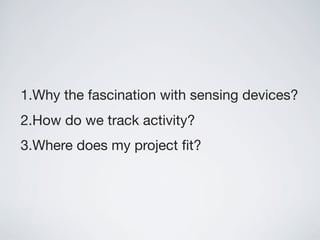
1.Why the fascination with sensing devices?
2.How do we track activity?
3.Where does my project fit?
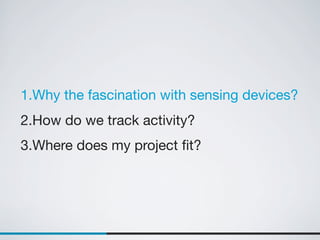
1.Why the fascination with sensing devices?
2.How do we track activity?
3.Where does my project fit?
Sensing.
Presence.
Understanding.
Improving.
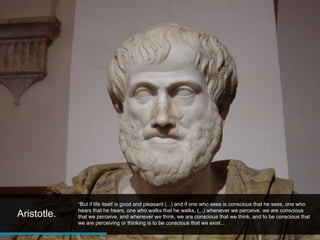
Our need to understand ourselves is not new.
“But if life itself is good and pleasant (...) and if one who sees is conscious that he sees, one who
             hears that he hears, one who walks that he walks, (...) whenever we perceive, we are conscious
Aristotle.   that we perceive, and whenever we think, we are conscious that we think, and to be conscious that
             we are perceiving or thinking is to be conscious that we exist...
Rene Descartes. Cogito Ergo Sum.
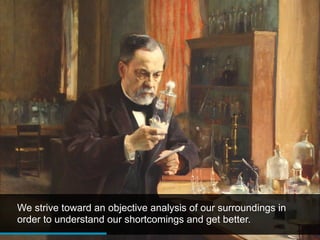
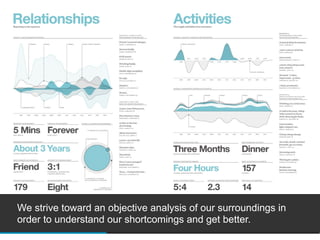
We strive toward an objective analysis of our surroundings in
order to understand our shortcomings and get better.
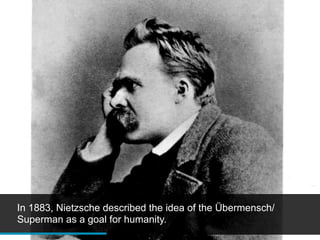
In 1883, Nietzsche described the idea of the Übermensch/
Superman as a goal for humanity.
Nietzsche's Overman or Superman is a human being who
generates values in accordance with data that he collects from
his environment. He employs his intuition (regarding good and
evil) to form values and then tests them empirically and without
prejudice. That which works, promotes his welfare and
happiness and helps him realize his full range of potentials - is
good. And everything - including values and the Superman
himself - everything - is transitory, contingent, replaceable,
changeable and subject to the continuous scrutiny of Darwinian
natural selection. His values are: self-realization, survival in
strength, and continual re-invention. Overcoming is not only a
process or a mechanism - it constitutes the reason to live.
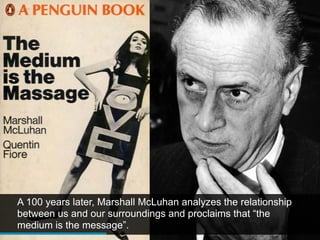
A 100 years later, Marshall McLuhan analyzes the relationship
between us and our surroundings and proclaims that “the
medium is the message”.
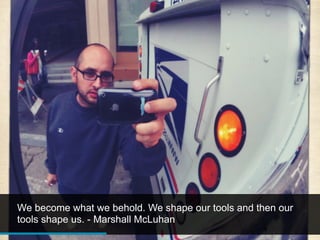
We become what we behold. We shape our tools and then our
tools shape us. - Marshall McLuhan
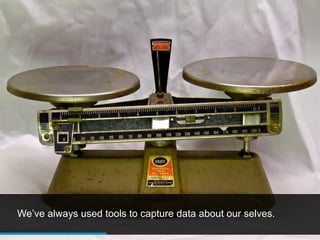
We’ve always used tools to capture data about our selves.
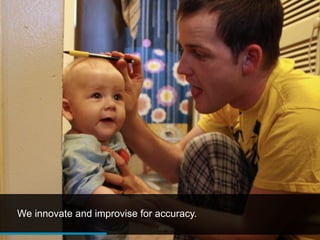
We innovate and improvise for accuracy.
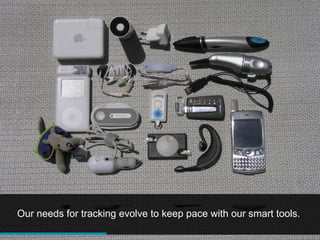
Our needs for tracking evolve to keep pace with our smart tools.
We follow a path that starts with curiosity...
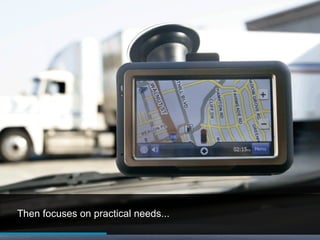
Then focuses on practical needs...
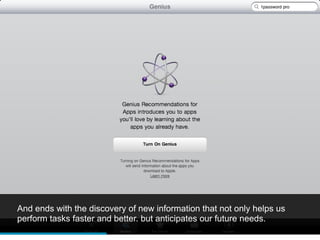
And ends with the discovery of new information that not only helps us
perform tasks faster and better. but anticipates our future needs.
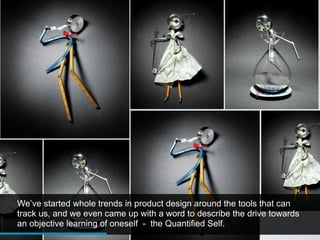
We’ve started whole trends in product design around the tools that can
track us, and we even came up with a word to describe the drive towards
an objective learning of oneself - the Quantified Self.
The Quantified Self as a term and as a group was formed in 2007 when
Kevin Kelly and Gary Wolf, former Wired contributors, began looking at
some new practices that seemed, loosely, to belong together: life logging,
personal genomics, location tracking, biometrics. These new tools were
being developed for many different reasons, but all of them had
something in common: they added a computational dimension to ordinary
existence.
1.Why the fascination with sensing devices?
2.How do we track activity?
3.Where does my project fit?
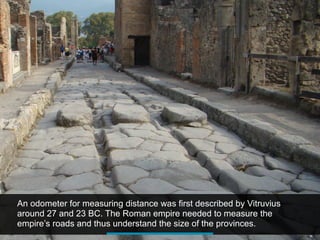
An odometer for measuring distance was first described by Vitruvius
around 27 and 23 BC. The Roman empire needed to measure the
empire’s roads and thus understand the size of the provinces.
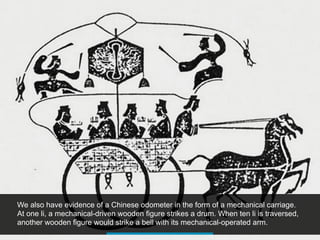
We also have evidence of a Chinese odometer in the form of a mechanical carriage.
At one li, a mechanical-driven wooden figure strikes a drum. When ten li is traversed,
another wooden figure would strike a bell with its mechanical-operated arm.
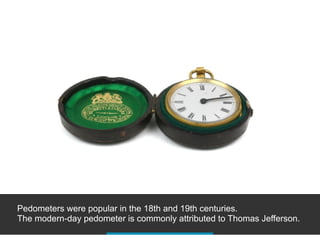
Pedometers were popular in the 18th and 19th centuries.
The modern-day pedometer is commonly attributed to Thomas Jefferson.
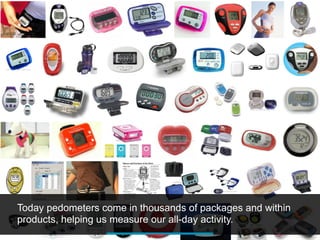
Today pedometers come in thousands of packages and within
products, helping us measure our all-day activity.
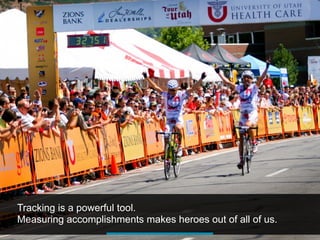
Tracking is a powerful tool.
Measuring accomplishments makes heroes out of all of us.
What we track
Type of activity
Level/Frequency
Time/Duration
Location
Many ways to
measure activity.
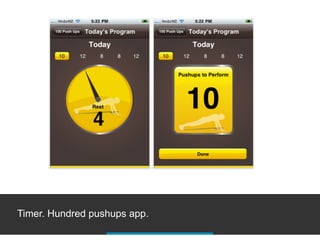
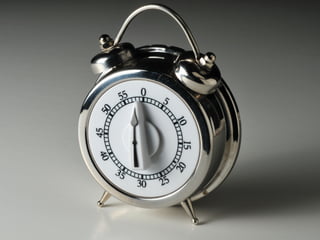
Timer. Hundred pushups app.
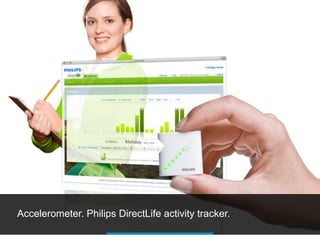
Accelerometer. Philips DirectLife activity tracker.
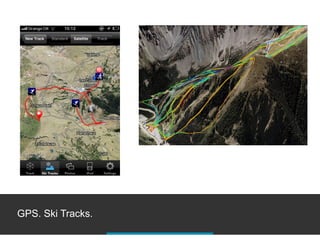
GPS. Ski Tracks.
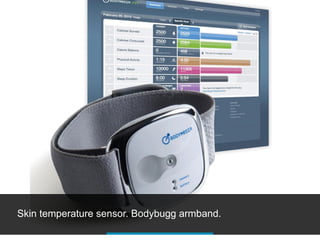
Skin temperature sensor. Bodybugg armband.
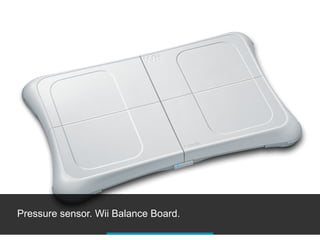
Pressure sensor. Wii Balance Board.
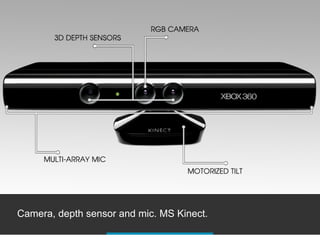
Camera, depth sensor and mic. MS Kinect.
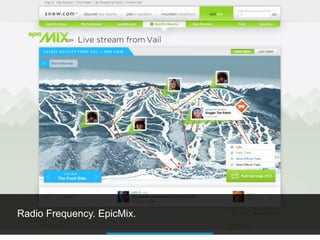
Radio Frequency. EpicMix.
What sets
products apart?
The best products tap into existing human behaviors around
motivation.
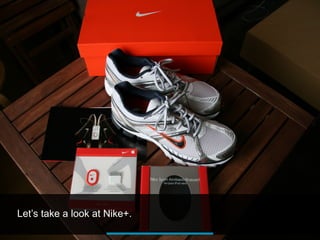
Let’s take a look at Nike+.
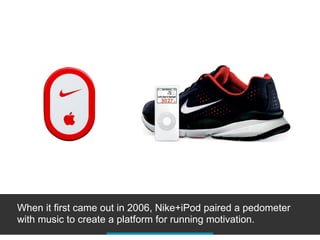
When it first came out in 2006, Nike+iPod paired a pedometer
with music to create a platform for running motivation.
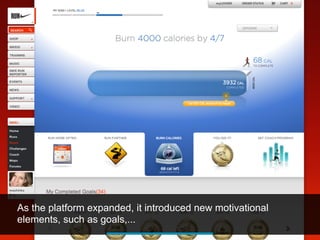
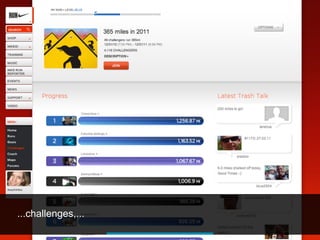
As the platform expanded, it introduced new motivational
elements, such as goals,...
...challenges,...
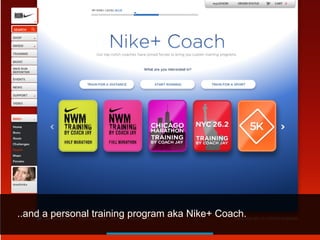
..and a personal training program aka Nike+ Coach.
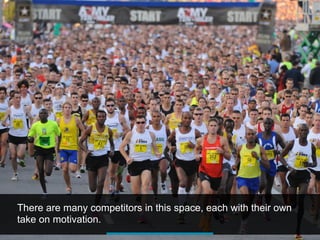
There are many competitors in this space, each with their own
take on motivation.
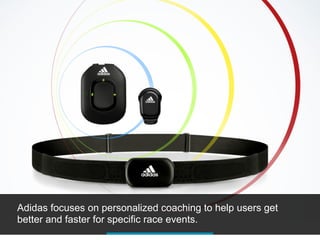
Adidas focuses on personalized coaching to help users get
better and faster for specific race events.
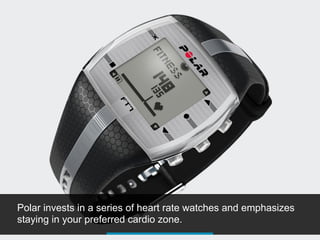
Polar invests in a series of heart rate watches and emphasizes
staying in your preferred cardio zone.
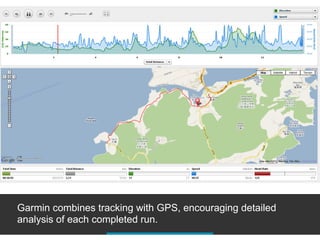
Garmin combines tracking with GPS, encouraging detailed
analysis of each completed run.
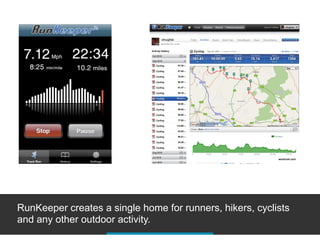
RunKeeper creates a single home for runners, hikers, cyclists
and any other outdoor activity.
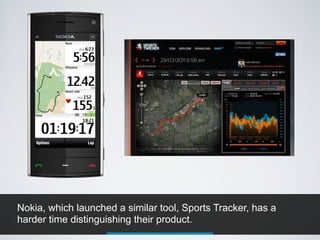
Nokia, which launched a similar tool, Sports Tracker, has a
harder time distinguishing their product.
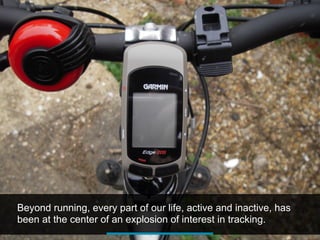
Beyond running, every part of our life, active and inactive, has
been at the center of an explosion of interest in tracking.
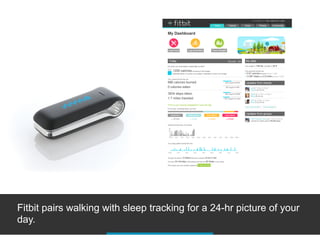
Fitbit pairs walking with sleep tracking for a 24-hr picture of your
day.
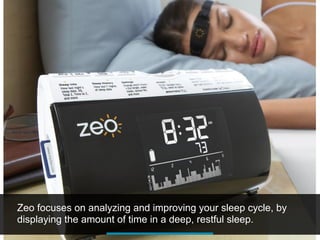
Zeo focuses on analyzing and improving your sleep cycle, by
displaying the amount of time in a deep, restful sleep.
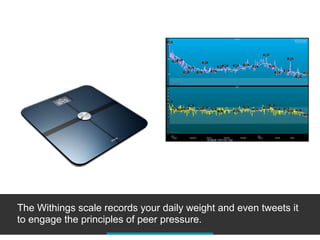
The Withings scale records your daily weight and even tweets it
to engage the principles of peer pressure.
Mint’s Goal feature lets users track their progress against a longer term
goal and provides reminder emails to help users stay on track.
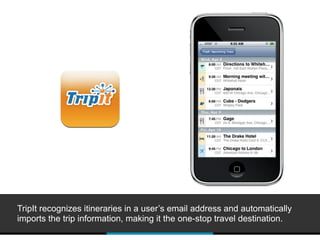
TripIt recognizes itineraries in a user’s email address and automatically
imports the trip information, making it the one-stop travel destination.
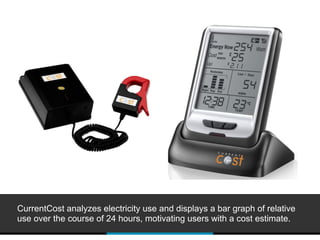
CurrentCost analyzes electricity use and displays a bar graph of relative
use over the course of 24 hours, motivating users with a cost estimate.
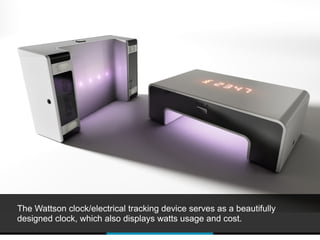
The Wattson clock/electrical tracking device serves as a beautifully
designed clock, which also displays watts usage and cost.
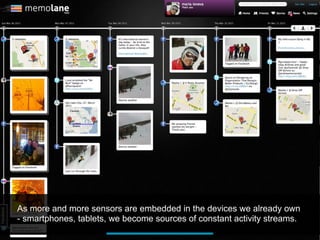
As more and more sensors are embedded in the devices we already own
- smartphones, tablets, we become sources of constant activity streams.
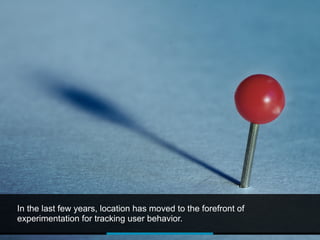
In the last few years, location has moved to the forefront of
experimentation for tracking user behavior.
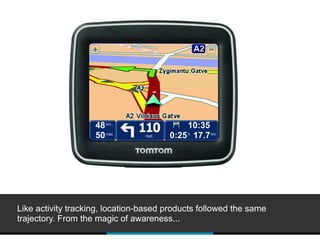
Like activity tracking, location-based products followed the same
trajectory. From the magic of awareness...
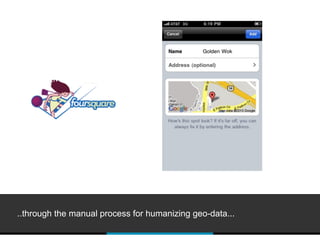
..through the manual process for humanizing geo-data...
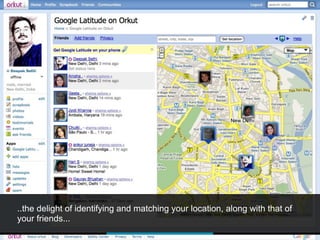
..the delight of identifying and matching your location, along with that of
your friends...
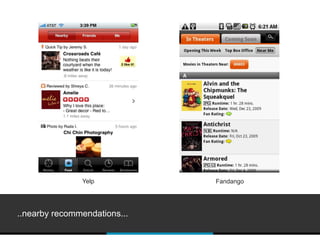
Yelp           Fandango


..nearby recommendations...
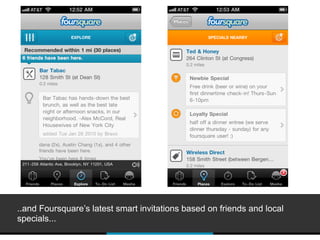
..and Foursquare’s latest smart invitations based on friends and local
specials...
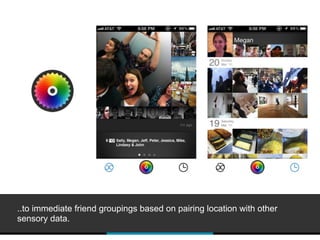
..to immediate friend groupings based on pairing location with other
sensory data.
As our sensors get smarter,
they also become:

Invisible
Immediate
Insightful
1.Why the fascination with sensing devices?
2.How do we track activity?
3.Where does my project fit?
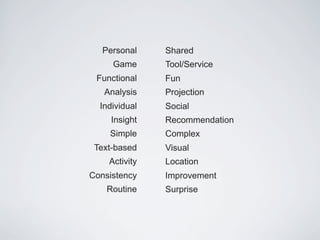
Personal    Shared
     Game      Tool/Service
 Functional    Fun
   Analysis    Projection
  Individual   Social
     Insight   Recommendation
    Simple     Complex
 Text-based    Visual
    Activity   Location
Consistency    Improvement
    Routine    Surprise

Appendix
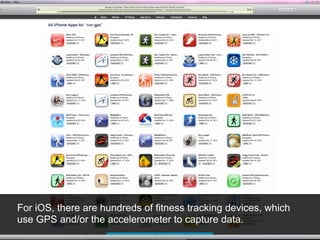
For iOS, there are hundreds of fitness tracking devices, which
use GPS and/or the accelerometer to capture data.
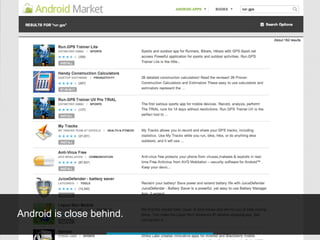
Android is close behind.
We strive toward an objective analysis of our surroundings in
order to understand our shortcomings and get better.

Sensing devices by Masha Ioveva

  • 1.
    Sensing Devices March 28, 2011
  • 2.
    1.Why the fascinationwith sensing devices? 2.How do we track activity? 3.Where does my project fit?
  • 3.
    1.Why the fascinationwith sensing devices? 2.How do we track activity? 3.Where does my project fit?
  • 4.
  • 5.
    Our need tounderstand ourselves is not new.
  • 6.
    “But if lifeitself is good and pleasant (...) and if one who sees is conscious that he sees, one who hears that he hears, one who walks that he walks, (...) whenever we perceive, we are conscious Aristotle. that we perceive, and whenever we think, we are conscious that we think, and to be conscious that we are perceiving or thinking is to be conscious that we exist...
  • 7.
  • 8.
    We strive towardan objective analysis of our surroundings in order to understand our shortcomings and get better.
  • 9.
    In 1883, Nietzschedescribed the idea of the Übermensch/ Superman as a goal for humanity.
  • 10.
    Nietzsche's Overman orSuperman is a human being who generates values in accordance with data that he collects from his environment. He employs his intuition (regarding good and evil) to form values and then tests them empirically and without prejudice. That which works, promotes his welfare and happiness and helps him realize his full range of potentials - is good. And everything - including values and the Superman himself - everything - is transitory, contingent, replaceable, changeable and subject to the continuous scrutiny of Darwinian natural selection. His values are: self-realization, survival in strength, and continual re-invention. Overcoming is not only a process or a mechanism - it constitutes the reason to live.
  • 11.
    A 100 yearslater, Marshall McLuhan analyzes the relationship between us and our surroundings and proclaims that “the medium is the message”.
  • 12.
    We become whatwe behold. We shape our tools and then our tools shape us. - Marshall McLuhan
  • 13.
    We’ve always usedtools to capture data about our selves.
  • 14.
    We innovate andimprovise for accuracy.
  • 15.
    Our needs fortracking evolve to keep pace with our smart tools.
  • 16.
    We follow apath that starts with curiosity...
  • 17.
    Then focuses onpractical needs...
  • 18.
    And ends withthe discovery of new information that not only helps us perform tasks faster and better. but anticipates our future needs.
  • 19.
    We’ve started wholetrends in product design around the tools that can track us, and we even came up with a word to describe the drive towards an objective learning of oneself - the Quantified Self.
  • 20.
    The Quantified Selfas a term and as a group was formed in 2007 when Kevin Kelly and Gary Wolf, former Wired contributors, began looking at some new practices that seemed, loosely, to belong together: life logging, personal genomics, location tracking, biometrics. These new tools were being developed for many different reasons, but all of them had something in common: they added a computational dimension to ordinary existence.
  • 21.
    1.Why the fascinationwith sensing devices? 2.How do we track activity? 3.Where does my project fit?
  • 22.
    An odometer formeasuring distance was first described by Vitruvius around 27 and 23 BC. The Roman empire needed to measure the empire’s roads and thus understand the size of the provinces.
  • 23.
    We also haveevidence of a Chinese odometer in the form of a mechanical carriage. At one li, a mechanical-driven wooden figure strikes a drum. When ten li is traversed, another wooden figure would strike a bell with its mechanical-operated arm.
  • 24.
    Pedometers were popularin the 18th and 19th centuries. The modern-day pedometer is commonly attributed to Thomas Jefferson.
  • 25.
    Today pedometers comein thousands of packages and within products, helping us measure our all-day activity.
  • 26.
    Tracking is apowerful tool. Measuring accomplishments makes heroes out of all of us.
  • 27.
    What we track Typeof activity Level/Frequency Time/Duration Location
  • 28.
  • 29.
  • 30.
  • 31.
  • 32.
    Skin temperature sensor.Bodybugg armband.
  • 33.
    Pressure sensor. WiiBalance Board.
  • 34.
    Camera, depth sensorand mic. MS Kinect.
  • 35.
  • 36.
  • 37.
    The best productstap into existing human behaviors around motivation.
  • 38.
    Let’s take alook at Nike+.
  • 39.
    When it firstcame out in 2006, Nike+iPod paired a pedometer with music to create a platform for running motivation.
  • 40.
    As the platformexpanded, it introduced new motivational elements, such as goals,...
  • 41.
  • 42.
    ..and a personaltraining program aka Nike+ Coach.
  • 43.
    There are manycompetitors in this space, each with their own take on motivation.
  • 44.
    Adidas focuses onpersonalized coaching to help users get better and faster for specific race events.
  • 45.
    Polar invests ina series of heart rate watches and emphasizes staying in your preferred cardio zone.
  • 46.
    Garmin combines trackingwith GPS, encouraging detailed analysis of each completed run.
  • 47.
    RunKeeper creates asingle home for runners, hikers, cyclists and any other outdoor activity.
  • 48.
    Nokia, which launcheda similar tool, Sports Tracker, has a harder time distinguishing their product.
  • 49.
    Beyond running, everypart of our life, active and inactive, has been at the center of an explosion of interest in tracking.
  • 50.
    Fitbit pairs walkingwith sleep tracking for a 24-hr picture of your day.
  • 51.
    Zeo focuses onanalyzing and improving your sleep cycle, by displaying the amount of time in a deep, restful sleep.
  • 52.
    The Withings scalerecords your daily weight and even tweets it to engage the principles of peer pressure.
  • 53.
    Mint’s Goal featurelets users track their progress against a longer term goal and provides reminder emails to help users stay on track.
  • 54.
    TripIt recognizes itinerariesin a user’s email address and automatically imports the trip information, making it the one-stop travel destination.
  • 55.
    CurrentCost analyzes electricityuse and displays a bar graph of relative use over the course of 24 hours, motivating users with a cost estimate.
  • 56.
    The Wattson clock/electricaltracking device serves as a beautifully designed clock, which also displays watts usage and cost.
  • 57.
    As more andmore sensors are embedded in the devices we already own - smartphones, tablets, we become sources of constant activity streams.
  • 58.
    In the lastfew years, location has moved to the forefront of experimentation for tracking user behavior.
  • 59.
    Like activity tracking,location-based products followed the same trajectory. From the magic of awareness...
  • 60.
    ..through the manualprocess for humanizing geo-data...
  • 61.
    ..the delight ofidentifying and matching your location, along with that of your friends...
  • 62.
    Yelp Fandango ..nearby recommendations...
  • 63.
    ..and Foursquare’s latestsmart invitations based on friends and local specials...
  • 64.
    ..to immediate friendgroupings based on pairing location with other sensory data.
  • 65.
    As our sensorsget smarter, they also become: Invisible Immediate Insightful
  • 66.
    1.Why the fascinationwith sensing devices? 2.How do we track activity? 3.Where does my project fit?
  • 69.
    Personal Shared Game Tool/Service Functional Fun Analysis Projection Individual Social Insight Recommendation Simple Complex Text-based Visual Activity Location Consistency Improvement Routine Surprise
  • 71.
  • 72.
    For iOS, thereare hundreds of fitness tracking devices, which use GPS and/or the accelerometer to capture data.
  • 73.
  • 74.
    We strive towardan objective analysis of our surroundings in order to understand our shortcomings and get better.