05_01_2005_01_20
MAKING AN EFFECTIVE BUSINESS
CASE
For Master Data Management
Strictly Confidential © 2019 Profisee Group, Inc. 1
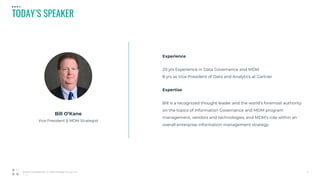
Bill O’Kane
bill.okane@profisee.com
05_01_20
TODAY’S SPEAKER
2Strictly Confidential © 2019 Profisee Group, Inc.
Experience
20 yrs Experience in Data Governance and MDM
8 yrs as Vice President of Data and Analytics at Gartner
Expertise
Bill is a recognized thought leader and the world’s foremost authority
on the topics of Information Governance and MDM program
management, vendors and technologies, and MDM’s role within an
overall enterprise information management strategy.
Bill O’Kane
Vice President & MDM Strategist
05_01_20
WHAT YOU’LL LEARN TODAY
3Strictly Confidential © 2019 Profisee Group, Inc.
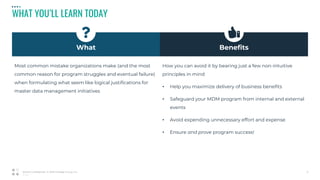
Most common mistake organizations make (and the most
common reason for program struggles and eventual failure)
when formulating what seem like logical justifications for
master data management initiatives
How you can avoid it by bearing just a few non-intuitive
principles in mind
• Help you maximize delivery of business benefits
• Safeguard your MDM program from internal and external
events
• Avoid expending unnecessary effort and expense
• Ensure and prove program success!
What Benefits
05_01_12
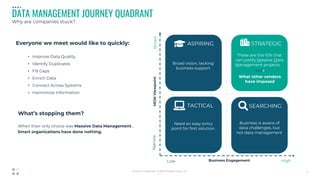
BroadNarrowMDMViewpoint
Low HighBusiness Engagement
Known data gaps
within the business
SEARCHING
Business is aware of
data challenges, but
not data management
ASPIRING
Broad vision, lacking
business support
TACTICAL
Need an easy entry
point for first solution.
STRATEGIC
These are the 10% that
can justify Massive Data
Management projects.
What other vendors
have imposed
Everyone we meet would like to quickly:
• Improve Data Quality
• Identify Duplicates
• Fill Gaps
• Enrich Data
• Connect Across Systems
• Harmonize Information
What’s stopping them?
When their only choice was Massive Data Management…
Smart organizations have done nothing.
4Strictly Confidential © 2018 Profisee Group, Inc.
DATA MANAGEMENT JOURNEY QUADRANT
Why are companies stuck?
05_01_20
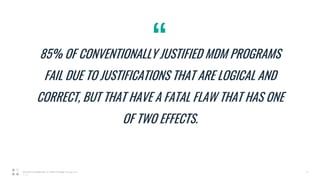
“85% OF CONVENTIONALLY JUSTIFIED MDM PROGRAMS
FAIL DUE TO JUSTIFICATIONS THAT ARE LOGICAL AND
CORRECT, BUT THAT HAVE A FATAL FLAW THAT HAS ONE
OF TWO EFFECTS.
5Strictly Confidential © 2019 Profisee Group, Inc.
05_01_20
WHAT
6Strictly Confidential © 2019 Profisee Group, Inc.
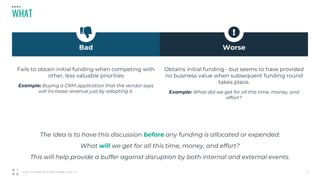
Bad Worse
Fails to obtain initial funding when competing with
other, less valuable priorities
Example: Buying a CRM application that the vendor says
will increase revenue just by adopting it.
Obtains initial funding - but seems to have provided
no business value when subsequent funding round
takes place.
Example: What did we get for all this time, money, and
effort?
The idea is to have this discussion before any funding is allocated or expended:
What will we get for all this time, money, and effort?
This will help provide a buffer against disruption by both internal and external events.
05_01_20
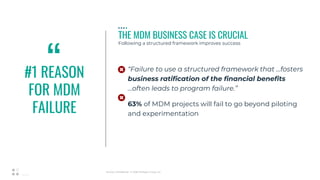
“Failure to use a structured framework that …fosters
business ratification of the financial benefits
…often leads to program failure.”
63% of MDM projects will fail to go beyond piloting
and experimentation
THE MDM BUSINESS CASE IS CRUCIAL
Following a structured framework improves success
Strictly Confidential © 2018 Profisee Group, Inc.
#1 REASON
FOR MDM
FAILURE
“
05_01_20
WHY
8Strictly Confidential © 2019 Profisee Group, Inc.
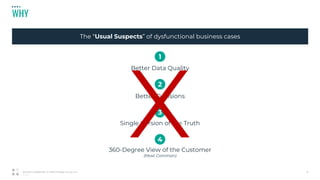
The “Usual Suspects” of dysfunctional business cases
Better Decisions
2
Single Version of the Truth
3
Better Data Quality
1
360-Degree View of the Customer
(Most Common)
4
05_01_20
WHY
9Strictly Confidential © 2019 Profisee Group, Inc.
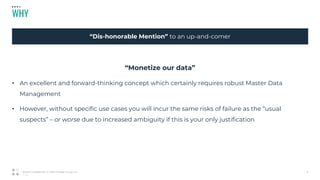
“Dis-honorable Mention” to an up-and-comer
“Monetize our data”
• An excellent and forward-thinking concept which certainly requires robust Master Data
Management
• However, without specific use cases you will incur the same risks of failure as the “usual
suspects” – or worse due to increased ambiguity if this is your only justification
05_01_20
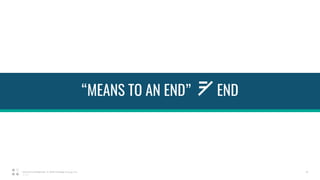
“MEANS TO AN END” = END
10Strictly Confidential © 2019 Profisee Group, Inc.
05_01_20
HOW
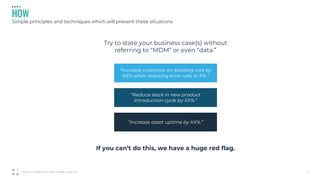
Simple principles and techniques which will prevent these situations
11Strictly Confidential © 2019 Profisee Group, Inc.
Try to state your business case(s) without
referring to “MDM” or even “data.”
“Increase customer on-barding rate by
XX% while reducing error rate to X%.”
“Reduce slack in new product
introduction cycle by XX%.”
“Increase asset uptime by XX%.”
If you can’t do this, we have a huge red flag.
05_01_20
12Strictly Confidential © 2018 Profisee Group, Inc.
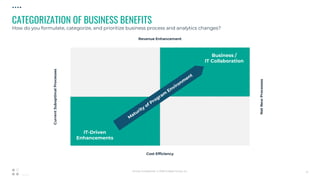
CATEGORIZATION OF BUSINESS BENEFITS
How do you formulate, categorize, and prioritize business process and analytics changes?
CurrentSuboptimalProcesses
NetNewProcesses
Cost Efficiency
Revenue Enhancement
Business /
IT Collaboration
IT-Driven
Enhancements
05_01_20
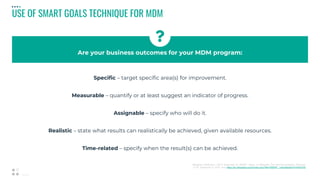
USE OF SMART GOALS TECHNIQUE FOR MDM
Specific – target specific area(s) for improvement.
Measurable – quantify or at least suggest an indicator of progress.
Assignable – specify who will do it.
Realistic – state what results can realistically be achieved, given available resources.
Time-related – specify when the result(s) can be achieved.
Are your business outcomes for your MDM program:
Wikipedia contributors. (2019, September 4). SMART criteria. In Wikipedia, The Free Encyclopedia. Retrieved
17:30, September 5, 2019, from https://en.wikipedia.org/w/index.php?title=SMART_criteria&oldid=914043780
05_01_20
HOW
14Strictly Confidential © 2019 Profisee Group, Inc.
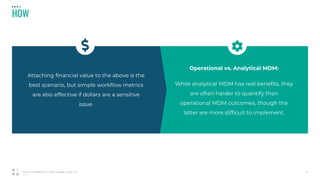
Operational vs. Analytical MDM:
While analytical MDM has real benefits, they
are often harder to quantify than
operational MDM outcomes, though the
latter are more difficult to implement.
Attaching financial value to the above is the
best scenario, but simple workflow metrics
are also effective if dollars are a sensitive
issue.
05_01_20
NOW WHAT…
Next Steps
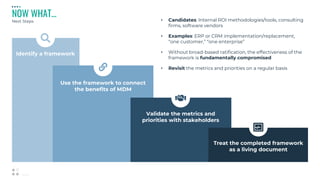
Identify a framework
Use the framework to connect
the benefits of MDM
Validate the metrics and
priorities with stakeholders
Treat the completed framework
as a living document
• Candidates: Internal ROI methodologies/tools, consulting
firms, software vendors
• Examples: ERP or CRM implementation/replacement,
“one customer,” “one enterprise”
• Without broad-based ratification, the effectiveness of the
framework is fundamentally compromised
• Revisit the metrics and priorities on a regular basis
05_01_20
QUESTIONS?
17Strictly Confidential © 2019 Profisee Group, Inc.

Making an Effective Business Case for Master Data Management

  • 1.
    05_01_2005_01_20 MAKING AN EFFECTIVEBUSINESS CASE For Master Data Management Strictly Confidential © 2019 Profisee Group, Inc. 1 Bill O’Kane bill.okane@profisee.com
  • 2.
    05_01_20 TODAY’S SPEAKER 2Strictly Confidential© 2019 Profisee Group, Inc. Experience 20 yrs Experience in Data Governance and MDM 8 yrs as Vice President of Data and Analytics at Gartner Expertise Bill is a recognized thought leader and the world’s foremost authority on the topics of Information Governance and MDM program management, vendors and technologies, and MDM’s role within an overall enterprise information management strategy. Bill O’Kane Vice President & MDM Strategist
  • 3.
    05_01_20 WHAT YOU’LL LEARNTODAY 3Strictly Confidential © 2019 Profisee Group, Inc. Most common mistake organizations make (and the most common reason for program struggles and eventual failure) when formulating what seem like logical justifications for master data management initiatives How you can avoid it by bearing just a few non-intuitive principles in mind • Help you maximize delivery of business benefits • Safeguard your MDM program from internal and external events • Avoid expending unnecessary effort and expense • Ensure and prove program success! What Benefits
  • 4.
    05_01_12 BroadNarrowMDMViewpoint Low HighBusiness Engagement Knowndata gaps within the business SEARCHING Business is aware of data challenges, but not data management ASPIRING Broad vision, lacking business support TACTICAL Need an easy entry point for first solution. STRATEGIC These are the 10% that can justify Massive Data Management projects. What other vendors have imposed Everyone we meet would like to quickly: • Improve Data Quality • Identify Duplicates • Fill Gaps • Enrich Data • Connect Across Systems • Harmonize Information What’s stopping them? When their only choice was Massive Data Management… Smart organizations have done nothing. 4Strictly Confidential © 2018 Profisee Group, Inc. DATA MANAGEMENT JOURNEY QUADRANT Why are companies stuck?
  • 5.
    05_01_20 “85% OF CONVENTIONALLYJUSTIFIED MDM PROGRAMS FAIL DUE TO JUSTIFICATIONS THAT ARE LOGICAL AND CORRECT, BUT THAT HAVE A FATAL FLAW THAT HAS ONE OF TWO EFFECTS. 5Strictly Confidential © 2019 Profisee Group, Inc.
  • 6.
    05_01_20 WHAT 6Strictly Confidential ©2019 Profisee Group, Inc. Bad Worse Fails to obtain initial funding when competing with other, less valuable priorities Example: Buying a CRM application that the vendor says will increase revenue just by adopting it. Obtains initial funding - but seems to have provided no business value when subsequent funding round takes place. Example: What did we get for all this time, money, and effort? The idea is to have this discussion before any funding is allocated or expended: What will we get for all this time, money, and effort? This will help provide a buffer against disruption by both internal and external events.
  • 7.
    05_01_20 “Failure to usea structured framework that …fosters business ratification of the financial benefits …often leads to program failure.” 63% of MDM projects will fail to go beyond piloting and experimentation THE MDM BUSINESS CASE IS CRUCIAL Following a structured framework improves success Strictly Confidential © 2018 Profisee Group, Inc. #1 REASON FOR MDM FAILURE “
  • 8.
    05_01_20 WHY 8Strictly Confidential ©2019 Profisee Group, Inc. The “Usual Suspects” of dysfunctional business cases Better Decisions 2 Single Version of the Truth 3 Better Data Quality 1 360-Degree View of the Customer (Most Common) 4
  • 9.
    05_01_20 WHY 9Strictly Confidential ©2019 Profisee Group, Inc. “Dis-honorable Mention” to an up-and-comer “Monetize our data” • An excellent and forward-thinking concept which certainly requires robust Master Data Management • However, without specific use cases you will incur the same risks of failure as the “usual suspects” – or worse due to increased ambiguity if this is your only justification
  • 10.
    05_01_20 “MEANS TO ANEND” = END 10Strictly Confidential © 2019 Profisee Group, Inc.
  • 11.
    05_01_20 HOW Simple principles andtechniques which will prevent these situations 11Strictly Confidential © 2019 Profisee Group, Inc. Try to state your business case(s) without referring to “MDM” or even “data.” “Increase customer on-barding rate by XX% while reducing error rate to X%.” “Reduce slack in new product introduction cycle by XX%.” “Increase asset uptime by XX%.” If you can’t do this, we have a huge red flag.
  • 12.
    05_01_20 12Strictly Confidential ©2018 Profisee Group, Inc. CATEGORIZATION OF BUSINESS BENEFITS How do you formulate, categorize, and prioritize business process and analytics changes? CurrentSuboptimalProcesses NetNewProcesses Cost Efficiency Revenue Enhancement Business / IT Collaboration IT-Driven Enhancements
  • 13.
    05_01_20 USE OF SMARTGOALS TECHNIQUE FOR MDM Specific – target specific area(s) for improvement. Measurable – quantify or at least suggest an indicator of progress. Assignable – specify who will do it. Realistic – state what results can realistically be achieved, given available resources. Time-related – specify when the result(s) can be achieved. Are your business outcomes for your MDM program: Wikipedia contributors. (2019, September 4). SMART criteria. In Wikipedia, The Free Encyclopedia. Retrieved 17:30, September 5, 2019, from https://en.wikipedia.org/w/index.php?title=SMART_criteria&oldid=914043780
  • 14.
    05_01_20 HOW 14Strictly Confidential ©2019 Profisee Group, Inc. Operational vs. Analytical MDM: While analytical MDM has real benefits, they are often harder to quantify than operational MDM outcomes, though the latter are more difficult to implement. Attaching financial value to the above is the best scenario, but simple workflow metrics are also effective if dollars are a sensitive issue.
  • 15.
    05_01_20 NOW WHAT… Next Steps Identifya framework Use the framework to connect the benefits of MDM Validate the metrics and priorities with stakeholders Treat the completed framework as a living document • Candidates: Internal ROI methodologies/tools, consulting firms, software vendors • Examples: ERP or CRM implementation/replacement, “one customer,” “one enterprise” • Without broad-based ratification, the effectiveness of the framework is fundamentally compromised • Revisit the metrics and priorities on a regular basis
  • 16.

Editor's Notes

  • #2 This is an introduction slide. Use the title for the title of your presentation. Use the subtitle for the presenter’s name, role, and/or title. Add a graphic pertinent to your presentation on the right side.
  • #5 Here we have the Data Management Journey Quadrant. Every company or organization is in a different place in their Data Management journey.  Let's look at what's different about the 10% of organizations that HAVE adopted a STRATEGIC approach to managing their data and the those that havaen't.  One the left axis is MDM Viewpoint. Companies with a broad MDM Viewpoint understand that MDM can solve a wide array of data challenges. On the bottom is Business Engagement. Companies with high Business Engagement have business stakeholders who understand data management, the value it can deliver, and are bought in.   The 10% of companies that have adopted MDM are mostly in the top right quadrant, called Strategic. Why is this, it's because they have been able to justify the traditional Massive Data Management projects, as well as, have both IT and the Business aligned on the business outcome of MDM.   At the same time, every company we meet with would like to be able to do all of these things. Everyone would like better their data quality or to improve cross system integrations.  What's stopping them?   When faced with the prospect of a Massive Data Management project, which has traditionally been the only option imposed by MDM vendors, the smart ones, have done nothing.  It's been too costly, too complex, and it takes too long to get the results needed for a fast moving, fast changing business.  What does that mean for the rest of the 90%? Well, they're in a different phase on their data management journey.  (THIS IS WHERE YOU CAN RELATE TO THE ROOM WITH SPECIFIC INFORMATION ABOUT THEIR STRATEGIC BUSINESS INITATIVE, OR PROJECT.)   Some organizations have a broad vision for data management, but limited buy in for the business. They may have a CDO, CIO or other IT executive who sees numerous opportunities for data management  to help the business, but are unable to get the business to buy-in.  Other organizations have IT resources that see perhaps a single data management problem they'd like to quickly solve, but need an easy entry point so they can show some results.   Organizations in the Searching quadrant have business users who are aware of data challenges, such as a CMO who know CRM is a mess, but aren't aware of data management as a solution to their problems.  AGAIN, THIS IS AN OPPORTUNTY TO ENGAGE THE PROSPECT AND ASK WHERE THEY FEEL THEY ARE IN THEIR JOURNEY.  Now let's take a look at how Profisee helps companies on this journey.
  • #6 This is a big impact quote slide. Use this for your most inspiring quote.
  • #7 This is a standard content slide. Try not to use the slide for everything. Try one of the background slides, or move some of your content to a callout, especially if you have a lot of text. Your audience will thank you. 
  • #8 63% of projects don’t get past the funding approval – Profisee experience 80% of project management executives don’t know how their projects align with their company’s business strategy. (Source: Changepoint)
  • #13 Here we have the Data Management Journey Quadrant. Every company or organization is in a different place in their Data Management journey.  Let's look at what's different about the 10% of organizations that HAVE adopted a STRATEGIC approach to managing their data and the those that havaen't.  One the left axis is MDM Viewpoint. Companies with a broad MDM Viewpoint understand that MDM can solve a wide array of data challenges. On the bottom is Business Engagement. Companies with high Business Engagement have business stakeholders who understand data management, the value it can deliver, and are bought in.   The 10% of companies that have adopted MDM are mostly in the top right quadrant, called Strategic. Why is this, it's because they have been able to justify the traditional Massive Data Management projects, as well as, have both IT and the Business aligned on the business outcome of MDM.   At the same time, every company we meet with would like to be able to do all of these things. Everyone would like better their data quality or to improve cross system integrations.  What's stopping them?   When faced with the prospect of a Massive Data Management project, which has traditionally been the only option imposed by MDM vendors, the smart ones, have done nothing.  It's been too costly, too complex, and it takes too long to get the results needed for a fast moving, fast changing business.  What does that mean for the rest of the 90%? Well, they're in a different phase on their data management journey.  (THIS IS WHERE YOU CAN RELATE TO THE ROOM WITH SPECIFIC INFORMATION ABOUT THEIR STRATEGIC BUSINESS INITATIVE, OR PROJECT.)   Some organizations have a broad vision for data management, but limited buy in for the business. They may have a CDO, CIO or other IT executive who sees numerous opportunities for data management  to help the business, but are unable to get the business to buy-in.  Other organizations have IT resources that see perhaps a single data management problem they'd like to quickly solve, but need an easy entry point so they can show some results.   Organizations in the Searching quadrant have business users who are aware of data challenges, such as a CMO who know CRM is a mess, but aren't aware of data management as a solution to their problems.  AGAIN, THIS IS AN OPPORTUNTY TO ENGAGE THE PROSPECT AND ASK WHERE THEY FEEL THEY ARE IN THEIR JOURNEY.  Now let's take a look at how Profisee helps companies on this journey.
  • #18 This is an impact slide. Use this to exclaim a fundamental, overarching idea that you want to really drive home. Put a big image in the back of the slide for even more impact.