Workshop presentation given at the HIMSS 2025 conference, featuring Martin Boyd from Profisee, Anna Taylor from Multicare, Brigitte Tebow from Azulity, and Camille Whicker from Microsoft.
HIMSS25 | March3-6 | Las Vegas
Brigitte Tebow
VP Data Management Services, Azulity
Brigitte Tebow is a seasoned healthcare technology executive with
over 20 years of experience in data management and analytics.
As the VP of Data Management Services at Azulity, she leads strategic
initiatives to improve healthcare outcomes through innovative data
solutions. Brigitte's expertise spans across data governance,
interoperability, and advanced analytics, making her a trusted advisor
in the healthcare technology sector.
Her passion – Teaching Healthcare Master Data Services to improve
patient care outcomes with the goal of making the lives of providers
easier!
3
4.
HIMSS25 | March3-6 | Las Vegas
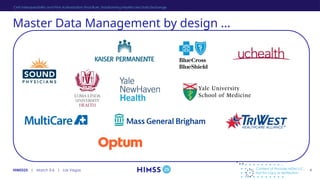
Master Data Management by design …
CMS Interoperability and Prior Authorization Final Rule: Transforming Healthcare Data Exchange
Content of Provider MDM LLC,
Not for copy or distribution
4
5.
HIMSS25 | March3-6 | Las Vegas
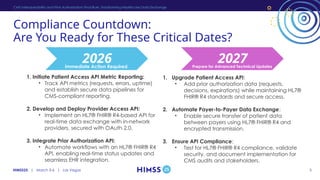
Compliance Countdown:
Are You Ready for These Critical Dates?
5
CMS Interoperability and Prior Authorization Final Rule: Transforming Healthcare Data Exchange
2026 2027
1. Upgrade Patient Access API:
• Add prior authorization data (requests,
decisions, expirations) while maintaining HL7®
FHIR® R4 standards and secure access.
2. Automate Payer-to-Payer Data Exchange:
• Enable secure transfer of patient data
between payers using HL7® FHIR® R4 and
encrypted transmission.
3. Ensure API Compliance:
• Test for HL7® FHIR® R4 compliance, validate
security, and document implementation for
CMS audits and stakeholders.
1. Initiate Patient Access API Metric Reporting:
• Track API metrics (requests, errors, uptime)
and establish secure data pipelines for
CMS-compliant reporting.
2. Develop and Deploy Provider Access API:
• Implement an HL7® FHIR® R4-based API for
real-time data exchange with in-network
providers, secured with OAuth 2.0.
3. Integrate Prior Authorization API:
• Automate workflows with an HL7® FHIR® R4
API, enabling real-time status updates and
seamless EHR integration.
Immediate Action Required Prepare for Advanced Technical Updates
6.
HIMSS25 | March3-6 | Las Vegas
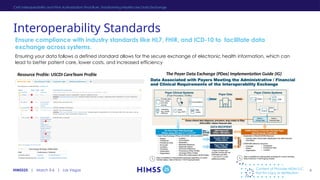
Interoperability Standards
Ensuring your data follows a defined standard allows for the secure exchange of electronic health information, which can
lead to better patient care, lower costs, and increased efficiency
CMS Interoperability and Prior Authorization Final Rule: Transforming Healthcare Data Exchange
Ensure compliance with industry standards like HL7, FHIR, and ICD-10 to facilitate data
exchange across systems.
Resource Profile: USCDI CareTeam Profile The Payer Data Exchange (PDex) Implementation Guide (IG)
Content of Provider MDM LLC,
Not for copy or distribution
6
7.
HIMSS25 | March3-6 | Las Vegas
CMS Interoperability and Prior Authorization Final Rule: Transforming Healthcare Data Exchange
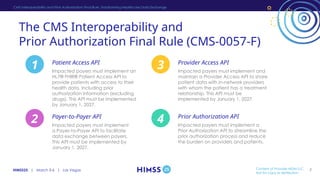
Impacted payers must implement an
HL7® FHIR® Patient Access API to
provide patients with access to their
health data, including prior
authorization information (excluding
drugs). This API must be implemented
by January 1, 2027.
Impacted payers must implement
a Payer-to-Payer API to facilitate
data exchange between payers.
This API must be implemented by
January 1, 2027.
Impacted payers must implement and
maintain a Provider Access API to share
patient data with in-network providers
with whom the patient has a treatment
relationship. This API must be
implemented by January 1, 2027.
Impacted payers must implement a
Prior Authorization API to streamline the
prior authorization process and reduce
the burden on providers and patients.
Payer-to-Payer API Prior Authorization API
Patient Access API Provider Access API
1
2
3
4
The CMS Interoperability and
Prior Authorization Final Rule (CMS-0057-F)
Content of Provider MDM LLC,
Not for copy or distribution
7
8.
HIMSS25 | March3-6 | Las Vegas
CMS Interoperability and Prior Authorization Final Rule: Transforming Healthcare Data Exchange
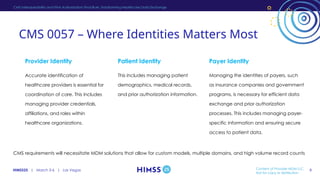
Patient Identity
This includes managing patient
demographics, medical records,
and prior authorization information.
Provider Identity
Accurate identification of
healthcare providers is essential for
coordination of care. This includes
managing provider credentials,
affiliations, and roles within
healthcare organizations.
Payer Identity
Managing the identities of payers, such
as insurance companies and government
programs, is necessary for efficient data
exchange and prior authorization
processes. This includes managing payer-
specific information and ensuring secure
access to patient data.
CMS requirements will necessitate MDM solutions that allow for custom models, multiple domains, and high volume record counts
CMS 0057 – Where Identities Matters Most
Content of Provider MDM LLC,
Not for copy or distribution
8
9.
HIMSS25 | March3-6 | Las Vegas
CMS Interoperability and Prior Authorization Final Rule: Transforming Healthcare Data Exchange
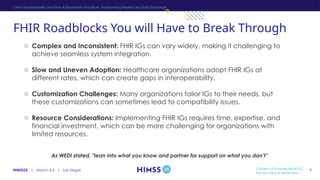
As WEDI stated, "lean into what you know and partner for support on what you don’t”
o Complex and Inconsistent: FHIR IGs can vary widely, making it challenging to
achieve seamless system integration.
o Slow and Uneven Adoption: Healthcare organizations adopt FHIR IGs at
different rates, which can create gaps in interoperability.
o Customization Challenges: Many organizations tailor IGs to their needs, but
these customizations can sometimes lead to compatibility issues.
o Resource Considerations: Implementing FHIR IGs requires time, expertise, and
financial investment, which can be more challenging for organizations with
limited resources.
Content of Provider MDM LLC,
Not for copy or distribution
9
FHIR Roadblocks You will Have to Break Through
Safeguard your
people, health
data,and
infrastructure
Help protect and govern
your health data across
clouds, apps and devices
Empower your
healthcare
workforce
Unlock value
from clinical
and operational
data
Accelerate research,
discovery, and
development
Stay focused with AI tools
that enhance productivity
and automate workflows
Realize savings and drive
better outcomes through
unified data insights.
Innovate with data and AI
at scale to transform
healthcare
Enhance patient
and member
experiences
Deliver personalized and
connected experiences to
improve care management
Microsoft Cloud for Healthcare
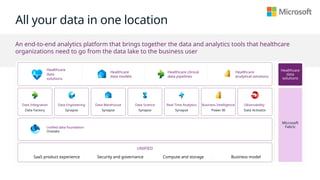
An end-to-end analyticsplatform that brings together the data and analytics tools that healthcare
organizations need to go from the data lake to the business user
All your data in one location
Data Factory Synapse Power BI Data Activator
Synapse Synapse
Data Integration Data Engineering Data Warehouse
Synapse
Data Science Real Time Analytics Business Intelligence Observability
Unified data foundation
Onelake
UNIFIED
SaaS product experience Security and governance Compute and storage Business model
Microsoft
Fabric
Healthcare
data
solutions
Healthcare
data models
Healthcare clinical
data pipelines
Healthcare
analytical solutions
Healthcare
data
solutions
14.
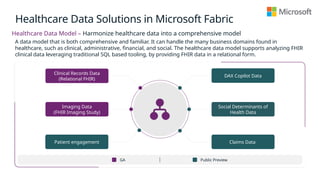
Healthcare Data Solutionsin Microsoft Fabric
Healthcare Data Model – Harmonize healthcare data into a comprehensive model
A data model that is both comprehensive and familiar. It can handle the many business domains found in
healthcare, such as clinical, administrative, financial, and social. The healthcare data model supports analyzing FHIR
clinical data leveraging traditional SQL based tooling, by providing FHIR data in a relational form.
Clinical Records Data
(Relational FHIR)
Imaging Data
(FHIR Imaging Study)
Social Determinants of
Health Data
DAX Copilot Data
Claims Data
Public Preview
GA
Patient engagement
15.
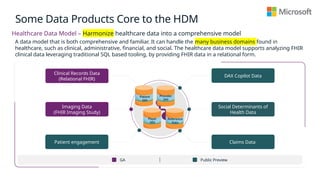
Some Data ProductsCore to the HDM
Healthcare Data Model – Harmonize healthcare data into a comprehensive model
A data model that is both comprehensive and familiar. It can handle the many business domains found in
healthcare, such as clinical, administrative, financial, and social. The healthcare data model supports analyzing FHIR
clinical data leveraging traditional SQL based tooling, by providing FHIR data in a relational form.
Clinical Records Data
(Relational FHIR)
Imaging Data
(FHIR Imaging Study)
Social Determinants of
Health Data
DAX Copilot Data
Claims Data
Public Preview
GA
Patient engagement
Patient
360
Provider
360
Reference
Data
Payer
360
16.
16
04_13_21
16
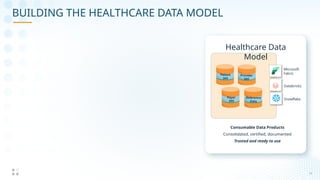
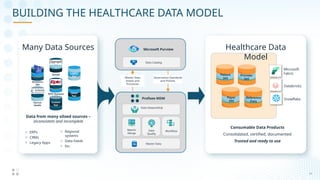
BUILDING THE HEALTHCAREDATA MODEL
Patient
360
Provider
360
Payer
360
Reference
Data
Consumable Data Products
Consolidated, certified, documented
Trusted and ready to use
Healthcare Data
Model
Microsoft
Fabric
Databricks
Snowflake
17.
17
04_13_21
17
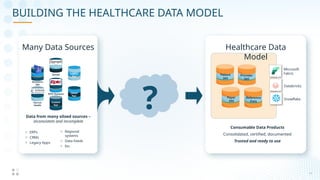
BUILDING THE HEALTHCAREDATA MODEL
Patient
360
Provider
360
Payer
360
Reference
Data
Consumable Data Products
Consolidated, certified, documented
Trusted and ready to use
Healthcare Data
Model
o ERPs
o CRMs
o Legacy Apps
Data from many siloed sources –
inconsistent and incomplete
o Regional
systems
o Data Feeds
o Etc.
?
Many Data Sources
Dynamics
365
Kyruus
Health
Symplr
EPIC Systems
Legacy
App
Cloud
App
Custom
App
Microsoft
Fabric
Databricks
Snowflake
18.
18
04_13_21
18
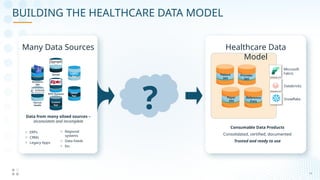
BUILDING THE HEALTHCAREDATA MODEL
o ERPs
o CRMs
o Legacy Apps
Data from many siloed sources –
inconsistent and incomplete
o Regional
systems
o Data Feeds
o Etc.
?
Many Data Sources
Dynamics
365
Kyruus
Health
Symplr
EPIC Systems
Legacy
App
Cloud
App
Custom
App
Patient
360
Provider
360
Payer
360
Reference
Data
Consumable Data Products
Consolidated, certified, documented
Trusted and ready to use
Healthcare Data
Model
Microsoft
Fabric
Databricks
Snowflake
19.
19
04_13_21
19
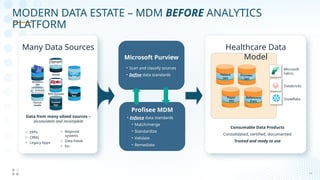
MODERN DATA ESTATE– MDM BEFORE ANALYTICS
PLATFORM
Microsoft Purview
• Scan and classify sources
• Define data standards
Profisee MDM
• Enforce data standards
• Match/merge
• Standardize
• Validate
• Remediate
o ERPs
o CRMs
o Legacy Apps
Data from many siloed sources –
inconsistent and incomplete
o Regional
systems
o Data Feeds
o Etc.
Many Data Sources
Dynamics
365
Kyruus
Health
Symplr
EPIC Systems
Legacy
App
Cloud
App
Custom
App
Patient
360
Provider
360
Payer
360
Reference
Data
Consumable Data Products
Consolidated, certified, documented
Trusted and ready to use
Healthcare Data
Model
Microsoft
Fabric
Databricks
Snowflake
20.
20
04_13_21
20
BUILDING THE HEALTHCAREDATA MODEL
Data Stewardship
Master Data
Match/
Merge
Workflow
Profisee MDM
Microsoft Purview
Data Catalog
Master Data
Assets and
Processes
Governance Standards
and Policies
Data
Quality
o ERPs
o CRMs
o Legacy Apps
Data from many siloed sources –
inconsistent and incomplete
o Regional
systems
o Data Feeds
o Etc.
Many Data Sources
Dynamics
365
Kyruus
Health
Symplr
EPIC Systems
Legacy
App
Cloud
App
Custom
App
Patient
360
Provider
360
Payer
360
Reference
Data
Consumable Data Products
Consolidated, certified, documented
Trusted and ready to use
Healthcare Data
Model
Microsoft
Fabric
Databricks
Snowflake
21.
21
04_13_21
21
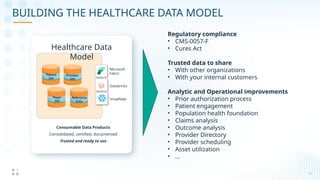
BUILDING THE HEALTHCAREDATA MODEL
Patient
360
Provider
360
Payer
360
Reference
Data
Consumable Data Products
Consolidated, certified, documented
Trusted and ready to use
Healthcare Data
Model
Microsoft
Fabric
Databricks
Snowflake
Regulatory compliance
• CMS-0057-F
• Cures Act
Trusted data to share
• With other organizations
• With your internal customers
Analytic and Operational improvements
• Prior authorization process
• Patient engagement
• Population health foundation
• Claims analysis
• Outcome analysis
• Provider Directory
• Provider scheduling
• Asset utilization
• …
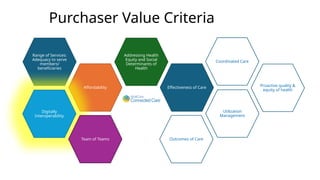
Purchaser Value Criteria
Rangeof Services:
Adequacy to serve
members/
beneficiaries
Affordability
Outcomes of Care
Effectiveness of Care Proactive quality &
equity of health
Addressing Health
Equity and Social
Determinants of
Health
Utilization
Management
Digitally
Interoperability
Coordinated Care
Team of Teams
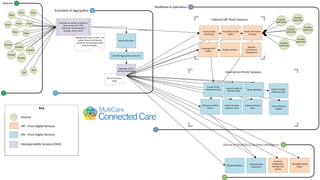
Sources
Workflows & Operations
Internal(on Prem) Systems
Acquisition & Aggregation
Advanced Analytics & Business Intelligence
Delimited file, xlsx, txt, json – all
unique formats and layouts
except for json payloads, these
follow standards
API, sFTP, secure
email
Payer
Payer
Payer
Payer
Payer
Payer
Payer
Payer
Payloads are picked up based on
Payer portal: API, sFTP,
Webportal, Automated ELT
package, secure email.
Internal File Share
Internal Aggregation processes
Aggregate and/or
Raw file distribution
Outbound Clinical
Data
Master Member
Reference Mart
Hospital at Home
Health Information
Exchange
Population Health
Engine
Financial Data
Warehouse
External (off Prem) Systems Provider
EMR CCDA
Provider
EMR CCDA
Provider
EMR CCDA
Provider
EMR CCDA
Provider
EMR CCDA
Provider
EMR CCDA
Actuarial Database
Customer
Relationship
Management
System
Master Provider
Reference Mart
Provider
Provider
Provider
Provider
Provider
Network
Performance
Management
CDC
DOH
Enterprise Data
Warehouse
Population Health
Engine
Community ADT
Notifies
Sources
Off - Prem Digital Services
ON - Prem Digital Services
Interoperability Services (DMZ)
Clinical Decision
support
Financial Data
Warehouse Copy
Internal Quality &
Risk Reporting
Payor Reporting
Electronic Medical
Record
26.
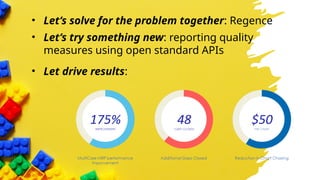
• Let’s solvefor the problem together: Regence
• Let’s try something new: reporting quality
measures using open standard APIs
• Let drive results:
27.
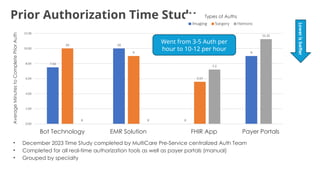
Prior Authorization TimeStudy
• December 2023 Time Study completed by MultiCare Pre-Service centralized Auth Team
• Completed for all real-time authorization tools as well as payer portals (manual)
• Grouped by specialty
Bot Technology EMR Solution FHIR App Payer Portals
Lower
is
better
Types of Auths
Average
Minutes
to
Complete
Prior
Auth
Went from 3-5 Auth per
hour to 10-12 per hour
28.
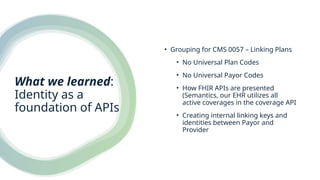
What we learned:
Identityas a
foundation of APIs
• Grouping for CMS 0057 – Linking Plans
• No Universal Plan Codes
• No Universal Payor Codes
• How FHIR APIs are presented
(Semantics, our EHR utilizes all
active coverages in the coverage API
• Creating internal linking keys and
identities between Payor and
Provider
29.
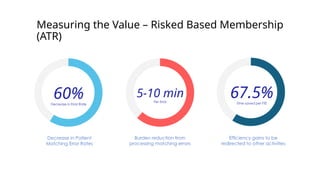
Decrease in Patient
MatchingError Rates
Burden reduction from
processing matching errors
5-10 min
Per Error
60%
Decrease in Error Rate
Measuring the Value – Risked Based Membership
(ATR)
29
67.5%
Time saved per FTE
Efficiency gains to be
redirected to other activities
30.
HL7 Da VinciProject Community Roundtable – June 2024 30
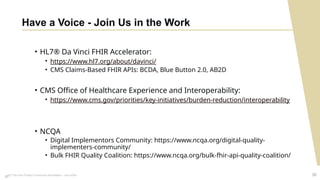
Have a Voice - Join Us in the Work
• HL7® Da Vinci FHIR Accelerator:
• https://www.hl7.org/about/davinci/
• CMS Claims-Based FHIR APIs: BCDA, Blue Button 2.0, AB2D
• CMS Office of Healthcare Experience and Interoperability:
• https://www.cms.gov/priorities/key-initiatives/burden-reduction/interoperability
• NCQA
• Digital Implementors Community: https://www.ncqa.org/digital-quality-
implementers-community/
• Bulk FHIR Quality Coalition: https://www.ncqa.org/bulk-fhir-api-quality-coalition/
30
31.
HL7 Da VinciProject Community Roundtable – June 2024 31
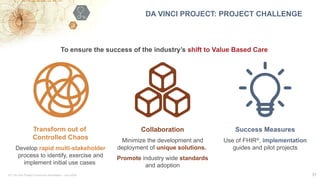
DA VINCI PROJECT: PROJECT CHALLENGE
To ensure the success of the industry’s shift to Value Based Care
Transform out of
Controlled Chaos
Develop rapid multi-stakeholder
process to identify, exercise and
implement initial use cases
Collaboration
Minimize the development and
deployment of unique solutions.
Promote industry wide standards
and adoption
Success Measures
Use of FHIR®
, implementation
guides and pilot projects
32.
HL7 Da VinciProject Community Roundtable – June 2024 32
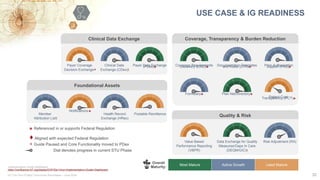
USE CASE & IG READINESS
Implementation Guide Dashboard:
https://confluence.hl7.org/display/DVP/Da+Vinci+Implementation+Guide+Dashboard
* Referenced in or supports Federal Regulation
Aligned with expected Federal Regulation
+ Guide Paused and Core Functionality moved to PDex
Dial denotes progress in current STU Phase
Overall
Maturity:
Most Mature Active Growth Least Mature
Coverage, Transparency & Burden Reduction
Clinical Data Exchange
Clinical Data
Exchange (CDex)t
Payer Data Exchange
(PDex)
*
Notifications
*
Coverage Requirements
Discovery (CRD)
*
Documentation Templates
and Rules (DTR)
*
Prior-Authorization
Support (PAS)
*
Formulary
* Plan Net/Directory
* Patient Cost
Transparency (PCT)
*
Foundational Assets
Member
Attribution Listt
Health Record
Exchange (HRex)
Payer Coverage
Decision Exchange+
Quality & Risk
Data Exchange for Quality
Measures/Gaps In Care
(DEQM/GIC)t
Risk Adjustment (RA)
Value Based
Performance Reporting
(VBPR)
Postable Remittance
HIMSS25 | March3-6 | Las Vegas
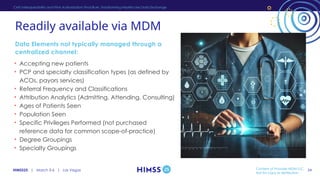
Readily available via MDM
• Accepting new patients
• PCP and specialty classification types (as defined by
ACOs, payors services)
• Referral Frequency and Classifications
• Attribution Analytics (Admitting, Attending, Consulting)
• Ages of Patients Seen
• Population Seen
• Specific Privileges Performed (not purchased
reference data for common scope-of-practice)
• Degree Groupings
• Specialty Groupings
Data Elements not typically managed through a
centralized channel:
CMS Interoperability and Prior Authorization Final Rule: Transforming Healthcare Data Exchange
Content of Provider MDM LLC,
Not for copy or distribution
34
35.
HIMSS25 | March3-6 | Las Vegas
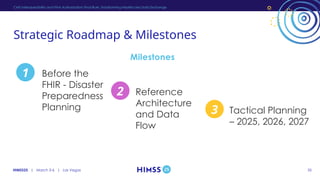
Strategic Roadmap & Milestones
35
Milestones
CMS Interoperability and Prior Authorization Final Rule: Transforming Healthcare Data Exchange
1
2
3
Reference
Architecture
and Data
Flow
Tactical Planning
– 2025, 2026, 2027
Before the
FHIR - Disaster
Preparedness
Planning
36.
HIMSS25 | March3-6 | Las Vegas
Before the FHIR
36
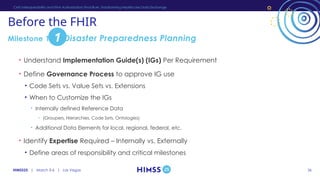
• Understand Implementation Guide(s) (IGs) Per Requirement
• Define Governance Process to approve IG use
• Code Sets vs. Value Sets vs. Extensions
• When to Customize the IGs
• Internally defined Reference Data
• (Groupers, Hierarchies, Code Sets, Ontologies)
• Additional Data Elements for local, regional, federal, etc.
• Identify Expertise Required – Internally vs. Externally
• Define areas of responsibility and critical milestones
Milestone 1- Disaster Preparedness Planning
CMS Interoperability and Prior Authorization Final Rule: Transforming Healthcare Data Exchange
1
37.
HIMSS25 | March3-6 | Las Vegas
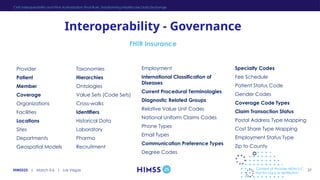
Interoperability - Governance
FHIR Insurance
CMS Interoperability and Prior Authorization Final Rule: Transforming Healthcare Data Exchange
Provider
Patient
Member
Coverage
Organizations
Facilities
Locations
Sites
Departments
Geospatial Models
Taxonomies
Hierarchies
Ontologies
Value Sets (Code Sets)
Cross-walks
Identifiers
Historical Data
Laboratory
Pharma
Recruitment
Employment
International Classification of
Diseases
Current Procedural Terminologies
Diagnostic Related Groups
Relative Value Unit Codes
National Uniform Claims Codes
Phone Types
Email Types
Communication Preference Types
Degree Codes
Specialty Codes
Fee Schedule
Patient Status Code
Gender Codes
Coverage Code Types
Claim Transaction Status
Postal Address Type Mapping
Cost Share Type Mapping
Employment Status Type
Zip to County
Content of Provider MDM LLC,
Not for copy or distribution
37
38.
HIMSS25 | March3-6 | Las Vegas
Before the FHIR
38
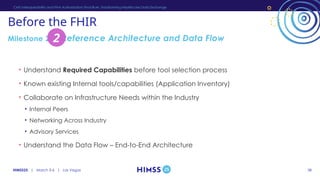
• Understand Required Capabilities before tool selection process
• Known existing Internal tools/capabilities (Application Inventory)
• Collaborate on Infrastructure Needs within the Industry
• Internal Peers
• Networking Across Industry
• Advisory Services
• Understand the Data Flow – End-to-End Architecture
Milestone 2- Reference Architecture and Data Flow
CMS Interoperability and Prior Authorization Final Rule: Transforming Healthcare Data Exchange
2
39.
HIMSS25 | March3-6 | Las Vegas
Before the FHIR
39
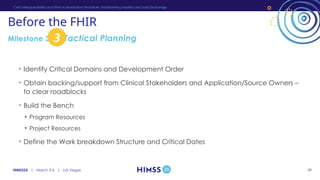
• Identify Critical Domains and Development Order
• Obtain backing/support from Clinical Stakeholders and Application/Source Owners –
to clear roadblocks
• Build the Bench
• Program Resources
• Project Resources
• Define the Work breakdown Structure and Critical Dates
Milestone 3- Tactical Planning
CMS Interoperability and Prior Authorization Final Rule: Transforming Healthcare Data Exchange
3
40.
HIMSS25 | March3-6 | Las Vegas
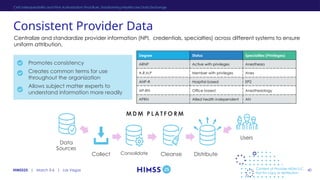
Consistent Provider Data
CMS Interoperability and Prior Authorization Final Rule: Transforming Healthcare Data Exchange
Degree Status Specialties (Privileges)
ARNP Active with privileges Anesthesia
A.R.N.P Member with privileges Anes
ANP-R Hospital based EP2
AP-RN Office based Anesthesiology
APRN Allied health independent AN
Promotes consistency
Creates common terms for use
throughout the organization
Allows subject matter experts to
understand information more readily
Data
Sources
Collect Consolidate Cleanse Distribute
Users
M D M P L A T F O R M
Centralize and standardize provider information (NPI, credentials, specialties) across different systems to ensure
uniform attribution.
Content of Provider MDM LLC,
Not for copy or distribution
40
41.
HIMSS25 | March3-6 | Las Vegas
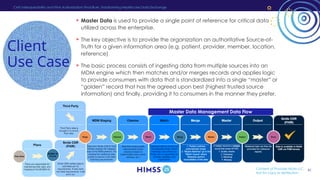
• Master Data is used to provide a single point of reference for critical data
utilized across the enterprise.
• The key objective is to provide the organization an authoritative Source-of-
Truth for a given information area (e.g. patient, provider, member, location,
reference)
• The basic process consists of ingesting data from multiple sources into an
MDM engine which then matches and/or merges records and applies logic
to provide consumers with data that is standardized into a single “master” or
“golden” record that has the agreed upon best (highest trusted source
information) and finally, providing it to consumers in the manner they prefer.
CMS Interoperability and Prior Authorization Final Rule: Transforming Healthcare Data Exchange
Client
Use Case
Master Data Management Data Flow
Content of Provider MDM LLC,
Not for copy or distribution
41
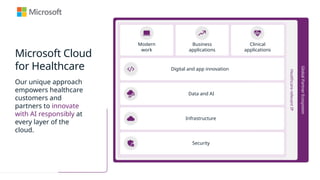
#12 Microsoft Cloud for Healthcare is our unique approach empowers healthcare customers and partners to innovate with AI responsibly at every layer of the cloud.
From cloud infrastructure, to data and AI, security surrounds everything we do.
With the Microsoft Cloud for Healthcare, we are helping our customers innovate responsibly at every layer of the cloud.
Let’s dive in a little bit more to each layer of the MC4H.
<Click>
#13 Microsoft Fabric provides a one-stop-shop for data integration, data engineering, real-time analytics, data science, and business intelligence needs without compromising the privacy and security of your data.
With this unified SaaS solution, you’ll have a single source of truth for all your data and analytics, enabling secure, democratized insights.
By leveraging this powerful open and scalable solution, you’ll accelerate time to value through cost management, spend optimization––making the most of your data investment.
Microsoft Fabric leverages the mature Azure Security stack and Azure Purview to discover, understand, govern, safeguard, and improve the risk and compliance posture of data.
The solutions enable healthcare organizations to:
Connect all the disperate healthcare data sources (electronic health records, images,…) regardless of where they are
Harmonize the diverse data records with healthcare data models and transformation pipelines to create a multi modal warehouse. Leverage industry standards, such as FHIR (Fast Healthcare Interoperability Resources) and DICOM (Digital Imaging and Communications in Medicine) to remove complexity and cost of mapping, transforming and synchronizing data between systems.
Accelerate time to insight and ease administrative burdens with out-of-the box healthcare specific solutions or develop your own custom advanced analytics
Improve collaboration and data governance in the organization by providing real-time view of the data to the right users
All in a platform that enables HIPAA (Health Insurance Portability and Accountability Act) compliance
<click>
<CLICK>
#14 Talking points
A key feature of the healthcare data solutions is our Healthcare Data Model
This data model aims to encompass all the major healthcare data domains
It is a composite model that leverages standards where they exist, and offers a comprehensive schema for those domains where no standards exist
We support the breadth of FHIR data, but go beyond this by supporting DICOM, Patient Engagement Data, Genomics Data, SDOH,
We have started our investments on enabling the persistence of FHIR data in a relational form leveraging delta parquet
Transition to the next slide to introduce Relational FHIR (move to the next slide)
#15 Talking points
A key feature of the healthcare data solutions is our Healthcare Data Model
This data model aims to encompass all the major healthcare data domains
It is a composite model that leverages standards where they exist, and offers a comprehensive schema for those domains where no standards exist
We support the breadth of FHIR data, but go beyond this by supporting DICOM, Patient Engagement Data, Genomics Data, SDOH,
We have started our investments on enabling the persistence of FHIR data in a relational form leveraging delta parquet
Transition to the next slide to introduce Relational FHIR (move to the next slide)
#16 All organizations have multiple data sources, and the larger the organization the greater the number of data sources. Typically, there will be ERPs, CRMs, Legacy applications, regional versions of each of these, external data feeds and so on
Inevitably, data that was created in different ‘silos’ with different governance standards to meet the needs of different applications will always have issues. When you look at the data drawn form each of these applications you will see that it is inconsistent in terms of both the standardization of data values and often in terms of the values themselves, and most often individual records are incomplete. And it should be pointed out that this is normal and 100% to be expected.
In fact, it would be surprising if this were not the case – but it does give us a problem, as what we really need is data that is complete, and consistent, and accurate. The ability to consolidate data from multiple disparate systems is key if we want to use the data to drive business insights and operational efficiencies – or any form of ‘digital transformation’. What we need in that case is high quality, trusted data that is ready to use, whether it is being consumed in basic enterprise metrics or advanced AI algorithms.
So we have a gap between the data as we have it and how we need it. Filling that gap is the job of Data Governance, such as Microsoft Purview, and Master Data Management, such as Profisee MDM!
While governance systems can *define* data standards, MDM is where they are *enforced*. Data from different systems can be matched and merged, validated against data quality and governance standards, and remediated where required. Then the new corrected and validated ‘master’ data can be shared to downstream analytics and well and back to source systems to drive operational improvements.
By properly creating and maintaining enterprise master data, we transform data into an asset of the business.
Now, lets look at how this all fits into an enterprise computing platform such as Azure.
#17 All organizations have multiple data sources, and the larger the organization the greater the number of data sources. Typically, there will be ERPs, CRMs, Legacy applications, regional versions of each of these, external data feeds and so on
Inevitably, data that was created in different ‘silos’ with different governance standards to meet the needs of different applications will always have issues. When you look at the data drawn form each of these applications you will see that it is inconsistent in terms of both the standardization of data values and often in terms of the values themselves, and most often individual records are incomplete. And it should be pointed out that this is normal and 100% to be expected.
In fact, it would be surprising if this were not the case – but it does give us a problem, as what we really need is data that is complete, and consistent, and accurate. The ability to consolidate data from multiple disparate systems is key if we want to use the data to drive business insights and operational efficiencies – or any form of ‘digital transformation’. What we need in that case is high quality, trusted data that is ready to use, whether it is being consumed in basic enterprise metrics or advanced AI algorithms.
So we have a gap between the data as we have it and how we need it. Filling that gap is the job of Data Governance, such as Microsoft Purview, and Master Data Management, such as Profisee MDM!
While governance systems can *define* data standards, MDM is where they are *enforced*. Data from different systems can be matched and merged, validated against data quality and governance standards, and remediated where required. Then the new corrected and validated ‘master’ data can be shared to downstream analytics and well and back to source systems to drive operational improvements.
By properly creating and maintaining enterprise master data, we transform data into an asset of the business.
Now, lets look at how this all fits into an enterprise computing platform such as Azure.
#18 All organizations have multiple data sources, and the larger the organization the greater the number of data sources. Typically, there will be ERPs, CRMs, Legacy applications, regional versions of each of these, external data feeds and so on
Inevitably, data that was created in different ‘silos’ with different governance standards to meet the needs of different applications will always have issues. When you look at the data drawn form each of these applications you will see that it is inconsistent in terms of both the standardization of data values and often in terms of the values themselves, and most often individual records are incomplete. And it should be pointed out that this is normal and 100% to be expected.
In fact, it would be surprising if this were not the case – but it does give us a problem, as what we really need is data that is complete, and consistent, and accurate. The ability to consolidate data from multiple disparate systems is key if we want to use the data to drive business insights and operational efficiencies – or any form of ‘digital transformation’. What we need in that case is high quality, trusted data that is ready to use, whether it is being consumed in basic enterprise metrics or advanced AI algorithms.
So we have a gap between the data as we have it and how we need it. Filling that gap is the job of Data Governance, such as Microsoft Purview, and Master Data Management, such as Profisee MDM!
While governance systems can *define* data standards, MDM is where they are *enforced*. Data from different systems can be matched and merged, validated against data quality and governance standards, and remediated where required. Then the new corrected and validated ‘master’ data can be shared to downstream analytics and well and back to source systems to drive operational improvements.
By properly creating and maintaining enterprise master data, we transform data into an asset of the business.
Now, lets look at how this all fits into an enterprise computing platform such as Azure.
#19 All organizations have multiple data sources, and the larger the organization the greater the number of data sources. Typically, there will be ERPs, CRMs, Legacy applications, regional versions of each of these, external data feeds and so on
Inevitably, data that was created in different ‘silos’ with different governance standards to meet the needs of different applications will always have issues. When you look at the data drawn form each of these applications you will see that it is inconsistent in terms of both the standardization of data values and often in terms of the values themselves, and most often individual records are incomplete. And it should be pointed out that this is normal and 100% to be expected.
In fact, it would be surprising if this were not the case – but it does give us a problem, as what we really need is data that is complete, and consistent, and accurate. The ability to consolidate data from multiple disparate systems is key if we want to use the data to drive business insights and operational efficiencies – or any form of ‘digital transformation’. What we need in that case is high quality, trusted data that is ready to use, whether it is being consumed in basic enterprise metrics or advanced AI algorithms.
So we have a gap between the data as we have it and how we need it. Filling that gap is the job of Data Governance, such as Microsoft Purview, and Master Data Management, such as Profisee MDM!
While governance systems can *define* data standards, MDM is where they are *enforced*. Data from different systems can be matched and merged, validated against data quality and governance standards, and remediated where required. Then the new corrected and validated ‘master’ data can be shared to downstream analytics and well and back to source systems to drive operational improvements.
By properly creating and maintaining enterprise master data, we transform data into an asset of the business.
Now, lets look at how this all fits into an enterprise computing platform such as Azure.
#20 All organizations have multiple data sources, and the larger the organization the greater the number of data sources. Typically, there will be ERPs, CRMs, Legacy applications, regional versions of each of these, external data feeds and so on
Inevitably, data that was created in different ‘silos’ with different governance standards to meet the needs of different applications will always have issues. When you look at the data drawn form each of these applications you will see that it is inconsistent in terms of both the standardization of data values and often in terms of the values themselves, and most often individual records are incomplete. And it should be pointed out that this is normal and 100% to be expected.
In fact, it would be surprising if this were not the case – but it does give us a problem, as what we really need is data that is complete, and consistent, and accurate. The ability to consolidate data from multiple disparate systems is key if we want to use the data to drive business insights and operational efficiencies – or any form of ‘digital transformation’. What we need in that case is high quality, trusted data that is ready to use, whether it is being consumed in basic enterprise metrics or advanced AI algorithms.
So we have a gap between the data as we have it and how we need it. Filling that gap is the job of Data Governance, such as Microsoft Purview, and Master Data Management, such as Profisee MDM!
While governance systems can *define* data standards, MDM is where they are *enforced*. Data from different systems can be matched and merged, validated against data quality and governance standards, and remediated where required. Then the new corrected and validated ‘master’ data can be shared to downstream analytics and well and back to source systems to drive operational improvements.
By properly creating and maintaining enterprise master data, we transform data into an asset of the business.
Now, lets look at how this all fits into an enterprise computing platform such as Azure.
#21 All organizations have multiple data sources, and the larger the organization the greater the number of data sources. Typically, there will be ERPs, CRMs, Legacy applications, regional versions of each of these, external data feeds and so on
Inevitably, data that was created in different ‘silos’ with different governance standards to meet the needs of different applications will always have issues. When you look at the data drawn form each of these applications you will see that it is inconsistent in terms of both the standardization of data values and often in terms of the values themselves, and most often individual records are incomplete. And it should be pointed out that this is normal and 100% to be expected.
In fact, it would be surprising if this were not the case – but it does give us a problem, as what we really need is data that is complete, and consistent, and accurate. The ability to consolidate data from multiple disparate systems is key if we want to use the data to drive business insights and operational efficiencies – or any form of ‘digital transformation’. What we need in that case is high quality, trusted data that is ready to use, whether it is being consumed in basic enterprise metrics or advanced AI algorithms.
So we have a gap between the data as we have it and how we need it. Filling that gap is the job of Data Governance, such as Microsoft Purview, and Master Data Management, such as Profisee MDM!
While governance systems can *define* data standards, MDM is where they are *enforced*. Data from different systems can be matched and merged, validated against data quality and governance standards, and remediated where required. Then the new corrected and validated ‘master’ data can be shared to downstream analytics and well and back to source systems to drive operational improvements.
By properly creating and maintaining enterprise master data, we transform data into an asset of the business.
Now, lets look at how this all fits into an enterprise computing platform such as Azure.
#23 Range of services – Adequacy to serve beneficiaries
Price of services
Effectiveness of Care
Outcomes of Care – (traditional hospital quality measures)
Utilization management
Proactive quality of health
Coordinated Care
Addressing Health Equity and SDOH (Closed loop referral – ex. Referring to oncologist vs. housing specialist, system built on medical) – benefits redesign
How sophisticated we are in digital interoperability
Self funded – market is to employers as well (direct to employer strategies)
#24 Anna
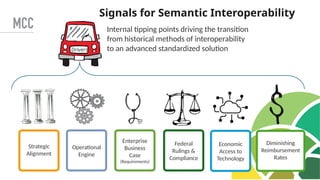
Strategic Alignment: Strategies backed by incentives that are driving performance in population-based care
Operational Engine: to move the change forward, operational owners
Use Cases: Enterprise culture, changing capabilities in the workforce
Rulings
Economic Access: Affordability of compute
Diminishing Reimbursement Rates: Not an economist, but we have to be able to afford bread on everyone’s table
Building a Population Health Engine with in an Integrated Health System
Use-cases to drive the capability and capacity - DaVinci
This Photo by Unknown Author is licensed under CC BY
#26 2018 – Joined DaVinci with sponsorship through Cambia
2019 – Proof of concept for quality measures reporting – MHS internal development, returns development investment in year 1. President’s award
2020 – Proof of concept for eligibility
2021 – Prior Authorization Trading Agreements
2022
April: Formal approval from CMS for Waiver Exception to utilize FHIR for Prior Authorization
Oct: Go Live for Smart Authorization and proof of concept for scalable FHIR services
DaVinci Steering Committee representation
Dec: scalable FHIR ecosystem
2023
FHIR Services
Eligibility scaled to multiple payers, creating 97% or higher match rates
Scaling Data Exchange for Quality Measures to multiple payers
Full scale API Management ecosystem
Acquisition of Grant Dollars for WA state implementation of Prior Auth (including MCOs and FQHCs)
2024
Developer Portal (Provider Directory Services for Payor connections)
Acquisition of MultiCare Connected Care Network provider g(10) APIs for Quality Reporting purposes
Acquisition of Provider Access APIs from Payers to Providers (claims data)
DaVinci Steering Chair
#31 Evolve commentary started on prior slide to pivot to Da Vinci simply is an group of industry payers, providers and HIT partners that understand how critical it is to develop common, ideally eventual standard ways for providers and payers to exchange the critical data required for value base case to work.
Scalability at national level. Critical to define standards based solutions that have input, credibility and usability and will be picked up and used by many without SPECIAL EFFORT.
Briefly touch upon the HL7 interplay and Da Vinci project with emphasizing membership is about garnering value from investment of dollars and resources to produce and implement standard approaches to solve business pain points. Value will be seen in the improvements achieved through implementation of a use case. In other words, deploying solutions to real world problems and avoiding rework to solutions to achieve interoperability & integration with trading partners. A goal of Da Vinci is to develop repeatable production focused projects that lead to implementations because the use cases represent real world pain points and the solutions are standards based.
Additional content if warranted
Interplay with HL7 processes:
When a Da Vinci project plans to produce an artifact, such as an Implementation Guide, that shall be balloted by HL7, an HL7 Project Scope Statement (PSS) will be created and taken to the appropriate HL7 Work Group(s) for discussion, ownership to manage the PSS, and submission to HL7’s approval process
Da Vinci participants will work with the appropriate HL7 Work Group(s) to prepare materials necessary to take the artifact to Notice for Intent to Ballot (NIB), balloting, resolution of ballot comments, and submission for publication
A Da Vinci artifact will be subject to all relevant HL7 policies and procedure when submitted using a PSS and in the subsequent standards effort related to the specific artifacts defined in the PSS
Artifacts submitted for HL7 balloting (via the PSS process) will become intellectual property owned and distributed under HL7 published guidelines
Project Deliverables
Define requirements (technical, business, communications, integration)
Create Implementation Guide (technical implementation requirements)
Create and test Reference Implementation (prove the guide works)
Initial Implementation (pilot)
Deploy the solution (go-live)
Implementation Guide (IG) - A specification that defines how the capabilities defined by the FHIR specification are used in particular data exchanges, or to solve particular problems (adapted from the HL7 FHIR Foundation Implementation Guide Registry (http://www.fhir.org/guides/registry).
Reference Implementation (RI) - A reference implementation is, in general, an implementation of a specification to be used as a definitive interpretation for that specification. During the development of the ... conformance test suite, at least one relatively trusted implementation of each interface is necessary to (1) discover errors or ambiguities in the specification, and (2) validate the correct functioning of the test suite.
#42 Formatted for cut-and-paste into Teams – best to cut-and-paste 1 line at a time (for link preview to be generated)
Recap videos:
Drive AI-Enablement with Profisee MDM and Microsoft Fabric – 4 mins
Profisee MDM the Obvious Choice for Microsoft Customers? – 3 mins
Profisee is the Best MDM for Azure – Live demo with MS Fabric – 18 mins
Microsoft-related:
Microsoft Resource Hub
Profisee Reference Architectures





![[WSO2 Summit Americas 2020] Healthcare Interoperability Through FHIR® APIs.pdf](https://cdn.slidesharecdn.com/ss_thumbnails/wso2summitamericas2020healthcareinteroperabilitythroughfhirapis-200826202126-thumbnail.jpg?width=640&height=640&fit=bounds)


