Making A Miracle
Robert E. Lucas, Jr. (March 1993)
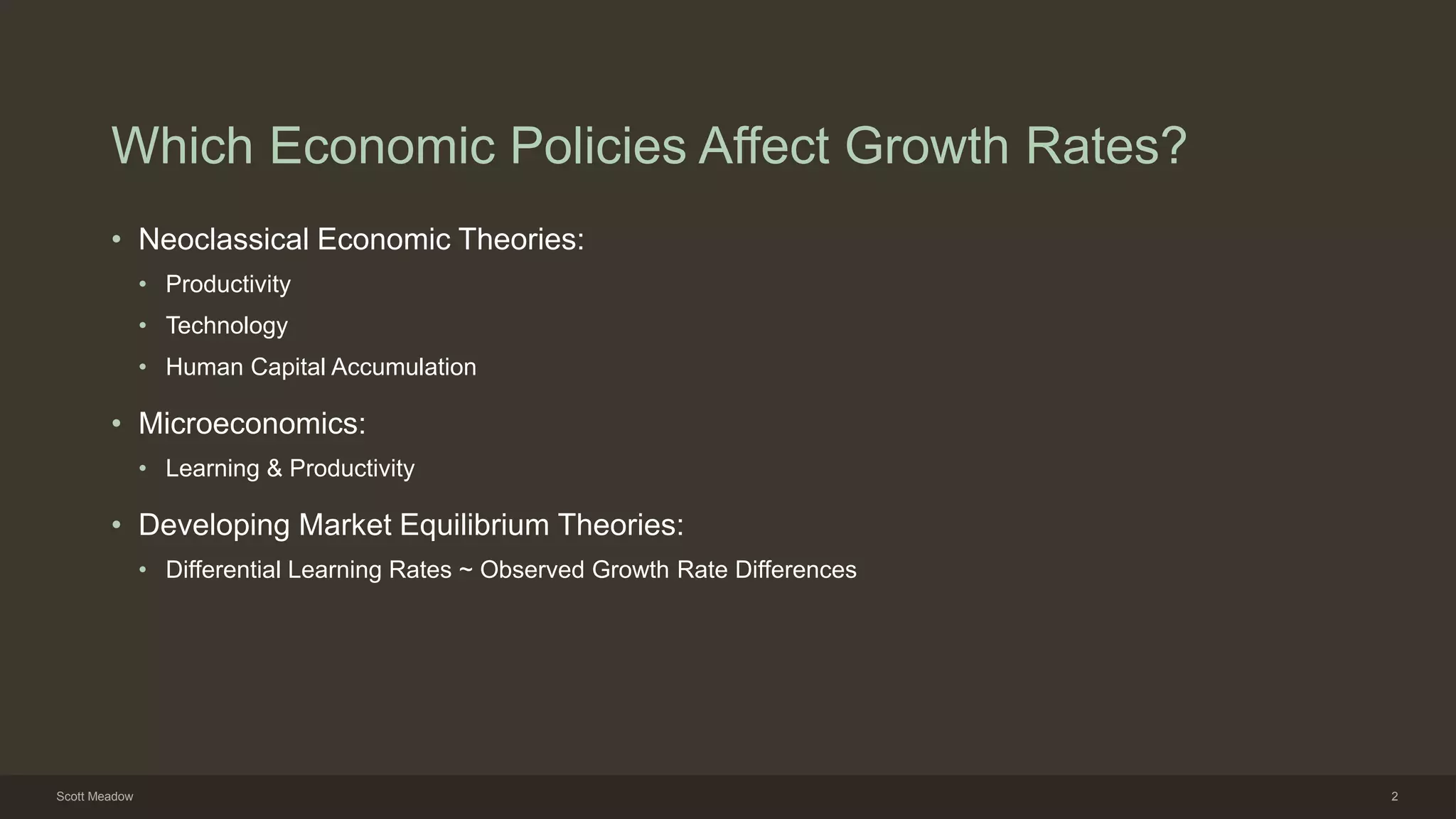
Which Economic Policies Affect Growth Rates?
• Neoclassical Economic Theories:
• Productivity
• Technology
• Human Capital Accumulation
• Microeconomics:
• Learning & Productivity
• Developing Market Equilibrium Theories:
• Differential Learning Rates ~ Observed Growth Rate Differences
Scott Meadow 2
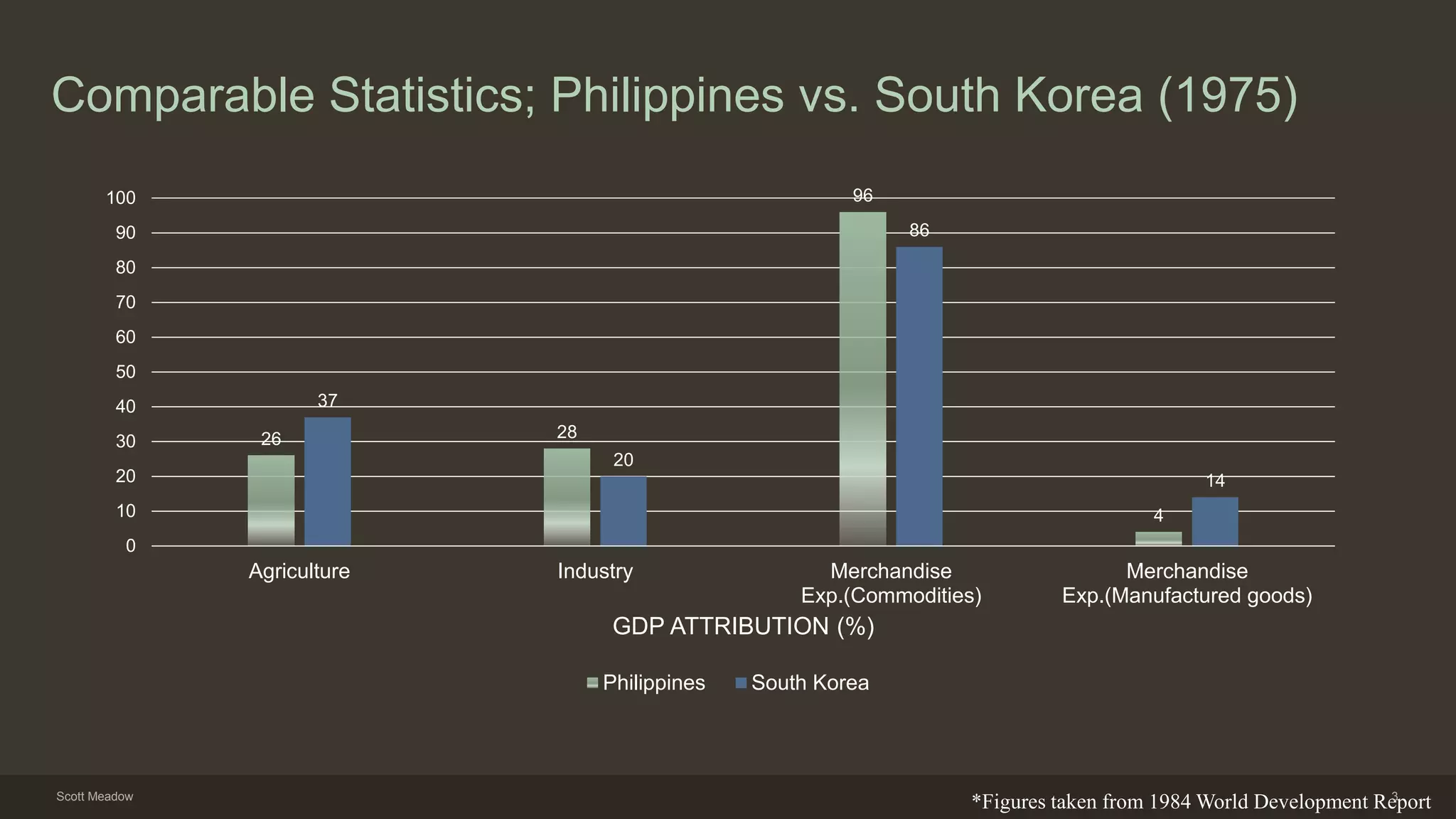
Comparable Statistics; Philippines vs. South Korea (1975)
26 28
96
4
37
20
86
14
0
10
20
30
40
50
60
70
80
90
100
Agriculture Industry Merchandise
Exp.(Commodities)
Merchandise
Exp.(Manufactured goods)
GDP ATTRIBUTION (%)
Philippines South Korea
*Figures taken from 1984 World Development ReportScott Meadow 3
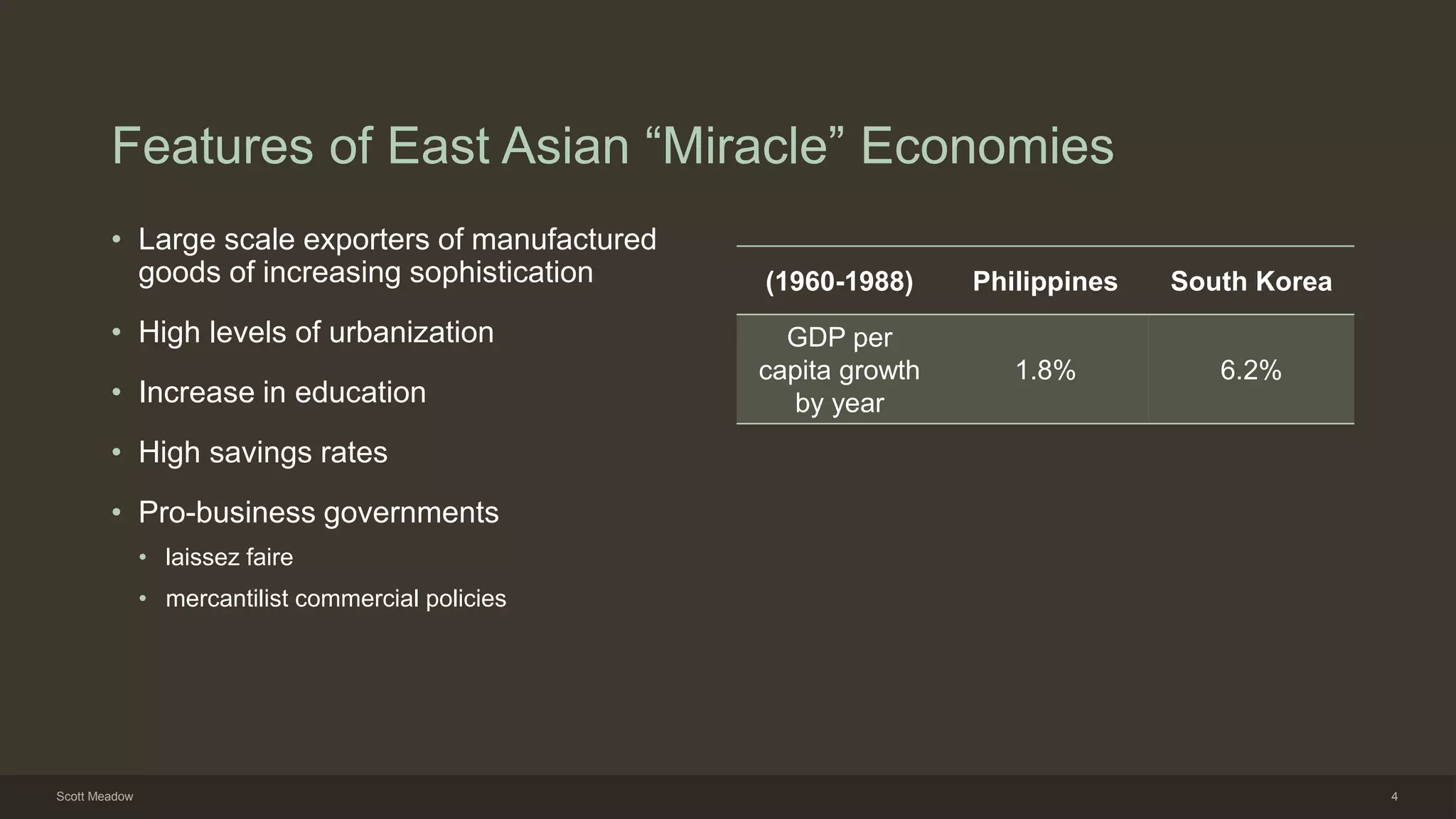
Features of East Asian “Miracle” Economies
• Large scale exporters of manufactured
goods of increasing sophistication
• High levels of urbanization
• Increase in education
• High savings rates
• Pro-business governments
• laissez faire
• mercantilist commercial policies
(1960-1988) Philippines South Korea
GDP per
capita growth
by year
1.8% 6.2%
Scott Meadow 4
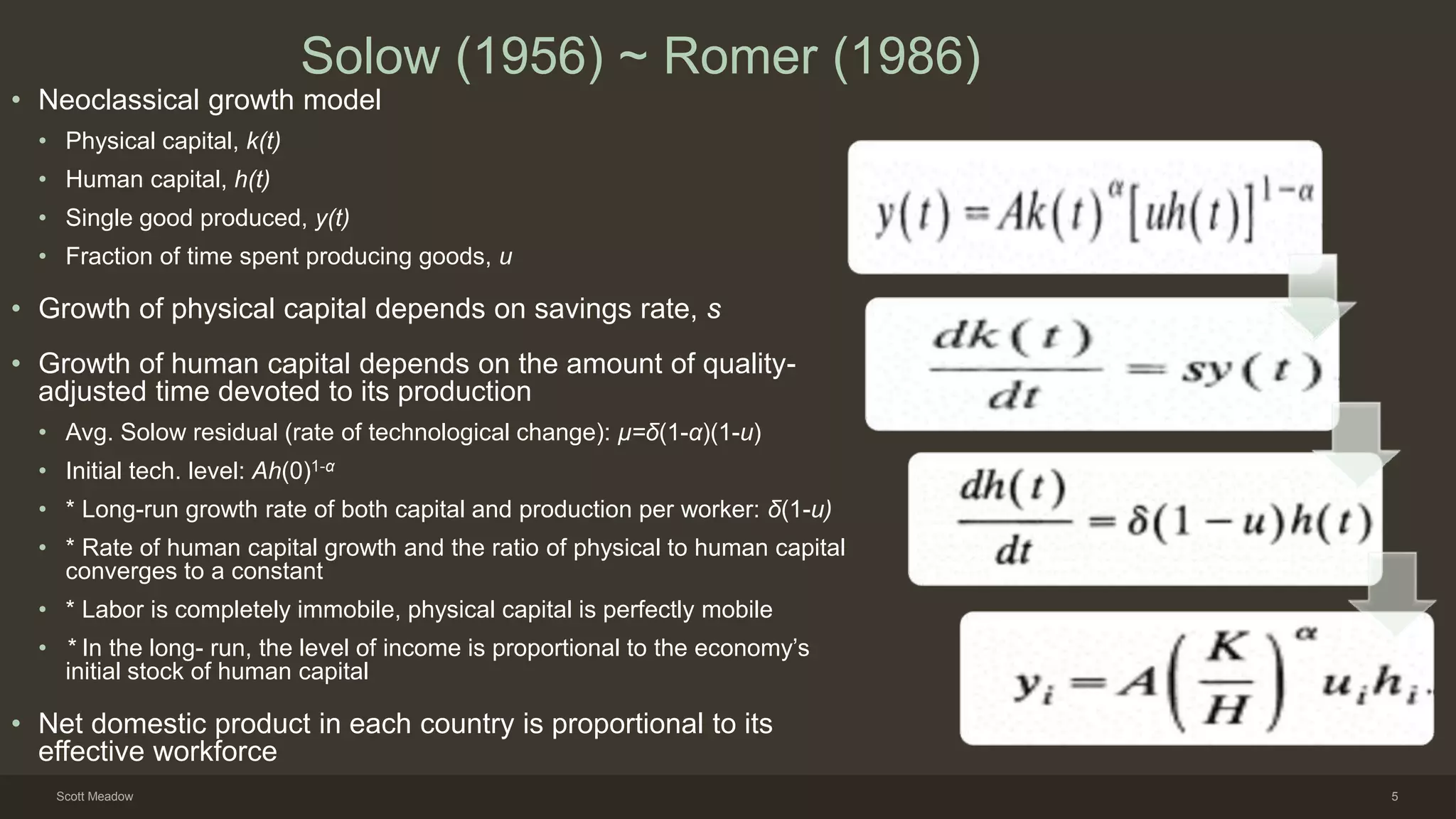
Solow (1956) ~ Romer (1986)
• Neoclassical growth model
• Physical capital, k(t)
• Human capital, h(t)
• Single good produced, y(t)
• Fraction of time spent producing goods, u
• Growth of physical capital depends on savings rate, s
• Growth of human capital depends on the amount of quality-
adjusted time devoted to its production
• Avg. Solow residual (rate of technological change): μ=δ(1-α)(1-u)
• Initial tech. level: Ah(0)1-α
• * Long-run growth rate of both capital and production per worker: δ(1-u)
• * Rate of human capital growth and the ratio of physical to human capital
converges to a constant
• * Labor is completely immobile, physical capital is perfectly mobile
• * In the long- run, the level of income is proportional to the economy’s
initial stock of human capital
• Net domestic product in each country is proportional to its
effective workforce
Scott Meadow 5
Solow (1956) ~ Romer (1986) [Assumptions]
• If each county has the technology with a common intercept A, this world return is,
r = αA(K/H)α-1
where H = Σiuihi is the world supply of effective labor devoted to goods production.
• If everyone has the same constant savings rate s, the dynamics of this world economy are
essentially the same as those of Solow’s model.
• The world capital stock follows (dK/ dt) = sAKαH1-α , and the time path of H is obtained by summing the savings rate
of goods production over countries, each multiplied by its own time allocation variable ui
• The long run growth rate of physical capital and of every country’s output is equal to the growth rate of human
capital, not only in the long run but all along the equilibrium path.
• * (The theory is thus consistent with the permanent maintenance of any degree of income inequality.)
• This ultimately implies that the reinterpretation of Solow's technology variable as a country-specific
stock of human capital, a model that predicts rapid convergence to common income levels is
converted into one that sis consistent with permanent income inequality.
• The key assumption on which this prediction is based- that human capital accumulation in any one
economy is independent of the level of human capital in other economies- conflicts with the evidence
fact that ideas developed in one place spread elsewhere, that there is one frontier of human
knowledge, not one for each separate economy.
Scott Meadow 6
Parente & Prescott (1991)
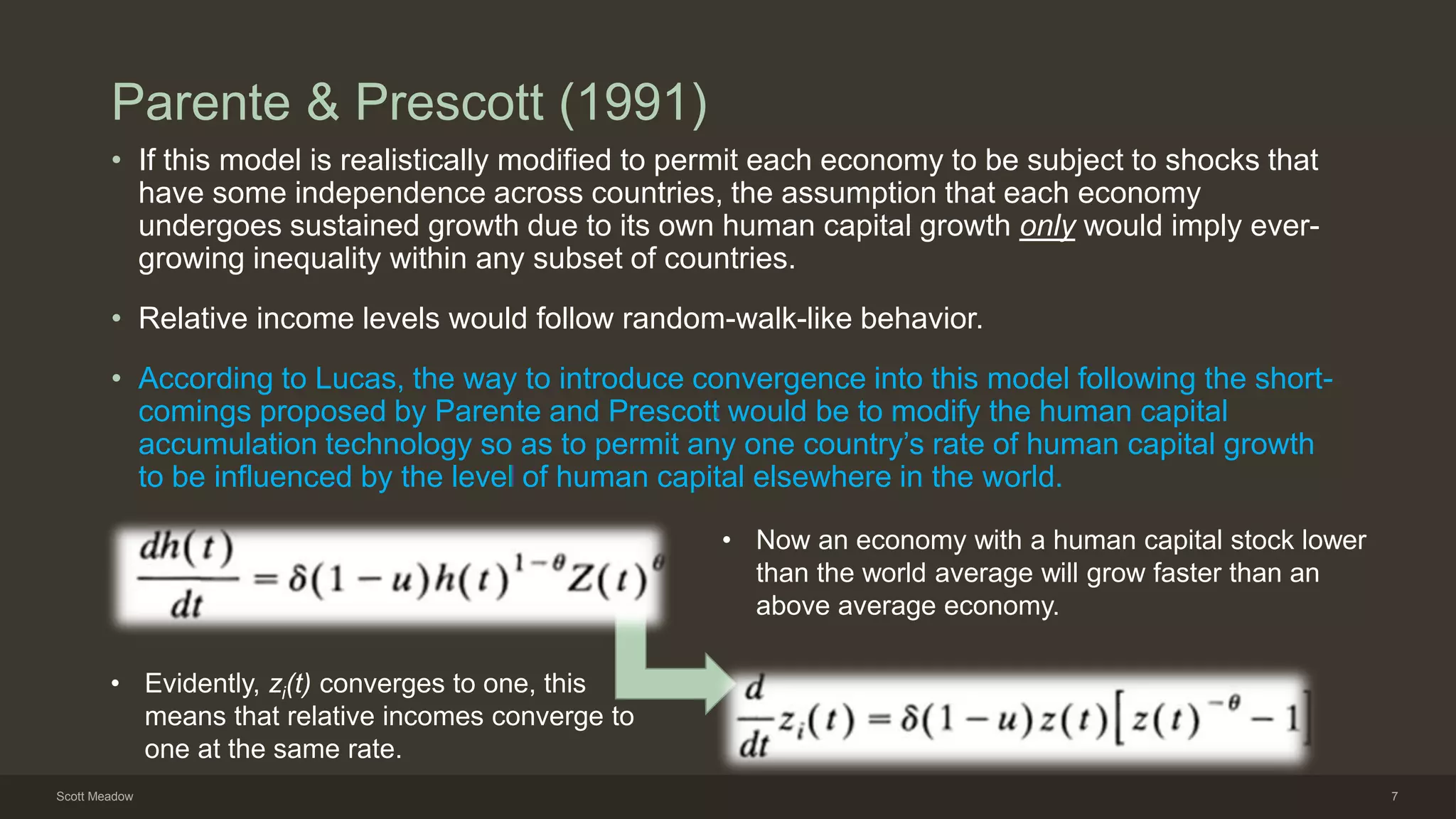
• If this model is realistically modified to permit each economy to be subject to shocks that
have some independence across countries, the assumption that each economy
undergoes sustained growth due to its own human capital growth only would imply ever-
growing inequality within any subset of countries.
• Relative income levels would follow random-walk-like behavior.
• According to Lucas, the way to introduce convergence into this model following the short-
comings proposed by Parente and Prescott would be to modify the human capital
accumulation technology so as to permit any one country’s rate of human capital growth
to be influenced by the level of human capital elsewhere in the world.
• Now an economy with a human capital stock lower
than the world average will grow faster than an
above average economy.
• Evidently, zi(t) converges to one, this
means that relative incomes converge to
one at the same rate.
Scott Meadow 7
Barro and Sala-i-Martin (1992)
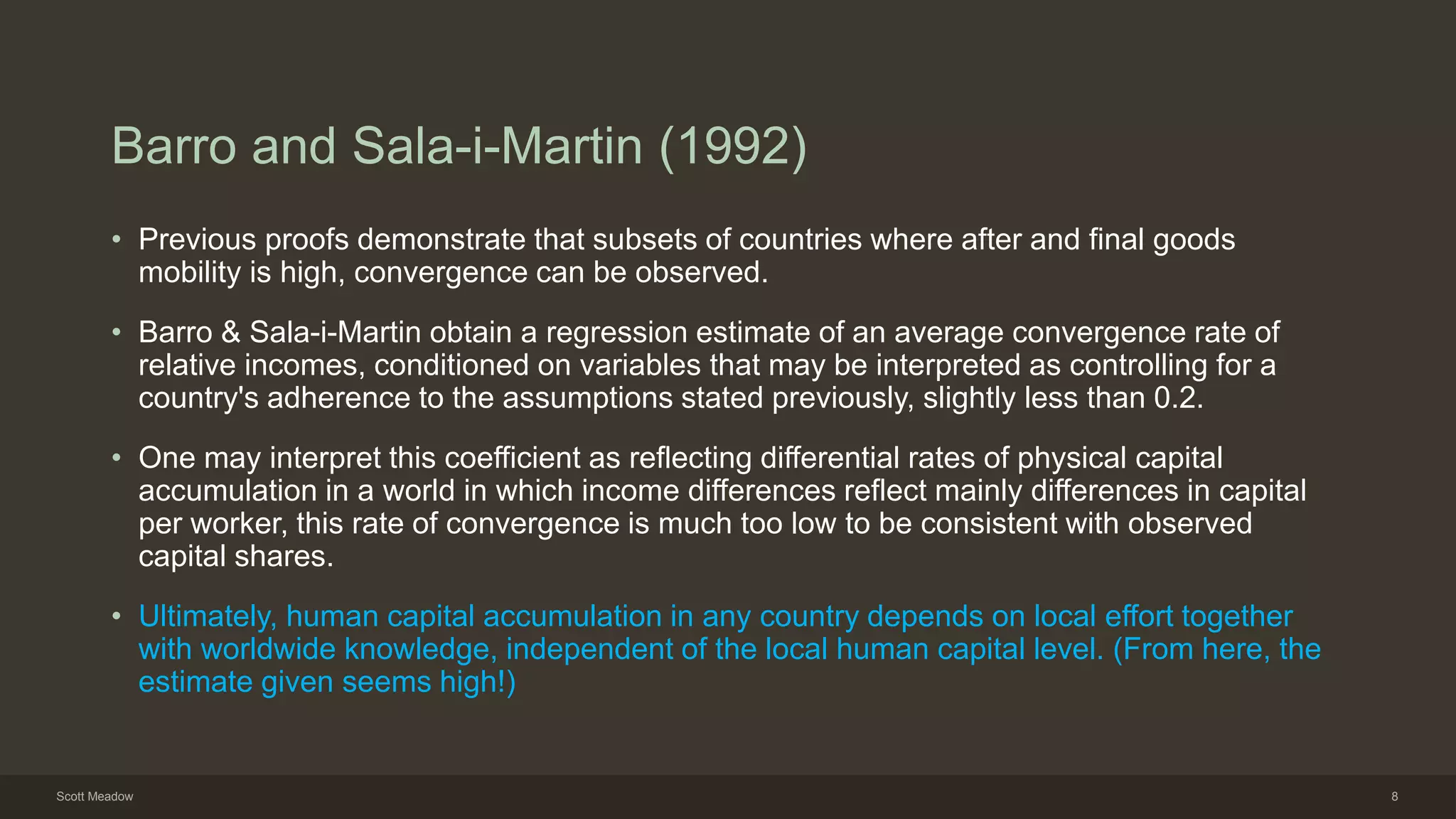
• Previous proofs demonstrate that subsets of countries where after and final goods
mobility is high, convergence can be observed.
• Barro & Sala-i-Martin obtain a regression estimate of an average convergence rate of
relative incomes, conditioned on variables that may be interpreted as controlling for a
country's adherence to the assumptions stated previously, slightly less than 0.2.
• One may interpret this coefficient as reflecting differential rates of physical capital
accumulation in a world in which income differences reflect mainly differences in capital
per worker, this rate of convergence is much too low to be consistent with observed
capital shares.
• Ultimately, human capital accumulation in any country depends on local effort together
with worldwide knowledge, independent of the local human capital level. (From here, the
estimate given seems high!)
Scott Meadow 8
South Korea
Taiwan
Hong Kong
Singapore
Philippines
Average
0
5
10
15
20
25
30
35
40
45
50
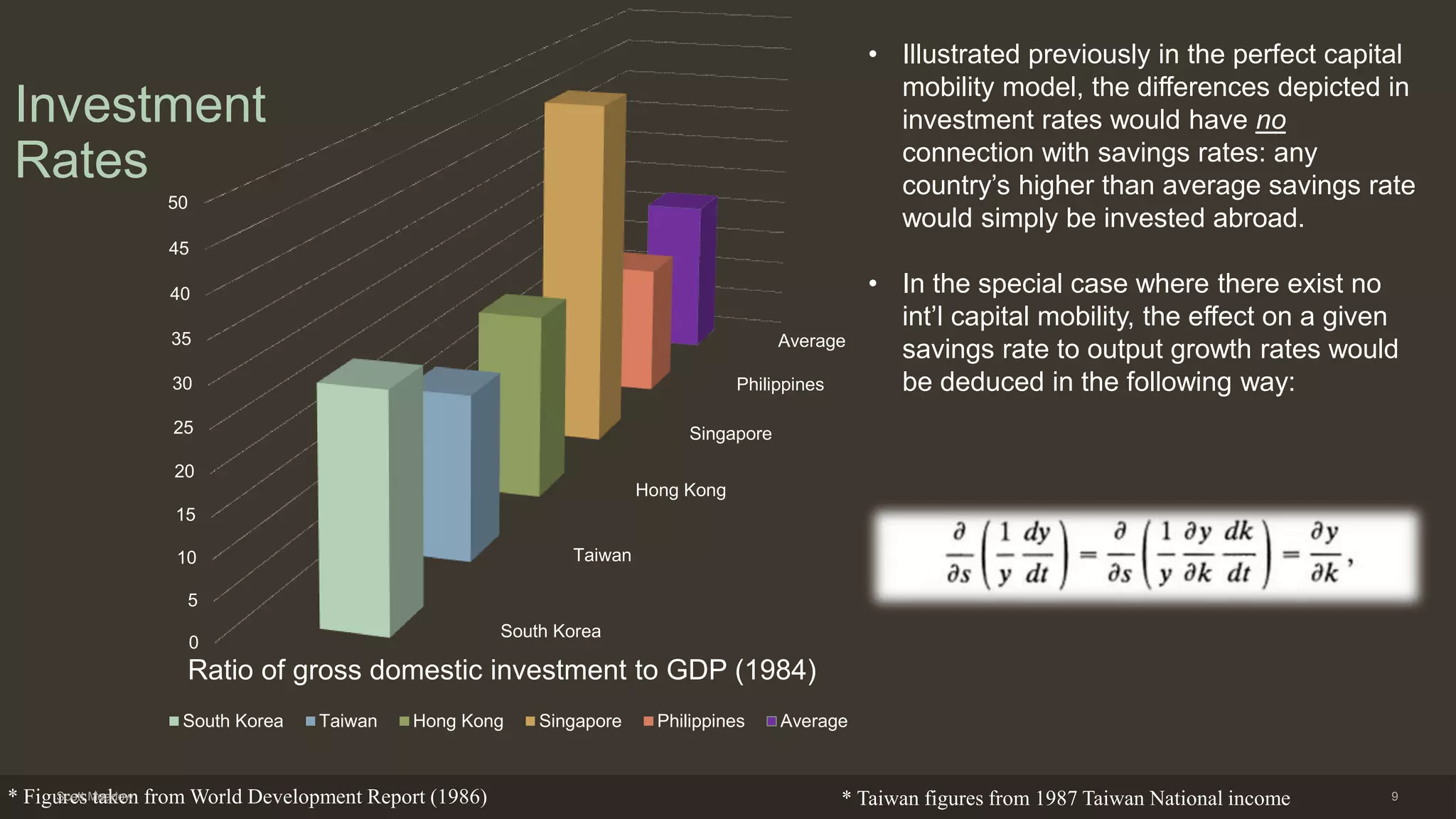
Ratio of gross domestic investment to GDP (1984)
South Korea Taiwan Hong Kong Singapore Philippines Average
Investment
Rates
• Illustrated previously in the perfect capital
mobility model, the differences depicted in
investment rates would have no
connection with savings rates: any
country’s higher than average savings rate
would simply be invested abroad.
• In the special case where there exist no
int’l capital mobility, the effect on a given
savings rate to output growth rates would
be deduced in the following way:
* Figures taken from World Development Report (1986) * Taiwan figures from 1987 Taiwan National incomeScott Meadow 9
Controversy
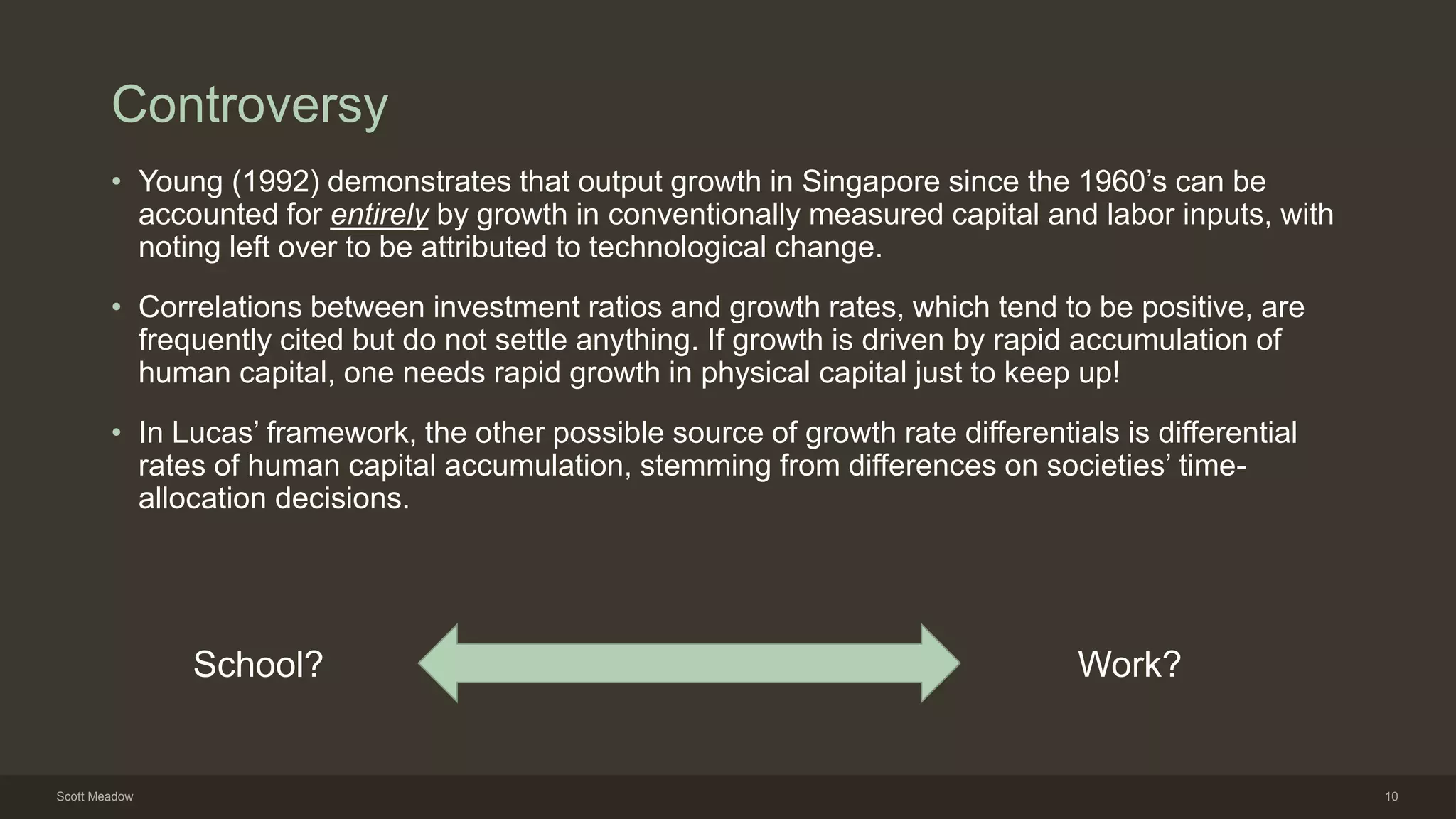
• Young (1992) demonstrates that output growth in Singapore since the 1960’s can be
accounted for entirely by growth in conventionally measured capital and labor inputs, with
noting left over to be attributed to technological change.
• Correlations between investment ratios and growth rates, which tend to be positive, are
frequently cited but do not settle anything. If growth is driven by rapid accumulation of
human capital, one needs rapid growth in physical capital just to keep up!
• In Lucas’ framework, the other possible source of growth rate differentials is differential
rates of human capital accumulation, stemming from differences on societies’ time-
allocation decisions.
School? Work?
Scott Meadow 10
Implications
• Identification of increases in average schooling levels with net human capital investment.
• Since schooling levels are increasing in virtually all societies today, this is a possibility worth developing, but it
cannot be pursued within a steady state framework. This is an important and neglected respect in which
neither advanced nor most backward economies can be viewed as moving along balanced growth paths.
• Alternatively, we can think of a balanced path on which time spent in school is constant
but the quality of schooling is improving due to increases in general knowledge.
• Stokey (1991a)
• Human capital accumulation also occurs at work (on the job training, learning by doing)
and can be modeled as a time- allocation decision.
• The mix of goods a society produces will affect its overall rate of human capital accumulation and growth.
Scott Meadow 11
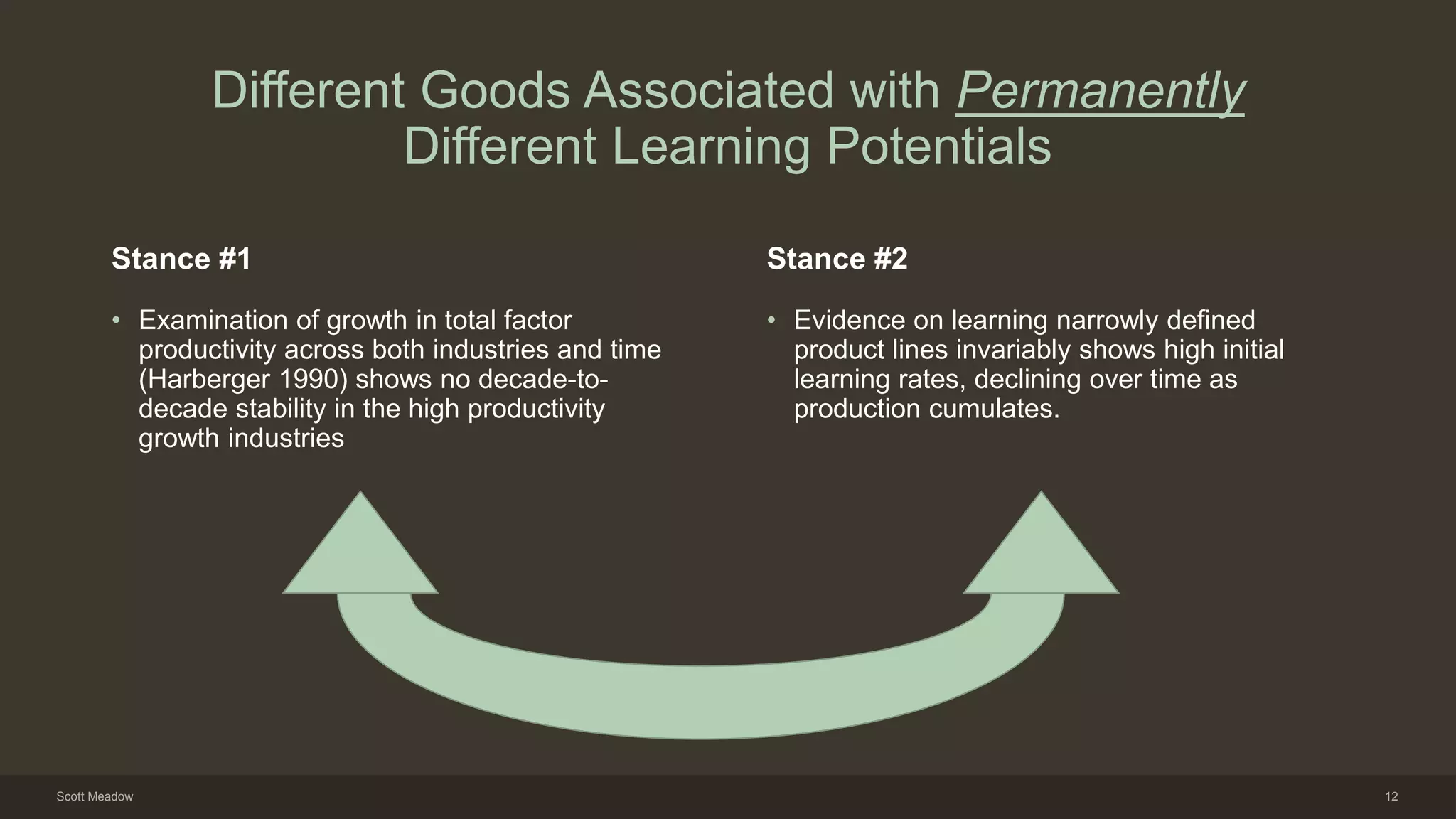
Different Goods Associated with Permanently
Different Learning Potentials
Stance #1
• Examination of growth in total factor
productivity across both industries and time
(Harberger 1990) shows no decade-to-
decade stability in the high productivity
growth industries
Stance #2
• Evidence on learning narrowly defined
product lines invariably shows high initial
learning rates, declining over time as
production cumulates.
Scott Meadow 12
Liberty Ship: On-The-Job Productivity
• Allan D. Searle (1945) & Leonard A. Rapping (1965)
• “Reductions in man-hours per ship with each doubling of cumulative output ranged from 12% -24%”
• Industry output per man-hour increased at a 40% rate during a three year period
• Kenneth Arrow (1961)
• Theoretically suggested that learning-by-doing might serve as the key factor in growth for an economy as a
whole
• Estimated by use of a Cobb-Douglas production function
• Estimate obtained of the learning effect , comparable to Searle, ranging from 11%-29%
• Inclusion of calendar time added nothing, slightly negative trend
• The Boston Consulting Group (1972) obtained fairly clean leaning curves, with sloped
similar to those estimated by Searle and Rapping
Scott Meadow 13
Learning Models: Technology
• Technology implies a scale effect, a link between the level of employment and the rate of
growth of productivity
• Matsuyama (1992) proposes thinking of a population as a containing a fixed fraction of
entrepreneurs, and of a technology that requires that each enterprise be headed by one
of them. Then doubling the population means doubling the umber of enterprises that are
subject to the learning technology, keeping the size of each fixed, and has no growth
effects.
• Insofar as leaning effects are party external to the firm, this device doesn’t quite work, and one needs to think
of some other limitation on scale.
• With the technology, one can obtain miraculous rates of productivity growth by shifting a
large amount of labor onto a single, new product line.
Scott Meadow 14
Learning Models: Technology Cont.
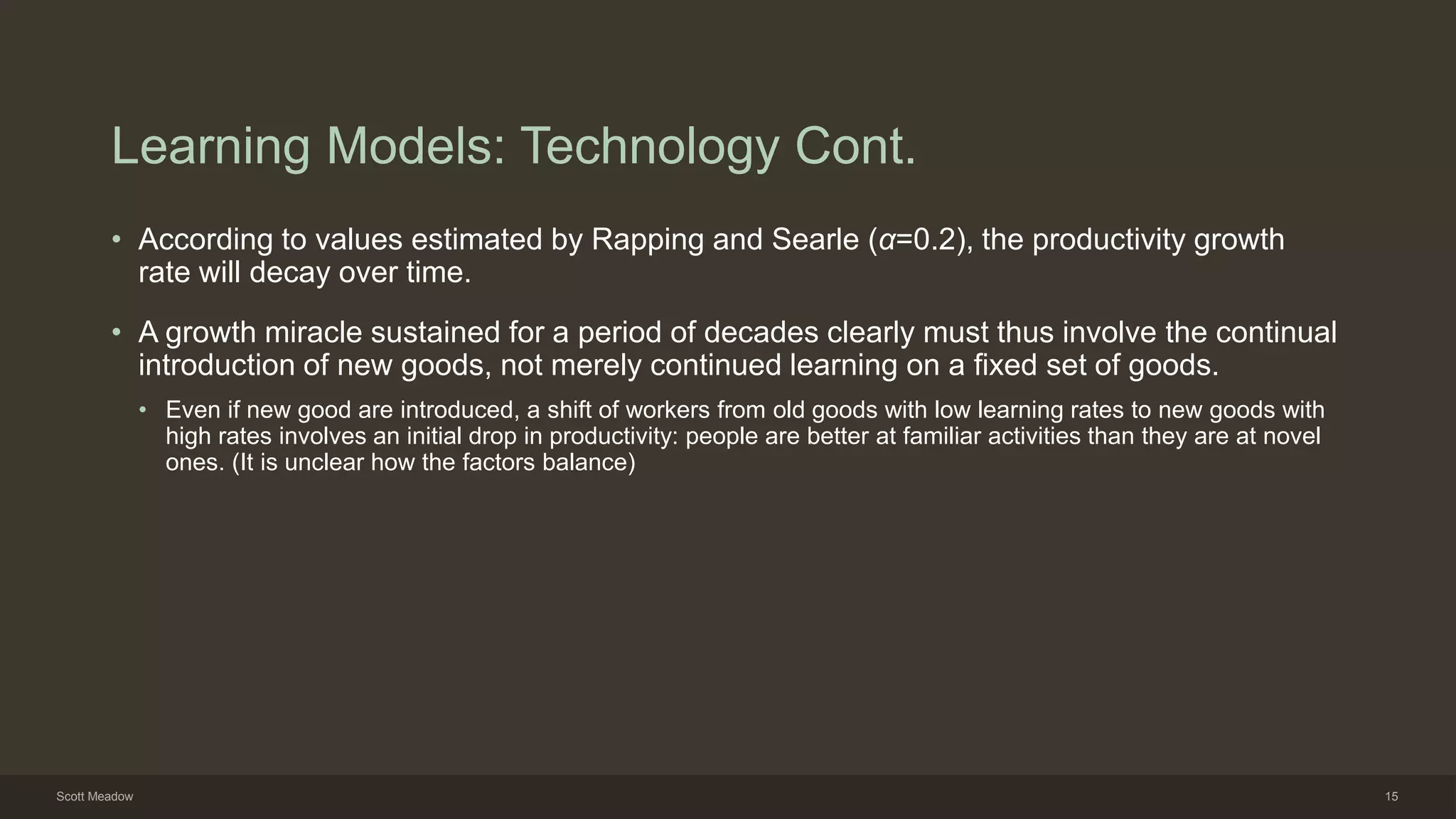
• According to values estimated by Rapping and Searle (α=0.2), the productivity growth
rate will decay over time.
• A growth miracle sustained for a period of decades clearly must thus involve the continual
introduction of new goods, not merely continued learning on a fixed set of goods.
• Even if new good are introduced, a shift of workers from old goods with low learning rates to new goods with
high rates involves an initial drop in productivity: people are better at familiar activities than they are at novel
ones. (It is unclear how the factors balance)
Scott Meadow 15
Learning and Market Equilibrium
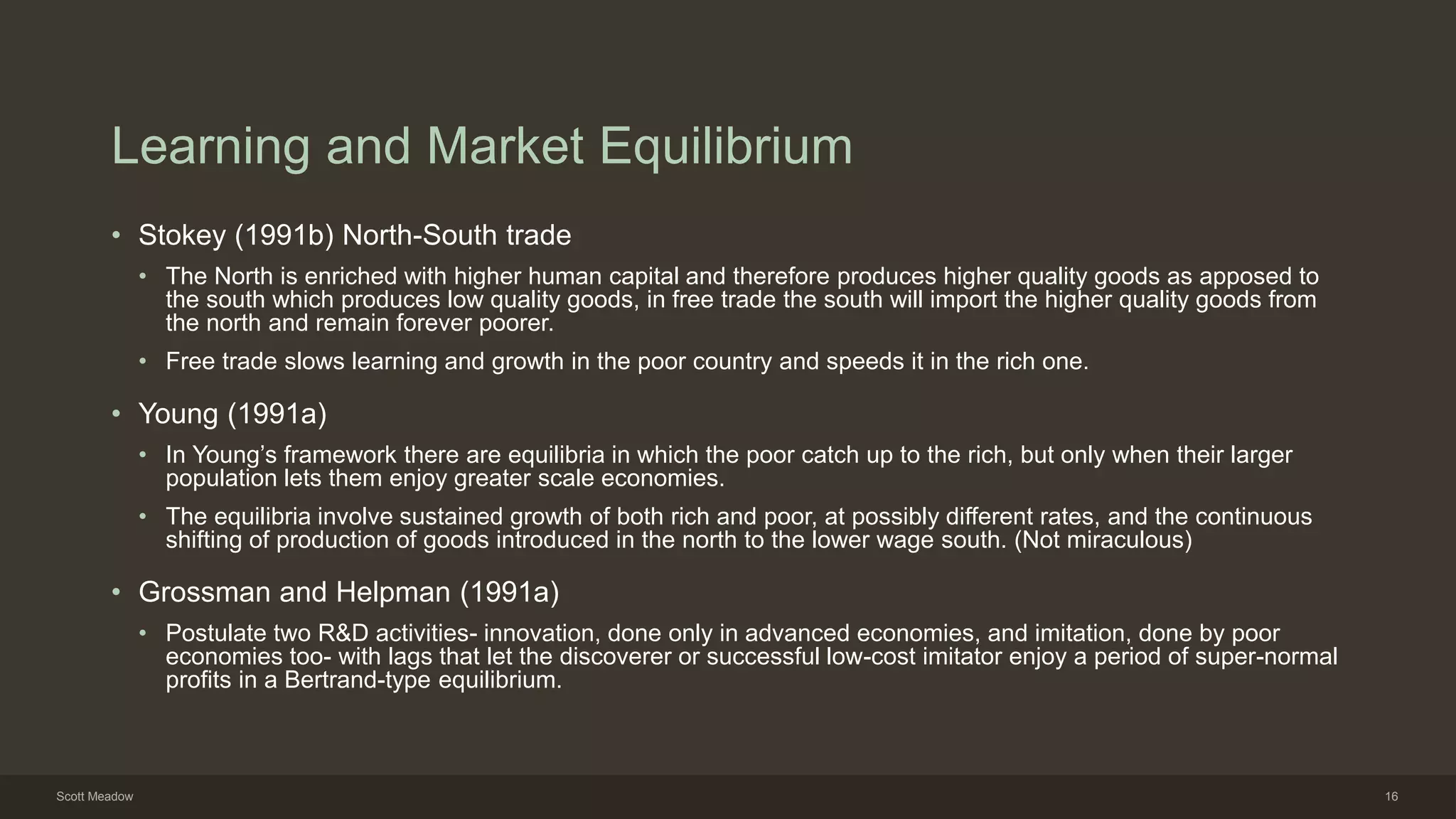
• Stokey (1991b) North-South trade
• The North is enriched with higher human capital and therefore produces higher quality goods as apposed to
the south which produces low quality goods, in free trade the south will import the higher quality goods from
the north and remain forever poorer.
• Free trade slows learning and growth in the poor country and speeds it in the rich one.
• Young (1991a)
• In Young’s framework there are equilibria in which the poor catch up to the rich, but only when their larger
population lets them enjoy greater scale economies.
• The equilibria involve sustained growth of both rich and poor, at possibly different rates, and the continuous
shifting of production of goods introduced in the north to the lower wage south. (Not miraculous)
• Grossman and Helpman (1991a)
• Postulate two R&D activities- innovation, done only in advanced economies, and imitation, done by poor
economies too- with lags that let the discoverer or successful low-cost imitator enjoy a period of super-normal
profits in a Bertrand-type equilibrium.
Scott Meadow 16
Learning Spillover Technology
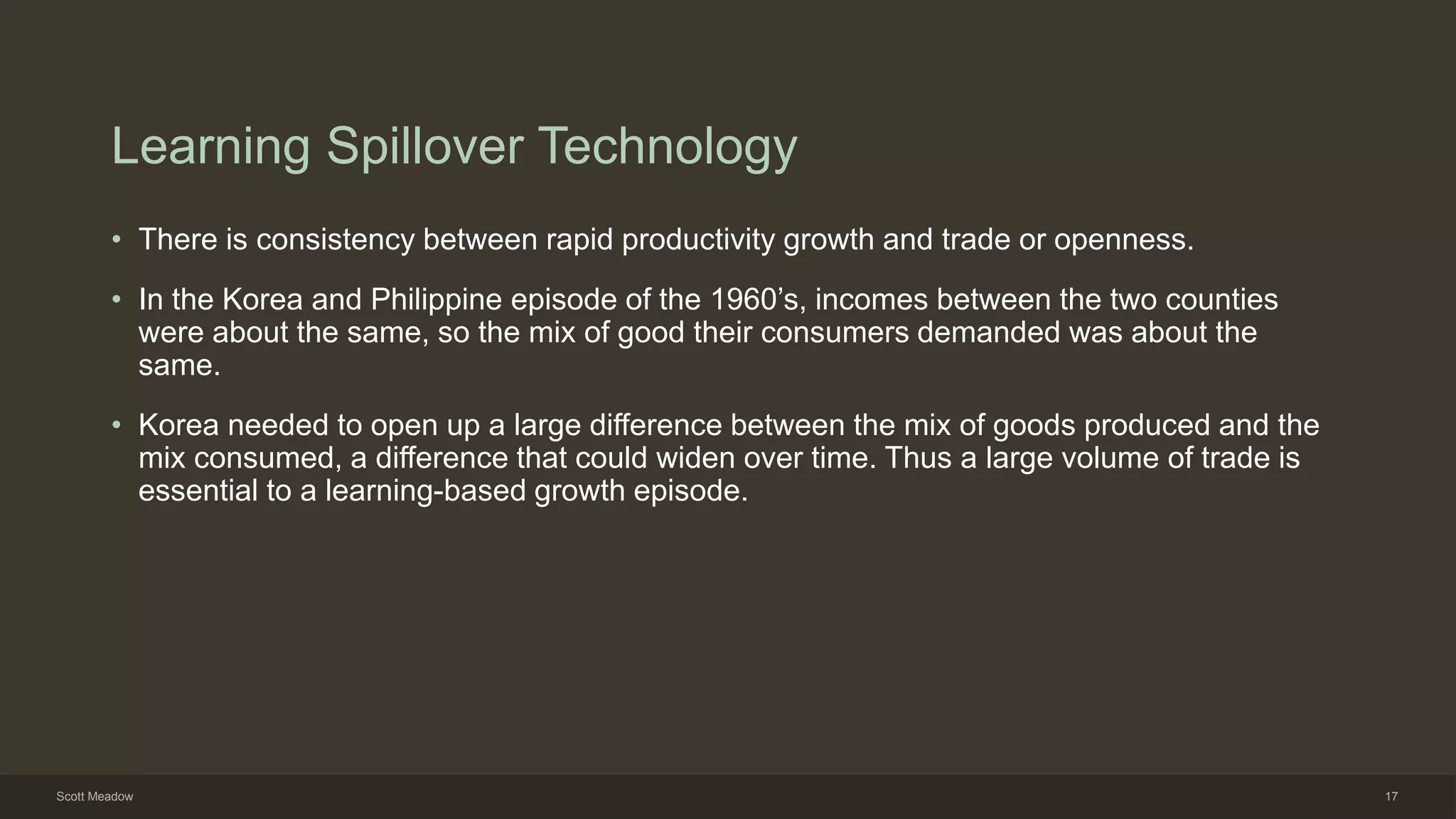
• There is consistency between rapid productivity growth and trade or openness.
• In the Korea and Philippine episode of the 1960’s, incomes between the two counties
were about the same, so the mix of good their consumers demanded was about the
same.
• Korea needed to open up a large difference between the mix of goods produced and the
mix consumed, a difference that could widen over time. Thus a large volume of trade is
essential to a learning-based growth episode.
Scott Meadow 17
Conclusions
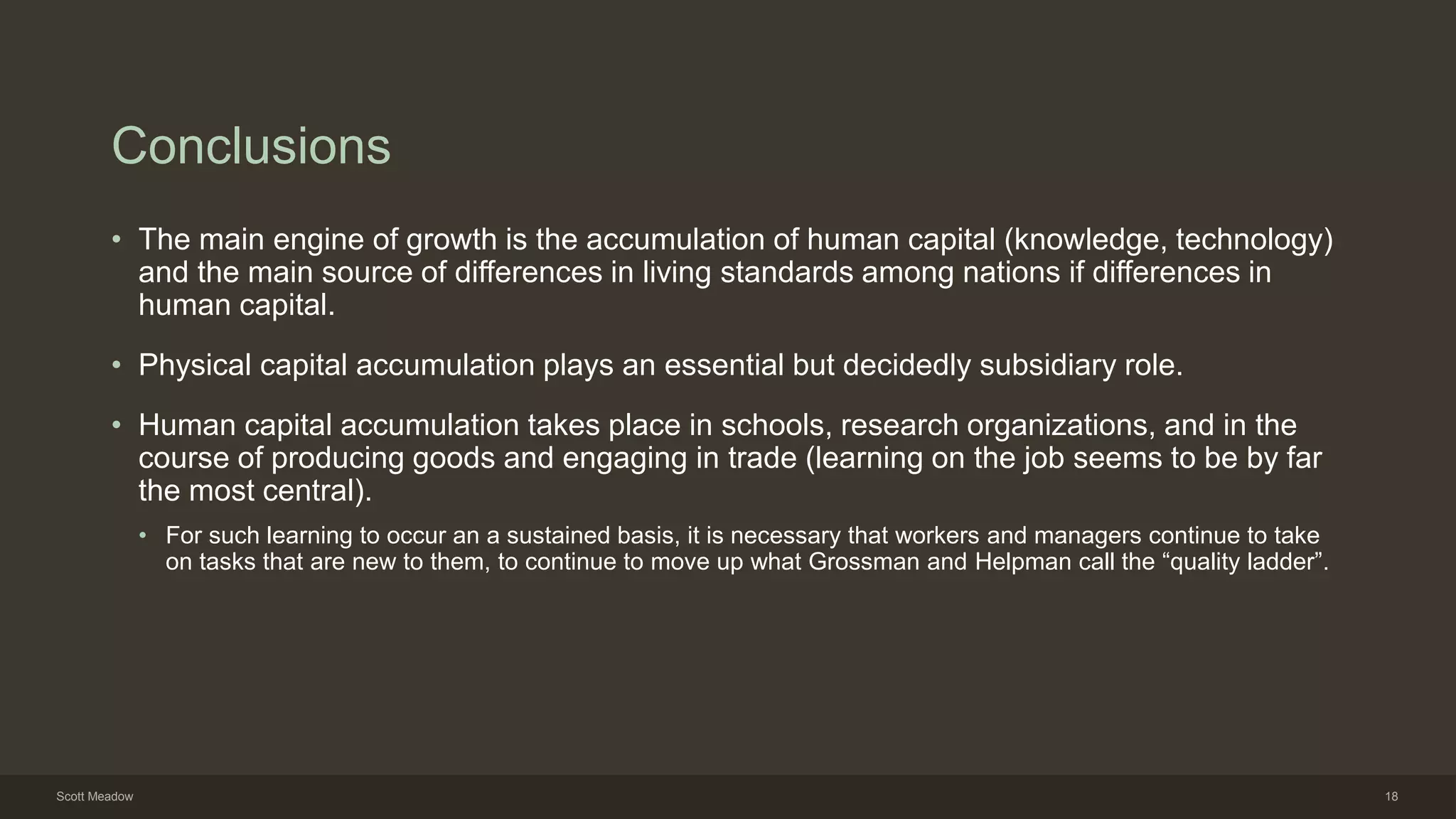
• The main engine of growth is the accumulation of human capital (knowledge, technology)
and the main source of differences in living standards among nations if differences in
human capital.
• Physical capital accumulation plays an essential but decidedly subsidiary role.
• Human capital accumulation takes place in schools, research organizations, and in the
course of producing goods and engaging in trade (learning on the job seems to be by far
the most central).
• For such learning to occur an a sustained basis, it is necessary that workers and managers continue to take
on tasks that are new to them, to continue to move up what Grossman and Helpman call the “quality ladder”.
Scott Meadow 18
In the Wake of the Crisis
Oliver Blanchard, David Romer, Michael Spence, Joseph Stiglitz
Reevaluation
of Growth
Policies
Implications of the economic
crisis and the difficulties
imposed on advanced
countries with debt overhang
and possibly lower growth.
Scott Meadow 20
Looking Forward
Convergence
• There exists a large gap between potential output
(provided by existing technology levels in
advanced economies) and the actual (based on
technology currently in the possession of the
developing countries), this gap drives
development.
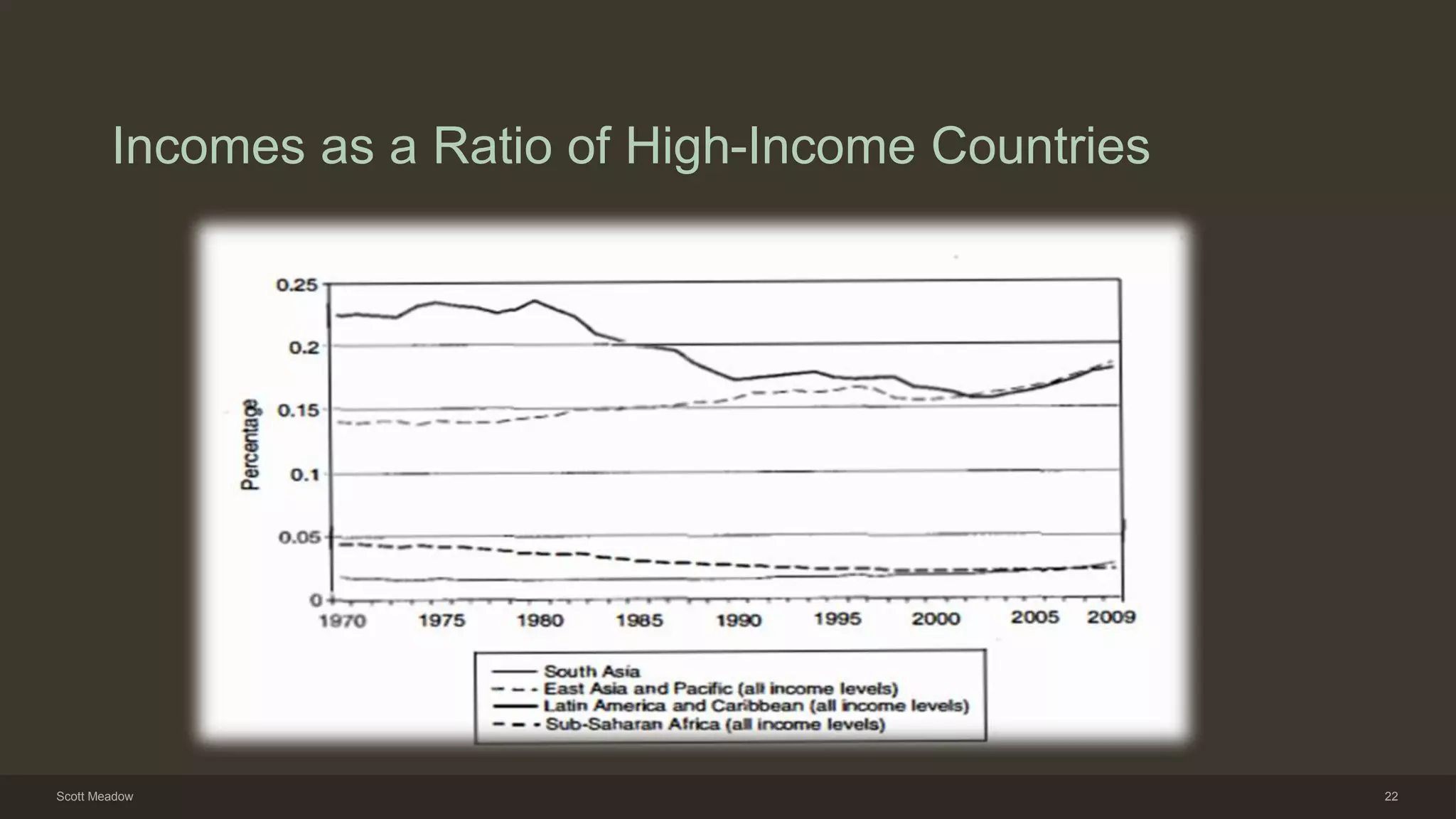
• This gap is larger than expected, in actuality wider
since the 1970’s.
Potentiality
• Growth isn’t automatic.
• Economies must plan to execute correctly on the
supply-side.
• The rapid nature of the frontier is second to the
relative gap between the frontier and poor
countries.
Scott Meadow 21
Incomes as a Ratio of High-Income Countries
Scott Meadow 22
Conditional Convergence
• The economic component of convergence is a process of ongoing structural
transformation.
• Growth driven by the creation of new industries at higher productivity levels and the transfer of resources
within those economies from the lower-productivity activities to the higher-productivity activities.
• Tradables play a crucial role in the globalized market.
• Safeguarding the health of modern tradable economic activities
• Monitoring the exchange rate
• Enacting policies that promote tradables
• Financial deglobalization may offer the transitory remedy
• Developing and emerging markets with varying exchange rates will ensure competitiveness not seen
otherwise
• Getting medium-term policies right
Scott Meadow 23
Scott Meadow 24

Making a Miracle

  • 1.
    Making A Miracle RobertE. Lucas, Jr. (March 1993)
  • 2.
    Which Economic PoliciesAffect Growth Rates? • Neoclassical Economic Theories: • Productivity • Technology • Human Capital Accumulation • Microeconomics: • Learning & Productivity • Developing Market Equilibrium Theories: • Differential Learning Rates ~ Observed Growth Rate Differences Scott Meadow 2
  • 3.
    Comparable Statistics; Philippinesvs. South Korea (1975) 26 28 96 4 37 20 86 14 0 10 20 30 40 50 60 70 80 90 100 Agriculture Industry Merchandise Exp.(Commodities) Merchandise Exp.(Manufactured goods) GDP ATTRIBUTION (%) Philippines South Korea *Figures taken from 1984 World Development ReportScott Meadow 3
  • 4.
    Features of EastAsian “Miracle” Economies • Large scale exporters of manufactured goods of increasing sophistication • High levels of urbanization • Increase in education • High savings rates • Pro-business governments • laissez faire • mercantilist commercial policies (1960-1988) Philippines South Korea GDP per capita growth by year 1.8% 6.2% Scott Meadow 4
  • 5.
    Solow (1956) ~Romer (1986) • Neoclassical growth model • Physical capital, k(t) • Human capital, h(t) • Single good produced, y(t) • Fraction of time spent producing goods, u • Growth of physical capital depends on savings rate, s • Growth of human capital depends on the amount of quality- adjusted time devoted to its production • Avg. Solow residual (rate of technological change): μ=δ(1-α)(1-u) • Initial tech. level: Ah(0)1-α • * Long-run growth rate of both capital and production per worker: δ(1-u) • * Rate of human capital growth and the ratio of physical to human capital converges to a constant • * Labor is completely immobile, physical capital is perfectly mobile • * In the long- run, the level of income is proportional to the economy’s initial stock of human capital • Net domestic product in each country is proportional to its effective workforce Scott Meadow 5
  • 6.
    Solow (1956) ~Romer (1986) [Assumptions] • If each county has the technology with a common intercept A, this world return is, r = αA(K/H)α-1 where H = Σiuihi is the world supply of effective labor devoted to goods production. • If everyone has the same constant savings rate s, the dynamics of this world economy are essentially the same as those of Solow’s model. • The world capital stock follows (dK/ dt) = sAKαH1-α , and the time path of H is obtained by summing the savings rate of goods production over countries, each multiplied by its own time allocation variable ui • The long run growth rate of physical capital and of every country’s output is equal to the growth rate of human capital, not only in the long run but all along the equilibrium path. • * (The theory is thus consistent with the permanent maintenance of any degree of income inequality.) • This ultimately implies that the reinterpretation of Solow's technology variable as a country-specific stock of human capital, a model that predicts rapid convergence to common income levels is converted into one that sis consistent with permanent income inequality. • The key assumption on which this prediction is based- that human capital accumulation in any one economy is independent of the level of human capital in other economies- conflicts with the evidence fact that ideas developed in one place spread elsewhere, that there is one frontier of human knowledge, not one for each separate economy. Scott Meadow 6
  • 7.
    Parente & Prescott(1991) • If this model is realistically modified to permit each economy to be subject to shocks that have some independence across countries, the assumption that each economy undergoes sustained growth due to its own human capital growth only would imply ever- growing inequality within any subset of countries. • Relative income levels would follow random-walk-like behavior. • According to Lucas, the way to introduce convergence into this model following the short- comings proposed by Parente and Prescott would be to modify the human capital accumulation technology so as to permit any one country’s rate of human capital growth to be influenced by the level of human capital elsewhere in the world. • Now an economy with a human capital stock lower than the world average will grow faster than an above average economy. • Evidently, zi(t) converges to one, this means that relative incomes converge to one at the same rate. Scott Meadow 7
  • 8.
    Barro and Sala-i-Martin(1992) • Previous proofs demonstrate that subsets of countries where after and final goods mobility is high, convergence can be observed. • Barro & Sala-i-Martin obtain a regression estimate of an average convergence rate of relative incomes, conditioned on variables that may be interpreted as controlling for a country's adherence to the assumptions stated previously, slightly less than 0.2. • One may interpret this coefficient as reflecting differential rates of physical capital accumulation in a world in which income differences reflect mainly differences in capital per worker, this rate of convergence is much too low to be consistent with observed capital shares. • Ultimately, human capital accumulation in any country depends on local effort together with worldwide knowledge, independent of the local human capital level. (From here, the estimate given seems high!) Scott Meadow 8
  • 9.
    South Korea Taiwan Hong Kong Singapore Philippines Average 0 5 10 15 20 25 30 35 40 45 50 Ratioof gross domestic investment to GDP (1984) South Korea Taiwan Hong Kong Singapore Philippines Average Investment Rates • Illustrated previously in the perfect capital mobility model, the differences depicted in investment rates would have no connection with savings rates: any country’s higher than average savings rate would simply be invested abroad. • In the special case where there exist no int’l capital mobility, the effect on a given savings rate to output growth rates would be deduced in the following way: * Figures taken from World Development Report (1986) * Taiwan figures from 1987 Taiwan National incomeScott Meadow 9
  • 10.
    Controversy • Young (1992)demonstrates that output growth in Singapore since the 1960’s can be accounted for entirely by growth in conventionally measured capital and labor inputs, with noting left over to be attributed to technological change. • Correlations between investment ratios and growth rates, which tend to be positive, are frequently cited but do not settle anything. If growth is driven by rapid accumulation of human capital, one needs rapid growth in physical capital just to keep up! • In Lucas’ framework, the other possible source of growth rate differentials is differential rates of human capital accumulation, stemming from differences on societies’ time- allocation decisions. School? Work? Scott Meadow 10
  • 11.
    Implications • Identification ofincreases in average schooling levels with net human capital investment. • Since schooling levels are increasing in virtually all societies today, this is a possibility worth developing, but it cannot be pursued within a steady state framework. This is an important and neglected respect in which neither advanced nor most backward economies can be viewed as moving along balanced growth paths. • Alternatively, we can think of a balanced path on which time spent in school is constant but the quality of schooling is improving due to increases in general knowledge. • Stokey (1991a) • Human capital accumulation also occurs at work (on the job training, learning by doing) and can be modeled as a time- allocation decision. • The mix of goods a society produces will affect its overall rate of human capital accumulation and growth. Scott Meadow 11
  • 12.
    Different Goods Associatedwith Permanently Different Learning Potentials Stance #1 • Examination of growth in total factor productivity across both industries and time (Harberger 1990) shows no decade-to- decade stability in the high productivity growth industries Stance #2 • Evidence on learning narrowly defined product lines invariably shows high initial learning rates, declining over time as production cumulates. Scott Meadow 12
  • 13.
    Liberty Ship: On-The-JobProductivity • Allan D. Searle (1945) & Leonard A. Rapping (1965) • “Reductions in man-hours per ship with each doubling of cumulative output ranged from 12% -24%” • Industry output per man-hour increased at a 40% rate during a three year period • Kenneth Arrow (1961) • Theoretically suggested that learning-by-doing might serve as the key factor in growth for an economy as a whole • Estimated by use of a Cobb-Douglas production function • Estimate obtained of the learning effect , comparable to Searle, ranging from 11%-29% • Inclusion of calendar time added nothing, slightly negative trend • The Boston Consulting Group (1972) obtained fairly clean leaning curves, with sloped similar to those estimated by Searle and Rapping Scott Meadow 13
  • 14.
    Learning Models: Technology •Technology implies a scale effect, a link between the level of employment and the rate of growth of productivity • Matsuyama (1992) proposes thinking of a population as a containing a fixed fraction of entrepreneurs, and of a technology that requires that each enterprise be headed by one of them. Then doubling the population means doubling the umber of enterprises that are subject to the learning technology, keeping the size of each fixed, and has no growth effects. • Insofar as leaning effects are party external to the firm, this device doesn’t quite work, and one needs to think of some other limitation on scale. • With the technology, one can obtain miraculous rates of productivity growth by shifting a large amount of labor onto a single, new product line. Scott Meadow 14
  • 15.
    Learning Models: TechnologyCont. • According to values estimated by Rapping and Searle (α=0.2), the productivity growth rate will decay over time. • A growth miracle sustained for a period of decades clearly must thus involve the continual introduction of new goods, not merely continued learning on a fixed set of goods. • Even if new good are introduced, a shift of workers from old goods with low learning rates to new goods with high rates involves an initial drop in productivity: people are better at familiar activities than they are at novel ones. (It is unclear how the factors balance) Scott Meadow 15
  • 16.
    Learning and MarketEquilibrium • Stokey (1991b) North-South trade • The North is enriched with higher human capital and therefore produces higher quality goods as apposed to the south which produces low quality goods, in free trade the south will import the higher quality goods from the north and remain forever poorer. • Free trade slows learning and growth in the poor country and speeds it in the rich one. • Young (1991a) • In Young’s framework there are equilibria in which the poor catch up to the rich, but only when their larger population lets them enjoy greater scale economies. • The equilibria involve sustained growth of both rich and poor, at possibly different rates, and the continuous shifting of production of goods introduced in the north to the lower wage south. (Not miraculous) • Grossman and Helpman (1991a) • Postulate two R&D activities- innovation, done only in advanced economies, and imitation, done by poor economies too- with lags that let the discoverer or successful low-cost imitator enjoy a period of super-normal profits in a Bertrand-type equilibrium. Scott Meadow 16
  • 17.
    Learning Spillover Technology •There is consistency between rapid productivity growth and trade or openness. • In the Korea and Philippine episode of the 1960’s, incomes between the two counties were about the same, so the mix of good their consumers demanded was about the same. • Korea needed to open up a large difference between the mix of goods produced and the mix consumed, a difference that could widen over time. Thus a large volume of trade is essential to a learning-based growth episode. Scott Meadow 17
  • 18.
    Conclusions • The mainengine of growth is the accumulation of human capital (knowledge, technology) and the main source of differences in living standards among nations if differences in human capital. • Physical capital accumulation plays an essential but decidedly subsidiary role. • Human capital accumulation takes place in schools, research organizations, and in the course of producing goods and engaging in trade (learning on the job seems to be by far the most central). • For such learning to occur an a sustained basis, it is necessary that workers and managers continue to take on tasks that are new to them, to continue to move up what Grossman and Helpman call the “quality ladder”. Scott Meadow 18
  • 19.
    In the Wakeof the Crisis Oliver Blanchard, David Romer, Michael Spence, Joseph Stiglitz
  • 20.
    Reevaluation of Growth Policies Implications ofthe economic crisis and the difficulties imposed on advanced countries with debt overhang and possibly lower growth. Scott Meadow 20
  • 21.
    Looking Forward Convergence • Thereexists a large gap between potential output (provided by existing technology levels in advanced economies) and the actual (based on technology currently in the possession of the developing countries), this gap drives development. • This gap is larger than expected, in actuality wider since the 1970’s. Potentiality • Growth isn’t automatic. • Economies must plan to execute correctly on the supply-side. • The rapid nature of the frontier is second to the relative gap between the frontier and poor countries. Scott Meadow 21
  • 22.
    Incomes as aRatio of High-Income Countries Scott Meadow 22
  • 23.
    Conditional Convergence • Theeconomic component of convergence is a process of ongoing structural transformation. • Growth driven by the creation of new industries at higher productivity levels and the transfer of resources within those economies from the lower-productivity activities to the higher-productivity activities. • Tradables play a crucial role in the globalized market. • Safeguarding the health of modern tradable economic activities • Monitoring the exchange rate • Enacting policies that promote tradables • Financial deglobalization may offer the transitory remedy • Developing and emerging markets with varying exchange rates will ensure competitiveness not seen otherwise • Getting medium-term policies right Scott Meadow 23
  • 24.