Make a Splash @ Your Library!But Document it with Data!Dr. Johan Koren
Summary2Making a splash and getting yourself and the library recognized is all very well, but it will not ensure your survival unless you can document that what you’re doing actually contributes to student achievement. To do that, you need data--which means you need to become a researcher! We will look at some ways you can do your own action research.Storms ahead!The economy is stormy, and principals and superintendents are looking for ways to save money.
That threatens school libraries and school librarians, and they are often among the first to succumb to the storms.3
What Could be the Result?4
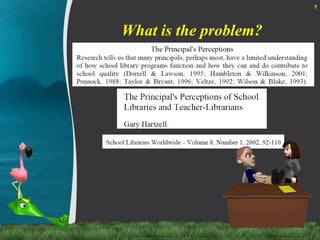
What is the problem?5
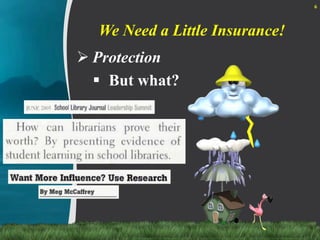
We Need a Little Insurance!ProtectionBut what?6
We need to presentEVIDENCE!7
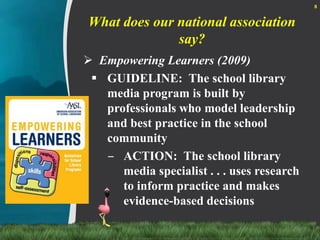
What does our national association say?Empowering Learners (2009)GUIDELINE:  The school library media program is built by professionals who model leadership and best practice in the school communityACTION:  The school library media specialist . . . uses research to inform practice and makes evidence-based decisions8
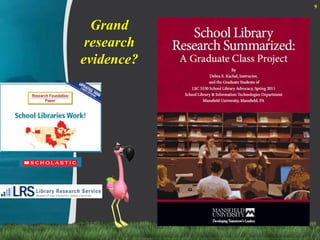
Grand research evidence?9
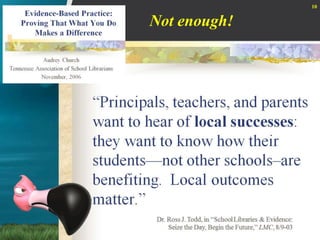
Not enough!10
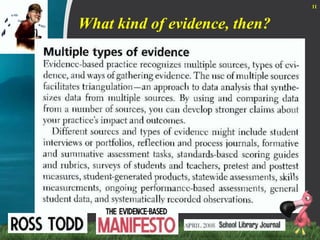
What kind of evidence, then?11
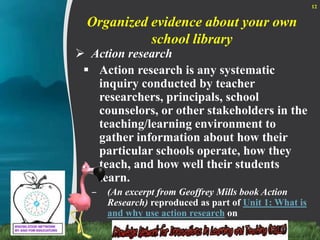
Organized evidence about your own school libraryAction researchAction research is any systematic inquiry conducted by teacher researchers, principals, school counselors, or other stakeholders in the teaching/learning environment to gather information about how their particular schools operate, how they teach, and how well their students learn. (An excerpt from Geoffrey Mills book Action Research) reproduced as part of Unit 1: What is and why use action research on 12
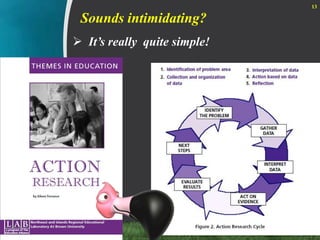
Sounds intimidating?It’s really  quite simple!13
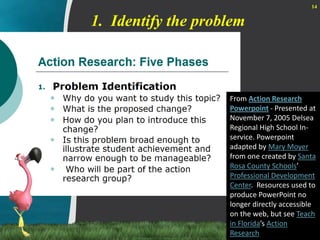
1.  Identify the problem14FromAction Research Powerpoint- Presented at November 7, 2005 Delsea Regional High School In-service. Powerpoint adapted by Mary Moyer from one created by Santa Rosa County Schools’ Professional Development Center.  Resources used to produce PowerPoint no longer directly accessible on the web, but see Teach in Florida’s Action Research
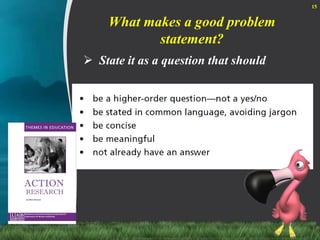
What makes a good problem statement?State it as a question that should  15
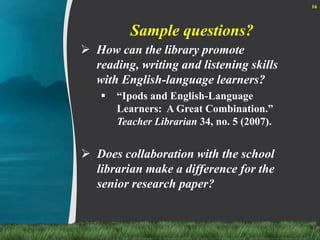
Sample questions?How can the library promote reading, writing and listening skills with English-language learners?“Ipods and English-Language Learners:  A Great Combination.” Teacher Librarian 34, no. 5 (2007).Does collaboration with the school librarian make a difference for the senior research paper?16
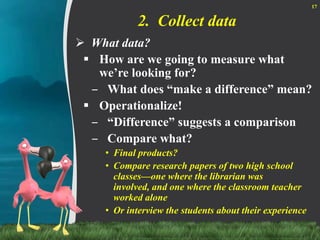
2.  Collect dataWhat data?How are we going to measure what we’re looking for?What does “make a difference” mean?Operationalize!“Difference” suggests a comparisonCompare what?Final products?Compare research papers of two high school classes—one where the librarian was involved, and one where the classroom teacher worked aloneOr interview the students about their experience17
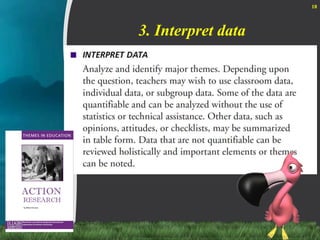
3. Interpret data18
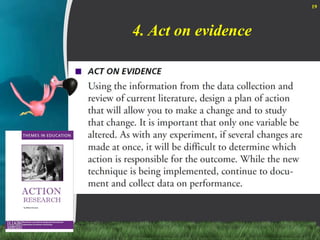
4. Act on evidence 19
5.  Evaluate results20
6.  What’s next?21
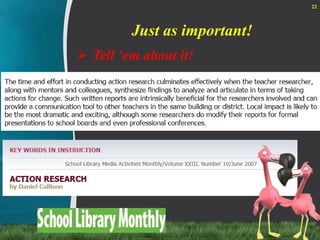
Just as important!Tell ‘em about it!22
Present and share!Ross Todd:23
Example of action researchImproving research paper assignments:English teachers and the school librarian collaborate to gather data in a qualitative action research study that investigates the effectiveness of an assignment that requires primary research methods and an essay of two thousand words. Gordon, Carol. Students As Authentic Researchers: A New Prescription for the High School Research AssignmentSchool Library Media Research vol. 2, 199924
Questions? Need More Information?25Johan KorenCoordinator, Murray State University Library Media Programjkoren@murraystate.eduDr. Ross J. ToddDIRECTOR, CISSL Center for International Scholarship in School LibrariesRutgers UniversityCarol Ann GordonAssociate ProfessorLibrary and Information ScienceRutgers University

Make a splash at your library!

  • 1.
    Make a Splash@ Your Library!But Document it with Data!Dr. Johan Koren
  • 2.
    Summary2Making a splashand getting yourself and the library recognized is all very well, but it will not ensure your survival unless you can document that what you’re doing actually contributes to student achievement. To do that, you need data--which means you need to become a researcher! We will look at some ways you can do your own action research.Storms ahead!The economy is stormy, and principals and superintendents are looking for ways to save money.
  • 3.
    That threatens schoollibraries and school librarians, and they are often among the first to succumb to the storms.3
  • 4.
    What Could bethe Result?4
  • 5.
    What is theproblem?5
  • 6.
    We Need aLittle Insurance!ProtectionBut what?6
  • 7.
    We need topresentEVIDENCE!7
  • 8.
    What does ournational association say?Empowering Learners (2009)GUIDELINE: The school library media program is built by professionals who model leadership and best practice in the school communityACTION: The school library media specialist . . . uses research to inform practice and makes evidence-based decisions8
  • 9.
  • 10.
  • 11.
    What kind ofevidence, then?11
  • 12.
    Organized evidence aboutyour own school libraryAction researchAction research is any systematic inquiry conducted by teacher researchers, principals, school counselors, or other stakeholders in the teaching/learning environment to gather information about how their particular schools operate, how they teach, and how well their students learn. (An excerpt from Geoffrey Mills book Action Research) reproduced as part of Unit 1: What is and why use action research on 12
  • 13.
  • 14.
    1. Identifythe problem14FromAction Research Powerpoint- Presented at November 7, 2005 Delsea Regional High School In-service. Powerpoint adapted by Mary Moyer from one created by Santa Rosa County Schools’ Professional Development Center. Resources used to produce PowerPoint no longer directly accessible on the web, but see Teach in Florida’s Action Research
  • 15.
    What makes agood problem statement?State it as a question that should 15
  • 16.
    Sample questions?How canthe library promote reading, writing and listening skills with English-language learners?“Ipods and English-Language Learners: A Great Combination.” Teacher Librarian 34, no. 5 (2007).Does collaboration with the school librarian make a difference for the senior research paper?16
  • 17.
    2. CollectdataWhat data?How are we going to measure what we’re looking for?What does “make a difference” mean?Operationalize!“Difference” suggests a comparisonCompare what?Final products?Compare research papers of two high school classes—one where the librarian was involved, and one where the classroom teacher worked aloneOr interview the students about their experience17
  • 18.
  • 19.
    4. Act onevidence 19
  • 20.
    5. Evaluateresults20
  • 21.
  • 22.
    Just as important!Tell‘em about it!22
  • 23.
  • 24.
    Example of actionresearchImproving research paper assignments:English teachers and the school librarian collaborate to gather data in a qualitative action research study that investigates the effectiveness of an assignment that requires primary research methods and an essay of two thousand words. Gordon, Carol. Students As Authentic Researchers: A New Prescription for the High School Research AssignmentSchool Library Media Research vol. 2, 199924
  • 25.
    Questions? Need MoreInformation?25Johan KorenCoordinator, Murray State University Library Media Programjkoren@murraystate.eduDr. Ross J. ToddDIRECTOR, CISSL Center for International Scholarship in School LibrariesRutgers UniversityCarol Ann GordonAssociate ProfessorLibrary and Information ScienceRutgers University