Mainframe Systems Overview
Batch and Online Architectures with
Tech Stacks
Introduction to Mainframes
• - Mainframes are powerful systems designed
for high reliability, scalability, and
performance.
• - Used in industries like banking, healthcare,
and government.
• - Operate in two modes: Batch Processing and
Online Processing.
Mainframe Batch Architecture
• - Processes large volumes of data sequentially
without user interaction.
• - High throughput, automated scheduling, and
data-driven.
• - Key Tools: JCL, COBOL, DB2, VSAM, IMS, CA-
7, Control-M.
• - Use Cases: Payroll processing, invoicing,
report generation.
Batch Architecture Workflow
• 1. Job Submission: Defined using JCL.
• 2. Scheduling: Managed with tools like IBM
Tivoli or Control-M.
• 3. Execution: Jobs processed sequentially or in
parallel.
• 4. Output: Results stored in datasets or
printed.
Mainframe Online Architecture
• - Supports real-time, interactive processing.
• - Handles multiple concurrent users with 24/7
availability.
• - Key Tools: CICS, IMS DC, DB2, Java,
WebSphere, z/OS Connect.
• - Use Cases: ATM transactions, flight bookings,
POS systems.
Online Architecture Workflow
• 1. User Request: Sent via terminal or web
interface.
• 2. Middleware: Processes request (e.g., CICS).
• 3. Database Interaction: Retrieves or updates
data.
• 4. Response: Displays results instantly.
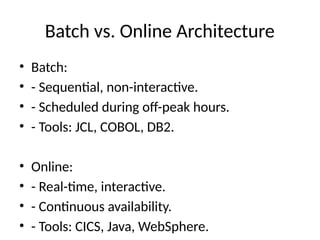
Batch vs. Online Architecture
• Batch:
• - Sequential, non-interactive.
• - Scheduled during off-peak hours.
• - Tools: JCL, COBOL, DB2.
• Online:
• - Real-time, interactive.
• - Continuous availability.
• - Tools: CICS, Java, WebSphere.
Integration of Batch and Online
• - Modern systems often integrate batch and
online processing.
• - Example: E-commerce systems process
orders in real-time (online) and update
inventory overnight (batch).
• - Ensures scalability and efficiency.
Mainframe_Systems_Overview_mainframe modernization

  • 1.
    Mainframe Systems Overview Batchand Online Architectures with Tech Stacks
  • 2.
    Introduction to Mainframes •- Mainframes are powerful systems designed for high reliability, scalability, and performance. • - Used in industries like banking, healthcare, and government. • - Operate in two modes: Batch Processing and Online Processing.
  • 3.
    Mainframe Batch Architecture •- Processes large volumes of data sequentially without user interaction. • - High throughput, automated scheduling, and data-driven. • - Key Tools: JCL, COBOL, DB2, VSAM, IMS, CA- 7, Control-M. • - Use Cases: Payroll processing, invoicing, report generation.
  • 4.
    Batch Architecture Workflow •1. Job Submission: Defined using JCL. • 2. Scheduling: Managed with tools like IBM Tivoli or Control-M. • 3. Execution: Jobs processed sequentially or in parallel. • 4. Output: Results stored in datasets or printed.
  • 5.
    Mainframe Online Architecture •- Supports real-time, interactive processing. • - Handles multiple concurrent users with 24/7 availability. • - Key Tools: CICS, IMS DC, DB2, Java, WebSphere, z/OS Connect. • - Use Cases: ATM transactions, flight bookings, POS systems.
  • 6.
    Online Architecture Workflow •1. User Request: Sent via terminal or web interface. • 2. Middleware: Processes request (e.g., CICS). • 3. Database Interaction: Retrieves or updates data. • 4. Response: Displays results instantly.
  • 7.
    Batch vs. OnlineArchitecture • Batch: • - Sequential, non-interactive. • - Scheduled during off-peak hours. • - Tools: JCL, COBOL, DB2. • Online: • - Real-time, interactive. • - Continuous availability. • - Tools: CICS, Java, WebSphere.
  • 8.
    Integration of Batchand Online • - Modern systems often integrate batch and online processing. • - Example: E-commerce systems process orders in real-time (online) and update inventory overnight (batch). • - Ensures scalability and efficiency.