



Global Logistics &
Supply Chain Management
Making Sense of it All and Where It is Going
Tom Craig – tomc@ltdmgmt.com
LTD Management www.ltdmgmt.com
Topics
 GLOBAL LOGISTICS--
 West Coast & Domino Effect
 Container Line Chaos
 SUPPLY CHAIN MANAGEMENT--
 Blue Ocean Strategy Using Supply Chain
Management
Global Logistics
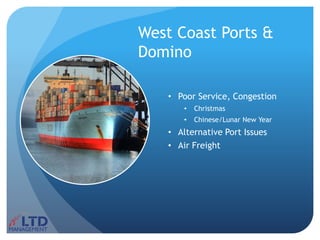
West Coast Ports &
Domino
• Poor Service, Congestion
• Christmas
• Chinese/Lunar New Year
• Alternative Port Issues
• Air Freight
Questions
 Do you use carriers directly or a forwarder?
 Do you use West Coast ports?
 How stable was and are your rates?
 Did you have any booking problems?
 Did you have any problems getting empties?
 Did you make any adjustments? When?
 How did you make out?
 AND---
THE Question
What are you going to
do now?
Pending Chaos!?
Is There More Ahead than
West Coast Port Issues?
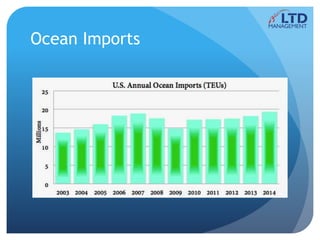
Ocean Imports
Issues
• Ship supply exceeds
demand
• Pricing/Rates
• Service & space
Need to know what is
going on in order to
negotiate and to buy
ocean transport service.
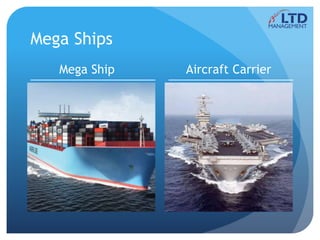
Mega Ships
Mega Ship Aircraft Carrier
CSCL Globe
•19,100 TEU
Containers stretch 72 miles
156 million pairs of shoes
300 million tablet computers
900 million standard tins of baked
beans
•Was biggest ship (for 53 days)
Now MSC Oscar
19,224 TEU
•One big ship or no megas vs fleet of
ultra large??
Issues They Face
• Megas / Ultra Large – 18,000+ TEU (vs.
1,000 TEU in 1970’s)
• Lower Operating Costs
• How Will Ships be Filled?
• Which Ports Will Handle Them?
• How Will Ports Handle Them?
• What’s the Investment?
• Bottlenecks!
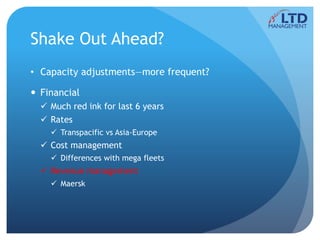
Shake Out Ahead?
• Capacity adjustments—more frequent?
 Financial
 Much red ink for last 6 years
 Rates
 Transpacific vs Asia-Europe
 Cost management
 Differences with mega fleets
 Revenue management
 Maersk
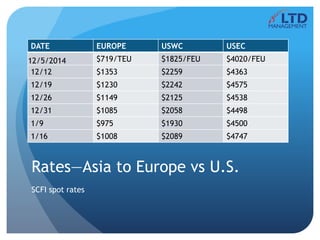
Rates—Asia to Europe vs U.S.
DATE EUROPE USWC USEC
12/5/2014 $719/TEU $1825/FEU $4020/FEU
12/12 $1353 $2259 $4363
12/19 $1230 $2242 $4575
12/26 $1149 $2125 $4538
12/31 $1085 $2058 $4498
1/9 $975 $1930 $4500
1/16 $1008 $2089 $4747
SCFI spot rates
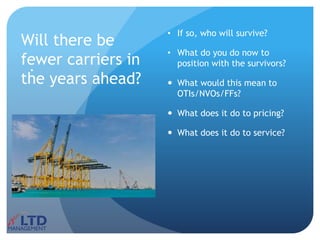
Will there be
fewer carriers in
the years ahead?
• If so, who will survive?
• What do you do now to
position with the survivors?
 What would this mean to
OTIs/NVOs/FFs?
 What does it do to pricing?
 What does it do to service?
•
Service--Global
Supply Chain Erosion
What Carriers Are Doing
 More to previous, with different take
 Remember that need to know to buy transport
 Alliances
 P3 is now the M2
 New -- Ocean 3 (CMA CGM, UASC, China Shipping)
 Operating issues
 Shipping Routes – revised
Carriers
 Sailing Schedules – made and reworked
 “Slow Steaming”
 Skipped / blank sailings
 Maersk closed 2 services in transpacifc (after losses in
trade for 9 of 10 years)
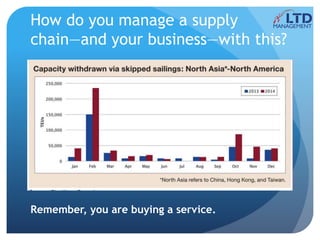
How do you manage a supply
chain—and your business—with this?
Remember, you are buying a service.
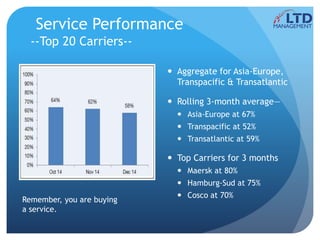
Service Performance
--Top 20 Carriers--
Remember-- you are
buying a service
 Aggregate for Asia-Europe,
Transpacific & Transatlantic
 Rolling 3-month average—
 Asia-Europe at 67%
 Transpacific at 52%
 Transatlantic at 59%
 Top Carriers for 3 months
 Maersk at 80%
 Hamburg-Sud at 75%
 Cosco at 70%
Remember, you are buying
a service.
Service Performance
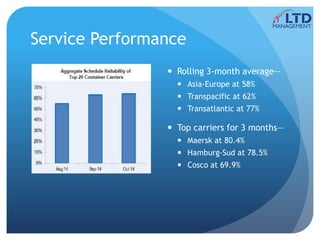
 Rolling 3-month average--
 Asia-Europe at 58%
 Transpacific at 62%
 Transatlantic at 77%
 Top carriers for 3 months—
 Maersk at 80.4%
 Hamburg-Sud at 78.5%
 Cosco at 69.9%
What It All Means
 Irregular Performance
 Will lower bunker/fuel prices improve on-time?
 Lack of service reliability
 Potential changes as to ports to handle ships
Which Means—For You
 Increased uncertainty for planning
 Negative impact on operations & sales
 Undermine inventory yield maximization
 More inventories
 More capital tied up
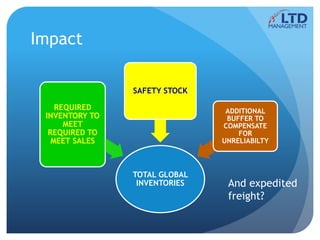
Impact
TOTAL GLOBAL
INVENTORIES
REQUIRED
INVENTORY TO
MEET
REQUIRED TO
MEET SALES
SAFETY STOCK
ADDITIONAL
BUFFER TO
COMPENSATE
FOR
UNRELIABILTY
And expedited
freight?
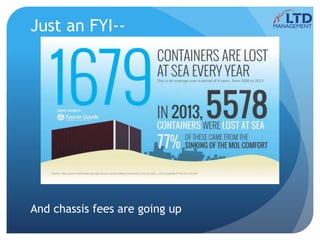
Just an FYI--
And chassis fees are going up
By The Way…
• How does all this factor into
your importing and carrier
selection (even if you use a
NVO)?
• How do you factor all this into
your business?
• Have you considered how
much is about big and big – big
carriers and big shippers?
• Do you form an IGA shippers
association to leverage buying
power for import freight rates
and service?
Questions???
Blue Ocean Strategy
Using Supply Chain Management
“We typically lose out when a market
commoditizes and we no longer
differentiate, further aggravated by us
being too slow or expensive.”
Frans van Houten, CEO, Royal Philips Electronics
Any of these your business?
 Commoditized?
 Sell mostly on price?
 Margin issues?
 Customer retention/turnover?
 Growth issues?
 Little/ no competitive differentiation?
What do your customers think of you?
Start simple—
Percent of orders delivered
complete, accurate, and on time
 Do you know?
 If you don’t know, how
can you say you provide
good service?
 Is it good?
 If not, what are you doing
about it?
 Where is your competitive
differentiation?
Blue Ocean Strategy
What blue ocean is
What blue ocean does
Uncontested market space
Create new industry –- OR—
Alter your boundaries (make blue ocean
from red ocean)
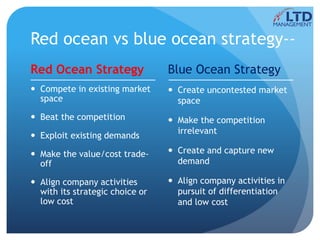
Red ocean vs blue ocean strategy--
Red Ocean Strategy
 Compete in existing market
space
 Beat the competition
 Exploit existing demands
 Make the value/cost trade-
off
 Align company activities
with its strategic choice or
low cost
Blue Ocean Strategy
 Create uncontested market
space
 Make the competition
irrelevant
 Create and capture new
demand
 Align company activities in
pursuit of differentiation
and low cost
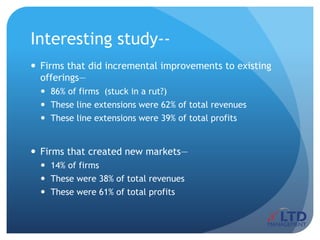
Interesting study--
 Firms that did incremental improvements to existing
offerings—
 86% of firms (stuck in a rut?)
 These line extensions were 62% of total revenues
 These line extensions were 39% of total profits
 Firms that created new markets—
 14% of firms
 These were 38% of total revenues
 These were 61% of total profits
Think about this
How much strategy is actually just a
reaction to competition?
Blue Ocean
Opportunities
New e-commerce
Multichannel
Global
Competitive differentiation
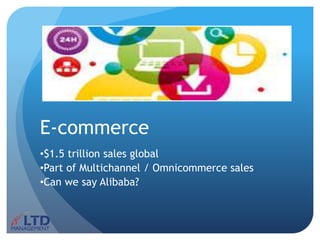
E-commerce
•$1.5 trillion sales global
•Part of Multichannel / Omnicommerce sales
•Can we say Alibaba?
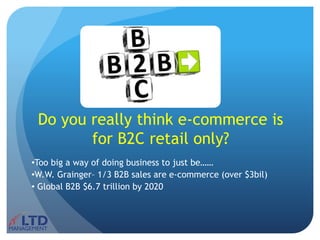
Do you really think e-commerce is
for B2C retail only?
•Too big a way of doing business to just be……
•W.W. Grainger– 1/3 B2B sales are e-commerce (over $3bil)
• Global B2B $6.7 trillion by 2020
Old vs New
e-commerce
 Immediacy
 Amazon
 Amazon Supply
 Macy’s
 Nieman Marcus
 Same old-same old
 Web site
 Ship orders
UPS and FedEx dim pricing!
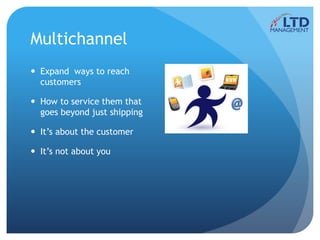
Multichannel
 Expand ways to reach
customers
 How to service them that
goes beyond just shipping
 It’s about the customer
 It’s not about you
Are we
 Looking at a paradigm
shift—
 For Selling
 For Supply Chain
Management
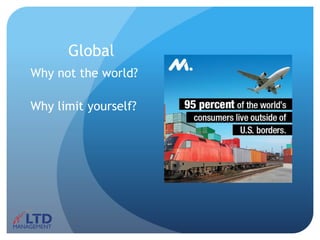
Global
Why not the world?
Why limit yourself?
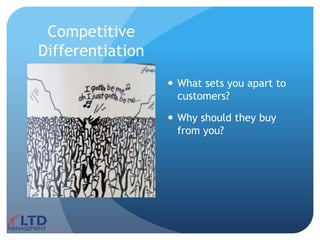
Competitive
Differentiation
 What sets you apart to
customers?
 Why should they buy
from you?
Red ocean supply chain
•Is monolithic
•Is defined by functions
•Is measured by costs
•Focus on orders
•Carry more inventory—and invest more working capital—
than is required
•Struggle to deliver orders complete, accurate and on-
time
•Utilize technology primarily for functions, such as for
warehouses and for “track and trace” transport
Blue Ocean Supply Chain
 Deliver orders complete,
accurate and on-time per
Immediacy
 Is defined by integrated
process
 Utilize integrated supply chain
execution technology across
the supply chain
 Use logistics service providers
that complement innovative
supply chain service
•Is segmented by channel
•Is measured by performance
and service
•Focus on customers
•Focus on delivery
•Focus on product positioning
and availability
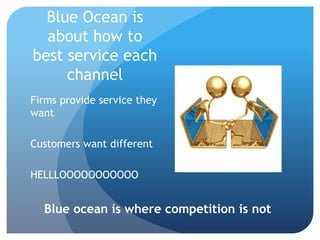
Blue Ocean is
about how to
best service each
channel
Firms provide service they
want
Customers want different
HELLLOOOOOOOOOOO
Blue ocean is where competition is not
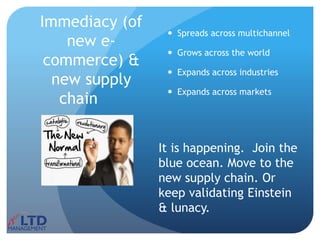
Immediacy (of
new e-
commerce) &
new supply
chain
 Spreads across multichannel
 Grows across the world
 Expands across industries
 Expands across markets
It is happening. Join the
blue ocean. Move to the
new supply chain. Or
keep validating Einstein
& lunacy.
For Blue Ocean Supply Chains
No quick fixes
No “you just”
It’s change
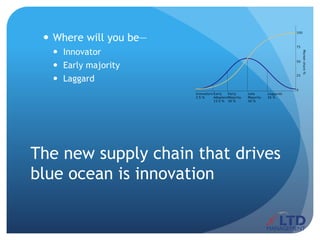
The new supply chain that drives
blue ocean is innovation
 Where will you be—
 Innovator
 Early majority
 Laggard
Questions
And Comments
"You got to be careful if you don’t know
where you’re going, because you might
not get there." –
Yogi Berra

LinkedIn Share

  • 1.
    Global Logistics & SupplyChain Management Making Sense of it All and Where It is Going Tom Craig – tomc@ltdmgmt.com LTD Management www.ltdmgmt.com
  • 2.
    Topics  GLOBAL LOGISTICS-- West Coast & Domino Effect  Container Line Chaos  SUPPLY CHAIN MANAGEMENT--  Blue Ocean Strategy Using Supply Chain Management
  • 3.
  • 4.
    West Coast Ports& Domino • Poor Service, Congestion • Christmas • Chinese/Lunar New Year • Alternative Port Issues • Air Freight
  • 5.
    Questions  Do youuse carriers directly or a forwarder?  Do you use West Coast ports?  How stable was and are your rates?  Did you have any booking problems?  Did you have any problems getting empties?  Did you make any adjustments? When?  How did you make out?  AND---
  • 6.
    THE Question What areyou going to do now?
  • 7.
    Pending Chaos!? Is ThereMore Ahead than West Coast Port Issues?
  • 8.
  • 9.
    Issues • Ship supplyexceeds demand • Pricing/Rates • Service & space Need to know what is going on in order to negotiate and to buy ocean transport service.
  • 10.
    Mega Ships Mega ShipAircraft Carrier
  • 11.
    CSCL Globe •19,100 TEU Containersstretch 72 miles 156 million pairs of shoes 300 million tablet computers 900 million standard tins of baked beans •Was biggest ship (for 53 days) Now MSC Oscar 19,224 TEU •One big ship or no megas vs fleet of ultra large??
  • 12.
    Issues They Face •Megas / Ultra Large – 18,000+ TEU (vs. 1,000 TEU in 1970’s) • Lower Operating Costs • How Will Ships be Filled? • Which Ports Will Handle Them? • How Will Ports Handle Them? • What’s the Investment? • Bottlenecks!
  • 13.
    Shake Out Ahead? •Capacity adjustments—more frequent?  Financial  Much red ink for last 6 years  Rates  Transpacific vs Asia-Europe  Cost management  Differences with mega fleets  Revenue management  Maersk
  • 14.
    Rates—Asia to Europevs U.S. DATE EUROPE USWC USEC 12/5/2014 $719/TEU $1825/FEU $4020/FEU 12/12 $1353 $2259 $4363 12/19 $1230 $2242 $4575 12/26 $1149 $2125 $4538 12/31 $1085 $2058 $4498 1/9 $975 $1930 $4500 1/16 $1008 $2089 $4747 SCFI spot rates
  • 15.
    Will there be fewercarriers in the years ahead? • If so, who will survive? • What do you do now to position with the survivors?  What would this mean to OTIs/NVOs/FFs?  What does it do to pricing?  What does it do to service? •
  • 16.
  • 17.
    What Carriers AreDoing  More to previous, with different take  Remember that need to know to buy transport  Alliances  P3 is now the M2  New -- Ocean 3 (CMA CGM, UASC, China Shipping)  Operating issues  Shipping Routes – revised
  • 18.
    Carriers  Sailing Schedules– made and reworked  “Slow Steaming”  Skipped / blank sailings  Maersk closed 2 services in transpacifc (after losses in trade for 9 of 10 years)
  • 19.
    How do youmanage a supply chain—and your business—with this? Remember, you are buying a service.
  • 20.
    Service Performance --Top 20Carriers-- Remember-- you are buying a service  Aggregate for Asia-Europe, Transpacific & Transatlantic  Rolling 3-month average—  Asia-Europe at 67%  Transpacific at 52%  Transatlantic at 59%  Top Carriers for 3 months  Maersk at 80%  Hamburg-Sud at 75%  Cosco at 70% Remember, you are buying a service.
  • 21.
    Service Performance  Rolling3-month average--  Asia-Europe at 58%  Transpacific at 62%  Transatlantic at 77%  Top carriers for 3 months—  Maersk at 80.4%  Hamburg-Sud at 78.5%  Cosco at 69.9%
  • 22.
    What It AllMeans  Irregular Performance  Will lower bunker/fuel prices improve on-time?  Lack of service reliability  Potential changes as to ports to handle ships
  • 23.
    Which Means—For You Increased uncertainty for planning  Negative impact on operations & sales  Undermine inventory yield maximization  More inventories  More capital tied up
  • 24.
    Impact TOTAL GLOBAL INVENTORIES REQUIRED INVENTORY TO MEET REQUIREDTO MEET SALES SAFETY STOCK ADDITIONAL BUFFER TO COMPENSATE FOR UNRELIABILTY And expedited freight?
  • 25.
    Just an FYI-- Andchassis fees are going up
  • 26.
    By The Way… •How does all this factor into your importing and carrier selection (even if you use a NVO)? • How do you factor all this into your business? • Have you considered how much is about big and big – big carriers and big shippers? • Do you form an IGA shippers association to leverage buying power for import freight rates and service?
  • 27.
  • 28.
    Blue Ocean Strategy UsingSupply Chain Management
  • 29.
    “We typically loseout when a market commoditizes and we no longer differentiate, further aggravated by us being too slow or expensive.” Frans van Houten, CEO, Royal Philips Electronics
  • 30.
    Any of theseyour business?  Commoditized?  Sell mostly on price?  Margin issues?  Customer retention/turnover?  Growth issues?  Little/ no competitive differentiation? What do your customers think of you?
  • 31.
    Start simple— Percent oforders delivered complete, accurate, and on time  Do you know?  If you don’t know, how can you say you provide good service?  Is it good?  If not, what are you doing about it?  Where is your competitive differentiation?
  • 32.
    Blue Ocean Strategy Whatblue ocean is What blue ocean does
  • 33.
    Uncontested market space Createnew industry –- OR— Alter your boundaries (make blue ocean from red ocean)
  • 34.
    Red ocean vsblue ocean strategy-- Red Ocean Strategy  Compete in existing market space  Beat the competition  Exploit existing demands  Make the value/cost trade- off  Align company activities with its strategic choice or low cost Blue Ocean Strategy  Create uncontested market space  Make the competition irrelevant  Create and capture new demand  Align company activities in pursuit of differentiation and low cost
  • 35.
    Interesting study--  Firmsthat did incremental improvements to existing offerings—  86% of firms (stuck in a rut?)  These line extensions were 62% of total revenues  These line extensions were 39% of total profits  Firms that created new markets—  14% of firms  These were 38% of total revenues  These were 61% of total profits
  • 36.
    Think about this Howmuch strategy is actually just a reaction to competition?
  • 37.
  • 38.
    E-commerce •$1.5 trillion salesglobal •Part of Multichannel / Omnicommerce sales •Can we say Alibaba?
  • 39.
    Do you reallythink e-commerce is for B2C retail only? •Too big a way of doing business to just be…… •W.W. Grainger– 1/3 B2B sales are e-commerce (over $3bil) • Global B2B $6.7 trillion by 2020
  • 40.
    Old vs New e-commerce Immediacy  Amazon  Amazon Supply  Macy’s  Nieman Marcus  Same old-same old  Web site  Ship orders UPS and FedEx dim pricing!
  • 41.
    Multichannel  Expand waysto reach customers  How to service them that goes beyond just shipping  It’s about the customer  It’s not about you
  • 42.
    Are we  Lookingat a paradigm shift—  For Selling  For Supply Chain Management
  • 43.
    Global Why not theworld? Why limit yourself?
  • 44.
    Competitive Differentiation  What setsyou apart to customers?  Why should they buy from you?
  • 45.
    Red ocean supplychain •Is monolithic •Is defined by functions •Is measured by costs •Focus on orders •Carry more inventory—and invest more working capital— than is required •Struggle to deliver orders complete, accurate and on- time •Utilize technology primarily for functions, such as for warehouses and for “track and trace” transport
  • 46.
    Blue Ocean SupplyChain  Deliver orders complete, accurate and on-time per Immediacy  Is defined by integrated process  Utilize integrated supply chain execution technology across the supply chain  Use logistics service providers that complement innovative supply chain service •Is segmented by channel •Is measured by performance and service •Focus on customers •Focus on delivery •Focus on product positioning and availability
  • 47.
    Blue Ocean is abouthow to best service each channel Firms provide service they want Customers want different HELLLOOOOOOOOOOO Blue ocean is where competition is not
  • 48.
    Immediacy (of new e- commerce)& new supply chain  Spreads across multichannel  Grows across the world  Expands across industries  Expands across markets It is happening. Join the blue ocean. Move to the new supply chain. Or keep validating Einstein & lunacy.
  • 49.
    For Blue OceanSupply Chains No quick fixes No “you just” It’s change
  • 50.
    The new supplychain that drives blue ocean is innovation  Where will you be—  Innovator  Early majority  Laggard
  • 51.
  • 52.
    "You got tobe careful if you don’t know where you’re going, because you might not get there." – Yogi Berra