Myocardial Infarction is not always a
simple diagnosis.
Case discussion
1
Background
 Mrs. S, 63 year old lady
 Adult onset sero-negative rheumatoid
Arthritis since 2009
 On Methotrexate 7.5mg weekly since 2010
 Diabetes Mellitus since 2012,on diet control
2
At ETU
 Central tightening chest pain
 Persistent
 severe
 No radiation
 Autonomic disturbances
 Worsening shortness of breath for three days.
 No palpitation
 No history of fever or cough
3
On examination
 In pain
 Mildly dyspnoeic at rest
 Afebrile
 Pallor
 JVP- not elevated
 PR – 90 bpm, BP – 110/80 mmHg, SpO2 – 94%
 B/L basal crepitation
4
ECG
5
At ETU
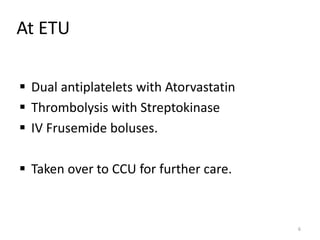
 Dual antiplatelets with Atorvastatin
 Thrombolysis with Streptokinase
 IV Frusemide boluses.
 Taken over to CCU for further care.
6
What they have done at CCU
 2D Echo revealed extensive anterior wall
motion abnormalities
 Started LMWH
 Rheumatology review.
7
At CCU
 Cardiac Enzyme profile
cpk MB – 109u/l, cpk-609, SGOT -87u/l , LDH – 1080 u/l
 FBC Hb – 7.1 g/dl, WBC – 12300 cumm3, N-89%, Plt – 303000
 Blood picture
NCNC anaemia, mild Neutrophil leucocytosis, adequate Plt
 ESR - 146 mm 1st hour
 Scr - 136 mmol/l
8
Liver function test
Total Protein 62 g/l
Albumin 31 g/l
Globulin 31 g/l
AST 61 u/l
ALT 31 u/l
ALP 396 u/l
T. Billi 7.8 mmol/l
INR 1.0
9
On admission to ward - 15
 She does not complain of chest pain. Mild short of
breath.
 LOA
 Malaise, body weakness
 Multiple small joint pain and swelling with no
significant morning stiffness.
 Bleeding from mouth, no other bleeding
manifestations.
 UOP was adequate.
10
On admission to ward - 15
 Conscious and rational.
 Not in pain.
 Mildly dyspoenic.
 Mild temperature.
 Gum bleeding.
 Pallor, Anicteric
 Painful oral ulcers, no genital ulcers
 No skin rashes, few ecchymotic patches.
 No lymph node enlargement.
 Haemodynamically stable.
 B/L crepitation.
 Abdomen – soft, no organomegaly.
 Multiple small joint tenderness and swelling, no evidence of extra articular
manifestations.
 No neurological weakness.
11
 FBC
 WBC – 600 cumm3
 HB – 7.6 g/dl
 PLT – 23000 cumm3
 Blood Picture
 RBC – normocytic normochromic
 WBC – marked leukopaenia with neutropaenia
 PLT – low with some large platelets.
Conclusion :
Pancytopaenia; most probably drug related.
12
 ESR – 133 mm 1st h
 CRP – 129 mg/dl
 UFR – RBC field full
 S.cr – 3.24 mg/dl
 Clotting profile
 APTT – 35 sec.
 INR - 1
 Serum Ferritin – 1196 ng/ml [20 – 400 ng/l]
13
Liver enzyme profile
Total protein 58 g/dl
Albumin 32 g/dl
Globulin 25 g/dl
T. Billi 1.87 mg/dl
AST 80 u/l
ALT 100 u/l
ALP 1072 mg/dl
GGT 130 mg/dl
INR 1.2
14
Problem list
 Problem list.
 In a patient with sero negative RA, on Methotrexate
 Recent, STEMI
 Mild Fever with Pancytopaenia
 Gum bleeding with normal clotting profile [low platelet].
 Multiple small joint pain, swelling, with minimal morning stiffness with
high inflammatory markers.
 Deranged liver function, marginally low albumin, predominantly
cholestatic
 Renal impairment (Acute kidney injury)
15
 Could single disease entity explain all her
problems??
16
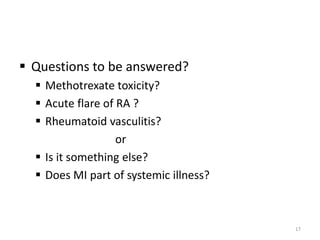
 Questions to be answered?
 Methotrexate toxicity?
 Acute flare of RA ?
 Rheumatoid vasculitis?
or
 Is it something else?
 Does MI part of systemic illness?
17
 How should we investigate her,now?
18
Is it a acute flare?
Common indicators of disease activity in RA include the
following measurements
 Swollen and tender joint counts
 Pain
 Patient and evaluator global assessments of disease activity
 Erythrocyte sedimentation rate and C-reactive protein (ESR, CRP)
 Duration of morning stiffness
 Fatigue
19
Is it Methotrexate toxicity?
 Oral ulcers
 Pancytopaenia
 Deranged liver function
 Acute kidney injury
 General ill health
20
21
22
Is it Rheumatoid vascuilitis?
 Typically occurs in patients with long-standing, joint-
destructive RA when the inflammatory arthritis is "burned
out,"
 Presentations of RV within five years of the RA diagnosis
are very unusual
 Significant constitutional symptoms.
 Nearly always have rheumatoid nodules.
 strongly positive for rheumatoid factor.
23
 Is it something else?
24
 Causes for Pancytopaenia in a patient with
rheumatoid arthritis?
 Mostly related to drugs,(Methotrexate, Leflunomide,
Azathioprine, Infliximab)
 Lymphoma
 Felty’s syndrome
 Macrophage activation syndrome
 Visceral leishmaniasis
25
 Causes for Ferritin > 1000 ng/l
 Still’s disease
 Milliary Tuberculosis
 Catastrophic APLS
 Haemophagocytic syndrome / Macrophage
activation syndrome(MAS)
 SIRS
26
Bone marrow biopsy
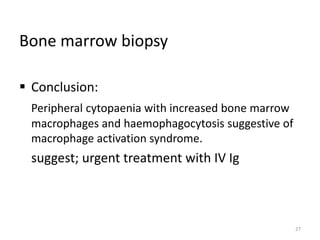
 Conclusion:
Peripheral cytopaenia with increased bone marrow
macrophages and haemophagocytosis suggestive of
macrophage activation syndrome.
suggest; urgent treatment with IV Ig
27
28
29
30
31
32
What we have done here.
“Multi disciplinary approach”
 IV Methylprednisolone 1 g daily for five days.
 Broad spectrum IV antibiotic on Microbiologist
guidance
 IV PPI
 Withheld Methotrexate
 IV Folinic acid “rescue therapy”
 Started IvIg 0.4 mg/kg daily.
33
What happened to the our patient?
 Respiratory arrest on D1 IvIg
 Transferred to ITU for ventilatory support
 Succumbs on D 4, admission to ICU
34
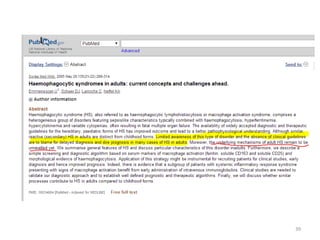
 What's new about ferritin?
35
Ferritin
36
37
38
39
Take home message
 MAS is a potentially fatal condition and it is
often missed in adults.
 Goals for the future include increasing
awareness of the condition, which requires
both early diagnosis and early effective
therapy to further reduce mortality.
40
41

Macrophage activation

  • 1.
    Myocardial Infarction isnot always a simple diagnosis. Case discussion 1
  • 2.
    Background  Mrs. S,63 year old lady  Adult onset sero-negative rheumatoid Arthritis since 2009  On Methotrexate 7.5mg weekly since 2010  Diabetes Mellitus since 2012,on diet control 2
  • 3.
    At ETU  Centraltightening chest pain  Persistent  severe  No radiation  Autonomic disturbances  Worsening shortness of breath for three days.  No palpitation  No history of fever or cough 3
  • 4.
    On examination  Inpain  Mildly dyspnoeic at rest  Afebrile  Pallor  JVP- not elevated  PR – 90 bpm, BP – 110/80 mmHg, SpO2 – 94%  B/L basal crepitation 4
  • 5.
  • 6.
    At ETU  Dualantiplatelets with Atorvastatin  Thrombolysis with Streptokinase  IV Frusemide boluses.  Taken over to CCU for further care. 6
  • 7.
    What they havedone at CCU  2D Echo revealed extensive anterior wall motion abnormalities  Started LMWH  Rheumatology review. 7
  • 8.
    At CCU  CardiacEnzyme profile cpk MB – 109u/l, cpk-609, SGOT -87u/l , LDH – 1080 u/l  FBC Hb – 7.1 g/dl, WBC – 12300 cumm3, N-89%, Plt – 303000  Blood picture NCNC anaemia, mild Neutrophil leucocytosis, adequate Plt  ESR - 146 mm 1st hour  Scr - 136 mmol/l 8
  • 9.
    Liver function test TotalProtein 62 g/l Albumin 31 g/l Globulin 31 g/l AST 61 u/l ALT 31 u/l ALP 396 u/l T. Billi 7.8 mmol/l INR 1.0 9
  • 10.
    On admission toward - 15  She does not complain of chest pain. Mild short of breath.  LOA  Malaise, body weakness  Multiple small joint pain and swelling with no significant morning stiffness.  Bleeding from mouth, no other bleeding manifestations.  UOP was adequate. 10
  • 11.
    On admission toward - 15  Conscious and rational.  Not in pain.  Mildly dyspoenic.  Mild temperature.  Gum bleeding.  Pallor, Anicteric  Painful oral ulcers, no genital ulcers  No skin rashes, few ecchymotic patches.  No lymph node enlargement.  Haemodynamically stable.  B/L crepitation.  Abdomen – soft, no organomegaly.  Multiple small joint tenderness and swelling, no evidence of extra articular manifestations.  No neurological weakness. 11
  • 12.
     FBC  WBC– 600 cumm3  HB – 7.6 g/dl  PLT – 23000 cumm3  Blood Picture  RBC – normocytic normochromic  WBC – marked leukopaenia with neutropaenia  PLT – low with some large platelets. Conclusion : Pancytopaenia; most probably drug related. 12
  • 13.
     ESR –133 mm 1st h  CRP – 129 mg/dl  UFR – RBC field full  S.cr – 3.24 mg/dl  Clotting profile  APTT – 35 sec.  INR - 1  Serum Ferritin – 1196 ng/ml [20 – 400 ng/l] 13
  • 14.
    Liver enzyme profile Totalprotein 58 g/dl Albumin 32 g/dl Globulin 25 g/dl T. Billi 1.87 mg/dl AST 80 u/l ALT 100 u/l ALP 1072 mg/dl GGT 130 mg/dl INR 1.2 14 Problem list
  • 15.
     Problem list. In a patient with sero negative RA, on Methotrexate  Recent, STEMI  Mild Fever with Pancytopaenia  Gum bleeding with normal clotting profile [low platelet].  Multiple small joint pain, swelling, with minimal morning stiffness with high inflammatory markers.  Deranged liver function, marginally low albumin, predominantly cholestatic  Renal impairment (Acute kidney injury) 15
  • 16.
     Could singledisease entity explain all her problems?? 16
  • 17.
     Questions tobe answered?  Methotrexate toxicity?  Acute flare of RA ?  Rheumatoid vasculitis? or  Is it something else?  Does MI part of systemic illness? 17
  • 18.
     How shouldwe investigate her,now? 18
  • 19.
    Is it aacute flare? Common indicators of disease activity in RA include the following measurements  Swollen and tender joint counts  Pain  Patient and evaluator global assessments of disease activity  Erythrocyte sedimentation rate and C-reactive protein (ESR, CRP)  Duration of morning stiffness  Fatigue 19
  • 20.
    Is it Methotrexatetoxicity?  Oral ulcers  Pancytopaenia  Deranged liver function  Acute kidney injury  General ill health 20
  • 21.
  • 22.
  • 23.
    Is it Rheumatoidvascuilitis?  Typically occurs in patients with long-standing, joint- destructive RA when the inflammatory arthritis is "burned out,"  Presentations of RV within five years of the RA diagnosis are very unusual  Significant constitutional symptoms.  Nearly always have rheumatoid nodules.  strongly positive for rheumatoid factor. 23
  • 24.
     Is itsomething else? 24
  • 25.
     Causes forPancytopaenia in a patient with rheumatoid arthritis?  Mostly related to drugs,(Methotrexate, Leflunomide, Azathioprine, Infliximab)  Lymphoma  Felty’s syndrome  Macrophage activation syndrome  Visceral leishmaniasis 25
  • 26.
     Causes forFerritin > 1000 ng/l  Still’s disease  Milliary Tuberculosis  Catastrophic APLS  Haemophagocytic syndrome / Macrophage activation syndrome(MAS)  SIRS 26
  • 27.
    Bone marrow biopsy Conclusion: Peripheral cytopaenia with increased bone marrow macrophages and haemophagocytosis suggestive of macrophage activation syndrome. suggest; urgent treatment with IV Ig 27
  • 28.
  • 29.
  • 30.
  • 31.
  • 32.
  • 33.
    What we havedone here. “Multi disciplinary approach”  IV Methylprednisolone 1 g daily for five days.  Broad spectrum IV antibiotic on Microbiologist guidance  IV PPI  Withheld Methotrexate  IV Folinic acid “rescue therapy”  Started IvIg 0.4 mg/kg daily. 33
  • 34.
    What happened tothe our patient?  Respiratory arrest on D1 IvIg  Transferred to ITU for ventilatory support  Succumbs on D 4, admission to ICU 34
  • 35.
     What's newabout ferritin? 35
  • 36.
  • 37.
  • 38.
  • 39.
  • 40.
    Take home message MAS is a potentially fatal condition and it is often missed in adults.  Goals for the future include increasing awareness of the condition, which requires both early diagnosis and early effective therapy to further reduce mortality. 40
  • 41.

Editor's Notes

  • #3 I m going to …………sequence of events.
  • #5 Now, you may be eagerly waiting to see her ECG, rather than listening to the rest of the story.
  • #8 She was clinically OK
  • #9 Basic investigations
  • #10 She continues to have malaise
  • #11 D - 5 of admission to CCU, she was transferred to our ward for further care.
  • #27 MAS potentially life threatening, can not be disregard in the background of RA