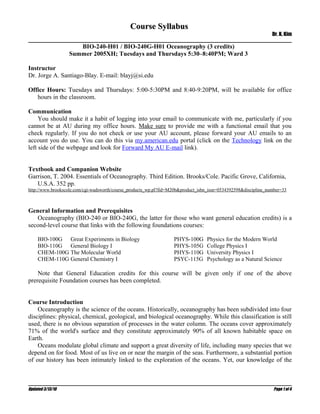
Course Syllabus
                                                                                                                 Dr. K. Kim

                      BIO-240-H01 / BIO-240G-H01 Oceanography (3 credits)
                   Summer 2005XH; Tuesdays and Thursdays 5:30–8:40PM; Ward 3

Instructor
Dr. Jorge A. Santiago-Blay. E-mail: blayj@si.edu

Office Hours: Tuesdays and Thursdays: 5:00-5:30PM and 8:40-9:20PM, will be available for office
   hours in the classroom.

Communication
     You should make it a habit of logging into your email to communicate with me, particularly if you
cannot be at AU during my office hours. Make sure to provide me with a functional email that you
check regularly. If you do not check or use your AU account, please forward your AU emails to an
account you do use. You can do this via my.american.edu portal (click on the Technology link on the
left side of the webpage and look for Forward My AU E-mail link).


Textbook and Companion Website
Garrison, T. 2004. Essentials of Oceanography. Third Edition. Brooks/Cole. Pacific Grove, California,
   U.S.A. 352 pp.
http://www.brookscole.com/cgi-wadsworth/course_products_wp.pl?fid=M20b&product_isbn_issn=0534392598&discipline_number=33


General Information and Prerequisites
   Oceanography (BIO-240 or BIO-240G, the latter for those who want general education credits) is a
second-level course that links with the following foundations courses:

     BIO-100G Great Experiments in Biology                         PHYS-100G       Physics for the Modern World
     BIO-110G General Biology I                                    PHYS-105G       College Physics I
     CHEM-100G The Molecular World                                 PHYS-110G       University Physics I
     CHEM-110G General Chemistry I                                 PSYC-115G       Psychology as a Natural Science

    Note that General Education credits for this course will be given only if one of the above
prerequisite Foundation courses has been completed.


Course Introduction
    Oceanography is the science of the oceans. Historically, oceanography has been subdivided into four
disciplines: physical, chemical, geological, and biological oceanography. While this classification is still
used, there is no obvious separation of processes in the water column. The oceans cover approximately
71% of the world's surface and they constitute approximately 90% of all known habitable space on
Earth.
    Oceans modulate global climate and support a great diversity of life, including many species that we
depend on for food. Most of us live on or near the margin of the seas. Furthermore, a substantial portion
of our history has been intimately linked to the exploration of the oceans. Yet, our knowledge of the


Updated 3/13/10                                                                                                   Page 1 of 4
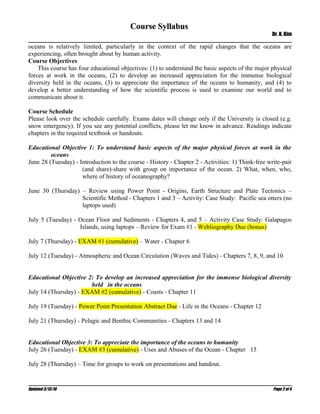
Course Syllabus
                                                                                                   Dr. K. Kim

oceans is relatively limited, particularly in the context of the rapid changes that the oceans are
experiencing, often brought about by human activity.
Course Objectives
    This course has four educational objectives: (1) to understand the basic aspects of the major physical
forces at work in the oceans, (2) to develop an increased appreciation for the immense biological
diversity held in the oceans, (3) to appreciate the importance of the oceans to humanity, and (4) to
develop a better understanding of how the scientific process is used to examine our world and to
communicate about it.

Course Schedule
Please look over the schedule carefully. Exams dates will change only if the University is closed (e.g.
snow emergency). If you see any potential conflicts, please let me know in advance. Readings indicate
chapters in the required textbook or handouts.

Educational Objective 1: To understand basic aspects of the major physical forces at work in the
         oceans
June 28 (Tuesday) - Introduction to the course - History - Chapter 2 - Activities: 1) Think-free write-pair
                     (and share)-share with group on importance of the ocean. 2) What, when, who,
                     where of history of oceanography?

June 30 (Thursday) – Review using Power Point - Origins, Earth Structure and Plate Tectonics –
                   Scientific Method - Chapters 1 and 3 – Activity: Case Study: Pacific sea otters (no
                   laptops used)

July 5 (Tuesday) - Ocean Floor and Sediments - Chapters 4, and 5 – Activity Case Study: Galapagos
                   Islands, using laptops – Review for Exam #1 - Webliography Due (bonus)

July 7 (Thursday) - EXAM #1 (cumulative) – Water - Chapter 6

July 12 (Tuesday) - Atmospheric and Ocean Circulation (Waves and Tides) - Chapters 7, 8, 9, and 10


Educational Objective 2: To develop an increased appreciation for the immense biological diversity
                       held in the oceans
July 14 (Thursday) - EXAM #2 (cumulative) - Coasts - Chapter 11

July 19 (Tuesday) - Power Point Presentation Abstract Due - Life in the Oceans - Chapter 12

July 21 (Thursday) - Pelagic and Benthic Communities - Chapters 13 and 14


Educational Objective 3: To appreciate the importance of the oceans to humanity
July 26 (Tuesday) - EXAM #3 (cumulative) - Uses and Abuses of the Ocean - Chapter 15

July 28 (Thursday) – Time for groups to work on presentations and handout.


Updated 3/13/10                                                                                    Page 2 of 4
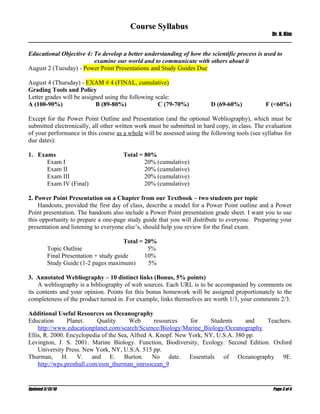
Course Syllabus
                                                                                                  Dr. K. Kim


Educational Objective 4: To develop a better understanding of how the scientific process is used to
                         examine our world and to communicate with others about it
August 2 (Tuesday) - Power Point Presentations and Study Guides Due

August 4 (Thursday) - EXAM # 4 (FINAL, cumulative)
Grading Tools and Policy
Letter grades will be assigned using the following scale:
A (100-90%)                B (89-80%)               C (79-70%)           D (69-60%)            F (<60%)

Except for the Power Point Outline and Presentation (and the optional Webliography), which must be
submitted electronically, all other written work must be submitted in hard copy, in class. The evaluation
of your performance in this course as a whole will be assessed using the following tools (see syllabus for
due dates):

1. Exams                              Total = 80%
      Exam I                                  20% (cumulative)
      Exam II                                 20% (cumulative)
      Exam III                                20% (cumulative)
      Exam IV (Final)                         20% (cumulative)

2. Power Point Presentation on a Chapter from our Textbook – two students per topic
    Handouts, provided the first day of class, describe a model for a Power Point outline and a Power
Point presentation. The handouts also include a Power Point presentation grade sheet. I want you to use
this opportunity to prepare a one-page study guide that you will distribute to everyone. Preparing your
presentation and listening to everyone else’s, should help you review for the final exam.

                                        Total = 20%
          Topic Outline                          5%
          Final Presentation + study guide      10%
          Study Guide (1-2 pages maximum)        5%

3. Annotated Webliography – 10 distinct links (Bonus, 5% points)
    A webliography is a bibliography of web sources. Each URL is to be accompanied by comments on
its contents and your opinion. Points for this bonus homework will be assigned proportionately to the
completeness of the product turned in. For example, links themselves are worth 1/3, your comments 2/3.

Additional Useful Resources on Oceanography
Education       Planet.    Quality      Web       resources    for   Students      and Teachers.
    http://www.educationplanet.com/search/Science/Biology/Marine_Biology/Oceanography
Ellis, R. 2000. Encyclopedia of the Sea, Alfred A. Knopf. New York, NY, U.S.A. 380 pp.
Levington, J. S. 2001. Marine Biology. Function, Biodiversity, Ecology. Second Edition. Oxford
    University Press. New York, NY, U.S.A. 515 pp.
Thurman, H. V. and E. Burton. No date. Essentials of Oceanography 9E.
    http://wps.prenhall.com/esm_thurman_introocean_9


Updated 3/13/10                                                                                   Page 3 of 4
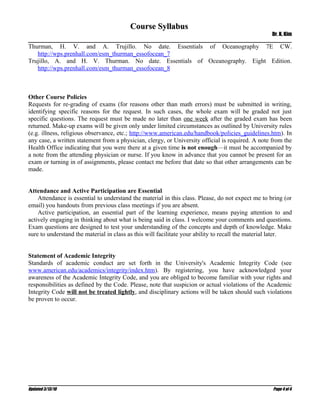
Course Syllabus
                                                                                                   Dr. K. Kim

Thurman, H. V. and A. Trujillo. No date. Essentials of Oceanography 7E CW.
   http://wps.prenhall.com/esm_thurman_essofocean_7
Trujillo, A. and H. V. Thurman. No date. Essentials of Oceanography. Eight Edition.
   http://wps.prenhall.com/esm_thurman_essofocean_8


Other Course Policies
Requests for re-grading of exams (for reasons other than math errors) must be submitted in writing,
identifying specific reasons for the request. In such cases, the whole exam will be graded not just
specific questions. The request must be made no later than one week after the graded exam has been
returned. Make-up exams will be given only under limited circumstances as outlined by University rules
(e.g. illness, religious observance, etc.; http://www.american.edu/handbook/policies_guidelines.htm). In
any case, a written statement from a physician, clergy, or University official is required. A note from the
Health Office indicating that you were there at a given time is not enough—it must be accompanied by
a note from the attending physician or nurse. If you know in advance that you cannot be present for an
exam or turning in of assignments, please contact me before that date so that other arrangements can be
made.


Attendance and Active Participation are Essential
    Attendance is essential to understand the material in this class. Please, do not expect me to bring (or
email) you handouts from previous class meetings if you are absent.
    Active participation, an essential part of the learning experience, means paying attention to and
actively engaging in thinking about what is being said in class. I welcome your comments and questions.
Exam questions are designed to test your understanding of the concepts and depth of knowledge. Make
sure to understand the material in class as this will facilitate your ability to recall the material later.


Statement of Academic Integrity
Standards of academic conduct are set forth in the University's Academic Integrity Code (see
www.american.edu/academics/integrity/index.htm). By registering, you have acknowledged your
awareness of the Academic Integrity Code, and you are obliged to become familiar with your rights and
responsibilities as defined by the Code. Please, note that suspicion or actual violations of the Academic
Integrity Code will not be treated lightly, and disciplinary actions will be taken should such violations
be proven to occur.


Updated 3/13/10                                                                                    Page 4 of 4

Oceanography Summer 05 Syllabus

  • 1.
    Course Syllabus Dr. K. Kim BIO-240-H01 / BIO-240G-H01 Oceanography (3 credits) Summer 2005XH; Tuesdays and Thursdays 5:30–8:40PM; Ward 3 Instructor Dr. Jorge A. Santiago-Blay. E-mail: blayj@si.edu Office Hours: Tuesdays and Thursdays: 5:00-5:30PM and 8:40-9:20PM, will be available for office hours in the classroom. Communication You should make it a habit of logging into your email to communicate with me, particularly if you cannot be at AU during my office hours. Make sure to provide me with a functional email that you check regularly. If you do not check or use your AU account, please forward your AU emails to an account you do use. You can do this via my.american.edu portal (click on the Technology link on the left side of the webpage and look for Forward My AU E-mail link). Textbook and Companion Website Garrison, T. 2004. Essentials of Oceanography. Third Edition. Brooks/Cole. Pacific Grove, California, U.S.A. 352 pp. http://www.brookscole.com/cgi-wadsworth/course_products_wp.pl?fid=M20b&product_isbn_issn=0534392598&discipline_number=33 General Information and Prerequisites Oceanography (BIO-240 or BIO-240G, the latter for those who want general education credits) is a second-level course that links with the following foundations courses: BIO-100G Great Experiments in Biology PHYS-100G Physics for the Modern World BIO-110G General Biology I PHYS-105G College Physics I CHEM-100G The Molecular World PHYS-110G University Physics I CHEM-110G General Chemistry I PSYC-115G Psychology as a Natural Science Note that General Education credits for this course will be given only if one of the above prerequisite Foundation courses has been completed. Course Introduction Oceanography is the science of the oceans. Historically, oceanography has been subdivided into four disciplines: physical, chemical, geological, and biological oceanography. While this classification is still used, there is no obvious separation of processes in the water column. The oceans cover approximately 71% of the world's surface and they constitute approximately 90% of all known habitable space on Earth. Oceans modulate global climate and support a great diversity of life, including many species that we depend on for food. Most of us live on or near the margin of the seas. Furthermore, a substantial portion of our history has been intimately linked to the exploration of the oceans. Yet, our knowledge of the Updated 3/13/10 Page 1 of 4
  • 2.
    Course Syllabus Dr. K. Kim oceans is relatively limited, particularly in the context of the rapid changes that the oceans are experiencing, often brought about by human activity. Course Objectives This course has four educational objectives: (1) to understand the basic aspects of the major physical forces at work in the oceans, (2) to develop an increased appreciation for the immense biological diversity held in the oceans, (3) to appreciate the importance of the oceans to humanity, and (4) to develop a better understanding of how the scientific process is used to examine our world and to communicate about it. Course Schedule Please look over the schedule carefully. Exams dates will change only if the University is closed (e.g. snow emergency). If you see any potential conflicts, please let me know in advance. Readings indicate chapters in the required textbook or handouts. Educational Objective 1: To understand basic aspects of the major physical forces at work in the oceans June 28 (Tuesday) - Introduction to the course - History - Chapter 2 - Activities: 1) Think-free write-pair (and share)-share with group on importance of the ocean. 2) What, when, who, where of history of oceanography? June 30 (Thursday) – Review using Power Point - Origins, Earth Structure and Plate Tectonics – Scientific Method - Chapters 1 and 3 – Activity: Case Study: Pacific sea otters (no laptops used) July 5 (Tuesday) - Ocean Floor and Sediments - Chapters 4, and 5 – Activity Case Study: Galapagos Islands, using laptops – Review for Exam #1 - Webliography Due (bonus) July 7 (Thursday) - EXAM #1 (cumulative) – Water - Chapter 6 July 12 (Tuesday) - Atmospheric and Ocean Circulation (Waves and Tides) - Chapters 7, 8, 9, and 10 Educational Objective 2: To develop an increased appreciation for the immense biological diversity held in the oceans July 14 (Thursday) - EXAM #2 (cumulative) - Coasts - Chapter 11 July 19 (Tuesday) - Power Point Presentation Abstract Due - Life in the Oceans - Chapter 12 July 21 (Thursday) - Pelagic and Benthic Communities - Chapters 13 and 14 Educational Objective 3: To appreciate the importance of the oceans to humanity July 26 (Tuesday) - EXAM #3 (cumulative) - Uses and Abuses of the Ocean - Chapter 15 July 28 (Thursday) – Time for groups to work on presentations and handout. Updated 3/13/10 Page 2 of 4
  • 3.
    Course Syllabus Dr. K. Kim Educational Objective 4: To develop a better understanding of how the scientific process is used to examine our world and to communicate with others about it August 2 (Tuesday) - Power Point Presentations and Study Guides Due August 4 (Thursday) - EXAM # 4 (FINAL, cumulative) Grading Tools and Policy Letter grades will be assigned using the following scale: A (100-90%) B (89-80%) C (79-70%) D (69-60%) F (<60%) Except for the Power Point Outline and Presentation (and the optional Webliography), which must be submitted electronically, all other written work must be submitted in hard copy, in class. The evaluation of your performance in this course as a whole will be assessed using the following tools (see syllabus for due dates): 1. Exams Total = 80% Exam I 20% (cumulative) Exam II 20% (cumulative) Exam III 20% (cumulative) Exam IV (Final) 20% (cumulative) 2. Power Point Presentation on a Chapter from our Textbook – two students per topic Handouts, provided the first day of class, describe a model for a Power Point outline and a Power Point presentation. The handouts also include a Power Point presentation grade sheet. I want you to use this opportunity to prepare a one-page study guide that you will distribute to everyone. Preparing your presentation and listening to everyone else’s, should help you review for the final exam. Total = 20% Topic Outline 5% Final Presentation + study guide 10% Study Guide (1-2 pages maximum) 5% 3. Annotated Webliography – 10 distinct links (Bonus, 5% points) A webliography is a bibliography of web sources. Each URL is to be accompanied by comments on its contents and your opinion. Points for this bonus homework will be assigned proportionately to the completeness of the product turned in. For example, links themselves are worth 1/3, your comments 2/3. Additional Useful Resources on Oceanography Education Planet. Quality Web resources for Students and Teachers. http://www.educationplanet.com/search/Science/Biology/Marine_Biology/Oceanography Ellis, R. 2000. Encyclopedia of the Sea, Alfred A. Knopf. New York, NY, U.S.A. 380 pp. Levington, J. S. 2001. Marine Biology. Function, Biodiversity, Ecology. Second Edition. Oxford University Press. New York, NY, U.S.A. 515 pp. Thurman, H. V. and E. Burton. No date. Essentials of Oceanography 9E. http://wps.prenhall.com/esm_thurman_introocean_9 Updated 3/13/10 Page 3 of 4
  • 4.
    Course Syllabus Dr. K. Kim Thurman, H. V. and A. Trujillo. No date. Essentials of Oceanography 7E CW. http://wps.prenhall.com/esm_thurman_essofocean_7 Trujillo, A. and H. V. Thurman. No date. Essentials of Oceanography. Eight Edition. http://wps.prenhall.com/esm_thurman_essofocean_8 Other Course Policies Requests for re-grading of exams (for reasons other than math errors) must be submitted in writing, identifying specific reasons for the request. In such cases, the whole exam will be graded not just specific questions. The request must be made no later than one week after the graded exam has been returned. Make-up exams will be given only under limited circumstances as outlined by University rules (e.g. illness, religious observance, etc.; http://www.american.edu/handbook/policies_guidelines.htm). In any case, a written statement from a physician, clergy, or University official is required. A note from the Health Office indicating that you were there at a given time is not enough—it must be accompanied by a note from the attending physician or nurse. If you know in advance that you cannot be present for an exam or turning in of assignments, please contact me before that date so that other arrangements can be made. Attendance and Active Participation are Essential Attendance is essential to understand the material in this class. Please, do not expect me to bring (or email) you handouts from previous class meetings if you are absent. Active participation, an essential part of the learning experience, means paying attention to and actively engaging in thinking about what is being said in class. I welcome your comments and questions. Exam questions are designed to test your understanding of the concepts and depth of knowledge. Make sure to understand the material in class as this will facilitate your ability to recall the material later. Statement of Academic Integrity Standards of academic conduct are set forth in the University's Academic Integrity Code (see www.american.edu/academics/integrity/index.htm). By registering, you have acknowledged your awareness of the Academic Integrity Code, and you are obliged to become familiar with your rights and responsibilities as defined by the Code. Please, note that suspicion or actual violations of the Academic Integrity Code will not be treated lightly, and disciplinary actions will be taken should such violations be proven to occur. Updated 3/13/10 Page 4 of 4