Deep Learning
– With an Example Implementation
Krishna Bhavsar
Vinayak Joglekar
• More than 11 years working on
natural language processing,
social media analytics, text mining
and machine learning in various
industry domains
• Worked on most of the Open
Source NLP libraries related to
computational linguistics.
• Published a paper on sentiment
analysis augmentation techniques
in 2010 NAACL.
• Created an NLP pipeline/toolset
and open sourced it for public use.
• Authored “Natural Language
Processing Cookbook Using
Python”
Krishnakumar Bhavsar
• Passionately building software
products with Lean and Agile
Teams
• Nurtured top notch software
professionals and built several self
organizing teams.
• Actively pursuing business
opportunities in big data analytics,
machine learning and natural
language processing.
• Deep domain expertise in
technical hiring including resume
processing, technical assessment
and interviews.
Vinayak Joglekar
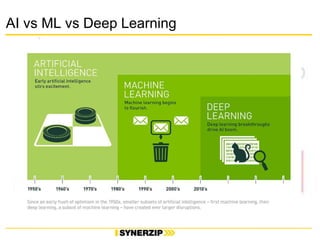
AI vs ML vs Deep Learning
Difference Between ML and Deep Learning
• ML – the concept existed in the 70s and 80s with the old
school statistical analysis, study of probabilities,
regressions,
• Concept of deep learning existed in the early 80s, only the
invent of parallel computing and cheap processing power
with commodity hardware has expedited the use of deep
learning algorithms
• Primary difference is the feedback mechanism involved
with the Deep Learning algorithms that is absent in ML
algorithms (it works in multiple passes)
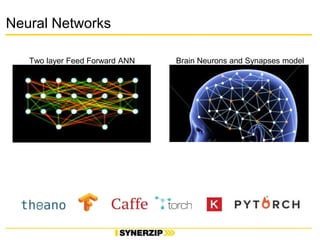
Neural Networks
Two layer Feed Forward ANN Brain Neurons and Synapses model
Example Problems that can be Solved
• Speech Recognition
• Natural Language Processing
• Bioinformatics
• Image Classification – classic cats and dogs
classification problem
–Edges
–Shapes (circles, rectangles, squares, ellipses)
–Whiskers, Ears, Eyes (definitive features)
–Cat or Dog
Preprocessing
• Image
–Size standardization/Scaling
–Color standardization
• Text
–Sentence Segmentation
–Tokenization
–Stemming/Lemmatization
–Standardizations (case, special characters)
• Statistical
–Normalization
–Outliers
–Missing values
Identifying the Cat
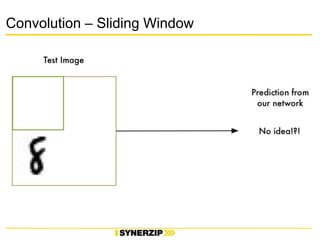
Convolution
Convolution – Sliding Window
Defining the Resume Classification Problem
• Continuous Stream of incoming resumes
• Heterogeneous formats
• Practically Unaccountable number of
buckets
• Manual labor to classify is immense
Any Typical Candidate Resume
GATE
Jape
Deep
Learning
CVs
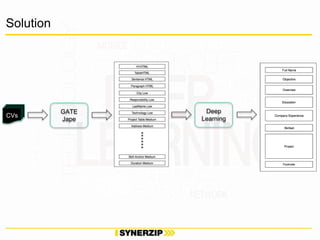
Solution
Modelling the Data
• More than a thousand samples (CVs)
• GATE(japes) gives all the pre-defined Entities and many
more lower level feature details
• Standardization of Resume Size
• Working at offset level
• Encoding 98 features per offset per CV
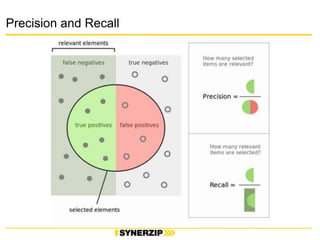
Precision and Recall
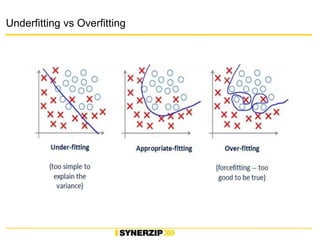
Underfitting vs Overfitting
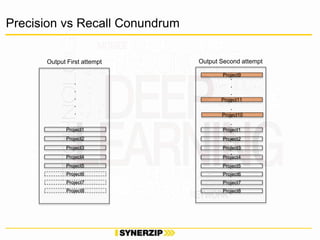
Precision vs Recall Conundrum
Project3
Project4
Project5
.
.
.
.
.
Output First attempt Output Second attempt
.
.
.
.
.
.
.
.
.
.
.
Project2
Project1
Project6
Project7
Project8
Project3
Project4
Project5
Project2
Project1
Project6
Project7
Project8
Project9
Project10
Project11
Results
• 1st Pass
–90 features and 8 target variables
–Smaller size target buckets were extremely accurate
–Larger size target buckets had sprinkled outliers all over
the place, unwarranted breaks and overlaps
• 2nd Pass
–Proximity, feature size in consecutive offsets and
location as features and same 8 target variables
–Outliers were largely gone, overlaps were completely
eliminated
• In terms of accuracy at the level of single offset the
prediction error was only 12%
First Pass vs Second Pass Output
Project
Project
Project
Project
.
.
.
.
.
.
.
Output First Pass
Project
Output Second Pass
.
.
.
.
.
.
.
.
.
.
.
Tools, Tech and Algorithms Used
• Logistic Regression, Random Forest, Tensor MLP, Neural
net Multinomial, SMOTE
Final Outcome with an Error Rate of 12.4%
First Pass Second Pass
First Name Objective
Overview Project
Education Footnote
Company Experience
Skillset
Recent Book Authored by Krishnakumar Bhavsar
© 2018 Synerzip© 2018, Synerzip
Texas
Tel: +1.469.374.0500 |
Fax: +1.469.322.0490
Silicon
Valley
Tel: +1.510.519.9673 |
Fax: +1.510.519.9673
India
Tel: +91.20.67283222 |
Fax: +91.20.67283222 sales@synerzip.com
© 2018 Synerzip26
Who is Synerzip
Synerzip is your Agile software product co-development partner
500+
strong
team
Dual-
Shore
matured delivery
model
110+
product success
stories
Inc.
5000
awarded Inc 5000
6 years in a row
10+
years in
business
50%
savings from
optimized
delivery
DNA
a truly agile
product
development
partner
2X
accelerate
product
roadmap
© 2018 Synerzip27
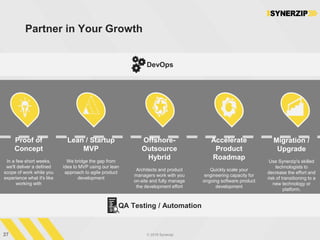
Partner in Your Growth
QA Testing / Automation
DevOps
Proof of
Concept
In a few short weeks,
we'll deliver a defined
scope of work while you
experience what it's like
working with
Lean / Startup
MVP
We bridge the gap from
idea to MVP using our lean
approach to agile product
development
Offshore-
Outsource
Hybrid
Architects and product
managers work with you
on-site and fully manage
the development effort
Accelerate
Product
Roadmap
Quickly scale your
engineering capacity for
ongoing software product
development
Migration /
Upgrade
Use Synerzip's skilled
technologists to
decrease the effort and
risk of transitioning to a
new technology or
platform.
© 2018 Synerzip28
Leveraging Dual Shore Operations
US Team: Customer + Architects
• Local team of architects and business
analysts coordinate with you to
understand product requirements
• Design a workable model for your
requirement after consulting with the
India team
• Enable a handshake between
Program Manager (client side) and
Product Owner (India team)
India Team: Product Owner + Dev
& QA
• Identify optimal setting for the project
and set up a team / hire
• Understand the product, market,
users, requirements, etc. and train
developers
• Use best practices for developing the
product in a dual-shore mode while
adopting existing processes (client
side)
Operating As One Extended Team
© 2018 Synerzip29
Clients…
…100 more
© 2018 Synerzip30
Next Webinar
Is REACT the Best Thing Since
Sliced Bread?
Tuesday, May 15, 2018 at 10am CT
presenter:
Yogesh Patel,
Author and Director of
Engineering at Synerzip
.
Thank You
Final outcome(use if required)
1. Full Name - 1st Pass, location check
2. Objective - 2nd Pass
3. Overview – 1st Pass
4. Education – 1st Pass, pure
5. Company Experience – 1st Pass
6. Skillset – 1st Pass, pure
7. Project – 2nd Pass, pure
8. Footnote – 2nd Pass, pure

Machine Learning Vs. Deep Learning – An Example Implementation

  • 1.
    Deep Learning – Withan Example Implementation Krishna Bhavsar Vinayak Joglekar
  • 2.
    • More than11 years working on natural language processing, social media analytics, text mining and machine learning in various industry domains • Worked on most of the Open Source NLP libraries related to computational linguistics. • Published a paper on sentiment analysis augmentation techniques in 2010 NAACL. • Created an NLP pipeline/toolset and open sourced it for public use. • Authored “Natural Language Processing Cookbook Using Python” Krishnakumar Bhavsar
  • 3.
    • Passionately buildingsoftware products with Lean and Agile Teams • Nurtured top notch software professionals and built several self organizing teams. • Actively pursuing business opportunities in big data analytics, machine learning and natural language processing. • Deep domain expertise in technical hiring including resume processing, technical assessment and interviews. Vinayak Joglekar
  • 4.
    AI vs MLvs Deep Learning
  • 5.
    Difference Between MLand Deep Learning • ML – the concept existed in the 70s and 80s with the old school statistical analysis, study of probabilities, regressions, • Concept of deep learning existed in the early 80s, only the invent of parallel computing and cheap processing power with commodity hardware has expedited the use of deep learning algorithms • Primary difference is the feedback mechanism involved with the Deep Learning algorithms that is absent in ML algorithms (it works in multiple passes)
  • 6.
    Neural Networks Two layerFeed Forward ANN Brain Neurons and Synapses model
  • 7.
    Example Problems thatcan be Solved • Speech Recognition • Natural Language Processing • Bioinformatics • Image Classification – classic cats and dogs classification problem –Edges –Shapes (circles, rectangles, squares, ellipses) –Whiskers, Ears, Eyes (definitive features) –Cat or Dog
  • 8.
    Preprocessing • Image –Size standardization/Scaling –Colorstandardization • Text –Sentence Segmentation –Tokenization –Stemming/Lemmatization –Standardizations (case, special characters) • Statistical –Normalization –Outliers –Missing values
  • 10.
  • 11.
  • 12.
  • 13.
    Defining the ResumeClassification Problem • Continuous Stream of incoming resumes • Heterogeneous formats • Practically Unaccountable number of buckets • Manual labor to classify is immense
  • 14.
  • 15.
  • 16.
    Modelling the Data •More than a thousand samples (CVs) • GATE(japes) gives all the pre-defined Entities and many more lower level feature details • Standardization of Resume Size • Working at offset level • Encoding 98 features per offset per CV
  • 17.
  • 18.
  • 19.
    Precision vs RecallConundrum Project3 Project4 Project5 . . . . . Output First attempt Output Second attempt . . . . . . . . . . . Project2 Project1 Project6 Project7 Project8 Project3 Project4 Project5 Project2 Project1 Project6 Project7 Project8 Project9 Project10 Project11
  • 20.
    Results • 1st Pass –90features and 8 target variables –Smaller size target buckets were extremely accurate –Larger size target buckets had sprinkled outliers all over the place, unwarranted breaks and overlaps • 2nd Pass –Proximity, feature size in consecutive offsets and location as features and same 8 target variables –Outliers were largely gone, overlaps were completely eliminated • In terms of accuracy at the level of single offset the prediction error was only 12%
  • 21.
    First Pass vsSecond Pass Output Project Project Project Project . . . . . . . Output First Pass Project Output Second Pass . . . . . . . . . . .
  • 22.
    Tools, Tech andAlgorithms Used • Logistic Regression, Random Forest, Tensor MLP, Neural net Multinomial, SMOTE
  • 23.
    Final Outcome withan Error Rate of 12.4% First Pass Second Pass First Name Objective Overview Project Education Footnote Company Experience Skillset
  • 24.
    Recent Book Authoredby Krishnakumar Bhavsar
  • 25.
    © 2018 Synerzip©2018, Synerzip Texas Tel: +1.469.374.0500 | Fax: +1.469.322.0490 Silicon Valley Tel: +1.510.519.9673 | Fax: +1.510.519.9673 India Tel: +91.20.67283222 | Fax: +91.20.67283222 sales@synerzip.com
  • 26.
    © 2018 Synerzip26 Whois Synerzip Synerzip is your Agile software product co-development partner 500+ strong team Dual- Shore matured delivery model 110+ product success stories Inc. 5000 awarded Inc 5000 6 years in a row 10+ years in business 50% savings from optimized delivery DNA a truly agile product development partner 2X accelerate product roadmap
  • 27.
    © 2018 Synerzip27 Partnerin Your Growth QA Testing / Automation DevOps Proof of Concept In a few short weeks, we'll deliver a defined scope of work while you experience what it's like working with Lean / Startup MVP We bridge the gap from idea to MVP using our lean approach to agile product development Offshore- Outsource Hybrid Architects and product managers work with you on-site and fully manage the development effort Accelerate Product Roadmap Quickly scale your engineering capacity for ongoing software product development Migration / Upgrade Use Synerzip's skilled technologists to decrease the effort and risk of transitioning to a new technology or platform.
  • 28.
    © 2018 Synerzip28 LeveragingDual Shore Operations US Team: Customer + Architects • Local team of architects and business analysts coordinate with you to understand product requirements • Design a workable model for your requirement after consulting with the India team • Enable a handshake between Program Manager (client side) and Product Owner (India team) India Team: Product Owner + Dev & QA • Identify optimal setting for the project and set up a team / hire • Understand the product, market, users, requirements, etc. and train developers • Use best practices for developing the product in a dual-shore mode while adopting existing processes (client side) Operating As One Extended Team
  • 29.
  • 30.
    © 2018 Synerzip30 NextWebinar Is REACT the Best Thing Since Sliced Bread? Tuesday, May 15, 2018 at 10am CT presenter: Yogesh Patel, Author and Director of Engineering at Synerzip .
  • 31.
  • 32.
    Final outcome(use ifrequired) 1. Full Name - 1st Pass, location check 2. Objective - 2nd Pass 3. Overview – 1st Pass 4. Education – 1st Pass, pure 5. Company Experience – 1st Pass 6. Skillset – 1st Pass, pure 7. Project – 2nd Pass, pure 8. Footnote – 2nd Pass, pure