


DEPARTMENT OF COMPUTER SCIENCE &
ENGG.
Presented By: Bhimsen D Joshi
Lecturer/CSE
B.L.D.E.A’S S.S.M. POLYTECHNIC
VIJAYAPUR
B.L.D.E.A’S S.S.M
POLYTECHNIC VIJAYAPUR
SEMINAR ON MACHINE
LEARNING LIFE CYCLE
INTRODUCTION
Machine learning has given the computer systems
the abilities to automatically learn without being
explicitly programmed. The main purpose of the life
cycle is to find a solution to the problem.
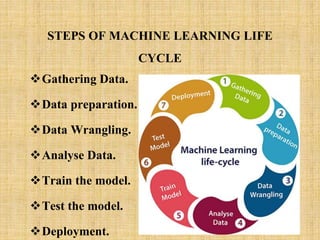
STEPS OF MACHINE LEARNING LIFE
CYCLE
Gathering Data.
Data preparation.
Data Wrangling.
Analyse Data.
Train the model.
Test the model.
Deployment.
1. GATHERING DATA
The goal of this step is to identify and obtain all data-
related problems……………………………………….
In this step, we need to identify the different data sources,
as data can be collected from various sources such
as files, database, internet, or mobile devices. The
quantity and quality of the collected data will
determine the efficiency of the output.
2. DATA PREPARATION
We put our data into a suitable place and prepare it to use
in our machine learning training.
This step can be further divided into two processes:
• Data exploration:
It is used to understand the nature of data that we have
to work with. We need to understand the characteristics,
format, and quality of data.
• Data pre-processing:
Data preprocessing is a process of preparing the raw
data and making it suitable for a machine learning
model.
3. DATA WRANGLING
Data wrangling is the process of cleaning and converting raw
data into a useable format. It is the process of cleaning the data,
selecting the variable to use, and transforming the data in a
proper format to make it more suitable for analysis.
In real-world applications, collected data may have various
issues, including:
• Missing Values
• Duplicate data
• Invalid data
• Noise
So, we use various filtering techniques to clean the data.
4. DATA ANALYSIS
This step involves:
• Selection of analytical techniques
• Building models
• Review the result
The aim of this step is to build a machine learning
model to analyze the data using various analytical
techniques and review the outcome.
5. TRAIN MODEL
In this step we train our model to improve its
performance for better outcome of the problem.
We use datasets to train the model using various
machine learning algorithms. Training a model is
required so that it can understand the various
patterns, rules, and, features.
6. TEST MODEL
Once our machine learning model has been trained
on a given dataset, then we test the model. In this
step, we check for the accuracy of our model by
providing a test dataset to it.
Testing the model determines the percentage
accuracy of the model as per the requirement of
project or problem.
7. DEPLOYMENT
If the above-prepared model is producing an accurate
result as per our requirement with acceptable speed,
then we deploy the model in the real system. But
before deploying the project, we will check whether
it is improving its performance using available data
or not. The deployment phase is similar to making
the final report for a project.
MACHINE LEARNING LIFE CYCLE

MACHINE LEARNING LIFE CYCLE

  • 1.
    DEPARTMENT OF COMPUTERSCIENCE & ENGG. Presented By: Bhimsen D Joshi Lecturer/CSE B.L.D.E.A’S S.S.M. POLYTECHNIC VIJAYAPUR B.L.D.E.A’S S.S.M POLYTECHNIC VIJAYAPUR SEMINAR ON MACHINE LEARNING LIFE CYCLE
  • 2.
    INTRODUCTION Machine learning hasgiven the computer systems the abilities to automatically learn without being explicitly programmed. The main purpose of the life cycle is to find a solution to the problem.
  • 3.
    STEPS OF MACHINELEARNING LIFE CYCLE Gathering Data. Data preparation. Data Wrangling. Analyse Data. Train the model. Test the model. Deployment.
  • 4.
    1. GATHERING DATA Thegoal of this step is to identify and obtain all data- related problems………………………………………. In this step, we need to identify the different data sources, as data can be collected from various sources such as files, database, internet, or mobile devices. The quantity and quality of the collected data will determine the efficiency of the output.
  • 5.
    2. DATA PREPARATION Weput our data into a suitable place and prepare it to use in our machine learning training. This step can be further divided into two processes: • Data exploration: It is used to understand the nature of data that we have to work with. We need to understand the characteristics, format, and quality of data. • Data pre-processing: Data preprocessing is a process of preparing the raw data and making it suitable for a machine learning model.
  • 6.
    3. DATA WRANGLING Datawrangling is the process of cleaning and converting raw data into a useable format. It is the process of cleaning the data, selecting the variable to use, and transforming the data in a proper format to make it more suitable for analysis. In real-world applications, collected data may have various issues, including: • Missing Values • Duplicate data • Invalid data • Noise So, we use various filtering techniques to clean the data.
  • 7.
    4. DATA ANALYSIS Thisstep involves: • Selection of analytical techniques • Building models • Review the result The aim of this step is to build a machine learning model to analyze the data using various analytical techniques and review the outcome.
  • 8.
    5. TRAIN MODEL Inthis step we train our model to improve its performance for better outcome of the problem. We use datasets to train the model using various machine learning algorithms. Training a model is required so that it can understand the various patterns, rules, and, features.
  • 9.
    6. TEST MODEL Onceour machine learning model has been trained on a given dataset, then we test the model. In this step, we check for the accuracy of our model by providing a test dataset to it. Testing the model determines the percentage accuracy of the model as per the requirement of project or problem.
  • 10.
    7. DEPLOYMENT If theabove-prepared model is producing an accurate result as per our requirement with acceptable speed, then we deploy the model in the real system. But before deploying the project, we will check whether it is improving its performance using available data or not. The deployment phase is similar to making the final report for a project.