Matlab Notes Part 1
Austin Baird
UNC Department of Mathematics
UNC Department of Biology
January 15, 2014
Introduction
• Matlab is a lot like a calculator!
• we can compute things like 3 · 2
• Arithmetic is preformed in order of operations (just like a
calculator)
• Matrices and matrix operations are where Matlab excels
• Today we will:
• Understand the basic Desktop environment
• Preform basic arithmetic
• use built in functions
• Create matices and write our first code
Desktop Basics
Desktop Basics
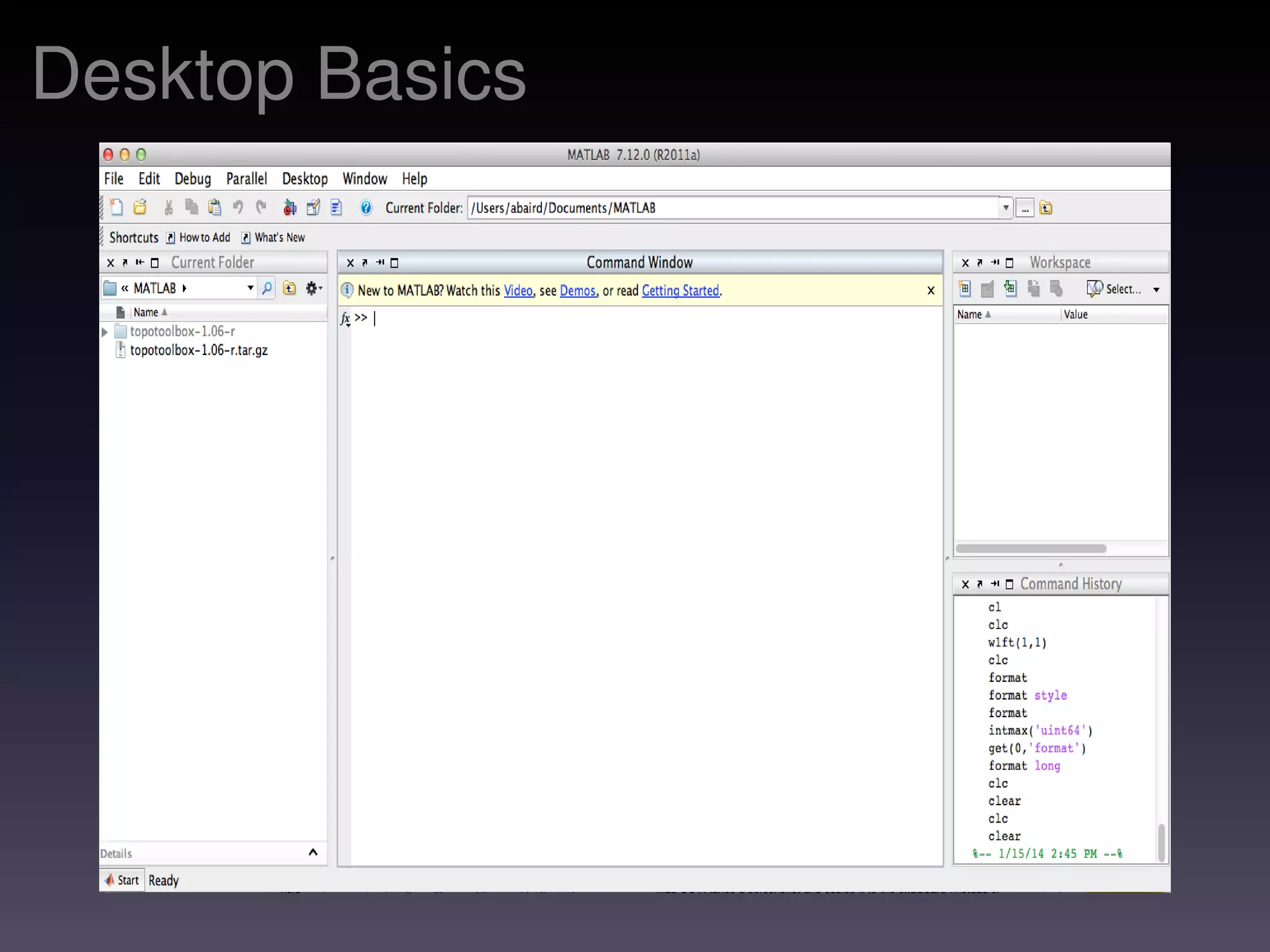
• Current Folder: This is where the files you are working
with will be stored. Note: you can navigate from the folder
you’re in to any folder you desire by clicking the magnifying
glass.
• Command Window: This is where you can calculate,
receive error messages, or print output from your
programs. Commands are input at the symbol.
• try to calculate things right now!
• Workspace: This is where variables are stored and will tell
you things about them (what they equal, how big a matrix is
ect.)
• Command History: This is where the commands you’ve
issued most recently will appear. ↑ on your keyboard will
scroll through these commands.
• Refer to the text (Matlab intro) for more detailed instruction.
Troubleshooting
• Often times things won’t work.
• One Common problem is that a variable you thought was
free is actually associated with a value.
• Try the command clear. This will clear all the variables
in the Workspace.
Try and do some computing and assign
variables to values.
Arrays
• Matlab = Matrix Laboratory, so do things with matrices!
• Create your first matrix!
• a = [1234], Row Vector!
• Indexing in matlab begins with 1 (NOT 0)
• Add more rows: a = [1234; 2345; 3456]
• Note This also works: a = [1, 2, 3, 4; 2, 3, 4, 5; 3, 4, 5, 6]
• We can call values from this array:
• a(1, 2)
• 2
• Or assign a value to a particular position:
• a(1, 2) = 10
• The notation is (row, column)
Array Creating Functions
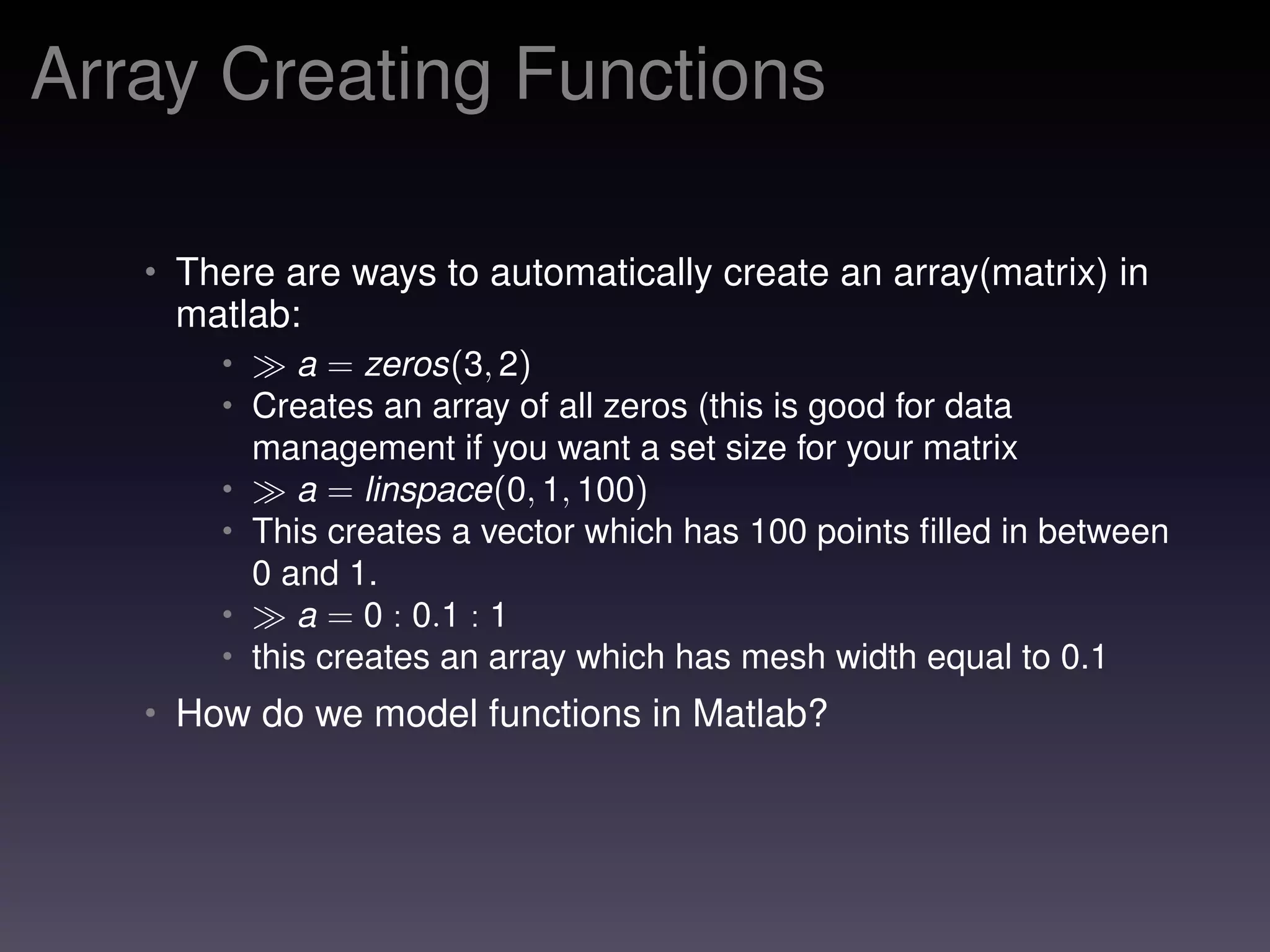
• There are ways to automatically create an array(matrix) in
matlab:
• a = zeros(3, 2)
• Creates an array of all zeros (this is good for data
management if you want a set size for your matrix
• a = linspace(0, 1, 100)
• This creates a vector which has 100 points filled in between
0 and 1.
• a = 0 : 0.1 : 1
• this creates an array which has mesh width equal to 0.1
• How do we model functions in Matlab?
Array Operations
• Colon operator:
• a = [123; 234; 456]
• The colon denotes start:end. Note: if you just place a
colon it will select everything.
• Select the first two rows of our matrix:
• a(1 : 2, :)
• What does a(1, :) do?
• We can also add to each element of the array:
• a − a
• a − 10
• We can do traditional and element wise multiplication of
matrices:
• traditional: a ∗ a, element wise: a. ∗ a
• In a similar way you can do other things element wise to a
matrix ex.: a. ∧ 3
Discrete Functions
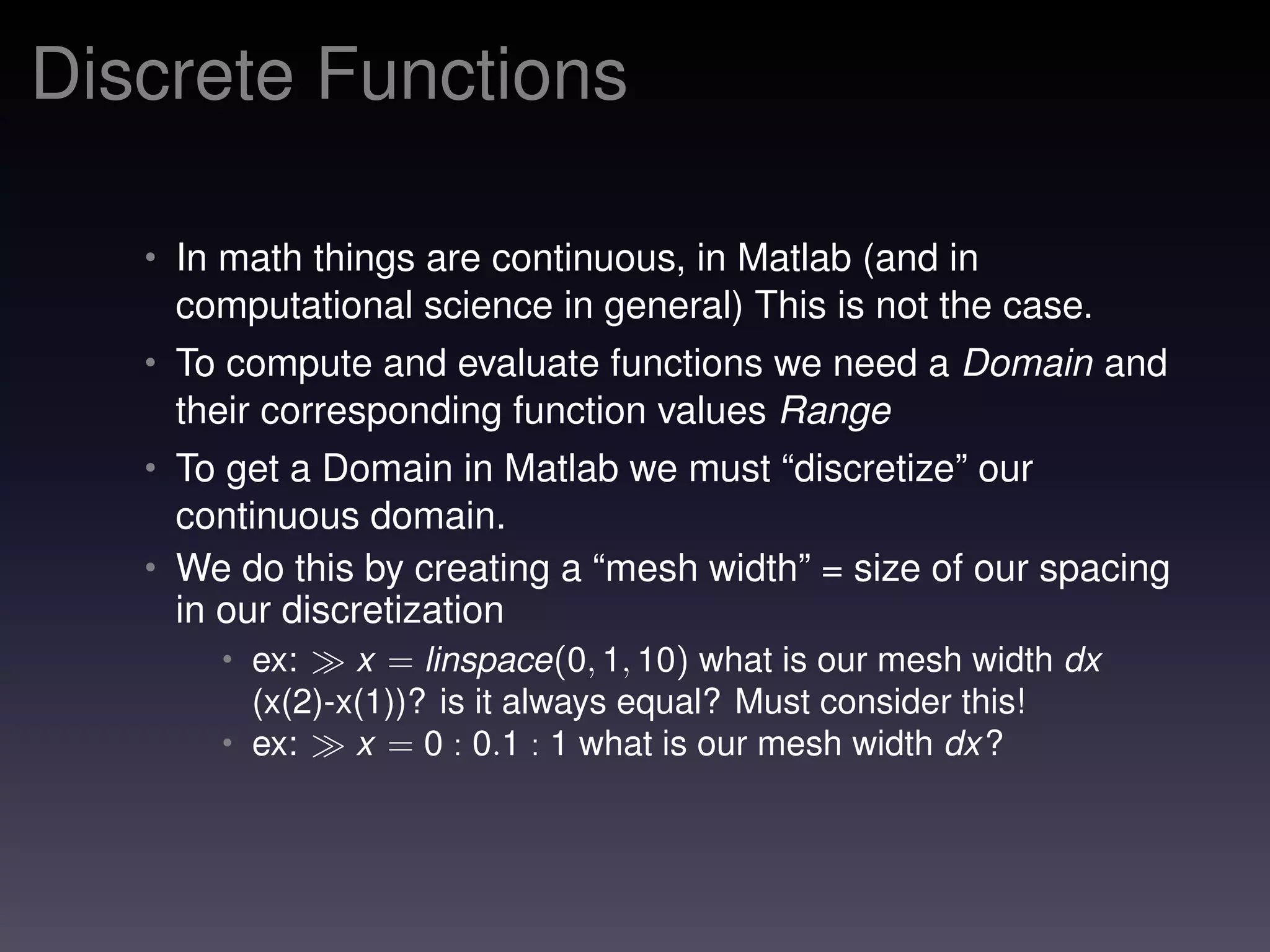
• In math things are continuous, in Matlab (and in
computational science in general) This is not the case.
• To compute and evaluate functions we need a Domain and
their corresponding function values Range
• To get a Domain in Matlab we must “discretize” our
continuous domain.
• We do this by creating a “mesh width” = size of our spacing
in our discretization
• ex: x = linspace(0, 1, 10) what is our mesh width dx
(x(2)-x(1))? is it always equal? Must consider this!
• ex: x = 0 : 0.1 : 1 what is our mesh width dx?
Evaluating Functions
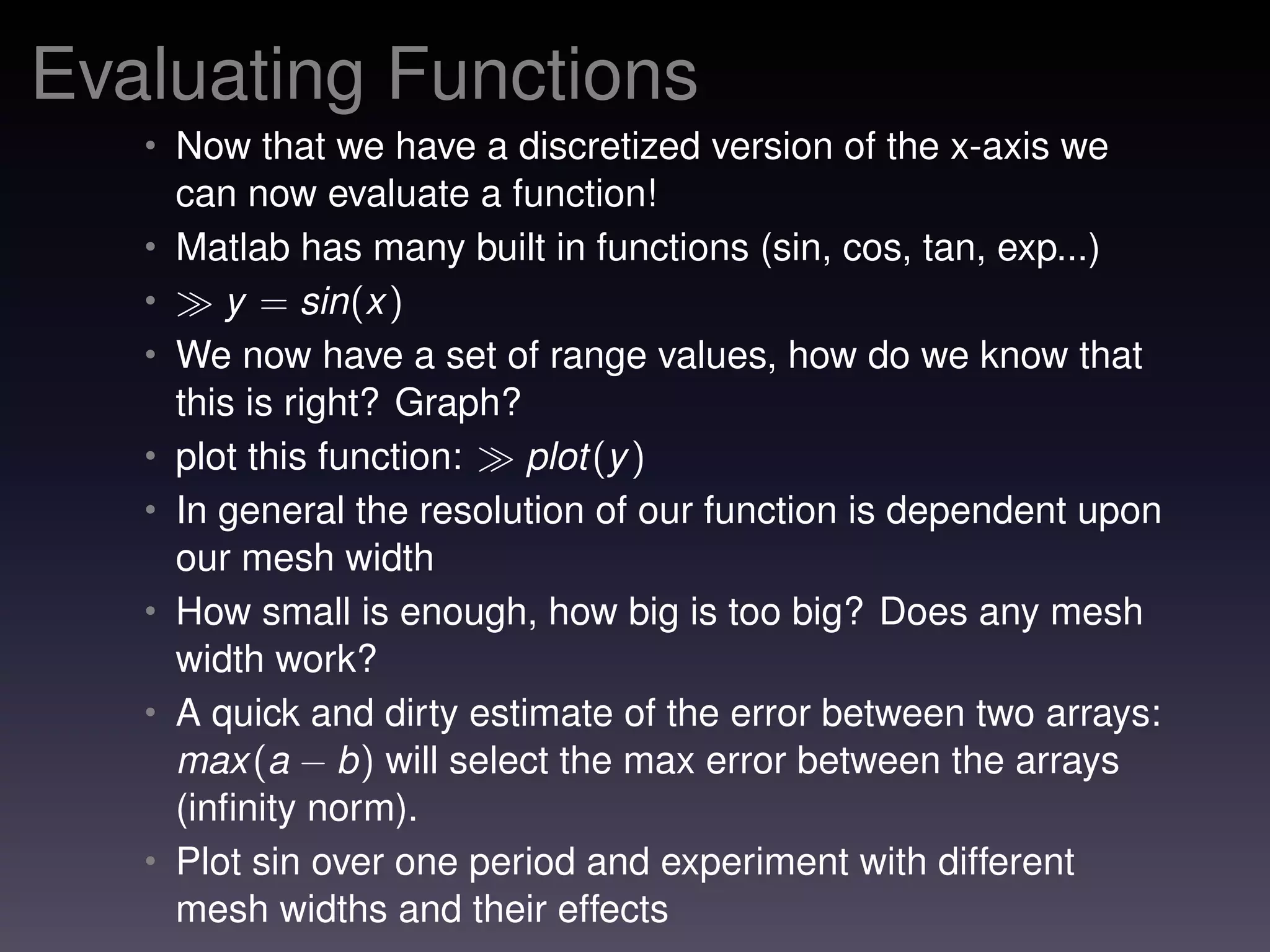
• Now that we have a discretized version of the x-axis we
can now evaluate a function!
• Matlab has many built in functions (sin, cos, tan, exp...)
• y = sin(x)
• We now have a set of range values, how do we know that
this is right? Graph?
• plot this function: plot(y)
• In general the resolution of our function is dependent upon
our mesh width
• How small is enough, how big is too big? Does any mesh
width work?
• A quick and dirty estimate of the error between two arrays:
max(a − b) will select the max error between the arrays
(infinity norm).
• Plot sin over one period and experiment with different
mesh widths and their effects
Our First Program
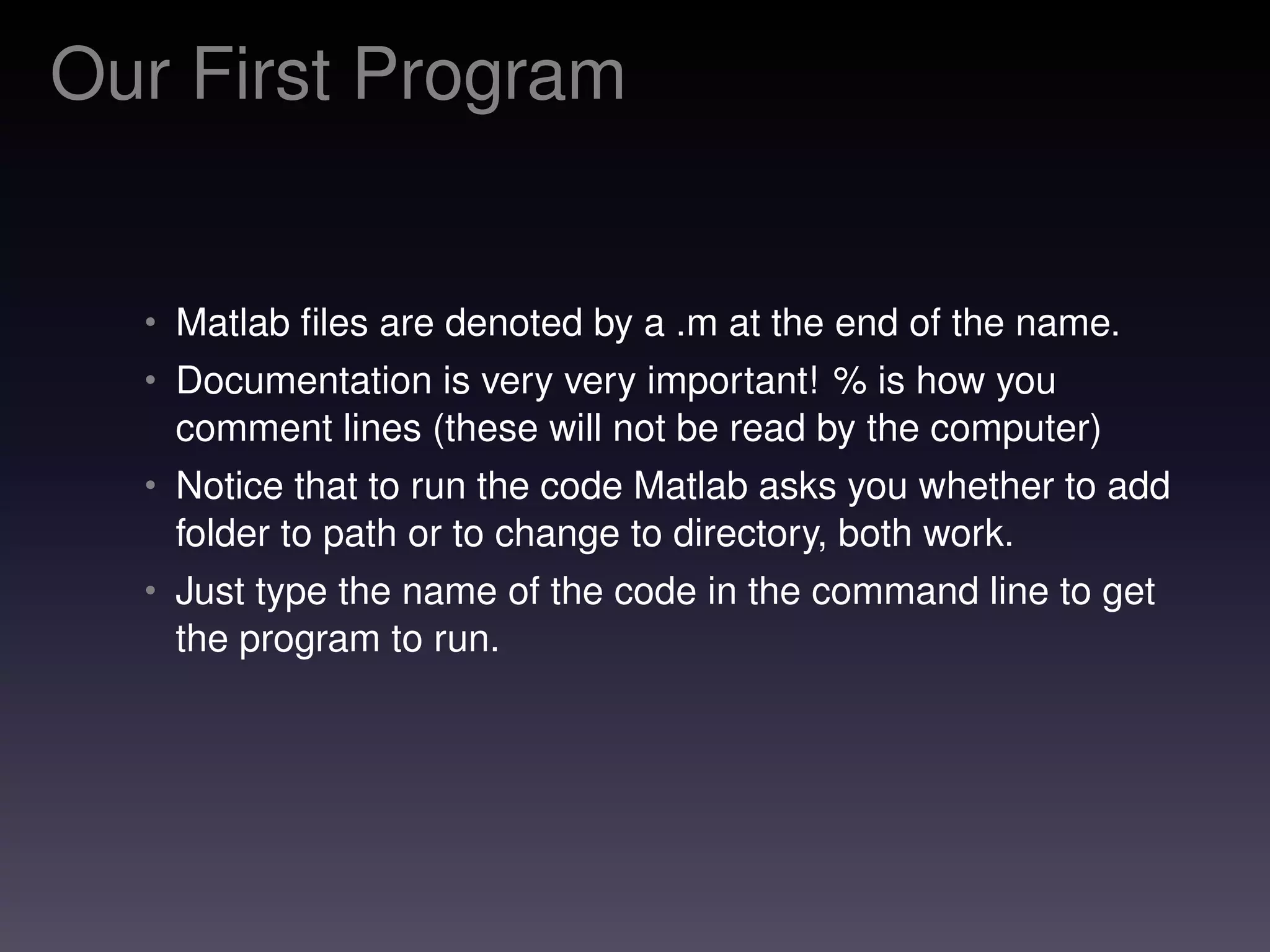
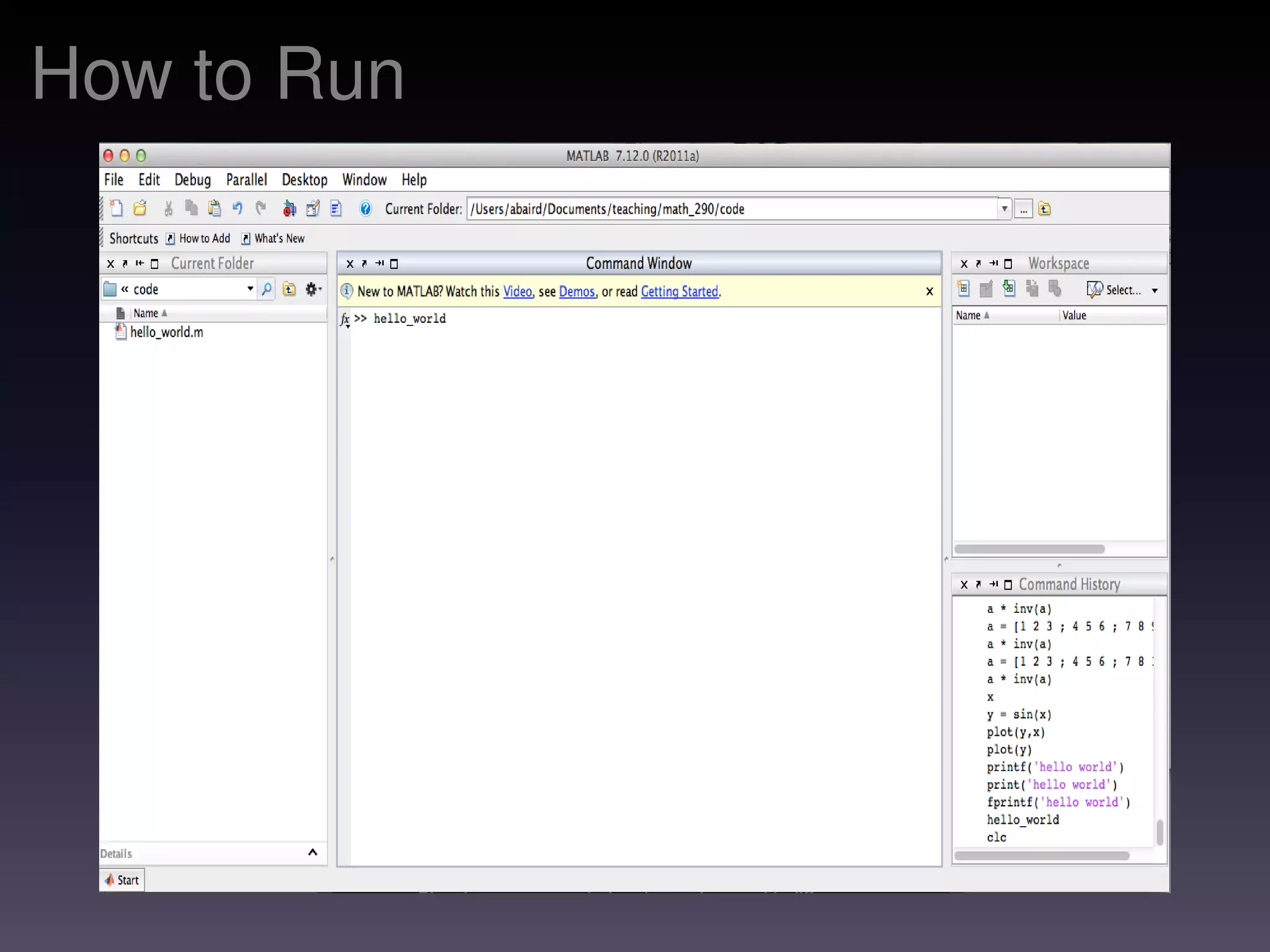
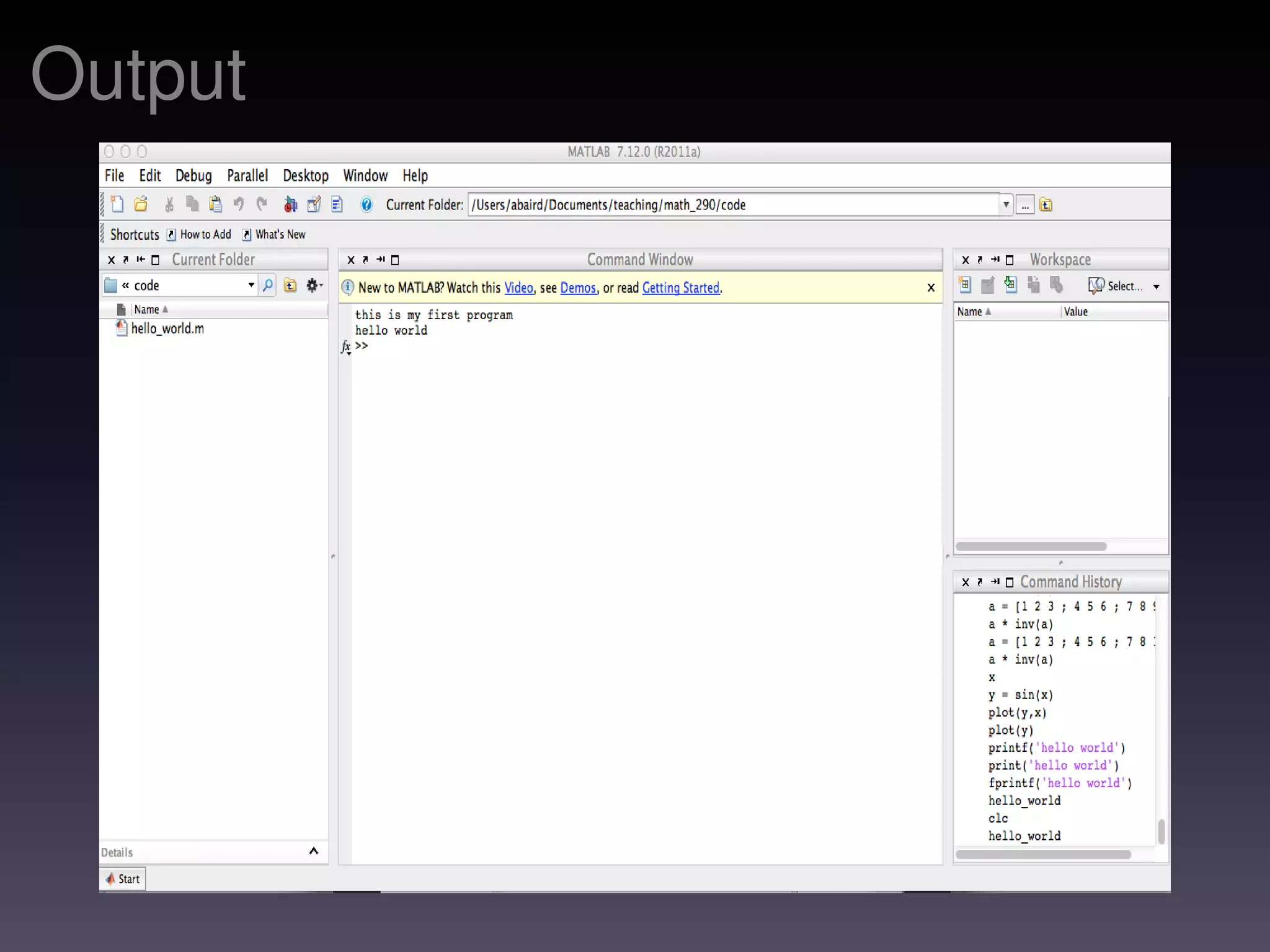
• Matlab files are denoted by a .m at the end of the name.
• Documentation is very very important! % is how you
comment lines (these will not be read by the computer)
• Notice that to run the code Matlab asks you whether to add
folder to path or to change to directory, both work.
• Just type the name of the code in the command line to get
the program to run.
How to Run
Output
Homework
• Read sections 1-17 to 1-23
• Email me by Tuesday at 12:01am a onyen.m file which
when run does the following ( and is commented at the top
of the file with your full name and who you worked with, if
anyone):
• Generates a figure which plots y = sin(x) + c for ten values
of c (all on the same figure).
• Generates the figure in section 1-23.

Matlab pt1

  • 1.
    Matlab Notes Part1 Austin Baird UNC Department of Mathematics UNC Department of Biology January 15, 2014
  • 2.
    Introduction • Matlab isa lot like a calculator! • we can compute things like 3 · 2 • Arithmetic is preformed in order of operations (just like a calculator) • Matrices and matrix operations are where Matlab excels • Today we will: • Understand the basic Desktop environment • Preform basic arithmetic • use built in functions • Create matices and write our first code
  • 3.
  • 4.
    Desktop Basics • CurrentFolder: This is where the files you are working with will be stored. Note: you can navigate from the folder you’re in to any folder you desire by clicking the magnifying glass. • Command Window: This is where you can calculate, receive error messages, or print output from your programs. Commands are input at the symbol. • try to calculate things right now! • Workspace: This is where variables are stored and will tell you things about them (what they equal, how big a matrix is ect.) • Command History: This is where the commands you’ve issued most recently will appear. ↑ on your keyboard will scroll through these commands. • Refer to the text (Matlab intro) for more detailed instruction.
  • 5.
    Troubleshooting • Often timesthings won’t work. • One Common problem is that a variable you thought was free is actually associated with a value. • Try the command clear. This will clear all the variables in the Workspace. Try and do some computing and assign variables to values.
  • 6.
    Arrays • Matlab =Matrix Laboratory, so do things with matrices! • Create your first matrix! • a = [1234], Row Vector! • Indexing in matlab begins with 1 (NOT 0) • Add more rows: a = [1234; 2345; 3456] • Note This also works: a = [1, 2, 3, 4; 2, 3, 4, 5; 3, 4, 5, 6] • We can call values from this array: • a(1, 2) • 2 • Or assign a value to a particular position: • a(1, 2) = 10 • The notation is (row, column)
  • 7.
    Array Creating Functions •There are ways to automatically create an array(matrix) in matlab: • a = zeros(3, 2) • Creates an array of all zeros (this is good for data management if you want a set size for your matrix • a = linspace(0, 1, 100) • This creates a vector which has 100 points filled in between 0 and 1. • a = 0 : 0.1 : 1 • this creates an array which has mesh width equal to 0.1 • How do we model functions in Matlab?
  • 8.
    Array Operations • Colonoperator: • a = [123; 234; 456] • The colon denotes start:end. Note: if you just place a colon it will select everything. • Select the first two rows of our matrix: • a(1 : 2, :) • What does a(1, :) do? • We can also add to each element of the array: • a − a • a − 10 • We can do traditional and element wise multiplication of matrices: • traditional: a ∗ a, element wise: a. ∗ a • In a similar way you can do other things element wise to a matrix ex.: a. ∧ 3
  • 9.
    Discrete Functions • Inmath things are continuous, in Matlab (and in computational science in general) This is not the case. • To compute and evaluate functions we need a Domain and their corresponding function values Range • To get a Domain in Matlab we must “discretize” our continuous domain. • We do this by creating a “mesh width” = size of our spacing in our discretization • ex: x = linspace(0, 1, 10) what is our mesh width dx (x(2)-x(1))? is it always equal? Must consider this! • ex: x = 0 : 0.1 : 1 what is our mesh width dx?
  • 10.
    Evaluating Functions • Nowthat we have a discretized version of the x-axis we can now evaluate a function! • Matlab has many built in functions (sin, cos, tan, exp...) • y = sin(x) • We now have a set of range values, how do we know that this is right? Graph? • plot this function: plot(y) • In general the resolution of our function is dependent upon our mesh width • How small is enough, how big is too big? Does any mesh width work? • A quick and dirty estimate of the error between two arrays: max(a − b) will select the max error between the arrays (infinity norm). • Plot sin over one period and experiment with different mesh widths and their effects
  • 11.
    Our First Program •Matlab files are denoted by a .m at the end of the name. • Documentation is very very important! % is how you comment lines (these will not be read by the computer) • Notice that to run the code Matlab asks you whether to add folder to path or to change to directory, both work. • Just type the name of the code in the command line to get the program to run.
  • 12.
  • 13.
  • 14.
    Homework • Read sections1-17 to 1-23 • Email me by Tuesday at 12:01am a onyen.m file which when run does the following ( and is commented at the top of the file with your full name and who you worked with, if anyone): • Generates a figure which plots y = sin(x) + c for ten values of c (all on the same figure). • Generates the figure in section 1-23.