CONTENTS:
INTRODUCTION
HISTORY
AI Vs. ML Vs. DL
ML LIFE CYCLE
APPLICATIONS OF ML IN POWER SYSTEM
ADVANTAGES & DISADVANTAGES
CONCLUSION
REFERENCES
INTRODUCTION
The power system is a network which consists of generation,
distribution, and transmission system and Learning is one of the key
features that humans differ from other lower forms of life, and
means an important intelligent behaviour of humans. In the process
of development and popularization of modern science and
technology, all kinds of definitions of learning.
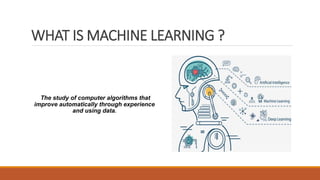
WHAT IS MACHINE LEARNING ?
The study of computer algorithms that
improve automatically through experience
and using data.
HISTORY
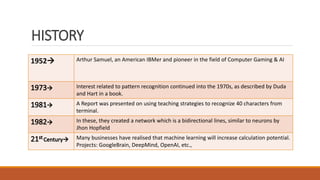
1952 Arthur Samuel, an American IBMer and pioneer in the field of Computer Gaming & AI
Interest related to pattern recognition continued into the 1970s, as described by Duda
and Hart in a book.
A Report was presented on using teaching strategies to recognize 40 characters from
terminal.
In these, they created a network which is a bidirectional lines, similar to neurons by
Jhon Hopfield
Many businesses have realised that machine learning will increase calculation potential.
Projects: GoogleBrain, DeepMind, OpenAI, etc.,
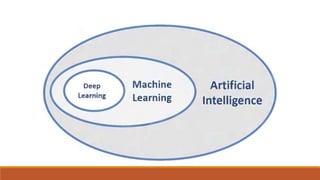
AI Vs ML Vs DL
AI ML DL
• AI is the study of pattern recognition
and mimicking human behavior.
• AI powered computers has started
simulating the human brain work
style, sensation, action, and
cognitive abilities .
• In today’s time, AI is increasingly
used as a wide term.
• In earlier times it was believed that
human intelligence can be precisely
described, and machines can
simulate it with AI
• A Subset of AI and simply an
approach to achieve AI.
• AI and ML are used
interchangeably often but they
are not the same
• What we simply need is MLaas
• ML is the one of the most active
areas and a way to achieve AI
• A technique for implementing
extremely powerful and much
better machine learning. DL is a
subset of ML.
• The objective of the technique is
to achieve a goal or an artificial
intelligence power that teaches
computers to tasks and the ability
to understand anything.
• DL is an algorithm which has no
theoretical limitations of what it
can learn.
Why Machine Learning?
Develop system that can automatically adapt and customize themselves to
individual users.
Example: Personalized news or mail filter
Discover new knowledge from large databases (Data Mining).
Example: Market basket analysis.
Ability to mimic human and replace certain monotonous tasks which require
some intelligence.
Example: Like recognizing handwritten characters.
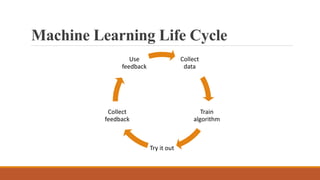
Machine Learning Life Cycle
Collect
data
Train
algorithm
Try it out
Collect
feedback
Use
feedback
ML in Electrical Engineering
Machine Learning in grid integration and power distribution
Machine Learning in end-user consumption pattern
Machine Learning in power quality analysis
Cyber security
Machine Learning in load balancing
Machine Learning in control and feedback system
Applications of ML in Transmission system
Equipment Monitoring
Identify Equipment/Substation Problems
It monitors and controls substation equipment through
mutual cooperation with a protective relay system and a
feeding/ control station system to realize the stable supply
of power.
Model validation
Equipment, Generation and power system
It is the procedure of evaluating the
wellness of models performance against the
real data.
Applications of ML in Transmission system
Wide area monitoring
Voltage, Angle and Frequency measurements are taken by
Phasor Measurement Units(PMUs) at selected locations in
the power system and Stored in a data concentrator every
100milli seconds.
Electricity Market Applications
Price & Load Forecasting, Algorithmic Trading
Electricity Markets have revolutionized the coordination of
economic activity large generators, transmission system
operators, and electricity distributors, other parts of the
electricity business have remained largely unaffected.
Applications of ML in Transmission system
Oscillation detection
The effect of inertia of the generators
could creep in causing the entire system
to swing. It might be significant and
doesn't decay which causes the system
to loss synchronism & collapse of the
system.
State Estimation
Linear State Estimation
It process redundant measurements provides steady-state
operating state for advance Energy Management system
(EMS) application program.
Applications of ML in Distribution system
Equipment Monitoring
Predictive Maintenance Online Diagnosis
Monitoring usually analyzes each measurement separately
using static limit information.
Distribution System Controls
Deep Reinforcement Learning
It combines the perception function of deep learning with decision
making ability of reinforcement learning. It is AI method closer to
human thinking and is regard as real AI.
Applications of ML in Distribution system
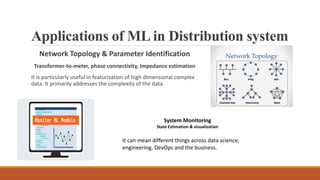
Network Topology & Parameter Identification
Transformer-to-meter, phase connectivity, Impedance estimation
It is particularly useful in featurization of high dimensional complex
data. It primarily addresses the complexity of the data.
System Monitoring
State Estimation & visualization
It can mean different things across data science,
engineering, DevOps and the business.
Applications of ML in Distribution system
Anomaly Detection
Electricity Theft, Unauthorized Solar Interconnection
It can help point out where an error is occurring, enhancing root cause
analysis and quickly getting tech support on the issue.
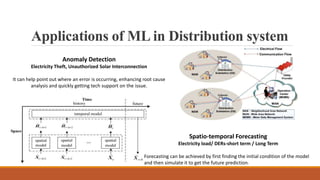
Spatio-temporal Forecasting
Electricity load/ DERs-short term / Long Term
Forecasting can be achieved by first finding the initial condition of the model
and then simulate it to get the future prediction.
Advantages
Automation of Everything
Wide Range of Applications
Scope of Improvement
Efficient identifies trends and patterns
Handling multi dimensional and multi variety data
Disadvantages
High error susceptibility
Interpretation of Results
Data Acquisition
Time and Resources
Conclusion:
Machine Learning is fundamental to AI and involves many areas, and many
techniques.
Machine learning and other AI based systems are disrupting many industries
and bringing us smarter, more targeting products and services.
Education and targeting are already feeling the wave of these technologies and
will be dramatically transformed by them.
References:
https://link.springer.com/content/pdf/10.1007/3-540-44673-
7_20.pdf&ved=2ahUKEwjh8v2Y57_vAhV4_XMBHREqCx0QFjACegQIFBAC&usg=AOvVaw3c3yqM
ANoSYTNmv4bfABjG
https://ieeexplore.ieee.org/document/8783340&ved=2ahUKEwjh8v2Y57_vAhV4_XMBHREqCx
0QFjADegQIEhAC&usg=AOvVaw2w4CNe9TwP8Q9D6UQrSeGu
https://www.mdpi.com/journal/inventions/special_issues/machine_learn&ved=2ahUKEwjh8v2
Y57_vAhV4_XMBHREqCx0QFjANegQICxAC&usg=AOvVaw3WZ2CQMF3pDhEQrvdmx5S9
Queries
Machine learning

Machine learning

  • 2.
    CONTENTS: INTRODUCTION HISTORY AI Vs. MLVs. DL ML LIFE CYCLE APPLICATIONS OF ML IN POWER SYSTEM ADVANTAGES & DISADVANTAGES CONCLUSION REFERENCES
  • 3.
    INTRODUCTION The power systemis a network which consists of generation, distribution, and transmission system and Learning is one of the key features that humans differ from other lower forms of life, and means an important intelligent behaviour of humans. In the process of development and popularization of modern science and technology, all kinds of definitions of learning.
  • 4.
    WHAT IS MACHINELEARNING ? The study of computer algorithms that improve automatically through experience and using data.
  • 5.
    HISTORY 1952 Arthur Samuel,an American IBMer and pioneer in the field of Computer Gaming & AI Interest related to pattern recognition continued into the 1970s, as described by Duda and Hart in a book. A Report was presented on using teaching strategies to recognize 40 characters from terminal. In these, they created a network which is a bidirectional lines, similar to neurons by Jhon Hopfield Many businesses have realised that machine learning will increase calculation potential. Projects: GoogleBrain, DeepMind, OpenAI, etc.,
  • 6.
    AI Vs MLVs DL AI ML DL • AI is the study of pattern recognition and mimicking human behavior. • AI powered computers has started simulating the human brain work style, sensation, action, and cognitive abilities . • In today’s time, AI is increasingly used as a wide term. • In earlier times it was believed that human intelligence can be precisely described, and machines can simulate it with AI • A Subset of AI and simply an approach to achieve AI. • AI and ML are used interchangeably often but they are not the same • What we simply need is MLaas • ML is the one of the most active areas and a way to achieve AI • A technique for implementing extremely powerful and much better machine learning. DL is a subset of ML. • The objective of the technique is to achieve a goal or an artificial intelligence power that teaches computers to tasks and the ability to understand anything. • DL is an algorithm which has no theoretical limitations of what it can learn.
  • 8.
    Why Machine Learning? Developsystem that can automatically adapt and customize themselves to individual users. Example: Personalized news or mail filter Discover new knowledge from large databases (Data Mining). Example: Market basket analysis. Ability to mimic human and replace certain monotonous tasks which require some intelligence. Example: Like recognizing handwritten characters.
  • 9.
    Machine Learning LifeCycle Collect data Train algorithm Try it out Collect feedback Use feedback
  • 10.
    ML in ElectricalEngineering Machine Learning in grid integration and power distribution Machine Learning in end-user consumption pattern Machine Learning in power quality analysis Cyber security Machine Learning in load balancing Machine Learning in control and feedback system
  • 12.
    Applications of MLin Transmission system Equipment Monitoring Identify Equipment/Substation Problems It monitors and controls substation equipment through mutual cooperation with a protective relay system and a feeding/ control station system to realize the stable supply of power. Model validation Equipment, Generation and power system It is the procedure of evaluating the wellness of models performance against the real data.
  • 13.
    Applications of MLin Transmission system Wide area monitoring Voltage, Angle and Frequency measurements are taken by Phasor Measurement Units(PMUs) at selected locations in the power system and Stored in a data concentrator every 100milli seconds. Electricity Market Applications Price & Load Forecasting, Algorithmic Trading Electricity Markets have revolutionized the coordination of economic activity large generators, transmission system operators, and electricity distributors, other parts of the electricity business have remained largely unaffected.
  • 14.
    Applications of MLin Transmission system Oscillation detection The effect of inertia of the generators could creep in causing the entire system to swing. It might be significant and doesn't decay which causes the system to loss synchronism & collapse of the system. State Estimation Linear State Estimation It process redundant measurements provides steady-state operating state for advance Energy Management system (EMS) application program.
  • 15.
    Applications of MLin Distribution system Equipment Monitoring Predictive Maintenance Online Diagnosis Monitoring usually analyzes each measurement separately using static limit information. Distribution System Controls Deep Reinforcement Learning It combines the perception function of deep learning with decision making ability of reinforcement learning. It is AI method closer to human thinking and is regard as real AI.
  • 16.
    Applications of MLin Distribution system Network Topology & Parameter Identification Transformer-to-meter, phase connectivity, Impedance estimation It is particularly useful in featurization of high dimensional complex data. It primarily addresses the complexity of the data. System Monitoring State Estimation & visualization It can mean different things across data science, engineering, DevOps and the business.
  • 17.
    Applications of MLin Distribution system Anomaly Detection Electricity Theft, Unauthorized Solar Interconnection It can help point out where an error is occurring, enhancing root cause analysis and quickly getting tech support on the issue. Spatio-temporal Forecasting Electricity load/ DERs-short term / Long Term Forecasting can be achieved by first finding the initial condition of the model and then simulate it to get the future prediction.
  • 18.
    Advantages Automation of Everything WideRange of Applications Scope of Improvement Efficient identifies trends and patterns Handling multi dimensional and multi variety data
  • 19.
    Disadvantages High error susceptibility Interpretationof Results Data Acquisition Time and Resources
  • 20.
    Conclusion: Machine Learning isfundamental to AI and involves many areas, and many techniques. Machine learning and other AI based systems are disrupting many industries and bringing us smarter, more targeting products and services. Education and targeting are already feeling the wave of these technologies and will be dramatically transformed by them.
  • 21.
  • 22.