OMROB
Lab.
Machine Learning
Course Instructor: Dr. M Ayaz Shirazi
Associate Professor
< 2 >
 Completed Ph.D. (Electronics) from Kyungpook National
University, South Korea
 Former Post-doctoral researcher in South Korea’s Highly
ranked university, KAIST
 Author of eleven (11) Impact factor journal publications
and several conference publications
 Active Researcher in the areas of Computer Vision, AI,
and Robotics
Introduction to Instructor
< 3 >
 KNU International Graduate Scholarship (KINGS) Award
(Fully-funded scholarship for Ph.D. course work)
 Best (Journal) Paper Award 2017 (Out of the SCI(E)
papers published in School of Electronics Engineering,
Kyungpook National University )
 GCORE and BK21 Plus Postdoctoral Fellowships
 Co–PI, HEC NRPU Research Grant 2021 (Funding
Rs. 8.818 Million).
Introduction to Instructor
4
AI Definition
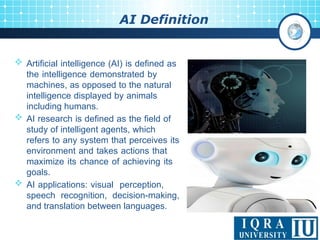
 Artificial intelligence (AI) is defined as
the intelligence demonstrated by
machines, as opposed to the natural
intelligence displayed by animals
including humans.
 AI research is defined as the field of
study of intelligent agents, which
refers to any system that perceives its
environment and takes actions that
maximize its chance of achieving its
goals.
 AI applications: visual perception,
speech recognition, decision-making,
and translation between languages.
5
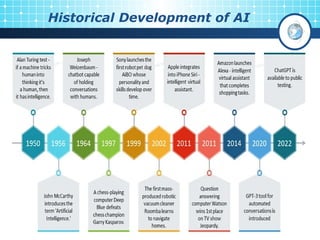
Historical Development of AI
6
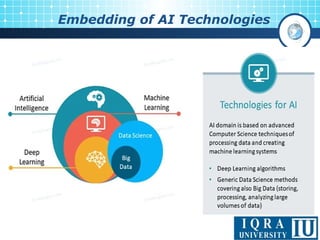
Embedding of AI Technologies
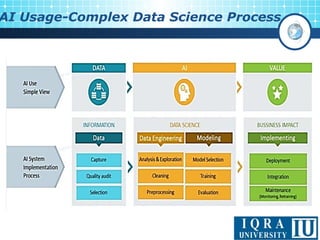
AI Usage-Complex Data Science Process
8
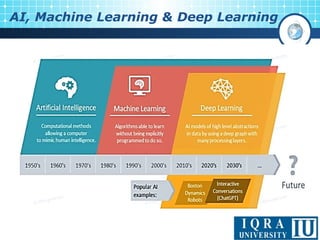
AI, Machine Learning & Deep Learning
9
AI & Its Sub-Domains
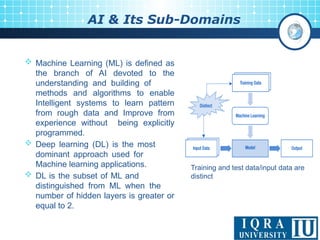
 Machine Learning (ML) is defined as
the branch of AI devoted to the
understanding and building of
methods and algorithms to enable
Intelligent systems to learn pattern
from rough data and Improve from
experience without being explicitly
programmed.
 Deep learning (DL) is the most
dominant approach used for
Machine learning applications.
 DL is the subset of ML and
distinguished from ML when the
number of hidden layers is greater or
equal to 2.
Training and test data/input data are
distinct
10
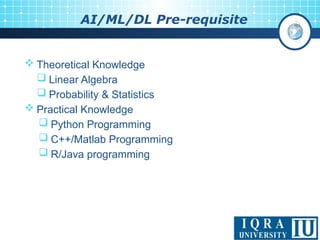
AI/ML/DL Pre-requisite
 Theoretical Knowledge
 Linear Algebra
 Probability & Statistics
 Practical Knowledge
 Python Programming
 C++/Matlab Programming
 R/Java programming
11
AI/ML/DL Frameworks
 Python
 OpenAI (Community of Researchers)
 PyTorch (Facebook)
 TensorFlow (Google)
 Keras (Google)
 Other languages
 Caffe (C++) (Berkley AI Research)
 AI practicing tools
 Google colab
 Kaggle
12
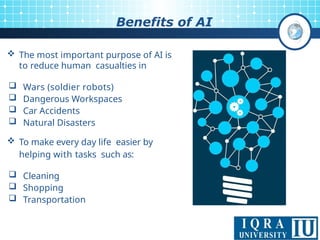
Benefits of AI
 The most important purpose of AI is
to reduce human casualties in
 Wars (soldier robots)
 Dangerous Workspaces
 Car Accidents
 Natural Disasters
 To make every day life easier by
helping with tasks such as:
 Cleaning
 Shopping
 Transportation
13
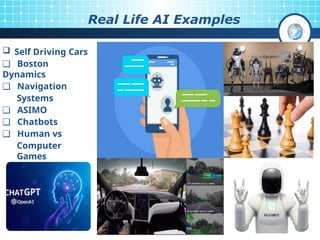
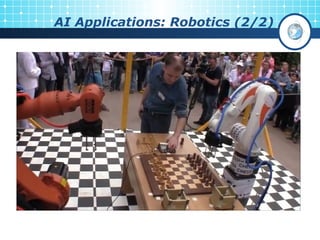
Real Life AI Examples
 Self Driving Cars
❏ Boston
Dynamics
❏ Navigation
Systems
❏ ASIMO
❏ Chatbots
❏ Human vs
Computer
Games
❏ Many More!
14
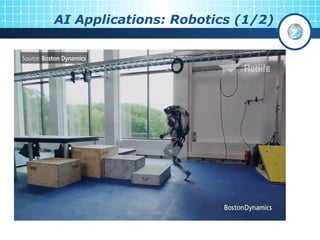
AI Applications: Robotics (1/2)
15
AI Applications: Robotics (2/2)
16
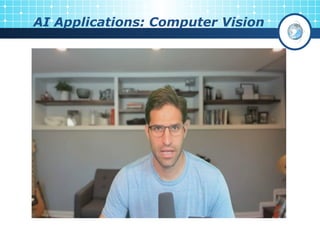
AI Applications: Computer Vision
< 17 >
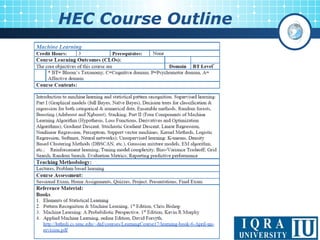
HEC Course Outline
Administrative
 At least 75% attendance policy will be enforced.
 Office Location: Faculty Cubicles 1st
Floor
 Lecture: Tuesday 18:30 to 21:30 hours
 Email: muhammad.ayaz@iqra.edu.pk
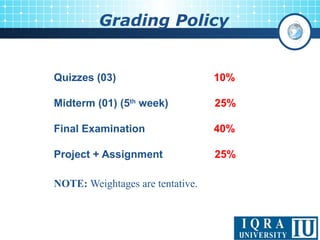
Grading Policy
Quizzes (03) 10%
Midterm (01) (5th
week) 25%
Final Examination 40%
Project + Assignment 25%
NOTE: Weightages are tentative.
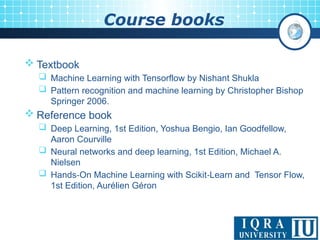
Course books
 Textbook
 Machine Learning with Tensorflow by Nishant Shukla
 Pattern recognition and machine learning by Christopher Bishop
Springer 2006.
 Reference book
 Deep Learning, 1st Edition, Yoshua Bengio, Ian Goodfellow,
Aaron Courville
 Neural networks and deep learning, 1st Edition, Michael A.
Nielsen
 Hands On Machine Learning with Scikit Learn and Tensor Flow,
‑ ‑
1st Edition, Aurélien Géron
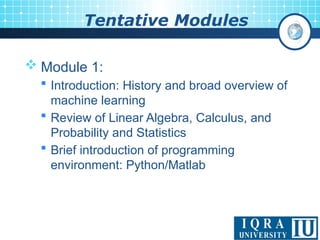
Tentative Modules
 Module 1:
 Introduction: History and broad overview of
machine learning
 Review of Linear Algebra, Calculus, and
Probability and Statistics
 Brief introduction of programming
environment: Python/Matlab
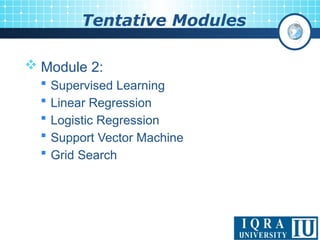
Tentative Modules
 Module 2:
 Supervised Learning
 Linear Regression
 Logistic Regression
 Support Vector Machine
 Grid Search
Tentative Modules
 Module 3:
 Artificial Neural Networks
 Convolutional Neural Networks
 Autoencoders
 Recurrent Neural Networks
 Random Forest
Tentative Modules
 Module 4:
 Deep Reinforcement Learning
 Naïve Bayes
 Decision Trees
 Unsupervised Learning
Why ML/DL?
 ML has covered almost all the fields of Engineering and
Sciences.
 The algorithms which used the manually prepared data
have shifted towards ML/DL paradigm.
 Time-consuming to prepare datasets manually (Prob 1)
 The generalization of the model is also difficult (Prob 2)
 ML/DL has solved the above problems
 ML has been crucial for Multidisciplinary research.
 ML/DL can be used for pattern recognition (in datasets)
and for the prediction of the future.
Why ML/DL?
 How to move from point A to B?
 Photo tagging
 Spam/anti-spam labeling
 Web search
 Autonomous car
 Hand-written character recognition
 Credit card fraud detection
 Language Translation
 Several Computer vision, Robotics, NLP and Control
Applications
Why ML/DL?
 Volume of data collected growing day by day
 Dataset production will be several times greater in the
current year than in the previous one.
 Humans will only be able to look at only a portion of the
entire data.
 Data is cheap and abundant; knowledge is scarce and
expensive.
 Knowledge discovery is needed to make sense and use
of data
AI vs. ML
 Artificial intelligence (AI) is defined as the intelligence
demonstrated by machines, as opposed to the natural
intelligence displayed by animals including humans.
 AI research is defined as the field of study of intelligent
agents, which refers to any system that perceives its
environment and takes actions that maximize its chance
of achieving its goals.
 ML is the subset of AI.
ML vs. DL
 Machine Learning (ML) is defined as the branch of AI
devoted to the understanding and building of methods
and algorithms to enable Intelligent systems to learn
pattern from rough data and improve from experience
without being explicitly programmed.
 Deep learning (DL) is the most dominant approach used
for Machine learning applications.
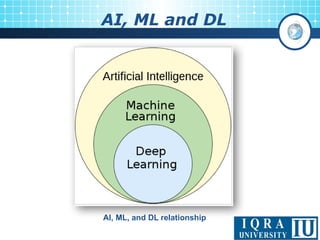
 DL is the subset of ML and distinguished from ML when
the number of hidden layers is greater or equal to 2.
AI, ML and DL
AI, ML, and DL relationship
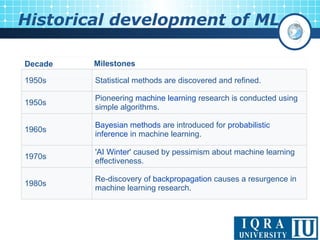
Historical development of ML
1950s Statistical methods are discovered and refined.
1950s
Pioneering machine learning research is conducted using
simple algorithms.
1960s
Bayesian methods are introduced for probabilistic
inference in machine learning.
1970s
'AI Winter' caused by pessimism about machine learning
effectiveness.
1980s
Re-discovery of backpropagation causes a resurgence in
machine learning research.
Decade Milestones
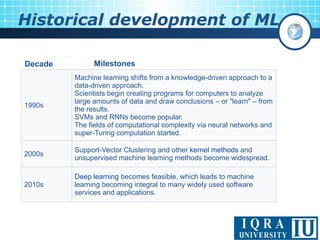
Historical development of ML
Decade Milestones
1990s
Machine learning shifts from a knowledge-driven approach to a
data-driven approach.
Scientists begin creating programs for computers to analyze
large amounts of data and draw conclusions – or "learn" – from
the results.
SVMs and RNNs become popular.
The fields of computational complexity via neural networks and
super-Turing computation started.
2000s
Support-Vector Clustering and other kernel methods and
unsupervised machine learning methods become widespread.
2010s
Deep learning becomes feasible, which leads to machine
learning becoming integral to many widely used software
services and applications.
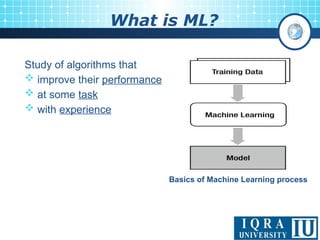
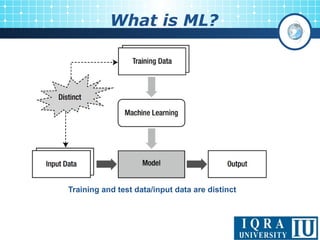
What is ML?
Study of algorithms that
 improve their performance
 at some task
 with experience
Basics of Machine Learning process
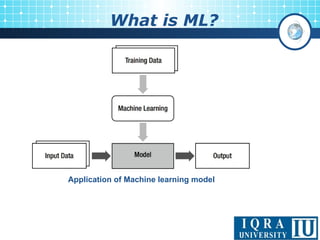
What is ML?
Application of Machine learning model
What is ML?
Training and test data/input data are distinct
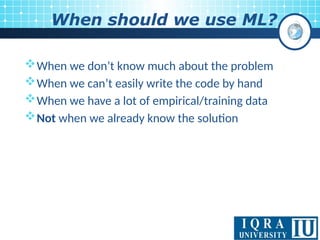
When should we use ML?
When we don’t know much about the problem
When we can’t easily write the code by hand
When we have a lot of empirical/training data
Not when we already know the solution
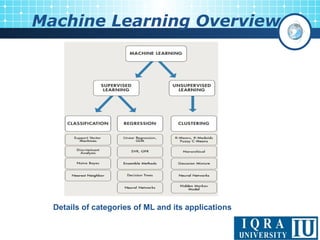
Machine Learning Overview
Details of categories of ML and its applications
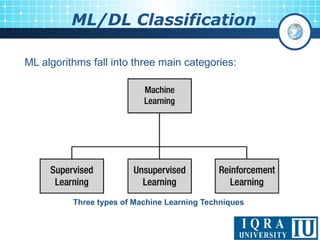
ML/DL Classification
ML algorithms fall into three main categories:
Three types of Machine Learning Techniques
ML/DL Classification
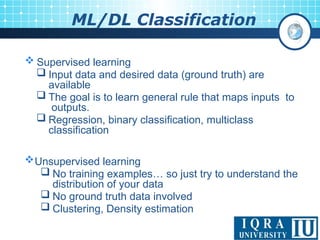
 Supervised learning
 Input data and desired data (ground truth) are
available
 The goal is to learn general rule that maps inputs to
outputs.
 Regression, binary classification, multiclass
classification
Unsupervised learning
 No training examples… so just try to understand the
distribution of your data
 No ground truth data involved
 Clustering, Density estimation
ML/DL Classification
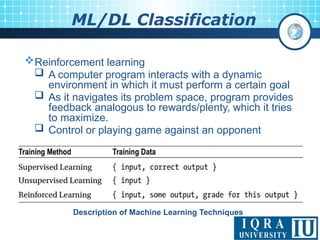
Reinforcement learning
 A computer program interacts with a dynamic
environment in which it must perform a certain goal
 As it navigates its problem space, program provides
feedback analogous to rewards/plenty, which it tries
to maximize.
 Control or playing game against an opponent
Description of Machine Learning Techniques
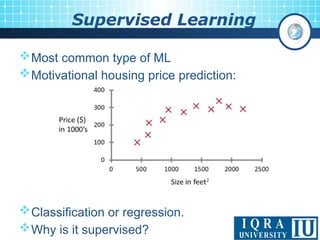
Supervised Learning
Most common type of ML
Motivational housing price prediction:
Classification or regression.
Why is it supervised?
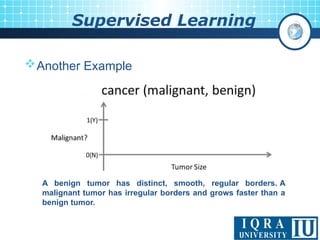
Supervised Learning
Another Example
A benign tumor has distinct, smooth, regular borders. A
malignant tumor has irregular borders and grows faster than a
benign tumor.
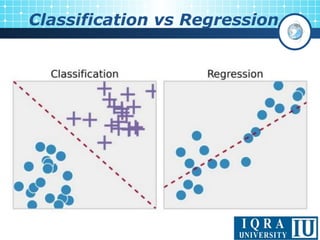
Classification vs Regression
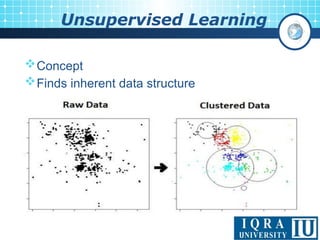
Unsupervised Learning
Concept
Finds inherent data structure

Deeeep Leeearning Leeeecture gor undergraduate.pptx

  • 1.
    OMROB Lab. Machine Learning Course Instructor:Dr. M Ayaz Shirazi Associate Professor
  • 2.
    < 2 > Completed Ph.D. (Electronics) from Kyungpook National University, South Korea  Former Post-doctoral researcher in South Korea’s Highly ranked university, KAIST  Author of eleven (11) Impact factor journal publications and several conference publications  Active Researcher in the areas of Computer Vision, AI, and Robotics Introduction to Instructor
  • 3.
    < 3 > KNU International Graduate Scholarship (KINGS) Award (Fully-funded scholarship for Ph.D. course work)  Best (Journal) Paper Award 2017 (Out of the SCI(E) papers published in School of Electronics Engineering, Kyungpook National University )  GCORE and BK21 Plus Postdoctoral Fellowships  Co–PI, HEC NRPU Research Grant 2021 (Funding Rs. 8.818 Million). Introduction to Instructor
  • 4.
    4 AI Definition  Artificialintelligence (AI) is defined as the intelligence demonstrated by machines, as opposed to the natural intelligence displayed by animals including humans.  AI research is defined as the field of study of intelligent agents, which refers to any system that perceives its environment and takes actions that maximize its chance of achieving its goals.  AI applications: visual perception, speech recognition, decision-making, and translation between languages.
  • 5.
  • 6.
    6 Embedding of AITechnologies
  • 7.
    AI Usage-Complex DataScience Process
  • 8.
    8 AI, Machine Learning& Deep Learning
  • 9.
    9 AI & ItsSub-Domains  Machine Learning (ML) is defined as the branch of AI devoted to the understanding and building of methods and algorithms to enable Intelligent systems to learn pattern from rough data and Improve from experience without being explicitly programmed.  Deep learning (DL) is the most dominant approach used for Machine learning applications.  DL is the subset of ML and distinguished from ML when the number of hidden layers is greater or equal to 2. Training and test data/input data are distinct
  • 10.
    10 AI/ML/DL Pre-requisite  TheoreticalKnowledge  Linear Algebra  Probability & Statistics  Practical Knowledge  Python Programming  C++/Matlab Programming  R/Java programming
  • 11.
    11 AI/ML/DL Frameworks  Python OpenAI (Community of Researchers)  PyTorch (Facebook)  TensorFlow (Google)  Keras (Google)  Other languages  Caffe (C++) (Berkley AI Research)  AI practicing tools  Google colab  Kaggle
  • 12.
    12 Benefits of AI The most important purpose of AI is to reduce human casualties in  Wars (soldier robots)  Dangerous Workspaces  Car Accidents  Natural Disasters  To make every day life easier by helping with tasks such as:  Cleaning  Shopping  Transportation
  • 13.
    13 Real Life AIExamples  Self Driving Cars ❏ Boston Dynamics ❏ Navigation Systems ❏ ASIMO ❏ Chatbots ❏ Human vs Computer Games ❏ Many More!
  • 14.
  • 15.
  • 16.
  • 17.
    < 17 > HECCourse Outline
  • 18.
    Administrative  At least75% attendance policy will be enforced.  Office Location: Faculty Cubicles 1st Floor  Lecture: Tuesday 18:30 to 21:30 hours  Email: muhammad.ayaz@iqra.edu.pk
  • 19.
    Grading Policy Quizzes (03)10% Midterm (01) (5th week) 25% Final Examination 40% Project + Assignment 25% NOTE: Weightages are tentative.
  • 20.
    Course books  Textbook Machine Learning with Tensorflow by Nishant Shukla  Pattern recognition and machine learning by Christopher Bishop Springer 2006.  Reference book  Deep Learning, 1st Edition, Yoshua Bengio, Ian Goodfellow, Aaron Courville  Neural networks and deep learning, 1st Edition, Michael A. Nielsen  Hands On Machine Learning with Scikit Learn and Tensor Flow, ‑ ‑ 1st Edition, Aurélien Géron
  • 21.
    Tentative Modules  Module1:  Introduction: History and broad overview of machine learning  Review of Linear Algebra, Calculus, and Probability and Statistics  Brief introduction of programming environment: Python/Matlab
  • 22.
    Tentative Modules  Module2:  Supervised Learning  Linear Regression  Logistic Regression  Support Vector Machine  Grid Search
  • 23.
    Tentative Modules  Module3:  Artificial Neural Networks  Convolutional Neural Networks  Autoencoders  Recurrent Neural Networks  Random Forest
  • 24.
    Tentative Modules  Module4:  Deep Reinforcement Learning  Naïve Bayes  Decision Trees  Unsupervised Learning
  • 25.
    Why ML/DL?  MLhas covered almost all the fields of Engineering and Sciences.  The algorithms which used the manually prepared data have shifted towards ML/DL paradigm.  Time-consuming to prepare datasets manually (Prob 1)  The generalization of the model is also difficult (Prob 2)  ML/DL has solved the above problems  ML has been crucial for Multidisciplinary research.  ML/DL can be used for pattern recognition (in datasets) and for the prediction of the future.
  • 26.
    Why ML/DL?  Howto move from point A to B?  Photo tagging  Spam/anti-spam labeling  Web search  Autonomous car  Hand-written character recognition  Credit card fraud detection  Language Translation  Several Computer vision, Robotics, NLP and Control Applications
  • 27.
    Why ML/DL?  Volumeof data collected growing day by day  Dataset production will be several times greater in the current year than in the previous one.  Humans will only be able to look at only a portion of the entire data.  Data is cheap and abundant; knowledge is scarce and expensive.  Knowledge discovery is needed to make sense and use of data
  • 28.
    AI vs. ML Artificial intelligence (AI) is defined as the intelligence demonstrated by machines, as opposed to the natural intelligence displayed by animals including humans.  AI research is defined as the field of study of intelligent agents, which refers to any system that perceives its environment and takes actions that maximize its chance of achieving its goals.  ML is the subset of AI.
  • 29.
    ML vs. DL Machine Learning (ML) is defined as the branch of AI devoted to the understanding and building of methods and algorithms to enable Intelligent systems to learn pattern from rough data and improve from experience without being explicitly programmed.  Deep learning (DL) is the most dominant approach used for Machine learning applications.  DL is the subset of ML and distinguished from ML when the number of hidden layers is greater or equal to 2.
  • 30.
    AI, ML andDL AI, ML, and DL relationship
  • 31.
    Historical development ofML 1950s Statistical methods are discovered and refined. 1950s Pioneering machine learning research is conducted using simple algorithms. 1960s Bayesian methods are introduced for probabilistic inference in machine learning. 1970s 'AI Winter' caused by pessimism about machine learning effectiveness. 1980s Re-discovery of backpropagation causes a resurgence in machine learning research. Decade Milestones
  • 32.
    Historical development ofML Decade Milestones 1990s Machine learning shifts from a knowledge-driven approach to a data-driven approach. Scientists begin creating programs for computers to analyze large amounts of data and draw conclusions – or "learn" – from the results. SVMs and RNNs become popular. The fields of computational complexity via neural networks and super-Turing computation started. 2000s Support-Vector Clustering and other kernel methods and unsupervised machine learning methods become widespread. 2010s Deep learning becomes feasible, which leads to machine learning becoming integral to many widely used software services and applications.
  • 33.
    What is ML? Studyof algorithms that  improve their performance  at some task  with experience Basics of Machine Learning process
  • 34.
    What is ML? Applicationof Machine learning model
  • 35.
    What is ML? Trainingand test data/input data are distinct
  • 36.
    When should weuse ML? When we don’t know much about the problem When we can’t easily write the code by hand When we have a lot of empirical/training data Not when we already know the solution
  • 37.
    Machine Learning Overview Detailsof categories of ML and its applications
  • 38.
    ML/DL Classification ML algorithmsfall into three main categories: Three types of Machine Learning Techniques
  • 39.
    ML/DL Classification  Supervisedlearning  Input data and desired data (ground truth) are available  The goal is to learn general rule that maps inputs to outputs.  Regression, binary classification, multiclass classification Unsupervised learning  No training examples… so just try to understand the distribution of your data  No ground truth data involved  Clustering, Density estimation
  • 40.
    ML/DL Classification Reinforcement learning A computer program interacts with a dynamic environment in which it must perform a certain goal  As it navigates its problem space, program provides feedback analogous to rewards/plenty, which it tries to maximize.  Control or playing game against an opponent Description of Machine Learning Techniques
  • 41.
    Supervised Learning Most commontype of ML Motivational housing price prediction: Classification or regression. Why is it supervised?
  • 42.
    Supervised Learning Another Example Abenign tumor has distinct, smooth, regular borders. A malignant tumor has irregular borders and grows faster than a benign tumor.
  • 43.
  • 44.