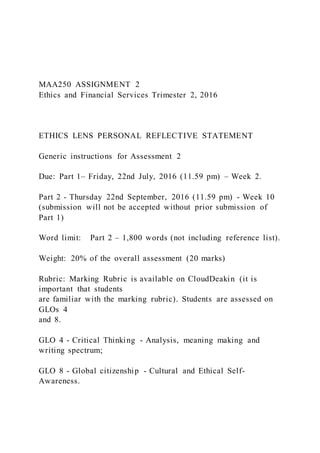
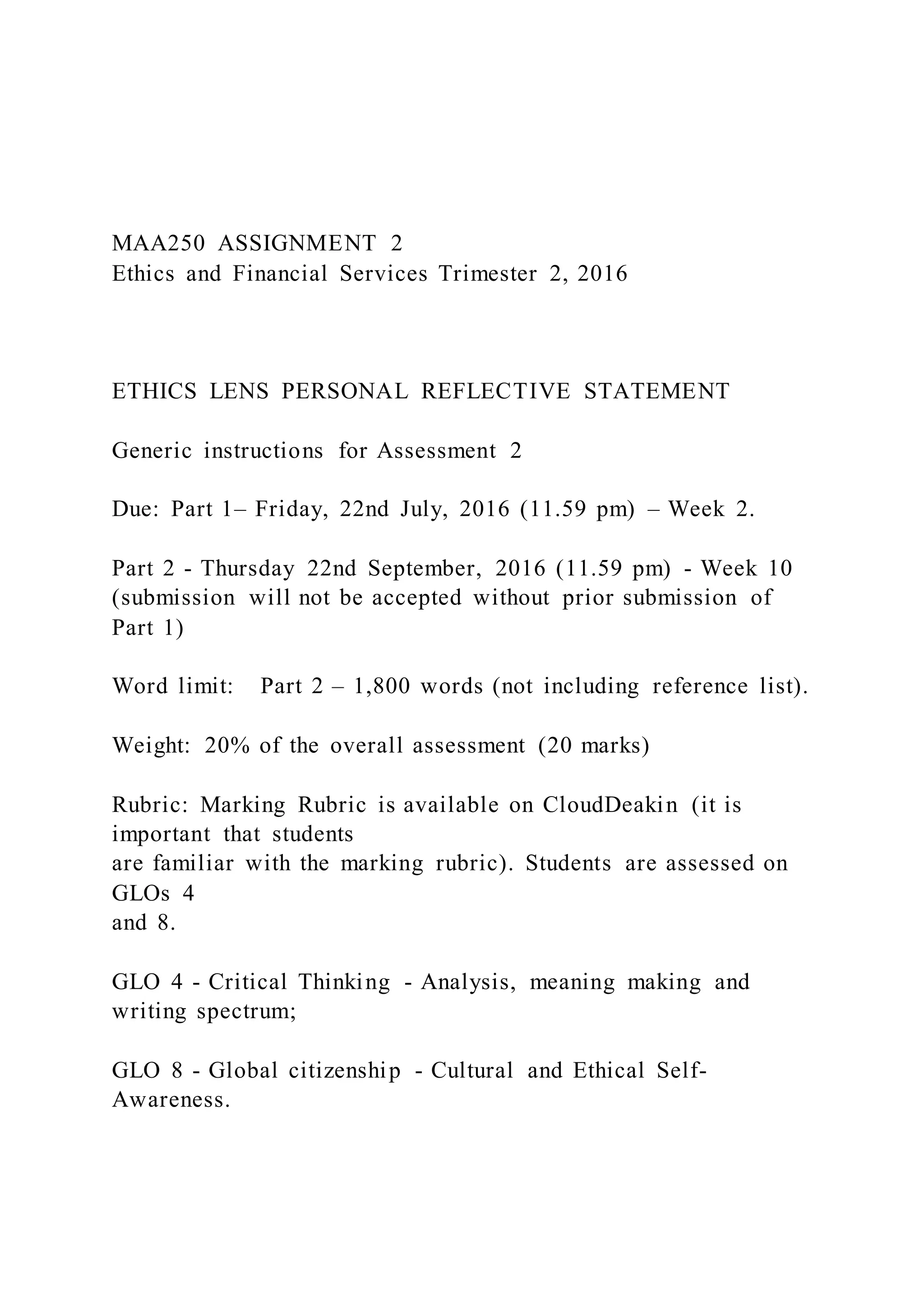
MAA250 ASSIGNMENT 2
Ethics and Financial Services Trimester 2, 2016
ETHICS LENS PERSONAL REFLECTIVE STATEMENT
Generic instructions for Assessment 2
Due: Part 1– Friday, 22nd July, 2016 (11.59 pm) – Week 2.
Part 2 - Thursday 22nd September, 2016 (11.59 pm) - Week 10
(submission will not be accepted without prior submission of
Part 1)
Word limit: Part 2 – 1,800 words (not including reference list).
Weight: 20% of the overall assessment (20 marks)
Rubric: Marking Rubric is available on CloudDeakin (it is
important that students
are familiar with the marking rubric). Students are assessed on
GLOs 4
and 8.
GLO 4 - Critical Thinking - Analysis, meaning making and
writing spectrum;
GLO 8 - Global citizenship - Cultural and Ethical Self-
Awareness.
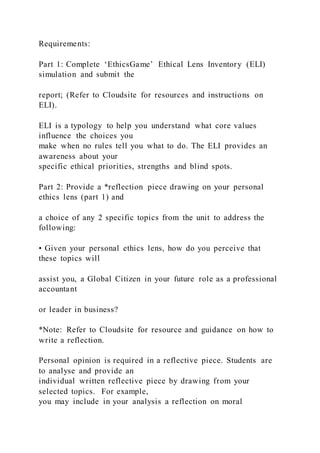
Requirements:
Part 1: Complete ‘EthicsGame’ Ethical Lens Inventory (ELI)
simulation and submit the
report; (Refer to Cloudsite for resources and instructions on
ELI).
ELI is a typology to help you understand what core values
influence the choices you
make when no rules tell you what to do. The ELI provides an
awareness about your
specific ethical priorities, strengths and blind spots.
Part 2: Provide a *reflection piece drawing on your personal
ethics lens (part 1) and
a choice of any 2 specific topics from the unit to address the
following:
• Given your personal ethics lens, how do you perceive that
these topics will
assist you, a Global Citizen in your future role as a professional
accountant
or leader in business?
*Note: Refer to Cloudsite for resource and guidance on how to
write a reflection.
Personal opinion is required in a reflective piece. Students are
to analyse and provide an
individual written reflective piece by drawing from your
selected topics. For example,
you may include in your analysis a reflection on moral
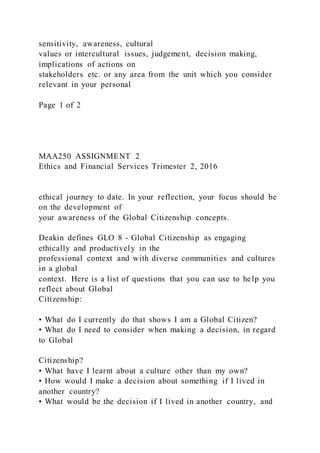
sensitivity, awareness, cultural
values or intercultural issues, judgement, decision making,
implications of actions on
stakeholders etc. or any area from the unit which you consider
relevant in your personal
Page 1 of 2
MAA250 ASSIGNMENT 2
Ethics and Financial Services Trimester 2, 2016
ethical journey to date. In your reflection, your focus should be
on the development of
your awareness of the Global Citizenship concepts.
Deakin defines GLO 8 - Global Citizenship as engaging
ethically and productively in the
professional context and with diverse communities and cultures
in a global
context. Here is a list of questions that you can use to help you
reflect about Global
Citizenship:
• What do I currently do that shows I am a Global Citizen?
• What do I need to consider when making a decision, in regard
to Global
Citizenship?
• What have I learnt about a culture other than my own?
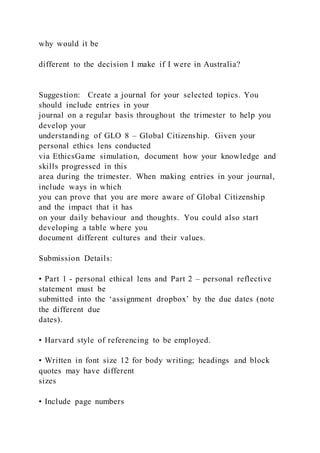
• How would I make a decision about something if I lived in
another country?
• What would be the decision if I lived in another country, and
why would it be
different to the decision I make if I were in Australia?
Suggestion: Create a journal for your selected topics. You
should include entries in your
journal on a regular basis throughout the trimester to help you
develop your
understanding of GLO 8 – Global Citizenship. Given your
personal ethics lens conducted
via EthicsGame simulation, document how your knowledge and
skills progressed in this
area during the trimester. When making entries in your journal,
include ways in which
you can prove that you are more aware of Global Citizenship
and the impact that it has
on your daily behaviour and thoughts. You could also start
developing a table where you
document different cultures and their values.
Submission Details:
• Part 1 - personal ethical lens and Part 2 – personal reflective
statement must be
submitted into the ‘assignment dropbox’ by the due dates (note
the different due
dates).
• Harvard style of referencing to be employed.
• Written in font size 12 for body writing; headings and block
quotes may have different
sizes
• Include page numbers
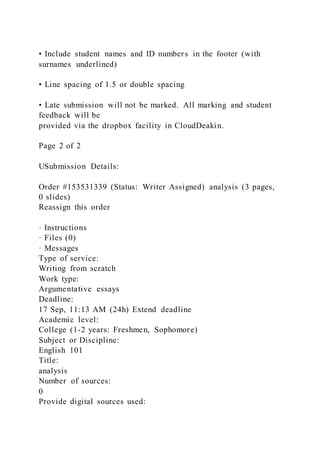
• Include student names and ID numbers in the footer (with
surnames underlined)
• Line spacing of 1.5 or double spacing
• Late submission will not be marked. All marking and student
feedback will be
provided via the dropbox facility in CloudDeakin.
Page 2 of 2
USubmission Details:
Order #153531339 (Status: Writer Assigned) analysis (3 pages,
0 slides)
Reassign this order
· Instructions
· Files (0)
· Messages
Type of service:
Writing from scratch
Work type:
Argumentative essays
Deadline:
17 Sep, 11:13 AM (24h) Extend deadline
Academic level:
College (1-2 years: Freshmen, Sophomore)
Subject or Discipline:
English 101
Title:
analysis
Number of sources:
0
Provide digital sources used:
No
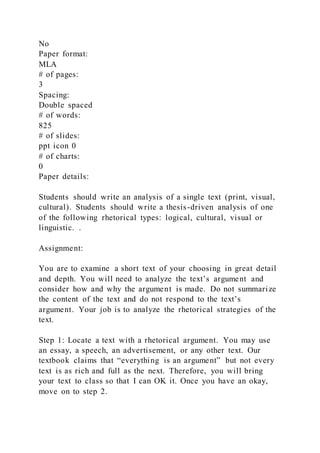
Paper format:
MLA
# of pages:
3
Spacing:
Double spaced
# of words:
825
# of slides:
ppt icon 0
# of charts:
0
Paper details:
Students should write an analysis of a single text (print, visual,
cultural). Students should write a thesis-driven analysis of one
of the following rhetorical types: logical, cultural, visual or
linguistic. .
Assignment:
You are to examine a short text of your choosing in great detail
and depth. You will need to analyze the text’s argument and
consider how and why the argument is made. Do not summarize
the content of the text and do not respond to the text’s
argument. Your job is to analyze the rhetorical strategies of the
text.
Step 1: Locate a text with a rhetorical argument. You may use
an essay, a speech, an advertisement, or any other text. Our
textbook claims that “everything is an argument” but not every
text is as rich and full as the next. Therefore, you will bring
your text to class so that I can OK it. Once you have an okay,
move on to step 2.
Step 2: Examine the author’s purpose. As with all texts we
discuss in class, your job is to consider the author’s purpose,
make a claim (using evidence) about why he or she wrote the
text, and who the text’s intended audience might be. Look for a
thesis statement and/or end-of- paragraph arguments and for the
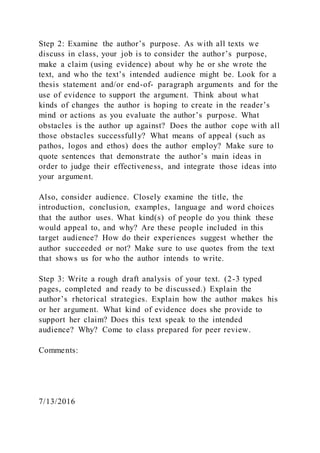
use of evidence to support the argument. Think about what
kinds of changes the author is hoping to create in the reader’s
mind or actions as you evaluate the author’s purpose. What
obstacles is the author up against? Does the author cope with all
those obstacles successfully? What means of appeal (such as
pathos, logos and ethos) does the author employ? Make sure to
quote sentences that demonstrate the author’s main ideas in
order to judge their effectiveness, and integrate those ideas into
your argument.
Also, consider audience. Closely examine the title, the
introduction, conclusion, examples, language and word choices
that the author uses. What kind(s) of people do you think these
would appeal to, and why? Are these people included in this
target audience? How do their experiences suggest whether the
author succeeded or not? Make sure to use quotes from the text
that shows us for who the author intends to write.
Step 3: Write a rough draft analysis of your text. (2-3 typed
pages, completed and ready to be discussed.) Explain the
author’s rhetorical strategies. Explain how the author makes his
or her argument. What kind of evidence does she provide to
support her claim? Does this text speak to the intended
audience? Why? Come to class prepared for peer review.
Comments:
7/13/2016
ELI Ethical Lens Inventory
Relationship and Reputation
Feng Cai
You balance your reasoning skills (rationality) and your
intuition (sensibility) to determine what processes, systems,
character traits
and virtues will best serve the community by assuring fairness
and justice for all (equality).
Core Values: Equality and Rationality/Sensibility
You prioritize the value of equality over autonomy. Your
primary concern is the well-being of the whole community and
you believe that assuring the
community's well-being is the best way to assure that
individuals are treated fairly. You value rationality and
sensibility equally. You believe that while
there are universal principles, each situation is unique and not
all exceptions can be categorized. For you the best solution is
both consistent and
flexible.
Classical Virtues: Justice and Fortitude
You value the social that is achieved through loyalty and
consistency in dealings among members of the community. In
your mind, a predictable
system that assures the well-being of all, especially those
without power, is a just system.You also demonstrate courage
and steadiness in the face of
obstacles. You tend to avoid rash actions while at the same time
charting an untested course.
Key Phrase: “I make fair and virtuous choices.”
Because you equally value rationality and sensibility, along
with equality, you tend to assume that the best ethical result is
achieved when everyone
lives out the positive character traits required by their role
within a just system.
Determining What Is Ethical: Being fair and Living out Role
Responsibilities
You define an ethical person as one with sound character traits
and habits of thoughtful reflection who seeks justice and
fundamental fairness in the
community. For you, those who demonstrate strong leadership
in their roles and give everyone in the community, especially
those without power, a
chance to succeed exemplify ethical behavior.
Analytical Tool: Authority and Tradition
You tend to think through a problem carefully and research
options. You pay particular attention to the experts on the
subject and what others in
your role have said or done. Your goal is to make a fully
informed decision and to meet the needs of the community,
without harming the least
advantaged. Although you consider what others you respect
have done in similar situations, you remain flexible and can
craft a unique or novel
solution when necessary.
Gift: Advocacy and Compassion
Because you are concerned with fairness, when you are at your
best you work for what is just for all, i.e., what keeps people
connected to others in
the community. You assure that systems and processes are
coherent, uniformly followed, and they protect the least
advantaged without creating
undue burdens for the rest. You are also able to "tell the story"
of each member of your community.
Blind Spot: Overconfidence in process or Unrealistic Role
Expectations
Because you believe that a consistent process results in a just
outcome for all, you sometimes trust the process too much. You
forget that unequal
access gives rise to unjust outcomes, even when the process
itself is fair. At other times, you develop unrealistic role
expectations, forgetting that
individuals are fallible regardless of their role.
Risk: Being authoritarian or Self-Righteous
Sometimes you require deference to power concentrated in a
hierarchical authority. Because you have thought carefully
about what is right in a given
situation, you tend to assume that your way is best. You may
then abuse power as you impose your will on others for their
own good. On the other
hand, when your compassion fails, you come to believe that the
perks and privileges of your role belong to you because you are
better than others.
Double Standard: Exemption and Entitlement
As you seek justice for all, you are sometimes tempted to
exempt yourself and leaders you trust from the rules or to
believe that you have a right to
special privileges because of your role. You'll convince yourself
that the rules were meant for other people or that the action you
want to take really is
just for everyone - even though your "Fair Self" tells you
otherwise. You will persuade yourself that your role gives you
rights inconsistent with good
character.
Vice: Becoming an ambitious elitist or Hard-hearted
W hen your personal ambition overpowers your concern for
justice, you overlook abuses of power by those in leadership
positions. This will be
especially true when the leaders are part of your group, and they
claim to be protecting the rights of those who cannot protect
themselves. If your
compassion fails and you become hard-hearted, you may apply
capricious and inappropriate solutions.
Crisis: Isolation, guilt and confusion
Unless you develop the practice of mindfulness and reflection,
at some point you will become isolated. No one can always
guarantee justice, or even a
fair process. You will also feel guilty if you begin to resent that
so few people you help seem grateful. At some point you will
also confront the loss of
your center, especially if you lose the role with which you have
become identified. If you find you have few friends, it could be
because your obsession
with justice or your role responsibilities drives everyone away.
Seeing Clearly: Consider the claims of individuals
To see more clearly, consider the claims of individuals in the
group, not just the group as a whole. Although you do a god job
of making sure your
head and your heart agree, you do tend to focus on the well -
being of the community at the expense of individual rights. As
you consider what is fair
and what character traits are necessary for the community,
remember to temper your actions with concern for individuals.
Look for ways to assure
that individual rights are protected. As you learn to consider the
perspectives of individuals in your decision making process,
you will live out the best
of your ideals with compassion and care for all.
7/13/2016ELI Ethical Lens InventoryRelationship and
ReputationFeng CaiCore Values: Equality and
Rationality/SensibilityClassical Virtues: Justice and
FortitudeKey Phrase: “I make fair and virtuous
choices.”Determining What Is Ethical: Being fair and Living
out Role ResponsibilitiesAnalytical Tool: Authority and
TraditionGift: Advocacy and CompassionBlind Spot:
Overconfidence in process or Unrealistic Role
ExpectationsRisk: Being authoritarian or Self-RighteousDouble
Standard: Exemption and EntitlementVice: Becoming an
ambitious elitist or Hard-heartedCrisis: Isolation, guilt and
confusionSeeing Clearly: Consider the claims of individuals

Maa250 assignment 2 ethics and financial services trimester

  • 1.
    MAA250 ASSIGNMENT 2 Ethicsand Financial Services Trimester 2, 2016 ETHICS LENS PERSONAL REFLECTIVE STATEMENT Generic instructions for Assessment 2 Due: Part 1– Friday, 22nd July, 2016 (11.59 pm) – Week 2. Part 2 - Thursday 22nd September, 2016 (11.59 pm) - Week 10 (submission will not be accepted without prior submission of Part 1) Word limit: Part 2 – 1,800 words (not including reference list). Weight: 20% of the overall assessment (20 marks) Rubric: Marking Rubric is available on CloudDeakin (it is important that students are familiar with the marking rubric). Students are assessed on GLOs 4 and 8. GLO 4 - Critical Thinking - Analysis, meaning making and writing spectrum; GLO 8 - Global citizenship - Cultural and Ethical Self- Awareness.
  • 2.
    Requirements: Part 1: Complete‘EthicsGame’ Ethical Lens Inventory (ELI) simulation and submit the report; (Refer to Cloudsite for resources and instructions on ELI). ELI is a typology to help you understand what core values influence the choices you make when no rules tell you what to do. The ELI provides an awareness about your specific ethical priorities, strengths and blind spots. Part 2: Provide a *reflection piece drawing on your personal ethics lens (part 1) and a choice of any 2 specific topics from the unit to address the following: • Given your personal ethics lens, how do you perceive that these topics will assist you, a Global Citizen in your future role as a professional accountant or leader in business? *Note: Refer to Cloudsite for resource and guidance on how to write a reflection. Personal opinion is required in a reflective piece. Students are to analyse and provide an individual written reflective piece by drawing from your selected topics. For example, you may include in your analysis a reflection on moral
  • 3.
    sensitivity, awareness, cultural valuesor intercultural issues, judgement, decision making, implications of actions on stakeholders etc. or any area from the unit which you consider relevant in your personal Page 1 of 2 MAA250 ASSIGNMENT 2 Ethics and Financial Services Trimester 2, 2016 ethical journey to date. In your reflection, your focus should be on the development of your awareness of the Global Citizenship concepts. Deakin defines GLO 8 - Global Citizenship as engaging ethically and productively in the professional context and with diverse communities and cultures in a global context. Here is a list of questions that you can use to help you reflect about Global Citizenship: • What do I currently do that shows I am a Global Citizen? • What do I need to consider when making a decision, in regard to Global Citizenship? • What have I learnt about a culture other than my own? • How would I make a decision about something if I lived in another country? • What would be the decision if I lived in another country, and
  • 4.
    why would itbe different to the decision I make if I were in Australia? Suggestion: Create a journal for your selected topics. You should include entries in your journal on a regular basis throughout the trimester to help you develop your understanding of GLO 8 – Global Citizenship. Given your personal ethics lens conducted via EthicsGame simulation, document how your knowledge and skills progressed in this area during the trimester. When making entries in your journal, include ways in which you can prove that you are more aware of Global Citizenship and the impact that it has on your daily behaviour and thoughts. You could also start developing a table where you document different cultures and their values. Submission Details: • Part 1 - personal ethical lens and Part 2 – personal reflective statement must be submitted into the ‘assignment dropbox’ by the due dates (note the different due dates). • Harvard style of referencing to be employed. • Written in font size 12 for body writing; headings and block quotes may have different sizes • Include page numbers
  • 5.
    • Include studentnames and ID numbers in the footer (with surnames underlined) • Line spacing of 1.5 or double spacing • Late submission will not be marked. All marking and student feedback will be provided via the dropbox facility in CloudDeakin. Page 2 of 2 USubmission Details: Order #153531339 (Status: Writer Assigned) analysis (3 pages, 0 slides) Reassign this order · Instructions · Files (0) · Messages Type of service: Writing from scratch Work type: Argumentative essays Deadline: 17 Sep, 11:13 AM (24h) Extend deadline Academic level: College (1-2 years: Freshmen, Sophomore) Subject or Discipline: English 101 Title: analysis Number of sources: 0 Provide digital sources used:
  • 6.
    No Paper format: MLA # ofpages: 3 Spacing: Double spaced # of words: 825 # of slides: ppt icon 0 # of charts: 0 Paper details: Students should write an analysis of a single text (print, visual, cultural). Students should write a thesis-driven analysis of one of the following rhetorical types: logical, cultural, visual or linguistic. . Assignment: You are to examine a short text of your choosing in great detail and depth. You will need to analyze the text’s argument and consider how and why the argument is made. Do not summarize the content of the text and do not respond to the text’s argument. Your job is to analyze the rhetorical strategies of the text. Step 1: Locate a text with a rhetorical argument. You may use an essay, a speech, an advertisement, or any other text. Our textbook claims that “everything is an argument” but not every text is as rich and full as the next. Therefore, you will bring your text to class so that I can OK it. Once you have an okay, move on to step 2.
  • 7.
    Step 2: Examinethe author’s purpose. As with all texts we discuss in class, your job is to consider the author’s purpose, make a claim (using evidence) about why he or she wrote the text, and who the text’s intended audience might be. Look for a thesis statement and/or end-of- paragraph arguments and for the use of evidence to support the argument. Think about what kinds of changes the author is hoping to create in the reader’s mind or actions as you evaluate the author’s purpose. What obstacles is the author up against? Does the author cope with all those obstacles successfully? What means of appeal (such as pathos, logos and ethos) does the author employ? Make sure to quote sentences that demonstrate the author’s main ideas in order to judge their effectiveness, and integrate those ideas into your argument. Also, consider audience. Closely examine the title, the introduction, conclusion, examples, language and word choices that the author uses. What kind(s) of people do you think these would appeal to, and why? Are these people included in this target audience? How do their experiences suggest whether the author succeeded or not? Make sure to use quotes from the text that shows us for who the author intends to write. Step 3: Write a rough draft analysis of your text. (2-3 typed pages, completed and ready to be discussed.) Explain the author’s rhetorical strategies. Explain how the author makes his or her argument. What kind of evidence does she provide to support her claim? Does this text speak to the intended audience? Why? Come to class prepared for peer review. Comments: 7/13/2016
  • 8.
    ELI Ethical LensInventory Relationship and Reputation Feng Cai You balance your reasoning skills (rationality) and your intuition (sensibility) to determine what processes, systems, character traits and virtues will best serve the community by assuring fairness and justice for all (equality). Core Values: Equality and Rationality/Sensibility You prioritize the value of equality over autonomy. Your primary concern is the well-being of the whole community and you believe that assuring the community's well-being is the best way to assure that individuals are treated fairly. You value rationality and sensibility equally. You believe that while there are universal principles, each situation is unique and not all exceptions can be categorized. For you the best solution is both consistent and flexible. Classical Virtues: Justice and Fortitude You value the social that is achieved through loyalty and consistency in dealings among members of the community. In your mind, a predictable system that assures the well-being of all, especially those without power, is a just system.You also demonstrate courage and steadiness in the face of obstacles. You tend to avoid rash actions while at the same time charting an untested course.
  • 9.
    Key Phrase: “Imake fair and virtuous choices.” Because you equally value rationality and sensibility, along with equality, you tend to assume that the best ethical result is achieved when everyone lives out the positive character traits required by their role within a just system. Determining What Is Ethical: Being fair and Living out Role Responsibilities You define an ethical person as one with sound character traits and habits of thoughtful reflection who seeks justice and fundamental fairness in the community. For you, those who demonstrate strong leadership in their roles and give everyone in the community, especially those without power, a chance to succeed exemplify ethical behavior. Analytical Tool: Authority and Tradition You tend to think through a problem carefully and research options. You pay particular attention to the experts on the subject and what others in your role have said or done. Your goal is to make a fully informed decision and to meet the needs of the community, without harming the least advantaged. Although you consider what others you respect have done in similar situations, you remain flexible and can craft a unique or novel solution when necessary. Gift: Advocacy and Compassion Because you are concerned with fairness, when you are at your best you work for what is just for all, i.e., what keeps people
  • 10.
    connected to othersin the community. You assure that systems and processes are coherent, uniformly followed, and they protect the least advantaged without creating undue burdens for the rest. You are also able to "tell the story" of each member of your community. Blind Spot: Overconfidence in process or Unrealistic Role Expectations Because you believe that a consistent process results in a just outcome for all, you sometimes trust the process too much. You forget that unequal access gives rise to unjust outcomes, even when the process itself is fair. At other times, you develop unrealistic role expectations, forgetting that individuals are fallible regardless of their role. Risk: Being authoritarian or Self-Righteous Sometimes you require deference to power concentrated in a hierarchical authority. Because you have thought carefully about what is right in a given situation, you tend to assume that your way is best. You may then abuse power as you impose your will on others for their own good. On the other hand, when your compassion fails, you come to believe that the perks and privileges of your role belong to you because you are better than others. Double Standard: Exemption and Entitlement As you seek justice for all, you are sometimes tempted to exempt yourself and leaders you trust from the rules or to believe that you have a right to special privileges because of your role. You'll convince yourself
  • 11.
    that the ruleswere meant for other people or that the action you want to take really is just for everyone - even though your "Fair Self" tells you otherwise. You will persuade yourself that your role gives you rights inconsistent with good character. Vice: Becoming an ambitious elitist or Hard-hearted W hen your personal ambition overpowers your concern for justice, you overlook abuses of power by those in leadership positions. This will be especially true when the leaders are part of your group, and they claim to be protecting the rights of those who cannot protect themselves. If your compassion fails and you become hard-hearted, you may apply capricious and inappropriate solutions. Crisis: Isolation, guilt and confusion Unless you develop the practice of mindfulness and reflection, at some point you will become isolated. No one can always guarantee justice, or even a fair process. You will also feel guilty if you begin to resent that so few people you help seem grateful. At some point you will also confront the loss of your center, especially if you lose the role with which you have become identified. If you find you have few friends, it could be because your obsession with justice or your role responsibilities drives everyone away. Seeing Clearly: Consider the claims of individuals
  • 12.
    To see moreclearly, consider the claims of individuals in the group, not just the group as a whole. Although you do a god job of making sure your head and your heart agree, you do tend to focus on the well - being of the community at the expense of individual rights. As you consider what is fair and what character traits are necessary for the community, remember to temper your actions with concern for individuals. Look for ways to assure that individual rights are protected. As you learn to consider the perspectives of individuals in your decision making process, you will live out the best of your ideals with compassion and care for all. 7/13/2016ELI Ethical Lens InventoryRelationship and ReputationFeng CaiCore Values: Equality and Rationality/SensibilityClassical Virtues: Justice and FortitudeKey Phrase: “I make fair and virtuous choices.”Determining What Is Ethical: Being fair and Living out Role ResponsibilitiesAnalytical Tool: Authority and TraditionGift: Advocacy and CompassionBlind Spot: Overconfidence in process or Unrealistic Role ExpectationsRisk: Being authoritarian or Self-RighteousDouble Standard: Exemption and EntitlementVice: Becoming an ambitious elitist or Hard-heartedCrisis: Isolation, guilt and confusionSeeing Clearly: Consider the claims of individuals