HumanIT www.twitter.com/Centre4HumanIT www.kau.se/en/humanit Jakob Svensson, Director
http://m4d.humanit.org


http://m4d.humanit.org
 
 
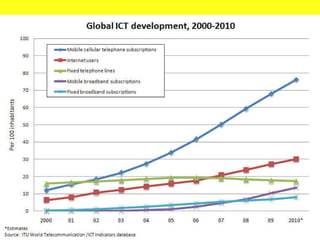
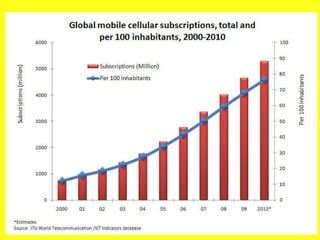
Over 5.3 billion connected by November 2010  Access to mobile networks available to 90% of the world population 200 000 SMS sent every second Mobile Telephony
 
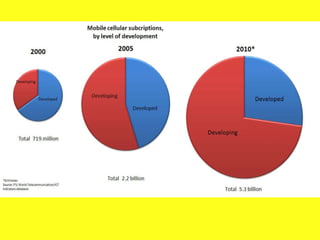
73% of total mobile subscriptions are in developing countries  68% penetration rate in developing countries Countries in development/ transition adopt mobile technology more rapidly Mobile telephony is better distributed among income levels than fixed phones and Internet Is used in inaccessible and rural regions (improving the livelyhood there) 99% of Internet subscriptions in East Africa in June 2009 where from mobile phones Developing world is dominating
What is M4D? Technology in itself does not lead to social change; people decide how a particular technology will be used and, depending on the political and socio-economic environment in which they live, adapt it accordingly
What is M4D? The impact that mobile phones have on the developing world is as revolutionary as roads, railways and ports, increasing social cohesion and releasing the entrepreneurial spirit that stimulates trade and creates jobs
What is M4D? Development? Economic growth  (reducing transactional costs/ increasing sales) Empowerment  (learning / technical pride / community-communication) Choice  (new associations- what to participate in)
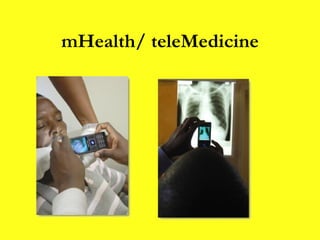
mHealth/ teleMedicine
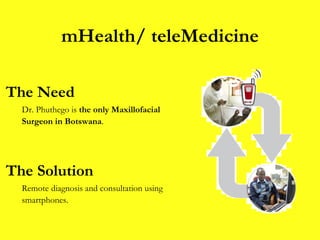
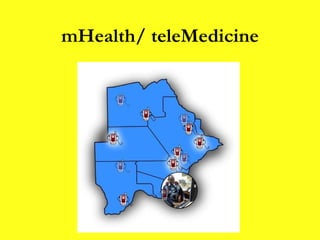
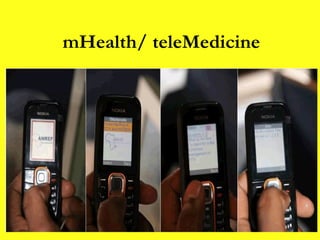
mHealth/ teleMedicine The Need Dr. Phuthego is  the only Maxillofacial Surgeon in Botswana .  The Solution Remote diagnosis and consultation using smartphones.
mHealth/ teleMedicine
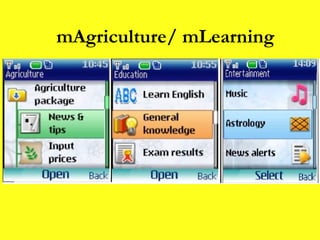
mAgriculture/ mLearning
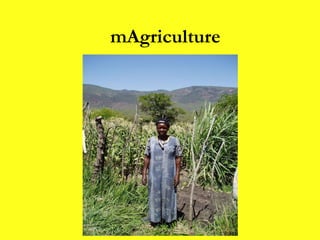
mAgriculture
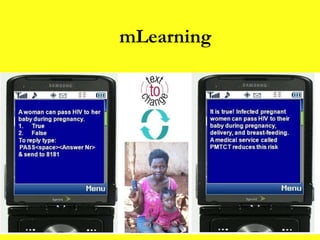
mLearning
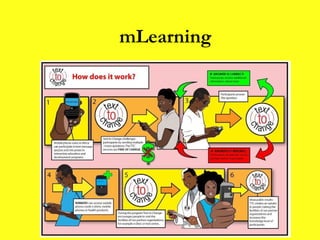
mLearning
mFinance Governance and Participation Other Areas of M4D
Makerere Mobile Mission We, the participants of the  M4D 2010 Conference  held in Kampala, Uganda on 10-11 November 2010, call on all stakeholders to make greater efforts at seizing the development opportunities on the back of more widely spread use of mobile phones. In this context, services and applications that can involve and help serve the needs of the poor, are of particular importance.
Makerere Mobile Mission The  M4D 2010 Conference  provided a unique platform to engage experts from academia, the private sector, civil society, donors and international organizations to examine available evidence and to explore possible needs for future action. Whilst there are clear indications of the potential positive effects of mobile phone use on the livelihoods of poor people, more systematic analysis is needed to convert anecdotes and isolated examples into generalizable and actionable evidence.
Makerere Mobile Mission The  Makerere Mobile Mission  encourages all stakeholders to consider fully the potential for mobile phones, including in combination with other means, to support development through, inter alia, the following areas:
Makerere Mobile Mission Good governance and increased transparency Government services Health care Environment management Rural development Private sector development Finance and insurance Improved livelihoods Citizen empowerment
Makerere Mobile Mission The potential is evident. It is our common responsibility to turn this into reality, and we need to work in partnership.   Academia  needs to scale up efforts to analyze the impact of current uses of mobile phones and understand the needs of users. The private sector  can fund research   and has a crucial role to play in terms of providing equipment, services and applications that can meet the needs of the intended users.
Makerere Mobile Mission Civil society  can serve a critical function in monitoring developments on the ground and helping citizens to gain a stronger voice. Governments  must attach adequate attention to the scope for mobile solutions in their development strategies. They need to provide an enabling environment to this end. They should also harness mobiles when designing and discharging their public services. Development partners  need to ratchet up their interest and activities in the M4D area. Their active involvement and support are needed to fund independent research and to accelerate the expansion of our knowledge base. Participants of the M4D 2010 Conference Kampala, 11 November 2010
Need for a greater conceptual and methodological rigor (theory and method) in the conduct of research (Duncombe) Importance of effective dissemination of research for informing policy and practice (Duncombe) Need for both theory and methodology development and discussion within the area of M4D Design Services for non-literate communities (White) M4D2012 India? The Future of M4D?
Thank you for listening! http://m4d.humanit.org

M4d2010

  • 1.
  • 2.
  • 3.
  • 4.
  • 5.
  • 6.
  • 7.
  • 8.
  • 9.
    Over 5.3 billionconnected by November 2010 Access to mobile networks available to 90% of the world population 200 000 SMS sent every second Mobile Telephony
  • 10.
  • 11.
    73% of totalmobile subscriptions are in developing countries 68% penetration rate in developing countries Countries in development/ transition adopt mobile technology more rapidly Mobile telephony is better distributed among income levels than fixed phones and Internet Is used in inaccessible and rural regions (improving the livelyhood there) 99% of Internet subscriptions in East Africa in June 2009 where from mobile phones Developing world is dominating
  • 12.
    What is M4D?Technology in itself does not lead to social change; people decide how a particular technology will be used and, depending on the political and socio-economic environment in which they live, adapt it accordingly
  • 13.
    What is M4D?The impact that mobile phones have on the developing world is as revolutionary as roads, railways and ports, increasing social cohesion and releasing the entrepreneurial spirit that stimulates trade and creates jobs
  • 14.
    What is M4D?Development? Economic growth (reducing transactional costs/ increasing sales) Empowerment (learning / technical pride / community-communication) Choice (new associations- what to participate in)
  • 15.
  • 16.
    mHealth/ teleMedicine TheNeed Dr. Phuthego is the only Maxillofacial Surgeon in Botswana . The Solution Remote diagnosis and consultation using smartphones.
  • 17.
  • 18.
  • 19.
  • 20.
  • 21.
  • 22.
  • 23.
    mFinance Governance andParticipation Other Areas of M4D
  • 24.
    Makerere Mobile MissionWe, the participants of the M4D 2010 Conference held in Kampala, Uganda on 10-11 November 2010, call on all stakeholders to make greater efforts at seizing the development opportunities on the back of more widely spread use of mobile phones. In this context, services and applications that can involve and help serve the needs of the poor, are of particular importance.
  • 25.
    Makerere Mobile MissionThe M4D 2010 Conference provided a unique platform to engage experts from academia, the private sector, civil society, donors and international organizations to examine available evidence and to explore possible needs for future action. Whilst there are clear indications of the potential positive effects of mobile phone use on the livelihoods of poor people, more systematic analysis is needed to convert anecdotes and isolated examples into generalizable and actionable evidence.
  • 26.
    Makerere Mobile MissionThe Makerere Mobile Mission encourages all stakeholders to consider fully the potential for mobile phones, including in combination with other means, to support development through, inter alia, the following areas:
  • 27.
    Makerere Mobile MissionGood governance and increased transparency Government services Health care Environment management Rural development Private sector development Finance and insurance Improved livelihoods Citizen empowerment
  • 28.
    Makerere Mobile MissionThe potential is evident. It is our common responsibility to turn this into reality, and we need to work in partnership. Academia needs to scale up efforts to analyze the impact of current uses of mobile phones and understand the needs of users. The private sector can fund research and has a crucial role to play in terms of providing equipment, services and applications that can meet the needs of the intended users.
  • 29.
    Makerere Mobile MissionCivil society can serve a critical function in monitoring developments on the ground and helping citizens to gain a stronger voice. Governments must attach adequate attention to the scope for mobile solutions in their development strategies. They need to provide an enabling environment to this end. They should also harness mobiles when designing and discharging their public services. Development partners need to ratchet up their interest and activities in the M4D area. Their active involvement and support are needed to fund independent research and to accelerate the expansion of our knowledge base. Participants of the M4D 2010 Conference Kampala, 11 November 2010
  • 30.
    Need for agreater conceptual and methodological rigor (theory and method) in the conduct of research (Duncombe) Importance of effective dissemination of research for informing policy and practice (Duncombe) Need for both theory and methodology development and discussion within the area of M4D Design Services for non-literate communities (White) M4D2012 India? The Future of M4D?
  • 31.
    Thank you forlistening! http://m4d.humanit.org

Editor's Notes

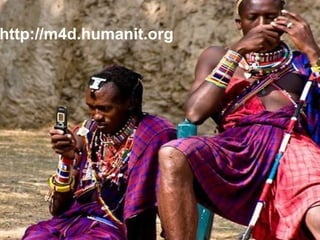
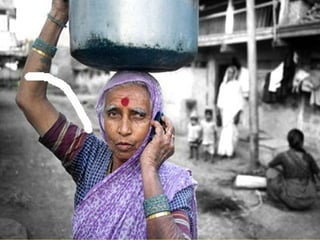
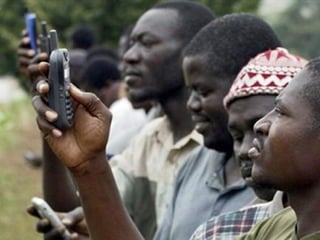
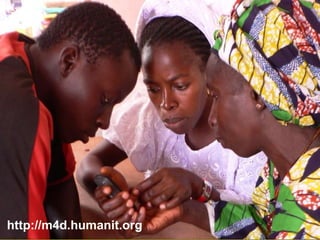
  • #3 What is M4D? These are some pictures from the presentors powerpoint presentations to give you an idea
  • #8 The point of departure – growth of mobile telephony (also in Duncombe)
  • #11 Developing world is coming
  • #13 Ken Banks
  • #15 GROWTH Easier to organise meetings (previously required entrusting a taxi driver with a letter, or physically delivering it – up to 200km between groups, costing ZAR130 (approx US$18) and taking 8 hours each way) increased sales Coordination of input to shows (many trophies) Swapping within the cooperative (wheat from the highlands for maize from the lowlands in 2010) EMPOWERMENT “ We were so proud, as women, to receive these cellphones” (lowlands) Learning English and mathematical literacy (highlands) “ we want to buy more mobiles in order to stay united” and “we are vulnerable – to be strong we need to be able to communicate” (lowlands) Access to governance and formal networks (e.g. Ministry of Agriculture, Ministry of Trade and Industry, Cooperatives and Marketing) Access to training opportunities (particularly in South Africa) CHOICE “ We turned mobiles into a business” Range of choices available to cooperative members has grown over the past 4 years Next choices Prepaid wireless telephones (reduced calling cost) Savings and Credit Association (available to cooperative member groups and individuals within those groups)
  • #19 Malaria - reporting
  • #21 Women farmers co-operative in Lesotho Recieving data from InPut dealers, market price - collective intelligence (fertlizers, seeds and pestcides) Study of 8 villages in Bangladesh - 54% of the farmers recieved info for their farming in their phones. Study in Tanzania shows that mobile phones affets the entire cycle of farming life (preparation/ farming/harvesting/ marketing) - leading to higher incomes
  • #22 mLearning - uses mobile phones to reinforce literacy (the Jokko Initiative)
  • #23 Även Malaria, barnafödande - i Arua (nordvästra Ugande ökade antal HIV test med 35 %
  • #24 Mobile-Money - new innovative ways to meet transaction needs of ordinary people PAAM - Personal Accounting Application for Mobile devises - allows users to track down their transactiosn anytime and anywhere - and you may have alerts when expenditure limits is reached Fault reporting of ATMs in Uganda - ATM monitoring Blacknoise - how to encrypt messages Improving Life on campus in Senegal (housing/ financing/administrative support/ community) Human Rights reporting in the Niger Delta Transparency and corruption fighting
  • #31 Should be based on accepted and proven theories Define and appropriate methodology which is rigorously applied Tends to be descriptive, (no methodology or theory) small samples, funded by industry Mobile Projects are predominatelyin a pilot or proof of conecpt stage