Module
                2
Analysis of Statically
      Indeterminate
  Structures by the
Matrix Force Method
             Version 2 CE IIT, Kharagpur
Lesson
              10
The Force Method of
  Analysis: Trusses
           Version 2 CE IIT, Kharagpur
Instructional Objectives
After reading this chapter the student will be able to
1. Calculate degree of statical indeterminacy of a planar truss
2. Analyse the indeterminate planar truss for external loads
3. Analyse the planar truss for temperature loads
4. Analyse the planar truss for camber and lack of fit of a member.


10.1 Introduction
The truss is said to be statically indeterminate when the total number of reactions
and member axial forces exceed the total number of static equilibrium equations.
In the simple planar truss structures, the degree of indeterminacy can be
determined from inspection. Whenever, this becomes tedious, one could use the
following formula to evaluate the static indeterminacy of static planar truss (see
also section 1.3).

                            i = (m + r ) − 2 j                        (10.1)

where m, j and r are number of members, joints and unknown reaction
components respectively. The indeterminacy in the truss may be external,
internal or both. A planar truss is said to be externally indeterminate if the
number of reactions exceeds the number of static equilibrium equations available
(three in the present case) and has exactly (2 j − 3) members. A truss is said to
be internally indeterminate if it has exactly three reaction components and more
than (2 j − 3) members. Finally a truss is both internally and externally
indeterminate if it has more than three reaction components and also has more
than (2 j − 3) members.

The basic method for the analysis of indeterminate truss by force method is
similar to the indeterminate beam analysis discussed in the previous lessons.
Determine the degree of static indeterminacy of the structure. Identify the number
of redundant reactions equal to the degree of indeterminacy. The redundants
must be so selected that when the restraint corresponding to the redundants are
removed, the resulting truss is statically determinate and stable. Select
redundant as the reaction component in excess of three and the rest from the
member forces. However, one could choose redundant actions completely from
member forces. Following examples illustrate the analysis procedure.

Example 10.1
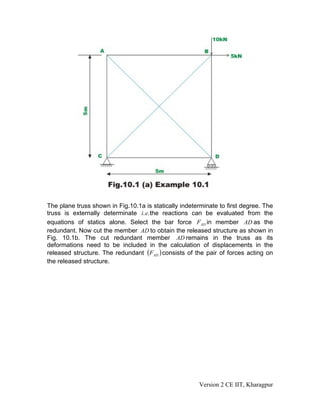
Determine the forces in the truss shown in Fig.10.1a by force method. All the
members have same axial rigidity.


                                                         Version 2 CE IIT, Kharagpur
The plane truss shown in Fig.10.1a is statically indeterminate to first degree. The
truss is externally determinate i.e. the reactions can be evaluated from the
equations of statics alone. Select the bar force FAD in member AD as the
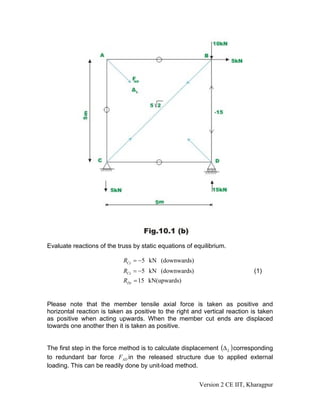
redundant. Now cut the member AD to obtain the released structure as shown in
Fig. 10.1b. The cut redundant member AD remains in the truss as its
deformations need to be included in the calculation of displacements in the
released structure. The redundant (FAD ) consists of the pair of forces acting on
the released structure.


                                                       Version 2 CE IIT, Kharagpur
Evaluate reactions of the truss by static equations of equilibrium.

                            RCy = −5 kN (downwards)
                            RCx = −5 kN (downwards)                          (1)
                            RDy = 15 kN(upwards)


Please note that the member tensile axial force is taken as positive and
horizontal reaction is taken as positive to the right and vertical reaction is taken
as positive when acting upwards. When the member cut ends are displaced
towards one another then it is taken as positive.


The first step in the force method is to calculate displacement (Δ L ) corresponding
to redundant bar force FAD in the released structure due to applied external
loading. This can be readily done by unit-load method.


                                                        Version 2 CE IIT, Kharagpur
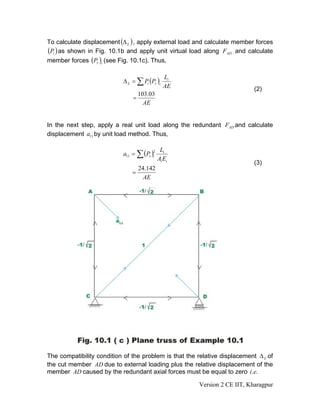
To calculate displacement (Δ L ) , apply external load and calculate member forces
(Pi ) as shown in Fig. 10.1b and apply unit virtual load along FAD and calculate
member forces (Pv )i (see Fig. 10.1c). Thus,

                                                Li
                            Δ L = ∑ Pi (Pv )i
                                                AE                          (2)
                                  103.03
                                =
                                    AE


In the next step, apply a real unit load along the redundant FAD and calculate
displacement a11 by unit load method. Thus,


                            a11 = ∑ (Pv )i
                                         2    Li
                                             Ai Ei
                                                                            (3)
                                  24.142
                                =
                                    AE


The compatibility condition of the problem is that the relative displacement Δ L of
the cut member AD due to external loading plus the relative displacement of the
member AD caused by the redundant axial forces must be equal to zero i.e.

                                                       Version 2 CE IIT, Kharagpur
Δ L + a11 FAD = 0                                                (4)

                                −103.03
                          FAD =
                                 24.142
                               = −4.268 kN(compressive)

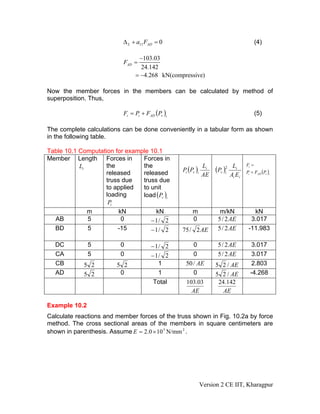
Now the member forces in the members can be calculated by method of
superposition. Thus,

                          Fi = Pi + FAD (Pv )i                                             (5)

The complete calculations can be done conveniently in a tabular form as shown
in the following table.

Table 10.1 Computation for example 10.1
Member Length Forces in         Forces in
                    the         the                                                 Fi =
                                                 Pi (Pv )i
                                                             Li              Li
           Li
                    released    released
                                                                  (Pv )i2           Pi + FAD (Pv )i
                                                             AE             Ai Ei
                    truss due   truss due
                    to applied  to unit
                    loading     load (Pv )i
                     Pi
              m          kN          kN               m             m/kN               kN
  AB          5           0        − 1/ 2             0            5 / 2 AE           3.017
  BD          5         -15        − 1/ 2        75 / 2 AE         5 / 2 AE          -11.983

  DC           5         0            − 1/ 2         0             5 / 2 AE           3.017
  CA           5         0            − 1/ 2         0             5 / 2 AE           3.017
  CB        5 2         5 2              1        50 / AE         5 2 / AE            2.803
  AD        5 2          0               1           0            5 2 / AE            -4.268
                                       Total      103.03           24.142
                                                    AE               AE

Example 10.2
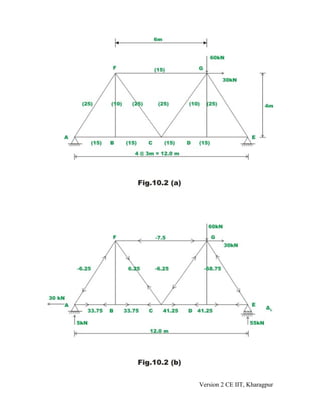
Calculate reactions and member forces of the truss shown in Fig. 10.2a by force
method. The cross sectional areas of the members in square centimeters are
shown in parenthesis. Assume E = 2.0 × 10 5 N/mm 2 .


                                                             Version 2 CE IIT, Kharagpur
Version 2 CE IIT, Kharagpur
The plane truss shown in Fg.10.2a is externally indeterminate to degree one.
Truss is internally determinate. Select the horizontal reaction at E , REx as the
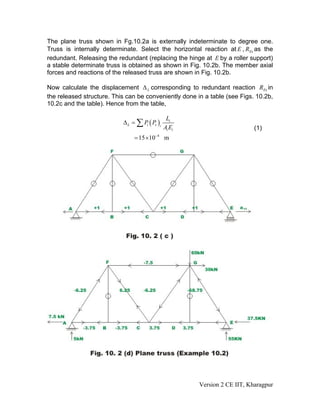
redundant. Releasing the redundant (replacing the hinge at E by a roller support)
a stable determinate truss is obtained as shown in Fig. 10.2b. The member axial
forces and reactions of the released truss are shown in Fig. 10.2b.

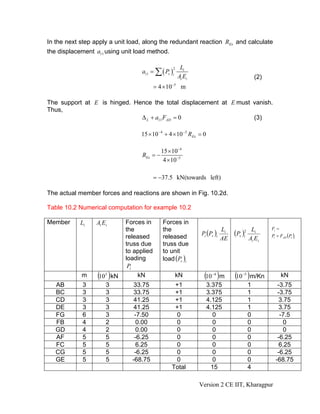
Now calculate the displacement Δ L corresponding to redundant reaction REx in
the released structure. This can be conveniently done in a table (see Figs. 10.2b,
10.2c and the table). Hence from the table,

                                                 Li
                           Δ L = ∑ Pi ( Pv )i
                                                Ai Ei                       (1)
                                           −4
                                = 15 ×10        m


                                                        Version 2 CE IIT, Kharagpur
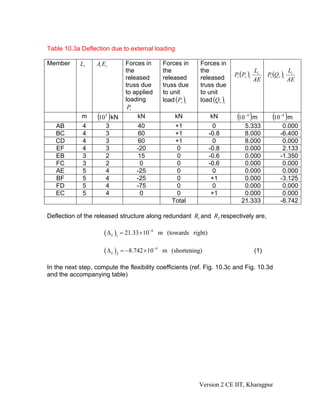
In the next step apply a unit load, along the redundant reaction REx and calculate
the displacement a11 using unit load method.

                                                      Li
                                   a11 = ∑ ( Pv )i
                                                 2

                                                     Ai Ei                                  (2)
                                          = 4 × 10⁻⁵ m

The support at E is hinged. Hence the total displacement at E must vanish.
Thus,
                              Δ L + a11 FAD = 0                    (3)

                                  15 × 10 −4 + 4 × 10 −5 REx = 0

                                           15 × 10−4
                                   REx = −
                                            4 ×10⁻⁵

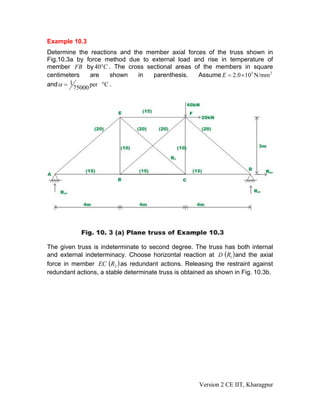
                                          = −37.5 kN(towards left)

The actual member forces and reactions are shown in Fig. 10.2d.

Table 10.2 Numerical computation for example 10.2

Member      Li   Ai Ei       Forces in       Forces in
                             the             the                                                  Fi =
                                                             Pi (Pv )i
                                                                         Li              Li
                             released        released
                                                                              (Pv )i2             Pi + FAD (Pv )i
                                                                         AE             Ai Ei
                             truss due       truss due
                             to applied      to unit
                             loading         load (Pv )i
                              Pi
            m     (10 ) kN
                     5           kN                  kN        (10 )m
                                                                    −4
                                                                              (10 ) m/Kn
                                                                                  −5                     kN
   AB        3       3          33.75            +1                3.375                1            -3.75
   BC        3       3          33.75            +1                3.375                1            -3.75
   CD        3       3          41.25            +1                4.125                1             3.75
   DE        3       3          41.25            +1                4.125                1             3.75
   FG        6       3          -7.50            0                   0                  0             -7.5
   FB        4       2           0.00            0                   0                  0               0
   GD        4       2           0.00            0                   0                  0              0
   AF        5       5          -6.25            0                   0                  0            -6.25
   FC        5       5           6.25            0                   0                  0             6.25
   CG        5       5          -6.25            0                   0                  0            -6.25
   GE        5       5         -68.75            0                   0                  0           -68.75
                                                Total               15                  4

                                                             Version 2 CE IIT, Kharagpur
Example 10.3
Determine the reactions and the member axial forces of the truss shown in
Fig.10.3a by force method due to external load and rise in temperature of
member FB by 40°C . The cross sectional areas of the members in square
centimeters     are    shown  in  parenthesis.   Assume E = 2.0 × 10⁵ N/mm 2
and α = 1       per °C .
          75000


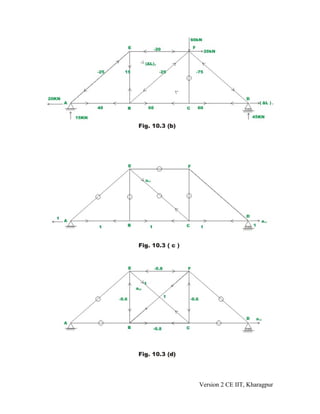
The given truss is indeterminate to second degree. The truss has both internal
and external indeterminacy. Choose horizontal reaction at D (R1 ) and the axial
force in member EC (R2 ) as redundant actions. Releasing the restraint against
redundant actions, a stable determinate truss is obtained as shown in Fig. 10.3b.


                                                      Version 2 CE IIT, Kharagpur
Version 2 CE IIT, Kharagpur
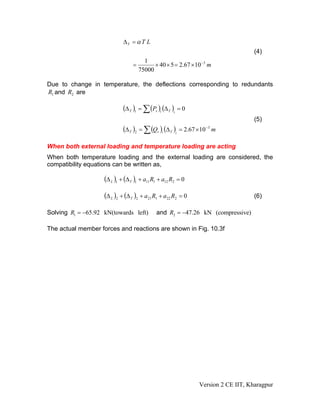
Table 10.3a Deflection due to external loading

Member      Li    Ai Ei       Forces in         Forces in     Forces in
                              the               the           the
                                                                            Pi (Pv )i
                                                                                        Li
                                                                                              Pi (Qv )i
                                                                                                          Li
                              released          released      released                  AE                AE
                              truss due         truss due     truss due
                              to applied        to unit       to unit
                              loading           load (Pv )i   load (Qv )i
                               Pi
             m     (10 ) kN
                      5           kN                 kN            kN        (10 )m
                                                                                 −4
                                                                                                (10 )m
                                                                                                    −4


   AB        4        3            40               +1              0           5.333                0.000
   BC        4        3             60              +1             -0.8         8.000               -6.400
   CD        4        3            60               +1              0           8.000                0.000
   EF        4        3            -20              0              -0.8         0.000                2.133
   EB        3        2             15               0             -0.6         0.000               -1.350
   FC        3        2              0               0             -0.6         0.000                0.000
   AE        5        4            -25              0               0           0.000                0.000
   BF        5        4            -25              0               +1          0.000               -3.125
   FD        5        4            -75              0               0           0.000                0.000
   EC        5        4              0              0               +1          0.000                0.000
                                                   Total                       21.333               -8.742

Deflection of the released structure along redundant R1 and R2 respectively are,

                     ( Δ L )1 = 21.33 ×10⁻⁴    m (towards right)

                     ( Δ L )2 = −8.742 ×10⁻⁴    m (shortening)                          (1)

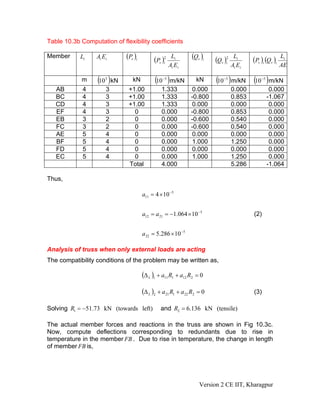
In the next step, compute the flexibility coefficients (ref. Fig. 10.3c and Fig. 10.3d
and the accompanying table)


                                                              Version 2 CE IIT, Kharagpur
Table 10.3b Computation of flexibility coefficients

Member      Li    Ai Ei      (Pv )i        (Pv )i2    Li     (Qv )i   (Qv )i2    Li
                                                                                        (Pv )i (Qv )i   Li
                                                     Ai Ei                      Ai Ei                   AE

            m     (10 ) kN
                      5         kN          (10 ) m/kN
                                                −5             kN      (10 ) m/kN (10 ) m/kN
                                                                          −5                −5


   AB        4        3       +1.00            1.333          0.000             0.000             0.000
   BC        4        3       +1.00            1.333         -0.800             0.853            -1.067
   CD        4        3       +1.00            1.333          0.000             0.000             0.000
   EF        4        3         0              0.000         -0.800             0.853             0.000
   EB        3        2         0              0.000         -0.600             0.540             0.000
   FC        3        2         0              0.000         -0.600             0.540             0.000
   AE        5        4         0              0.000          0.000             0.000             0.000
   BF        5        4         0              0.000          1.000             1.250             0.000
   FD        5        4         0              0.000          0.000             0.000             0.000
   EC        5        4         0              0.000          1.000             1.250             0.000
                              Total            4.000                            5.286            -1.064

Thus,

                                      a11 = 4 × 10 −5


                                      a12 = a 21 = −1.064 × 10 −5                       (2)


                                      a 22 = 5.286 × 10 −5

Analysis of truss when only external loads are acting
The compatibility conditions of the problem may be written as,

                                      (Δ L )1 + a11 R1 + a12 R2 = 0

                                      (Δ L )2 + a21 R1 + a22 R2 = 0                     (3)

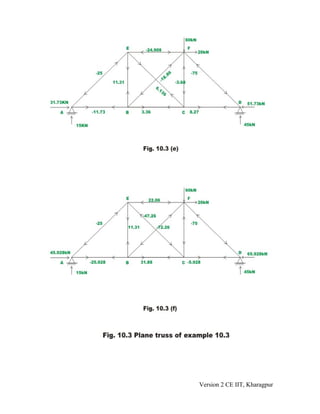
Solving R1 = −51.73 kN (towards left)         and R2 = 6.136 kN (tensile)

The actual member forces and reactions in the truss are shown in Fig 10.3c.
Now, compute deflections corresponding to redundants due to rise in
temperature in the member FB . Due to rise in temperature, the change in length
of member FB is,


                                                                 Version 2 CE IIT, Kharagpur
ΔT = α T L
                                                                                   (4)
                                       1
                                 =         × 40 × 5 = 2.67 × 10 −3 m
                                     75000

Due to change in temperature, the deflections corresponding to redundants
R1 and R2 are

                             (Δ T )1 = ∑ (Pv )i (Δ T )i = 0
                                                                                   (5)
                             (Δ T )2 = ∑ (Qv )i (Δ T )i = 2.67 ×10 −3 m

When both external loading and temperature loading are acting
When both temperature loading and the external loading are considered, the
compatibility equations can be written as,

                    (Δ L )1 + (Δ T )1 + a11 R1 + a12 R2 = 0

                    (Δ L )2 + (Δ T )2 + a21 R1 + a22 R2 = 0                        (6)

Solving R1 = −65.92 kN(towards left)         and R2 = −47.26 kN (compressive)

The actual member forces and reactions are shown in Fig. 10.3f


                                                               Version 2 CE IIT, Kharagpur
Version 2 CE IIT, Kharagpur
Summary
In this lesson, the flexibility matrix method is used to analyse statically
indeterminate planar trusses. The equation to calculate the degree of statical
indeterminacy of a planar truss is derived. The forces induced in the members
due to temperature loading and member lack of fit is also discussed in this
lesson. Few examples are solved to illustrate the force method of analysis as
applied to statically indeterminate planar trusses.


                                                    Version 2 CE IIT, Kharagpur

M2l10

  • 1.
    Module 2 Analysis of Statically Indeterminate Structures by the Matrix Force Method Version 2 CE IIT, Kharagpur
  • 2.
    Lesson 10 The Force Method of Analysis: Trusses Version 2 CE IIT, Kharagpur
  • 3.
    Instructional Objectives After readingthis chapter the student will be able to 1. Calculate degree of statical indeterminacy of a planar truss 2. Analyse the indeterminate planar truss for external loads 3. Analyse the planar truss for temperature loads 4. Analyse the planar truss for camber and lack of fit of a member. 10.1 Introduction The truss is said to be statically indeterminate when the total number of reactions and member axial forces exceed the total number of static equilibrium equations. In the simple planar truss structures, the degree of indeterminacy can be determined from inspection. Whenever, this becomes tedious, one could use the following formula to evaluate the static indeterminacy of static planar truss (see also section 1.3). i = (m + r ) − 2 j (10.1) where m, j and r are number of members, joints and unknown reaction components respectively. The indeterminacy in the truss may be external, internal or both. A planar truss is said to be externally indeterminate if the number of reactions exceeds the number of static equilibrium equations available (three in the present case) and has exactly (2 j − 3) members. A truss is said to be internally indeterminate if it has exactly three reaction components and more than (2 j − 3) members. Finally a truss is both internally and externally indeterminate if it has more than three reaction components and also has more than (2 j − 3) members. The basic method for the analysis of indeterminate truss by force method is similar to the indeterminate beam analysis discussed in the previous lessons. Determine the degree of static indeterminacy of the structure. Identify the number of redundant reactions equal to the degree of indeterminacy. The redundants must be so selected that when the restraint corresponding to the redundants are removed, the resulting truss is statically determinate and stable. Select redundant as the reaction component in excess of three and the rest from the member forces. However, one could choose redundant actions completely from member forces. Following examples illustrate the analysis procedure. Example 10.1 Determine the forces in the truss shown in Fig.10.1a by force method. All the members have same axial rigidity. Version 2 CE IIT, Kharagpur
  • 4.
    The plane trussshown in Fig.10.1a is statically indeterminate to first degree. The truss is externally determinate i.e. the reactions can be evaluated from the equations of statics alone. Select the bar force FAD in member AD as the redundant. Now cut the member AD to obtain the released structure as shown in Fig. 10.1b. The cut redundant member AD remains in the truss as its deformations need to be included in the calculation of displacements in the released structure. The redundant (FAD ) consists of the pair of forces acting on the released structure. Version 2 CE IIT, Kharagpur
  • 5.
    Evaluate reactions ofthe truss by static equations of equilibrium. RCy = −5 kN (downwards) RCx = −5 kN (downwards) (1) RDy = 15 kN(upwards) Please note that the member tensile axial force is taken as positive and horizontal reaction is taken as positive to the right and vertical reaction is taken as positive when acting upwards. When the member cut ends are displaced towards one another then it is taken as positive. The first step in the force method is to calculate displacement (Δ L ) corresponding to redundant bar force FAD in the released structure due to applied external loading. This can be readily done by unit-load method. Version 2 CE IIT, Kharagpur
  • 6.
    To calculate displacement(Δ L ) , apply external load and calculate member forces (Pi ) as shown in Fig. 10.1b and apply unit virtual load along FAD and calculate member forces (Pv )i (see Fig. 10.1c). Thus, Li Δ L = ∑ Pi (Pv )i AE (2) 103.03 = AE In the next step, apply a real unit load along the redundant FAD and calculate displacement a11 by unit load method. Thus, a11 = ∑ (Pv )i 2 Li Ai Ei (3) 24.142 = AE The compatibility condition of the problem is that the relative displacement Δ L of the cut member AD due to external loading plus the relative displacement of the member AD caused by the redundant axial forces must be equal to zero i.e. Version 2 CE IIT, Kharagpur
  • 7.
    Δ L +a11 FAD = 0 (4) −103.03 FAD = 24.142 = −4.268 kN(compressive) Now the member forces in the members can be calculated by method of superposition. Thus, Fi = Pi + FAD (Pv )i (5) The complete calculations can be done conveniently in a tabular form as shown in the following table. Table 10.1 Computation for example 10.1 Member Length Forces in Forces in the the Fi = Pi (Pv )i Li Li Li released released (Pv )i2 Pi + FAD (Pv )i AE Ai Ei truss due truss due to applied to unit loading load (Pv )i Pi m kN kN m m/kN kN AB 5 0 − 1/ 2 0 5 / 2 AE 3.017 BD 5 -15 − 1/ 2 75 / 2 AE 5 / 2 AE -11.983 DC 5 0 − 1/ 2 0 5 / 2 AE 3.017 CA 5 0 − 1/ 2 0 5 / 2 AE 3.017 CB 5 2 5 2 1 50 / AE 5 2 / AE 2.803 AD 5 2 0 1 0 5 2 / AE -4.268 Total 103.03 24.142 AE AE Example 10.2 Calculate reactions and member forces of the truss shown in Fig. 10.2a by force method. The cross sectional areas of the members in square centimeters are shown in parenthesis. Assume E = 2.0 × 10 5 N/mm 2 . Version 2 CE IIT, Kharagpur
  • 8.
    Version 2 CEIIT, Kharagpur
  • 9.
    The plane trussshown in Fg.10.2a is externally indeterminate to degree one. Truss is internally determinate. Select the horizontal reaction at E , REx as the redundant. Releasing the redundant (replacing the hinge at E by a roller support) a stable determinate truss is obtained as shown in Fig. 10.2b. The member axial forces and reactions of the released truss are shown in Fig. 10.2b. Now calculate the displacement Δ L corresponding to redundant reaction REx in the released structure. This can be conveniently done in a table (see Figs. 10.2b, 10.2c and the table). Hence from the table, Li Δ L = ∑ Pi ( Pv )i Ai Ei (1) −4 = 15 ×10 m Version 2 CE IIT, Kharagpur
  • 10.
    In the nextstep apply a unit load, along the redundant reaction REx and calculate the displacement a11 using unit load method. Li a11 = ∑ ( Pv )i 2 Ai Ei (2) = 4 × 10⁻⁵ m The support at E is hinged. Hence the total displacement at E must vanish. Thus, Δ L + a11 FAD = 0 (3) 15 × 10 −4 + 4 × 10 −5 REx = 0 15 × 10−4 REx = − 4 ×10−5 = −37.5 kN(towards left) The actual member forces and reactions are shown in Fig. 10.2d. Table 10.2 Numerical computation for example 10.2 Member Li Ai Ei Forces in Forces in the the Fi = Pi (Pv )i Li Li released released (Pv )i2 Pi + FAD (Pv )i AE Ai Ei truss due truss due to applied to unit loading load (Pv )i Pi m (10 ) kN 5 kN kN (10 )m −4 (10 ) m/Kn −5 kN AB 3 3 33.75 +1 3.375 1 -3.75 BC 3 3 33.75 +1 3.375 1 -3.75 CD 3 3 41.25 +1 4.125 1 3.75 DE 3 3 41.25 +1 4.125 1 3.75 FG 6 3 -7.50 0 0 0 -7.5 FB 4 2 0.00 0 0 0 0 GD 4 2 0.00 0 0 0 0 AF 5 5 -6.25 0 0 0 -6.25 FC 5 5 6.25 0 0 0 6.25 CG 5 5 -6.25 0 0 0 -6.25 GE 5 5 -68.75 0 0 0 -68.75 Total 15 4 Version 2 CE IIT, Kharagpur
  • 11.
    Example 10.3 Determine thereactions and the member axial forces of the truss shown in Fig.10.3a by force method due to external load and rise in temperature of member FB by 40°C . The cross sectional areas of the members in square centimeters are shown in parenthesis. Assume E = 2.0 × 10⁵ N/mm 2 and α = 1 per °C . 75000 The given truss is indeterminate to second degree. The truss has both internal and external indeterminacy. Choose horizontal reaction at D (R1 ) and the axial force in member EC (R2 ) as redundant actions. Releasing the restraint against redundant actions, a stable determinate truss is obtained as shown in Fig. 10.3b. Version 2 CE IIT, Kharagpur
  • 12.
    Version 2 CEIIT, Kharagpur
  • 13.
    Table 10.3a Deflectiondue to external loading Member Li Ai Ei Forces in Forces in Forces in the the the Pi (Pv )i Li Pi (Qv )i Li released released released AE AE truss due truss due truss due to applied to unit to unit loading load (Pv )i load (Qv )i Pi m (10 ) kN 5 kN kN kN (10 )m −4 (10 )m −4 AB 4 3 40 +1 0 5.333 0.000 BC 4 3 60 +1 -0.8 8.000 -6.400 CD 4 3 60 +1 0 8.000 0.000 EF 4 3 -20 0 -0.8 0.000 2.133 EB 3 2 15 0 -0.6 0.000 -1.350 FC 3 2 0 0 -0.6 0.000 0.000 AE 5 4 -25 0 0 0.000 0.000 BF 5 4 -25 0 +1 0.000 -3.125 FD 5 4 -75 0 0 0.000 0.000 EC 5 4 0 0 +1 0.000 0.000 Total 21.333 -8.742 Deflection of the released structure along redundant R1 and R2 respectively are, ( Δ L )1 = 21.33 ×10⁻⁴ m (towards right) ( Δ L )2 = −8.742 ×10⁻⁴ m (shortening) (1) In the next step, compute the flexibility coefficients (ref. Fig. 10.3c and Fig. 10.3d and the accompanying table) Version 2 CE IIT, Kharagpur
  • 14.
    Table 10.3b Computationof flexibility coefficients Member Li Ai Ei (Pv )i (Pv )i2 Li (Qv )i (Qv )i2 Li (Pv )i (Qv )i Li Ai Ei Ai Ei AE m (10 ) kN 5 kN (10 ) m/kN −5 kN (10 ) m/kN (10 ) m/kN −5 −5 AB 4 3 +1.00 1.333 0.000 0.000 0.000 BC 4 3 +1.00 1.333 -0.800 0.853 -1.067 CD 4 3 +1.00 1.333 0.000 0.000 0.000 EF 4 3 0 0.000 -0.800 0.853 0.000 EB 3 2 0 0.000 -0.600 0.540 0.000 FC 3 2 0 0.000 -0.600 0.540 0.000 AE 5 4 0 0.000 0.000 0.000 0.000 BF 5 4 0 0.000 1.000 1.250 0.000 FD 5 4 0 0.000 0.000 0.000 0.000 EC 5 4 0 0.000 1.000 1.250 0.000 Total 4.000 5.286 -1.064 Thus, a11 = 4 × 10 −5 a12 = a 21 = −1.064 × 10 −5 (2) a 22 = 5.286 × 10 −5 Analysis of truss when only external loads are acting The compatibility conditions of the problem may be written as, (Δ L )1 + a11 R1 + a12 R2 = 0 (Δ L )2 + a21 R1 + a22 R2 = 0 (3) Solving R1 = −51.73 kN (towards left) and R2 = 6.136 kN (tensile) The actual member forces and reactions in the truss are shown in Fig 10.3c. Now, compute deflections corresponding to redundants due to rise in temperature in the member FB . Due to rise in temperature, the change in length of member FB is, Version 2 CE IIT, Kharagpur
  • 15.
    ΔT = αT L (4) 1 = × 40 × 5 = 2.67 × 10 −3 m 75000 Due to change in temperature, the deflections corresponding to redundants R1 and R2 are (Δ T )1 = ∑ (Pv )i (Δ T )i = 0 (5) (Δ T )2 = ∑ (Qv )i (Δ T )i = 2.67 ×10 −3 m When both external loading and temperature loading are acting When both temperature loading and the external loading are considered, the compatibility equations can be written as, (Δ L )1 + (Δ T )1 + a11 R1 + a12 R2 = 0 (Δ L )2 + (Δ T )2 + a21 R1 + a22 R2 = 0 (6) Solving R1 = −65.92 kN(towards left) and R2 = −47.26 kN (compressive) The actual member forces and reactions are shown in Fig. 10.3f Version 2 CE IIT, Kharagpur
  • 16.
    Version 2 CEIIT, Kharagpur
  • 17.
    Summary In this lesson,the flexibility matrix method is used to analyse statically indeterminate planar trusses. The equation to calculate the degree of statical indeterminacy of a planar truss is derived. The forces induced in the members due to temperature loading and member lack of fit is also discussed in this lesson. Few examples are solved to illustrate the force method of analysis as applied to statically indeterminate planar trusses. Version 2 CE IIT, Kharagpur