MCQ of THORAX for practice……………..
Dr. Ashfaq.
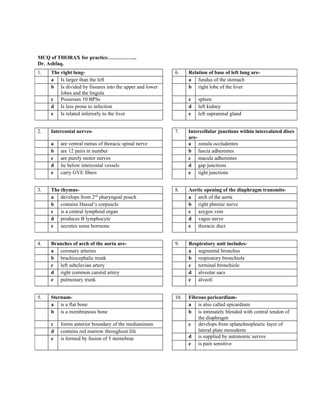
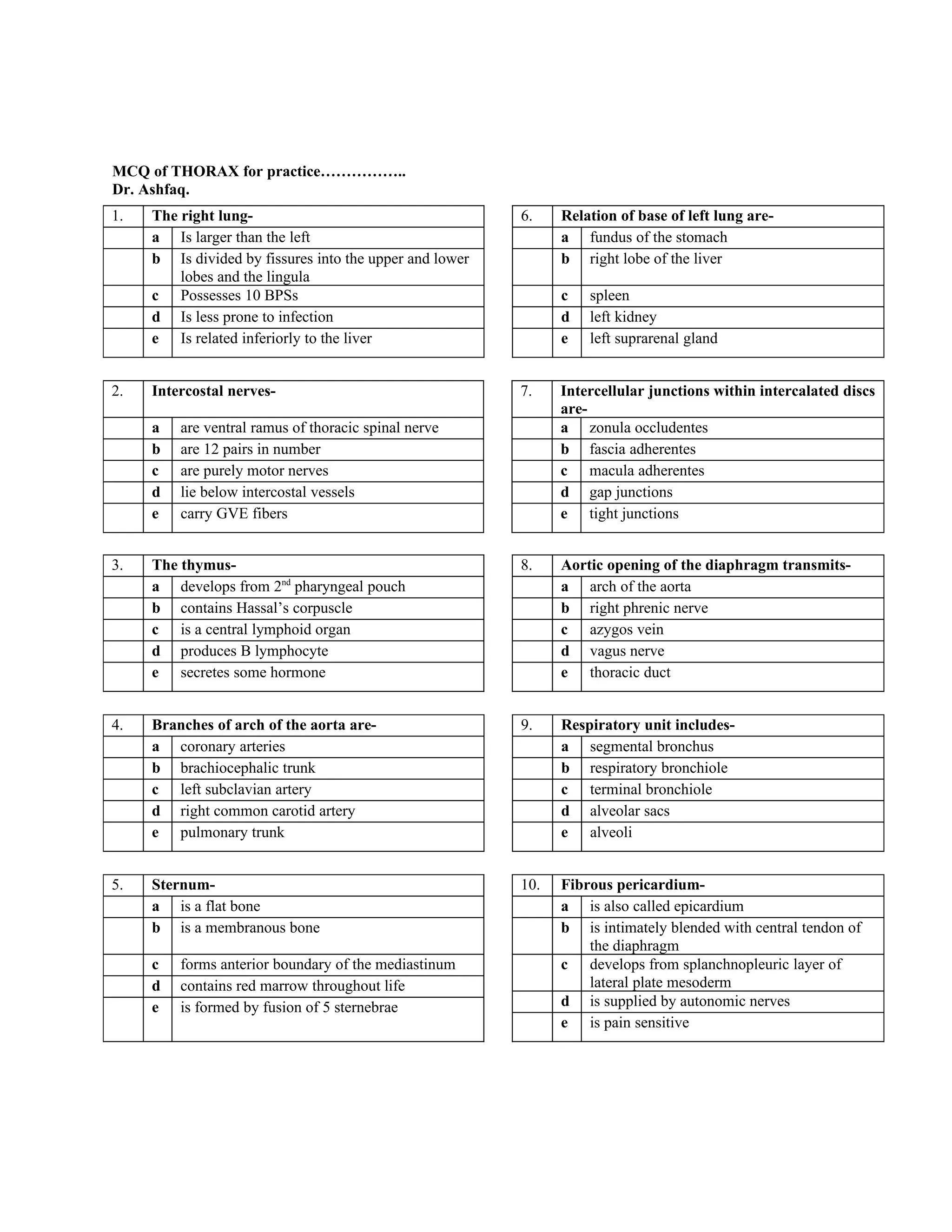
1.   The right lung-                                     6.    Relation of base of left lung are-
     a Is larger than the left                                 a fundus of the stomach
     b Is divided by fissures into the upper and lower         b right lobe of the liver
         lobes and the lingula
     c Possesses 10 BPSs                                       c   spleen
     d Is less prone to infection                              d   left kidney
     e Is related inferiorly to the liver                      e   left suprarenal gland


2.   Intercostal nerves-                                 7.    Intercellular junctions within intercalated discs
                                                               are-
     a   are ventral ramus of thoracic spinal nerve            a zonula occludentes
     b   are 12 pairs in number                                b fascia adherentes
     c   are purely motor nerves                               c macula adherentes
     d   lie below intercostal vessels                         d gap junctions
     e   carry GVE fibers                                      e tight junctions


3.   The thymus-                                         8.    Aortic opening of the diaphragm transmits-
     a develops from 2nd pharyngeal pouch                      a arch of the aorta
     b contains Hassal’s corpuscle                             b right phrenic nerve
     c is a central lymphoid organ                             c azygos vein
     d produces B lymphocyte                                   d vagus nerve
     e secretes some hormone                                   e thoracic duct


4.   Branches of arch of the aorta are-                  9.    Respiratory unit includes-
     a coronary arteries                                       a segmental bronchus
     b brachiocephalic trunk                                   b respiratory bronchiole
     c left subclavian artery                                  c terminal bronchiole
     d right common carotid artery                             d alveolar sacs
     e pulmonary trunk                                         e alveoli


5.   Sternum-                                            10.   Fibrous pericardium-
     a is a flat bone                                          a is also called epicardium
     b is a membranous bone                                    b is intimately blended with central tendon of
                                                                   the diaphragm
     c   forms anterior boundary of the mediastinum            c develops from splanchnopleuric layer of
     d   contains red marrow throughout life                       lateral plate mesoderm
     e   is formed by fusion of 5 sternebrae                   d is supplied by autonomic nerves
                                                               e is pain sensitive
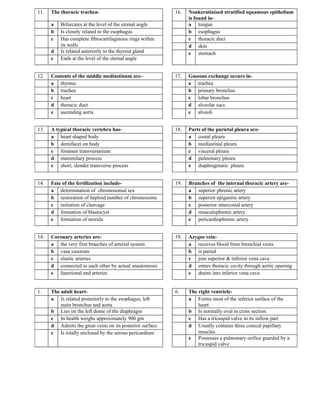
11.   The thoracic trachea-                               16.   Nonkeratinized stratified squamous epithelium
                                                                is found in-
      a   Bifurcates at the level of the sternal angle          a tongue
      b   Is closely related to the esophagus                   b esophagus
      c   Has complete fibrocartilaginous rings within          c thoracic duct
          its walls                                             d skin
      d   Is related anteriorly to the thyroid gland            e stomach
      e   Ends at the level of the sternal angle


12.   Contents of the middle mediastinum are-             17.   Gaseous exchange occurs in-
      a thymus                                                  a trachea
      b trachea                                                 b primary bronchus
      c heart                                                   c lobar bronchus
      d thoracic duct                                           d alveolar sacs
      e ascending aorta                                         e alveoli


13.   A typical thoracic vertebra has-                    18.   Parts of the parietal pleura are-
      a heart shaped body                                       a costal pleura
      b demifacet on body                                       b mediastinal pleura
      c foramen transversarium                                  c visceral pleura
      d mammilary process                                       d pulmonary pleura
      e short, slender transverse process                       e diaphragmatic pleura


14.   Fate of the fertilization include-                  19.   Branches of the internal thoracic artery are-
      a determination of chromosomal sex                        a superior phrenic artery
      b restoration of haploid number of chromosome             b superior epigastric artery
      c initiation of cleavage                                  c posterior intercostal artery
      d formation of blastocyst                                 d musculophrenic artery
      e formation of morula                                     e pericardiophrenic artery


14.   Coronary arteries are-                              19.   Azygos vein-
      a the very first branches of arterial system              a receives blood from bronchial veins
      b vasa vasorum                                            b is paired
      c elastic arteries                                        c join superior & inferior vena cava
      d connected to each other by actual anastomosis           d enters thoracic cavity through aortic opening
      e functional end arteries                                 e drains into inferior vena cava


1.    The adult heart-                                    6.    The right ventricle-
      a Is related posteriorly to the esophagus, left           a Forms most of the inferior surface of the
          main bronchus and aorta                                   heart
      b Lies on the left dome of the diaphragm                  b Is normally oval in cross section
      c In health weighs approximately 900 gm                   c Has a tricuspid valve in its inflow part
      d Admits the great veins on its posterior surface         d Usually contains three conical papillary
      e Is totally enclosed by the serous pericardium               muscles
                                                                e Possesses a pulmonary orifice guarded by a
                                                                    tricuspid valve
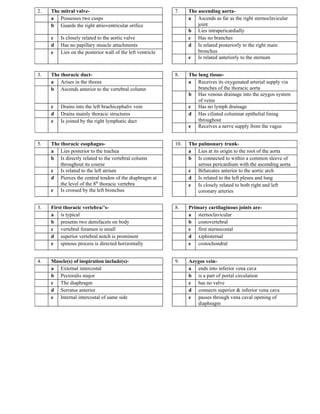
2.   The mitral valve-                                      7.    The ascending aorta-
     a Possesses two cusps                                        a Ascends as far as the right sternoclavicular
     b Guards the right atrioventricular orifice                      joint
                                                                  b Lies intrapericardially
     c   Is closely related to the aortic valve                   c Has no branches
     d   Has no papillary muscle attachments                      d Is related posteriorly to the right main
     e   Lies on the posterior wall of the left ventricle             bronchus
                                                                  e Is related anteriorly to the sternum


3.   The thoracic duct-                                     8.    The lung tissue-
     a Arises in the thorax                                       a Receives its oxygenated arterial supply via
     b Ascends anterior to the vertebral column                       branches of the thoracic aorta
                                                                  b Has venous drainage into the azygos system
                                                                      of veins
     c   Drains into the left brachicephaliv vein                 c Has no lymph drainage
     d   Drains mainly thoracic structures                        d Has ciliated columnar epithelial lining
     e   Is joined by the right lymphatic duct                        throughout
                                                                  e Receives a nerve supply from the vagus


5.   The thoracic esophagus-                                10.   The pulmonary trunk-
     a Lies posterior to the trachea                              a Lies at its origin to the root of the aorta
     b Is directly related to the vertebral column                b Is connected to within a common sleeve of
         throughout its course                                        serous pericardium with the ascending aorta
     c Is related to the left atrium                              c Bifurcates anterior to the aortic arch
     d Pierces the central tendon of the diaphragm at             d Is related to the left pleura and lung
         the level of the 8th thoracic vertebra                   e Is closely related to both right and left
     e Is crossed by the left bronchus                                coronary arteries


3.   First thoracic vertebra/’s-                            8.    Primary cartilaginous joints are-
     a is typical                                                 a sternoclavicular
     b presents two demifacets on body                            b costovertebral
     c vertebral foramen is small                                 c first sternocostal
     d superior vertebral notch is prominent                      d xiphisternal
     e spinous process is directed horizontally                   e costochondral


4.   Muscle(s) of inspiration include(s)-                   9.    Azygos vein-
     a External intercostal                                       a ends into inferior vena cava
     b Pectoralis major                                           b is a part of portal circulation
     c The diaphragm                                              c has no valve
     d Serratus anterior                                          d connects superior & inferior vena cava
     e Internal intercostal of same side                          e passes through vena caval opening of
                                                                     diaphragm

M C Q Thorax

  • 1.
    MCQ of THORAXfor practice…………….. Dr. Ashfaq. 1. The right lung- 6. Relation of base of left lung are- a Is larger than the left a fundus of the stomach b Is divided by fissures into the upper and lower b right lobe of the liver lobes and the lingula c Possesses 10 BPSs c spleen d Is less prone to infection d left kidney e Is related inferiorly to the liver e left suprarenal gland 2. Intercostal nerves- 7. Intercellular junctions within intercalated discs are- a are ventral ramus of thoracic spinal nerve a zonula occludentes b are 12 pairs in number b fascia adherentes c are purely motor nerves c macula adherentes d lie below intercostal vessels d gap junctions e carry GVE fibers e tight junctions 3. The thymus- 8. Aortic opening of the diaphragm transmits- a develops from 2nd pharyngeal pouch a arch of the aorta b contains Hassal’s corpuscle b right phrenic nerve c is a central lymphoid organ c azygos vein d produces B lymphocyte d vagus nerve e secretes some hormone e thoracic duct 4. Branches of arch of the aorta are- 9. Respiratory unit includes- a coronary arteries a segmental bronchus b brachiocephalic trunk b respiratory bronchiole c left subclavian artery c terminal bronchiole d right common carotid artery d alveolar sacs e pulmonary trunk e alveoli 5. Sternum- 10. Fibrous pericardium- a is a flat bone a is also called epicardium b is a membranous bone b is intimately blended with central tendon of the diaphragm c forms anterior boundary of the mediastinum c develops from splanchnopleuric layer of d contains red marrow throughout life lateral plate mesoderm e is formed by fusion of 5 sternebrae d is supplied by autonomic nerves e is pain sensitive
  • 2.
    11. The thoracic trachea- 16. Nonkeratinized stratified squamous epithelium is found in- a Bifurcates at the level of the sternal angle a tongue b Is closely related to the esophagus b esophagus c Has complete fibrocartilaginous rings within c thoracic duct its walls d skin d Is related anteriorly to the thyroid gland e stomach e Ends at the level of the sternal angle 12. Contents of the middle mediastinum are- 17. Gaseous exchange occurs in- a thymus a trachea b trachea b primary bronchus c heart c lobar bronchus d thoracic duct d alveolar sacs e ascending aorta e alveoli 13. A typical thoracic vertebra has- 18. Parts of the parietal pleura are- a heart shaped body a costal pleura b demifacet on body b mediastinal pleura c foramen transversarium c visceral pleura d mammilary process d pulmonary pleura e short, slender transverse process e diaphragmatic pleura 14. Fate of the fertilization include- 19. Branches of the internal thoracic artery are- a determination of chromosomal sex a superior phrenic artery b restoration of haploid number of chromosome b superior epigastric artery c initiation of cleavage c posterior intercostal artery d formation of blastocyst d musculophrenic artery e formation of morula e pericardiophrenic artery 14. Coronary arteries are- 19. Azygos vein- a the very first branches of arterial system a receives blood from bronchial veins b vasa vasorum b is paired c elastic arteries c join superior & inferior vena cava d connected to each other by actual anastomosis d enters thoracic cavity through aortic opening e functional end arteries e drains into inferior vena cava 1. The adult heart- 6. The right ventricle- a Is related posteriorly to the esophagus, left a Forms most of the inferior surface of the main bronchus and aorta heart b Lies on the left dome of the diaphragm b Is normally oval in cross section c In health weighs approximately 900 gm c Has a tricuspid valve in its inflow part d Admits the great veins on its posterior surface d Usually contains three conical papillary e Is totally enclosed by the serous pericardium muscles e Possesses a pulmonary orifice guarded by a tricuspid valve
  • 3.
    2. The mitral valve- 7. The ascending aorta- a Possesses two cusps a Ascends as far as the right sternoclavicular b Guards the right atrioventricular orifice joint b Lies intrapericardially c Is closely related to the aortic valve c Has no branches d Has no papillary muscle attachments d Is related posteriorly to the right main e Lies on the posterior wall of the left ventricle bronchus e Is related anteriorly to the sternum 3. The thoracic duct- 8. The lung tissue- a Arises in the thorax a Receives its oxygenated arterial supply via b Ascends anterior to the vertebral column branches of the thoracic aorta b Has venous drainage into the azygos system of veins c Drains into the left brachicephaliv vein c Has no lymph drainage d Drains mainly thoracic structures d Has ciliated columnar epithelial lining e Is joined by the right lymphatic duct throughout e Receives a nerve supply from the vagus 5. The thoracic esophagus- 10. The pulmonary trunk- a Lies posterior to the trachea a Lies at its origin to the root of the aorta b Is directly related to the vertebral column b Is connected to within a common sleeve of throughout its course serous pericardium with the ascending aorta c Is related to the left atrium c Bifurcates anterior to the aortic arch d Pierces the central tendon of the diaphragm at d Is related to the left pleura and lung the level of the 8th thoracic vertebra e Is closely related to both right and left e Is crossed by the left bronchus coronary arteries 3. First thoracic vertebra/’s- 8. Primary cartilaginous joints are- a is typical a sternoclavicular b presents two demifacets on body b costovertebral c vertebral foramen is small c first sternocostal d superior vertebral notch is prominent d xiphisternal e spinous process is directed horizontally e costochondral 4. Muscle(s) of inspiration include(s)- 9. Azygos vein- a External intercostal a ends into inferior vena cava b Pectoralis major b is a part of portal circulation c The diaphragm c has no valve d Serratus anterior d connects superior & inferior vena cava e Internal intercostal of same side e passes through vena caval opening of diaphragm