Marketing mix
MR. RATHESH J
ASST. PROFESSOR, NEW HORIZON COLLEGE, KASTURINAGAR
Marketing mix
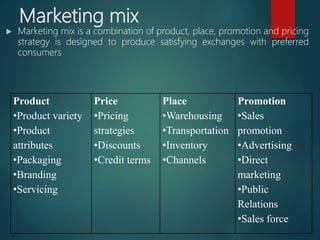
 Marketing mix is a combination of product, place, promotion and pricing
strategy is designed to produce satisfying exchanges with preferred
consumers
Product
•Product variety
•Product
attributes
•Packaging
•Branding
•Servicing
Price
•Pricing
strategies
•Discounts
•Credit terms
Place
•Warehousing
•Transportation
•Inventory
•Channels
Promotion
•Sales
promotion
•Advertising
•Direct
marketing
•Public
Relations
•Sales force
PRODUCT MIX
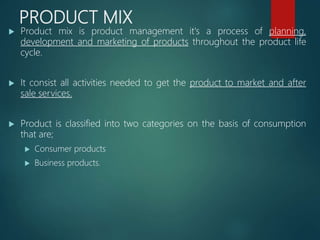
 Product mix is product management it's a process of planning,
development and marketing of products throughout the product life
cycle.
 It consist all activities needed to get the product to market and after
sale services.
 Product is classified into two categories on the basis of consumption
that are;
 Consumer products
 Business products.
PRODUCT PLANNING &
DEVELOPMENT
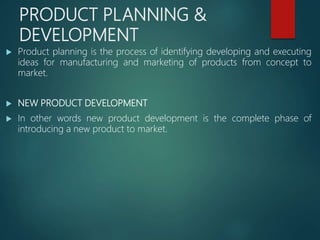
 Product planning is the process of identifying developing and executing
ideas for manufacturing and marketing of products from concept to
market.
 NEW PRODUCT DEVELOPMENT
 In other words new product development is the complete phase of
introducing a new product to market.
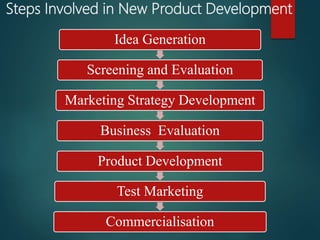
Steps Involved in New Product Development
Idea Generation
Screening and Evaluation
Marketing Strategy Development
Business Evaluation
Product Development
Test Marketing
Commercialisation
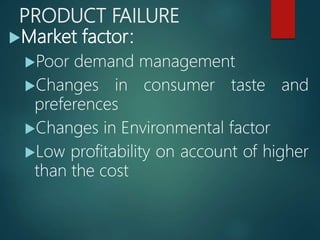
PRODUCT FAILURE
Market factor:
Poor demand management
Changes in consumer taste and
preferences
Changes in Environmental factor
Low profitability on account of higher
than the cost
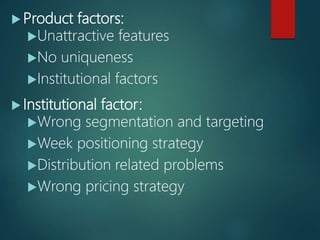
 Product factors:
Unattractive features
No uniqueness
Institutional factors
 Institutional factor:
Wrong segmentation and targeting
Week positioning strategy
Distribution related problems
Wrong pricing strategy
PRODUCT LIFE CYCLE
 The term product life cycle (PLC) used for the first time in 1965 for the
first time by ‘Theodore Levitt’ in Harvard Business Review Article.
 It means “analysis of a product’s life in the market from the time of its
launch till its withdrawn from the market”
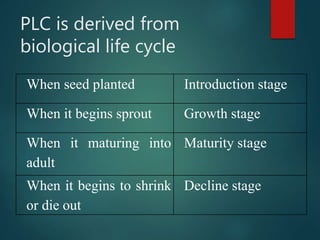
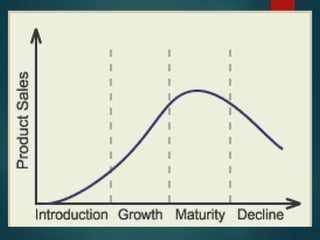
PLC is derived from
biological life cycle
When seed planted Introduction stage
When it begins sprout Growth stage
When it maturing into
adult
Maturity stage
When it begins to shrink
or die out
Decline stage
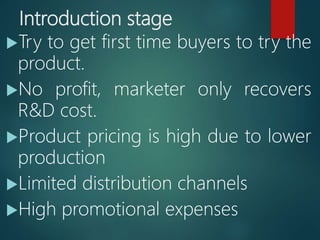
Introduction stage
Try to get first time buyers to try the
product.
No profit, marketer only recovers
R&D cost.
Product pricing is high due to lower
production
Limited distribution channels
High promotional expenses
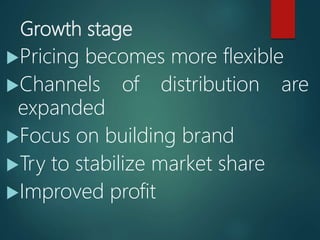
Growth stage
Pricing becomes more flexible
Channels of distribution are
expanded
Focus on building brand
Try to stabilize market share
Improved profit
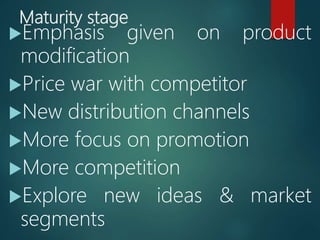
Maturity stage
Emphasis given on product
modification
Price war with competitor
New distribution channels
More focus on promotion
More competition
Explore new ideas & market
segments
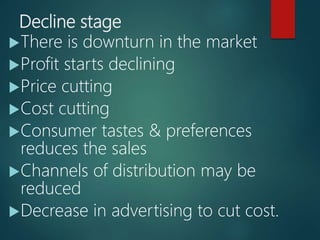
Decline stage
There is downturn in the market
Profit starts declining
Price cutting
Cost cutting
Consumer tastes & preferences
reduces the sales
Channels of distribution may be
reduced
Decrease in advertising to cut cost.
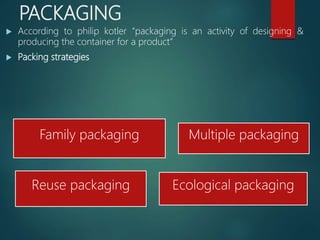
PACKAGING
 According to philip kotler “packaging is an activity of designing &
producing the container for a product”
 Packing strategies
Family packaging Multiple packaging
Reuse packaging Ecological packaging
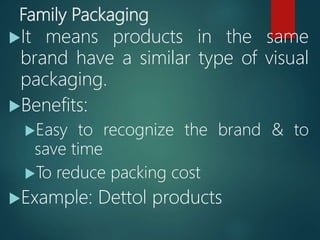
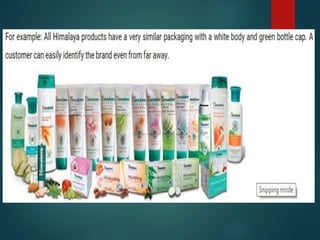
Family Packaging
It means products in the same
brand have a similar type of visual
packaging.
Benefits:
Easy to recognize the brand & to
save time
To reduce packing cost
Example: Dettol products
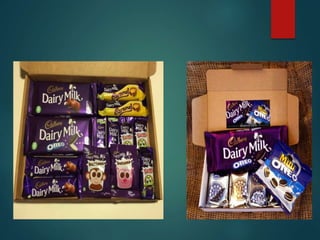
Multiple packaging
The concept behind Multiple
packaging is to meet a
combination of needs of a
consumer.
It best, quickest & easiest way to
increase the volume of sales.
Reuse packaging
Marketer offer products in packages
that can be reusable after
consumption.
Eg: products sold in plastic jars &
glass can be reused by the customer
Ecological packaging
Marketer offer products in eco-
friendly packing products.
It is cost saving packing method
This method is a part of Green
marketing.
Price Mix
Pricing is the process of
coating or deciding price for
a product.
Internal factor
Product uniqueness
Cost of production
Stage of product life
cycle
 Pricing objectives
Distribution channels
External factors
Product supply and
demand
Economic situation
Government regulations
Suppliers
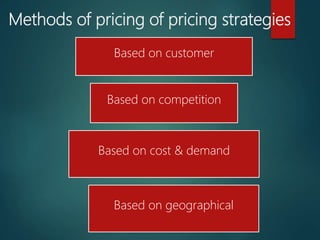
Methods of pricing of pricing strategies
Based on customer
Based on competition
Based on cost & demand
Based on geographical
 Odd-even pricing:
 (eg: fixing Rs 499 for Rs 500 ranged products)
 Dual pricing:
 (different price in different market)
 Psychological pricing:
 [higher price indicates a higher level of quality & vice versa]
 Prestige pricing:
 also known as premium pricing.
 Price lining:
 (eg- car seller come up with 3 verities of pricing for same model,
Movie tickets)
Based on customer
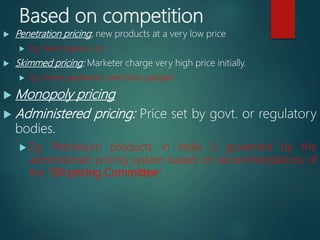
Based on competition
 Penetration pricing: new products at a very low price
 Eg: News papers, Jio
 Skimmed pricing: Marketer charge very high price initially.
 Eg: home appliances, electronic gadgets
 Monopoly pricing
 Administered pricing: Price set by govt. or regulatory
bodies.
 Eg: Petroleum products in India is governed by the
administered pricing system based on recommendations of
the “Oil pricing Committee”
Based on Cost & Demand
Cost plus pricing
method
Target return pricing
Demand based pricing
Based on Geographical Location
FOB Pricing (Free on board): Includes
price of goods plus cost service of
loading goods to vehicle or vessel.
Zone pricing
Base point pricing: Marketer first decides
one or more locations as base points &
the transport cost is collected from the
base point of the buyer’s location
PLACE MIX OR PHYSICAL DISTRIBUTION
Physical distribution in marketing implies
to set of activities dealing with handling,
movement & storage of goods from the
point of origin to the point of
consumption.
The supply chain: Supply chain refers to
set of activities that flow of goods
amongst network of interconnected
business to maximize total profitability.
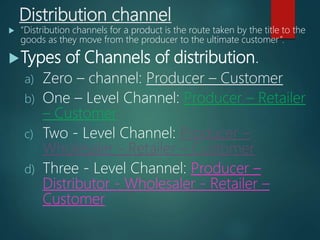
Distribution channel
 “Distribution channels for a product is the route taken by the title to the
goods as they move from the producer to the ultimate customer”.
Types of Channels of distribution.
a) Zero – channel: Producer – Customer
b) One – Level Channel: Producer – Retailer
– Customer
c) Two - Level Channel: Producer –
Wholesaler - Retailer – Customer
d) Three - Level Channel: Producer –
Distributor - Wholesaler - Retailer –
Customer
Functions of intermediaries
Procurement & Assembling
Warehousing & storing
Grading & packing
Selling
Financing
Supply of market information
Advertising & communication
Promotion
?
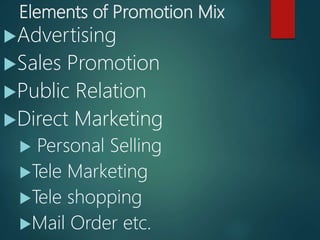
Elements of Promotion Mix
Advertising
Sales Promotion
Public Relation
Direct Marketing
 Personal Selling
Tele Marketing
Tele shopping
Mail Order etc.
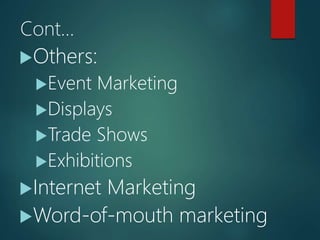
Cont…
Others:
Event Marketing
Displays
Trade Shows
Exhibitions
Internet Marketing
Word-of-mouth marketing

Marketing mix

  • 1.
    Marketing mix MR. RATHESHJ ASST. PROFESSOR, NEW HORIZON COLLEGE, KASTURINAGAR
  • 2.
    Marketing mix  Marketingmix is a combination of product, place, promotion and pricing strategy is designed to produce satisfying exchanges with preferred consumers Product •Product variety •Product attributes •Packaging •Branding •Servicing Price •Pricing strategies •Discounts •Credit terms Place •Warehousing •Transportation •Inventory •Channels Promotion •Sales promotion •Advertising •Direct marketing •Public Relations •Sales force
  • 3.
    PRODUCT MIX  Productmix is product management it's a process of planning, development and marketing of products throughout the product life cycle.  It consist all activities needed to get the product to market and after sale services.  Product is classified into two categories on the basis of consumption that are;  Consumer products  Business products.
  • 4.
    PRODUCT PLANNING & DEVELOPMENT Product planning is the process of identifying developing and executing ideas for manufacturing and marketing of products from concept to market.  NEW PRODUCT DEVELOPMENT  In other words new product development is the complete phase of introducing a new product to market.
  • 5.
    Steps Involved inNew Product Development Idea Generation Screening and Evaluation Marketing Strategy Development Business Evaluation Product Development Test Marketing Commercialisation
  • 6.
    PRODUCT FAILURE Market factor: Poordemand management Changes in consumer taste and preferences Changes in Environmental factor Low profitability on account of higher than the cost
  • 7.
     Product factors: Unattractivefeatures No uniqueness Institutional factors  Institutional factor: Wrong segmentation and targeting Week positioning strategy Distribution related problems Wrong pricing strategy
  • 8.
    PRODUCT LIFE CYCLE The term product life cycle (PLC) used for the first time in 1965 for the first time by ‘Theodore Levitt’ in Harvard Business Review Article.  It means “analysis of a product’s life in the market from the time of its launch till its withdrawn from the market”
  • 9.
    PLC is derivedfrom biological life cycle When seed planted Introduction stage When it begins sprout Growth stage When it maturing into adult Maturity stage When it begins to shrink or die out Decline stage
  • 11.
    Introduction stage Try toget first time buyers to try the product. No profit, marketer only recovers R&D cost. Product pricing is high due to lower production Limited distribution channels High promotional expenses
  • 12.
    Growth stage Pricing becomesmore flexible Channels of distribution are expanded Focus on building brand Try to stabilize market share Improved profit
  • 13.
    Maturity stage Emphasis givenon product modification Price war with competitor New distribution channels More focus on promotion More competition Explore new ideas & market segments
  • 14.
    Decline stage There isdownturn in the market Profit starts declining Price cutting Cost cutting Consumer tastes & preferences reduces the sales Channels of distribution may be reduced Decrease in advertising to cut cost.
  • 15.
    PACKAGING  According tophilip kotler “packaging is an activity of designing & producing the container for a product”  Packing strategies Family packaging Multiple packaging Reuse packaging Ecological packaging
  • 16.
    Family Packaging It meansproducts in the same brand have a similar type of visual packaging. Benefits: Easy to recognize the brand & to save time To reduce packing cost Example: Dettol products
  • 18.
    Multiple packaging The conceptbehind Multiple packaging is to meet a combination of needs of a consumer. It best, quickest & easiest way to increase the volume of sales.
  • 20.
    Reuse packaging Marketer offerproducts in packages that can be reusable after consumption. Eg: products sold in plastic jars & glass can be reused by the customer
  • 21.
    Ecological packaging Marketer offerproducts in eco- friendly packing products. It is cost saving packing method This method is a part of Green marketing.
  • 22.
    Price Mix Pricing isthe process of coating or deciding price for a product.
  • 23.
    Internal factor Product uniqueness Costof production Stage of product life cycle  Pricing objectives Distribution channels
  • 24.
    External factors Product supplyand demand Economic situation Government regulations Suppliers
  • 25.
    Methods of pricingof pricing strategies Based on customer Based on competition Based on cost & demand Based on geographical
  • 26.
     Odd-even pricing: (eg: fixing Rs 499 for Rs 500 ranged products)  Dual pricing:  (different price in different market)  Psychological pricing:  [higher price indicates a higher level of quality & vice versa]  Prestige pricing:  also known as premium pricing.  Price lining:  (eg- car seller come up with 3 verities of pricing for same model, Movie tickets) Based on customer
  • 27.
    Based on competition Penetration pricing: new products at a very low price  Eg: News papers, Jio  Skimmed pricing: Marketer charge very high price initially.  Eg: home appliances, electronic gadgets  Monopoly pricing  Administered pricing: Price set by govt. or regulatory bodies.  Eg: Petroleum products in India is governed by the administered pricing system based on recommendations of the “Oil pricing Committee”
  • 28.
    Based on Cost& Demand Cost plus pricing method Target return pricing Demand based pricing
  • 29.
    Based on GeographicalLocation FOB Pricing (Free on board): Includes price of goods plus cost service of loading goods to vehicle or vessel. Zone pricing Base point pricing: Marketer first decides one or more locations as base points & the transport cost is collected from the base point of the buyer’s location
  • 30.
    PLACE MIX ORPHYSICAL DISTRIBUTION Physical distribution in marketing implies to set of activities dealing with handling, movement & storage of goods from the point of origin to the point of consumption. The supply chain: Supply chain refers to set of activities that flow of goods amongst network of interconnected business to maximize total profitability.
  • 31.
    Distribution channel  “Distributionchannels for a product is the route taken by the title to the goods as they move from the producer to the ultimate customer”. Types of Channels of distribution. a) Zero – channel: Producer – Customer b) One – Level Channel: Producer – Retailer – Customer c) Two - Level Channel: Producer – Wholesaler - Retailer – Customer d) Three - Level Channel: Producer – Distributor - Wholesaler - Retailer – Customer
  • 32.
    Functions of intermediaries Procurement& Assembling Warehousing & storing Grading & packing Selling Financing Supply of market information Advertising & communication
  • 33.
  • 34.
    Elements of PromotionMix Advertising Sales Promotion Public Relation Direct Marketing  Personal Selling Tele Marketing Tele shopping Mail Order etc.
  • 35.