


Why I do not like to be a
tester in Agile project
Lucjan Stapp
Warsaw University of Technology
Stowarzyszenie Jakości Systemów Informatycznych
L.Stapp@mini.pw.edu.pl
L.Stapp@sjsi.org
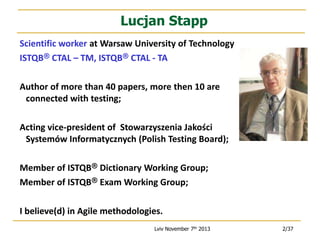
Lucjan Stapp
Scientific worker at Warsaw University of Technology
ISTQB® CTAL – TM, ISTQB® CTAL - TA
Author of more than 40 papers, more then 10 are
connected with testing;
Acting vice-president of Stowarzyszenia Jakości
Systemów Informatycznych (Polish Testing Board);
Member of ISTQB® Dictionary Working Group;
Member of ISTQB® Exam Working Group;

I believe(d) in Agile methodologies.
Lviv November 7th 2013

2/37
Agile manifesto
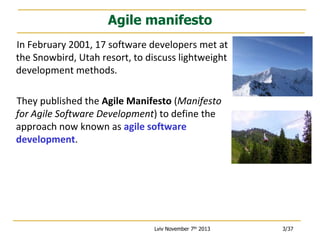
In February 2001, 17 software developers met at
the Snowbird, Utah resort, to discuss lightweight
development methods.
They published the Agile Manifesto (Manifesto
for Agile Software Development) to define the
approach now known as agile software
development.

Lviv November 7th 2013

3/37
Agile manifesto
We are uncovering better ways of developing software by
doing it and helping others do it.
Through this work we have come to value:
Individuals and interactions over
Working software

over

Customer collaboration
Responding to change

over
over

processes and tools
comprehensive
documentation
contract negotiation
following a plan

That is, while there is value in the items on the right, we value
the items on the left more.
agilemanifesto.org
Lviv November 7th 2013

4/37
Agile manifesto
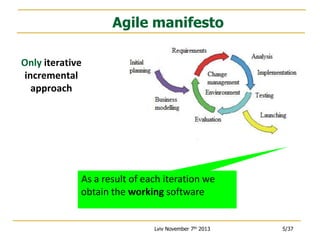
Only iterative
incremental
approach

As a result of each iteration we
obtain the working software

Lviv November 7th 2013

5/37
Agile manifesto
Basic Agile principles:


Working software is the primary measure of progress



Informal (face-to-face) communication,



Self-organization and motivation,


Inspect and adapt,



the team reflects on how to become more effective, then tunes and adjusts
its behavior accordingly



Customer collaboration:


welcome changing requirements, even late in development.



Improving the chances of understanding what the customer wants
Lviv November 7th 2013

6/37
Agile manifesto
Agile methodologies (between others):

 eXtreme Programming XP
XP,
 Scrum,
 Kanban,
 Dynamic Systems Development Method,
 Adaptive Software Development,
 …...

Lviv November 7th 2013

7/37
How it works?
Main aspects
0.7
0.6

0.6

0.6
0.6
0.5

0.5

0.4
0.4

0.4

0.4
0.3

0.3

0.3

0.2

0.2
0.2

0.2

0.1

0.1

0.1 0.1

0.0
0.0
Quality

Functionality
Ad-hoc

Waterfall

ROI (money)
Classical Iterative

Schedule
Agile

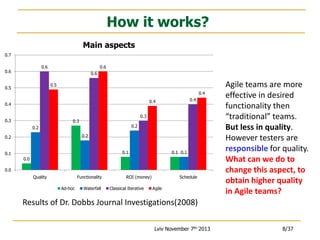
Agile teams are more
effective in desired
functionality then
“traditional” teams.
But less in quality.
However testers are
responsible for quality.
What can we do to
change this aspect, to
obtain higher quality
in Agile teams?

Results of Dr. Dobbs Journal Investigations(2008)
Lviv November 7th 2013

8/37
How improve quality?
Higher ROI.

Agile teams work in more effective way (but not harder) and
should propose needed functionality earlier, hence there is a
shorter path to the market and greater profit.
Faith

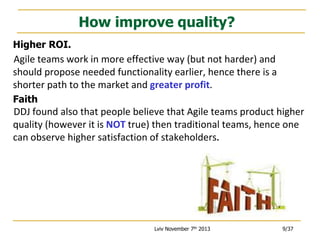
DDJ found also that people believe that Agile teams product higher
quality (however it is NOT true) then traditional teams, hence one
can observe higher satisfaction of stakeholders.

Lviv November 7th 2013

9/37
How improve quality?
Power of Three.


“Whole Team Approach”






Whole Team usage means involving all of the people with the knowledge
and skills necessary to ensure project success.
quality is the responsibility of the Whole Team

Testers work closely with both developers and the business
representatives to ensure quality across all test levels

Lviv November 7th 2013

10/37
How improve quality?
Power of Three.




From the individual agile tester perspective “Whole Team
approach” means daily collaboration with both developers and
business representatives.
Testers should






transfer testing knowledge to non-testing team members and
influence the development of the product.
ensure the right level of integration with developers and the right
level of collaboration with customers.

How to do it?:


the daily stand-up meeting, involving all members of the team, at
which project status is discussed and any impediments to progress
are highlighted.
Lviv November 7th 2013

11/37
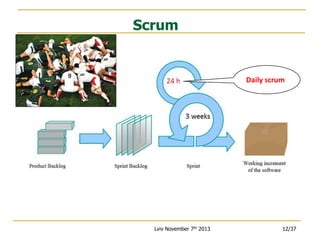
Scrum

Daily scrum

Lviv November 7th 2013

12/37
Teams
 Teamwork is one of the fundamental principles in agile


development.
It is important to select the right people that work well
together to successfully create the desired product

Lviv November 7th 2013

13/37
Team

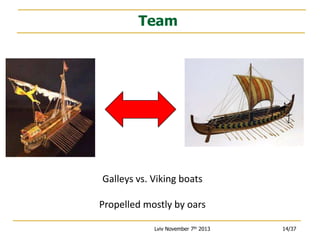
Galleys vs. Viking boats
Propelled mostly by oars
Lviv November 7th 2013

14/37
Team

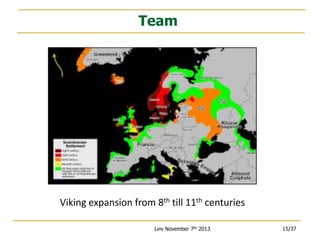
Viking expansion from 8th till 11th centuries
Lviv November 7th 2013

15/37
Team
But
• Viking expansion from late 8th till 12th century
• Galleys are used from the 9th century BC until development
of advanced sailing warships in the 16th century
• Trade and transport used galleys, not Viking knörr

Lviv November 7th 2013

16/37
Team
Team complement
There is no division on developers and testers.
Testers should be build in team.
But:
• How many team members do concentrate on quality
problems? (1/10, 2/10 ???);
• “Group thinking” – typically only positive;
• Not enough “business knowledge” (power of three?)
• Problems with product owner.

Lviv November 7th 2013

17/37
User Story
User Story the basis of requirements
 Elements of User Story
 As… (concrete type of user)
 I want… (problems to be solved)
 because… (desired results).
 Definition of user satisfaction criteria




Typically as set of acceptance tests (Done)

Test priority and story criticality can be based on the users
category.

Lviv November 7th 2013

18/37
User story
INVEST
A good user story is:
 Independent
 Negotiable
 Valuable
 Estimable
 Sized Appropriately
 Testable

Lviv November 7th 2013

19/37
Testing in Agile Projects
INVEST –Testable

• Testing in Agile should be iterative
• Testers in Agile must work without complete
documentation
• Testers in Agile should be flexible.

Lviv November 7th 2013

20/37
User Story
INVEST –Testable
• Tests concentrate on “simple” problems
Agile team does not expect very specific complicated
conditions.
World wide transaction system for an international bank
A fish trade company in Japan makes a payment to a vendor
on Iceland. It should have been a payment in Icelandic
Kronur, but it was done in Yen instead. The error is
discovered after 9 days and the payment is revised and
corrected, however, the interest calculation (value dating)…
From a talk by Hans Buwalda

Lviv November 7th 2013

21/37
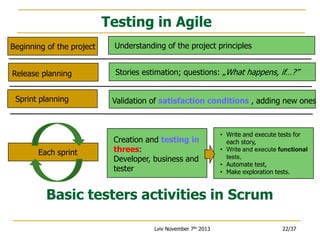
Testing in Agile
Beginning of the project

Understanding of the project principles

Release planning

Stories estimation; questions: „What happens, if…?”

Sprint planning

Each sprint

Validation of satisfaction conditions , adding new ones

Creation and testing in
threes:
Developer, business and
tester

• Write and execute tests for
each story,
• Write and execute functional
tests,
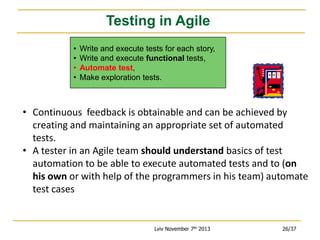
• Automate test,
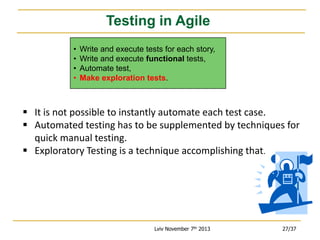
• Make exploration tests.

Basic testers activities in Scrum
Lviv November 7th 2013

22/37
Testing in Agile
•
•
•
•

Write and execute tests for each story,
Write and execute functional tests,
Automate test,
Make exploration tests.

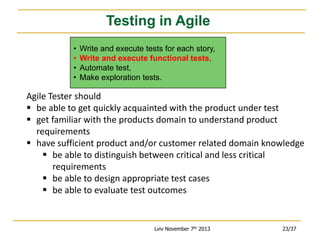
Agile Tester should
 be able to get quickly acquainted with the product under test
 get familiar with the products domain to understand product
requirements
 have sufficient product and/or customer related domain knowledge
 be able to distinguish between critical and less critical
requirements
 be able to design appropriate test cases
 be able to evaluate test outcomes

Lviv November 7th 2013

23/37
Testing in Agile
•
•
•
•

Write and execute tests for each story,
Write and execute functional tests,
Automate test,
Make exploration tests.

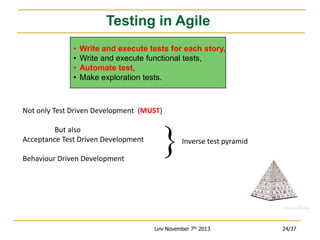
Not only Test Driven Development (MUST)
But also
Acceptance Test Driven Development

Inverse test pyramid

Behaviour Driven Development

Lviv November 7th 2013

24/37
Testing in Agile
•
•
•
•

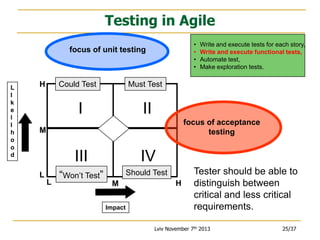
focus of unit testing

L
I
k
e
l
I
h
o
o
d

Could Test

H

Must Test

I

II
focus of acceptance
testing

M

III
L

Write and execute tests for each story,
Write and execute functional tests,
Automate test,
Make exploration tests.

L

IV

“Won’t Test”

Should Test
M
Impact

H

Tester should be able to
distinguish between
critical and less critical
requirements.

Lviv November 7th 2013

25/37
Testing in Agile
•
•
•
•

Write and execute tests for each story,
Write and execute functional tests,
Automate test,
Make exploration tests.

• Continuous feedback is obtainable and can be achieved by
creating and maintaining an appropriate set of automated
tests.
• A tester in an Agile team should understand basics of test
automation to be able to execute automated tests and to (on
his own or with help of the programmers in his team) automate
test cases

Lviv November 7th 2013

26/37
Testing in Agile
•
•
•
•

Write and execute tests for each story,
Write and execute functional tests,
Automate test,
Make exploration tests.

 It is not possible to instantly automate each test case.
 Automated testing has to be supplemented by techniques for
quick manual testing.
 Exploratory Testing is a technique accomplishing that.

Lviv November 7th 2013

27/37
Testing in Agile
What it means for Agile testers?
 “fanatic”, „maniac”, „zealot”
 continuous learning
by experience ?
 when?
 Fail fast
 Fail often
 Fail cheap
tools, tools, tools
 exploratory testing




Learn quickly
Learn continually
Learn inexpensively *
*d’Amico V. The state of Agile

Lviv November 7th 2013

28/37
But ……

Problems
…

Module tests (also TDD) are limited in finding bugs:
Capers Jones1 found that average effectiveness for unit test is between
25 - 30%.
And Rex Black2 (for American market ) found that good system tests
done by independent test team achieves 85% effectiveness in
founding bugs.
1Capers Jones: MEASURING DEFECT POTENTIALS AND DEFECT REMOVAL EFFICIENCY http://www.rbcs-

us.com/images/documents/Measuring-Defect-Potentials-and-Defect-Removal-Efficiency.pdf
2

http://www.rbcs-us.com/images/documents/

Lviv November 7th 2013

29/37
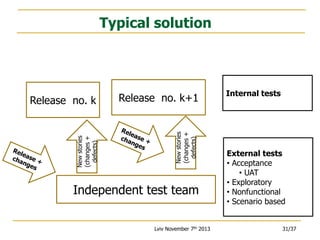
Typical solution

Solution:
Two levels of testing:
• Internal testing – build in Agile team
• External testing – independent test team
•ATDD facilitates the use of external testing teams to
perform functional testing

Lviv November 7th 2013

30/37
Typical solution

New stories
(changes +
defects)

New stories
(changes +
defects)

Release no. k

Release no. k+1

Independent test team
Lviv November 7th 2013

Internal tests

External tests
• Acceptance
• UAT
• Exploratory
• Nonfunctional
• Scenario based
31/37
Typical solution
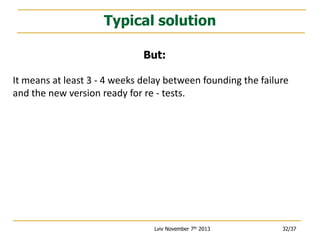
But:
It means at least 3 - 4 weeks delay between founding the failure
and the new version ready for re - tests.

Lviv November 7th 2013

32/37
Examples

AGILE == SUCCESS??

Lviv November 7th 2013

33/37
Examples
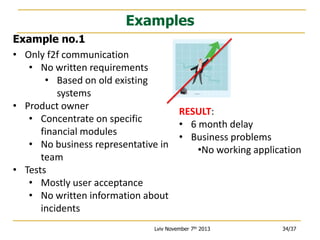
Example no.1
• Only f2f communication
• No written requirements
• Based on old existing
systems
• Product owner
RESULT:
• Concentrate on specific
• 6 month delay
financial modules
• Business problems
• No business representative in
•No working application
team
• Tests
• Mostly user acceptance
• No written information about
incidents
Lviv November 7th 2013

34/37
Examples
Example no. 2 NEW FUNCTIONALITY in bank system
• Only f2f communication
• No written requirements
• Frequent changes
• Without info to test team

• Product owner
• Less of business knowledge
• Concentrate on security
problems

RESULT:
• disaster

• Tests
• Long time before bugs closure
Lviv November 7th 2013

35/37
Examples
Example no. 3 Telecom application connected with
EURO 2012
• 90% written requirements
• Product owner
• Concentrate on performance
problems

RESULT:
• Ready June 1st 2012
• Success??

• Tests
• 2 performance testers in team
• 60% time – performance tests

Lviv November 7th 2013

36/37
Thanks for your attention

Lviv November 7th 2013

37/37

Why I do not like to be a tester in Agile project?

  • 1.
    Why I donot like to be a tester in Agile project Lucjan Stapp Warsaw University of Technology Stowarzyszenie Jakości Systemów Informatycznych L.Stapp@mini.pw.edu.pl L.Stapp@sjsi.org
  • 2.
    Lucjan Stapp Scientific workerat Warsaw University of Technology ISTQB® CTAL – TM, ISTQB® CTAL - TA Author of more than 40 papers, more then 10 are connected with testing; Acting vice-president of Stowarzyszenia Jakości Systemów Informatycznych (Polish Testing Board); Member of ISTQB® Dictionary Working Group; Member of ISTQB® Exam Working Group; I believe(d) in Agile methodologies. Lviv November 7th 2013 2/37
  • 3.
    Agile manifesto In February2001, 17 software developers met at the Snowbird, Utah resort, to discuss lightweight development methods. They published the Agile Manifesto (Manifesto for Agile Software Development) to define the approach now known as agile software development. Lviv November 7th 2013 3/37
  • 4.
    Agile manifesto We areuncovering better ways of developing software by doing it and helping others do it. Through this work we have come to value: Individuals and interactions over Working software over Customer collaboration Responding to change over over processes and tools comprehensive documentation contract negotiation following a plan That is, while there is value in the items on the right, we value the items on the left more. agilemanifesto.org Lviv November 7th 2013 4/37
  • 5.
    Agile manifesto Only iterative incremental approach Asa result of each iteration we obtain the working software Lviv November 7th 2013 5/37
  • 6.
    Agile manifesto Basic Agileprinciples:  Working software is the primary measure of progress  Informal (face-to-face) communication,  Self-organization and motivation,  Inspect and adapt,  the team reflects on how to become more effective, then tunes and adjusts its behavior accordingly  Customer collaboration:  welcome changing requirements, even late in development.  Improving the chances of understanding what the customer wants Lviv November 7th 2013 6/37
  • 7.
    Agile manifesto Agile methodologies(between others):   eXtreme Programming XP XP,  Scrum,  Kanban,  Dynamic Systems Development Method,  Adaptive Software Development,  …... Lviv November 7th 2013 7/37
  • 8.
    How it works? Mainaspects 0.7 0.6 0.6 0.6 0.6 0.5 0.5 0.4 0.4 0.4 0.4 0.3 0.3 0.3 0.2 0.2 0.2 0.2 0.1 0.1 0.1 0.1 0.0 0.0 Quality Functionality Ad-hoc Waterfall ROI (money) Classical Iterative Schedule Agile Agile teams are more effective in desired functionality then “traditional” teams. But less in quality. However testers are responsible for quality. What can we do to change this aspect, to obtain higher quality in Agile teams? Results of Dr. Dobbs Journal Investigations(2008) Lviv November 7th 2013 8/37
  • 9.
    How improve quality? HigherROI. Agile teams work in more effective way (but not harder) and should propose needed functionality earlier, hence there is a shorter path to the market and greater profit. Faith DDJ found also that people believe that Agile teams product higher quality (however it is NOT true) then traditional teams, hence one can observe higher satisfaction of stakeholders. Lviv November 7th 2013 9/37
  • 10.
    How improve quality? Powerof Three.  “Whole Team Approach”    Whole Team usage means involving all of the people with the knowledge and skills necessary to ensure project success. quality is the responsibility of the Whole Team Testers work closely with both developers and the business representatives to ensure quality across all test levels Lviv November 7th 2013 10/37
  • 11.
    How improve quality? Powerof Three.   From the individual agile tester perspective “Whole Team approach” means daily collaboration with both developers and business representatives. Testers should    transfer testing knowledge to non-testing team members and influence the development of the product. ensure the right level of integration with developers and the right level of collaboration with customers. How to do it?:  the daily stand-up meeting, involving all members of the team, at which project status is discussed and any impediments to progress are highlighted. Lviv November 7th 2013 11/37
  • 12.
  • 13.
    Teams  Teamwork isone of the fundamental principles in agile  development. It is important to select the right people that work well together to successfully create the desired product Lviv November 7th 2013 13/37
  • 14.
    Team Galleys vs. Vikingboats Propelled mostly by oars Lviv November 7th 2013 14/37
  • 15.
    Team Viking expansion from8th till 11th centuries Lviv November 7th 2013 15/37
  • 16.
    Team But • Viking expansionfrom late 8th till 12th century • Galleys are used from the 9th century BC until development of advanced sailing warships in the 16th century • Trade and transport used galleys, not Viking knörr Lviv November 7th 2013 16/37
  • 17.
    Team Team complement There isno division on developers and testers. Testers should be build in team. But: • How many team members do concentrate on quality problems? (1/10, 2/10 ???); • “Group thinking” – typically only positive; • Not enough “business knowledge” (power of three?) • Problems with product owner. Lviv November 7th 2013 17/37
  • 18.
    User Story User Storythe basis of requirements  Elements of User Story  As… (concrete type of user)  I want… (problems to be solved)  because… (desired results).  Definition of user satisfaction criteria   Typically as set of acceptance tests (Done) Test priority and story criticality can be based on the users category. Lviv November 7th 2013 18/37
  • 19.
    User story INVEST A gooduser story is:  Independent  Negotiable  Valuable  Estimable  Sized Appropriately  Testable Lviv November 7th 2013 19/37
  • 20.
    Testing in AgileProjects INVEST –Testable • Testing in Agile should be iterative • Testers in Agile must work without complete documentation • Testers in Agile should be flexible. Lviv November 7th 2013 20/37
  • 21.
    User Story INVEST –Testable •Tests concentrate on “simple” problems Agile team does not expect very specific complicated conditions. World wide transaction system for an international bank A fish trade company in Japan makes a payment to a vendor on Iceland. It should have been a payment in Icelandic Kronur, but it was done in Yen instead. The error is discovered after 9 days and the payment is revised and corrected, however, the interest calculation (value dating)… From a talk by Hans Buwalda Lviv November 7th 2013 21/37
  • 22.
    Testing in Agile Beginningof the project Understanding of the project principles Release planning Stories estimation; questions: „What happens, if…?” Sprint planning Each sprint Validation of satisfaction conditions , adding new ones Creation and testing in threes: Developer, business and tester • Write and execute tests for each story, • Write and execute functional tests, • Automate test, • Make exploration tests. Basic testers activities in Scrum Lviv November 7th 2013 22/37
  • 23.
    Testing in Agile • • • • Writeand execute tests for each story, Write and execute functional tests, Automate test, Make exploration tests. Agile Tester should  be able to get quickly acquainted with the product under test  get familiar with the products domain to understand product requirements  have sufficient product and/or customer related domain knowledge  be able to distinguish between critical and less critical requirements  be able to design appropriate test cases  be able to evaluate test outcomes Lviv November 7th 2013 23/37
  • 24.
    Testing in Agile • • • • Writeand execute tests for each story, Write and execute functional tests, Automate test, Make exploration tests. Not only Test Driven Development (MUST) But also Acceptance Test Driven Development Inverse test pyramid Behaviour Driven Development Lviv November 7th 2013 24/37
  • 25.
    Testing in Agile • • • • focusof unit testing L I k e l I h o o d Could Test H Must Test I II focus of acceptance testing M III L Write and execute tests for each story, Write and execute functional tests, Automate test, Make exploration tests. L IV “Won’t Test” Should Test M Impact H Tester should be able to distinguish between critical and less critical requirements. Lviv November 7th 2013 25/37
  • 26.
    Testing in Agile • • • • Writeand execute tests for each story, Write and execute functional tests, Automate test, Make exploration tests. • Continuous feedback is obtainable and can be achieved by creating and maintaining an appropriate set of automated tests. • A tester in an Agile team should understand basics of test automation to be able to execute automated tests and to (on his own or with help of the programmers in his team) automate test cases Lviv November 7th 2013 26/37
  • 27.
    Testing in Agile • • • • Writeand execute tests for each story, Write and execute functional tests, Automate test, Make exploration tests.  It is not possible to instantly automate each test case.  Automated testing has to be supplemented by techniques for quick manual testing.  Exploratory Testing is a technique accomplishing that. Lviv November 7th 2013 27/37
  • 28.
    Testing in Agile Whatit means for Agile testers?  “fanatic”, „maniac”, „zealot”  continuous learning by experience ?  when?  Fail fast  Fail often  Fail cheap tools, tools, tools  exploratory testing   Learn quickly Learn continually Learn inexpensively * *d’Amico V. The state of Agile Lviv November 7th 2013 28/37
  • 29.
    But …… Problems … Module tests(also TDD) are limited in finding bugs: Capers Jones1 found that average effectiveness for unit test is between 25 - 30%. And Rex Black2 (for American market ) found that good system tests done by independent test team achieves 85% effectiveness in founding bugs. 1Capers Jones: MEASURING DEFECT POTENTIALS AND DEFECT REMOVAL EFFICIENCY http://www.rbcs- us.com/images/documents/Measuring-Defect-Potentials-and-Defect-Removal-Efficiency.pdf 2 http://www.rbcs-us.com/images/documents/ Lviv November 7th 2013 29/37
  • 30.
    Typical solution Solution: Two levelsof testing: • Internal testing – build in Agile team • External testing – independent test team •ATDD facilitates the use of external testing teams to perform functional testing Lviv November 7th 2013 30/37
  • 31.
    Typical solution New stories (changes+ defects) New stories (changes + defects) Release no. k Release no. k+1 Independent test team Lviv November 7th 2013 Internal tests External tests • Acceptance • UAT • Exploratory • Nonfunctional • Scenario based 31/37
  • 32.
    Typical solution But: It meansat least 3 - 4 weeks delay between founding the failure and the new version ready for re - tests. Lviv November 7th 2013 32/37
  • 33.
    Examples AGILE == SUCCESS?? LvivNovember 7th 2013 33/37
  • 34.
    Examples Example no.1 • Onlyf2f communication • No written requirements • Based on old existing systems • Product owner RESULT: • Concentrate on specific • 6 month delay financial modules • Business problems • No business representative in •No working application team • Tests • Mostly user acceptance • No written information about incidents Lviv November 7th 2013 34/37
  • 35.
    Examples Example no. 2NEW FUNCTIONALITY in bank system • Only f2f communication • No written requirements • Frequent changes • Without info to test team • Product owner • Less of business knowledge • Concentrate on security problems RESULT: • disaster • Tests • Long time before bugs closure Lviv November 7th 2013 35/37
  • 36.
    Examples Example no. 3Telecom application connected with EURO 2012 • 90% written requirements • Product owner • Concentrate on performance problems RESULT: • Ready June 1st 2012 • Success?? • Tests • 2 performance testers in team • 60% time – performance tests Lviv November 7th 2013 36/37
  • 37.
    Thanks for yourattention Lviv November 7th 2013 37/37