25 June 2015
Agile Mëtteg : Agile Testing
Objectives
This session will focus on a Agile Testing and provide
you with practical examples and techniques to help your
team understand what is behind this approach.
Agenda
Let’s get acquainted
What is agile testing?
Unit testing
Test Driven Development
Acceptance testing
Behavior Driven Development
Q&A
28 Feb. 2013 3
OBJECTIVES & AGENDA
Introduction to agile methods
LET’S GET ACQUAINTED
28 Feb. 2013 4Introduction to agile methods
28 Feb. 2013 Introduction to agile methods 5
Eric FERROT
Senior Software Developer
ME
6.
AGILE PARTNER
28 Feb. 2013 Introduction to agile methods 6
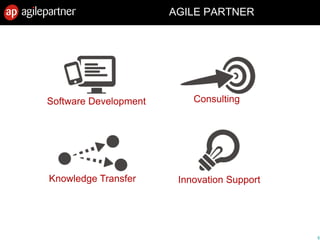
Software Development
Knowledge Transfer Innovation Support
Consulting
YOU
What about you?
What do you know about agility?
What are your expectations?
28 Feb. 2013 Introduction to agile methods 7
WHAT IS AGILE TESTING?
28 Feb. 2013 8Introduction to agile methods
WHAT IS TESTING?
28 Feb. 2013 9Introduction to agile methods
WHAT IS SOFTWARE TESTING?
Definition:
Software testing is an investigation conducted to
provide stakeholders with information about the
quality of the product or service under test.
(Wikipedia)
WHAT IS SOFTWARE TESTING?
Definition:
Software testing is a way to measure the quality of the
product using tests.
(me)
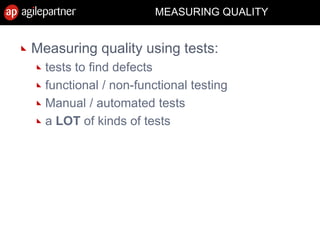
MEASURING QUALITY
Measuring quality using tests:
tests to find defects
functional / non-functional testing
Manual / automated tests
a LOT of kinds of tests
15 July 2010 12
SO WHAT IS AGILE TESTING ?
… AND WHY?
… AND HOW?
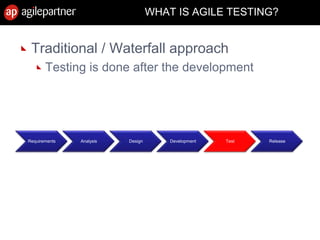
Traditional / Waterfall approach
Testing is done after the development
Requirements Analysis Design Development Test Release
WHAT IS AGILE TESTING?
15 July 2010 Agile Mëtteg - Agile testing 14
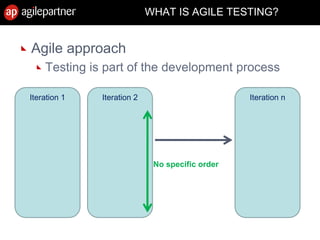
Agile approach
Testing is part of the development process
WHAT IS AGILE TESTING?
15 July 2010 Agile Mëtteg - Agile testing 15
Iteration 1 Iteration 2 Iteration n
No specific order
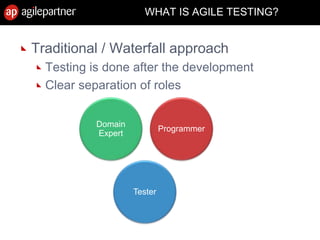
Traditional / Waterfall approach
Testing is done after the development
Clear separation of roles
WHAT IS AGILE TESTING?
15 July 2010 Agile Mëtteg - Agile testing 16
Programmer
Domain
Expert
Tester
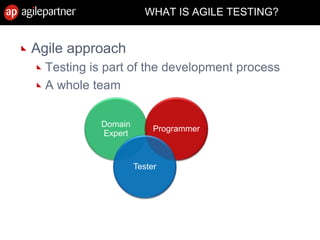
Agile approach
Testing is part of the development process
A whole team
WHAT IS AGILE TESTING?
15 July 2010 Agile Mëtteg - Agile testing 17
Programmer
Domain
Expert
Tester
Programmer
Tester
Agile testing places an increased portion of the
testing in the hands of the developers
Wait… WHAT?!?!
I’m a programmer not a tester
It’s trivial I don’t need a test
I don’t have time for testing
My code is very difficult to test
WHAT IS AGILE TESTING?
WHY AGILE TESTING?
WHY should developers write tests?
Fear / Confidence
Do you dare to change the code?
 Tests = safety net
It places developers as users
 Better usability
It makes the code testable
 Better design
15 July 2010 Agile Mëtteg - Agile testing 19
WHY AGILE TESTING?
A better design
“How good the design is doesn't matter near as much as
whether the design is getting better or worse.
If it is getting better, day by day, I can live with it forever.
If it is getting worse, I will die.”
(Kent Beck )
AGILE TESTING… HOW?
Agile testing… HOW?
Unit testing
Test Driven Development
Acceptance testing
Behaviour Driven Development
BUT FIRST…
15 July 2010 22
A PAGE OF ADVERTISMENT!
15 July 2010 23
http://www.dinoeggsrebirth.com/
COMING THIS SUMMER
UNIT TESTING
UNIT TESTING
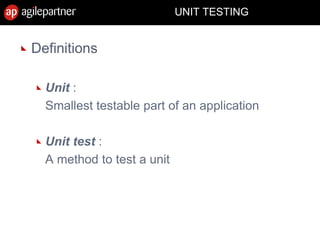
Definitions
Unit :
Smallest testable part of an application
Unit test :
A method to test a unit
UNIT TESTING
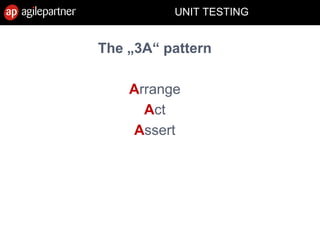
The „3A“ pattern
Arrange
Act
Assert
UNIT TESTING
F.I.R.S.T.
Fast
Independent
Repeatable
Self-Validating
Timely
[Clean Code – Robert C. Martin]
UNIT TESTING
DEMO
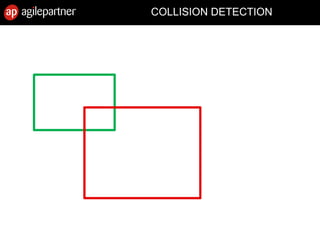
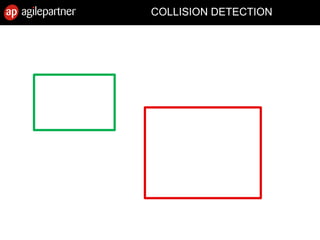
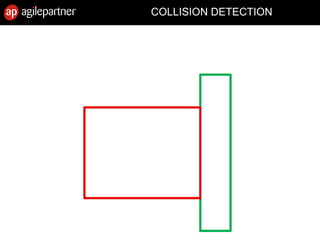
COLLISION DETECTION
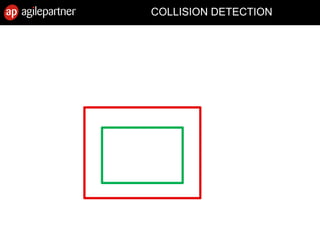
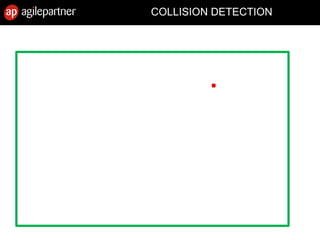
COLLISION DETECTION
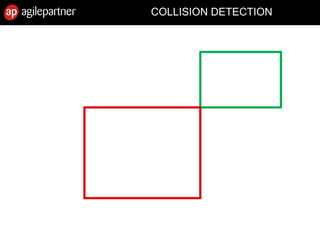
COLLISION DETECTION
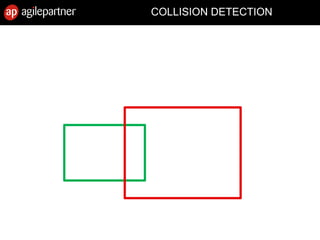
COLLISION DETECTION
COLLISION DETECTION
COLLISION DETECTION
COLLISION DETECTION
TEST DRIVEN
DEVELOPMENT (TDD)
TEST DRIVEN DEVELOPMENT (TDD)
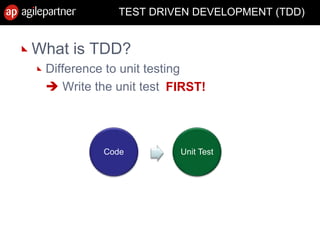
What is TDD?
Difference to unit testing
 Write the unit test
Unit TestCode
FIRST!
TEST DRIVEN DEVELOPMENT (TDD)
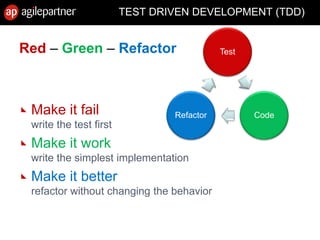
Red – Green – Refactor
Make it fail
write the test first
Make it work
write the simplest implementation
Make it better
refactor without changing the behavior
15 July 2010 Agile Mëtteg - Agile testing 44
Test
CodeRefactor
TEST DRIVEN DEVELOPMENT (TDD)
TDD is not only about testing
Also called Test Driven Design
TDD is a methodology that helps creating a
good design when developing code.
TEST DRIVEN DEVELOPMENT (TDD)
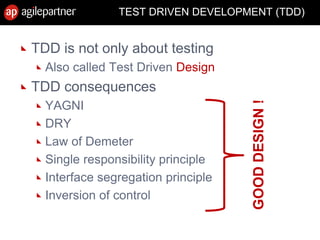
TDD is not only about testing
Also called Test Driven Design
TDD consequences
YAGNI
DRY
Law of Demeter
Single responsibility principle
Interface segregation principle
Inversion of control
GOODDESIGN!
TEST DRIVEN DEVELOPMENT (TDD)
DEMO
TEST DRIVEN DEVELOPMENT (TDD)
ACCEPTANCE TESTING
ACCEPTANCE TESTING
Unit testing tells us that the code is meeting
the programmer‘s expectations
Unit testing is essential but not sufficient
Acceptance tests are specifications for the
desired behaviour and functionality of a system.
Customer oriented
About the what and not the how
Usually black box system tests
Integration tests character
15 July 2010 Agile Mëtteg - Agile testing 53
ACCEPTANCE TESTING
Implementing acceptance tests
 means automation
Examples of automation tools:
Framework for Integrated Test (Fit) is an open-
source tool for automated acceptance test
Fitnesse is a webserver, a wiki and an
automated testing tool based on Fit
15 July 2010 Agile Mëtteg - Agile testing 54
ACCEPTANCE TESTING
DEMO
BEHAVIOUR DRIVEN
DEVELOPMENT (BDD)
15 July 2010 Agile Mëtteg - Agile testing 56
BEHAVIOUR DRIVEN DEVELOPMENT
Behaviour Driven Development (BDD)
Evolution of TDD introduced by Dan North
Using terminology focused on the behavioural
aspects of the system rather than testing
 Unit ≠ behaviour
 Focus on why the code should be created
 Business value > Code
 Specification > Test
15 July 2010 Agile Mëtteg - Agile testing 57
BEHAVIOUR DRIVEN DEVELOPMENT
Outside-in methodology
 from the known to the unknown
Helps the developer to think YAGNI
 Leads to better design
 BDD = Behaviour Driven Design
Don‘t forget about the roots (TDD)
 Red – Green – Refactor
15 July 2010 Agile Mëtteg - Agile testing 58
BEHAVIOUR DRIVEN DEVELOPMENT
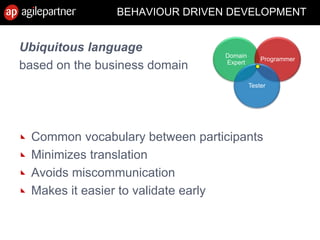
Ubiquitous language
based on the business domain
Common vocabulary between participants
Minimizes translation
Avoids miscommunication
Makes it easier to validate early
15 July 2010 Agile Mëtteg - Agile testing 59
Domain
Expert
Programmer
Tester
BEHAVIOUR DRIVEN DEVELOPMENT
Story framework
Each feature is captured in a „story“, which defines
the scope of the feature along with its acceptance
criteria
Feature
Feature: Title
As a [role]
I want [feature]
So that [benefit] Feature: End of Agile Mëtteg session
As a speaker
I want to end the session in a beautiful way
So that the audience is very impressed
BEHAVIOUR DRIVEN DEVELOPMENT
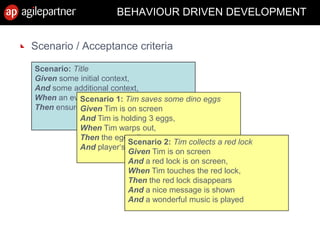
Scenario / Acceptance criteria
Scenario: Title
Given some initial context,
And some additional context,
When an event occurs,
Then ensure some outcomes
Scenario 1: Tim saves some dino eggs
Given Tim is on screen
And Tim is holding 3 eggs,
When Tim warps out,
Then the eggs disappear
And player‘s score is increased by 6 points
Scenario 2: Tim collects a red lock
Given Tim is on screen
And a red lock is on screen,
When Tim touches the red lock,
Then the red lock disappears
And a nice message is shown
And a wonderful music is played
BEHAVIOUR DRIVEN DEVELOPMENT
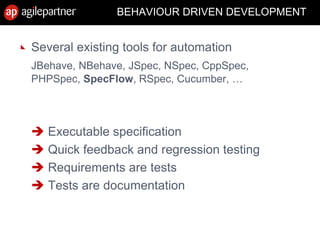
Several existing tools for automation
JBehave, NBehave, JSpec, NSpec, CppSpec,
PHPSpec, SpecFlow, RSpec, Cucumber, …
 Executable specification
 Quick feedback and regression testing
 Requirements are tests
 Tests are documentation
15 July 2010 Agile Mëtteg - Agile testing 62
BEHAVIOUR DRIVEN DEVELOPMENT
DEMO
15 July 2010 Agile Mëtteg - Agile testing 63
SUMMARY
15 July 2010 Agile Mëtteg - Agile testing 64
SUMMARY
Some things to remember about Agile Testing:
Testing is part of the development process
Whole-team approach: roles are not strictly
separated like in a traditional approach
Building a testable architecture leads to a
better design
Unit tests and acceptance tests are
complementary
Use agile practices: TDD, BDD, Continuous
Integration
QUESTIONS & ANSWERS
28 Feb. 2013 Introduction to agile methods 66
YOUR FEEDBACK
28 Feb. 2013 67Introduction to agile methods
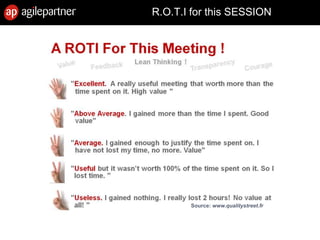
R.O.T.I for this SESSION
28 Feb. 2013 Introduction to agile methods 68
Source: www.qualitystreet.fr
THANK
YOU
28 Feb. 2013 72Introduction to agile methods
Retrouvez nous sur :
Agile Partner: www.agilepartner.net & http://blog.agilepartner.net

Agile Mëtteg #5: Agile Testing

  • 2.
    25 June 2015 AgileMëtteg : Agile Testing
  • 3.
    Objectives This session willfocus on a Agile Testing and provide you with practical examples and techniques to help your team understand what is behind this approach. Agenda Let’s get acquainted What is agile testing? Unit testing Test Driven Development Acceptance testing Behavior Driven Development Q&A 28 Feb. 2013 3 OBJECTIVES & AGENDA Introduction to agile methods
  • 4.
    LET’S GET ACQUAINTED 28Feb. 2013 4Introduction to agile methods
  • 5.
    28 Feb. 2013Introduction to agile methods 5 Eric FERROT Senior Software Developer ME
  • 6.
    6. AGILE PARTNER 28 Feb.2013 Introduction to agile methods 6 Software Development Knowledge Transfer Innovation Support Consulting
  • 7.
    YOU What about you? Whatdo you know about agility? What are your expectations? 28 Feb. 2013 Introduction to agile methods 7
  • 8.
    WHAT IS AGILETESTING? 28 Feb. 2013 8Introduction to agile methods
  • 9.
    WHAT IS TESTING? 28Feb. 2013 9Introduction to agile methods
  • 10.
    WHAT IS SOFTWARETESTING? Definition: Software testing is an investigation conducted to provide stakeholders with information about the quality of the product or service under test. (Wikipedia)
  • 11.
    WHAT IS SOFTWARETESTING? Definition: Software testing is a way to measure the quality of the product using tests. (me)
  • 12.
    MEASURING QUALITY Measuring qualityusing tests: tests to find defects functional / non-functional testing Manual / automated tests a LOT of kinds of tests 15 July 2010 12
  • 13.
    SO WHAT ISAGILE TESTING ? … AND WHY? … AND HOW?
  • 14.
    Traditional / Waterfallapproach Testing is done after the development Requirements Analysis Design Development Test Release WHAT IS AGILE TESTING? 15 July 2010 Agile Mëtteg - Agile testing 14
  • 15.
    Agile approach Testing ispart of the development process WHAT IS AGILE TESTING? 15 July 2010 Agile Mëtteg - Agile testing 15 Iteration 1 Iteration 2 Iteration n No specific order
  • 16.
    Traditional / Waterfallapproach Testing is done after the development Clear separation of roles WHAT IS AGILE TESTING? 15 July 2010 Agile Mëtteg - Agile testing 16 Programmer Domain Expert Tester
  • 17.
    Agile approach Testing ispart of the development process A whole team WHAT IS AGILE TESTING? 15 July 2010 Agile Mëtteg - Agile testing 17 Programmer Domain Expert Tester Programmer Tester
  • 18.
    Agile testing placesan increased portion of the testing in the hands of the developers Wait… WHAT?!?! I’m a programmer not a tester It’s trivial I don’t need a test I don’t have time for testing My code is very difficult to test WHAT IS AGILE TESTING?
  • 19.
    WHY AGILE TESTING? WHYshould developers write tests? Fear / Confidence Do you dare to change the code?  Tests = safety net It places developers as users  Better usability It makes the code testable  Better design 15 July 2010 Agile Mëtteg - Agile testing 19
  • 20.
    WHY AGILE TESTING? Abetter design “How good the design is doesn't matter near as much as whether the design is getting better or worse. If it is getting better, day by day, I can live with it forever. If it is getting worse, I will die.” (Kent Beck )
  • 21.
    AGILE TESTING… HOW? Agiletesting… HOW? Unit testing Test Driven Development Acceptance testing Behaviour Driven Development
  • 22.
  • 23.
    A PAGE OFADVERTISMENT! 15 July 2010 23
  • 24.
  • 25.
  • 26.
    UNIT TESTING Definitions Unit : Smallesttestable part of an application Unit test : A method to test a unit
  • 27.
    UNIT TESTING The „3A“pattern Arrange Act Assert
  • 28.
  • 29.
  • 30.
  • 31.
  • 32.
  • 33.
  • 34.
  • 35.
  • 36.
  • 37.
  • 38.
    TEST DRIVEN DEVELOPMENT(TDD) What is TDD? Difference to unit testing  Write the unit test Unit TestCode FIRST!
  • 39.
    TEST DRIVEN DEVELOPMENT(TDD) Red – Green – Refactor Make it fail write the test first Make it work write the simplest implementation Make it better refactor without changing the behavior 15 July 2010 Agile Mëtteg - Agile testing 44 Test CodeRefactor
  • 40.
    TEST DRIVEN DEVELOPMENT(TDD) TDD is not only about testing Also called Test Driven Design TDD is a methodology that helps creating a good design when developing code.
  • 41.
    TEST DRIVEN DEVELOPMENT(TDD) TDD is not only about testing Also called Test Driven Design TDD consequences YAGNI DRY Law of Demeter Single responsibility principle Interface segregation principle Inversion of control GOODDESIGN!
  • 42.
  • 43.
  • 44.
  • 45.
  • 46.
  • 47.
  • 48.
    ACCEPTANCE TESTING Unit testingtells us that the code is meeting the programmer‘s expectations Unit testing is essential but not sufficient Acceptance tests are specifications for the desired behaviour and functionality of a system. Customer oriented About the what and not the how Usually black box system tests Integration tests character 15 July 2010 Agile Mëtteg - Agile testing 53
  • 49.
    ACCEPTANCE TESTING Implementing acceptancetests  means automation Examples of automation tools: Framework for Integrated Test (Fit) is an open- source tool for automated acceptance test Fitnesse is a webserver, a wiki and an automated testing tool based on Fit 15 July 2010 Agile Mëtteg - Agile testing 54
  • 50.
  • 51.
    BEHAVIOUR DRIVEN DEVELOPMENT (BDD) 15July 2010 Agile Mëtteg - Agile testing 56
  • 52.
    BEHAVIOUR DRIVEN DEVELOPMENT BehaviourDriven Development (BDD) Evolution of TDD introduced by Dan North Using terminology focused on the behavioural aspects of the system rather than testing  Unit ≠ behaviour  Focus on why the code should be created  Business value > Code  Specification > Test 15 July 2010 Agile Mëtteg - Agile testing 57
  • 53.
    BEHAVIOUR DRIVEN DEVELOPMENT Outside-inmethodology  from the known to the unknown Helps the developer to think YAGNI  Leads to better design  BDD = Behaviour Driven Design Don‘t forget about the roots (TDD)  Red – Green – Refactor 15 July 2010 Agile Mëtteg - Agile testing 58
  • 54.
    BEHAVIOUR DRIVEN DEVELOPMENT Ubiquitouslanguage based on the business domain Common vocabulary between participants Minimizes translation Avoids miscommunication Makes it easier to validate early 15 July 2010 Agile Mëtteg - Agile testing 59 Domain Expert Programmer Tester
  • 55.
    BEHAVIOUR DRIVEN DEVELOPMENT Storyframework Each feature is captured in a „story“, which defines the scope of the feature along with its acceptance criteria Feature Feature: Title As a [role] I want [feature] So that [benefit] Feature: End of Agile Mëtteg session As a speaker I want to end the session in a beautiful way So that the audience is very impressed
  • 56.
    BEHAVIOUR DRIVEN DEVELOPMENT Scenario/ Acceptance criteria Scenario: Title Given some initial context, And some additional context, When an event occurs, Then ensure some outcomes Scenario 1: Tim saves some dino eggs Given Tim is on screen And Tim is holding 3 eggs, When Tim warps out, Then the eggs disappear And player‘s score is increased by 6 points Scenario 2: Tim collects a red lock Given Tim is on screen And a red lock is on screen, When Tim touches the red lock, Then the red lock disappears And a nice message is shown And a wonderful music is played
  • 57.
    BEHAVIOUR DRIVEN DEVELOPMENT Severalexisting tools for automation JBehave, NBehave, JSpec, NSpec, CppSpec, PHPSpec, SpecFlow, RSpec, Cucumber, …  Executable specification  Quick feedback and regression testing  Requirements are tests  Tests are documentation 15 July 2010 Agile Mëtteg - Agile testing 62
  • 58.
    BEHAVIOUR DRIVEN DEVELOPMENT DEMO 15July 2010 Agile Mëtteg - Agile testing 63
  • 59.
    SUMMARY 15 July 2010Agile Mëtteg - Agile testing 64
  • 60.
    SUMMARY Some things toremember about Agile Testing: Testing is part of the development process Whole-team approach: roles are not strictly separated like in a traditional approach Building a testable architecture leads to a better design Unit tests and acceptance tests are complementary Use agile practices: TDD, BDD, Continuous Integration
  • 61.
    QUESTIONS & ANSWERS 28Feb. 2013 Introduction to agile methods 66
  • 62.
    YOUR FEEDBACK 28 Feb.2013 67Introduction to agile methods
  • 63.
    R.O.T.I for thisSESSION 28 Feb. 2013 Introduction to agile methods 68 Source: www.qualitystreet.fr
  • 64.
    THANK YOU 28 Feb. 201372Introduction to agile methods Retrouvez nous sur : Agile Partner: www.agilepartner.net & http://blog.agilepartner.net

Editor's Notes

  • #11 ERF
  • #12 ERF
  • #13 ERF
  • #14 ERF
  • #15 ERF
  • #16 ERF
  • #17 ERF
  • #18 ERF
  • #19 ERF(+SZ)
  • #20 ERF
  • #21 ERF
  • #22 ERF
  • #23 ERF
  • #24 ERF
  • #25 ERF
  • #26 SZ
  • #27 SZ The goal of unit testing is to isolate each part of the program and show that the individual parts are correct. Unit tests find problems early in the development cycle. A unit test provides a strict, written contract that the piece of code must satisfy. As a result, it affords several benefits.
  • #28 SZ
  • #29 SZ More confidence in the code Avoid regression: If tests are run frequently the developer can see when new code breaks old code. The tests themselves are documentation Encourages better software design: simpler, smaller methods; less coupling instead of strongly coupled code [Compare introduction, maybe too similar?]
  • #30 SZ Principles for unit tests It’s much easier to see: What is being set up and initialized in the arrange section What method is being executed in the act section What determines the outcome of the test in the assert section
  • #31 SZ
  • #32 SZ Originated in XP. Unit tests are essential parts of XP and other agile methods.
  • #33 SZ
  • #34 ERF
  • #35 ERF
  • #36 ERF
  • #37 ERF
  • #38 ERF
  • #39 ERF
  • #40 ERF
  • #41 ERF
  • #42 ERF
  • #43 ERF
  • #44 ERF
  • #45 ERF
  • #46 ERF
  • #47 ERF
  • #48 ERF
  • #49 ERF
  • #50 ERF
  • #51 ERF
  • #52 ERF
  • #53 SZ
  • #54 SZ Acceptance tests are specifications for the desired behavior and functionality of a system. WHY? Although acceptance testing traditionally takes place at the end of development or major milestones, in agile software development acceptance testing needs to be performed at the user story level. There are several reasons for why this is important: A passed test case becomes a measure of completeness of a user story; that is, a user story cannot be considered complete till it has passed all acceptance tests associated with it. Even though there is thorough unit testing performed, this is not enough. Unit tests, by their nature, test for a localized used case and are not concerned about the overall system. When we have iterations longer than a couple of weeks, it becomes easy to loose focus on initial agreements; acceptance test cases made for each story at the beginning of each iteration help the developers to keep things within the expectations. Acceptance test cases can serve as an excellent guide to developers to better interpret the requirements from a user story
  • #55 SZ Fit – the engine The customers' examples are formatted in tables and saved as HTML using ordinary business tools such as Microsoft Excel. When Fit checks the document, it creates a copy and colors the tables green, red, and yellow according to whether the software behaved as expected. Fitnesse – Also the wiki on top FitNesse allows users of a developed system to enter specially formatted input (its format is accessible to non-programmers). This input is interpreted and tests are created automatically. These tests are then executed by the system and output is returned back to the user. The advantage of this approach is very fast feedback from users. The developer of the system to be tested needs to provide some support (classes named "fixtures", conforming to certain conventions). fast user feedback ERF demo -> score computation dino legs
  • #56 ERF
  • #57 SZI
  • #58 SZ Behavior-driven development BDD aims to help focus on the delivery of prioritised, verifiable business value by providing a common vocabulary By using terminology focused on the behavioural aspects of the system rather than testing, BDD attempts to help direct developers towards a focus on the real value to be found in TDD at its most successful. "Behavior-driven development is what you are doing already, if you are doing Test-driven development well." (Dave Astels) Behavior Driven Development is more about interactions with the application than just unit testing. It forces the developer to understand the responsibility of the method he is about to write. Using good tools, the specs written to test the application can be used as specifications. Doing what comes naturally BDD isn't anything new or revolutionary. It's just an evolutionary offshoot of TDD in which the word "test" is replaced by the word "should." Semantics aside, many people find the concept of should a much more natural development driver than the concept of testing. Thinking in terms of behavior (shoulds) somehow paves the way into writing specification classes first, which, in turn, can be a very efficient implementation driver. For many developers, the shift from test-driven development to BDD is a smart move. With BDD, you don't have to think about tests, you can just pay attention to the requirements of your application and ensure that the application behavior does what it should to meet those requirements. Using BDD to drive development Behavior driven development (BDD) is an evolutionary result of test driven development (TDD) in the sense that rather than thinking in terms of tests (which have the tendency to make you think after the fact) you can more easily think in terms of a specification. By thinking about an application’s specification or behavior, it becomes easier to validate things early– in fact, when thinking in terms of a specification, it becomes quite easy to write things upfront.
  • #59 SZ
  • #60 SZ BDD relies on the use of a very specific (and small) vocabulary to minimize miscommunication and to ensure that everyone – the business, developers, testers, analysts and managers – are not only on the same page but using the same words. BDD provides a “ubiquitous language” for analysis Around this time, Eric Evans published his bestselling book Domain-Driven Design. In it, he describes the concept of modeling a system using a ubiquitous language based on the business domain, so that the business vocabulary permeates right into the codebase.
  • #61 SZI Structural templates Feature: As a [X] I want [Y] so that [Z] (In order) The template had to be loose enough that it wouldn’t feel artificial or constraining to analysts but structured enough that we could break the story into its constituent fragments and automate them. We started describing the acceptance criteria in terms of scenarios, which took the following form: Scenarios: Given some initial context (the givens), When an event occurs, then ensure some outcomes.
  • #62 SZI Structural templates Feature: As a [X] I want [Y] so that [Z] (In order) The template had to be loose enough that it wouldn’t feel artificial or constraining to analysts but structured enough that we could break the story into its constituent fragments and automate them. We started describing the acceptance criteria in terms of scenarios, which took the following form: Scenarios: Given some initial context (the givens), When an event occurs, then ensure some outcomes.
  • #63 SZI
  • #64 ERF
  • #65 SZI
  • #66 SZI