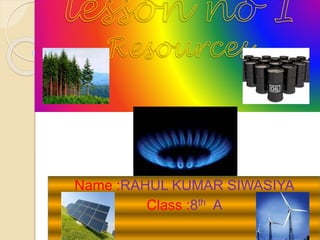
Name :RAHUL KUMAR SIWASIYA
Class :8th A
Q1 .Which one of the following does NOT make
a substance a resource ?
(a)utility (b)
value
(c) quantity
Q2. which of the following is human made
resources?
(a)Medicines to treat cancer
(b) spring water
(c) Tropical forest
Answer : Q1.
Q2.
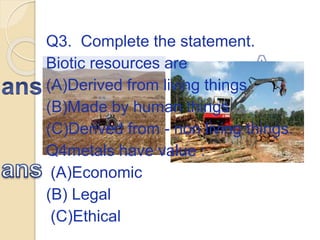
Q3. Complete the statement.
Biotic resources are
(A)Derived from living things
(B)Made by human things
(C)Derived from - non living things.
Q4metals have value :
(A)Economic
(B) Legal
(C)Ethical
M C Q
1. Kaveri water dispute is in between:
(a) India and Pakistan
(b) Punjab and Haryana
(c) Uttar Pradesh and Madhya Pradesh
(d) Karnataka and Tamil Nadu
2. In respect of water crisis, there have been
conflicts/disputes between two countries, or states
of the same country. Which of the following has
never been the case of water conflict?
(a) Cauvery water dispute between Tamil Nadu and
Karnataka
(b) Yamuna-Betwa dispute between U.P. and M.P.
(c) Sutlej Yamuna Link (SYL) canal dispute between
Punjab and Haryana
(d) Jordan, Tigris-Euphrates, and Nile river basins dispute
among Jordan, Syria and Israel
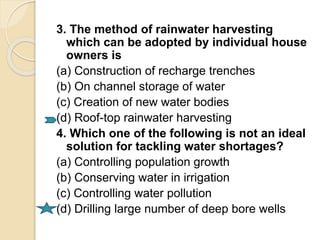
3. The method of rainwater harvesting
which can be adopted by individual house
owners is
(a) Construction of recharge trenches
(b) On channel storage of water
(c) Creation of new water bodies
(d) Roof-top rainwater harvesting
4. Which one of the following is not an ideal
solution for tackling water shortages?
(a) Controlling population growth
(b) Conserving water in irrigation
(c) Controlling water pollution
(d) Drilling large number of deep bore wells
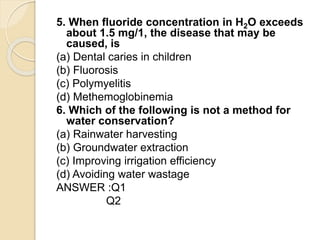
5. When fluoride concentration in H2O exceeds
about 1.5 mg/1, the disease that may be
caused, is
(a) Dental caries in children
(b) Fluorosis
(c) Polymyelitis
(d) Methemoglobinemia
6. Which of the following is not a method for
water conservation?
(a) Rainwater harvesting
(b) Groundwater extraction
(c) Improving irrigation efficiency
(d) Avoiding water wastage
ANSWER :Q1
Q2
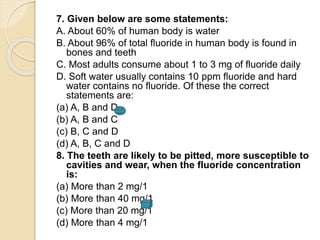
7. Given below are some statements:
A. About 60% of human body is water
B. About 96% of total fluoride in human body is found in
bones and teeth
C. Most adults consume about 1 to 3 mg of fluoride daily
D. Soft water usually contains 10 ppm fluoride and hard
water contains no fluoride. Of these the correct
statements are:
(a) A, B and D
(b) A, B and C
(c) B, C and D
(d) A, B, C and D
8. The teeth are likely to be pitted, more susceptible to
cavities and wear, when the fluoride concentration
is:
(a) More than 2 mg/1
(b) More than 40 mg/1
(c) More than 20 mg/1
(d) More than 4 mg/1
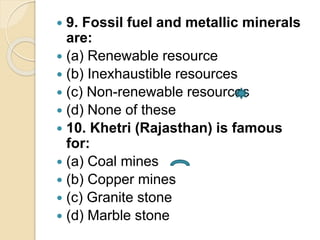
 9. Fossil fuel and metallic minerals
are:
 (a) Renewable resource
 (b) Inexhaustible resources
 (c) Non-renewable resources
 (d) None of these
 10. Khetri (Rajasthan) is famous
for:
 (a) Coal mines
 (b) Copper mines
 (c) Granite stone
 (d) Marble stone
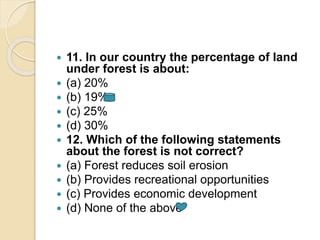
 11. In our country the percentage of land
under forest is about:
 (a) 20%
 (b) 19%
 (c) 25%
 (d) 30%
 12. Which of the following statements
about the forest is not correct?
 (a) Forest reduces soil erosion
 (b) Provides recreational opportunities
 (c) Provides economic development
 (d) None of the above
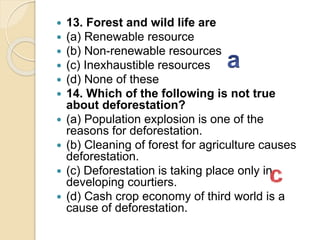
 13. Forest and wild life are
 (a) Renewable resource
 (b) Non-renewable resources
 (c) Inexhaustible resources
 (d) None of these
 14. Which of the following is not true
about deforestation?
 (a) Population explosion is one of the
reasons for deforestation.
 (b) Cleaning of forest for agriculture causes
deforestation.
 (c) Deforestation is taking place only in
developing courtiers.
 (d) Cash crop economy of third world is a
cause of deforestation.
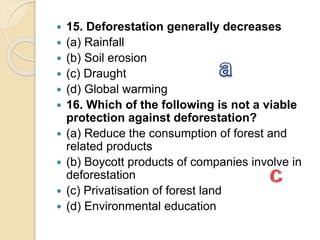
 15. Deforestation generally decreases
 (a) Rainfall
 (b) Soil erosion
 (c) Draught
 (d) Global warming
 16. Which of the following is not a viable
protection against deforestation?
 (a) Reduce the consumption of forest and
related products
 (b) Boycott products of companies involve in
deforestation
 (c) Privatisation of forest land
 (d) Environmental education
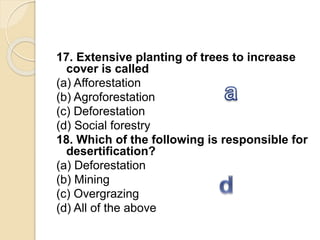
17. Extensive planting of trees to increase
cover is called
(a) Afforestation
(b) Agroforestation
(c) Deforestation
(d) Social forestry
18. Which of the following is responsible for
desertification?
(a) Deforestation
(b) Mining
(c) Overgrazing
(d) All of the above
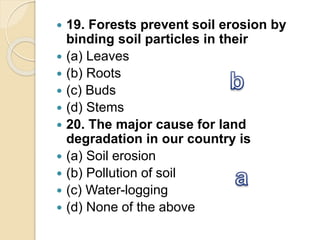
 19. Forests prevent soil erosion by
binding soil particles in their
 (a) Leaves
 (b) Roots
 (c) Buds
 (d) Stems
 20. The major cause for land
degradation in our country is
 (a) Soil erosion
 (b) Pollution of soil
 (c) Water-logging
 (d) None of the above
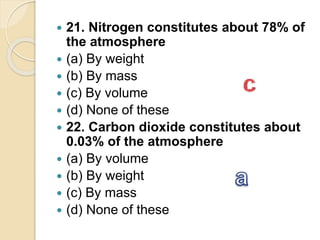
 21. Nitrogen constitutes about 78% of
the atmosphere
 (a) By weight
 (b) By mass
 (c) By volume
 (d) None of these
 22. Carbon dioxide constitutes about
0.03% of the atmosphere
 (a) By volume
 (b) By weight
 (c) By mass
 (d) None of these
 23. Which among the following is a
sedimentary type of cycle?
 (a) Sulphur cycle
 (b) Nitrogen cycle
 (c) Oxygen cycle
 (d) Carbon cycle
 24. The percentage of total world’s
precipitation, which is lost to the
atmosphere through evaporation,
approximates to:
 (a) 57%
 (b) 7%
 (c) 37%
 (d) 43%
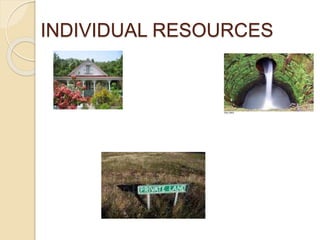
ON THE BASIS OF OWNERSHIP
 INDIVIDUAL RESOURCES
 COMMUNITY OWNED RESOURCES
 NATIONAL RESOURCES
 INTERNATIONAL RESOURCES
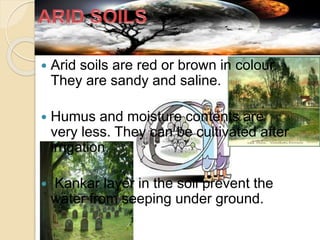
 Arid soils are red or brown in colour.
They are sandy and saline.
 Humus and moisture contents are
very less. They can be cultivated after
irrigation.
 Kankar layer in the soil prevent the
water from seeping under ground.
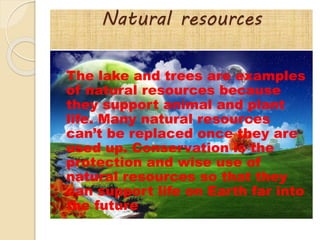
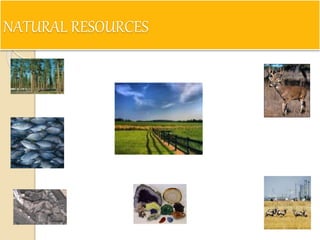
Natural resources
 The lake and trees are examples
of natural resources because
they support animal and plant
life. Many natural resources
can’t be replaced once they are
used up. Conservation is the
protection and wise use of
natural resources so that they
can support life on Earth far into
the future
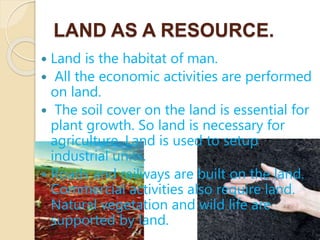
LAND AS A RESOURCE.
 Land is the habitat of man.
 All the economic activities are performed
on land.
 The soil cover on the land is essential for
plant growth. So land is necessary for
agriculture. Land is used to setup
industrial units.
 Roads and railways are built on the land.
Commercial activities also require land.
Natural vegetation and wild life are
supported by land.
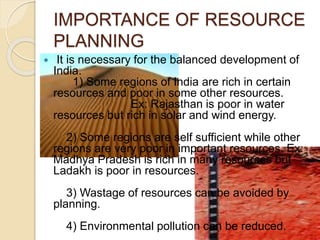
IMPORTANCE OF RESOURCE
PLANNING
 It is necessary for the balanced development of
India.
1) Some regions of India are rich in certain
resources and poor in some other resources.
Ex: Rajasthan is poor in water
resources but rich in solar and wind energy.
2) Some regions are self sufficient while other
regions are very poor in important resources. Ex:
Madhya Pradesh is rich in many resources but
Ladakh is poor in resources.
3) Wastage of resources can be avoided by
planning.
4) Environmental pollution can be reduced.
INDIVIDUAL RESOURCES
NATURAL RESOURCES
PROBLEMS CREATED BY INDISCRIMINATE
USE OF RESOURCE BY MAN
a. Many resources got depleted. Ex: Forest
b. Resources got accumulated in the hands of
few people. The society is divided into rich
and poor.
c. Global warming, ozone layer depletion,
environmental degradation are other
problems.
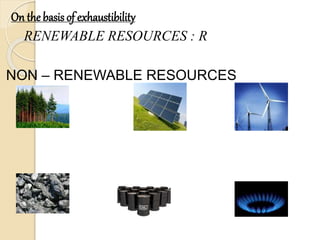
On the basis of exhaustibility
RENEWABLE RESOURCES : R
NON – RENEWABLE RESOURCES

Rahul kumar siwasiya

  • 1.
    Name :RAHUL KUMARSIWASIYA Class :8th A
  • 2.
    Q1 .Which oneof the following does NOT make a substance a resource ? (a)utility (b) value (c) quantity Q2. which of the following is human made resources? (a)Medicines to treat cancer (b) spring water (c) Tropical forest Answer : Q1. Q2.
  • 3.
    Q3. Complete thestatement. Biotic resources are (A)Derived from living things (B)Made by human things (C)Derived from - non living things. Q4metals have value : (A)Economic (B) Legal (C)Ethical
  • 4.
    M C Q 1.Kaveri water dispute is in between: (a) India and Pakistan (b) Punjab and Haryana (c) Uttar Pradesh and Madhya Pradesh (d) Karnataka and Tamil Nadu 2. In respect of water crisis, there have been conflicts/disputes between two countries, or states of the same country. Which of the following has never been the case of water conflict? (a) Cauvery water dispute between Tamil Nadu and Karnataka (b) Yamuna-Betwa dispute between U.P. and M.P. (c) Sutlej Yamuna Link (SYL) canal dispute between Punjab and Haryana (d) Jordan, Tigris-Euphrates, and Nile river basins dispute among Jordan, Syria and Israel
  • 5.
    3. The methodof rainwater harvesting which can be adopted by individual house owners is (a) Construction of recharge trenches (b) On channel storage of water (c) Creation of new water bodies (d) Roof-top rainwater harvesting 4. Which one of the following is not an ideal solution for tackling water shortages? (a) Controlling population growth (b) Conserving water in irrigation (c) Controlling water pollution (d) Drilling large number of deep bore wells
  • 6.
    5. When fluorideconcentration in H2O exceeds about 1.5 mg/1, the disease that may be caused, is (a) Dental caries in children (b) Fluorosis (c) Polymyelitis (d) Methemoglobinemia 6. Which of the following is not a method for water conservation? (a) Rainwater harvesting (b) Groundwater extraction (c) Improving irrigation efficiency (d) Avoiding water wastage ANSWER :Q1 Q2
  • 7.
    7. Given beloware some statements: A. About 60% of human body is water B. About 96% of total fluoride in human body is found in bones and teeth C. Most adults consume about 1 to 3 mg of fluoride daily D. Soft water usually contains 10 ppm fluoride and hard water contains no fluoride. Of these the correct statements are: (a) A, B and D (b) A, B and C (c) B, C and D (d) A, B, C and D 8. The teeth are likely to be pitted, more susceptible to cavities and wear, when the fluoride concentration is: (a) More than 2 mg/1 (b) More than 40 mg/1 (c) More than 20 mg/1 (d) More than 4 mg/1
  • 8.
     9. Fossilfuel and metallic minerals are:  (a) Renewable resource  (b) Inexhaustible resources  (c) Non-renewable resources  (d) None of these  10. Khetri (Rajasthan) is famous for:  (a) Coal mines  (b) Copper mines  (c) Granite stone  (d) Marble stone
  • 9.
     11. Inour country the percentage of land under forest is about:  (a) 20%  (b) 19%  (c) 25%  (d) 30%  12. Which of the following statements about the forest is not correct?  (a) Forest reduces soil erosion  (b) Provides recreational opportunities  (c) Provides economic development  (d) None of the above
  • 10.
     13. Forestand wild life are  (a) Renewable resource  (b) Non-renewable resources  (c) Inexhaustible resources  (d) None of these  14. Which of the following is not true about deforestation?  (a) Population explosion is one of the reasons for deforestation.  (b) Cleaning of forest for agriculture causes deforestation.  (c) Deforestation is taking place only in developing courtiers.  (d) Cash crop economy of third world is a cause of deforestation.
  • 11.
     15. Deforestationgenerally decreases  (a) Rainfall  (b) Soil erosion  (c) Draught  (d) Global warming  16. Which of the following is not a viable protection against deforestation?  (a) Reduce the consumption of forest and related products  (b) Boycott products of companies involve in deforestation  (c) Privatisation of forest land  (d) Environmental education
  • 12.
    17. Extensive plantingof trees to increase cover is called (a) Afforestation (b) Agroforestation (c) Deforestation (d) Social forestry 18. Which of the following is responsible for desertification? (a) Deforestation (b) Mining (c) Overgrazing (d) All of the above
  • 13.
     19. Forestsprevent soil erosion by binding soil particles in their  (a) Leaves  (b) Roots  (c) Buds  (d) Stems  20. The major cause for land degradation in our country is  (a) Soil erosion  (b) Pollution of soil  (c) Water-logging  (d) None of the above
  • 14.
     21. Nitrogenconstitutes about 78% of the atmosphere  (a) By weight  (b) By mass  (c) By volume  (d) None of these  22. Carbon dioxide constitutes about 0.03% of the atmosphere  (a) By volume  (b) By weight  (c) By mass  (d) None of these
  • 15.
     23. Whichamong the following is a sedimentary type of cycle?  (a) Sulphur cycle  (b) Nitrogen cycle  (c) Oxygen cycle  (d) Carbon cycle  24. The percentage of total world’s precipitation, which is lost to the atmosphere through evaporation, approximates to:  (a) 57%  (b) 7%  (c) 37%  (d) 43%
  • 16.
    ON THE BASISOF OWNERSHIP  INDIVIDUAL RESOURCES  COMMUNITY OWNED RESOURCES  NATIONAL RESOURCES  INTERNATIONAL RESOURCES
  • 17.
     Arid soilsare red or brown in colour. They are sandy and saline.  Humus and moisture contents are very less. They can be cultivated after irrigation.  Kankar layer in the soil prevent the water from seeping under ground.
  • 18.
    Natural resources  Thelake and trees are examples of natural resources because they support animal and plant life. Many natural resources can’t be replaced once they are used up. Conservation is the protection and wise use of natural resources so that they can support life on Earth far into the future
  • 19.
    LAND AS ARESOURCE.  Land is the habitat of man.  All the economic activities are performed on land.  The soil cover on the land is essential for plant growth. So land is necessary for agriculture. Land is used to setup industrial units.  Roads and railways are built on the land. Commercial activities also require land. Natural vegetation and wild life are supported by land.
  • 20.
    IMPORTANCE OF RESOURCE PLANNING It is necessary for the balanced development of India. 1) Some regions of India are rich in certain resources and poor in some other resources. Ex: Rajasthan is poor in water resources but rich in solar and wind energy. 2) Some regions are self sufficient while other regions are very poor in important resources. Ex: Madhya Pradesh is rich in many resources but Ladakh is poor in resources. 3) Wastage of resources can be avoided by planning. 4) Environmental pollution can be reduced.
  • 21.
  • 22.
  • 23.
    PROBLEMS CREATED BYINDISCRIMINATE USE OF RESOURCE BY MAN a. Many resources got depleted. Ex: Forest b. Resources got accumulated in the hands of few people. The society is divided into rich and poor. c. Global warming, ozone layer depletion, environmental degradation are other problems.
  • 24.
    On the basisof exhaustibility RENEWABLE RESOURCES : R NON – RENEWABLE RESOURCES