© 2016 Lehigh Valley Health Network
Lehigh Valley Health Network, Allentown, Pennsylvania
Stop the Radiation! Decreasing CT scan utilization in pediatric trauma patients
Hoffman, J. R., Mower, W. R., Wolfson, A. B., Todd, K. H., & Zucker, M.
I. (2000). Validity of a Set of Clinical Criteria to Rule Out
Injury to the Cervical Spine in Patients with Blunt Trauma. New
England Journal of Medicine N Engl J Med,343(2), 94-99.
Kreykes, N. S., & Letton, R. W. (2010). Current issues in the diagnosis of
pediatric cervical spine injury. Seminars in Pediatric
Surgery, 19(4), 257-264.
Markel, T. A., Kumar, R., Koontz, N. A., Scherer, L. R., & Applegate, K. E.
(2009). The Utility of Computed Tomography as a Screening Tool
for the Evaluation of Pediatric Blunt Chest Trauma. The Journal
of Trauma: Injury, Infection, and Critical Care, 67(1), 23-28.
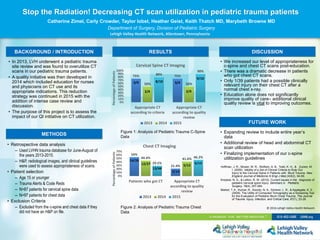
• We increased our level of appropriateness for
c-spine and chest CT scans post-education.
• There was a dramatic decrease in patients
who got chest CT scans.
• Only 1/39 patients had a possible clinically
relevant injury on their chest CT after a
normal chest x-ray.
• Education alone does not significantly
improve quality of care– additional clinical
quality review is vital to improving outcomes.
• Retrospective data analysis
– Used LVHN trauma database for June-August of
the years 2013-2015.
– H&P, radiological images, and clinical guidelines
were used to assess appropriateness of scans.
• Patient selection
– Age 15 or younger
– Trauma Alerts & Code Reds
– N=87 patients for cervical spine data
– N=97 patients for chest data
• Exclusion Criteria
– Excluded from the c-spine and chest data if they
did not have an H&P on file.
• Expanding review to include entire year’s
data
• Additional review of head and abdominal CT
scan utilization
• Finalizing implementation of our c-spine
utilitzation guidelines
Catherine Zimel, Carly Crowder, Taylor Iobst, Heather Geist, Keith Thatch MD, Marybeth Browne MD
Department of Surgery, Division of Pediatric Surgery
BACKGROUND / INTRODUCTION
METHODS
RESULTS DISCUSSION
FUTURE WORK
• In 2013, LVH underwent a pediatric trauma
site review and was found to overutilize CT
scans in our pediatric trauma patients.
• A quality initiative was then developed in
2014 which included education for nurses
and physicians on CT use and its
appropriate indications. This reduction
strategy was continued in 2015 with the
addition of intense case review and
discussion.
• The purpose of this project is to assess the
impact of our QI intitative on CT utilization.
75% 75%
50% 50%
80%
90%
0%
10%
20%
30%
40%
50%
60%
70%
80%
90%
100%
Appropriate CT
according to criteria
Appropriate CT
according to quality
review
PercentageofPatients
Cervical Spine CT Imaging
2013 2014 2015
Figure 1: Analysis of Pediatric Trauma C-Spine
Data
Figure 2: Analysis of Pediatric Trauma Chest
Data
3/4 3/4
2/42/4
8/10
9/10
54%
21.4%
44.4% 41.6%
29.5%
46.2%
0%
10%
20%
30%
40%
50%
60%
70%
Patients who got CT Appropriate CT
according to quality
review
PercentageofPatients
Chest CT Imaging
2013 2014 2015
14/26
12/27
13/44
3/14
5/12
6/13

LVHN Poster

  • 1.
    © 2016 LehighValley Health Network Lehigh Valley Health Network, Allentown, Pennsylvania Stop the Radiation! Decreasing CT scan utilization in pediatric trauma patients Hoffman, J. R., Mower, W. R., Wolfson, A. B., Todd, K. H., & Zucker, M. I. (2000). Validity of a Set of Clinical Criteria to Rule Out Injury to the Cervical Spine in Patients with Blunt Trauma. New England Journal of Medicine N Engl J Med,343(2), 94-99. Kreykes, N. S., & Letton, R. W. (2010). Current issues in the diagnosis of pediatric cervical spine injury. Seminars in Pediatric Surgery, 19(4), 257-264. Markel, T. A., Kumar, R., Koontz, N. A., Scherer, L. R., & Applegate, K. E. (2009). The Utility of Computed Tomography as a Screening Tool for the Evaluation of Pediatric Blunt Chest Trauma. The Journal of Trauma: Injury, Infection, and Critical Care, 67(1), 23-28. • We increased our level of appropriateness for c-spine and chest CT scans post-education. • There was a dramatic decrease in patients who got chest CT scans. • Only 1/39 patients had a possible clinically relevant injury on their chest CT after a normal chest x-ray. • Education alone does not significantly improve quality of care– additional clinical quality review is vital to improving outcomes. • Retrospective data analysis – Used LVHN trauma database for June-August of the years 2013-2015. – H&P, radiological images, and clinical guidelines were used to assess appropriateness of scans. • Patient selection – Age 15 or younger – Trauma Alerts & Code Reds – N=87 patients for cervical spine data – N=97 patients for chest data • Exclusion Criteria – Excluded from the c-spine and chest data if they did not have an H&P on file. • Expanding review to include entire year’s data • Additional review of head and abdominal CT scan utilization • Finalizing implementation of our c-spine utilitzation guidelines Catherine Zimel, Carly Crowder, Taylor Iobst, Heather Geist, Keith Thatch MD, Marybeth Browne MD Department of Surgery, Division of Pediatric Surgery BACKGROUND / INTRODUCTION METHODS RESULTS DISCUSSION FUTURE WORK • In 2013, LVH underwent a pediatric trauma site review and was found to overutilize CT scans in our pediatric trauma patients. • A quality initiative was then developed in 2014 which included education for nurses and physicians on CT use and its appropriate indications. This reduction strategy was continued in 2015 with the addition of intense case review and discussion. • The purpose of this project is to assess the impact of our QI intitative on CT utilization. 75% 75% 50% 50% 80% 90% 0% 10% 20% 30% 40% 50% 60% 70% 80% 90% 100% Appropriate CT according to criteria Appropriate CT according to quality review PercentageofPatients Cervical Spine CT Imaging 2013 2014 2015 Figure 1: Analysis of Pediatric Trauma C-Spine Data Figure 2: Analysis of Pediatric Trauma Chest Data 3/4 3/4 2/42/4 8/10 9/10 54% 21.4% 44.4% 41.6% 29.5% 46.2% 0% 10% 20% 30% 40% 50% 60% 70% Patients who got CT Appropriate CT according to quality review PercentageofPatients Chest CT Imaging 2013 2014 2015 14/26 12/27 13/44 3/14 5/12 6/13