Does the techniques for teaching of
laparoscopic surgery to surgeons and
registrars at North Queensland add
educational values?
Knowledge and attitude of surgeons and registrar in
North Queensland about the different techniques for
teaching laparoscopic surgery.
Dr Alfred Oghenemano Egedovo
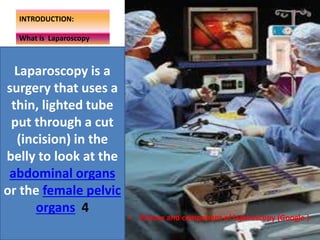
INTRODUCTION:
What is Laparoscopy
• Picture and component of laparoscopy (Google )
Laparoscopy is a
surgery that uses a
thin, lighted tube
put through a cut
(incision) in the
belly to look at the
abdominal organs
or the female pelvic
organs 4
(Google image)
The first Laparoscopic
Surgery
 Laparoscopic
cholecystectomy
operation was first done
by Erich Muhe in 1985
and since then
Laparoscopic procedure
became the focus of all
surgeons.5
 Gallbladder injury
complication rate was
very high initially1
Laparoscopic Surgery Emerging
trends
 Laparoscopic Surgery have
become a gold standard in
surgical Practice .
 Laparoscopic surgery had
spread into General Surgery,
Gynaecology, urology .
Laparoscopic Surgery have
brought innovation into the
surgical field.
 Laparoscopic Robotic Surgery
 Endoscopic reflux surgery
 telepresence Surgery
 Laparoscopic Surgery Training
Traditional Training( Apprententship)
 Stimulation Training(VRT)
(Google image)
(Google image)
Background
Teaching of Laparoscopic Surgery
Operating room Based
• Standard surgical training
has traditionally been one
of apprenticeship, where
the surgical trainee learns
to perform surgery under
the supervision of a trained
surgeon. This is time-
consuming, costly, and of
variable effectiveness
because of learning curve.2
Stimulations
• There is high-grade evidence
to suggest that virtual reality
simulators can support both
training and assessment in
laparoscopy surgery. Virtual
reality training improves the
technical skills of surgical
trainees such as decreased
time for suturing and
improved accuracy. The
educational impact of virtual
reality training is not known1.
Background and Literatures
Laparoscopic surgery training
Why teaching laparoscopic Surgery is important?
• Michael Moore et.al highlight that laparoscopic surgery without
previous training increases complication(learning Curve) .2
• There are voluminous paper that supported argument Virtual reality
stimulator ( MIST-VR) video improves laparoscopic surgery
performance as argued by G.Ahlberg et.al.3
• Aggarwal. R et. al Argued in his work that the stimulator based
training video has not proven persistence effectiveness over various
cases. 1
• Does the Laparoscopic training video(VRT) used in NQ add
educational value? ?? Problem to Research ! Research Question!!
Virtual Reality Training(VRT)
METHODOLOGY
Design Of Study
Descriptive study – Survey and interview of Surgeons and
Registrars in North Queensland
Participants and sampling
 25 Consultant surgeons and 6 trainees in Townsville and Mackay
 Completed training in basic laparoscopic surgery and had used a
web-based training video within 1990 to 2013 (FLS development)
 Performed 10 -60 laparoscopic surgery within last two years
 Age 47 to retirement ( active surgeons)
Data Collection
The collection of information will not involve patient data, therefore
ethical issue is low risk no clinical sample to be collected
Qualitative - interview of participants of topic questions
Do you know of web-based training video, where?, cost , how you
rate it, what you prefer ?
Survey Questionnaires - using survey Monkey and anticipated 25%
Analysis
Quantitative methods would be used to determine (a) how attitudes
toward laparoscopic surgical skills acquisitions from my interview
Analysis of Variance (ANOVA) statistical method would be used to
test differences between two or more variance opinion of the
surgeons and registrar.
Objective Structured Assessment of Technical Skill (OSATS) to assess
their knowledge
Likernt response scale of 5 points
Results
The attitude and knowledge if positive from the statically calculation
would be use to assess the value of the training.
Conclusion
The techniques of teaching laparoscopic surgery need to be assess to
know the adaptability and its benefits to various settings.
References:
1. Aggarwal R, Ward J, Balasundaram I, Sains P, Athanasiou T, Darzi A. Proving the effectiveness
of virtual reality simulation for training in laparoscopic surgery. Annals of Surgery.
2007;246(5):771-779.
1. Michael J. Moore, PhD,Charles L. Bennett, MD, PhD, The Learning Curve for Laparoscopic
Cholecystectomy. Am J. Surgery VOLUME 170 JULY 1995
1. Ahlberg G, Heikkinen T, Iselius L, Leijonmarck CE, Rutqvist J, Arvidsson D. Does training in a
virtual reality simulator improve surgical performance? Surgical Endoscopy and Other
Interventional Techniques. 2002;16(1):126-129.
2. Nathaniel J. Soper LLS, W.Stephen Eubanks. Mastery of Endoscopic and Laparoscopic
Surgery Lippincott Williams & Wilkins; 2009.
5 Philipp SR, Miedema BW, Thaler K. Single-incision laparoscopic cholecystectomy using
conventional instruments: early experience in comparison with the gold standard. Journal of the
American College of Surgeons. Nov 2009;209(5):632-637.

Dr Alfred Egedovo powerpoint presentation

  • 1.
    Does the techniquesfor teaching of laparoscopic surgery to surgeons and registrars at North Queensland add educational values? Knowledge and attitude of surgeons and registrar in North Queensland about the different techniques for teaching laparoscopic surgery. Dr Alfred Oghenemano Egedovo
  • 2.
    INTRODUCTION: What is Laparoscopy •Picture and component of laparoscopy (Google ) Laparoscopy is a surgery that uses a thin, lighted tube put through a cut (incision) in the belly to look at the abdominal organs or the female pelvic organs 4
  • 3.
    (Google image) The firstLaparoscopic Surgery  Laparoscopic cholecystectomy operation was first done by Erich Muhe in 1985 and since then Laparoscopic procedure became the focus of all surgeons.5  Gallbladder injury complication rate was very high initially1
  • 4.
    Laparoscopic Surgery Emerging trends Laparoscopic Surgery have become a gold standard in surgical Practice .  Laparoscopic surgery had spread into General Surgery, Gynaecology, urology . Laparoscopic Surgery have brought innovation into the surgical field.  Laparoscopic Robotic Surgery  Endoscopic reflux surgery  telepresence Surgery  Laparoscopic Surgery Training Traditional Training( Apprententship)  Stimulation Training(VRT) (Google image) (Google image)
  • 5.
    Background Teaching of LaparoscopicSurgery Operating room Based • Standard surgical training has traditionally been one of apprenticeship, where the surgical trainee learns to perform surgery under the supervision of a trained surgeon. This is time- consuming, costly, and of variable effectiveness because of learning curve.2 Stimulations • There is high-grade evidence to suggest that virtual reality simulators can support both training and assessment in laparoscopy surgery. Virtual reality training improves the technical skills of surgical trainees such as decreased time for suturing and improved accuracy. The educational impact of virtual reality training is not known1.
  • 6.
    Background and Literatures Laparoscopicsurgery training Why teaching laparoscopic Surgery is important? • Michael Moore et.al highlight that laparoscopic surgery without previous training increases complication(learning Curve) .2 • There are voluminous paper that supported argument Virtual reality stimulator ( MIST-VR) video improves laparoscopic surgery performance as argued by G.Ahlberg et.al.3 • Aggarwal. R et. al Argued in his work that the stimulator based training video has not proven persistence effectiveness over various cases. 1 • Does the Laparoscopic training video(VRT) used in NQ add educational value? ?? Problem to Research ! Research Question!! Virtual Reality Training(VRT)
  • 7.
    METHODOLOGY Design Of Study Descriptivestudy – Survey and interview of Surgeons and Registrars in North Queensland Participants and sampling  25 Consultant surgeons and 6 trainees in Townsville and Mackay  Completed training in basic laparoscopic surgery and had used a web-based training video within 1990 to 2013 (FLS development)  Performed 10 -60 laparoscopic surgery within last two years  Age 47 to retirement ( active surgeons) Data Collection The collection of information will not involve patient data, therefore ethical issue is low risk no clinical sample to be collected Qualitative - interview of participants of topic questions Do you know of web-based training video, where?, cost , how you rate it, what you prefer ? Survey Questionnaires - using survey Monkey and anticipated 25%
  • 8.
    Analysis Quantitative methods wouldbe used to determine (a) how attitudes toward laparoscopic surgical skills acquisitions from my interview Analysis of Variance (ANOVA) statistical method would be used to test differences between two or more variance opinion of the surgeons and registrar. Objective Structured Assessment of Technical Skill (OSATS) to assess their knowledge Likernt response scale of 5 points Results The attitude and knowledge if positive from the statically calculation would be use to assess the value of the training. Conclusion The techniques of teaching laparoscopic surgery need to be assess to know the adaptability and its benefits to various settings.
  • 9.
    References: 1. Aggarwal R,Ward J, Balasundaram I, Sains P, Athanasiou T, Darzi A. Proving the effectiveness of virtual reality simulation for training in laparoscopic surgery. Annals of Surgery. 2007;246(5):771-779. 1. Michael J. Moore, PhD,Charles L. Bennett, MD, PhD, The Learning Curve for Laparoscopic Cholecystectomy. Am J. Surgery VOLUME 170 JULY 1995 1. Ahlberg G, Heikkinen T, Iselius L, Leijonmarck CE, Rutqvist J, Arvidsson D. Does training in a virtual reality simulator improve surgical performance? Surgical Endoscopy and Other Interventional Techniques. 2002;16(1):126-129. 2. Nathaniel J. Soper LLS, W.Stephen Eubanks. Mastery of Endoscopic and Laparoscopic Surgery Lippincott Williams & Wilkins; 2009. 5 Philipp SR, Miedema BW, Thaler K. Single-incision laparoscopic cholecystectomy using conventional instruments: early experience in comparison with the gold standard. Journal of the American College of Surgeons. Nov 2009;209(5):632-637.