MANTHAN TOPIC : TOWARDS CLEARNER
INDIA:PROVIDING CLEAN DRINKING WATER AND PROPER
SANITATION FACILITY TO ALL
SUSTAINABLE OPERATIONS OF
WATER SUPPLY & SANITATION
SERVICES IN INDIA
Overview
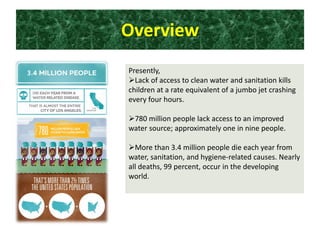
Presently,
Lack of access to clean water and sanitation kills
children at a rate equivalent of a jumbo jet crashing
every four hours.
780 million people lack access to an improved
water source; approximately one in nine people.
More than 3.4 million people die each year from
water, sanitation, and hygiene-related causes. Nearly
all deaths, 99 percent, occur in the developing
world.
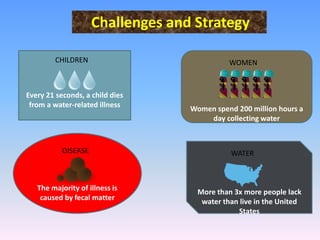
Every 21 seconds, a child dies
from a water-related illness
CHILDREN
Women spend 200 million hours a
day collecting water
WOMEN
The majority of illness is
caused by fecal matter
DISEASE
More than 3x more people lack
water than live in the United
States
WATER
Challenges and Strategy
“IMPROVED” MEANS….
An improved drinking water source is:
“a source that by the nature of its construction
adequately protects the source from outside
contamination in particular with fecal matter”
An improved sanitation facility:
“ a facility that hygienically separates human waste
from human contact”
Sustainable And Community
Managed Operations
Have more savvy at
leveraging local financial
resources for cost-sharing in
projects.
Working through local
partners is more cost effective
than maintaining expatriate
staff.
 LOCAL PARTNER
A preliminary screening.
field visits and evaluations of
completed and in-progress projects.
interviews with the field staff of
potential partner. organizations,
community leaders, and beneficiary
households of water and sanitation
projects.
 surveys including questionnaires
completed by staff at the potential
partner organization as well as by
community members served through
past and present projects
Selecting partner organizations
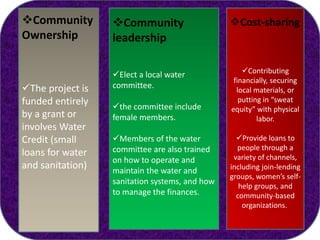
The project is
funded entirely
by a grant or
involves Water
Credit (small
loans for water
and sanitation)
Community
Ownership
Elect a local water
committee.
the committee include
female members.
Members of the water
committee are also trained
on how to operate and
maintain the water and
sanitation systems, and how
to manage the finances.
Community
leadership
Contributing
financially, securing
local materials, or
putting in “sweat
equity” with physical
labor.
Provide loans to
people through a
variety of channels,
including join-lending
groups, women’s self-
help groups, and
community-based
organizations.
Cost-sharing
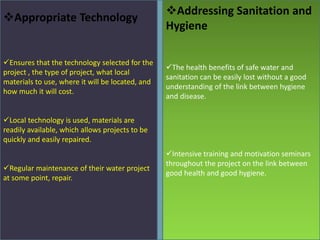
Ensures that the technology selected for the
project , the type of project, what local
materials to use, where it will be located, and
how much it will cost.
Local technology is used, materials are
readily available, which allows projects to be
quickly and easily repaired.
Regular maintenance of their water project
at some point, repair.
The health benefits of safe water and
sanitation can be easily lost without a good
understanding of the link between hygiene
and disease.
Intensive training and motivation seminars
throughout the project on the link between
good health and good hygiene.
Appropriate Technology
Addressing Sanitation and
Hygiene
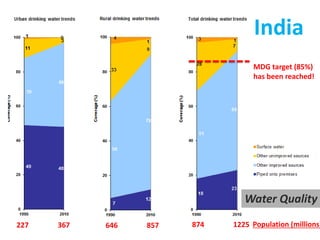
Population (millions)227 367 646 857 874 1225
MDG target (85%)
has been reached!
Water Quality
India
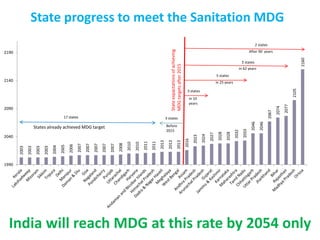
State progress to meet the Sanitation MDG2003
2003
2003
2003
2004
2005
2006
2007
2007
2007
2007
2007
2008
2010
2010
2011
2011
2013
2013
2013
2016
2023
2024
2027
2028
2028
2032
2033
2046
2046
2067
2074
2077
2105
2160
1990
2040
2090
2140
2190
States already achieved MDG target
Stateexpactationsofachieving
MDGtargetsafter2015
Before
2015
in 10
years
in 25 years
in 62 years
After 90 years
3 states
5 states
5 states
2 states
3 states17 states
India will reach MDG at this rate by 2054 only
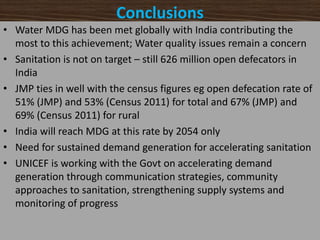
Conclusions
• Water MDG has been met globally with India contributing the
most to this achievement; Water quality issues remain a concern
• Sanitation is not on target – still 626 million open defecators in
India
• JMP ties in well with the census figures eg open defecation rate of
51% (JMP) and 53% (Census 2011) for total and 67% (JMP) and
69% (Census 2011) for rural
• India will reach MDG at this rate by 2054 only
• Need for sustained demand generation for accelerating sanitation
• UNICEF is working with the Govt on accelerating demand
generation through communication strategies, community
approaches to sanitation, strengthening supply systems and
monitoring of progress

BRAVO007

  • 1.
    MANTHAN TOPIC :TOWARDS CLEARNER INDIA:PROVIDING CLEAN DRINKING WATER AND PROPER SANITATION FACILITY TO ALL SUSTAINABLE OPERATIONS OF WATER SUPPLY & SANITATION SERVICES IN INDIA
  • 2.
    Overview Presently, Lack of accessto clean water and sanitation kills children at a rate equivalent of a jumbo jet crashing every four hours. 780 million people lack access to an improved water source; approximately one in nine people. More than 3.4 million people die each year from water, sanitation, and hygiene-related causes. Nearly all deaths, 99 percent, occur in the developing world.
  • 3.
    Every 21 seconds,a child dies from a water-related illness CHILDREN Women spend 200 million hours a day collecting water WOMEN The majority of illness is caused by fecal matter DISEASE More than 3x more people lack water than live in the United States WATER Challenges and Strategy
  • 4.
    “IMPROVED” MEANS…. An improveddrinking water source is: “a source that by the nature of its construction adequately protects the source from outside contamination in particular with fecal matter” An improved sanitation facility: “ a facility that hygienically separates human waste from human contact”
  • 5.
    Sustainable And Community ManagedOperations Have more savvy at leveraging local financial resources for cost-sharing in projects. Working through local partners is more cost effective than maintaining expatriate staff.  LOCAL PARTNER A preliminary screening. field visits and evaluations of completed and in-progress projects. interviews with the field staff of potential partner. organizations, community leaders, and beneficiary households of water and sanitation projects.  surveys including questionnaires completed by staff at the potential partner organization as well as by community members served through past and present projects Selecting partner organizations
  • 6.
    The project is fundedentirely by a grant or involves Water Credit (small loans for water and sanitation) Community Ownership Elect a local water committee. the committee include female members. Members of the water committee are also trained on how to operate and maintain the water and sanitation systems, and how to manage the finances. Community leadership Contributing financially, securing local materials, or putting in “sweat equity” with physical labor. Provide loans to people through a variety of channels, including join-lending groups, women’s self- help groups, and community-based organizations. Cost-sharing
  • 7.
    Ensures that thetechnology selected for the project , the type of project, what local materials to use, where it will be located, and how much it will cost. Local technology is used, materials are readily available, which allows projects to be quickly and easily repaired. Regular maintenance of their water project at some point, repair. The health benefits of safe water and sanitation can be easily lost without a good understanding of the link between hygiene and disease. Intensive training and motivation seminars throughout the project on the link between good health and good hygiene. Appropriate Technology Addressing Sanitation and Hygiene
  • 8.
    Population (millions)227 367646 857 874 1225 MDG target (85%) has been reached! Water Quality India
  • 9.
    State progress tomeet the Sanitation MDG2003 2003 2003 2003 2004 2005 2006 2007 2007 2007 2007 2007 2008 2010 2010 2011 2011 2013 2013 2013 2016 2023 2024 2027 2028 2028 2032 2033 2046 2046 2067 2074 2077 2105 2160 1990 2040 2090 2140 2190 States already achieved MDG target Stateexpactationsofachieving MDGtargetsafter2015 Before 2015 in 10 years in 25 years in 62 years After 90 years 3 states 5 states 5 states 2 states 3 states17 states India will reach MDG at this rate by 2054 only
  • 10.
    Conclusions • Water MDGhas been met globally with India contributing the most to this achievement; Water quality issues remain a concern • Sanitation is not on target – still 626 million open defecators in India • JMP ties in well with the census figures eg open defecation rate of 51% (JMP) and 53% (Census 2011) for total and 67% (JMP) and 69% (Census 2011) for rural • India will reach MDG at this rate by 2054 only • Need for sustained demand generation for accelerating sanitation • UNICEF is working with the Govt on accelerating demand generation through communication strategies, community approaches to sanitation, strengthening supply systems and monitoring of progress