LTE Evolved Packet System Architecture
LTE enables you to redefine the end-user experience
with the most advanced packet-based solution in
the industry. Continuing our 3G partnership into LTE,
the Alcatel-Lucent end-to-end LTE solution provides:
• A comprehensive transformation to an IP
infrastructure with minimal risk
• An open LTE ecosystem of devices, applications
and content providers
• Smooth interworking with existing 2G/3G networks
and evolution to the next generation
For more information, visit:
www.alcatel-lucent.com/LTEinfo
or call your Alcatel-Lucent representative.
• IMS architecture is described in TS 23.228
• IMS supports VoIP on EV-DO, HSPA+ and LTE
• Single Radio Voice Call Continuity (SRVCC) IMS supports optimized
handoff of calls between VoIP domains and wireless circuit domains
using the Voice Call Continuity (VCC) application server (TS 23.216)
• IMS centralized services (ICS) (TS 23.292) and service centralization and
continuity (SCC) (TS 23.237) enable IMS services for user equipment in
the circuit-switched domain
Circuit-switched (CS) fall back
IMS - Industry-standard service architecture
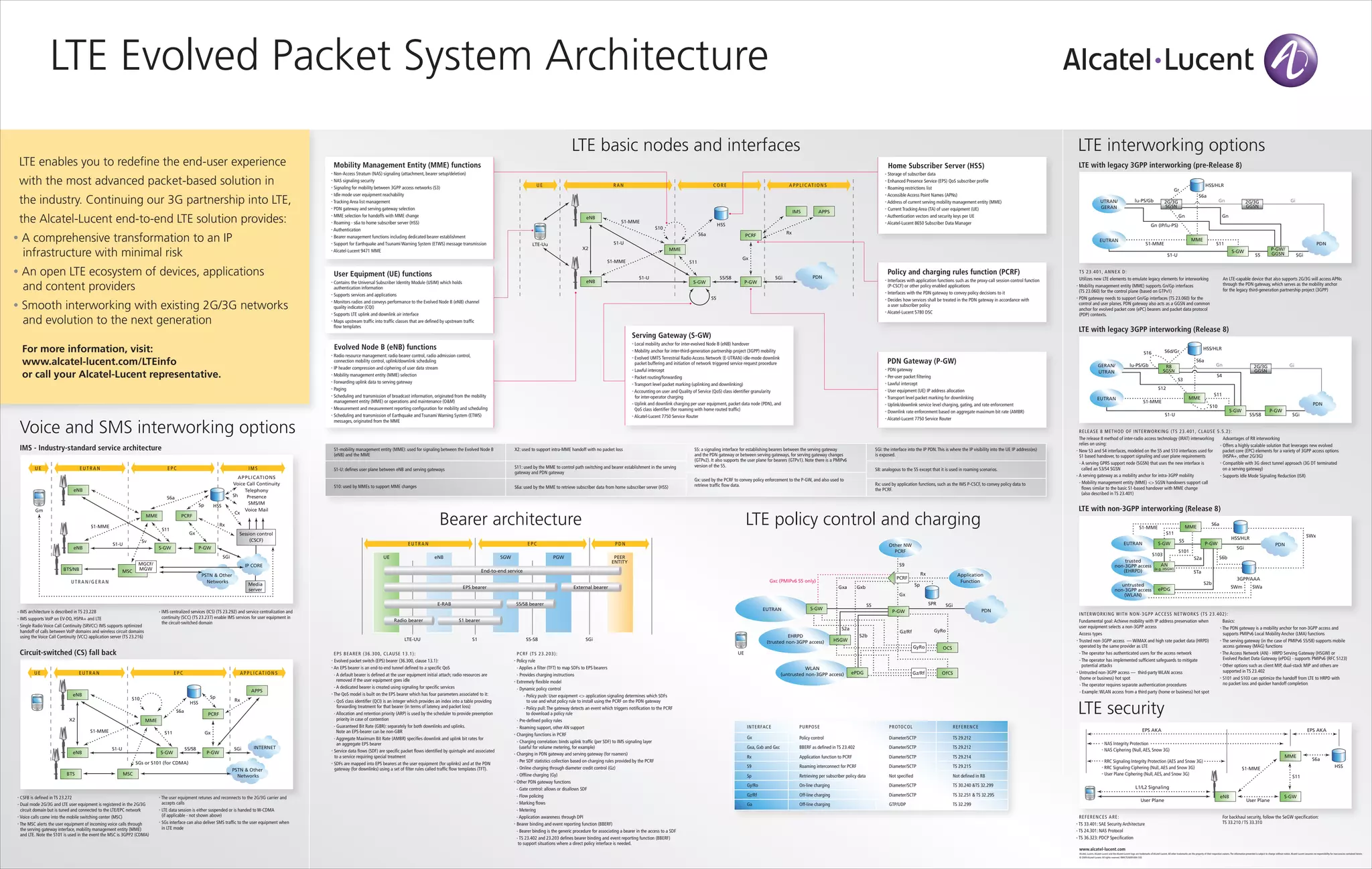
Mobility Management Entity (MME) functions
• Non-Access Stratum (NAS) signaling (attachment, bearer setup/deletion)
• NAS signaling security
• Signaling for mobility between 3GPP access networks (S3)
• Idle mode user equipment reachability
• Tracking Area list management
• PDN gateway and serving gateway selection
• MME selection for handoffs with MME change
• Roaming - s6a to home subscriber server (HSS)
• Authentication
• Bearer management functions including dedicated bearer establishment
• Support for Earthquake and Tsunami Warning System (ETWS) message transmission
• Alcatel-Lucent 9471 MME
User Equipment (UE) functions
• Contains the Universal Subscriber Identity Module (USIM) which holds
authentication information
• Supports services and applications
• Monitors radios and conveys performance to the Evolved Node B (eNB) channel
quality indicator (CQI)
• Supports LTE uplink and downlink air interface
• Maps upstream traffic into traffic classes that are defined by upstream traffic
flow templates
Home Subscriber Server (HSS)
• Storage of subscriber data
• Enhanced Presence Service (EPS) QoS subscriber profile
• Roaming restrictions list
• Accessible Access Point Names (APNs)
• Address of current serving mobility management entity (MME)
• Current Tracking Area (TA) of user equipment (UE)
• Authentication vectors and security keys per UE
• Alcatel-Lucent 8650 Subscriber Data Manager
Policy and charging rules function (PCRF)
• Interfaces with application functions such as the proxy-call session control function
(P-CSCF) or other policy enabled applications
• Interfaces with the PDN gateway to convey policy decisions to it
• Decides how services shall be treated in the PDN gateway in accordance with
a user subscriber policy
• Alcatel-Lucent 5780 DSC
PDN Gateway (P-GW)
• PDN gateway
• Per-user packet filtering
• Lawful intercept
• User equipment (UE) IP address allocation
• Transport level packet marking for downlinking
• Uplink/downlink service level charging, gating, and rate enforcement
• Downlink rate enforcement based on aggregate maximum bit rate (AMBR)
• Alcatel-Lucent 7750 Service Router
Serving Gateway (S-GW)
• Local mobility anchor for inter-evolved Node B (eNB) handover
• Mobility anchor for inter-third-generation partnership project (3GPP) mobility
• Evolved UMTS Terrestrial Radio Access Network (E-UTRAN) idle-mode downlink
packet buffering and initiation of network triggered service request procedure
• Lawful intercept
• Packet routing/forwarding
• Transport level packet marking (uplinking and downlinking)
• Accounting on user and Quality of Service (QoS) class identifier granularity
for inter-operator charging
• Uplink and downlink charging per user equipment, packet data node (PDN), and
QoS class identifier (for roaming with home routed traffic)
• Alcatel-Lucent 7750 Service Router
Evolved Node B (eNB) functions
• Radio resource management: radio bearer control, radio admission control,
connection mobility control, uplink/downlink scheduling
• IP header compression and ciphering of user data stream
• Mobility management entity (MME) selection
• Forwarding uplink data to serving gateway
• Paging
• Scheduling and transmission of broadcast information, originated from the mobility
management entity (MME) or operations and maintenance (O&M)
• Measurement and measurement reporting configuration for mobility and scheduling
• Scheduling and transmission of Earthquake and Tsunami Warning System (ETWS)
messages, originated from the MME
EPS BEARER (36.300, CLAUSE 13.1):
• Evolved packet switch (EPS) bearer (36.300, clause 13.1):
• An EPS bearer is an end-to-end tunnel defined to a specific QoS
- A default bearer is defined at the user equipment initial attach; radio resources are
removed if the user equipment goes idle
- A dedicated bearer is created using signaling for specific services
• The QoS model is built on the EPS bearer which has four parameters associated to it:
- QoS class identifier (QCI) is an integer which provides an index into a table providing
forwarding treatment for that bearer (in terms of latency and packet loss)
- Allocation and retention priority (ARP) is used by the scheduler to provide preemption
priority in case of contention
- Guaranteed Bit Rate (GBR): separately for both downlinks and uplinks.
Note an EPS-bearer can be non-GBR
- Aggregate Maximum Bit Rate (AMBR) specifies downlink and uplink bit rates for
an aggregate EPS bearer
• Service data flows (SDF) are specific packet flows identified by quintuple and associated
to a service requiring special treatment
• SDFs are mapped into EPS bearers at the user equipment (for uplinks) and at the PDN
gateway (for downlinks) using a set of filter rules called traffic flow templates (TFT).
PCRF (TS 23.203):
• Policy rule
- Applies a filter (TFT) to map SDFs to EPS bearers
- Provides charging instructions
• Extremely flexible model
- Dynamic policy control
- Policy push: User equipment <> application signaling determines which SDFs
to use and what policy rule to install using the PCRF on the PDN gateway
- Policy pull:The gateway detects an event which triggers notification to the PCRF
to download a policy rule
- Pre-defined policy rules
- Roaming support, other AN support
• Charging functions in PCRF
- Charging correlation: binds uplink traffic (per SDF) to IMS signaling layer
(useful for volume metering, for example)
• Charging in PDN gateway and serving gateway (for roamers)
- Per SDF statistics collection based on charging rules provided by the PCRF
- Online charging through diameter credit control (Gz)
- Offline charging (Gy)
• Other PDN gateway functions
- Gate control: allows or disallows SDF
- Flow policing
- Marking flows
- Metering
- Application awareness through DPI
• Bearer binding and event reporting function (BBERF)
- Bearer binding is the generic procedure for associating a bearer in the access to a SDF
- TS 23.402 and 23.203 defines bearer binding and event reporting function (BBERF)
to support situations where a direct policy interface is needed.
• CSFB is defined in TS 23.272
• Dual mode 2G/3G and LTE user equipment is registered in the 2G/3G
circuit domain but is tuned and connected to the LTE/EPC network
• Voice calls come into the mobile switching center (MSC)
• The MSC alerts the user equipment of incoming voice calls through
the serving gateway interface, mobility management entity (MME)
and LTE. Note the S101 is used in the event the MSC is 3GPP2 (CDMA)
• The user equipment retunes and reconnects to the 2G/3G carrier and
accepts calls
• LTE data session is either suspended or is handed to W-CDMA
(if applicable - not shown above)
• SGs interface can also deliver SMS traffic to the user equipment when
in LTE mode
LTE with legacy 3GPP interworking (pre-Release 8)
LTE with legacy 3GPP interworking (Release 8)
LTE with non-3GPP interworking (Release 8)
TS 23.401, ANNEX D:
Utilizes new LTE elements to emulate legacy elements for interworking
• Mobility management entity (MME) supports Gn/Gp interfaces
(TS 23.060) for the control plane (based on GTPv1)
• PDN gateway needs to support Gn/Gp interfaces (TS 23.060) for the
control and user planes. PDN gateway also acts as a GGSN and common
anchor for evolved packet core (ePC) bearers and packet data protocol
(PDP) contexts.
An LTE-capable device that also supports 2G/3G will access APNs
through the PDN gateway, which serves as the mobility anchor
for the legacy third-generation partnership project (3GPP)
RELEASE 8 METHOD OF INTERWORKING (TS 23.401, CLAUSE 5.5.2):
The release 8 method of inter-radio access technology (IRAT) interworking
relies on using:
• New S3 and S4 interfaces, modeled on the S5 and S10 interfaces used for
S1 based handover, to support signaling and user plane requirements
- A serving GPRS support node (SGSN) that uses the new interface is
called an S3/S4 SGSN
• A serving gateway as a mobility anchor for intra-3GPP mobility
- Mobility management entity (MME) <> SGSN handovers support call
flows similar to the basic S1-based handover with MME change
(also described in TS 23.401)
Advantages of R8 interworking
• Offers a highly scalable solution that leverages new evolved
packet core (EPC) elements for a variety of 3GPP access options
(HSPA+, other 2G/3G)
• Compatible with 3G direct tunnel approach (3G DT terminated
on a serving gateway)
• Supports Idle Mode Signaling Reduction (ISR)
INTERWORKING WITH NON-3GPP ACCESS NETWORKS (TS 23.402):
Fundamental goal:Achieve mobility with IP address preservation when
user equipment selects a non-3GPP access
Access types
• Trusted non-3GPP access — WiMAX and high rate packet data (HRPD)
operated by the same provider as LTE
- The operator has authenticated users for the access network
- The operator has implemented sufficient safeguards to mitigate
potential attacks
• Untrusted non-3GPP access — third-party WLAN access
(home or business) hot spot
- The operator requires separate authentication procedures
- Example:WLAN access from a third party (home or business) hot spot
Basics:
• The PDN gateway is a mobility anchor for non-3GPP access and
supports PMIPv6 Local Mobility Anchor (LMA) functions
• The serving gateway (in the case of PMIPv6 S5/S8) supports mobile
access gateway (MAG) functions
• The Access Network (AN) - HRPD Serving Gateway (HSGW) or
Evolved Packet Data Gateway (ePDG) - supports PMIPv6 (RFC 5123)
• Other options such as client MIP, dual-stack MIP and others are
supported in TS 23.402
• S101 and S103 can optimize the handoff from LTE to HRPD with
no packet loss and quicker handoff completion
REFERENCES ARE:
• TS 33.401: SAE Security Architecture
• TS 24.301: NAS Protocol
• TS 36.323: PDCP Specification
INTERFACE
Gx
Gxa, Gxb and Gxc
Rx
S9
Sp
Gy/Ro
Gz/Rf
Ga
PURPOSE
Policy control
BBERF as defined in TS 23.402
Application function to PCRF
Roaming interconnect for PCRF
Retrieving per subscriber policy data
On-line charging
Off-line charging
Off-line charging
PROTOCOL
Diameter/SCTP
Diameter/SCTP
Diameter/SCTP
Diameter/SCTP
Not specified
Diameter/SCTP
Diameter/SCTP
GTP/UDP
REFERENCE
TS 29.212
TS 29.212
TS 29.214
TS 29.215
Not defined in R8
TS 30.240 &TS 32.299
TS 32.251 & TS 32.295
TS 32.299
For backhaul security, follow the SeGW specification:
TS 33.210 / TS 33.310
LTE interworking options
LTE security
Voice and SMS interworking options
www.alcatel-lucent.com
Alcatel, Lucent,Alcatel-Lucent and the Alcatel-Lucent logo are trademarks of Alcatel-Lucent.All other trademarks are the property of their respective owners.The information presented is subject to change without notice.Alcatel-Lucent assumes no responsibility for inaccuracies contained herein.
© 2009 Alcatel-Lucent.All rights reserved. RMK7526091004 (10)
S6a
S10
S5
S5/S8
S11
SGi
Rx
X2
S1-U
S1-U
S1-MME
S1-MME
Gx
LTE-Uu
HSS
PDN
•
•
•
•
•
•
•
•
•
•
•
•
•
•
•
•
•
•
•
•
•
•
•
•
•
•
•
•
• • • • • • • • • • • • • • • • • • • • • • • •
• • • • • • • • • • • • • • • • • • • • • • • •
• • • • • • • • • • • • • • • • • • •
A P P L I C AT I O N S
C O R E
R A N
U E
MME
IMS APPS
eNB
eNB P-GW
PCRF
S-GW
•
•
•
•
•
• • • • • •
•
•
•
•
•
S1-mobility management entity (MME): used for signaling between the Evolved Node B
(eNB) and the MME
S1-U: defines user plane between eNB and serving gateways
S10: used by MMEs to support MME changes
X2: used to support intra-MME handoff with no packet loss
S11: used by the MME to control path switching and bearer establishment in the serving
gateway and PDN gateway
S6a: used by the MME to retrieve subscriber data from home subscriber server (HSS)
S5: a signaling interface for establishing bearers between the serving gateway
and the PDN gateway or between serving gateways, for serving gateway changes
(GTPv2). It also supports the user plane for bearers (GTPv1). Note there is a PMIPv6
version of the S5.
Gx: used by the PCRF to convey policy enforcement to the P-GW, and also used to
retrieve traffic flow data.
SGi: the interface into the IP PDN.This is where the IP visibility into the UE IP address(es)
is exposed.
S8: analogous to the S5 except that it is used in roaming scenarios.
Rx: used by application functions, such as the IMS P-CSCF, to convey policy data to
the PCRF.
E P C
E U T R A N P D N
End-to-end service
EPS bearer
E-RAB S5/S8 bearer
External bearer
Radio bearer S1 bearer
eNB
UE
LTE-UU S5-S8 SGi
S1
SGW PGW PEER
ENTITY
PDN
HSS/HLR
S5 SGi
S1-U
S11
S6a
Gr
Gn
Gn
Gn (IP/lu-PS)
lu-PS/Gb Gi
Gn
S1-MME
2G/3G
GGSN
P-GW/
GGSN
•
•
•
•
•
•
•
•
•
•
•
•
•
•
•
•
•
•
•
•
•
•
•
•
•
•
•
•
•
•
•
•
2G/3G
SGSN
•
•
•
•
•
•
•
•
•
•
•
•
•
•
•
•
•
•
•
•
•
•
•
•
•
•
•
•
•
•
•
UTRAN/
GERAN
PDN
HSS/HLR
S5/S8 SGi
S1-U
S11
S6a
S16
S10
S6d/Gr
Gn
S4
S12
lu-PS/Gb Gi
S3
S1-MME
2G/3G
GGSN
GERAN/
UTRAN
•
•
•
•
•
• • • • •
•
•
•
•
•
•
•
•
•
•
•
•
•
•
• • • • •
•
•
•
•
•
•
•
•
•
P-GW
HSS
User Plane
L1/L2 Signaling
S1-MME
EPS AKA
S11
S-GW
MME
eNB
User Plane
•
•
•
•
•
•
•
•
•
•
•
•
•
•
•
•
•
S6a
EPS AKA
• • • • • • • • • • • • • • • • • • • • • • • • • • • • • • • • • • • • • • • • • • • • • • • • • • • • • • • • • • • • • • • • • • • • • • • • • • • • •
• • • • • • • • • • • • • • • • • • • • • • • • • • • • • • • • • • • • • • • • • • •
• RRC Signaling Integrity Protection (AES and Snow 3G)
• RRC Signaling Ciphering (Null,AES and Snow 3G)
• User Plane Ciphering (Null,AES, and Snow 3G)
• NAS Integrity Protection
• NAS Ciphering (Null,AES, Snow 3G)
PDN
HSS/HLR
S5
S2a
S2b
SGi
STa
S6a
S6b
SWx
S11
S1-MME
S103
S101
SWm SWa
3GPP/AAA
trusted
non-3GPP access
(EHRPD)
LTE basic nodes and interfaces
Bearer architecture LTE policy control and charging
EUTRAN
EHRPD
(trusted non-3GPP access)
WLAN
(untrusted non-3GPP access)
UE
S9
Rx
Sp
S5
S2a
SGi
S2b
GyRo
Gz/Rf
Gxc (PMIPv6 S5 only)
Gxa Gxb
Gx
• • • • • • • • • • • • • • • • • • • • • • • • • •
• • • • • • • • • • • • • • • • • • • • • •
• • • • • • • • • • • • • • • • • • • • • • • • • • • • • • •
• • • • • • • • • • • • • • • • • • • • • • • • • • • • • • •
• • • • • • • • • • • • • • • • • • • • • • • • • • • • • • • • • • • • • • • •
• • • • • • • • • • • • • • • • • • • • • • • • • •
• • • • • • • • • • • • • • • • • • • • • • • • • •
Application
Function
SPR
PDN
•
•
•
•
•
•
•
•
•
•
•
•
•
•
•
•
•
•
•
•
•
•
•
•
•
•
•
•
•
•
•
•
•
•
•
•
•
•
•
•
•
•
Other NW
PCRF
• • • • • • • • • • • • • • • • • • • • • • • • • • • • • • • •
PCRF
S6a
Sp
S10
S5/S8
SGs or S101 (for CDMA)
S11
SGi
Rx
X2
S1-U
S1-MME Gx
HSS
INTERNET
PSTN & Other
Networks
•
•
•
•
•
•
•
•
•
•
•
•
•
•
•
•
•
•
•
•
•
•
•
•
•
•
• • • • • • • • • • • • • •
• • • • • • •
•
•
•
•
•
•
•
•
•
•
•
•
•
•
A P P L I C AT I O N S
E P C
E U T R A N
U E
•
•
•
•
•
MME
APPS
eNB
eNB
BTS
P-GW
PCRF
S-GW
MSC
•
•
•
•
•
• • • • • •
•
•
•
•
•
S6a
APPLICATIONS
Voice Call Continuity
Telephony
Presence
SMS/IM
Voice Mail
Sp
Sv
S11
SGi
Rx
Cx
Sh
Gm
S1-U
S1-MME
Gx
IP CORE
PSTN & Other
Networks
•
•
•
•
•
•
•
•
•
•
•
•
•
•
•
•
•
•
•
•
•
•
•
•
• • • • • • • • • • • • • • • • • • •
• • • • • • • • • • • • •
• • • • • • • • • • • • • • • • • • • • • •
• • • • • • • • • • • • • • • • • • • • • •
•
•
•
•
•
•
•
•
•
•
•
•
•
•
•
•
•
•
•
•
•
•
•
•
•
•
•
•
•
I M S
E P C
E U T R A N
U T R A N / G E R A N
U E
MME
eNB
eNB
BTS/NB
P-GW
PCRF
S-GW
MSC
MGCF/
MGW
HSS
Session control
(CSCF)
Media
server
• • • • • • • • • • • • • • • • • • • • • • • • • • • • • • • • •
• • • • • • • • • • • • • • • • • • • • • • • • • • • • • • • • • • • • • • • • • • • • • •
•
•
•
•
•
• • • • • • • • • • • • • • • • • • • • • • • • • • • • • • • • • • • • • • • • • • • • • • • • • • • • • • • • •
• • • • • • • • • • • • • • • • • • • • • • • • • • • • • • • • • • • • • • • • • • • • • • • • • • • • • • • • • •
• • • • • • • • • • • • • • • • • • • • • • • • • • • • • • • • •
• • • • • • • • • •
• • • • • • • • • • • • • • • • • • • • • • • • • • • • • • • • • • • • • • • • • • • • • • •
untrusted
non-3GPP access
(WLAN)
ePDG
• • • • • • • • • • • • • • • • • • • • • • • • • •
•
•
•
•
•
•
•
•
•
•
•
•
•
•
•
•
•
•
•
•
•
•
•
•
•
•
•
•
•
•
•
•
•
•
•
•
•
•
•
•
•
•
•
•
•
•
•
•
•
•
•
•
•
•
•
•
•
•
•
•
•
•
•
•
•
•
•
•
•
•
•
•
•
•
•
•
•
•
•
•
•
•
•
•
•
•
•
•
•
•
•
•
•
•
•
•
•
•
•
•
•
•
•
•
•
• • • • • • • • • • • • • • • • • • • • • • • • •
• • • • • • • • • • • • • • • • • • • • • • • • • •
•
•
•
•
•
•
•
•
•
•
•
•
•
•
•
•
•
•
•
•
•
•
•
•
•
•
•
•
•
•
•
•
•
•
•
•
•
•
•
•
•
•
•
•
•
•
•
•
•
• • • • • • • • • • • • • • • • • • • • •
• • • • • • • • • • • • • • • • • • • • • •
•
•
•
•
•
•
•
•
•
•
OfCS
OCS
• • • • • • • • • • • • • • • • • • • • • • • • • • • • • • •
GyRo
•
•
•
•
•
•
•
•
•
•
•
•
•
•
•
•
•
•
•
•
•
•
•
•
•
•
•
•
•
•
•
•
•
•
•
•
•
•
•
•
•
•
•
•
•
•
•
•
•
•
•
•
•
•
•
•
•
•
•
•
•
•
•
•
•
•
•
•
•
•
•
•
•
•
•
•
P-GW
ePDG
HSGW
S-GW
MME
•
•
•
•
•
•
•
•
•
•
•
•
•
•
•
•
•
•
• • • • • • • • • • • • • • • • • • • • • • • • • • • • • • • • • • • • • • • • • • • • • • • • • • • • • • • • • • • • • • • • • • • • • • • • • • • • • • • • • • • • • • • • • • • • • •
• • • • • • • • • • • • • •
• • • • • • •
• • • •
• • • • • • • •
•
•
•
•
•
•
•
•
•
•
•
•
•
AN
(e.g. HSGW)
P-GW
• • • • • • • • • • • • •
S-GW
EUTRAN
•
•
•
•
•
•
•
•
•
•
•
•
•
•
•
•
•
•
•
•
•
•
•
•
•
•
•
•
•
•
•
•
•
•
•
•
•
•
•
•
•
•
•
•
•
•
•
•
•
•
•
•
•
•
R8
SGSN
S-GW
MME
EUTRAN
• • • • • • • • • • • • • • • • • •
•
•
•
S-GW
MME
EUTRAN
•
•
•
•
•
•
•
•
•
•
•
•
•
•
•
•
•
•
•
•
•
•
•
•
•
•
•
•
•
•
•
•
•
•
•
•
•
•
•
•
•
•
•
•
•
•
•
•
•
•
•
•
•
•
•
•
•
•
• • • • • • • • • • • • • • • • • • • • • • • • • • • • • • • • • • • • • • • • • • • • • • • • • • • • • • • • • • • • • • • • • • • • • • • • • • • • • • • • • • • • • • • • • • • • • • •
• • • • • • • • • • • • • • • • • • •
Gz/Rf

LTE_poster.pdf

  • 1.
    LTE Evolved PacketSystem Architecture LTE enables you to redefine the end-user experience with the most advanced packet-based solution in the industry. Continuing our 3G partnership into LTE, the Alcatel-Lucent end-to-end LTE solution provides: • A comprehensive transformation to an IP infrastructure with minimal risk • An open LTE ecosystem of devices, applications and content providers • Smooth interworking with existing 2G/3G networks and evolution to the next generation For more information, visit: www.alcatel-lucent.com/LTEinfo or call your Alcatel-Lucent representative. • IMS architecture is described in TS 23.228 • IMS supports VoIP on EV-DO, HSPA+ and LTE • Single Radio Voice Call Continuity (SRVCC) IMS supports optimized handoff of calls between VoIP domains and wireless circuit domains using the Voice Call Continuity (VCC) application server (TS 23.216) • IMS centralized services (ICS) (TS 23.292) and service centralization and continuity (SCC) (TS 23.237) enable IMS services for user equipment in the circuit-switched domain Circuit-switched (CS) fall back IMS - Industry-standard service architecture Mobility Management Entity (MME) functions • Non-Access Stratum (NAS) signaling (attachment, bearer setup/deletion) • NAS signaling security • Signaling for mobility between 3GPP access networks (S3) • Idle mode user equipment reachability • Tracking Area list management • PDN gateway and serving gateway selection • MME selection for handoffs with MME change • Roaming - s6a to home subscriber server (HSS) • Authentication • Bearer management functions including dedicated bearer establishment • Support for Earthquake and Tsunami Warning System (ETWS) message transmission • Alcatel-Lucent 9471 MME User Equipment (UE) functions • Contains the Universal Subscriber Identity Module (USIM) which holds authentication information • Supports services and applications • Monitors radios and conveys performance to the Evolved Node B (eNB) channel quality indicator (CQI) • Supports LTE uplink and downlink air interface • Maps upstream traffic into traffic classes that are defined by upstream traffic flow templates Home Subscriber Server (HSS) • Storage of subscriber data • Enhanced Presence Service (EPS) QoS subscriber profile • Roaming restrictions list • Accessible Access Point Names (APNs) • Address of current serving mobility management entity (MME) • Current Tracking Area (TA) of user equipment (UE) • Authentication vectors and security keys per UE • Alcatel-Lucent 8650 Subscriber Data Manager Policy and charging rules function (PCRF) • Interfaces with application functions such as the proxy-call session control function (P-CSCF) or other policy enabled applications • Interfaces with the PDN gateway to convey policy decisions to it • Decides how services shall be treated in the PDN gateway in accordance with a user subscriber policy • Alcatel-Lucent 5780 DSC PDN Gateway (P-GW) • PDN gateway • Per-user packet filtering • Lawful intercept • User equipment (UE) IP address allocation • Transport level packet marking for downlinking • Uplink/downlink service level charging, gating, and rate enforcement • Downlink rate enforcement based on aggregate maximum bit rate (AMBR) • Alcatel-Lucent 7750 Service Router Serving Gateway (S-GW) • Local mobility anchor for inter-evolved Node B (eNB) handover • Mobility anchor for inter-third-generation partnership project (3GPP) mobility • Evolved UMTS Terrestrial Radio Access Network (E-UTRAN) idle-mode downlink packet buffering and initiation of network triggered service request procedure • Lawful intercept • Packet routing/forwarding • Transport level packet marking (uplinking and downlinking) • Accounting on user and Quality of Service (QoS) class identifier granularity for inter-operator charging • Uplink and downlink charging per user equipment, packet data node (PDN), and QoS class identifier (for roaming with home routed traffic) • Alcatel-Lucent 7750 Service Router Evolved Node B (eNB) functions • Radio resource management: radio bearer control, radio admission control, connection mobility control, uplink/downlink scheduling • IP header compression and ciphering of user data stream • Mobility management entity (MME) selection • Forwarding uplink data to serving gateway • Paging • Scheduling and transmission of broadcast information, originated from the mobility management entity (MME) or operations and maintenance (O&M) • Measurement and measurement reporting configuration for mobility and scheduling • Scheduling and transmission of Earthquake and Tsunami Warning System (ETWS) messages, originated from the MME EPS BEARER (36.300, CLAUSE 13.1): • Evolved packet switch (EPS) bearer (36.300, clause 13.1): • An EPS bearer is an end-to-end tunnel defined to a specific QoS - A default bearer is defined at the user equipment initial attach; radio resources are removed if the user equipment goes idle - A dedicated bearer is created using signaling for specific services • The QoS model is built on the EPS bearer which has four parameters associated to it: - QoS class identifier (QCI) is an integer which provides an index into a table providing forwarding treatment for that bearer (in terms of latency and packet loss) - Allocation and retention priority (ARP) is used by the scheduler to provide preemption priority in case of contention - Guaranteed Bit Rate (GBR): separately for both downlinks and uplinks. Note an EPS-bearer can be non-GBR - Aggregate Maximum Bit Rate (AMBR) specifies downlink and uplink bit rates for an aggregate EPS bearer • Service data flows (SDF) are specific packet flows identified by quintuple and associated to a service requiring special treatment • SDFs are mapped into EPS bearers at the user equipment (for uplinks) and at the PDN gateway (for downlinks) using a set of filter rules called traffic flow templates (TFT). PCRF (TS 23.203): • Policy rule - Applies a filter (TFT) to map SDFs to EPS bearers - Provides charging instructions • Extremely flexible model - Dynamic policy control - Policy push: User equipment <> application signaling determines which SDFs to use and what policy rule to install using the PCRF on the PDN gateway - Policy pull:The gateway detects an event which triggers notification to the PCRF to download a policy rule - Pre-defined policy rules - Roaming support, other AN support • Charging functions in PCRF - Charging correlation: binds uplink traffic (per SDF) to IMS signaling layer (useful for volume metering, for example) • Charging in PDN gateway and serving gateway (for roamers) - Per SDF statistics collection based on charging rules provided by the PCRF - Online charging through diameter credit control (Gz) - Offline charging (Gy) • Other PDN gateway functions - Gate control: allows or disallows SDF - Flow policing - Marking flows - Metering - Application awareness through DPI • Bearer binding and event reporting function (BBERF) - Bearer binding is the generic procedure for associating a bearer in the access to a SDF - TS 23.402 and 23.203 defines bearer binding and event reporting function (BBERF) to support situations where a direct policy interface is needed. • CSFB is defined in TS 23.272 • Dual mode 2G/3G and LTE user equipment is registered in the 2G/3G circuit domain but is tuned and connected to the LTE/EPC network • Voice calls come into the mobile switching center (MSC) • The MSC alerts the user equipment of incoming voice calls through the serving gateway interface, mobility management entity (MME) and LTE. Note the S101 is used in the event the MSC is 3GPP2 (CDMA) • The user equipment retunes and reconnects to the 2G/3G carrier and accepts calls • LTE data session is either suspended or is handed to W-CDMA (if applicable - not shown above) • SGs interface can also deliver SMS traffic to the user equipment when in LTE mode LTE with legacy 3GPP interworking (pre-Release 8) LTE with legacy 3GPP interworking (Release 8) LTE with non-3GPP interworking (Release 8) TS 23.401, ANNEX D: Utilizes new LTE elements to emulate legacy elements for interworking • Mobility management entity (MME) supports Gn/Gp interfaces (TS 23.060) for the control plane (based on GTPv1) • PDN gateway needs to support Gn/Gp interfaces (TS 23.060) for the control and user planes. PDN gateway also acts as a GGSN and common anchor for evolved packet core (ePC) bearers and packet data protocol (PDP) contexts. An LTE-capable device that also supports 2G/3G will access APNs through the PDN gateway, which serves as the mobility anchor for the legacy third-generation partnership project (3GPP) RELEASE 8 METHOD OF INTERWORKING (TS 23.401, CLAUSE 5.5.2): The release 8 method of inter-radio access technology (IRAT) interworking relies on using: • New S3 and S4 interfaces, modeled on the S5 and S10 interfaces used for S1 based handover, to support signaling and user plane requirements - A serving GPRS support node (SGSN) that uses the new interface is called an S3/S4 SGSN • A serving gateway as a mobility anchor for intra-3GPP mobility - Mobility management entity (MME) <> SGSN handovers support call flows similar to the basic S1-based handover with MME change (also described in TS 23.401) Advantages of R8 interworking • Offers a highly scalable solution that leverages new evolved packet core (EPC) elements for a variety of 3GPP access options (HSPA+, other 2G/3G) • Compatible with 3G direct tunnel approach (3G DT terminated on a serving gateway) • Supports Idle Mode Signaling Reduction (ISR) INTERWORKING WITH NON-3GPP ACCESS NETWORKS (TS 23.402): Fundamental goal:Achieve mobility with IP address preservation when user equipment selects a non-3GPP access Access types • Trusted non-3GPP access — WiMAX and high rate packet data (HRPD) operated by the same provider as LTE - The operator has authenticated users for the access network - The operator has implemented sufficient safeguards to mitigate potential attacks • Untrusted non-3GPP access — third-party WLAN access (home or business) hot spot - The operator requires separate authentication procedures - Example:WLAN access from a third party (home or business) hot spot Basics: • The PDN gateway is a mobility anchor for non-3GPP access and supports PMIPv6 Local Mobility Anchor (LMA) functions • The serving gateway (in the case of PMIPv6 S5/S8) supports mobile access gateway (MAG) functions • The Access Network (AN) - HRPD Serving Gateway (HSGW) or Evolved Packet Data Gateway (ePDG) - supports PMIPv6 (RFC 5123) • Other options such as client MIP, dual-stack MIP and others are supported in TS 23.402 • S101 and S103 can optimize the handoff from LTE to HRPD with no packet loss and quicker handoff completion REFERENCES ARE: • TS 33.401: SAE Security Architecture • TS 24.301: NAS Protocol • TS 36.323: PDCP Specification INTERFACE Gx Gxa, Gxb and Gxc Rx S9 Sp Gy/Ro Gz/Rf Ga PURPOSE Policy control BBERF as defined in TS 23.402 Application function to PCRF Roaming interconnect for PCRF Retrieving per subscriber policy data On-line charging Off-line charging Off-line charging PROTOCOL Diameter/SCTP Diameter/SCTP Diameter/SCTP Diameter/SCTP Not specified Diameter/SCTP Diameter/SCTP GTP/UDP REFERENCE TS 29.212 TS 29.212 TS 29.214 TS 29.215 Not defined in R8 TS 30.240 &TS 32.299 TS 32.251 & TS 32.295 TS 32.299 For backhaul security, follow the SeGW specification: TS 33.210 / TS 33.310 LTE interworking options LTE security Voice and SMS interworking options www.alcatel-lucent.com Alcatel, Lucent,Alcatel-Lucent and the Alcatel-Lucent logo are trademarks of Alcatel-Lucent.All other trademarks are the property of their respective owners.The information presented is subject to change without notice.Alcatel-Lucent assumes no responsibility for inaccuracies contained herein. © 2009 Alcatel-Lucent.All rights reserved. RMK7526091004 (10) S6a S10 S5 S5/S8 S11 SGi Rx X2 S1-U S1-U S1-MME S1-MME Gx LTE-Uu HSS PDN • • • • • • • • • • • • • • • • • • • • • • • • • • • • • • • • • • • • • • • • • • • • • • • • • • • • • • • • • • • • • • • • • • • • • • • • • • • • • • • • • • • • • • • • • • • • • • • A P P L I C AT I O N S C O R E R A N U E MME IMS APPS eNB eNB P-GW PCRF S-GW • • • • • • • • • • • • • • • • S1-mobility management entity (MME): used for signaling between the Evolved Node B (eNB) and the MME S1-U: defines user plane between eNB and serving gateways S10: used by MMEs to support MME changes X2: used to support intra-MME handoff with no packet loss S11: used by the MME to control path switching and bearer establishment in the serving gateway and PDN gateway S6a: used by the MME to retrieve subscriber data from home subscriber server (HSS) S5: a signaling interface for establishing bearers between the serving gateway and the PDN gateway or between serving gateways, for serving gateway changes (GTPv2). It also supports the user plane for bearers (GTPv1). Note there is a PMIPv6 version of the S5. Gx: used by the PCRF to convey policy enforcement to the P-GW, and also used to retrieve traffic flow data. SGi: the interface into the IP PDN.This is where the IP visibility into the UE IP address(es) is exposed. S8: analogous to the S5 except that it is used in roaming scenarios. Rx: used by application functions, such as the IMS P-CSCF, to convey policy data to the PCRF. E P C E U T R A N P D N End-to-end service EPS bearer E-RAB S5/S8 bearer External bearer Radio bearer S1 bearer eNB UE LTE-UU S5-S8 SGi S1 SGW PGW PEER ENTITY PDN HSS/HLR S5 SGi S1-U S11 S6a Gr Gn Gn Gn (IP/lu-PS) lu-PS/Gb Gi Gn S1-MME 2G/3G GGSN P-GW/ GGSN • • • • • • • • • • • • • • • • • • • • • • • • • • • • • • • • 2G/3G SGSN • • • • • • • • • • • • • • • • • • • • • • • • • • • • • • • UTRAN/ GERAN PDN HSS/HLR S5/S8 SGi S1-U S11 S6a S16 S10 S6d/Gr Gn S4 S12 lu-PS/Gb Gi S3 S1-MME 2G/3G GGSN GERAN/ UTRAN • • • • • • • • • • • • • • • • • • • • • • • • • • • • • • • • • • • • • • P-GW HSS User Plane L1/L2 Signaling S1-MME EPS AKA S11 S-GW MME eNB User Plane • • • • • • • • • • • • • • • • • S6a EPS AKA • • • • • • • • • • • • • • • • • • • • • • • • • • • • • • • • • • • • • • • • • • • • • • • • • • • • • • • • • • • • • • • • • • • • • • • • • • • • • • • • • • • • • • • • • • • • • • • • • • • • • • • • • • • • • • • • • • • • • • • • • RRC Signaling Integrity Protection (AES and Snow 3G) • RRC Signaling Ciphering (Null,AES and Snow 3G) • User Plane Ciphering (Null,AES, and Snow 3G) • NAS Integrity Protection • NAS Ciphering (Null,AES, Snow 3G) PDN HSS/HLR S5 S2a S2b SGi STa S6a S6b SWx S11 S1-MME S103 S101 SWm SWa 3GPP/AAA trusted non-3GPP access (EHRPD) LTE basic nodes and interfaces Bearer architecture LTE policy control and charging EUTRAN EHRPD (trusted non-3GPP access) WLAN (untrusted non-3GPP access) UE S9 Rx Sp S5 S2a SGi S2b GyRo Gz/Rf Gxc (PMIPv6 S5 only) Gxa Gxb Gx • • • • • • • • • • • • • • • • • • • • • • • • • • • • • • • • • • • • • • • • • • • • • • • • • • • • • • • • • • • • • • • • • • • • • • • • • • • • • • • • • • • • • • • • • • • • • • • • • • • • • • • • • • • • • • • • • • • • • • • • • • • • • • • • • • • • • • • • • • • • • • • • • • • • • • • • • • • • • • • • • • • • • • • • • • • • • • • • • • • • • • • • • • • • • • • • • • • • • • • • • • Application Function SPR PDN • • • • • • • • • • • • • • • • • • • • • • • • • • • • • • • • • • • • • • • • • • Other NW PCRF • • • • • • • • • • • • • • • • • • • • • • • • • • • • • • • • PCRF S6a Sp S10 S5/S8 SGs or S101 (for CDMA) S11 SGi Rx X2 S1-U S1-MME Gx HSS INTERNET PSTN & Other Networks • • • • • • • • • • • • • • • • • • • • • • • • • • • • • • • • • • • • • • • • • • • • • • • • • • • • • • • • • • • • • A P P L I C AT I O N S E P C E U T R A N U E • • • • • MME APPS eNB eNB BTS P-GW PCRF S-GW MSC • • • • • • • • • • • • • • • • S6a APPLICATIONS Voice Call Continuity Telephony Presence SMS/IM Voice Mail Sp Sv S11 SGi Rx Cx Sh Gm S1-U S1-MME Gx IP CORE PSTN & Other Networks • • • • • • • • • • • • • • • • • • • • • • • • • • • • • • • • • • • • • • • • • • • • • • • • • • • • • • • • • • • • • • • • • • • • • • • • • • • • • • • • • • • • • • • • • • • • • • • • • • • • • • • • • • • • • • • • • • • • • • • • • • • • • • • • • I M S E P C E U T R A N U T R A N / G E R A N U E MME eNB eNB BTS/NB P-GW PCRF S-GW MSC MGCF/ MGW HSS Session control (CSCF) Media server • • • • • • • • • • • • • • • • • • • • • • • • • • • • • • • • • • • • • • • • • • • • • • • • • • • • • • • • • • • • • • • • • • • • • • • • • • • • • • • • • • • • • • • • • • • • • • • • • • • • • • • • • • • • • • • • • • • • • • • • • • • • • • • • • • • • • • • • • • • • • • • • • • • • • • • • • • • • • • • • • • • • • • • • • • • • • • • • • • • • • • • • • • • • • • • • • • • • • • • • • • • • • • • • • • • • • • • • • • • • • • • • • • • • • • • • • • • • • • • • • • • • • • • • • • • • • • • • • • • • • • • • • • • • • • • • • • • • • • • • • • • • • • • • • untrusted non-3GPP access (WLAN) ePDG • • • • • • • • • • • • • • • • • • • • • • • • • • • • • • • • • • • • • • • • • • • • • • • • • • • • • • • • • • • • • • • • • • • • • • • • • • • • • • • • • • • • • • • • • • • • • • • • • • • • • • • • • • • • • • • • • • • • • • • • • • • • • • • • • • • • • • • • • • • • • • • • • • • • • • • • • • • • • • • • • • • • • • • • • • • • • • • • • • • • • • • • • • • • • • • • • • • • • • • • • • • • • • • • • • • • • • • • • • • • • • • • • • • • • • • • • • • • • • • • • • • • • • • • • • • • • • • • • • • • • • • • • • • • • • • • • • • • • • • • • • • • OfCS OCS • • • • • • • • • • • • • • • • • • • • • • • • • • • • • • • GyRo • • • • • • • • • • • • • • • • • • • • • • • • • • • • • • • • • • • • • • • • • • • • • • • • • • • • • • • • • • • • • • • • • • • • • • • • • • • • P-GW ePDG HSGW S-GW MME • • • • • • • • • • • • • • • • • • • • • • • • • • • • • • • • • • • • • • • • • • • • • • • • • • • • • • • • • • • • • • • • • • • • • • • • • • • • • • • • • • • • • • • • • • • • • • • • • • • • • • • • • • • • • • • • • • • • • • • • • • • • • • • • • • • • • • • • • • • • • • • • • • • • • • • • • • • • • • AN (e.g. HSGW) P-GW • • • • • • • • • • • • • S-GW EUTRAN • • • • • • • • • • • • • • • • • • • • • • • • • • • • • • • • • • • • • • • • • • • • • • • • • • • • • • R8 SGSN S-GW MME EUTRAN • • • • • • • • • • • • • • • • • • • • • S-GW MME EUTRAN • • • • • • • • • • • • • • • • • • • • • • • • • • • • • • • • • • • • • • • • • • • • • • • • • • • • • • • • • • • • • • • • • • • • • • • • • • • • • • • • • • • • • • • • • • • • • • • • • • • • • • • • • • • • • • • • • • • • • • • • • • • • • • • • • • • • • • • • • • • • • • • • • • • • • • • • • • • • • • • • • • • • • • • • • • • • Gz/Rf